With this My Favorite Wargame Cards Series, I hope to take a look at a specific card from the various wargames that I have played and share how it is used in the game. I am not a strategist and frankly I am not that good at games but I do understand how things should work and be used in games. With that being said, here is the next entry in this series.
Card #54: Barbatio from Barbarians at the Gates, The Decline and Fall of the Western Roman Empire 337 – 476 from Compass Games
Barbarians at the Gates, The Decline and Fall of the Western Roman Empire 337 – 476 from Compass Games is a Card Driven Game for two players set during the final hundred plus years of the Western Roman Empire as the Barbarian tribes in the north came down with a vengeance as they clashed with civilization and carved out their place amongst it. The time period covered in the game is from the death of Constantine the Great (337 AD) to the deposition of the last Western Roman Emperor by Odoacer in 476 AD. The Roman player will command the Roman Legions loyal to the failing central authority and those Germanic peoples who have settled peacefully inside the Roman Empire, while the Barbarian player leads Usurper Emperors, and controls the migrations of the Germanic peoples, who are the Barbarians at the Gates. This game is really quite good and feels very much like a wargame even though it is a Card Driven Game. There are lots of opportunities for troop movement, combat and maneuver. And I really liked that. The game is a Card Driven Game and the use of cards is all important and very well done. Each player has their own unique deck of cards that are used and these cards are sometimes removed from those decks when played for an event and also new cards will be added to the deck after each turn. The cards played during a player’s impulse which are not used for the Event are then used for their Operation Points value. These Operation Points can be used for many purposes including Activating a leader, Forced Marches, Raiding, Reinforcement, Migration and Successful Usurpation.
The real trick to the cards is to plan out how you are going to use them to your advantage but also how best to use them. Activating Leaders is very important as you can then move them to attack, defend, change control of areas and other actions. Activating a leader depends on their strategy rating (the lower the strategy rating, the better). When a leader activates from a card, they receive a number of Action Points which can be used for movement (1 over highway, 2 over rough or river connections, 3 over strait or for naval movement), continuation after battle (a kind of advance after combat), changing control over unfortified spaces and sieges of fortified spaces. But the cards also are very mean spirited. What do I mean by this? Well, in our first play, I was carefully using my cards to build up my armies to fend off the initial attacks of the Barbarian hordes. I also had begun to build somewhat of a super stack as well to attempt to foray into England and take on the Barbarians there. As I did this building up, I was unaware of the nasty nature of some of the cards. Some of the cards, both for the Barbarians and Romans, allow a play that will turn a single leader and their entire stack into either a Usurper or a Pacified Barbarian Settlement. Both are equally nasty and you have to keep in mind that you can have your best armies simply taken from you and turned to your enemy.
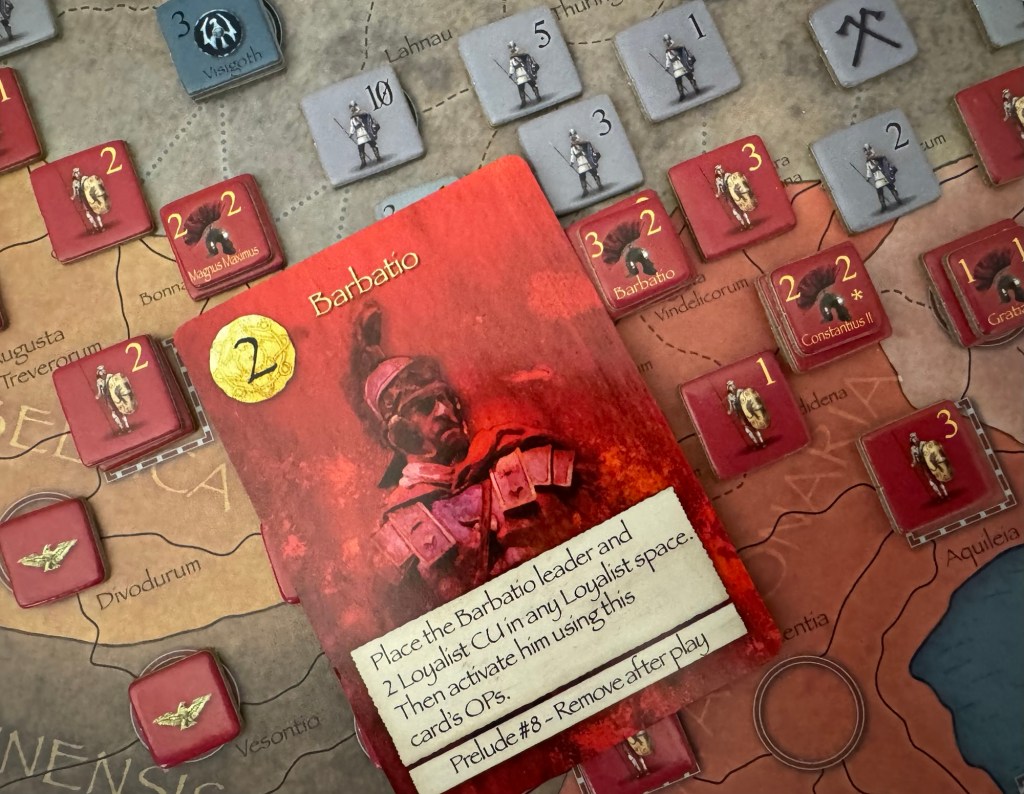
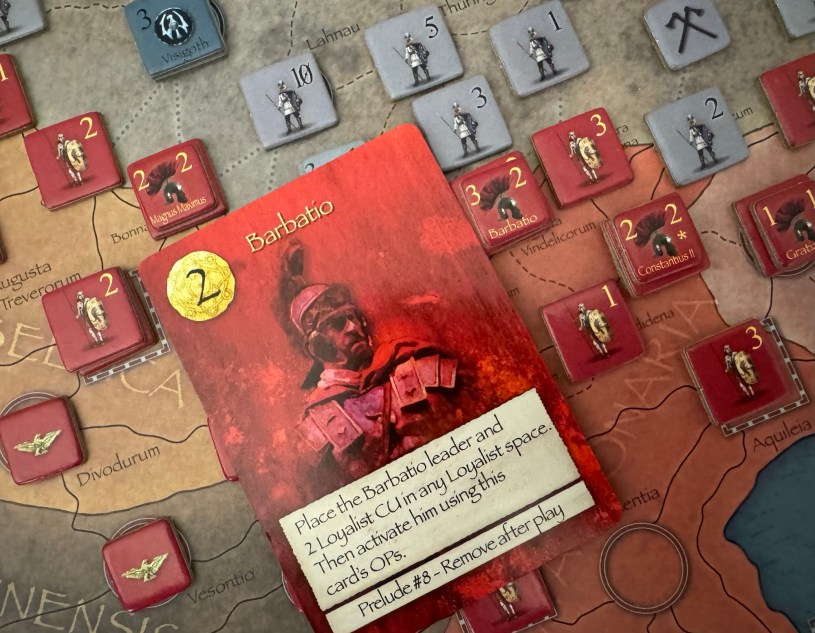
Today I am going to look at the Barbartio card as it reinforces the concept of Leader activation and also placing a new Leader on the board to assist in moving and attacking with the Roman Legions. As you can see, Barbatio allows the player to place the Barbatio Leader counter onto the board with an additional 2 Loyalist Combat Units (CU). The card also then allows the player to activate Barbatio, even though he has just been placed onto the board, to then use those 2 Operations Points to move and attack. If you look at the Barbatio counter, you will see that his Initiative Rating, shown in the upper left hand corner of the counter, is a 3 which is the amount of OP’s required to activate the Leader. The lower this value the better so Barbatio is not one of your best Leaders but the card allows you to place him on the board and then activate him for free, which would normally take 3 OP’s, leaving an additional 2 OP’s to use on movement and attack. Cards like this are really, really good as they give you a utility in addition to the placement bonus and in this case the 2 free CU’s.
The other value in the upper right corner of the counter is the Tactical Rating, which is the bonus the Leader receives for Intercept or Avoid Battle attempts and is used in battle to determine if either side receives a combat modifier for superior leadership. While Barbatio is not one of your best Leaders, he is middle of the road, but this card really gives the Roman player a chance to jump in with both feet and get to the killing. In the picture above, you can see that there are quite the assemblage of Barbarian units that have amassed at the border and are awaiting the chance to cross over the Rhine and invade Rome. The play of this card was good timing and really plugged a hole in the line and provided Rome with the chance to proactively attack and attempt to break the line of Barbarian units.
Barbatio was a Roman general of the infantry commonly referred to as Magister Peditum (Master of Foot) under the command of Constantius II (notice that Constantius II is in close proximity to Barbatio on the board in the picture above). Previously he was a commander of the household troops (Protectores Domestici) under Gallus Caesar, but he arrested Gallus under the instruction of Constantius, thereby ensuring his promotion on the death of Claudius Silvanus. In 359 AD, both he and his wife Assyria were arrested and beheaded for treason against Constantius, possibly as part of a plot by Arbitio, a senior cavalry commander and another exponent of the forms of scheming and political intrigue that became such a large part of the later Roman Empire.
In 359, with Barbatio away on another campaign, his wife, Assyria, whom Ammanius describes as an “indiscreet and silly woman”, decided to write to him, seemingly fearful that he was about to cast her off. Her letter, which has not survived, hinted, in Ammianus’ account, at Barbatio’s own imperial ambitions, and his possible intention of marrying the empress Eusebia in the event of Constantius’ death. It was not composed by Assyria herself, but by a female slave, who had formerly belonged to Silvanus, and may possibly have harbored some grudge towards her new owners. The servant immediately took a copy of this letter to Arbitio, suggesting that the whole thing was part of an elaborate plot. Arbitio at once brought the matter to the attention of Constantius. Barbatio was arrested and confessed that he had received the letter. Both he and Assyria were subsequently executed.
There is no evidence at all that Barbatio actually planned to murder Constantius. According to some historians, it seems more likely that he was following his usual pattern of behavior and just wished to ingratiate himself still further with the Emperor, with the possible hope of becoming a co-emperor. It is also questionable if the incriminating letter contained Assyria’s actual words.
Here is a look at our unboxing video:
We also did a video review and you can watch that at the following link:
I also wrote a First Impressions post on the game and you can read that at the following link: https://theplayersaid.com/2022/11/08/first-impressions-barbarians-at-the-gates-the-decline-and-fall-of-the-western-roman-empire-337-476-from-compass-games/
In the next entry in this series, we will take a look at Common European Home from 1989: Dawn of Freedom from GMT Games.
-Grant

