For October, I was able to find 26 games to highlight in the Wargame Watch! Of that total, 4 games were offered on Crowdfunding (3 on Kickstarter and 1 on Backerkit).
This month we have a sponsor for the Wargame Watch feature in Sound of Drums who has made some really great looking games over the past few years including their History of the Ancient Seas Trilogy (HOTAS: HELLAS, HOTAS: DIES IRAE and HOTAS: MARE NOSTRUM), 1793: Patriots & Traitors, Eylau 1807 and a few others. Sound of Drums really has a great approach to game design and they also are committed to high quality production with great components, fantastic art and really sharp graphic design. They are definitely a publisher to keep an eye on and you should give their games a try!
But now onto the games for October!
Pre-Order
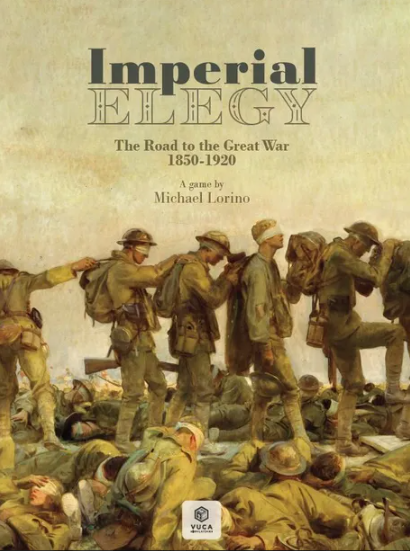
1. Imperial Elegy: The Imperial World at War 1850-1920 from VUCA Simulations
VUCA Simulations is a new company on the scene the last few years and they are coming out with some really great looking games. We have played several of their games and always have a great with them. One of their newest pre-order offerings is called Imperial Elegy: The Imperial World at War 1850-1920 designed by Mike Lorino. It looks so good and is a very ambitious game taking a look at the time period covering 1850-1920 and the start of the Great War.
From the game page, we read the following:
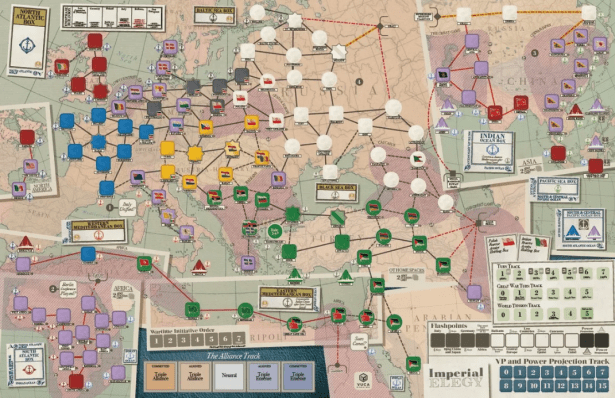
Steam and steel redraw the map as telegrams outpace cavalry and dreadnoughts cast long shadows on distant straits. Imperial Elegy lets you steer a great power through seven decades of brinkmanship—industrial booms, colonial crises, and alliances that never sit still. Each turn spans a decade; the Great War may erupt…or be averted—depending on how you play your hand.
Your engine of statecraft is a hand of Action Cards. Spend them as command points to recruit, industrialize, move fleets and armies, influence minors, set war aims and build reach—or unleash their events to bend history at exactly the right moment. Control the pace by dominating flashpoints—the Low Countries, the Balkans, and global Power Projection—to draw more cards and roll your industry forward. At sea, ports and bases across linked naval boxes determine how far your influence can travel; chokepoints like the Suez Canal and the Dardanelles can open or close entire theaters.
Alliances breathe. Political shifts and crisis checks can flip blocs, sometimes twice in a single step. If the guns do speak, the game changes cadence: fixed wartime budgets, trenches, reserves and naval interceptions make every decision tighter—and every loss sting—until winter closes the campaign.
Victory wears many faces. If peace holds to the end, reveal National Goals and tally your triumphs. If the Great War crowns a side, alliance victory (with room for a canny neutral to slip through) decides the outcome. On rare occasions, sheer territorial conquest ends it early.
Just a beautiful looking game that I cannot wait to see more about. I am going to reach out to the designer to get some more information to share with you.
We have played several of VUCA’s games to date that use a chit-pull mechanic to activate HQ’s and are somewhat similar to the Red Box Series from Multi-Man Publishing with the most recent being Traces of War, which is a fantastic low complexity hex and counter wargame. The newest offering in this series called the Fierce Fight Series is called Traces of Victory and it looks amazing! This one however is not designed by Tetsuya Nakamura but a new voice in Allyn Vannoy.
From the game page, we read the following:
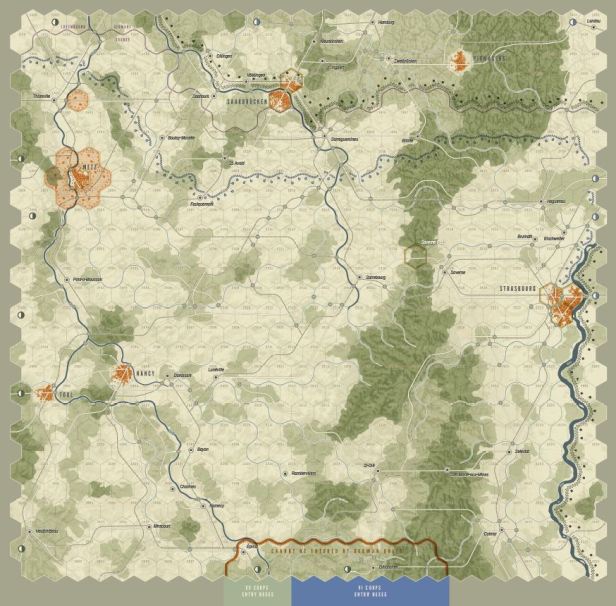
November 1944—rain hangs over Lorraine, the Moselle swells, and between the forts of Metz and the passes of the Vosges two U.S. armies prepare to break the German line. Traces of Victory puts you in the map room of an army headquarters: orders are scarce, weather is unforgiving, and every activation can tip the front. As Patton drives east and Patch feels for openings through the mountains, your sense of timing, supply, and risk decides the fate of entire corps.
A HQ chit-pull powers the tempo: when an HQ is drawn, you unleash regiments and battalions to force rivers, seize towns, and pry open fortified lines—Metz, the Maginot remnants, the Westwall. Allied air power cracks defenses or slows German movement with interdiction, but mud bogs armor and turns quick thrusts into grinding fights. Push your luck with Combat Intensity—shift the odds for a bigger punch at the cost of higher losses. What starts as a routine offensive can become the operation that ends with Strasbourg in Allied hands—or with your spearheads stuck in the mire.
Traces of War was just so very good and I am eagerly anticipating this one and cannot wait to give it a go. This Fierce Fight Series is highly playable and has a lot of great meat on its bones without a lot of overcomplicated rules overhead.
3. Modern Tactics #1 – Afghanistan from VUCA Simulations
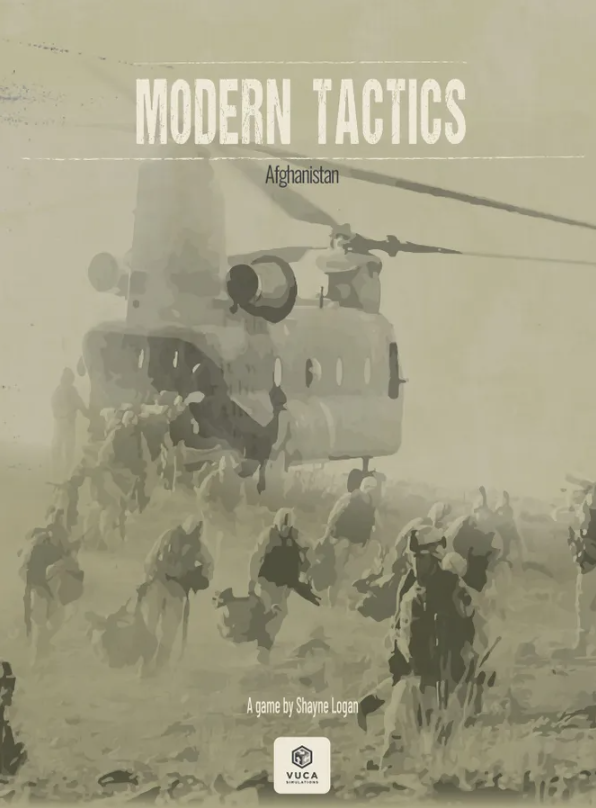
We have played a lot of Old School Tactical from Flying Pig Games, which is designed by Shayne Logan. Shayne now has a design coming from VUCA Simulations that deals with modern warfare in Afghanistan called Modern Tactics: Afghanistan.
From the game page, we read the following:
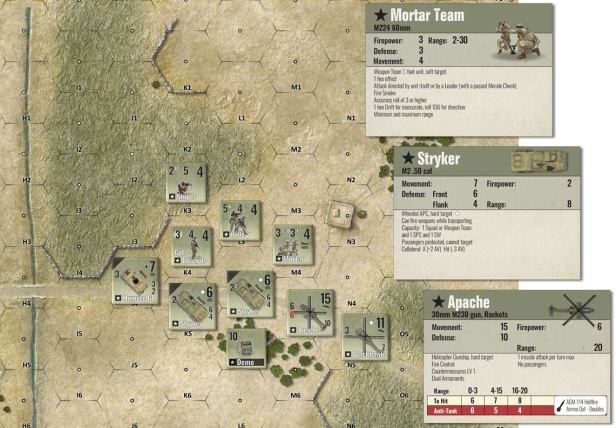
Dust kicks off an unpaved road, echoes bounce inside walled compounds, and one radio call can change the plan. Modern Tactics: Afghanistan drops you into platoon-level firefights from 2006–2009, where coalition patrols trade impulses with a nimble insurgency across villages, vineyards, and wadis. Every activation is a hard choice—move, fire, breach, rally, call support—while civilians, contacts, and rules of engagement keep the battlefield tense.
Snap decisions, constant pressure: Alternating impulse play captures the push-and-pull of real operations.
Terrain that tells a story: Walled and multi-hex compounds, high and low walls, irrigation ditches, grape fields, rough ground, and wadis shape LOS, cover, and movement.
Civilians and ROE matter: Unknown contacts, civilian presence, and collateral risk influence your tempo as much as raw firepower.
Combined arms, cleanly integrated: LAV III, Bison, RG-31, Leopard 2, and air support (including Apache gunship) join infantry, engineers, mortars, and AT weapons.
Twenty scenarios spanning quick raids, relief missions, and set-piece assaults—e.g., Barton’s Holdouts, Open Market, Operation Medusa, High Value Target, Snake Pit, Outside the Wire, Strongpoint, and more.
Play the compounds right: Edge-hex firing arcs, interior LOS, and wall bonuses reward careful positioning and breaching.
Air & artillery windows: Timed off-board fire missions and gunship arrivals open corridors—or close them.
Risk vs. momentum: Smoke, interdiction, suppression, and morale create openings…but overreach gets punished fast.
Hermann Luttmann is a great designer and I just love his solitaire takes on historical battles. His newest design is a solitaire game called A Hell So Terrible: Verdun 1916 that focuses on the German assault on the city of Verdun in 1916 during World War I. Keep in mind that Hermann is a very creative designer and uses lots of very interesting and chaotic design elements to create a very interesting and satisfying gaming experience. Also, most of his games are just that, with very engaging gameplay and a lot of the unknown that will hit you in the face from time to time! I just love his games.
From the game page, we read the following:
A Hell So Terrible is a solitaire wargame simulating “Operation Gericht” (Operation Judgement), the German assault on the city of Verdun launched on February 21st, 1916. You take the role of Germany’s Crown Prince Wilhelm (eldest son of Kaiser Wilhelm) in command of the German 5th Army as he attempts to fulfill Falkenhayn’s goal of knocking France out of the Great War through attrition. The attack on Verdun is envisioned as a stab at the heart of French national morale. Falkenhayn hoped that threatening this iconic city and fortress complex would force France to react hastily and carelessly, thereby compelling its forces to launch suicidal counterattacks against prepared German defenses and artillery kill zones. Falkenhayn anticipated that this sacrifice would be so bloody and demoralizing that it would ultimately drive France from the war. Thus, you must push your forces forward and inflict as much damage and destruction on the French defenders in front of Verdun as possible and do so before the opening guns of the Battle of the Somme are fired at the start of July 1916. If you cannot accomplish that goal, precious reinforcements, supplies, and heavy artillery resources will be diverted to the defense of the Somme River line, and with that will come an end to the effort to “bleed France white.”
Unlike other “tower defense” games (including a certain one where Horrors invade a place called Plum Island!), you will now step into the shoes of the German attackers while the game system controls the French defenders. This game system simply and accurately depicts the tough tactical decision-making imposed by the conditions prevalent during the First World War. You will be forced to constantly choose whether to push the German units harder and faster—balancing the risk of higher casualties against the seizure of enemy territory and destruction of their forces. And because you only have ten game turns in which to accomplish your mission, time is of the essence, and you will often be forced to push your troops hard. But there is also one other insidious factor to this conundrum…keeping up the pace of advance of your artillery and logistical support. Every German unit has a “Support” marker on its track and the relative position of that marker has consequences to the unit’s ability to fight well. But the “Support” marker only moves with certain events or when the attached unit Regroups…meaning it must sometimes stop and become “Spent” to allow its assigned “Support” marker to catch up. If, and when, to Regroup a German unit is a critical decision for the player.
Hermann loves his press your luck mechanics and I always feel like they fit in the history of the game. You have to take chances, but these must be measured chances or you risk burning yourself out and ending gup with nothing left to fight with.
A Hell So Terrible uses a unique dice-activation system that challenges the solitaire player every turn of play. There are nine tracks spread across three Sectors, all leading to the outskirts of the Verdun fortress. Located on each track is a German unit, representing an amalgamation of the various divisions that fought at the battle. You must push each of these units along their respective tracks, advancing against the French defenders while enduring artillery barrages, bombing raids, and counterattacks.
And custom dice are always welcome in my humble opinion.
The activation of the German units is accomplished with the roll of custom Activation Dice, of which there are four types: two “Movement” types and two “Casualties” types. Every unit being activated must have one “Movement” die assigned to it along with one “Casualties” die. You roll all dice at one time and then assign the dice as you wish to each unit in the activated Sector. The pair of dice assigned dictate how far the unit can move (if at all) and if it takes any casualties from enemy fire. The concept is that the effect of enemy incoming fire is built into the activation/movement mechanism. It’s your German units pushing up against the French “wall of fire.” By building that effect into the movement system, gameplay is sped up as the player does not need to separately resolve every single incidence of opposing fire combat.
The two “Movement” type dice are the “Advance” die, which is your basic die possibly allowing one space of movement forward, and the “Infiltration” die, which represents the deployment of Stosstruppen and other assault assets which can allow the assigned unit to move up to two spaces and gain benefits during combat. You receive one “Advance” die per German unit for free but may convert that die into an “Infiltration” die by spending one Command Point (these are points that you can spend to beneficially affect some game mechanics and which abstractly represent German higher command influences).
The two “Casualties” dice are the “Friction” die, which is the default die and could inflict up to a 2-Strength Point loss on your unit, and the “Suppression” die, which can be substituted for the “Friction” die if the German unit has its “Support” marker close enough. The “Suppression” die reduces the chance of a Strength Point loss on your unit by simulating the suppressing effects on the French defenders of the close artillery support from the local German batteries.
And the game uses cards as events which represent the Fog and Friction of War.
5. Barbarossa: Typhoon! 2nd Edition from GMT Games
Over the past month, GMT shipped out their new print run of Barbarossa: Army Group North, 1941 2nd Edition and now they are adding another of these East Front Series games to their P500 list, which is great because it allows us to get them as well and play them as they are out of print.
From the game page, we read the following:
In the fall of 1941, German High Command focused their renewed Blitzkrieg on the ultimate prize in Russia: Moscow! In what proved to be one of the most decisive campaigns of the Second World War, the German attack fell short of capturing the Soviet capital, but just barely. Barbarossa: Typhoon! 2nd Edition recreates that great battle for Moscow that began in earnest on 30 September 1941 and ended around 6 January 1942 when the first great Soviet counteroffensive that took the strategic initiative away from Germany.
This game is part of the other East FrontSeries of games and can be combined with these games. There are nine game scenarios that cover important phases of the campaign, as well as the entire 49 turn Campaign game itself.
This game can be added as an extension of the Army Group Center game that covers the preceding Operation Barbarossa offensive to form a 99 turn combined game from 22nd June. The other games in the series can also be combined to cover the massive East Front offensive in 1941.
Scenarios:
Guderian’s Panzer Group covers Guderian’s 2nd Panzer Group offensive toward Orel and Tula, to the south of Moscow.
The Vyazma Pocket is the initial phase of Typhoon Offensive, which caught the Soviets improperly prepared and thus they became enveloped in a great encirclement at Vyazma. As with many such double-envelopment battles, it took time for the German 4th Army to close and reduce the pocket.
The Mozhaysk Line picks-up where the previous scenario concluded with Army Group Center renewed in its offensive, now with Moscow as the clear goal. The panzers of German 40th Motorized Corps pushed eastward; opposing the Germans in this sector was a newly formed 5th Army.
The Kalinin Front covers the initial German actions toward the north of Moscow.
The Battle for Tula is Guderian’s 2nd Panzer Army attempt to take Tula and then Kolomna, and then strike north to encircle Moscow from the east.
Last Gamble for Moscow covers that period during which German forces had the strength for offensive action. They captured Klin and the Istra Reservoir while holding Borodino, Volokolamsk, and Kalinin, for a total of five objectives and suffered substantial armored and artillery losses.
The Battle for Moscow covers the late November attempt by the (by now weakened) German forces to take Moscow. The Soviets had greatly recovered from the October battles; they were still weak in many spots and had only enough reserves to meet the local situation.
Zhukov Attacks covers the first Soviet counter-offensive against the over-extended and weakened German forces.
The Campaign. The full Typhoon Offensive game from its beginning at the start of October 1941 until the Soviet winter offensive and ending in January 1942.
This 2nd Edition version of the venerable 1995 Typhoon! game comprehensively updates and extends this game, bringing it up to date with the results of the latest research. It includes an Inset Map for Moscow, several smaller scenarios that build toward the larger Campaign game.
6. Combat Commander: Pacific 3rd Printing from GMT Games
Chaos. Uncertainty. Lack of resources. Poor communication. All things that occur on any battlefield and which cause trouble for any perfect plan of attack. I love this aspect to most wargames but have found that they don’t always give it justice. Well, Combat Commander is a simple tactical system that just gets it and enforces these negative aspects onto the players in the game through the use of cards.
I have played all of the Combat Commander family of games many, many times over the years with Alexander and truly love the system. We have played and experienced all of the volumes including Europe, Mediterranean and Pacific as well as a host of the Battle Packs. They are really fun games and I love the system! I also recently acquired a copy of Resistance and need to get it to the table. I really love the narrative that the game creates. I love the cards and how they are used for combat, there are no dice in CC in case you didn’t know, for activations and events. The system is just full of chaos and fun. I was very pleased when I heard that they were reprinting one of the best in the series Combat Commander: Pacific. Keep in mind though that I do prefer the original but do enjoy the changes made to the system in Pacific.
From the game page, we read the following:
Combat Commander: Pacific is a card-driven board game covering tactical infantry combat in the Pacific Theater of World War II. CC: Pacific‘s main theme is the addition of three new factions to the Combat Commander family:
Imperial Japan
the Pacific US – with a strong emphasis on the US Marine Corps
the Pacific Commonwealth – focusing on Indian and ANZAC forces
Combat Commander: Pacific is a stand-alone game in the card-driven Combat Commander game series. While utilizing Combat Commander: Europe‘s basic rules, CC: Pacific includes numerous rule tweaks and additions in order to more accurately portray tactical warfare as experienced by the participants in and around the Pacific and Indian Oceans. This will slightly ramp up the complexity of the Combat Commander series while at the same time imparting a bit more depth and realism. Just a few of the additions include:
Banzai attacks
BARs and Thompson SMGs
Beach landings & river crossings
Hidden movement
Caves
Scouts
Aircraft
Bayonets
Mortar spotting
Reconnoitering
A game of Combat Commander is divided into several Time segments. There is no sequence of play to follow, however: each Time segment is divided into a variable number of Player Turns, each of which may consist of one or more Fate Card “Orders” conducted by the active player. Fate Card “Actions” may generally be conducted by either player at any time. “Events” and die roll “Triggers”—both good and bad—will occur at random intervals to add a bit of chaos and uncertainty to each player’s perfect plan.
CC: Pacific will include twelve new maps featuring terrain specific to the PTO.
Note on 3rd Printing: This will be identical to the 2nd Printing, except that any known errata will be corrected.
Errata is a fact of life with all publishers and all games! No matter what, a mistake will always slip through and cause us gamers a bit of angst. This is where GMT Games stands head and shoulders above the competition though as they admit to their mistakes and more importantly try to make them right. We have seen this time and time again. So they have a solution for errata found on counters in their new games this year that makes a lot of sense and makes it economically very easy to acquire: a replacement countersheet.
From the P500 page, we read the following:
We are happy to announce today that we have created a 2025 Replacement Countersheet that includes all of the counter updates that we and the designers know of as errata for games from 2025. We’re setting this up as a P500 item like we did last year—except that it’s already approved to print. We just need to know how many of you want the item. Please get your order in over the coming few weeks so we can get these in your hands by year-end.
The price for this item will be $5 for US customers and $10 for non-US customers. Note that the cost INCLUDES shipping. Clearly, we’re supplementing most of the cost on these, which we think is only fair, in that these counters represent mostly errata that we missed when we produced the games the counters belong to.
P500 Ordering: In the pricing box at the right side of this page, you’ll see two prices—one for US ($5) and one for non-US ($10). Please double check and make sure you choose what applies to where your countersheet will be shipped. This will save our office folks a lot of work when we get to charge time. Thanks much!
The games with counters on the sheet are:
By Swords & Bayonets
Here I Stand NOTE: These are the same as the 2024 versions but not everyone got theirs so we’re printing them again.
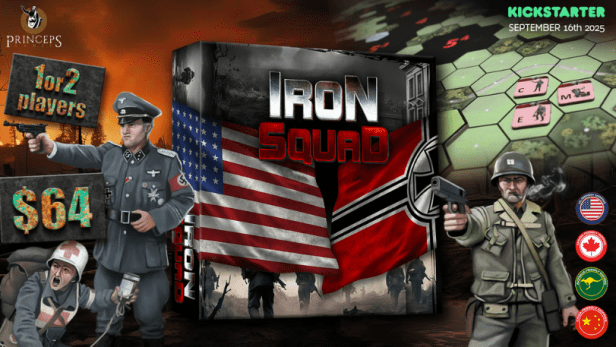
Iron Squad is a WW2 squad level wargame for two players and it is set somewhere in Northern France in the summer of 1944. The allies are getting ready to invade the mainland and a series of special missions are set to prepare the ground for the main troops.
American and German players are facing each other with a series of missions they have to accomplish in order to win the game. You have to pick your squad and decide which strategy will you implement. Will you try to sneak behind the enemy lines? Will you set an ambush for the oncoming enemy? Will you try to move fast and try to grasp a quick victory?
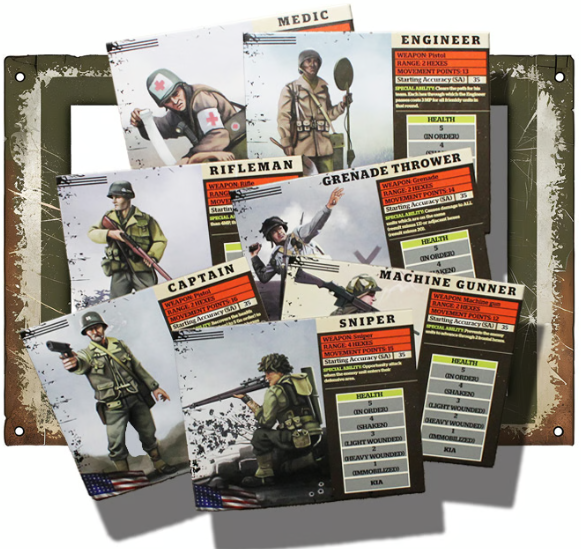
Players choose 5 out of 7 units they have at their disposal. The type of the unit they will chose depends on the mission goal. Each unit has it’s weapon, movement points, health, accuracy and special abilities.
Units have their respective counters which will be used to indicate the units position on the map.
Both players have their own missions in the game. The player who accomplishes their mission first is the winner! There are two types of missions and players jointly decide what type of mission they will play with.
As I have looked at this one, I am very intrigued. I know that the game is fairly simple but I do like the art and I find that the choice of how to build a squad, meaning being able to choose the functions and roles that I want to have access to during the mission, is a very interesting concept and I wish that more of these type of tactical, squad-based games included that type of choice.
As of October 1st, the Kickstarter campaign has raised $2,049 toward its $7,500 funding goal with 32 backers. The campaign will conclude on Tuesday, October 7, 2025 at 12:00pm EDT.
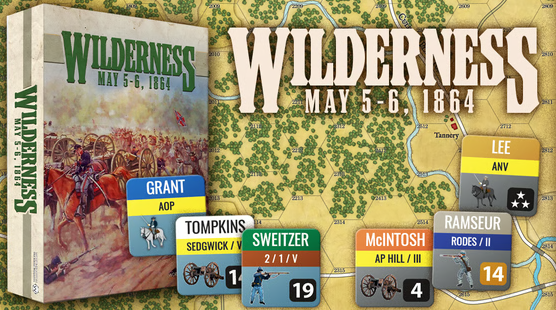
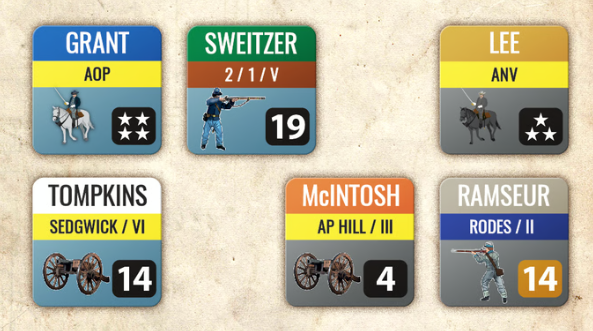
9. Wilderness May 5-6, 1864 from Worthington Publishing Currently on Kickstarter
Worthington has just been on fire over the past few years and they have a new game being offered on Kickstarter in their Civil War Brigade Battle Series called Wilderness May 5-6, 1864.
From the game page, we read the following:
In this project we are offering Volume VII in the Civil War Brigade Battle Series, Wilderness 1864 with the latest version (1.5) of the series rules. This is the first game of this magnitude (hard mounted board, large counters with rounded corners) at the brigade level on the battle of the Wilderness. The game is based on extensive research so that each scenario is accurate for unit locations and strengths.
We are also offering a 2nd printing of the sold out Gettysburg 1863. We will be doing a limited print run of the 2nd printing. Both games will also come with version 1.5 of the series rules.
Add-on’s include extra copies of each game that can be added to any package as well as neoprene maps for each game.
As of October 1st, the Kickstarter campaign has raised $28,154 toward its $1,864 funding goal with 290 backers. The campaign will conclude on Saturday, October 11, 2025 at 4:00pm EDT.
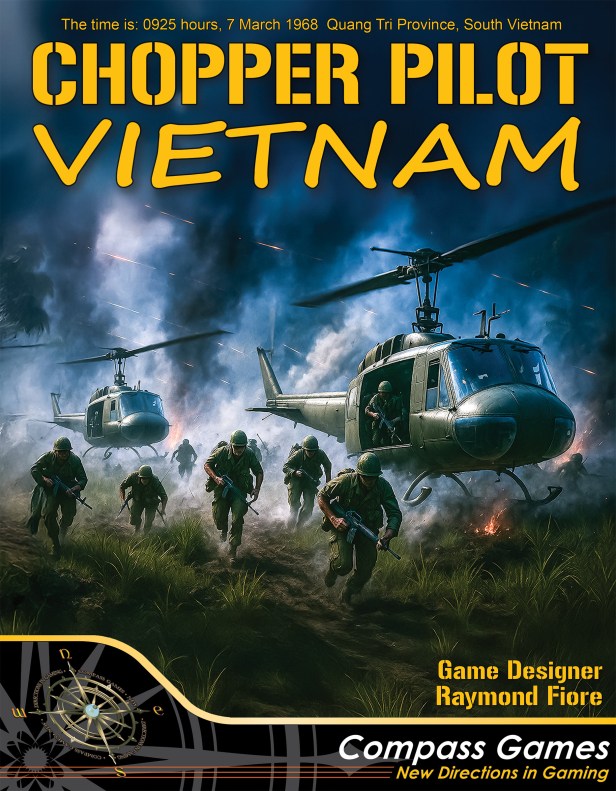
10. Chopper Pilot Vietnam from Compass Games
This month, Compass Games has added just a ton of new pre-order games and I am going to call this Pre-Order Palooza! The first game that I am highlighting here is Chopper Pilot Vietnam, which is a look at air missions during the Vietnam War and looks very intriguing. I am going to say that I am not a fan of the chosen art as I believe that it is AI….but to each his own!
From the game page, we read the following:
Chopper Pilot Vietnam is a solitaire and cooperative game in which you fly as a US Army Warrant Officer helicopter pilot during the Vietnam War. You will start your career as a member of the 1st Air Cav Division as a UH-1 “Huey” pilot. Missions will include transporting infantry units to designated landing zones (LZs), resupplying units already in the field, medevaccing wounded grunts from the battlefield, and more.
You may be afforded the opportunity to become an AH-1 Cobra pilot and fly assault missions in support of the infantry. If you are good enough, you might even be called upon to work for the infamous Military Assistance Command, Vietnam – Studies and Observation Group (MACV-SOG). Your missions there will be in support of the Special Forces patrols, whom you will drop off deep into North Vietnam, Cambodia, or Laos, then pick them up under dire circumstances if they are discovered by the North Vietnamese. Regardless of your mission, there will be ground troops depending on you, either to get them to the battlefield or resupply them under fire, or to evacuate them if they are wounded in combat. Are you up to the challenge?
This one is going to be high on my list for sure! I am also very glad to see that it is solitaire but can be played cooperatively. I have already reached out to the designer Raymond Fiore about doing an interview.
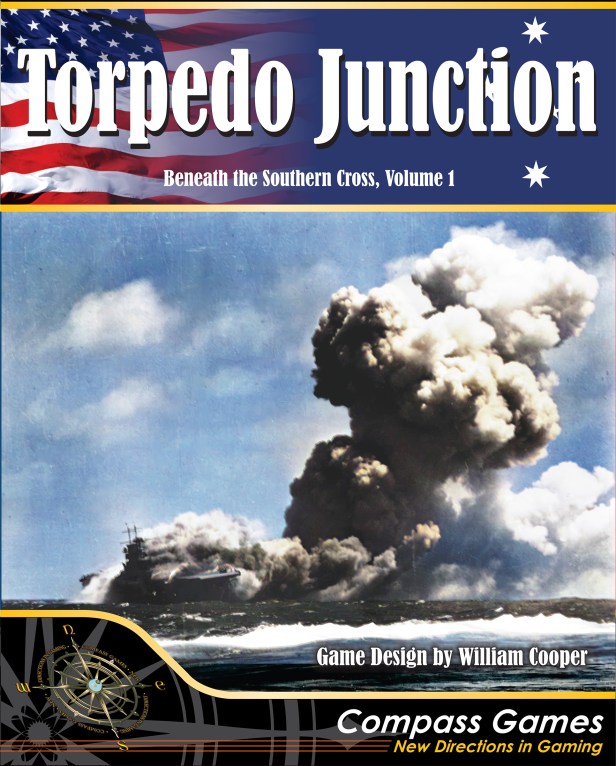
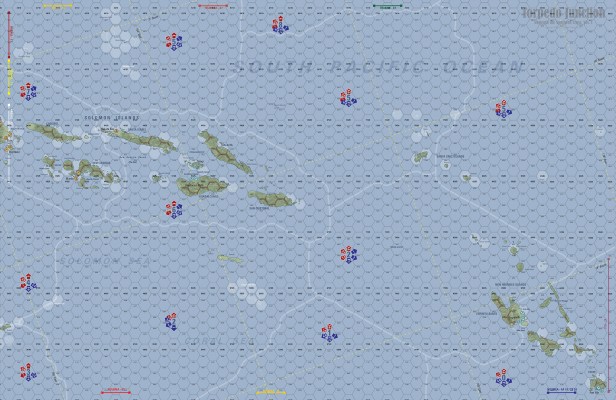
11. Torpedo Junction: Beneath The Southern Cross, Volume 1 from Compass Games
The 2nd game in the Compass Games Pre-Order Palooza! is a very interesting looking offering called Torpedo Junction: Beneath the Southern Cross, Volume 1. The game deals with the battle for control of Henderson Field on Guadalcanal and is an air-naval wargame. I am very intrigued by what I see here!
From the game page, we read the following:
Torpedo Junction simulates key events of the campaign for Guadalcanal from August – October 1942. Players face the challenge of coordinating task forces, air formations, and logistics as they engage in the struggle for control of Henderson Field. And you’re looking to sink enemy ships along the way.
The game is designed to allow you to recreate the narrative of events between August and October 1942 – creating a full experience whether you play the one-day Santa Cruz battle scenario, the three-day Battle of the Eastern Solomons, or the three-week October campaign.
Scenarios include:
Perdido: Savo Island — 9 August 1942
Don’t Get Around Much Anymore: Santa Cruz — 26 October 1942
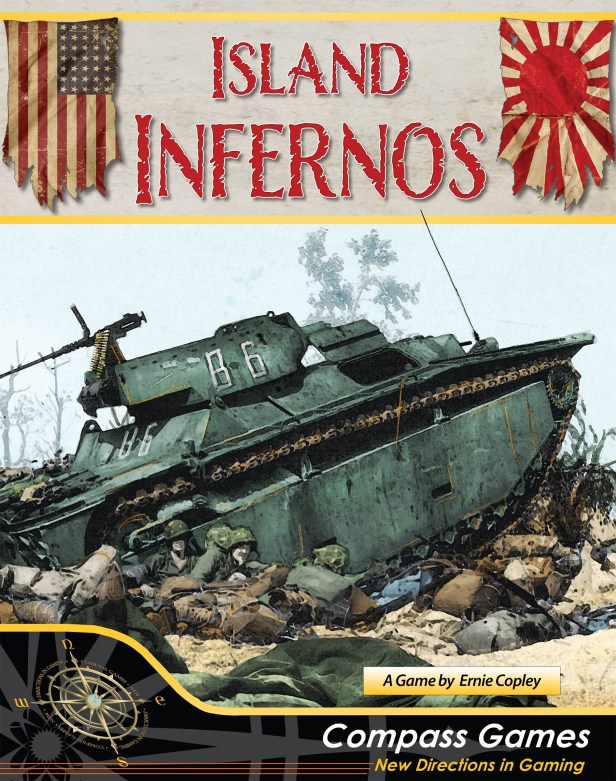
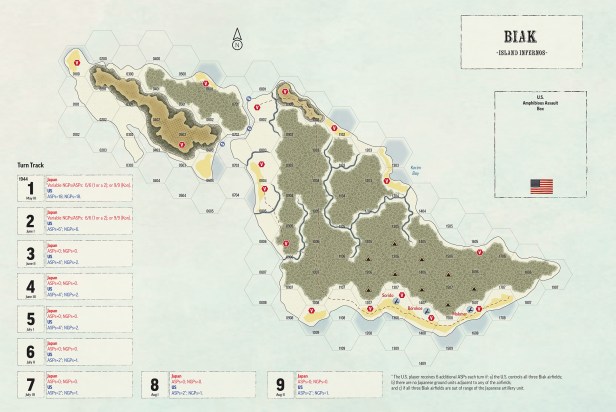
Next up in the Compass Games Pre-Order Palooza! is Island Infernos, which is a game focused on various amphibious landings during the Pacific Theater of Operations of WWII. The four landings included are Guadalcanal, Bougainville, Biak and Saipan.
From the game page, we read the following:
Island Infernos is a WWII Pacific strategy game that features four Allied amphibious invasions in that theater: Guadalcanal, Bougainville, Biak, and Saipan. Although the master rulebook sets out a common framework, each island battle presents unique challenges.
Guadalcanal. As the Japanese player, can you overcome debilitating attrition and command-and-control problems and drive the Marines back into the sea? As the U.S. player, can you defend Henderson Field like your real-life counterparts?
Bougainville. As the Japanese player, you only need to survive to win. As the Allied player, you must achieve two objectives—building and defending American airbases and using your Australian troops to wipe out the Japanese garrison. Will you accomplish both?
Biak. As the Japanese player, your options might include Operation Kon, a massive naval mission to repel the U.S. invasion. As the U.S. player, no matter how well you do, you must deal with General MacArthur’s War by Public Relations: premature victory announcements from MacArthur’s headquarters that adversely affect the invaders’ morale. As in the real campaign, the Biak scenario is rich in what-ifs.
Saipan. As the Japanese player, you can explore a variety of outcomes. What if the Great Marianas Turkey Shoot had never occurred? What if many more Japanese vessels carrying troops and supplies had made it to the island? What if Japanese submarines had been more effective? Conversely, as the U.S. player, you must overcome a virulent inter-service rivalry, capture key objectives, and eliminate the Japanese garrison. Doable? Yes. Easy? No.
Island Inferno’s combat system almost guarantees the Allied player will try to maximize firepower to destroy determined Japanese resistance. Moving too cautiously will mean you don’t conquer strategic Pacific Islands fast enough to win. Move too aggressively, and Allied casualties will become prohibitive—and the Japanese player will win on Victory Points. An optional combat card system helps ensure players can’t “crack” the Ground Combat system. Naval and air support are abstract, simplifying and streamlining the game system.
This is a low-to-moderate complexity two-player game that easily lends itself to solitaire play. Units are mostly battalions for an operational-level treatment. All four scenarios fit on a small-to-moderate tabletop space, with even the longest scenarios (Guadalcanal and Saipan) being playable in an afternoon. The master rules offer a gentle learning curve with minimal administrative overhead. I.I. offers Pacific War buffs a fun and challenging experience for beginner and veteran wargamers alike.
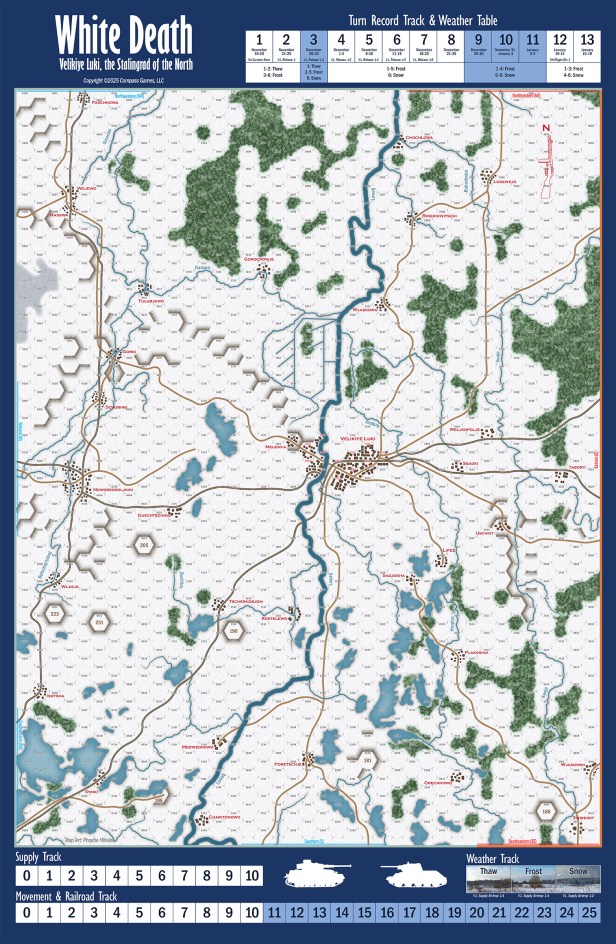
13. White Death: Velikiye Luki, the Stalingrad of the North from Compass Games
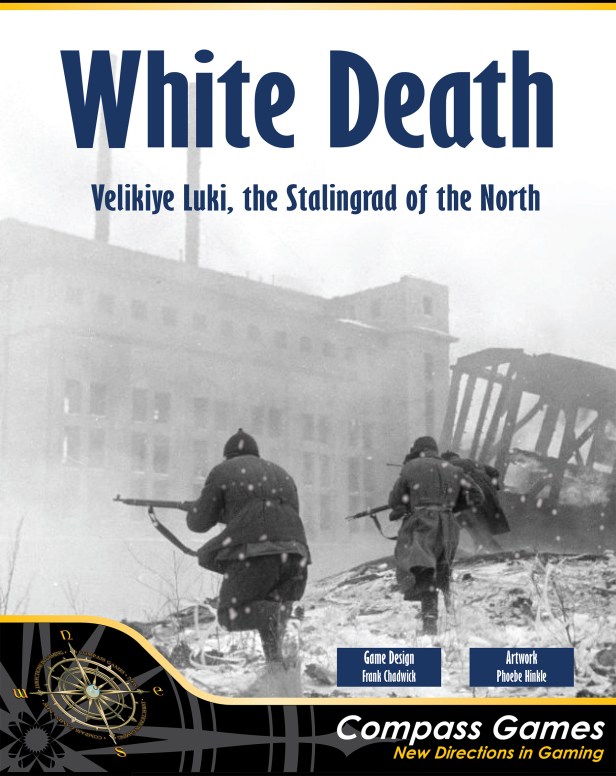
This is now the 2nd game that I have seen recently covering the action at Velikiye Luki on the East Front of WWII. White Death: Velikiye Luki, the Stalingrad of the North is the 4th game in the Pre-Order Palooza! from Compass Games and is designed by Frank Chadwick and looks really good.
From the game page, we read the following:
White Death: Velikiye Luki, The Stalingrad of the North is a game of the battle of Velikiye Luki in the winter of 1942-1943. The game begins with the massive Soviet offensive that led to the encirclement of the city of Velikiye Luki by the forces of the Red Army’s Kalinin Front against the Wehrmacht’s 3rd Panzer Army during the Winter Campaign of 1942–1943 with the objective of liberating the Russian city of Velikiye Luki as part of the northern pincer of the Rzhev-Sychevka Strategic Offensive Operation (Operation Mars).
White Death was originally published by Game Designers’ Workshop (GDW) in 1979. Compass Games’ reprint preserves the original design, while incorporating official errata and clarifying ambiguities. The graphics have been updated and improved to provide a better experience. There are also many new informational markers and map features to help players.
The game uses an innovative system with unique mechanics representing battalion-level, combined-arms combat. Supply is critical, but presented simply. Frank Chadwick’s movement, combat, and impulse systems stand out from other wargames, even today. White Death includes five scenarios, plus the full campaign.
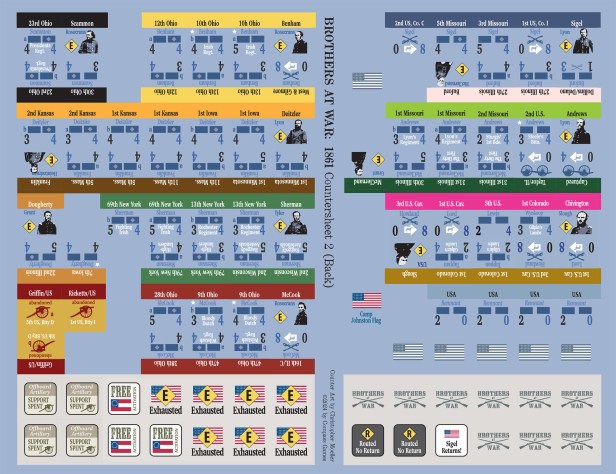
We have definitely played more ACW games over the past few years than ever before and there is a new one upcoming from Compass Games (yes as a part of the Pre-Order Palooza!) that packs a whole lot of punch into one box. The classic concept of the quadri-game is making a comeback and this one looks very interesting. Brothers at War: 1861 is the follow-up effort to Christopher Moeller’s Brothers at War: 1862 and is a very fun and lite ACW system that we had a good time playing.
From the game page, we read the following:
Brothers at War: 1861 is a quick-playing, brigade commander’s view of the American Civil War. The game’s six maps feature historical battlegrounds, each roughly a mile square: a cannon-shot from end to end. Unit density varies. Turns are highly interactive. Brigades track reserves and casualties on easy-to-use displays. Skirmishers block the enemy’s line of sight. Battle Cards like “Cowardly Legs” that force retreat, or “Well Drilled” that allows overstacking, add to the chaos of battle at this scale.
The battles covered include:
BULL RUN – Battle for Henry Hill (2 Maps!) 10 am-5 pm, July 21st, 1861 Two Maps, Seven scenarios, from the fight for Matthews Hill through the Jackson’s famous stand on Henry Hill.
WILSON’S CREEK – Bloody Hill 5 am-12 pm, August 10th, 1861 Three scenarios covering Lyon’s surprise attack on two Confederate armies.
CARNIFEX FERRY-Fight for the Kanawha Valley 3 pm-7 pm, September 10th, 1861 Three scenarios covering Rosecrans’ assault on a fortified rebel camp in the mountains of Western Virginia.
BELMONT-Grant‘s First Command 11 am-4 pm, November 7th, 1861 Three scenarios covering U.S. Grant’s riverine expedition across the Mississippi from Columbus, Kentucky.
Wait, there’s more! Brothers at War: 1861 includes the legendary fight in Glorieta Pass, New Mexico (1862), featuring three additional scenarios.
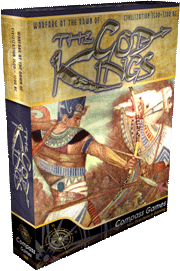
15. The God Kings: Warfare at the Dawn of Civilization, 1500-1250 BC Deluxe Edition from Compass Games
We are nearing the finish line of our games from Compass Games and their Pre-Order Palooza! with The God Kings: Warfare at the Dawn of Civilization, 1500-1250 BC Deluxe Edition.
From the game page, we read the following:
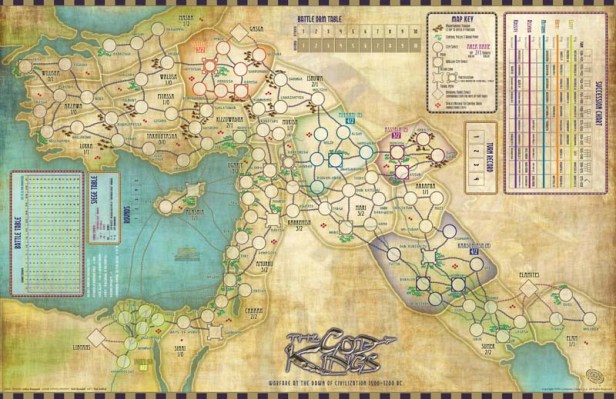
The God Kings, Deluxe Edition is a wargame covering the ancient wars of the Near East, from the 15th to the 13th century BC. Players control the armies of Egypt (New Kingdom), the Hittites, the Mitanni (a long-forgotten Hurrite kingdom), and the Babylonian Kassites. A resurgent Assyria also makes an appearance as raiding parties.
The God Kings is a card-driven game, a system modeled on Hannibal: Rome vs. Carthage. Each kingdom and its army is led by its King, and there are many Kings included, some great and some not so great… Ramesses II, the Pharaoh Queen Hatchepsut, Thutmosis III (the Napoleon of antiquity), Amenophis IV (better known as Akenathon), and, of course, Tutankhamon all appear for Egypt’s greater Glory! Discover also Suppiluliuma, the greatest of the Hittite kings, terror of his enemies, and Muwatalli II, who would face and defeat the Egyptians at Kadesh.
The object of the game is to establish the greatest Empire of the time, dominating provinces that will pay the Empire tribute and provide you with timber, whilst defeating the armies of your neighbors and the Barbarians that always seem to appear at the worst possible times. Playable by 2 to 4 players, with numerous scenarios – playing time from 15 minutes (Battle of Kadesh) up to 6 hours for the complete campaign.
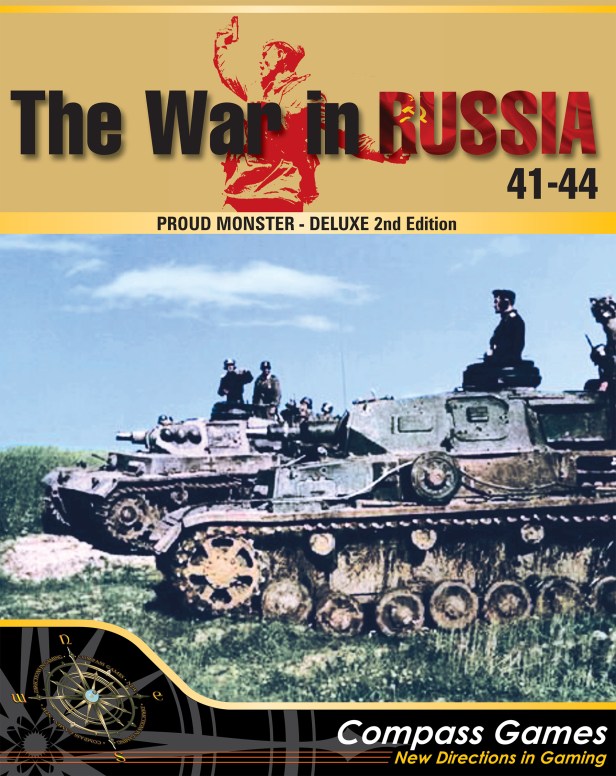
16. The War in Russia, 41-44: Proud Monster Deluxe 2nd Edition
The final game in the Pre-Order Palooza! is The War in Russia, 41-44: Proud Monster Deluxe 2nd Edition.
From the game page, we read the following:
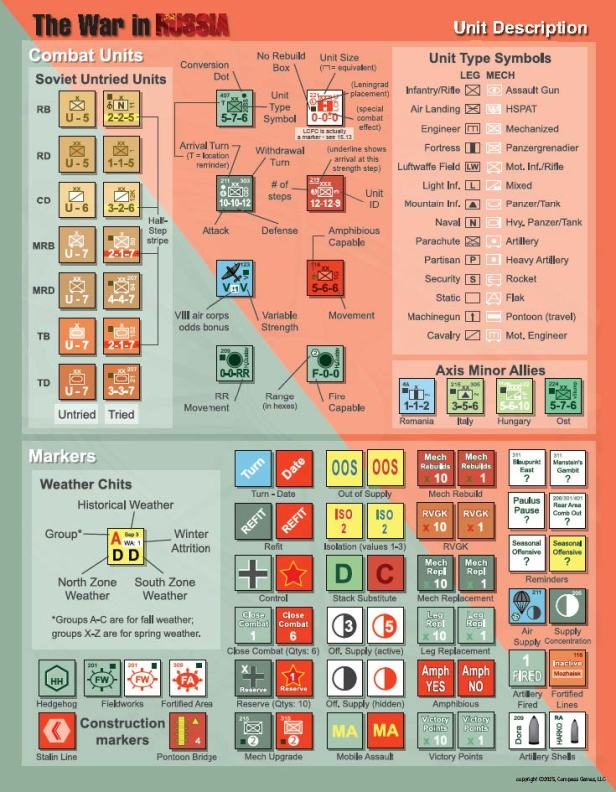
The War in Russia, 41-44: Proud Monster Deluxe 2nd Edition is a simulation of the Russo-German War beginning with the launch of Operation Barbarossa in June of 1941, and ending in April of 1944. It is a two-player (or multi-player) strategic/operational wargame of low complexity. Originally published in Command Magazine as two separate games, Proud Monster and Death & Destruction, this Deluxe 2nd Edition combines both games into one monster package.
Units are typically divisions with some corps, brigades, and regiments also included. Hexes are 20 miles (about 33 kilometers) across, and each turn represents about a 2-week period.
With TWO MOUNTED MAPS, over 2000 counters, a definitive set of player aids, and a comprehensive, consolidated rulebook, this is the playable monster for the Eastern Front. It is your “Proud Destructive Monster!”
Notes from the Deluxe 1st Edition:
In addition to updated graphics, the major changes are Reserves and Reserve Movement phases to simulate the potential for encirclement or defensive reaction. Soviet first winter offensive rules allow the Soviets to retake parts of Russia in early 1942, as happened in history. Both sides now have offensive supply markers to show historical offensive potential and limitations. Innovative weather chits allow for weather variation without extreme weather swings biasing the game. AFV units become even more important due to the AFV combat shift. Close Combat option allows for use of an alternate loss procedure and attacker advance to form a jointly-occupied hex, for example, to simulate Stalingrad’s gradual fall to the Axis. The ability to fully exploit holes created by mobile assaults is limited to reserves.
The Axis forces degrade in capability over time, while the Soviet forces upgrade in capability. The Axis super heavy artillery Thor and Odin, Heavy Gustav and Dora can fire before combat resolution. Besides the 1941 Free setups, 1941 historical setups are provided for both sides, as well as a 1942 scenario. Seasonal offensive rules allow for special turns when special things can happen. The 2 sides show a greater disparity in capability; the Axis can do things the Soviets cannot do, and vice versa. Things that work when playing the Axis may not work when playing the Soviets, and vice versa.
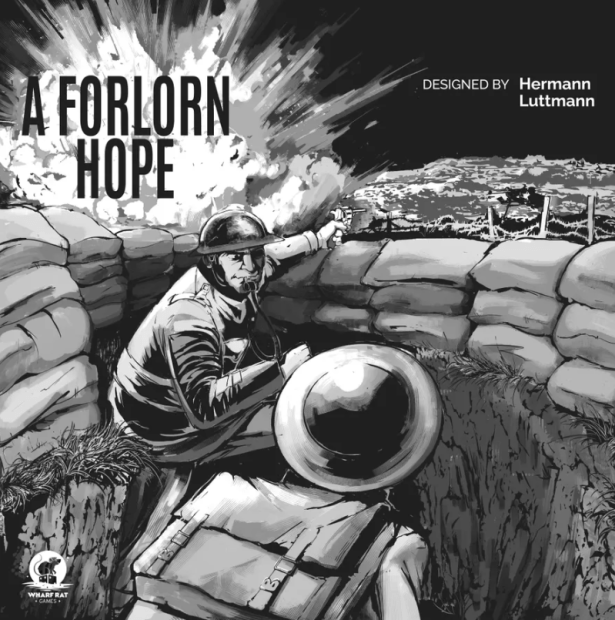
17. A Forlorn Hope from Wharf Rat Games Coming to Backer Kit
I have already said plenty about Hermann Luttmann (see above A Hell So Terrible: Verdun 1916 entry). A new publisher on the scene is Wharf Rat Games and they have signed their first game and it is from Hermann Luttmann. A Forlorn Hope places solo players or up to three cooperative players in command of a battalion charging across No Man’s Land to capture enemy trenches during World War I. Success requires careful balancing of bold advances and timely retreats to avoid casualties, maintain cohesion, and keep troops from becoming pinned under relentless enemy fire.
Over a decade ago, Hermann pitched a groundbreaking design to Alan Emrich at Victory Point Games—a push-your-luck mechanic within a wargame framework, originally set in the WWI trenches. While the concept was well-received, Alan suggested a Civil War theme instead, leading to the creation of In Magnificent Style, based on Pickett’s Charge at Gettysburg. This game went on to be published by Victory Point Games and later by Worthington Publishing. Now, Hermann is brining that original concept to the wargaming hobby in A Forlorn Hope and it looks very good.
From the game page, we read the following:
A Forlorn Hope is an abstract simulation wargame of a typical trench assault, modeling those attacks that were conducted during the First World War (1914-1918). The player represents an attacking regiment of troops consisting of three battalions, with each battalion made up of two or three assault companies (depending on the number of players).
The game uses a “press-your-luck” design philosophy that will challenge you with tough decision-making and risk-taking throughout the game. The goal is for the player(s) to drive their forces across No Man’s Land in the quickest and most efficient manner possible to achieve the best level of victory.
A Forlorn Hope is designed both for solitaire and multiplayer co-operative play. Numerous scenarios are included, starting with a basic assault scenario (which is ideal for learning the intricacies of the game system), then adding multiple historically-based scenarios simulating actual battles from World War I that offer a slightly more complex and layered gaming experience. Each scenario features singular aspects of the historical battle it is simulating, and each will therefore be a unique gaming experience.
The game doesn’t officially launch until February 2026 but you can follow the project so you won’t miss out.
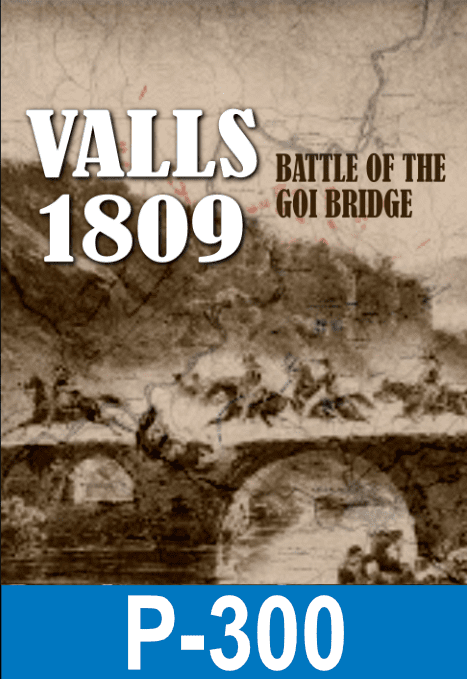
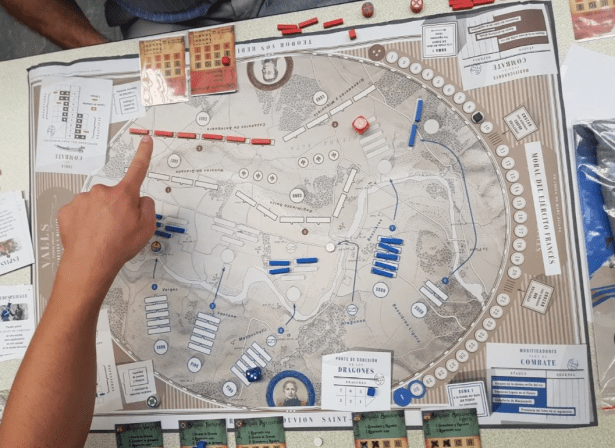
18. Valls 1809: Battle of the Goi Bridge from Neva Wargames
Neva Wargames is a new publisher who appeared on the scene last year. When I started seeing their posts on Twitter and Facebook, I was immediately impressed with their interesting topic choices for their upcoming games as well as the fact that they are trying to make small footprint wargames that pack a punch. And the art is also very appealing and brings an aesthetically pleasing and attractive look to their games! This month they have offered a new pre-order on their P-300 and it looks really good. The game is called Valls 1809: Battle of the Goi Bridge.
From the game page, we read the following:
The French defeat at the Battle of Bailén (July 19, 1808), which saw an entire army corps surrender, was a shocking blow. It forced the Napoleonic troops to abandon Madrid and retreat to the Ebro river, marking a spectacular failure for the first French invasion of Spain.
In response, Emperor Napoleon I decided to intervene directly, leading an army of his best troops. In November, General Gouvion Saint-Cyr entered Catalonia with about 22,000 men. After defeating Spanish troops at Cardedeu, he reached Barcelona on November 17, lifting the city’s blockade.
Shortly after, Saint-Cyr demonstrated his tactical prowess at the Battle of Molins de Rei, where he again defeated the Spanish forces. Despite the French victory, the Spanish troops managed to escape before being completely surrounded and captured.
After these two successive defeats, the Swiss general Teodor Reding took command of the Army of the Right. He reorganized and rearmed his men in Tarragona and set out with a small column to regroup his scattered units. The French army, aware of his movements, deployed around Valls.
Learning that Valls was occupied, Reding changed course towards Montblanc. After several days of skirmishes and maneuvers, and a difficult night march, his troops arrived near the Pont de Goi on the morning of February 25. The Battle of Valls began around 5:30 a.m.
The initial combat was intense. The Spanish attack was repelled, and after several hours of fighting, the arrival of the French Fontane brigade around noon shifted the battle’s momentum. Seeing the new enemy reinforcements, General Reding realized it was pointless to continue attacking and losing more men.
This is where the second phase of the battle begins, fought at the Pont de Goi. The Napoleonic objective is simple and direct: a decisive confrontation to annihilate the Spanish army before nightfall. For the Spanish, the mission is to survive, to wear down the enemy with minimal casualties, and to hold out until dusk to make a safe and orderly retreat.
This game presents an asymmetrical and dynamic challenge. The key is not just what actions you take, but the precise moment you execute them.
If you play as the French, your strategy must be aggressive and coordinated. Can you break through the Spanish defensive lines and achieve victory before nightfall? If you play as the Spanish, your goal is survival. Can you withstand the onslaught of the terrible French charge across the Francolí river and escape with your army intact?
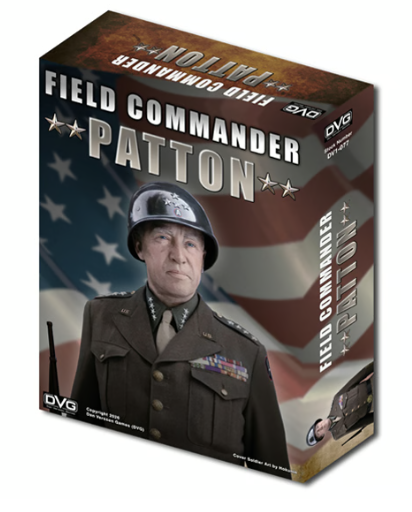
19. Field Commander: Patton from Dan Verssen Games Coming to Kickstarter Soon
The Field Commander Series is a collection of solitaire wargames designed by Dan Verssen and published by DVG. In each game, the player recreates the battles fought by the military leader and tries to perform as well or better than the historical counterpart. To date, there have been 3 of these games including Field Commander: Rommel, Field Commander: Alexander, Field Commander: Nimitz, Field Commander: Napoleon and Field Commander: Robert E. Lee (funded on Kickstarter but as yet unreleased). They now have introduced a new volume in Field Commander: Patton.
From the game page, we read the following:
Take command of history’s most daring general in Field Commander: Patton! Step into the role of General George S. Patton and lead U.S. forces through some of World War II’s most critical campaigns.
This is a solo strategy game packed with tension and tough decisions. March across North Africa, storm the beaches of Normandy, battle through Sicily, and push into the heart of Germany. Every mission challenges you with historically inspired objectives and dynamic gameplay that never plays the same way twice.
Keep your supply lines moving. Maximize your unit strengths. Outthink an enemy that reacts to your every move. Will you gamble on bold offensives, or play it safe to secure your advance?
With streamlined rules, rich historical flavor, and endless replayability, Field Commander: Patton is the ultimate experience for players who love deep strategy and solitaire play. Command the battlefield. Prove your skill. Rewrite history.
As of October 1st, the Kickstarter campaign has raised $15,567 toward its $15,000 funding goal with 116 backers. The campaign will conclude on Saturday, October 23, 2025 at 2:59pm EDT.
New Release
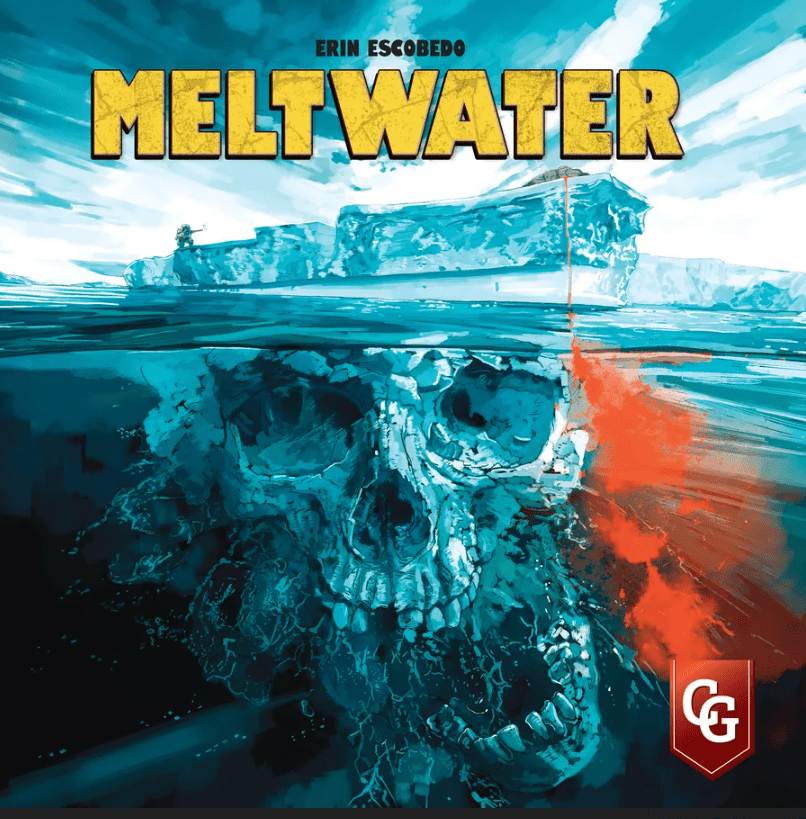
1. Meltwater 2nd Edition from Capstone Games
I missed this one when it was with Hollandspiele and I have been very interested ever since learning about this new edition. Meltwater 2nd Edition is currently available from Capstone Games and the new art and components really have snazzed it up quite a bit.
From the game page, we read the following:
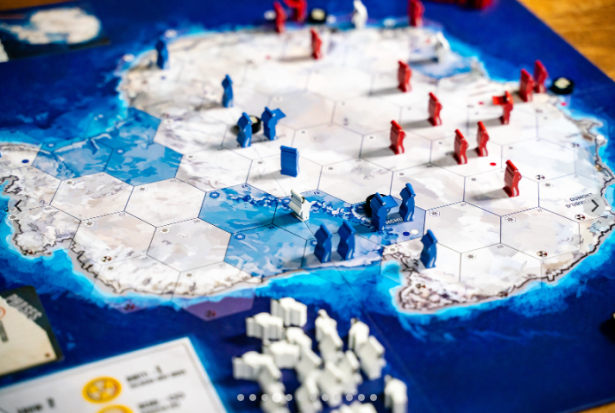
The unthinkable happens. The world is scoured clean in nuclear fire. The oceans are poisoned for generations to come. One last patch of habitable land remains: Antarctica. The remnants of humanity huddle together in a fragile patchwork of research stations and refugee ships. But even here, the Cold War survives. And our civilization may not.
In Meltwater, 2 players command the shattered remains of the superpowers, struggling for control of the ice. Simple diceless mechanics let players displace, corner, and isolate their opponent’s survivors. Here, hunger is a crueler weapon than gunfire, and the barren tundra can only support so many souls. And every turn, radioactive contamination pushes in from the coastline, shrinking the available space and forcing the belligerents closer and closer together.
In the end, there is only submission or annihilation, and whatever world is left.
I do have a copy that was provided by the publisher and cannot wait to get into this one with Alexander.
If you are interested in Meltwater 2nd Edition, you can order a copy for $34.95 from the Capstone Games website at the following link: https://capstone-games.com/product/meltwater/
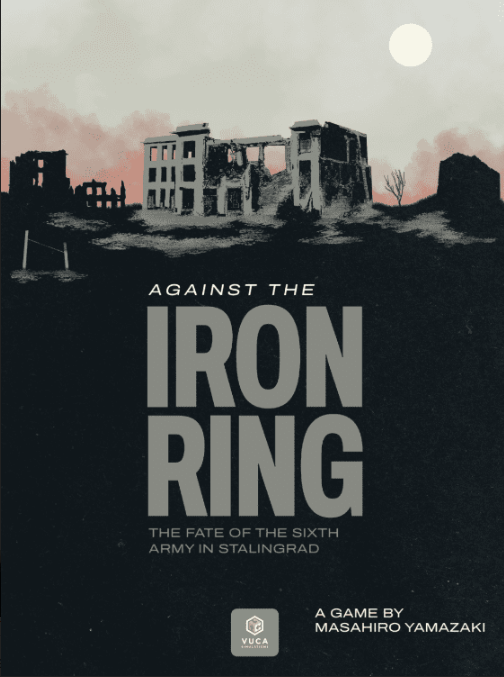
2. Against the Iron Ring – The Fate of the Sixth Army in Stalingrad from VUCA Simulations
VUCA Simulations is one of the best new publishers, both with their components which are top notch, but also with the game mechanics and systems that they use in their games. I am especially partial to their Operational games and their newest offering is Against the Iron Ring, which takes a look at the fate of the Sixth German Army in Stalingrad.
From the game page, we read the following:
Against the Iron Ring is an operational simulation portraying events in the Don River Basin area from November to December 1942, capturing a pivotal moment in history – often referred to as the turning point of the Second World War. This game marks the Soviet Red Army’s notable operational triumph over the Wehrmacht. Designed for two players, one commands the Soviet Red Army, while the other directs the German and Romanian forces. The game offers 3 distinct scenarios, each playable independently.
Each game turn spans three days. Scenarios 1 & 3 (Campaign) start on November 19th, 1942, Scenario 2 starts on December 10th, 1942. Scenario 1 ends on November 27th, 1942. Scenario 2 & 3 end on December 24th, 1942.
If you are interested in Against the Iron Ring – The Fate of the Sixth Army in Stalingrad, you can order a copy for €89,99 ($105.42) from the VUCA Simulations website at the following link: https://vucasims.com/products/against-the-iron-ring
3. War & Peace 7th Edition from Avalon Digital
This is a game that we have never been able to play even though we own a copy and have read through the rules. There now is a new 7th Edition reprint available of Mark McLaughlin’s classic War & Peace from Avalon Digital and it looks really great.
From the game page, we read the following:
War & Peace is a game that allows players to recreate the fight for Europe from 1805 to 1815. The game is designed for play by two players, one player being the French player and the other player is the British. Each player also controls one of the major countries of France, Britain, Austria, Russia, or Spain. Prussia is also in the game but starts neutral. The countries of France, Britain, Russia, Austria, Prussia, and Spain are represented by infantry, artillery, cavalry, naval units. The countries of France and Britain are at war throughout the game. The countries of Russia, Austria, Prussia, and Spain become neutral, conquered neutrals, French allies, or British allies through the use of diplomatic resources or military conquest.
France starts out strong militarily with the aid of the Spanish navy and a strong French army. Austria and Russia, when united, have strong armies while England rules the waves and buys influence and allies. Victory is determined by the conquest of France or Britain, or causing the isolation of Britain through political and economic means. The fate of Europe rests in your hands…
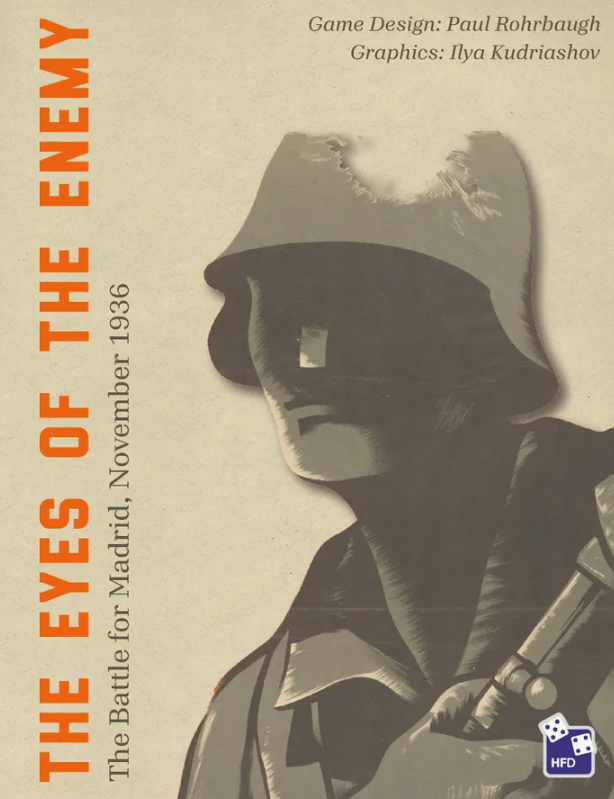
4. The Eyes of the Enemy: The Battle for Madrid, November 1936 from High Flying Dice Games
Small format wargames on lesser gamed subjects are always welcome at my table. High Flying Dice Games seems to specialize in these type of games and this month have a very interesting looking game on The Spanish Civil War.
The game is The Eyes of the Enemy: The Battle for Madrid, November 1936.
From the game page, we read the following:
The Eyes of the Enemy is a moderate complexity level solitaire play game on the battle for the capital city of Madrid during the first months of the Spanish Civil War.
Following liberal victories in Spain’s early 1936 elections the Spanish military in Spanish colonies in North Africa, led notably by Generals Emilio Mola and Francisco Franco, rose in rebellion in July starting a civil war. Aided by planes sent by Adolf Hitler that transported Spanish troops from North Africa to Spain proper, the “Nationalist” regular army soldiers, joined by fascist “Falangist” and royalist “Carlist” volunteers soon began taking control of several Spanish cities and towns in western provinces. These were joined by fascist “volunteers” soldiers and airmen sent by Italian dictator Benito Mussolini, as well as airmen and aircraft from Nazi Germany. The loyal “Republican” Spanish navy and armed forces, as well as some loyal elements of the Spanish Army, were hard-pressed to stop the Nationalist forces, now under the unified command of Franco (General Mola was killed just weeks after the start of the conflict in an airplane crash), who ordered that the capital of Madrid be taken as quickly as possible.
However, volunteers and weapons from many democratic nations, as well as the Soviet Union, were also arriving at Spain’s ports and deploying to Madrid. What ensued was the largest battle in Europe since the end of the Great War.
If you are interested in The Eyes of the Enemy: The Battle for Madrid, November 1936, you can order a copy for $22.96 from the High Flying Dice Games website at the following link: https://www.hfdgames.com/madrid.html
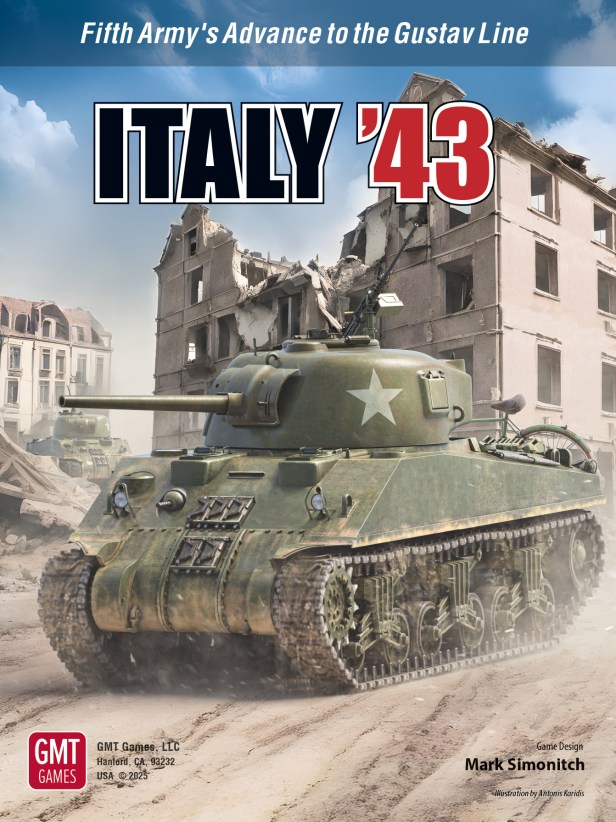
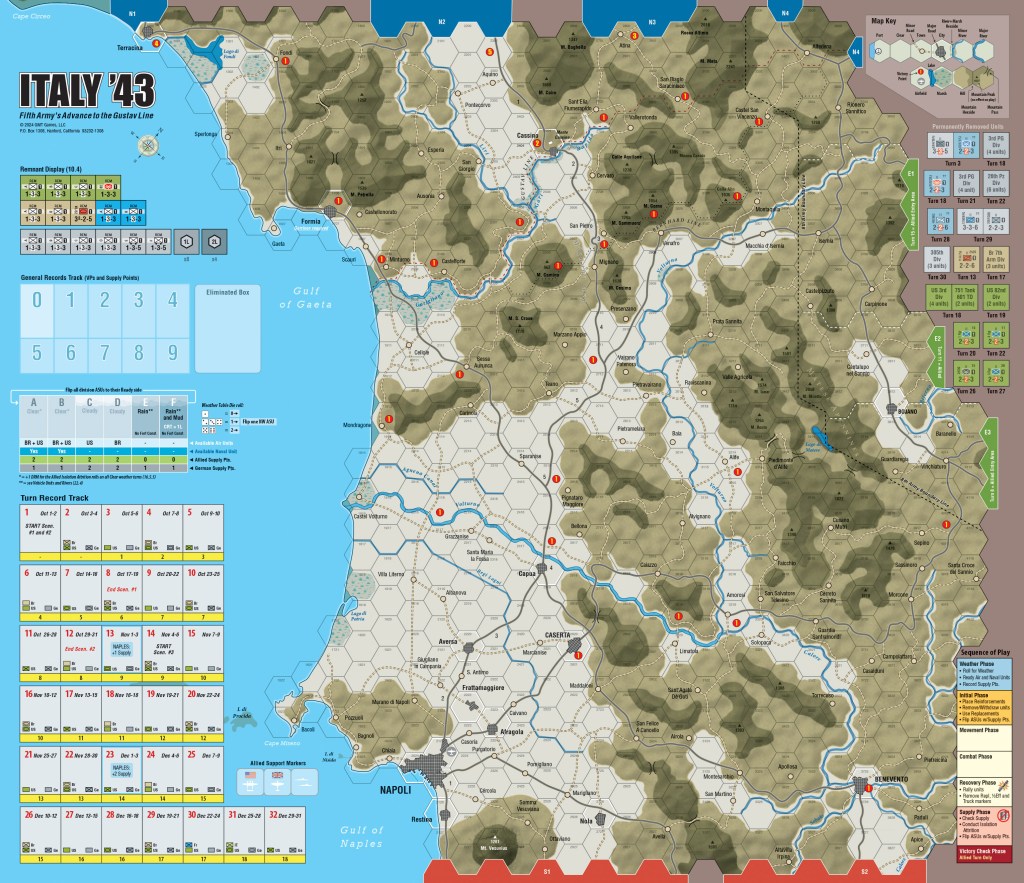
5. Italy ’43 from GMT Games
As you know, we have really enjoyed our plays of games designed by Mark Simonitch, including Holland ’44, Stalingrad ’42, Caesar: Rome vs. Gaul and most recently North Africa ’41. He has an amazing ability to boil down all the elements involved and come out with a very playable simulation of the historical event. A few years ago, his focus on the Italian campaigns of WWII started with his game called Salerno ’43, which covers the Allied invasion of mainland Italy in September 1943. Since that time, we had heard rumors of his plans with the game to include a few additional volumes as the Allies moved north up the peninsula towards Rome. With the update, we got the next volume in the series called Italy ’43.
From the game page, we read the following:
Italy ’43 is a two-player game depicting the U.S. Fifth Army’s advance from Naples to the Gustav Line in 1943. The game (picking up where Salerno ’43 left off) covers the time period from October 2nd to December 31, 1943. Initially, the Allied advance moved quickly with the Fifth Army crossing the Volturno River on October 13th. But from then on, the Germans began to fight a stubborn delay action as they slowly withdrew to their prepared defense lines — The Barbara Line and then The Gustav Line. For the next two and a half months, the Allies advanced slowly north, fighting for practically every village and mountain top to even reach the Gustav Line. It was a grueling campaign known for the battles of San Pietro Infine, Monte Lungo, and Monte Camino.
Italy ’43 uses the exact same map and unit scale as Salerno ’43 and Normandy ’44. Italy ’43 uses the same game system used in Salerno ’43 with some modifications and rule improvements.
Italy ’43 includes four scenarios: Across the Volturno, The Barabara Line, The Mignano Gap, and the full Campaign Game.
As in other 19xx games, the rules include ZOC Bonds, Determined Defense, Extended Movement, and a straightforward CRT. New rules include: Construction of Defense Lines, Mountain units, and two new attack options: Prepared Offensives and Sustained Attacks.
Players will find the game and order of battle extremely useful in understanding what happened in this campaign. It allows players to experience and understand how a depleted German army was able to slow and then stop the Fifth Army at the Gustav Line.
Salerno ’43 was a well designed game that has a short scenario of 8 turns and a full campaign game of 22 turns. I think that this game is very good and will be one that you can play over and over again until you get the strategies down and can really stretch its legs at that point. But the game plays fast and furiously and was frankly a very good way to spend a Friday evening for 4 hours. If you are a fan of the ZOC Bond System, then this is a no brainer for you as it carries out that system well. If you are wanting to get into that system, this is probably the very best place to start. And as stated above, Italy ’43 is going to use the same system with some new rules.
If you are interested in Italy ’43, you can order a copy for $38.00 (but do it fast as the game is set to ship in mid-October and will increase to $60.00) at the following link: https://www.gmtgames.com/p-1123-italy-43.aspx
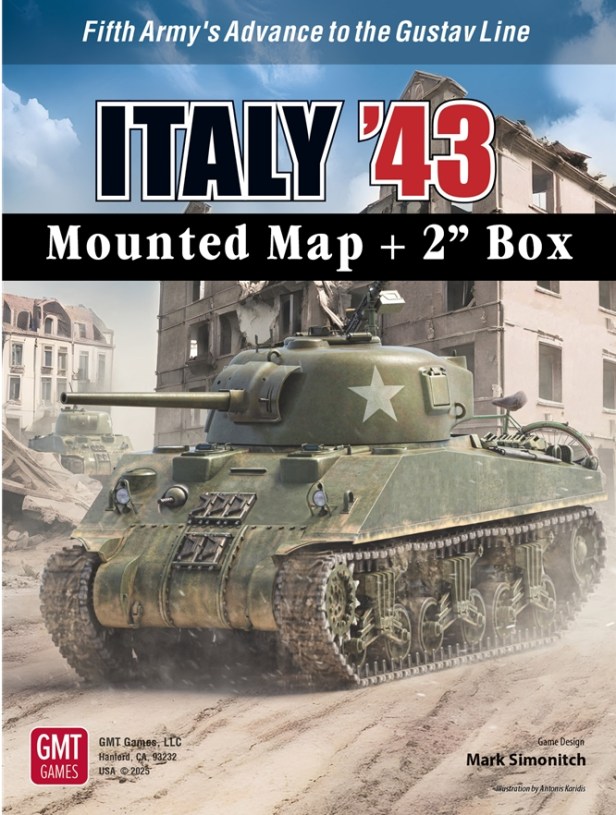
6. Mounted Maps and 2″ Box for Italy ’43 from GMT Games
Italy ’43 is also offering some tasty upgraded components to buyers and you definitely want to give these a look if you are getting the game, and you really should be. These upgraded components include a mounted mapboard and a larger, roomier 2″ box so that you can place those mounted mapboards into the box and fit the lid on.
From the game page, we read the following:
Because so many of our customers bought mounted maps for Salerno ’43, we are also producing mounted maps (and a larger box) for the 2nd game in Mark’s Italy series, Italy ’43. This item is At the Printer already. We offer it here so that you can all get the discounted price by ordering before we ship it.
If you are interested in P500 Upgrades/Mounted Maps and 2″ Box for Italy ’43, you can order a copy for $22.00 (but do it fast as the game is set to ship in mid-October and will increase to $31.00) from the GMT Games website at the following link: https://www.gmtgames.com/p-1168-italy-43-mounted-map-2-box.aspx
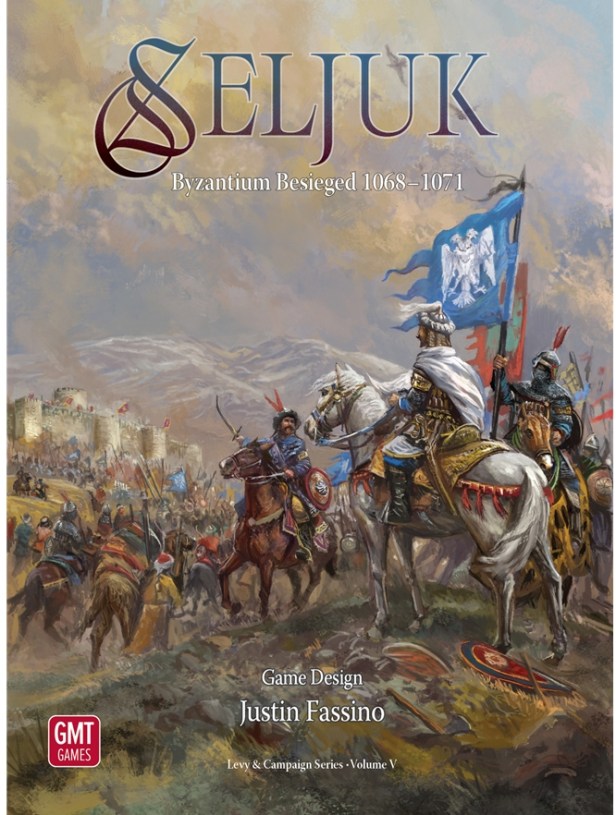
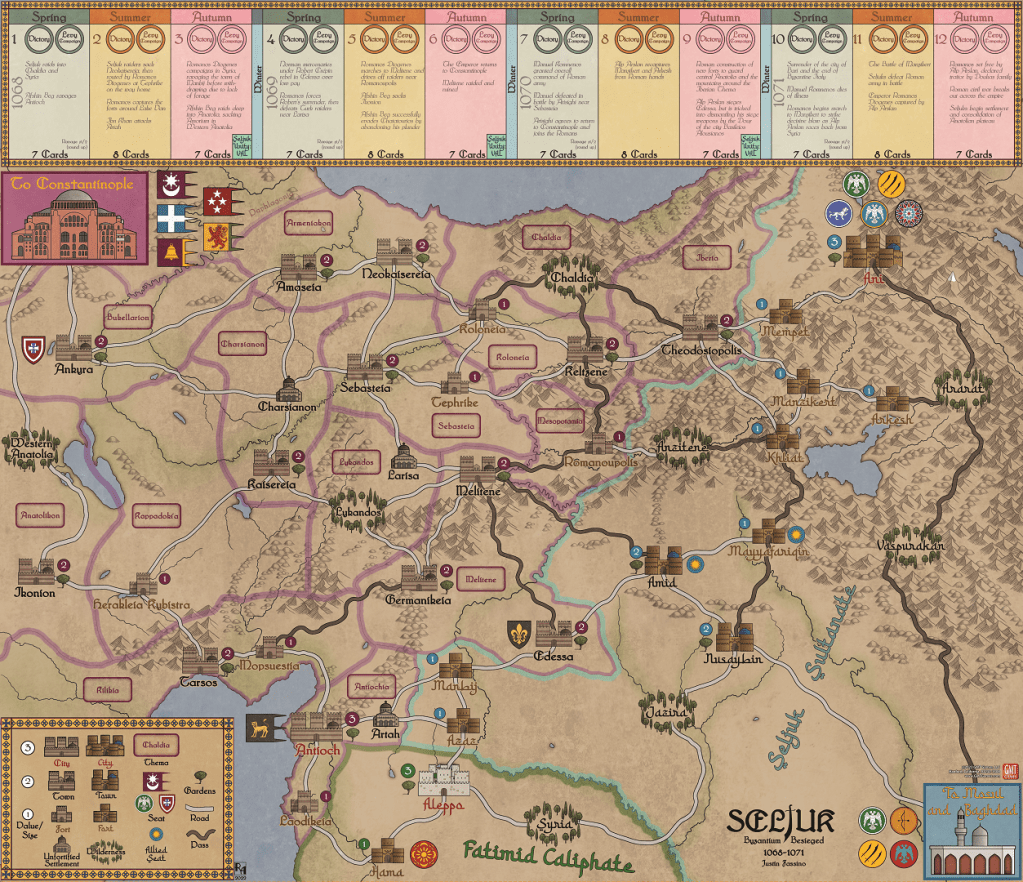
7. Levy & Campaign Series Volume VI Seljuk: Byzantium Besieged 1068-1071 from GMT Games
It seems that the hottest series out there today is the Levy & Campaign Series from GMT Games. Initially started by Volko Ruhnke with his Nevsky: Teutons & Rus in Collision, 1240-1242 and then followed up with Almoravid: Reconquista and Riposte in Spain, 1085-1086 there are 2 other titles currently listed on the P500 as well at least another dozen (or more) that have yet to be announced but are being developed and playtested. The newest release is Seljuk: Byzantium Besieged 1068-1071 that pits Romans versus Turks and will be shipping later this month.
From the game page, we read the following:
Anatolia, 1068. Romanos Diogenes has assumed the imperial throne of the Eastern Roman Empire. Ferocious armies of Seljuk Turks are on the doorstep, ravaging the border cities of the East and sending yearly raids and campaigns into Roman lands. Beset by political intrigue in Constantinople and assuming command of a fragile military, Romanos has only a short time to assemble the largest Roman army in over a century to drive off the forces of the Sultan Alp Arslan before the Empire collapses.
Seljuk—Volume VI in Volko Ruhnke’s Levy & CampaignSeries—brings players into the challenges of medieval logistics and maneuver across Asia Minor during the clash between Orthodox Christian and Muslim power in the lead-up to the climactic Battle of Manzikert. Players will assume the role of either the Eastern Romans or Seljuk Turks as they seek to make their mark on this historic land. Asymmetric victory objectives and new and unique additions to the Levy & Campaign system mean a dynamic game of cat and mouse between these two great powers.
I am glad to see that these new entries are not just pumping out the same product, even though the system is really good and creates some very interesting challenges, but are innovating in order to meet the demands of the historical actors and periods covered. In Seljuk, it appears that both sides have to confront the real possibility that some of their allied Lords might switch sides which is always a fun mechanic.
If you are interested in Seljuk: Byzantium Besieged 1068-1071, you can order a copy for $69.00 (but do it fast as the game is set to ship in mid-October and will increase to $107.00) from the GMT Games website at the following link: https://www.gmtgames.com/p-1025-seljuk-byzantium-besieged-1068-1071.aspx
As usual, thanks so much for reading along and sticking with me this month as I navigated through the many websites and game pages looking for new and interesting games to share.
Finally, thanks once again to this month’s sponsor Sound of Drums!
No problem – i just wanted to mention it because we receive a lot of “WOW” feedbacks. And the preorders are opened until 11/11 (with reduced price) (+ special price for US customers – no Tariffs !!)
I am not that impressed that GMT issues errata sheets and charges you for them. I am paying $15 for the Mr. President errata set (to include booklets) to “fix” that game, and I have been waiting two years for it. I will point out that Compass provides free counter replacements and DG gives free Variant and replacement counters for magazine games. Just sayin’…













 The Players' Aid
La Der des Ders (Hexasim)
LikeLiked by 1 person
I forgot to add that one. I will next month.
LikeLike
No problem – i just wanted to mention it because we receive a lot of “WOW” feedbacks. And the preorders are opened until 11/11 (with reduced price) (+ special price for US customers – no Tariffs !!)
LikeLiked by 1 person
I am not that impressed that GMT issues errata sheets and charges you for them. I am paying $15 for the Mr. President errata set (to include booklets) to “fix” that game, and I have been waiting two years for it. I will point out that Compass provides free counter replacements and DG gives free Variant and replacement counters for magazine games. Just sayin’…
LikeLiked by 1 person