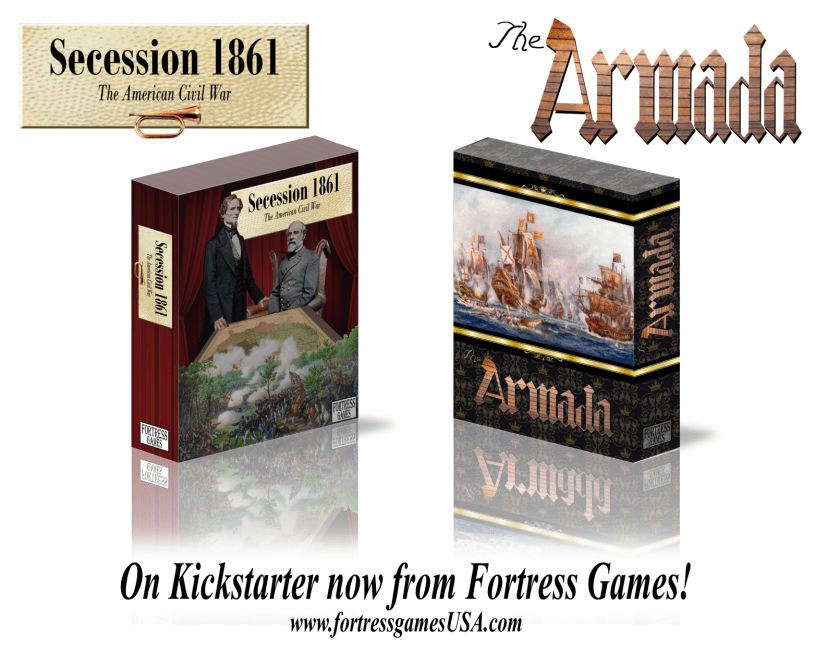
Fortress Games, operated by Bob Phaneuf, is the maker of some very good and interesting solitaire wargames, of which I have played 20th Air Force: A Solitaire Game of the Strategic Bombing Campaign against Japan 1944-1945. They have 3 other published games though on interesting topics and recently announced a new Kickstarter campaign for 2 new games, 1 solitaire and 1 that is a 2-player game. The 2-fer has 2 different games that are kicking off a new series and the first is Secession 1861: The American Civil War and the 2nd is The Armada. I reached out to Bob to get some inside information on the games and their design process and he was more than willing to work with us.
If you are interested in Secession 1861: The American Civil War and The Armada, you can back the project on the Kickstarter page at the following link: https://www.kickstarter.com/projects/1301120681/the-armada-and-secession-1861
Grant: Bob welcome to our blog. First off please tell us a little about yourself. What are your hobbies? What’s your day job?
Bob: Hi Alexander and Grant! Honored to be part of your blog. I spent my career in property & casualty insurance, and am the retired (young, of course) president of a national workers’ compensation insurer. I probably have too many hobbies, but I’m an avid golfer of extremely average skill, and I could design and play wargames all day long.
Grant: What motivated you to break into game design? What have you enjoyed most about the experience thus far?
Bob: I started designing games as a kid, but realized I had a knack for it in college in the early eighties. I designed a hex-and-counter game about the war in El Salvador and left it in the common room of my dorm, and it got played by the kids on my floor day and night – if you walked into the common room, two people were sure to be playing, and a crowd was watching and critiquing the play. I then made a game about the Iraqi invasion of Iran, and a Vietnam offering. Again, both were very popular. Not only were they popular to play, but they really sparked discussion about the conflicts themselves, which I found very inspirational. My friends and I would have formed a game company at graduation, but the pre-internet logistics of forming a company, finding/creating artwork, printing, copyrighting, etc. etc. were truly daunting. Hence, I went into property & casualty insurance!
Grant: What lessons have you learned from designing your games?
Bob: Graphical beauty matters a great deal. It can never be a substitute for game quality, but in 2025 you need both. I grew up in the era of very basic hex and counter games: think AH’s D-Day, or Waterloo, or even Panzerblitz. I remember being shocked at the beauty of 1776 and Anzio game boards when they came out later, such a dramatic change from D-Day! We make it a point to make our prototypes as plain as possible so as not to be seduced by a pretty look on a sub-par game, but if the game makes the cut, we try to make all the game components, especially the game boards, very attractive to the eye.
Grant: What are your new upcoming games Secession 1861 and The Armada about?
Bob: Secession 1861 is a solitaire game where the player takes the role of the besieged Confederacy, struggling to parry the powerful military, political and industrial strength of Lincoln’s determined North. The game spans the entire war, from Lincoln’s inauguration through Appomattox Court House (or, if you play well, a different outcome!). The Armada is a two-player game simulating the Anglo-Spanish War of 1585-1604. Two major drivers of the war were English support for Protestant rebels in the Spanish Netherlands, and England and Spain trying to affect the outcomes of France’s ongoing religious civil wars. Spain, with its vast treasure from the Spanish Main, must make (or keep) France and the Netherlands Catholic, England must keep that from happening. Of course, a successful invasion of England by your “Spanish Armada” will give Spain instant victory.
Grant: Why were these subjects you wanted to focus on?
Bob: I have always been disappointed in Civil War board games, which put far too much focus on the purely military struggle, which the US Civil War was certainly not. In The Armada, I felt this important, fascinating, historical, and frankly very game-able asymmetrical struggle has been very under-gamed.
Grant: What is your design goal with the games?
Bob: Secession 1861 incorporates into the military conflict the important political and industrial efforts of both sides, and the importance of home front morale. After all, Lincoln was essentially fighting a bloody war of conquest, and had to use his many remarkable skills to successfully navigate the few highs and many lows of 1861-1865. Meantime the South had to exert great efforts to not only frustrate the North’s many initiatives, but to (for example) become an industrial entity unto itself and protect its vital “breadbaskets” in the Shenandoah Valley and elsewhere. A successful player will allocate his initiatives in a way that maximizes potential southern advantages while also maximizing northern frustration.
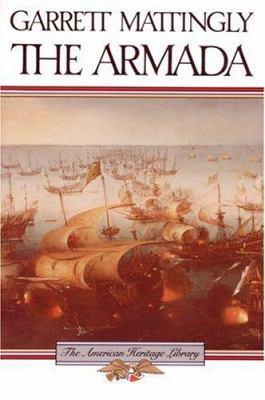
The Armada simulates the Great Anglo-Spanish War of 1585-1604, a conflict that had everything – great Spanish wealth pouring in from the New World, (and of course the English privateering of same!), the great religious struggles between Catholicism and upstart Protestantism that dominated the age, the emergence of fleets of sailing ships that could carry struggles across vast distances, the rise of England as a major European power, and more. For inspiration I read (and re-read) Garrett Mattingly’s classic The Armada. In the game I want players to feel the very different emotional push and pull of the two sides: as Spain, always knowing you can’t play with your food – you have a ton of treasure but a ton to do – how are you advancing the Catholic cause THIS TURN? As England, knowing you are always vulnerable to mighty Spain. Dislocation, distraction and disorientation are your friends – you can’t let Spain dictate the tempo and locations of the struggle.
Grant: First off let’s take a quick look at Secession 1861. What is the goal of the game?
Bob: As the Confederacy you can win three ways: capture Washington and dictate terms from the White House (possible, but good luck), see Lincoln lose his reelection bid in 1864 (his successor wins on a platform of a negotiated end to the war), or simply survive until the North runs out of steam. I really like especially the election situation. The game has three decks of game cards, an “Early War” deck, a “Mid War” deck, and a “Late War” deck. Between the Early and Mid War decks Lincoln signs the Emancipation Proclamation, which can turn the struggle into a moral crusade for the North. But between Mid War and Late War, Lincoln must run for reelection, and your actions can literally determine the outcome! Lincoln won because enough northerners supported abolition, appreciated the army’s advances throughout the Western Theater, witnessed an obviously successful blockade and ensuing seizures of almost every southern port, major and minor, and celebrated the fall of major Confederate cities such as New Orleans, Chattanooga and most recently Atlanta. These more than offset the dilatory effects of Grant’s mostly desultory campaign in Virginia and the war’s long and bloody course. Well, in Secession 1861, you have a say in all that!
Grant: As a solo game how does the bot work?
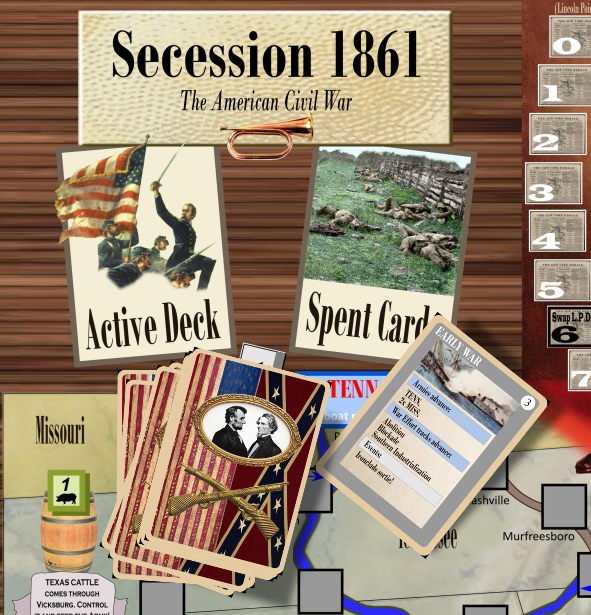
Bob: The solitaire system is driven by the three decks of game cards (Early War, Mid War, and Late War) and the events that take place between decks (the Emancipation Proclamation and Lincoln’s reelection bid). The cards determine which Union armies advance toward your vital areas, and what are the North’s political, industrial and other priorities.
Grant: What are its priorities and how does it make decisions?
Bob: Its priorities will shift as the game progresses, but the Anaconda Plan is alive and well. The bot will try to close the Mississippi and tighten the blockade, as its armies try to pound away in Virginia and push through Tennessee. Its early focus will especially be on abolition sentiment as it seeks to put the South on the wrong side of a moral crusade, and loading the rivers with its powerful gunboats. You will see, it will keep you quite busy!
Grant: Why did you want the player to take on the role of the CSA?
Bob: The US Civil War is without question one of the most consequential events in modern history. What the US is today, and its place in the world, and the world itself, would be incalculably different had the war ended differently. Thus, there are few more fertile areas for educational, simulation-ai gaming. And while both sides had gigantic challenges, the challenges faced by an under-industrialized, under-populated, under-militarized South, trying to defend a truly vast, vulnerable frontier and equally exposed waterways that doubled as military highways into their interior, plus a coast measured in the thousands of miles but a navy belonging only to your enemy…these make for a fabulous solitaire game challenge.
Most of my games came out of an original desire to educate MYSELF on history’s often mysterious stories (why on earth would the Viet Cong launch the Tet Offensive?!?!), and I think Secession 1861 does a remarkable job simulating the decisions forced on the South and the risk/reward calculations they often had to make, sometimes successfully and sometimes disastrously not. I believe players will learn a lot playing this game, all while having what came out to be, in my opinion (of course), a really fun gaming experience.
Grant: How does the unique tactical battle system work?
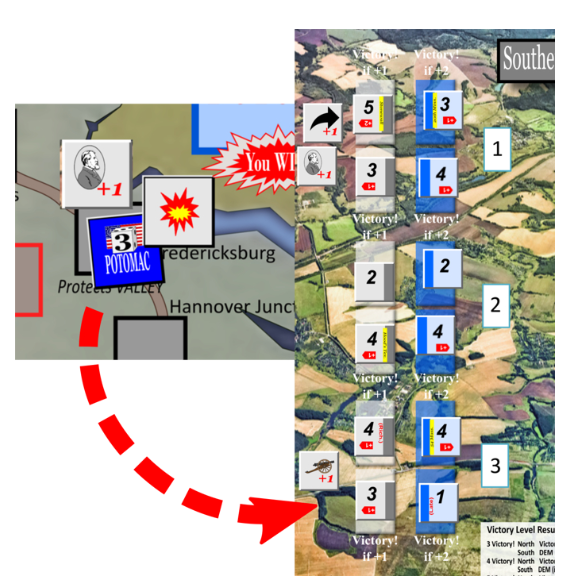
Bob: Battles are such exclamation points in the story of the Civil War that I daresay those less historically curious than your fans may know little more about it than a battle or two! And big battle’s reverberations on the national will of both combatants is well known. So, I felt they deserved more than a chuck of dice against a CRT. The tactical battle system allows the player to use leadership, artillery and maneuvers as they choose to. Union armies often have assisting river gunboats, too. Divisions man the center and flanks of both armies and those bloody matches will determine a winner. And winning a battle echoes throughout the game, not only pushing armies back and forth but greatly affecting home front morale, crippling the defeated army’s effectiveness for a period of time, and potentially weakening both armies with casualties to elite formations. Although the game incorporates, as stated earlier, all the important aspects of politics and industry, a decisive military victory in a large battle can absolutely change the tone and direction of a game!
Grant: What is the layout of the Battle Board?
Bob: Each side has a center and two flanks, and behind them supporting leaders, artillery and gunboats can participate. Also, when combat is initiated by you, you can select a maneuver to try to push the odds in your favor. But equally important, the outcome of battles has a longer-term effect on both sides’ morale and readiness for the next big battle. Thus, success is a self-rewarding cycle, failure puts more challenges in your path.
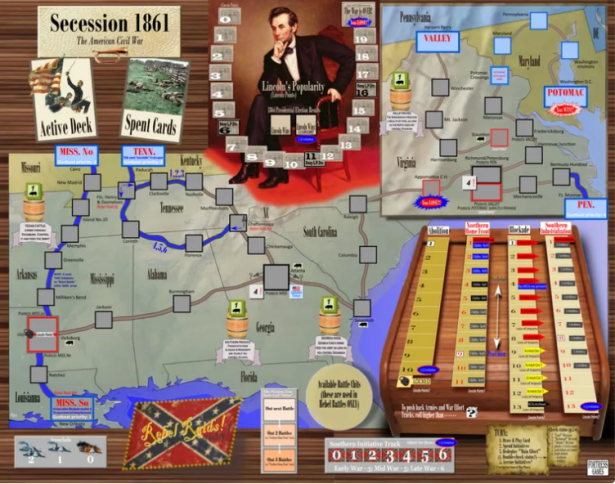
Grant: What is the layout of the game board?
Bob: The game board displays 6 different Union army tracks, each of which is pushing toward a specific objective. For example, there is a Mississippi north army originating in Cairo and a Mississippi south army originating in New Orleans, assuming the North has successfully taken that vital port. Both armies track toward a single objective – shutting the Mississippi to you. Additionally, the “War Efforts” Tracks tally abolition sentiment, home front morale, the blockade, and southern industrialization. Other tracks and staging areas watch ironclads, Rebel Raids (a feature where you can send raiders deep behind northern fronts trying to disrupt and delay them), and other game information. Lincoln’s popularity has a dominant track in the upper-middle of the board, and Northern sentiment toward their president can absolutely change the war, for good or ill. A holding area for the active card deck, and the card currently in play, sits near the top.
Grant: How does the game use cards? How do these cards change over the course of the Early, Mid and Late War?
Bob: The game cards drive northern actions, plus they can trigger an “Event” or two. Some events, like a sortie by your ironclads, are great! Others, like the Union seizing the port of Norfolk, not so much. And as discussed earlier, the Early War cards tend to emphasize northern prioritizations like increasing abolition sentiment in an effort to isolate the south early on, and on closing the Mississippi. Mid and Late efforts tend to emphasize more movement through Virginia and Tennessee, ever more tightening of the blockade, and improving home morale (think “Gettysburg Address”), while undermining southern industrialization.
Grant: How is victory achieved in the game?
Bob: As described in more detail above, capture Washington (good luck), having enough successes to ensure Lincoln’s reelection defeat, or surviving until the North runs out of the will to continue.
Grant: What is the goal of The Armada?
Bob: In this 2-player game, Spain and its forces of Catholicism must be on the offensive. The Spanish Netherlands is in full revolt, and France’s religious civil wars rage on. If Spain can make (or keep) France’s provinces Catholic and reconquer the rebellious Dutch they win. Or, of course, send a “Great Armada” into the Thames estuary and deliver a death blow to Queen Elizabeth’s Protestant England (replacing her with a Catholic monarch, of course!). As the English, you must simply avoid Spanish victory, but Spain is rich and you are not! So simply fighting the Spanish on their terms won’t gain you victory – you need to keep Spain off balance with raids on the Spanish Main, supporting Protestant unrest and action in France, and supplying men and ships to Protestant Netherlands.
Grant: How have you included the breadth and depth of the full Anglo-Spanish War of 1585-1604?
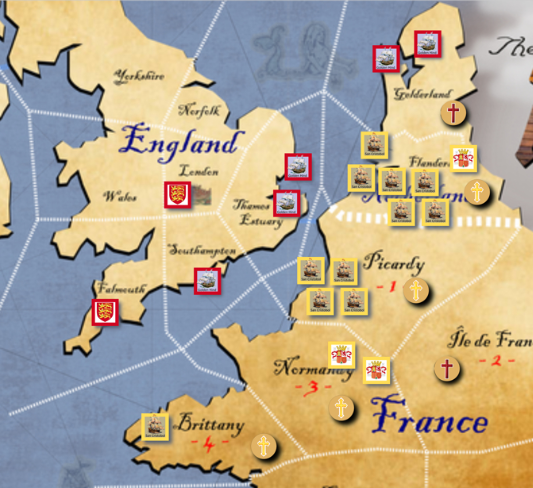
Bob: The game board spans all of Spain, England, France and the Netherlands. To the west is the Spanish Main, from where Spain gets her fabulous wealth and, for a daring and risk-taking English player, pilfered Spanish gold is available. The religious element of the conflict is present in all of France and Netherlands, as are their armed forces when stoked to rise up. The game has a tremendous amount of ebb and flow from turn to turn, the 20 year war is 20 years of nail-biting.
Grant: How do players go about swaying areas to join their cause?
Bob: There are two ways – either through a “French Control” purchase during its phase of the turn or by a straight-up attack on the Province. For French Control, a player can spend a Treasury point to roll a die. Each French province has a number 1 – 8, and if the number rolled matches an ENEMY controlled province, your allies rise up there, contesting control. You can choose to leave them to their own devices or send your own capital ships and/or army regiments in to assist. Or, you can simply attack an enemy province by sending your own capital ships and/or army regiments into that province, which mobilizes the local levees against you. This is the only option for a player, usually Spain, to attack the Netherlands. In the Battle phase, your forces will fight whatever local forces mobilized plus whatever of the enemy player’s capital ships or army regiments are there as well. During the “Battle” phase, all contending forces in all provinces must fight a battle to the death!
Grant: How does battle work?
Bob: Battles are quite simple: each unit (capital ship, army regiment or local levee) rolls an 8-sided die. On a 7 or 8 they score a hit – anything else has no effect. Each hit removes one enemy unit. The defender may reinforce if they wish with capital ships in adjacent provinces after each round. All battles are fought to the death!
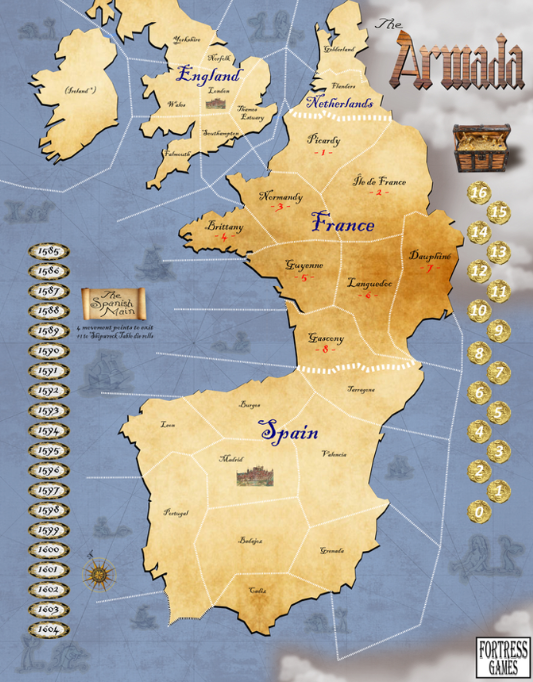
Grant: What is the layout of the board?
Bob: The board shows the totality of England, France and Spain, plus the “Spanish Main” area. France and Netherlands are divided into provinces, which will always be either Catholic or Protestant. England and Spain also have province-equivalent areas. The game board also includes a calendar track and a treasury track.
Grant: How is victory achieved in the game?
Bob: Spain wins by conquering England (capturing London) or making every French and Dutch province Catholic. England wins by capturing Madrid (again, good luck) or, much more likely, preventing Spanish victory.
Grant: What type of an experience do the games create?
Bob: We think Secession 1861 will mature as a classic solitaire nail-biter. The player has a lot of agency, having many options each turn for how they want to use their initiatives. The North is unrelenting and plays pretty smart! But there are a lot of opportunities to frustrate its efforts and advance your own, and battles themselves can alter the entire direction and center of gravity of the game! The Armada is a classic asymmetrical warfare 2-player game. Spain is more powerful and plenty more rich, but England’s bite is occasionally stronger than its bark, and good use of raids on the Spanish Main, French Control efforts, and counterattacks against vulnerable or isolated Spanish assets can advance England’s cause mightily. In fact, at the end of the designer notes we ask players to email us and let us know which side “fits their personality” more. You two should play a game as well and tell us who’s a better Spain and who’s a better England!
Grant: What are you most pleased about with the designs?
Bob: We wanted The Armada to be a fun, low complexity game that still very much conveys the strategies and imperatives of the two belligerents in this long, undeclared war. We believe it to be a very accessible game, and in development the play testers, including me, found a lot of “non-gamers” caught on quickly and really enjoyed the experience! And asymmetrical games can be difficult to pull off, but we found it to be well-balanced. In Secession 1861, I really feel like I’m in Richmond trying to decide how to lead the rebel nation. The decisions are realistic and historic, and the game typically plays out in a way historically possible. And, there are no “artificial events” that simply make the Union stronger and you weaker – 95% of improvements in the Union’s strength relative to you are the result of successes they’ve built on, so you, quite literally, control your own destiny.
Grant: What has been the response of playtesters?
Bob: That could be such a long answer! I’ll boil each game down to the main sentiments: Secession 1861 – the interaction between all the elements of the game, from abolition to blockade, from the advance of the Army of the Tennessee to the North’s seizure of the Shenandoah Valley (if they do!), from ironclads to industrialization to gunboats – so many of the game’s elements interact and affect each other. For example, the tighter the blockade, the more difficult for you to industrialize. The more that the “breadbaskets” of the South fall to the North, the more your army will be hampered by hunger and desertion. But it all works in a simple and organic way. The play testers found that to be an original, perhaps unique, accomplishment in this type of solitaire game.
In The Armada, everyone commented on the game’s back and forth, which makes it a non-stop thrill, where you always know you’re in it, but also a mistake or two away from disaster. I quoted one of our local Tampa guys on the Kickstarter page: “I’ve never seen ebb and flow like this – one turn I think I can’t win, two turns later I think I can’t lose, and on it goes…”
Grant: What other designs are you working on?
Bob: We continue to work on the 2-player The First Air War, 1915-1918, which hit some logjams with ideas that we love but haven’t figured elegant ways to implement. Plus, we’re working on the next in both these series: 2-player Nelson’s Victory in the Brittania Rules the Waves Series, and untitled solitaire games about British campaigns in the War of 1812 and the Mexican-American war in the 19th Century America series.
Thank you again, Alexander and Grant, for giving us a chance to discuss our latest offerings with you. The Kickstarter is moving along nicely, having hit its funding goal a few days after launch and growing daily. We have already submitted The Armada‘s artwork to our printer and will be doing the same with Secession 1861 soon. As many of your fans will know, we work very, very hard to fulfill Kickstarter campaigns fast as lightning, which means getting a head start on printing.
Thank you so much for your time in answering our questions Bob and for your efforts to create such interesting and engaging games with your company Fortress Games. I am very much interested in both of these titles and cannot wait to see how they play and to see what other great games you bring to us in the future.
If you are interested in Secession 1861: The American Civil War and The Armada, you can back the project on the Kickstarter page at the following link: https://www.kickstarter.com/projects/1301120681/the-armada-and-secession-1861
-Grant


“After all, Lincoln was essentially fighting a bloody war of conquest” an interesting way of whitewashing what the conflict was about. Why is slavery not mentioned at all in the campaign or this interview?
The American Civil War was primarily about slavery and any game that neglects the topic is lying to itself.
LikeLike
I’d suggest some therapy Mr Myers – if you think a Civil War game needs to be about slavery you live in a very weird world – good luck. Make sure you spam every WW2 game that isn’t about the Holocaust while you’re at it.
By the way – Lincoln had to invade the self-declared independent South, and seize their cities, ports, strong points, forts, control their coasts and waterways, and destroy their armies. It was extremely bloody. I’d say “bloody war of conquest” is a pretty good summary.
Learn your history, learn how to game, and lose your unsightly self-righteousness. Didn’t your parents teach you anything?
LikeLike
Looks like Bob’s dog whistles found their home.
LikeLike
Thanks for your list of games to avoid on BGG, I wouldn’t have found these interesting games it without your help!
LikeLike
Garbage interview of a garbage individual. Grant, I would have expected you to dig deeper into the claims your guest made here. Were you seeing his answers before moving the topic from his racist claims to board design? Did you consider not posting this on your website or to provide more context from an expert on this period of history?
LikeLike
You are entitled to your opinion and if this was your blog you could ask whatever you would like. I’m not here to grill anyone or fight with them or accuse them of racism or other flippant assertions. These interviews are about game design and not about social issues or beliefs. I don’t believe that wargames have to include every aspect of the conflict or cover all of the ugly parts of history. But I understand why people are charged up about things. Thanks for commenting and if you don’t come back I am sorry to see you go. Thanks.
LikeLike
Thanks for the reply Grant! Sure, it’s about game design, but it’s a historical game, and the subject is, to paraphrase the designer, not a “purely military struggle”. This specific game is about the beliefs of the designer about these social issues, and I wish the interview dug into that more rather than simply promoting it.
LikeLiked by 1 person