As you know, last month there was a bit of a bomb shell dropped on all of us as we found out the true struggles that GMT Games has been anticipating with the current tariff and trade war situation. In the April 2025 Monthly Update email, Gene masterfully laid out the concerns, provided GMT’s path forward and even offered us a way to help by doing a Loyalty Sale that I know many of us took advantage of. I know that we did as both of us purchased several games to round out our collections and fill holes. But this month, Gene followed up on that situation with an update post sharing how things were going and also to give us a really in-depth look at the mission and approach of GMT Games in how they treat their customers, their games and most importantly their staff. I really enjoyed reading his thoughts on this and am simply amazed at the vision of GMT. I have always loved their games and the way they do things (such as providing review copies to new content creators, fixing issues when they arise and taking accountability) and the update this month really gave us all a deeper understanding of the approach that I think has made them who they are.
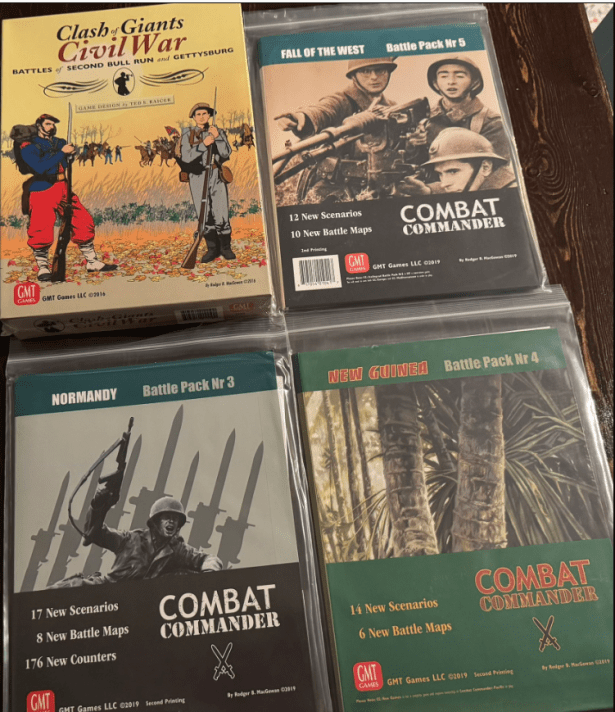
I used the Loyalty Sale to fill some holes in my collection including Clash of Giants designed by Ted Raicer as well as 3 Combat Commander Battle Packs that I didn’t have.
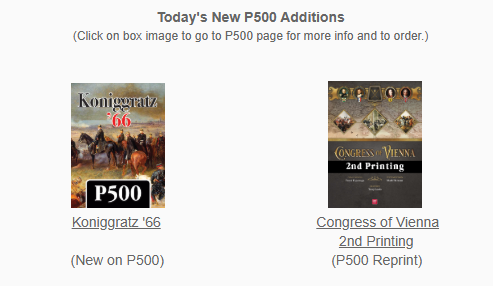
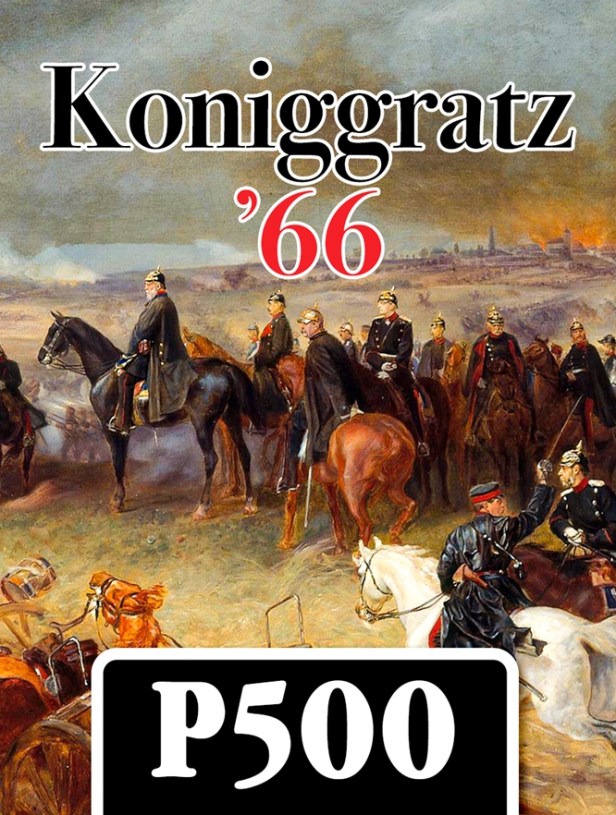
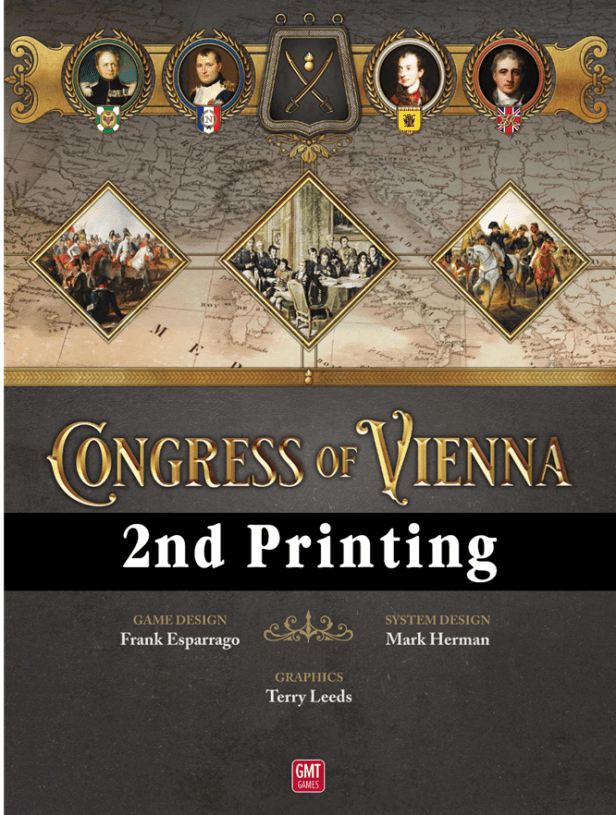
In addition to this, there was 1 new P500 offered this month in Koniggratz ’66 designed by Mark Simonitch and 1 new reprint in Congress of Vienna2nd Printing.
But that wasn’t all as there was plenty of other information shared including updates on GMT One products, development updates, new digital games news, upcoming future P500 additions and the usual gorgeous art samples!
As already mentioned, Gene started off the update with a summary of their status and a sharing of their business vision and philosophy.
I know many of you are looking forward to an update on how we’re doing on our Operational Plan (see last month’s newsletter for details), but I want to start today with something I didn’t really talk about last month: the “why” behind our operations at GMT. If you’d like to skip the “Why,” feel free to skip down to the “So are things improving overall for GMT compared to last month?” section a few paragraphs down.
It’s really difficult, first off, for me to speak or write about ANYTHING and be truly representative of all of our GMT teams. At GMT, we are 150 or so creative, operations, and management people of different race, gender, age, education levels, life experience, religious affiliation, political views, etc. For most of us, what we do as we create products together at GMT is not our “real job,” but rather a labor of love where we get paid some relatively small amount to make cool games with our friends. For some, though, it’s our main job, and every GMT paycheck is the difference between paying our bills and, well, not. So we are not even CLOSE to being one thing. We’re just a group of unique, talented, and very different people who share a love for creating games, and we like to do that together.
What DOES unify us in STAYING together is how we treat each other. We aim to treat others the way we’d want to be treated in their shoes. Some people call this the “Golden Rule.” Whatever you want to call it, we believe it is a really good way to build and keep friendships and to build and maintain teams of people working together in a shared enterprise. NOT that we’re perfect at it; we’re human beings, and we don’t always achieve what we aim for. But it IS what we aim for, and we’ve done our best over the years to make THAT a key part of the GMT company/team/family DNA. You should see it when you chat with our office folks and they go out of their way to solve the issue for you. They’ve been empowered to “think about what you would want if you were the customer, then give them that—or better.” Hopefully you’ve seen it in the open way that we’ve communicated with you over 35 years. And we sure hope you see it in our products—made BY gamers FOR gamers. We’re just making the games that we’d want to play in your shoes—because we ARE game players. And when we mess something up—which occurs occasionally despite our best intentions—we commit to fix it because that’s what we’d want someone to do for us in that same situation. And we choose people over profits on a regular basis because we’re people, and that’s what we’d want a company who makes games we love to do for us as customers, employees, strategic partners, or co-workers.
So, as we face some pretty tough business challenges, we’re naturally trying to let that “Golden Rule” approach guide us. Why shift operations to direct International shipping? Because if any of us lived in Canada or Europe or Australia or Japan (actually, several of us DO!) or any of the scores of countries where our customers live, we’d like a company to at least TRY to minimize our shipping costs. The various approaches we tried with UPS over the years didn’t really move that needle appreciably, so the current tariff situation gave us the opportunity and impetus to just eliminate the “everything goes through the US first” approach and thus help our international customers get a better deal. Why contribute GMT funds to help minimize tariff surcharges? Because what I would want if I were a customer with a limited game budget is to pay as little as possible for tariffs. And you’ll note that for our next batch of P500 games shipping (we hope in June), we’ve managed to keep all of the tariff surcharges under $4, even at a 30% tariff rate (which is SO MUCH BETTER than 145%, and we are thankful for that). And as we deal with the stress and frustration of dealing with these challenges, where there is a lot of uncertainty and something goes sub-optimally on pretty much a daily basis, we try to be kind to each other, apologize where needed, pick up a team member after a failure, encourage one another, and show compassion and respect throughout. These aren’t religious or political themes or statements. They just represent who we choose to be—in all of our imperfection—at GMT.
So are things improving overall for GMT compared to last month? Yes! We are making progress on all of our “Action Plan” fronts. The biggest progress has been in the “Build Cash Reserves” area, and that is almost completely due to the thousands of you who have ordered either our newest P500 game releases or our warehoused games in our 25% off Loyalty Appreciation Sale over the past month. You’ve helped us trade about 15,000 games into cash reserves during the five weeks or so since our April Update, and this has helped us immensely as we modify and enhance our operations to help us survive and eventually thrive through near-term difficult times. So thank you!!!!!!
We have also been moved by your generosity, as scores of you have sent us donations on Paypal or ordered $100 Gift Certificates, often telling us privately that you have no intention of ever using them—you’re just trying to help. You have really answered the call for us and greatly helped us during a time of need. Wow, talk about practicing the Golden Rule—we’re watching YOU do it! For example, at our Weekend at the Warehouse in April, 140 or so of our customers came with lots of cash, intending to leave with small mountains of games in order to “do their part” to help us. The $25,000+ that we added to our coffers due to that event paled in comparison to hearing the stories from many about how GMT games (and the Weekend at the Warehouse) had brought them so many great gaming experiences and friends over the years, and their resolve that they were going to be “part of the solution” and that they were going to do their part to keep GMT alive. Wow. And their actions, as they marched out with a LOT of games, matched their words. All of you together have been a huge help to us, and we appreciate you!
Jason Carr has perhaps the most difficult of all of our “transition our operations” jobs right now, as he has been working with potential and actual international partners, our printers, Kai, Mary, Tony, and Mitch, tax experts, and several of you who have years of experience and expertise in international fulfillment who have offered to help him (thank you!) to create a “direct shipping” capability to our international customers so that you can get games sent directly from our printer without having to ship into and back out of the US. This is a massive undertaking that has added layers of complexity to our overall operations, but it’s going to really benefit our international customers, both in speed of game delivery and in decreased shipping costs. Jason has the major relationships lined up now and is moving into the “make sure we understand exact costs for every step of the process” phase so that we can reset the shipping tables on our website to reflect the new rates when they are ready. It’s difficult to point to an exact time when this will all be ready, but we are aiming at a mid-June target for being able to do the first “test” batch of shipments, which will ship 6 of the 14 games we have currently at the printer to both international and US customers (see our Charge/Ship section later in this newsletter for more details). We will update you with EXACT details of how this will work and what the pricing will be over the coming weeks as Jason, Kai, Mitch, Mary, and Tony get all the operational details in place.
I really appreciate these comments and particularly like that Gene reminded us that wargame publishing is a cottage industry and is not necessarily a full time gig for most publishers. There just isn’t the market there to become rich but GMT has found their niche, done things the correct way, built brand loyalty and consistently produced fantastic games for 35 years by partnering with the best designers, artists, developers and production staff. GMT is a real American success story and I love it!
The next part of the update gave us some great news about digital offerings.
GMT’s Digital Game Strategy and Offerings. For more details on what GMT is doing with their Digital Games, check out Part 1 and Part 2 of their ongoing article series “Play GMT Games Anytime, Anywhere!” on InsideGMT. And check out their growing DIGITAL EDITIONS page on the GMT Website.
But there are 2 new games coming out way and one of them is very exciting as I just really enjoy the Battles of the American Revolution Series designed by Mark Miklos.
Today, we are announcing TWO new digital games in development – Mark Miklos’ Saratoga and John Butterfield’s SpaceCorp! Keep an eye on this space in our upcoming newsletters as we’ll keep you updated on our digital game progress each month.
Announcing Digital Saratoga! GMT is happy to announce that Saratoga, Volume I of the Great Battles of the American Revolution series designed by Mark Miklos is in development and is expected to be released on Steam for Windows, Mac, and Linux within the next few months. Brought to you by the digital team that brought you a digital version of Mark Herman’s Rebel Fury, this game will include the three Saratoga scenarios found in the Tri-Pack edition of the game including variants. Players will be able to play against an AI, solo by controlling both sides, or online against human opponents. Screenshots represent a work in progress—the final UI is likely to differ from these images.
Beta testers will be needed soon, particularly players who have experience with and can validate that all rules are implemented correctly. If you’re interested, please e-mail bob@hexesofwar.com.
Please consider adding Saratoga to your Steam wishlist—there’s no cost or commitment, but you’ll receive an e-mail notification when the game is released, and the more wishlists we have, the more Steam will promote the game. You can find the game on Steam at this link: https://store.steampowered.com/app/3689690/Saratoga/
SpaceCorp: 2025-2300AD is coming to Digital! We are happy to announce that our friends at Logix Interactive are creating a digital version of the popular boardgame SpaceCorp: 2025-2300AD for PC/Mac/iPhone/iPad! The release date is set for August 21, 2025!
For the first time ever, players around the world will be able to play John Butterfield’s SpaceCorp DIGITALLY on phones, tablets, and desktops! SpaceCorp has a special place in our hearts because of its well-liked sci-fi setting, its commitment to hard-science and realism, and, of course, its pedigree as one of the most popular titles ever developed by award winning designer, John Butterfield. SpaceCorp’s design brings players into a near-future space race as rival corporations lead humankind into outer space, and beyond. And although it leans towards the kind of hard-science that makes pop-culture giants The Expanse and For All Mankind cultural touchstones, SpaceCorp infuses a great deal of imaginative gameplay elements, as players strive to advance human civilization through genetic engineering, fantastic technological achievements, and, of course, finding Alien Life!
SpaceCorp is the kind of title that we think brings more gamers to our hobby. Its sci-fi setting crosses cultural boundaries and resonates with space-loving fans worldwide. As such, we have high hopes for it and hope that you can give it a try and forward this to your friends outside the hobby. We greatly appreciate your support for GMT and for our wonderful digital developers as we try to expand our offerings, broaden our hobby, and give you more ways to enjoy the games you love (and also protect some of you from running out of board game shelf space).
Don’t forget to visit the newly launched SpaceCorp Steam page, and most importantly, ADD IT TO YOUR WISHLISTS! Growing wishlist numbers and positive reviews are the only way to raise the visibility of our digital titles on Steam so that fans of other video games can see what we are up to! And the more fans we get, the more games we can make! So please, visit, wishlist, and REVIEW (when it comes out).
I very much have enjoyed the few digital games from GMT that I play pretty regularly including Fort Sumter (on my phone) and Twilight Struggle on Steam. I have tried Labyrinth several times on Steam as well but the UI just doesn’t do it for me and the game feels more like work than I want it to. I also need to by Rebel Fury and give it a go as we really loved the game and system and I am also hotly anticipating Mr. President.
Gene also shared with us some news about a new game from Hexasim that GMT is selling called The Twelfth Battle designed by Hermann Luttman.
New Hexasim Game Available for Sale! As we mentioned in our April update, we are going to be expanding and accelerating the number of International games we add to our line over the coming months. So we are excited to announce today that we now have Hermann Luttmann’s latest solitiare game gem, Hexasim’s The Twelfth Battle, the Caporetto Campaign, 1917, in our warehouse and available for sale! We have 350 copies in stock, so get them while they last!
As mentioned above, there was 1 new P500 offered this month in Koniggratz ’66 designed by Mark Simonitch and 1 new reprint in Congress of Vienna 2nd Printing.
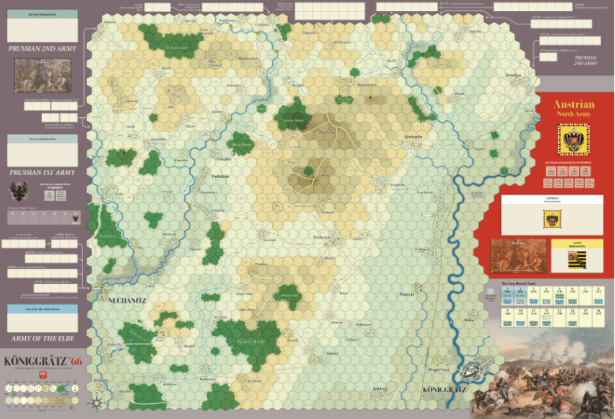
Koniggratz ’66
Mark Simonitch is a very talented designer! (understatement I know but its very true). His talents have given us many great games including the ’40X Series (Normandy ’44, Ardennes ’44 and Holland ’44, Stalingrad ’42, Salerno ’43, North Africa ’41 amongst others) and the great Hannibal: Rome vs. Carthage and many others (The U.S. Civil War, Successors, etc.). I am always amazed by his talents and the way he mixes a bunch of great mechanics together to make a very playable and enjoyable simulation of historical events. He also is quite the artist and his boards are always fantastic as his style is very clear and functional but he always puts nice touches on terrain and important aspects such as bridges, roads and cities. His maps just seem to pop and really set a great mood for his games.
Well, when GMT offers a new Simonitch game, I am immediately interested and this month we get a new game in a new series called Koniggratz ’66.
From the game page, we read the following:
Three years after Gettysburg, a similar epic battle occurred in Europe—The Battle of Koniggratz. It was on this battlefield on July 3rd, 1866, that the Kingdom of Prussia fought and beat the Austrian Empire in the decisive battle of the Austro-Prussian War. Their victory would lead to Prussia becoming the dominant kingdom over the independent German states and within 5 years would create and lead the German Empire.
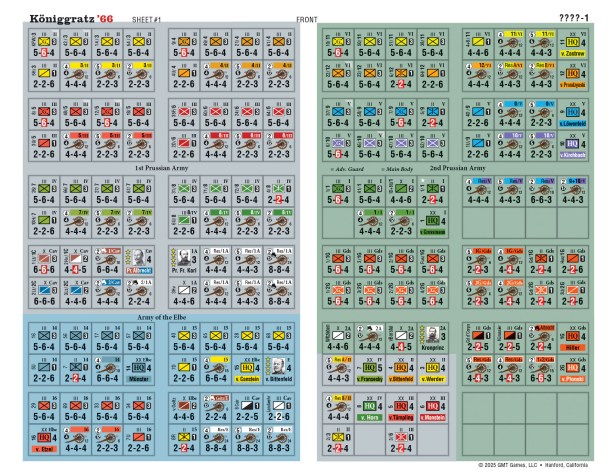
Koniggratz ’66 is a 2 to 4 player game on that decisive battle. The scale is battalions/regiments for infantry and regiments/brigades for cavalry. The battlefield and forces engaged were twice the size of the largest American Civil War battle, so two maps at a scale of 400 yards per hex are required.
The game is intended to be an easy game to learn and play but large enough so players will learn the details of the battlefield as well as the weapons, tactics, and maneuvers that succeeded or faile The important elements of the battle are included, such as the Prussian breechloading Needle gun, Austrian shock tactics, and the superior Austrian artillery that had recently been modernized.
The game includes two main scenarios covering the initial action in the morning and the full day scenario. It will also include an introductory scenario, a retreat scenario, and a “what if” scenario that gives the Austrian player more freedom with his reserve corps.
I can’t wait to dig into this one and learn a bit more about the system and how it works to model the Austro-Prussian War.
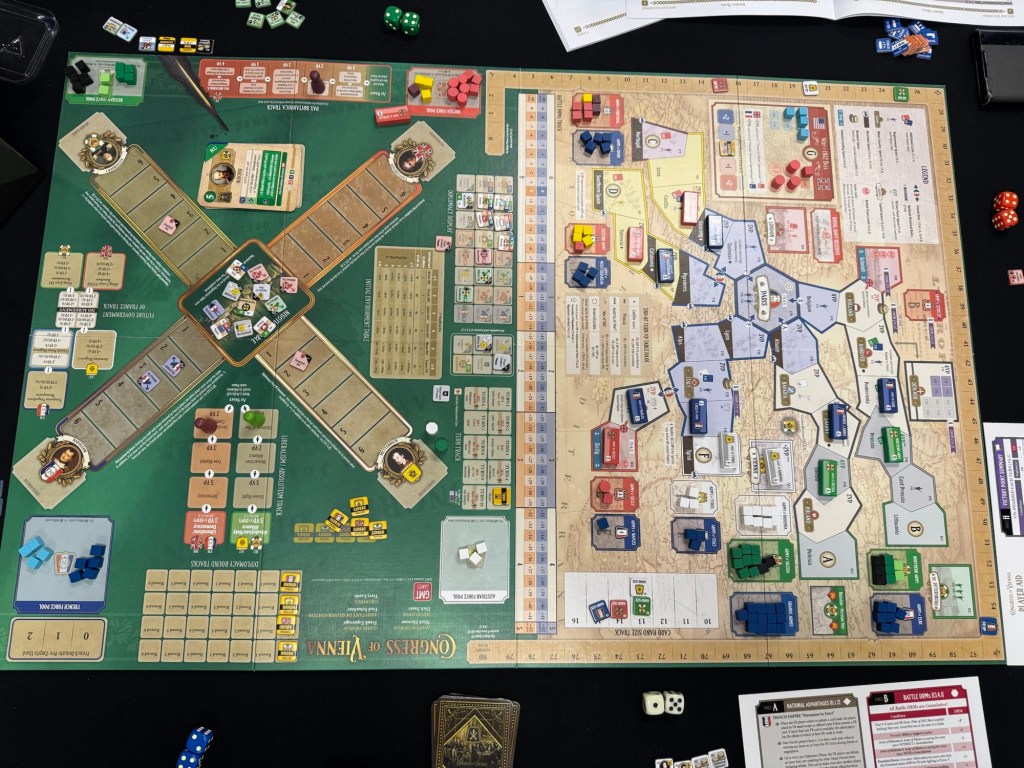
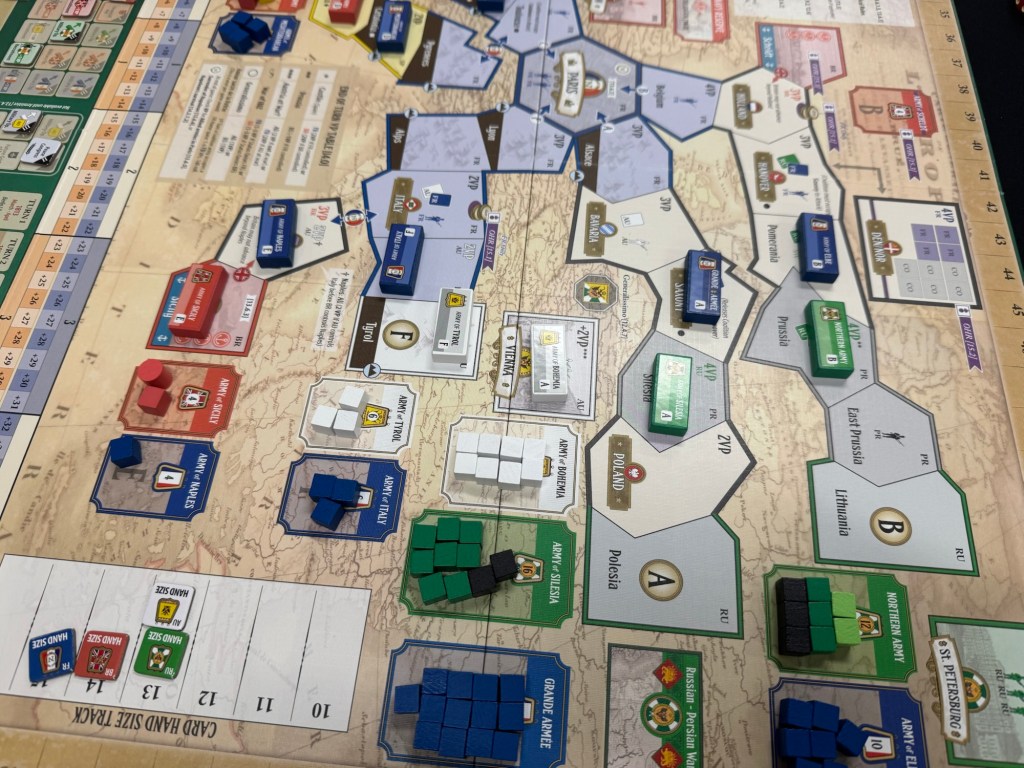
Recently, we had an opportunity to take Congress of Vienna out for an initial test drive while attending Buckeye Game Fest in Columbus, Ohio and let me tell you we had a great time. It took us about 3 hours to get the setup complete, rules reviewed and everyone up to speed (we had one new player to the system) and then to play one full turn.
Congress of Vienna is a diplomatic card driven wargame. It is based on Churchill designed by Mark Herman and is the 4th game after Churchill, Pericles and Versailles in the Great Statesmen Series. The game is set during the years of 1813-1814 and sees players take on the role of the main characters in the battles of the time.
From the game page, we read the following:
Congress of Vienna creates an enthralling gaming arena. It allows players to become the main characters of the dramatic, titanic struggle between the struggling Napoleonic Empire and the coalition of Russia, Austria, and Great Britain (with their Prussian, Spanish, Portuguese, and Swedish allies).
The game starts after Napoleon’s disastrous 1812 retreat from Moscow, covering the decisive years of 1813 and 1814. The abstract game map involves a strategic theatre portraying Europe from the Iberian Peninsula to the boundaries of Poland and Prussia. It also includes the secondary front of Italy, an area for depicting maritime warfare and the British/American War of 1812. This game by designer Frank Esparrago and developer Dick Sauer (with much appreciated input from Mark Herman) has been created to be played as both a diplomatic and strategic military conflict without losing the taste of the Napoleonic era’s great battles.
All tables necessary for gameplay are printed on the game board. Congress of Vienna reproduces the spirit of Churchill in the mechanics and organization of its rules, diplomatic display, and its military map.
Historical Context and Congress of Vienna Scenarios
CoV recreates The Full Campaign (10 turns) with a low density of pieces: 14 army blocks and other auxiliary counters. The game also includes three shorter scenarios: (i) The Spring Campaign of Saxony in 1813; (ii) The German Liberation War of 1813; and (iii) The 1814 Campaign for France. Each turn, players decide the most important geopolitical issues for their nation and the strategy to achieve them: high diplomatic and organizational efforts will be needed. If you’re a fan of multiplayer games involving persuasion—often intense and occasionally desperate with your nation’s fate at stake…this is for you!
The aim of the game is to become the leading European power at the end of the Napoleonic Wars by employing a wise combination of negotiation and resources. Bludgeon-like tactics are doomed to fail; whereas deliberation and elegant finesse among ambassadors are key characteristics for successful CoV play. Nevertheless, armies and generals will be ready to do their duty and carry out military operations which culminate in dramatic battles across Europe and America. This is a fight for the soul of a continent. Will the Europe the players create entrench the rule of autocracy or shall the spirit of liberalism prevail?
Replayability is assured by CoV’s Card Driven Game (CDG) design. The deck of Initial Turn cards along with traditional CDG cards (play the event or the card’s numerical value) through the Diplomacy and Negotiation Segments ensure a fun and exciting game every time the box is opened. Furthermore, another deck of cards, called Handicap Cards, has been developed. These allow more playability and offer balancing factors to help inexperienced CoV gamers learn how to play, be competitive, and best enjoy the game.
There are 100 small markers to designate military units: white for Austrian, green for Russian, blue for French, black for Prussian, red for British, yellow for Spanish, carmine for Portuguese, light green for Swedish, orange for King Joseph’s satellite, and light blue for American, with 8 brown pieces to indicate British Fleets. These military units fight within an army. An army is represented by a large token which marks its position, along with its military units placed in their respective “Army Boxes” near each player’s National Track.
The game has two different but related phases including the conference table where players debate over the control of issues that are then used on the battlefield to recruit units, attack and take overall command of battles. The cards also can be used in battles to add DRM’s and battles are fought by adding up a bunch of DRM’s with +1 for each furor involved and then a battle track is consulted to determine losses.
Congress of Vienna is both a diplomatic and strategic military conflict. Congress of Vienna is similar to Churchill in the mechanics and organization of its rules, diplomatic display, and its military map. But it very much feels more like a true wargame and was extremely interesting. We are still learning and need to keep playing this one but I did enjoy what it was that we were doing.
One of the features that I have always enjoyed about these Monthly Updates has been the New P500’s on the Horizon segment where Gene Billingsley shares a few very cryptic comments about an upcoming project and we are supposed to somehow decipher his meaning from these “clues”. If you remember, last month this was not included in the update and I was a bit saddened by that but this month they brought it back with a vengeance.
Here is a brief tease for P500 additions lining up in the coming months. This month’s Koniggratz ’66 was teased in March as “A hex and counter battle game from the Austro-Prussian War.” Note that this is not a comprehensive list (nor will I preview EVERY game we have planned), so I will switch these up a bit from month to month. Over the coming 1-6 months, I anticipate that we will add:
A long-awaited game from Jerry White – Pacific Chase. Book it!
An Old West-themed strategy game from Ben Knight – this sounds intriguing but I don’t have any guess on this.
Another new Combat Commander product – I know that this might be a stretch but could this be Combat Commander: Spanish Civil War?
A WWI battle game from Hermann Luttmann – a solitaire game on the Battle of Verdun called The Price of Glory.
I think that I might have got 2 correct but possibly a 3rd. Gene how did I do?!?
Charging & Shipping
The following information for Charging and Shipping was copied directly from the Update:
Current Charge/Shipment: GMT started shipping May 6th for the five games listed below.
Next Charge/Shipment: GMT is planning and preparing for their first SPLIT charge/shipment (with international orders shipping directly from the printer and charging a couple weeks sooner than US orders). They’re aiming for mid-June to get the following seven items charging:
Tariff Surcharge: GMT has also noted the amount of the Tariff Surcharge (at far right) for each game. These Tariff Surcharges are per game and apply to all US orders (P500, distributor, and retail) for these five games. For website orders, they are applied automatically when your credit cards are charged.
Production Outlook
Also we got the following production update from Kai Jensen:
As of this week, production is back in action! Stalingrad ’42 with the Little Saturn expansion and Unconditional Surrender: Western Campaigns are both going to print with several other titles wrapping up shortly. At the other end of the cycle, there are eleven games plus counter trays coming out of the factory soon, ready for us to test our new shipping model in two batches. Coming shortly behind that is another batch of three more games, so we should have all the kinks worked out of the shipping over the course of the summer.
Our production was offline for 36 days as we figured out how to pivot around the tariff situation and get improved international shipping systems in place. I expect we will have a corresponding dip in new game deliveries about four months from now.
I had a US printer I thought was going to be able to print Next War: Taiwan for us as their per unit cost was only double what we normally pay (for a US-based printer, that’s very low), but when I received the written quote I noted they hadn’t quoted for the punchboards as they are not able to handle them at all. Having to part out the production to two print shops raised the cost by an additional factor as we would need to have the punchboards shipped from one printer to the other for final assembly. The combined printing costs plus the additional shipping put us back into the range of 3-4 times our normal cost for a game of this size.
During the production hiatus, I continued the search for a stateside printer who can meet all of our needs (this has actually been an ongoing process for over a year now). I had a great phone conversation with another print shop, and I am waiting to hear back from their sales team once they have taken a close look at a sample of one of our games. The punchboards (countersheets) are the biggest sticking point, so I shipped a game to their office last week. I am cautiously optimistic that the 57th time’s the charm!
I have very much been looking forward to many of the games mentioned in this Production Outlook including Unconditional Surrender: Western Campaigns and the Little SaturnExpansion to Stalingrad 42′ as we never got a chance to play it and gave away our copy to someone that could.
Project Updates and Sample Art
As is usually the case, I wanted to share last all of the great sample art that has been shared as a part of the update on various games as they run up to production.
The first item we were shown was the cover for The Plum Island Horror: More of a Bad Thing. The Plum Island Horror was announced in June 2021 and came to production pretty quickly. We played the game last year and had a blast with it as it just plain fun. But, the game is very long and will take some time to play. Remember, it is not a wargame but designed by a wargame designer who also just happens to have a knack for great designs that are cooperative such as Dawn of the Zeds. Plus who doesn’t like zombies? And with the success of the game they have decided to add content to make the game even better and more versatile with the announcement of The Plum Island Horror: More of a Bad Thing Expansion.
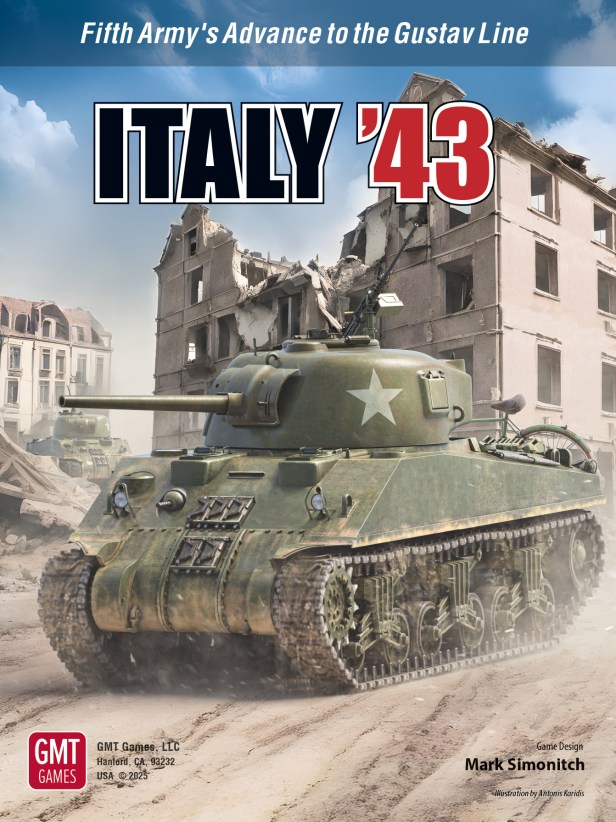
Next up we got a look at the final cover for Italy ’43 and I am very excited about this one! A few years ago, Mark focused on the Italian campaigns of WWII and started with his game called Salerno ’43, which covers the Allied invasion of mainland Italy in September 1943. Since that time, we got the next volume in the series called Italy ’43.
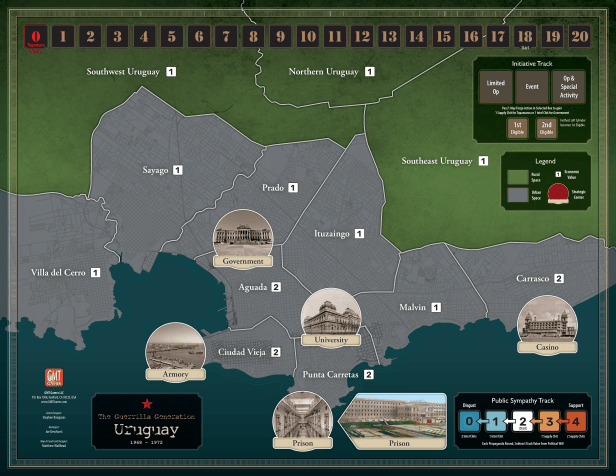
We then were shown a look at the final map for The Guerilla Generation Uruguay and it looks awesome!
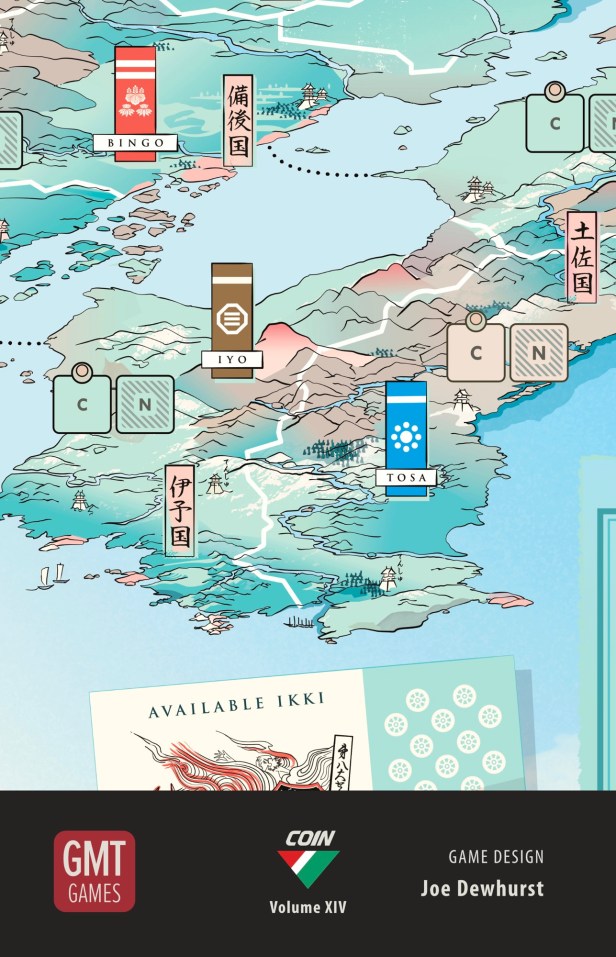
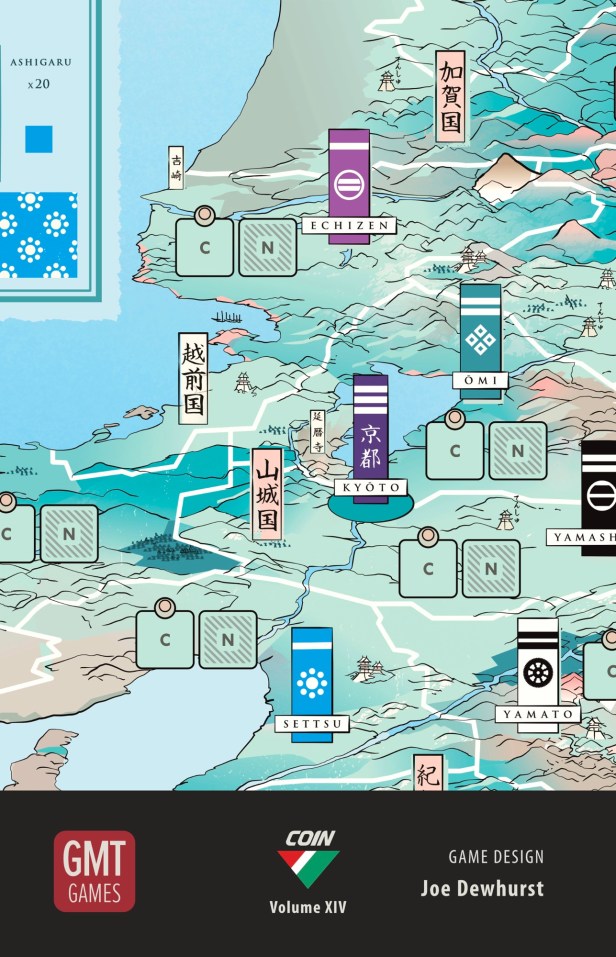
We then were introduced to a few board snippets from the upcoming The Pure Land designed by Joe Dewhurst. I like the look and feel of these snippets as they do feel very authentic and Nihon-teki (what concerns Japan).
First, a big thanks to everyone for the support you have shown the game thus far. The full team was able to get together back in March for CircleDC and the in-person response across four playthroughs was incredible. Your excitement really fuels all of us to keep pushing forward with the design, to get it into your hands as soon as possible.
Since the game went up on P500 the team has been quite busy. The current goal is to be content complete before the end of summer. Towards that end a full draft of the base rules has been done using CC:E as the foundation (with some CC:P carry overs). The cards were overhauled to get much closer to final. The OoB’s have gone through some value adjustments based on our playtests. We’ve increased the prototype map count to 21 (see draft map images below), just 3 shy of the total. Almost all of the maps now have their written scenarios. And the campaign rules are being further refined.
Even more, there has been a lot of testing across the team. Multiple campaign games have been in play. The RSG continues to produce some great plays in addition to testing the written scenarios. Lots of progress has us pacing really well towards our goal. Once again, thanks for all of the support.
I am currently doing some final testing and user-interface work on Marco’s excellent solitaire system, which has already been well-received by our wider group of testers. At the same time, we are preparing the main game materials for final art and layout, so we will be ready as soon as there is an artist available. We can’t wait to get this neat little game into your hands!
First, for all of you patiently waiting for Next War: Taiwan 2nd Edition, I understand that the details are still being worked around printing. Second, now that NWT:2E has wrapped, work has actively begun on Next War: Supplement #4: Combined Arms. This Supplement will feature updates for many games in the series (mostly Poland with a smattering of others) as well as new optional rules, insurgency scenarios, and a new 3-player “fantasy” scenario for Next War: Iran, which playtesters have so far labeled as “absolutely bonkers fun.” Of course, as the name suggests, it will also provide guidelines around running combined games, e.g. Korea, Taiwan, and Vietnam at the same time.
And, finally, I’ve begun work on a new project (not yet on P500) tentatively titled: Next War: Flashpoints. The idea behind this is to provide smaller footprint scenarios which use the full Advanced Game rules so you can experience the full game without the large time commitment. Most scenarios should be playable in one or two nightly sessions. That said, if anyone wants to test any of the scenarios (for either the Supplement or Flashpoints), let Ralph or me know.
I’m still primarily focused on getting Calixto finished before I return to Resisting Revolution, but I have been able to find time to tinker with the expansion’s bonus events while working on this. Resisting Revolution will include 16 new Cuba Libre event cards that are compatible with both the original game and the three-player variant scenario, selected by me to highlight unique personalities or situations that didn’t appear in the original game. For example, there are events highlighting the urban wing of the 26 July Movement (Action and Sabotage Units, Frank País), as well as events highlighting specific counterinsurgency techniques used by the Batista government against the rebels (Population Resettlement, Napalm). I’m doing some work now to ensure that these new events will be compatible with both the Calixto non-player system and the original non-player flowchart system, and we will be including instructions for their use by non-player factions with Resisting Revolution.
Things have been quite busy on the Ortona front. I’ve been working with developer Evan Yoak on updating the ruleset to make sure everything is as clear and concise as possible. A key part of that has been incorporating the campaign rules into the base rule set. The majority of the design time spent recently has been around the campaign so ensuring those rules fit well within the broader set has been essential.
One of the most recent updates with regard to the campaign has been the operational maps. These show the relative positions of the tactical engagement maps at the higher scale, to be used during the campaign. I’ve had a regional one from the start, but it’s been known there would need to be another one for the urban maps.
Working on the Urban made it clear both would need to be updated for playability. During the campaign these aren’t just references but interactive pictures of the operational environment. Players have to make decisions on these maps which affect both the tactical engagements and the rest of the campaign.
I spent the last couple of months iterating over this part of the game and have arrived at a solid place where the operational and tactical sides of the game are truly talking to each other. Even more they are both solid enough to stand on their own. Most recently I’ve been testing just campaign play to make sure things are in line with the history.
Lastly, a couple months back I took the playtest kit to CircleDC where I ran a demo using team rules. Groups of players controlled their own formation attempting to coordinate an assault in the middle of the city. It was eye opening seeing what this cooperative element brought to the game, not to mention getting to see play on connected maps.
Joe and Adrian are almost finished with their extended campaign game, which they’ve been playing on-and-off for the past few months. So far this has been a tense affair, with a very narrow British defeat in Palestine, a narrow British victory in Malaya, and a devastating British surrender in Kenya. Now they only have Cyprus left, where Joe is sure to gamble on a bold British strategy in order to reclaim some prestige. The new expansion variants have had an interesting impact in each game, with escalating “violent outbidding” between Irgun and Lehi in Palestine, lingering MCP jungle camps being hunted by the SAS in Malaya, and some very effective coordinated raids from the Kenya Land and Freedom Army commanders Dedan Kimathi and Waruhiu Itote. Meanwhile we’ve also been conducting some further testing of the new Arab Revolt and Japanese Occupations games, with no major issues aside from some minor rules clarifications, so it’s looking like we are pretty close to done now.
I will end this post by sharing our recent content on the blog and YouTube Channel for GMT Games products including reviews/interviews/unboxing videos:
Unboxing Video: Fighting Formations – US 29th Infantry Division:
Unboxing Video: In the Shadows: Resistance in France, 1943-1944:
RAW Video: Congress of Vienna:
Thank you for reading along this month. Please let me know what caught your interest from the update this month and what GMT Games products that you have been enjoying lately.








 The Players' Aid
I’m already hyped for Koniggratz ’66. I would love to read an interview with Mark about it (hint hint).
LikeLiked by 1 person
I’m amazed by the amount of information you provide 😳, i’m frankly impressed, a big thanks, that’s invaluable.
LikeLiked by 1 person