Hermann Luttmann is a very prolific designer and he has been doing what he does for a while now. Many of his games are very good historical games but they also have a very playable element to them that attempts to replicate the various elements associated with combat including fog-of-war, fortunes-of-war and friction-of-war and does a great job of making these elements matter. Plus, Hermann is a good guy. I have met him at several conventions including Origins and Buckeye Game Fest a few times, played a few games with him and have had multiple interactions through the blog. Herm is really a great guy and a great designer! Recently, I caught wind of one of his new upcoming games called The Twelfth Battle, which is a solitaire wargame that simulates the Central Powers offensive in Italy that began on October 24, 1917, with an all-out assault around the town of Caporetto. I am very much interested in this one and reached out to Hermann to see if he would answer our questions and he gave of his time freely.
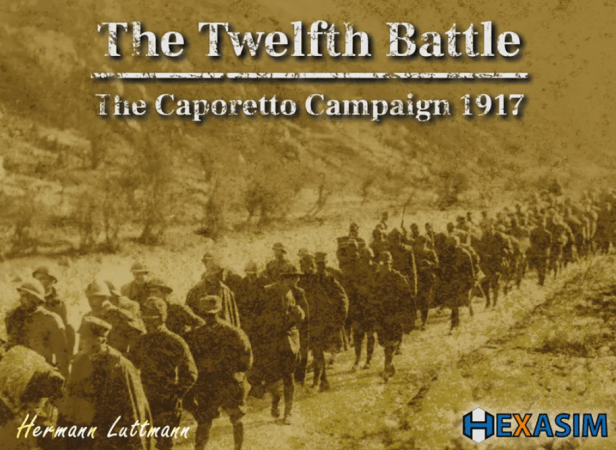
Grant: Welcome back to the blog Hermann! What is your upcoming game The Twelfth Battle about?
Hermann: The game covers the final Central Powers offensive in northern Italy in 1917, often referred to as the Caporetto Campaign. It is a solitaire design where you play as the Central Powers armies of Germany and Austria-Hungary as they attempt to knock Italy out of the First World War. But you have to do so quickly as the Allied forces of France and Great Britain react to your offensive and Germany needs to divert resources for the upcoming Kaiserschlacht on the Western Front.
Grant: Why was this a subject that drew your interest?
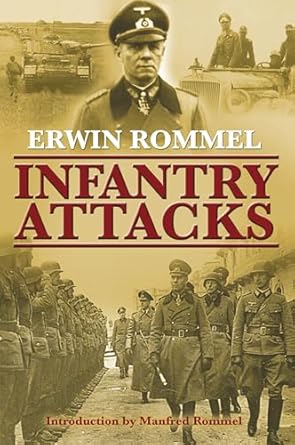
Hermann: I was first inspired to look into this campaign more closely after reading Erwin Rommel’s Infantry Attacks book, detailing his experiences at Caporetto and elsewhere. As I read more, the significance of the campaign and the circumstances that surrounded its launch, success, and ultimate failure intrigued me and I always thought it would make a great game theme.
Grant: What is your design goal with the game?
Hermann: Well, the idea is to put pressure on the player to accomplish the Central Power goals as quickly as possible, forcing the player to essentially “push-your-luck” in a manner similar to my other game designs that use that principle. The German and Austro-Hungarian forces initially have a huge advantage over the demoralized and rather worn-down Italian defenders, but that evaporates quickly as attrition and, ironically, success make that advantage harder to maintain. As the forces advance, keeping them supplied and supported gets tougher and tougher for the player. So, my main goal was for the player to feel that pressure and walk the tightrope of having to push hard and fast, but not so hard and fast that the rope snaps. I thought that would be a terrific challenge for any game player and this campaign models that tension nicely.
Grant: What from the Caporetto Campaign of 1917 is important to model?
Hermann: There are a few key elements to this campaign that the game design has to reflect. First, the Italian army at this point was at a near state of collapse after the previous eleven bloody battles along the Isonzo River (thus the game’s title). So, there were mass surrenders at the start of the Caporetto battle and for the immediate period thereafter. But amazingly, with a change of leadership (Cadorna is sacked and Diaz takes over) along with a renewed fighting spirit as the Italians were now defending their homeland against a mass invasion, the fortunes of war flipped, and the Italian defense became more stubborn. Capturing that change over accurately and effectively was an important ingredient in the game design. In addition, the logistical strain on the Central Powers units as they gained ground was becoming untenable. Ironically, the more successful they were, the harder they made it on themselves! Portraying that unique situation was another important aspect to model correctly and I hope I accomplished that. Finally, this campaign was rife with unique, memorable, and significant historical events and personalities. Seamlessly incorporating all the important events that actually occurred during the campaign – and some that didn’t happen (but could have) – into the game play has always been an essential aspect of all my historical designs and this is no exception. Using events to steer the game in certain directions with subtle nudges rather than a strict scripting of history has always been a primary goal for me and I think we found a nice balance doing that in this game.
Grant: What sources did you consult about the details of the history? What one must read source would you recommend?
Hermann: Various wargames cover the Caporetto battle but have great historical backgrounds. And since this is 2025, I perused numerous online articles and YouTube documentaries to get a broader sense of the historical flow of events. But I did reference the following books:
Caporetto by Cyril Falls
Infantry Attacks by Erwin Rommel
Grant: What other published games did you draw inspiration from?
Hermann: Not many! The Great War in the East quad by SPI was my main gaming interest covering this topic. There are a few others that have been published, but most are just specifically about the battles around Caporetto in particular, and not the whole campaign of 1917.
Grant: What has been your most challenging design obstacle to overcome with the game? How did you solve the problem?
Hermann: Well, as referenced in your earlier question, all those important aspects of the campaign – the changing state of the Italian armies, their command shakeup, the actual military goals of the Central Powers armies, their stretching logistics network, and the divergent interests of the German high command – were all design challenges. Incorporating all those factors without forcing the issue through scripting was a tough grind and I hope that I did meet the challenge with the final product. The simplest and yet most direct way to handle these challenges is by using “design for effect”, which is basically finding the shortest and easiest mechanic to best reflect the conditions with which to produce the results you want. In other words, something that will feel right in the end without an accompanying cavalcade of new rules and charts. So, to handle the logistics nightmare, I color-coded the spaces on the map so that the farther along the track the CP units advance, the more Action Points they need to spend to conduct certain actions like bombardment, regrouping, etc.
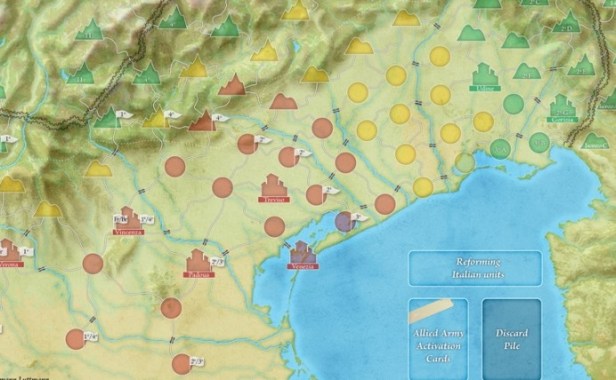
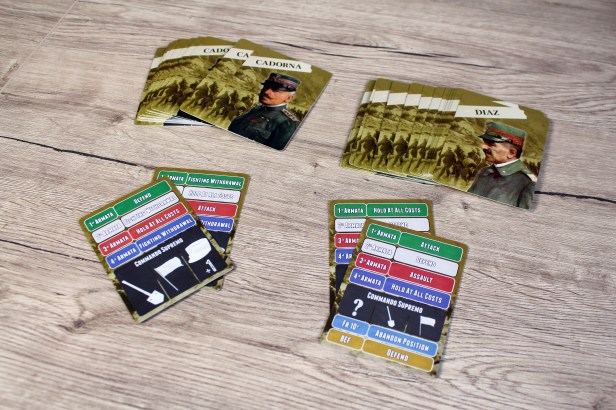
The command change at Italian HQ was handled with different sets of Allied Army Activation Cards – one for Cadorna (which reflects the more inefficient, demoralized, and flat-footed Italian army reaction) and Diaz (which offers more steady and efficient results for the Italians and other Allied armies). German units begin getting syphoned off the front as the game goes on (the Germans can’t wait any longer for this campaign to conclude) or if the player scores too many Victory Points too quickly (the German high command figures the Austro-Hungarians can handle things well enough and begin withdrawing support). This offers the player the same interesting and challenging conundrums to deal with as their historical counterparts had. All that along with a fully robust Event Table to reflect Rommel, the weather, the air war, etc. offers the player the full experience of all the key elements of the campaign in what I hope is a nice simple but comprehensive design package.
Grant: As a solitaire game, what side does the player control; the Italians or the Central Powers?
Hermann: I thought it was most interesting to have the player control the Central Powers and the AI to take the role of the Italian forces.
Grant: Why did you make this decision? How has that made for a more interesting game?
Hermann: Though conceptually you could model either side of this campaign in a solo design, I felt that having the player control the Central Powers was the more active, challenging and thus interesting side to play. Yes, the design could have been done as a States of Siege Series style game with the player playing the Italian army staving off the advancing Central Powers forces, but I judged that in this case the real game play interest stems from the player trying to manage this critical offensive, curtailed and leveraged by the greater strategic factors of the ongoing Great War.
Grant: What priorities does the AI bot use to make its defense of Caporetto?
Hermann: The Bot is built into the Allied Army Activation Cards. For the Cadorna Cards, it will issue an Order to each Italian Army based roughly on what that army tended to do during the early stages of the campaign. So, more withdrawal and defensive instructions, but not always. Again, this game uses my overriding design theory of “historically-weighted chaos” – anything can happen, but it will be within the reasonable parameters of the historical situation. Thus, no aliens will land, or zombies emerge from the graveyards…at least not in this edition. 😉 With the Diaz Cards, which come into play when Cadorna gets relieved of duty, the Italian armies get a stiffer backbone and become sharper and more aggressive, and his cards also now include the arriving French and British contingents (which were sent to the Italian front as the Allies realized the extent of the crisis occurring in northern Italy). In addition to these specific Orders, there are also entries on both cards for the possibility of additional actions by the Commando Supremo – the supreme headquarters of the Italian armies – representing higher level orders. These are additional actions that will create events, build entrenchments along the Piave River line, rally defeated troops, etc. There will be lots of variety and challenges for the player to experience with this AI system.
Grant: What is the layout of the game board?
Hermann: Well, it has kind of a States of Siege look to it, but it is not that at all. Each unit of the Central Powers armies has a track that it starts on. These tracks represent the main avenues of advance that were used by the armies as they attacked across northern Italy. There are also tracks in the Italian rear areas that indicate main lines of maneuver for the Allied armies. The player may move their armies around freely from track to track, provided there is a connecting path. The Allied armies are guided along their Tracks by the AI.
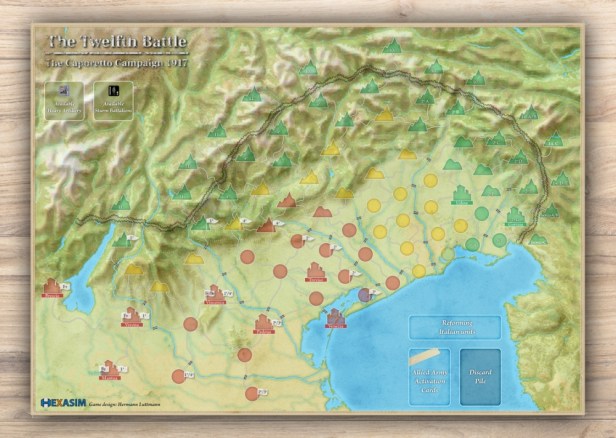
Grant: What are the values written in the different areas? What is the purpose of the different colors used for the areas?
Hermann: In the case of the Central Powers areas, these are the starting positions of the various units, and the entries are the identities of those units. For the Allies, the labels also indicate setup areas for the various armies plus some show where an army’s units will retreat to when falling back. The background colors of all areas indicate the Supply Level for the Central Powers units…green = Supplied; yellow = Limited Supply; red = Strained Supply. So, as the Central Powers units advance deeper into Italy, the supply situation becomes more challenging.
Grant: What is the function of the several unit boxes on the board?
Hermann: Two of those are holding boxes for markers. The player has access to both Sturmbattalions markers (stormtrooper units) and Heavy Artillery markers. Both are limited and cost Action Points to bring into the game, so you must be careful how you use them. There are also two boxes to place the Allied Army Activation Cards, one for the draw pile and the other for the discards. Finally, there is a box to place Italian units that are in the process of reforming after they’ve been eliminated. They may re-enter the game on their Reformed side with a Rally action, which is the back of the counter and represents the unit with a lower strength but also a higher morale rating.
Grant: What is the anatomy of the counters?
Hermann: The top left of the counter shows the units Army ID, which is the indicator for when the unit activates. Under the Army ID is the Unit ID, which can be merely a letter code or an actual historical name and identifies this singular counter. At the top in red font is the unit’s Strength Point value, measuring its size and power based on its troop makeup and armament. Next in orange font is the unit’s Artillery Factor, which is an abstract representation of the unit’s complement of attached artillery batteries. Next down the counter in the white circle is the unit’s Morale Rating, a basic measure of its élan, experience, and training. Finally, at the bottom right, in black font is the unit’s Defense Rating, which is its ability to survive and defend itself on the field of battle. Of course, each counter also has a beautiful depiction of what these soldiers looked like because – well – it’s one of my designs and I love colorful soldier figures! 😊
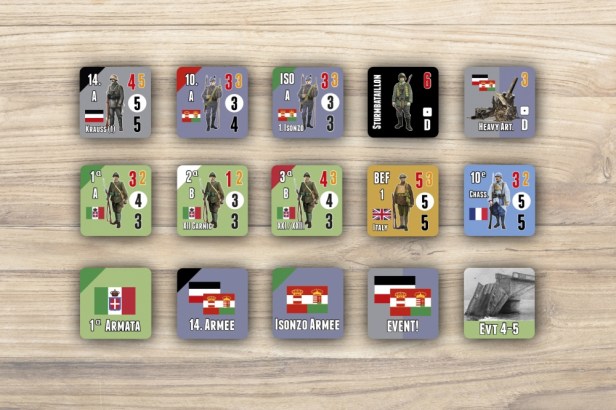
Grant: What different type of units are available to the Central Powers? What abilities do they provide?
Hermann: All the units are an amalgamation of infantry, of various types, and artillery, of various calibers. These are comprehensive fighting units and organizing them for this game was one of the harder tasks I had for this design. I was constantly fighting myself deciding how tactical to get with the units and how fiddly the combat should be. There were areas of the front that were held by entire armies and others by a few divisions. How to represent that distribution of troop strength and also the huge variety of assault troops, garrison troops, engineers, standard infantry, mortars, heavy artillery, etc. was nightmarish. I settled on dividing the fronts into sections and then determining what forces were deployed into those sections. Those then got amalgamated into unit counters, sometimes two counters if two different armies were in that same sector. I abstracted the fighting abilities of those units, accounting for heavy artillery apportionment, better quality troops, etc. So, on the Isonzo and Caporetto fronts, there are higher concentrations of troops for both sides. In the north, along the mountain areas, troops strength and artillery concentrations are sparse, and logistics are more challenging. The deployments in the mountains were especially tough to figure out, as they changed often and finding detailed info was tough. But I think I got the right feel of the various fronts and that’s the main thing – again, design for effect and not necessarily accounting for every single detail.
Grant: How are Events introduced to the game?
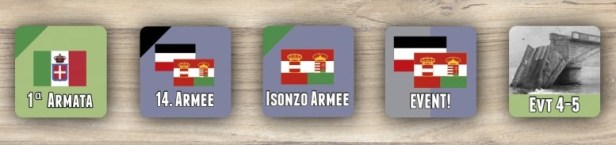
Hermann: Well, there are actually two ways that Events enter the game as the Central Powers and Allies have different methods. For the player, there is an “Event” Activation Chit that can be chosen as the player’s activation for the current phase. You will normally do this if you have a low activation dice roll. This allows you to roll on the Central Powers Event Table and enact whatever event comes up (most are good for the CP but not all). In the Allies case, if the “Commando Supremo” Activation Chit is drawn, the player will draw the next Allied Army Activation Card and reference the Commando Supremo instructions. One of those instructions could be to roll on the Allied Event Table (most are bad for you, but some may be beneficial). Those events are special narrative occurrences that happened during the campaign and can affect gameplay subtly or substantially. Historically-weighted chaos, baby! 😊
Grant: What different Events are included?
Hermann: There are thirteen separate Events, including an “All Quiet” Event where nothing happens. These Events range from Rommel’s leadership skills to Mountain Snowstorms to Control of the Skies to Isonzo Campaign Fatigue…lots of fun stuff for both sides to deal with. Many of these events represent ingredients that could have been turned into another page of rules and mechanics but placing them here allows them to be easily and effortlessly inserted into the game without much rules overhead.
Grant: How are units activated?
Hermann: The activation system is pretty unique, a version of which I used once before in The Struggle for Zorn: The Red Blight from Blue Panther, but this one has its own tweaks. The Allies have an Activation Chit for each army plus one for the Commando Supremo. These are placed face-down and mixed and then placed on the activation track on spaces 2, 4, 6, 8 and 10. The player also gets an Activation Chit for each of their armies plus one labeled “Event”. At the start of the Activation Phase, the player rolls two dice and adds them together to get the total Action Points they can use for the next activation. They then choose which Army they wish to activate using that total or, normally if the total is low, they can choose the Event Chit (which doesn’t use AP). The chosen Army chit is placed in the #1 space on the track and is activated with the rolled number of AP. After that army is finished, the player moves to space #2, reveals the Allied Activation Chit there, and activates that Italian Army or resolves the Commando Supremo Chit if that is revealed. The same process is then conducted for the next Central Powers activation…roll two dice to get the allowed AP and choose an Army…but the player cannot choose the Army they already activated earlier (the one in the #1 space). This leads to an interesting activation sequence and some tough choices for the player depending on their dice rolls!
Grant: How does combat work in the design?
Hermann: There are actually a number of different ways to conduct combat.
Sturmbattalion markers can be placed by the player at the start of the turn and represent specialized assault troop infiltration attacks, but these are limited. The same for the Heavy Artillery markers, which are handled in roughly the same way but represent concentrated super-heavy caliber artillery strikes.
A unit can just conduct bombardment against an adjacent unit using its Artillery Factor or it may actually enter and assault that space. Assaults do cost more Action Points to conduct but are also more decisive.
Bombardment combat is resolved by the firing unit rolling a number of dice equal to its Artillery Factor and comparing the rolled results to the Defense Rating of the targeted unit’s space (which is dependent on its terrain and entrenchment level). Every number that exceeds that rating is a hit against the target. If a number is equal to the defense rating, the effect depends on the Morale Rating of the defending unit – a lower morale unit suffers a hit with each equal number result while a higher morale unit suffers a hit with every two equal number results.
Assault combat uses the same method but both sides roll dice and inflict hits on each other. The winner is the one inflicting the most hits and forces the other unit to leave the space. If tied, the higher morale unit wins.
Grant: What different type of cards are included? How are they used?
Hermann: The only cards in the game are the Allied Activation Cards. One of these is drawn after the current Allied Activation Chit is revealed. The player finds the entry on the card corresponding to the activated Allied army and this will produce an Order for that army. The player references the Allied Army Order details on the player aid and then activates each unit in that Army using the parameters laid out by that Order to conduct movement and combat.
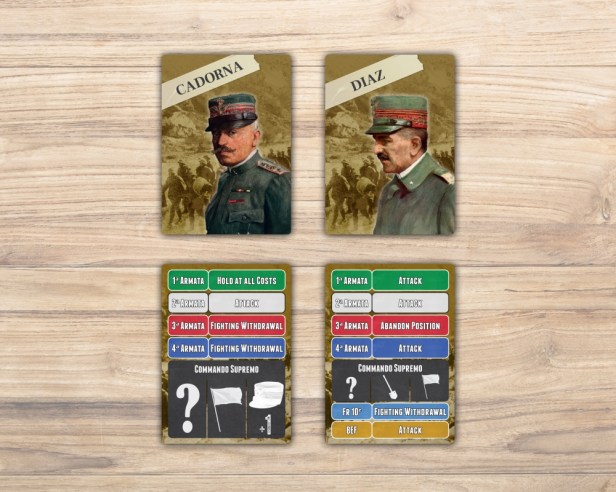
In the case of the Command Supremo Chit, a card is drawn and the player references the Command Supremo entries. These span a myriad of possible actions – resolving an Allied Event, building trenches along the Piave River, Rallying of army units, and/or checking for the dismissal of Cadorna (if he has not already been sacked).
Grant: How is victory achieved?
Hermann: With great difficulty! 😊 The player scores Victory Points during play, which are recorded on the Victory Point Track. You get points for eliminating (decimating) Allied units, capturing Piave River and City spaces, and every turn you earn VP for how many total spaces in Italy that you control. So, for the player, the onus is on advancing, capturing territory, and eliminating units. Pretty straight forward but getting to the Piave River line (which was the line on which the Italians planned their final stand) is critical. The total VP you score is then matched on a chart to see how well you did compared to the historical result.
Grant: What type of experience does the game create for the players?
Hermann: Well ultimately, one of frustration and tough decisions! 😊 This design has an element of “push-your-luck” in it, as the Central Powers forces are more challenged the greater success they achieve, and this is what actually happened during the campaign. Therefore, the player will constantly be balancing the most efficient ways to advance and attack while also keeping an eye on the growing resistance being created and the threat of the Germans giving up on the campaign and heading off to the Western Front.
Grant: What are you most pleased about with the design?
Hermann: I think – I hope – that I’ve managed to capture the essence of this campaign’s drama from a historical context and translated that into a fun game-playing experience as well. The design does follow my general design philosophy of never exactly duplicating any of my previous designs but rather interject new mechanics and tweaks around the core of a tried-and-true operating system. As a solo game, it should be constantly nail-baiting for the player and yes, it should cause constant anxiety! Each turn in this game will be a persistent test of the player’s judgement, patience, and risk-taking tolerance and if I can keep the player on edge in a game decision-making sense while also providing a satisfying historical experience and simulation, then the design has achieved its goal. And I feel that this game does that.

Grant: Here comes the big final questions. What other designs are you currently working on?
Hermann: Wow – you always ask me this question and the list never gets shorter! 😊
OK…coming out at about the time this interview publishes will be The Rock of Chickamauga by Flying Pig Games and Miracle at Dunkerque by Legion Wargames. Also, the fourth printing (!) of A Most Fearful Sacrifice should be out with some new content as well.
The big news for me is that I got back the rights to Dawn of the Zeds and I will be re-visiting that game design, updating it, and adding some new stuff. Blue Panther will publish Dawn of the Zeds – Designer’s Edition” hopefully later this year. This will bring the game back to the accessibility and footprint of the 2nd Edition, but I’m re-working the combat mechanics (which will be a lot simpler now using custom D6 combat dice instead of CRT’s), the cooperative play mode will be much easier, there will be only one rulebook, and so many other smaller fixes and improvements.
Flying Pig Games will be releasing Kill All Fermetians! later this year, which is an updated version of my previous design Volters Lead the Way!. I’m also working with Claude Whalen on the next Black Swan Series game on Antietam.
I am currently working on They March Against Us: Leipzig 1813, which is the first of the Bonaparte’s Sword Series of games for Revolution Games. This is essentially Napoleonic Blind Swords and I’m very excited about its progress.
I submitted a solitaire game on the Battle of Verdun called The Price of Glory to GMT Games and they’ve accepted it for the P500, probably this summer. That game is a crunchier wargame version of my “push-your-luck” game design philosophy and came out really well.
Also, Nuts Publishing has my epic multiplayer cooperative science fiction design called Nemto, which is the name of the planet that you will be invading. I designed a framework story for the game, which consists of multiple scenarios and a full-on campaign. Nuts Publishing has hired a fiction writer and an artist to flesh out the storyline more broadly and with more detail. This will be a truly wonderful game production with a space-opera feel to it and I look forward to its release hopefully by the end of the year.
Ryan Heilman and I have submitted a game called Alpha Zeds to Pungo Games (Worthington Publishing) which is a solitaire/cooperative zombie game where you play as the zombie leaders (the Alpha Zeds) leading a massive horde of zombies against a city. [Editor’s Note: We played this one at Buckeye Game Fest 2024 and had a blast with it!]
And speaking of Ryan Heilman and his compatriot Wes Crawford, they gave me the honor of designing the first game for their new game company Wharf Rat Games. This will be called A Forlorn Hope and is a WWI trench assault game that is basically the game I meant to design back in 2011 that then morphed into In Magnificent Style. It has multiple scenarios, each based on actual trench battles that occurred throughout World War I and each with its own twists and turns. The game should be ready before the end of the year.
And finally, the expansion for The Plum Island Horror is coming out this summer, called More of a Bad Thing, and this will add tons of new content to the original game, including a harder Alarming Mode and some shorter scenarios that each tell unique stories. Later this year, I will also start putting together a design that GMT asked me to do that is essentially Plum Island Horror Express, which uses the same design ideas as the original game but boiled down to a smaller, tighter, 90-minute experience. That will be a challenge but also sounds like so much fun.
Is that enough? 😊
Thanks again for letting me do this interview! You guys are awesome and thanks for all you do for the hobby.
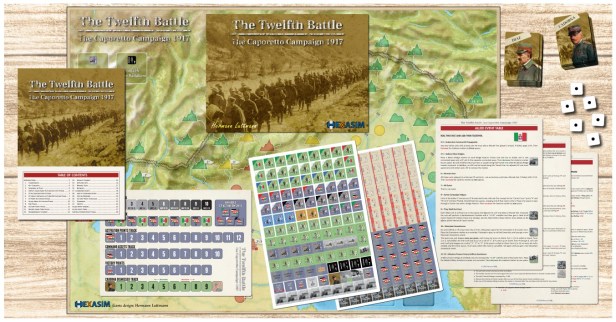
As always it was a pleasure speaking with you Hermann. I am very excited about this one as it sounds very interesting and is also a unique gaming subject. I am looking forward to meeting up at Buckeye Game Fest at the end of April to talk and play some games!
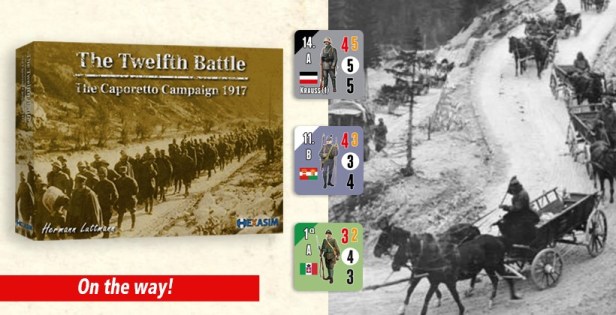
If you are interested in The Twelfth Battle: – The Caporetto Campaign 1917, you can pre-order a copy for 45.00 € ($47.00 in US Dollars) from the Hexasim website at the following link: https://www.hexasim.com/en/4166-The-Twelfth-Battle-The-Caporetto-Campaign-1917.html
-Grant


Great Interview! The game looks interesting, i am going to look deeper into it! Thank you for Sharing.
LikeLiked by 1 person
Thanks Grant; a Hermann Luttmann game is generally an auto purchase, and this looks to be no different! With all those titles he announced, this sounds like a great year of Luttmann — excited!
Cheers!
LikeLiked by 1 person