
There is nothing quite as exciting as plane to plane fighting referred to as dogfighting in a historical setting! I just love the tension and the way that games model this is typically through the use of cards. Alexander and I have really enjoyed playing games focused on the air war during World War II and have played many games on the subject including Wing Leader: Supremacy, A Wing and a Prayer, Target for Today and Bomber Command amongst others. These games all use a system designed to mimic the rigors of aerial combat in World War II by providing each player with a deck of cards from which they draw and then play those cards to take actions. I say all of these games but the first game on this list is a bit different in the way it uses its cards. These cards include attack and defense cards as well as reaction cards that allow players to maneuver their aircraft away from enemy attacks and gain favorable position to take better shots. In this entry in the Best 3 Games with Series, I want to take a look at some games that focus on the Air War!
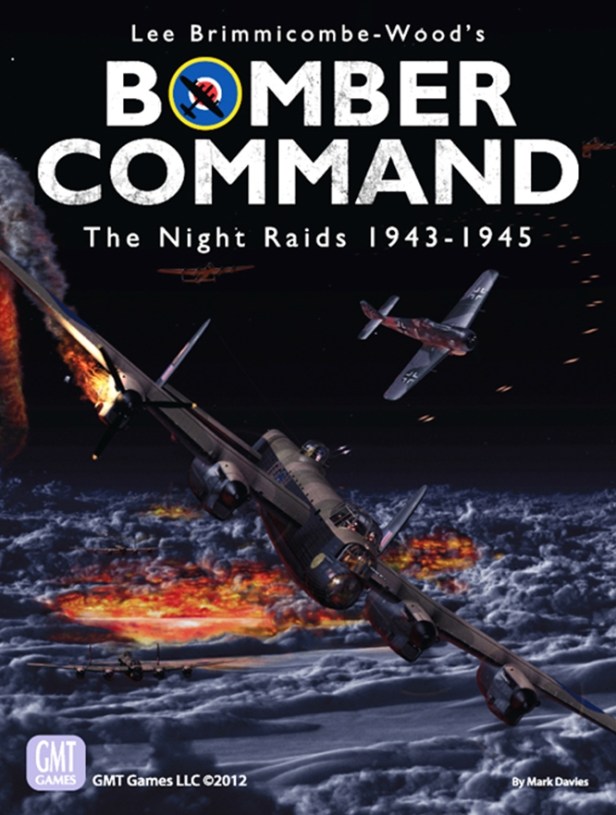
3. Bomber Command: The Night Raids 1943-1945 from GMT Games
Bomber Command: The Night Raids 1943-1945 is a game of the night war in the skies over the Reich during World War II. The game recreates the great RAF bombing raids against the heart of Germany and the defense of the German Luftwaffe’s night fighter arm. This game is a follow up effort to Nightfighter (2011) by GMT Games. Based on an air combat system derived from the award-winning Downtown and The Burning Blue ‘raid-scale’ games, Bomber Command details the tactics of night fighting.
The game is designed for 2 players, with one player controlling the RAF and the other playing the Germans in their desperate attempt to protect the Reich and its industrial heartland. Strategic bombing during World War II began in September 1939 when Germany invaded Poland and the Luftwaffe began bombing cities and the civilian population in Poland in an indiscriminate aerial bombardment campaign. As the war continued to expand, bombing by both the Axis and the Allies increased significantly. In September 1940, the Luftwaffe began targeting British cities in what became known as The Blitz. This game really focuses on the planning and execution of your bombing runs on industrial centers but does have a good bit of card play that is focused on intercepting the bombers as they make their way to their target.
The setup and target selection of the game is very interesting but a bit stressful. You wouldn’t think that it would be but this game, like many of the other well designed World War II games by GMT Games, does cause you to immerse yourself in the moment and actually causes anxiety. I have enough anxiety and stress in my real life but this is different, this is good anxiety and stress as it allows me to get away from my life for a few hours! Making the long trip to bombing targets is also fraught with dangers as the Allied player will have to fight off intercepting German fighters and survive AAA fire as well taking hits, losing and injuring key crew members, but the real payoff for the game, and really the part that made me pause for a moment and think, was that of the bombing run routine.

But, before we go into that, there are really devious choices at the start of the game as you are trying to chose your loadout including High Explosive and Incendiaries. One of the goals of the bombing run is to do the maximum amount of damage to military targets such as shipping, manufacturing and industries. But, the use of Incendiaries can cause a fire storm that might end up burning down targets adjacent if you miss your target slightly so it is important to use a mix of both. The really tough part here is that the bombs can fall onto residential areas as well, due to damage to the bomber, high winds or other factors from cards, so you can never be sure you are only hitting military targets.

As you can see in the picture above, when bombs are dropped they can drift and end up landing in residential areas which include housing, schools, churches and the like. This is really where the feels start to take over as I considered what I was doing and it bothered me. Normally in a wargame, I am going against combatants who are trained military operators but in Bomber Command you are targeting civilians, either intentionally or unintentionally, and the damage caused by your actions can be catastrophic to these people. Remember, the average German resident was not necessarily the hardened Nazi scum who caused so much loss of life but were husbands, wives, fathers, mothers and even children but they suffered from the war just as much as the soldiers did and many lost their lives. The game was sobering when I thought about it in those terms and I know that this was one of the reasons that the Allies called off the type of total bombing that created the Hamburg firestorm and basically leveled the city.

Bomber Command is a great game, partly because of the hidden movement, the mission planning and the tension of the journey to target locations but also because it makes you think about what it is that is being done. Anytime a game can make me stop and think, I consider that a pretty special thing. We will play Bomber Command at any opportunity and it is a very special Air War game.

2. Down in Flames: Locked-On from Dan Verssen Games
Down in Flames: Locked-On (or as I like to refer to it Down in Flames: Top Gun) brings the Down in Flames System to the jet age, by adding deadly tone seeking missile combat, afterburners and range. With the advent of jets, the headliness of the game ratchets up as the “one hit one kill” sudden death nature of modern combat and brings a new feel to a beloved and fantastic game that is very different than earlier versions of Down in Flames!
The general mechanics of the system are still there, with the use of cards to maneuver into position and to bring your guns and missiles to bear on your target, with the same counter play of cards to get you out of trouble, but the element of range has now been introduced which was a challenge at first to get my head around, but more on that later.
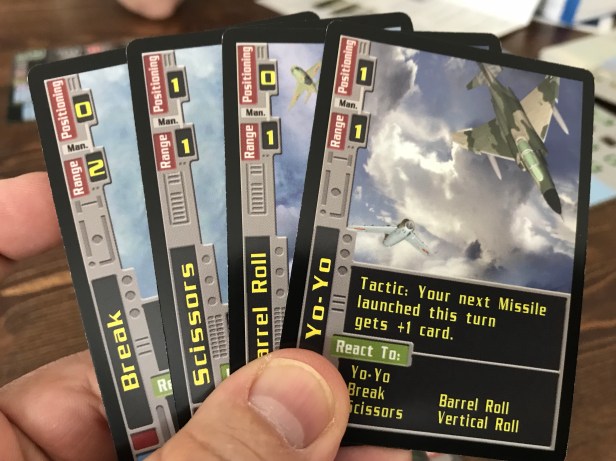
Down in Flames: Locked-On offers aircraft from the very end of World War II, from the Korean War through to modern times and the most advanced fighter jet ever made the F-22 Raptor. Other aircraft include the Harrier, Phantom, Tomcat, Eagle, Fighting Falcon, Hornet, MiG-21, MiG-23, MiG-29, Corsair II, Intruder, Aardvark, Su-22, and many more. All of these advanced aircraft have upgraded systems including the best Performance Ratings ever seen in a DiF product, with Afterburners and Missiles.
The game now provides these very cool Aircraft Display Cards that help players keep their information in one space and all nice and tidy. This card tracks your available missiles, your altitude, relative range to your target and also tracks your counter measures and Afterburners. These cards are not necessary to play but definitely improve the overall function of the DiF experience.

Locked-On uses a relative range system. This measures how far an Aircraft is from the center of the combat air space. When determining the Range between two Aircraft, use the Range of the Aircraft at the longest Range, then add 1 to the Range for each level of Altitude separation. As compared to other DiF games, a difference in elevation doesn’t eliminate the option for engaging your enemy but simply makes it harder to use certain weapons. I liked this change although it took me a few moments to get my mind wrapped around it.
As you can see in the chart below, the ranges have letter codes for each, starting wtih the closest range being a G for Guns and the farthest being AH or Active Homing. Any Range beyond Active Homing is considered to be Active Homing.

Each of a jets Missiles and guns are only effective at a certain Range and these Ranges are color coded. There are 4 Ranges in the game. From closest to farthest, they are: Gun (G) which is yellow, Heat Seeking (HS) which is red, Radar Homing (RH) which is black and Active Homing (AH) which is green.
All Aircraft begin at Active Homing Range and must close to within Range of the weapon they wish to fire at their enemies. How do you close Range? You have to play a card for the Range section in the upper left corner and your enemy can try to evade you by any laying a counter card. If your card is successful, you simply move up that many Range increments and can then fire a Missile if you are within its Range. The Range part of the game was a little hard to fathom at first but once you get it down, it won’t be a problem.
Down in Flames uses a card system where players play certain Action cards that can then be countered by their target to evade them. You initiate an action during your turn by playing an Action card. The opposing player can respond by playing an Action card in Reaction to yours, if the title of your Action card appears in their Action card’s React To: area.
For example, if you are trying to gain an advantage over your opponent and you play the following Scissors card for the Positioning portion of the Card in the upper left hand corner, in order to get away from you and avoid being Disadvantaged, your opponent must play a card in Reaction that has the title of your played Scissors Card to get away.
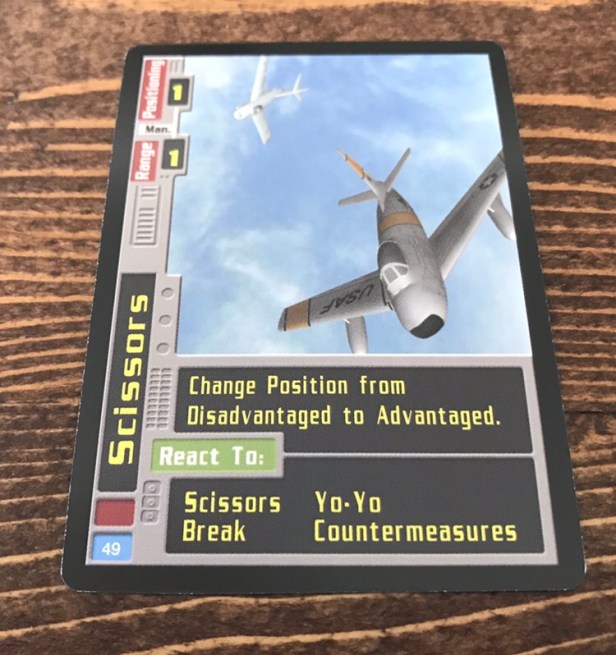
There are many cards that can be played including Scissors, Barrel Roll or an Ace Pilot Card which counters all cards. If he can play a counter card, you then have the choice to play another card that will counter his chosen played card and so on and so forth. This can go on for a while until either they cannot counter your played card, you can’t counter their played card or either of you decide to give up the Chase. There is great strategy in this game about knowing the cards and when to push your luck and continue the chase and when to give up. Card management is key to victory and you must make sure you hold Attack cards, counter cards as well as some trump cards to get you out of really sticky situations. I love this game and have had a blast with it!
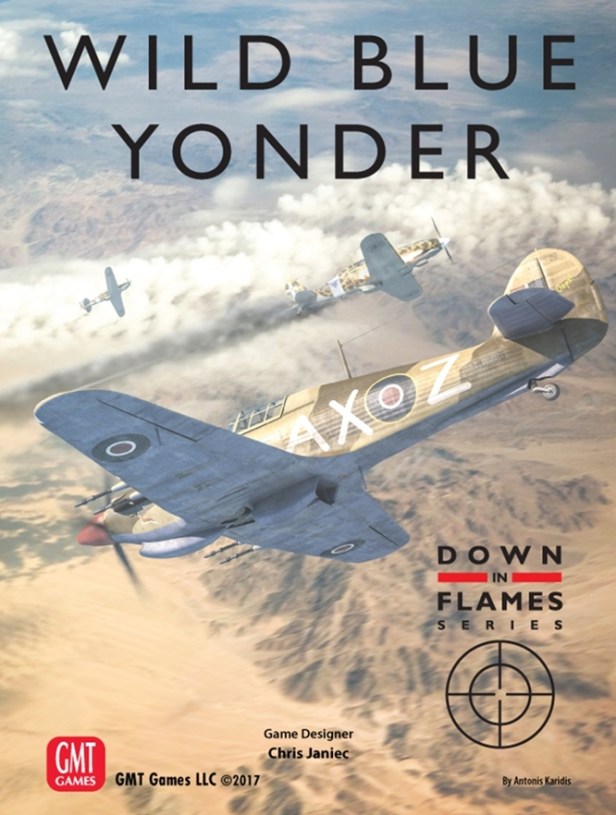
1. Wild Blue Yonder from GMT Games
Wild Blue Yonder: The Air War in Europe, 1940-1944 from GMT Games is an amalgamation of several classic World War II aerial combat games released over the past 20+ years in the Down in Flames Series. Starting with Rise of the Luftwaffe in 1993, followed by Eight Air Force: The Air War over Europe, 1942-1945 in 1995, Zero!: The Rise and Fall of the Imperial Japanese Air Force in 2001 and Corsairs and Hellcats: WWII Air Combat in the Pacific Theatre, 1942-1945 in 2003 along with a host of other aircraft packs and inserts in C3i Magazine, this series has been beloved for awhile. But, the early games were all out of print and there was definitely interest in players getting their hands on copies. So, with that in mind, GMT decided to not simply reprint the early editions but somehow synthesize the games down into what was best and not just reprint them but make them deluxe by adding several other options including campaigns.
The game is played as players control an “Element” consisting of two aircraft, a Leader plus his Wingman. These aircraft are fighters and we all know what the role of fighters is – to simply shoot down enemy aircraft. Players have total control over the Leader with the cards that they are allowed to draw and keep in their hand but less control over the Wingman as they will draw a temporary mini-hand whenever it attacks or is attacked.
There is no board with Wild Blue Yonder, as cards are simply laid out on the table facing each other and two mechanisms are used to represent the spatial relationship between aircraft. First is Altitude. At the beginning of the game, each player will take an Altitude counter of their choosing to reveal simultaneously to identify their starting altitude. If aircraft are at differing Altitudes, an Attack card cannot be played until they are at the same level. This can be accomplished by the active player simply adjusting their Altitude at the start of their turn. This will however have a cost, or even a possible benefit. In order to adjust your Altitude up one level, you must discard a card. If you are adjusting down, you will pick up an extra card. Once the opposing aircraft are at the same level, then an Attack card can be played but we will cover that in the second Action Point in this series.
The second mechanism used to represent this spatial relationship ballet between the two enemies is Position. There are three types of Position that players will need to focus on and remember including Unengaged, Engaged (including both Advantaged and Disadvantaged) and Engaged (Tailed).

The difference in these types is important as it will determine the number of Bursts that you can fire at your enemy. During the Unengaged Position no aircraft has an advantage and they can fire only the number of Bursts identified on their Aircraft card. When you are Advantaged, you can fire an additional Burst in addition to your printed Burst level. When you are Tailing an enemy aircraft, you can fire an additional three Bursts in addition to your printed Burst level. Also if you are Tailed or Disadvantaged you cannot fire upon your enemy with your Leader unless you have a Rear Gunner. You Wingman can have a different Position than your Leader and will also have to pay attention to their advantages and disadvantages.
So that you understand why Bursts are important, I will show you a few cards.

You will notice that these two cards share the same name, In My Sights, but are very different cards. Notice on the left side the number of Bursts that are printed on the card. The front most card only has 1 Burst printed, which means that this card can be played as one of your available Bursts. The back most card requires 2 Bursts to play. If you don’t have 2 Bursts available, this card cannot be used. You will also notice that the lower the Bursts required usually equates to less Hits. 1 Burst equates to only 1 Hit while 2 Bursts equals 2 Hits. This is why Position is important.
The great thing about Position and being Advantaged or Tailing is that you will be able to play more Attack cards. If you have 4 Attack cards in your hand, that require a total of 4 Bursts to play, you will only be able to play all of them if you are Tailing your enemy and have 1 printed Burst on your Aircraft card. That is the key to the game. Managing your hand to make sure you can play the cards you want to when you can. I really enjoyed the dogfighting in Wild Blue Yonder and the back and forth, counter vs. counter nature of the design. My only concern with the game is that it is a card game and sometimes the cards are just not in your favor. If you don’t have a favorable draw, then there is not much you can do for that turn. You will simply have to discard cards and hope to draw better cards to replace what you have thrown away. I really liked the Hand Management aspect of the game as well as you want to make sure you have a good balance of Attack cards and Response cards, including cards that can give you Advantage by changing your Altitude or your Position as this will give you more Bursts and the ability to play more Attack cards during your turn. I always feel better when I have at least one Ace Pilot Response card in my hand as it will get me out of any jam. Just a very tense and fun quick playing game on the Air War!
Alexander wrote a review which you can read here: “68 Gallons Fortis Leader” – A Review of Wild Blue Yonder from GMT Games
Please share with me your favorite games on the Air War. Thanks for reading.
-Grant


Interesting, none of the DVG “leader” games…is that because the rules are so terrible?
LikeLiked by 1 person
No. I really wanted to focus on air combat. I know that sounds weird. I love the Leader Series but just think these hit better with me.
LikeLike
I have all Wing Leader games. Fantastic story telling scenarios with bombing missions and dogfights with a unique view.
No longer turning endless inner circles, but an operational system with Flights and Squadrons instead of individual planes.
I combine some of its ship attack scenarios with Atlantic Chase to view the fights from different angles. Huge fun!
The designer of Wing Leader is a bit of a Xxx, but the system is fabulous for both solo play (bombers normally fly on a fixed route) and crazy 2 player fun.
LikeLiked by 1 person
We have enjoyed Wing Leader but I don’t love it. Does that make sense?
LikeLike
Before I played Skies Above Britain, I read the Battle for Britain (James Holland) – it was fantastic and really set the stage for what the early war aerial fights were like for the pilots.
When I started playing the game, I found that (more or less) there were VERY BRIEF engagements and as often as not, you simply lost contact with your squad and the enemy.
Had I not read the book first, I think I would have been very disappointed in the game. Instead, I found that the game was an incredible recreation of how frustrating things were for the pilots – no radar, a couple of gun bursts and then trying to figure out where they were so they could get home.
LikeLiked by 1 person
An interesting selection of games.
However, I go back to Avalon Hill’s
Flight Leader: Air-to-Air Jet Combat Tactics 1950 – Present [i.e. 1986].
This is a hex and counter game featuring engagements with aircraft from the US, UN, Russia, China, North Korea, Israel and Lebanon. I believe there was 200 aircraft counters. The mapboard depicted the ground from several thousand feet (and had overlays for clouds).
It’s meticulous detail put you in the cockpit through basic and advanced rules. Following it’s publication, the designer, Gary C. Morgan, penned an article for AH’s The General magazine (Vol. 23 #1) on Basic Fighting Maneuvers for fledging “pilots” and, as a bonus, contained two additional Top Gunn scenarios: Never Leave a Wingman – the Miramar engagement and, of course, “Maverick” to the Rescue – the movie’s last combat.
LikeLiked by 1 person
Rich I’ll back you on AH’s Flight Leader, it was a good game and still is. Grant if you want cards in the game pick up a copy of AH’s Knights of the Air, it uses cards to plan the maneuvers of the plane. There is a solitaire scenario where you’re in a single Sopwith Camel trying to take out a Zeppelin. The map is also absolutely gorgeous. Ah the good old days of flight, when if your guns jammed you could pull out your pistol and have a go.
LikeLiked by 1 person
Although I like your 3 games and own two of them, I find them somewhat abstract in their approach to air warfare Grant. Granted, it makes them easier to learn, teach, and execute, but to get the real “stick and rudder” feel of air combat (trading altitude for airspeed, cornering at the best airspeed, and wingman tactics) I would have to go with my 3 favs: Canvas Eagles (WW I), Flight Leader (WW II as mentioned by Rich above), and for something a bit easier Wings of War (Wings of Glory) both WW I and WW II. The first two are hex and counter and the last is miniatures based, all well established in their field. I try and stay away from the really complex monsters like Air War: Modern Air Combat and Foxbat vs Phantom (a bit easier) because they just take too long to do a 5 second real-time turn and you get thrown out of the immersion of being in a cockpit with your hair on fire.
I started way back in the day with Richthofen’s War and never looked back. 🙂
Keep the greasy side down!
LikeLiked by 1 person