Several years ago, Sergio Schiavi broke onto the scene with his new company called Dissimula Edizioni with their first Kickstarter called Radetsky’s March: The Hundred Hours Campaign and that game was then followed a few years later by From Salerno to Rome: World War II – The Italian Campaign, 1943-1944 and their third game called Give Us Victories: The Chancellorsville Campaign. They are a solid publisher and have really made some fantastic games. In 2023, they launched a new Kickstarter for a small box introductory wargame that truly looked unique and interesting called The Soft Underbelly: 1943-1945 that covers the Allied invasion of Italy during World War II. I ordered the game and we played it recently and I was totally blown away by the tactical depth and crisp mechanics that created a very engaging and interesting game on this subject. I want to share my First Impression thoughts on the design and give you a good idea about how the game plays.

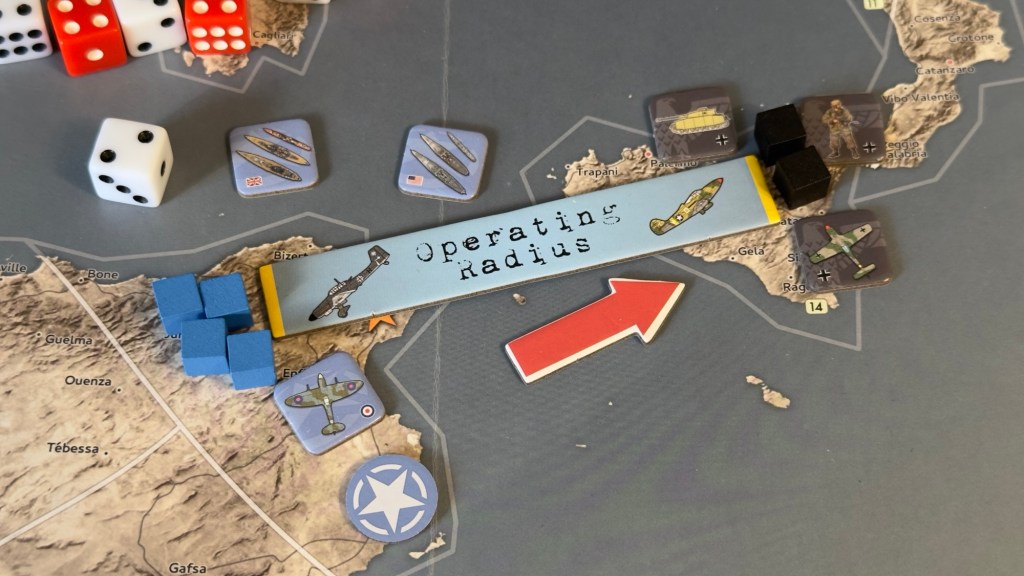
First off, I would like to talk about the production of this game. The price point offered on Kickstarter was very affordable at €29 ($30 US Dollars), as you would expect from a small box wargame, but the production and product inside that box was really very well done and took me quite a bit by surprise. Sergio is a great designer but also is an artist and does amazing work with his maps in his other games. This one is no exception as the board itself is just great to look at! The board is zoned and players will move from bordering zones to connected zones. The game pieces include counters, which are very well done, and use silhouettes of vehicles and men as the unit identifier. The generic units, which include infantry, are represented by wooden cubes; black for the Nazis and Italians and blue for the Allies (British and Americans). The game also has fantastic little red cardboard arrows that are used by the players to identify attacks into an area from adjacent areas. These interesting markers give the players a real sense of being the overall theater commander gaming out the invasion as the action moves from North Africa to Sicily and then onto the mainland of Italy and through to the north and southern Germany.
Finally, the turn record track is very well done and clear graphically and there is a player aid that provides a look at a further explanation of the special Events that each side has access to. This was one of the best parts of the game and really made the player consider how best to use their limited access to these Events as the game progressed.

Now a little about the game. The Soft Underbelly: 1943-1945 is somewhat of an abstract strategy game about the Allied Italian campaign in 1943 during World War II that plays in about an hour. The game deals with the second part of the war in the Mediterranean, that period which starts from the operations in Tunisia and reaches the Italian campaign and the landings in southern France from 1943-1945. The game uses some counters but also uses cubes and other more Euro focused elements and really gave us a feeling of the Combat Rations Series from Nuts! Publishing with games like 300: Earth & Water and Port Arthur as well as an as of yet unreleased game called Guerre Eclair that we had a chance to play while attending SDHistCon this past November. Even though it is a bit abstract and uses wooden bits, the game is very well done and creates some interesting opportunities to try some new strategies out but with plausibility all while having a bit of fun! This is a completely new system created by Sergio and is truly simple yet not simplistic. The players have to consider how they utilize their forces and must maintain a combined arms stance to ensure better results as there are bonuses in combat when infantry, tanks and planes attack together.
I mentioned that the game is simple and is designed as an introductory wargame. As such, the rules have a total of 8 pages and the game can be setup and readied to go in very short order. Our only real problem with the game was that the rules were not totally clear. There were times we had to talk our way through them to gain a greater understanding but that is really just a minor problem as the game is not that complex. I say that but there are plenty of things to consider and think about as you plan out and take your moves and attacks. There is quite a bit of flexibility for the Axis at the start as they can deploy their pieces wherever they desire in the initial set up phase. For the Allied player, they begin the game only with a few forces in North Africa. Their initial moves and attacks are pretty much decided as they have to clear North Africa to setup their attempted amphibious landings on Italy or in Southern France.

Also keep in mind that the Allies have a numerical superiority as they will gain 4 Reinforcement Cubes each round from the 1943 Spring Turn through the 1943-1944 Fall/Winter Turn and thereafter will receive 3 reinforcements from the 1944 Spring Turn through the 1944-1945 Fall/Winter Turn and will still receive 1 reinforcement in the final turn of the game. The Axis only receive 3 Reinforcement Cubes in the 1943 Spring Turn and then this drops to just 2 from 1943 Summer through 1944 Summer when it changes to just 1 in 1944-45 Fall/Winter and then drops to zero in 1945 Spring. This means that the Allies will receive a total of 23 Reinforcement Cubes as compared to just 12 for the Axis. Each side must keep this in mind and take their turns knowing what and where they should risk forces. You only get what you get and there are costs to replacing the different units that mean you will have to give up some Reinforcement Cubes to pay the cost of building a new tank, plane or special unit such as Airborne troops.

The Reinforcement Cubes enter at the beginning of each game round or when particular events are played and they enter player-controlled areas and are immediately operational meaning that they can move and fight or be converted into the Specialized Units. The Specialized Units common to both armies are tanks and aircraft; they have different conversion costs: the Axis pays a lot for both tanks (2 cubes) and planes (3 cubes) while the Allies instead pay only one cube for both. Then there are other particular units, elite for the Axis and Airborne for the Allies, each with different game effects. There are also fleets and U-boats but they are already in play and if they leave for particular reasons (Overlord, fall of Italy) they never return.

The game mechanics and play are very simple meaning that the general mechanics are pretty standard stuff including movement and combat. The game is divided into a total of 8 rounds with each round including 4 total impulses. These impulses alternate so each player will get 2 actions per game Turn. Players will move their and then attack. The combat mechanic is very simple: at the end of the movement phase, players will place one of the 3 red attack arrows and start rolling the dice, one die for each attacking cube. If a 6 is rolled then 1 loss is inflicted on the enemy. If tanks also participate in the attack, the result for hitting drops to 5; and if there are also planes involved it drops to 4. Brutal but effective and truly mimics history here as no general will attack when they don’t have armor and air support. The concept here is the benefit of combined arms and players want to plan out their reinforcements and attacking forces to ensure they have this lower to hit number for every single attack. There is a maximum of 4 dice per attack. Never attack without adequate air cover! I say that but as the game moves along and each side is losing their units and don’t have the ability to recover them sometimes you will have to just bite the bullet and go for it, whether you are hitting on a 4, 5 or 6. Trust the dice here as it is really your only hope. In fact, a wise man has said “you will lose every battle you don’t fight!” – General Montgomery maybe.

One other pretty important aspect of the game, has a call back to miniatures gaming with the use of a ruler that provides the effective operating radius for aircraft. The rules on planes are very particular: they can be used both to support land combat and to bomb or intercept enemy transports. Their operating range is given by using a ruler that measures the maximum engagement distance called their Operating Radius. There are 2 rulers included. One is used by both from the start and is the shorter of the 2. But, after 1944 onwards, the Allies use the longer ruler while the Axis still use the shorter ruler. I like this part of the game as it is a bit fun, measuring out your Operating Radius while keeping it light and fun. Similar to miniatures games, you are not necessarily precisely measuring but more of an eye test.
I mentioned earlier that the best part of the game is the Events. The Events in the game are very different than you might expect and are more special actions that each side can use to do specific things. These include things like the arrival of reinforcements, taking an immediate additional impulse (which allows you to extend the turn), stopping a battle (especially helpful for the defending Axis player), partisans which siphon off defending forces from a space making them easier to attack and the like. Each side has a specific number of Event Markers and the player will get to decide where to place them on the special Event Track to trigger that specific type of event. Each of the Events identifies how many times that can be used during the game and once that number of Event Markers are placed there, that means the Event is no longer available so use them wisely. Oh wait, the Axis has a special unique Event that allows them to remove an already placed Event Marker and take that Event again. Really diabolical stuff that! These Events can be done at anytime and really are at the heart of the operational game as players have to use them wisely to benefit their advance or to foil the efforts of their opponent. I like that these are very asymmetric for each side and unique and this really added the concept of resource management in areas of not just the number and type of troops that other wargames typically focus on.

When the United States entered World War II, Winston Churchill said “Now at this very moment I knew that the United States was in the war, up to the neck and in to the death. So we had won after all!…How long the war would last or in what fashion it would end no man could tell, nor did I at this moment care…We should not be wiped out. Our history would not come to an end…Hitler’s fate was sealed. Mussolini’s fate was sealed. As for the Japanese, they would be ground to a powder. All the rest was merely the proper application of overwhelming force.”
I think that the game takes this quote to heart and really creates an interesting experience for the players. As the Allies, you must not make mistakes. If the Allies plan every move, trying to occupy areas in order to be able to property deploy their forces and have gone through the process of figuring out when the best time to launch a landing is and where to place planes, how to exploit a successful attack, the Allies should win a majority of the time. This is not to say that this is a no win chance for the Axis. If the the Axis properly and smartly use their counterattacks, understand which areas can be vacated and at what time and in which areas to really put up a spirited defense, they can win. Dice can also be very fickle and even a well planned out attack can end in defeat. All of this planning and daring and risk taking create a very interesting gaming experience…and all this in less than an hour! This one is a really fast playing game. Part of that reason is that the game is very small, has a small number of areas where attacks can take place and also has a limited number of Replacement Cubes but it all works together really well. The tension is very high until the end and there is always doubt or hope in the outcome of any of the battles. The good news here is that Sergio is working on a few follow-up games using the system including one on the Korean War and the other on the Yugoslavia and Greece campaign in 1941.

I hope that you have an opportunity to get this great little game and give it a try. We both thoroughly enjoyed it and definitely will be keeping this one in the collection.
If you are interested in The Soft Underbelly: 1943-1945, you can order a copy from the Dissimula Edizioni website at the following link: https://www.dsimula.com/1943
-Grant
 The Players' Aid