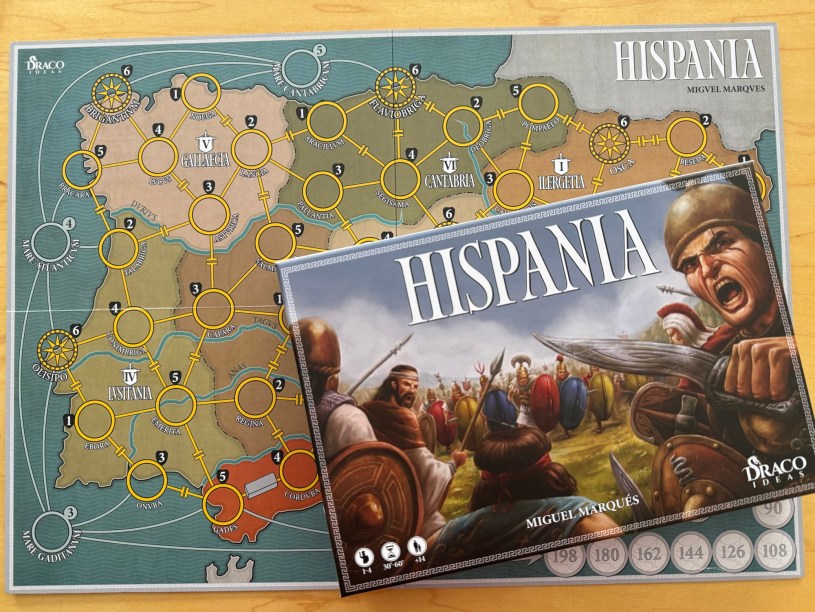
HISPANIA from Draco Ideas is a slick little small box game with a big punch that sees the player controlling the Roman Empire and attempting to subjugate and put down resistance in the provinces of Hispania from 198 to 18BC. The game is extremely flexible and may be played cooperatively by 2-3 players, competitively with 4 players or as a solo game. The game is somewhat of a resource management game as the players must use their limited funds in the form of Denarii wisely to attack and put down revolts springing up around the country as local armies rally support for the resistance to Roman rule.
In this series of Action Points, we will take a look at the Board, discussing the point to point movement and various terrain features that make moving Legions about rather difficult, cover the Roman Phase and the various actions including Move, Garrison, Besiege and Attack, take a look at the Hispanic Phase and how they spread Revolt and move Armies around the board, discuss the way to acquire a Roman Victory and finally discuss some points of strategy to keep in mind.
Board
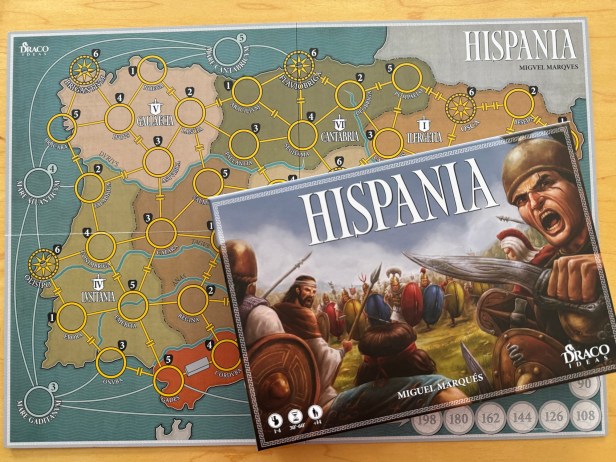
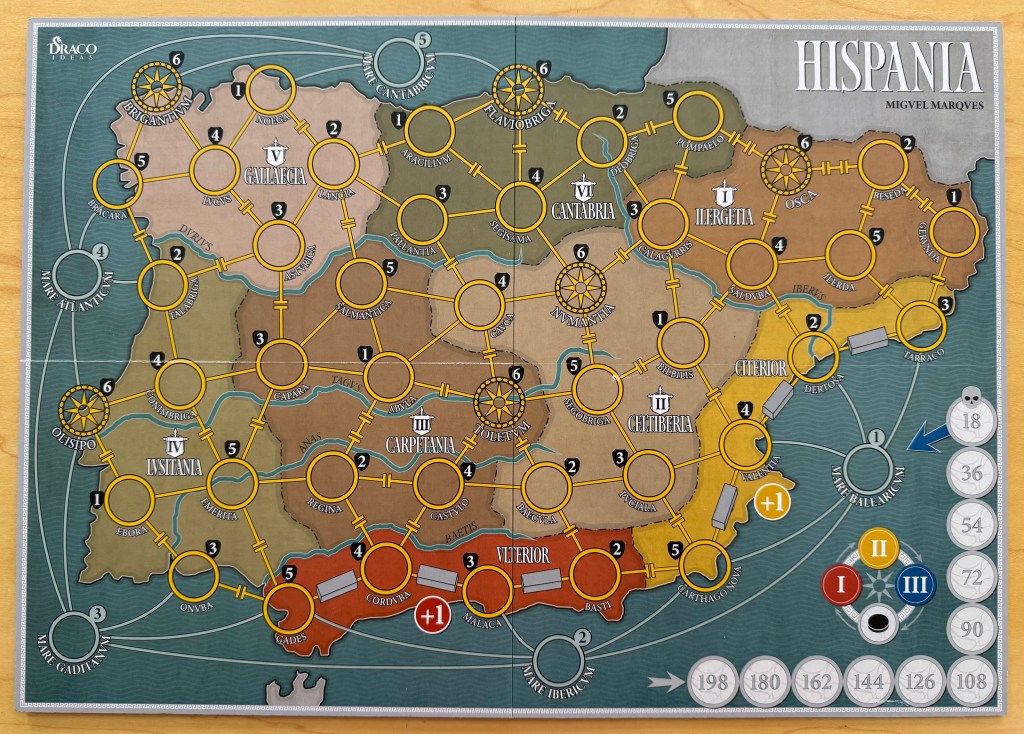
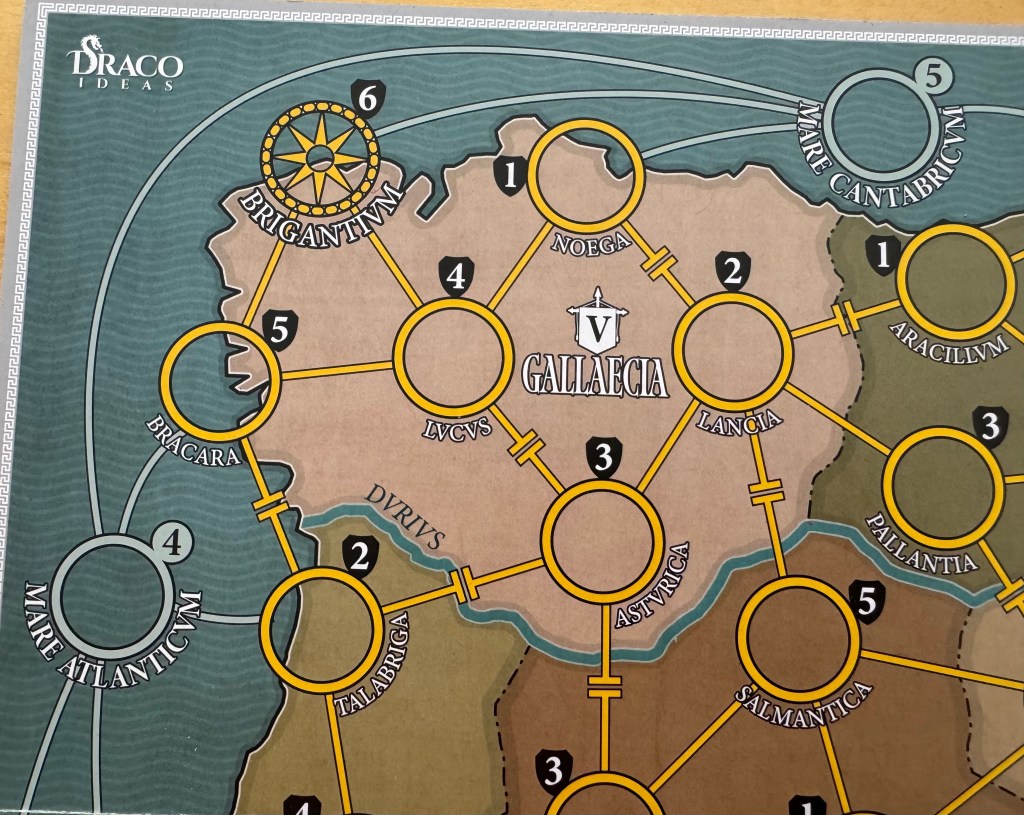
The Board for HISPANIA represents a map of Hispania at the beginning of the 2nd century BC and is really quite stunning. The use of bright and bold colors for the various provinces and then the overlay of the yellow lines for movement from point to point really make the board clear and attractive. The geography of Hispania and the various historical names have been somewhat adapted for playability so the map of the era was changed a bit with some abstractions of the transition between Iberian settlements and Roman cities.
The Board contains 49 different circles, which represent the playable board spaces including 44 cities and 5 seas. Through these spaces, Generals, Fleets and Armies may move and this is where the action takes place. The 44 cities are distributed among 2 Roman Provinces located at the bottom of the Board, Ulterior shown in red and Citerior shown in yellow each with 4 cities and 6 zones occupied by various Hispanic peoples called Provinces including Ulergetia, Celtiberia, Carpetania, Lusitania, Gallaecia and Cantabria each with 6 cities.
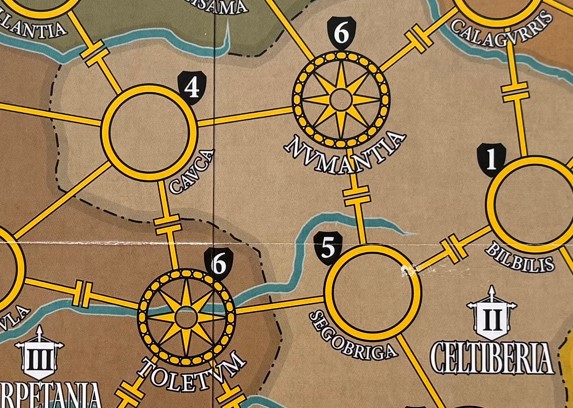
Each of the Provinces shows a Roman numeral in the middle of a white banner, which is used to determine the locations for random Hispanic Revolts at the end of each player turn or a total of 3 times per game turn. Ulergetia is number I, Celtiberia is number II, Carpetania is number III, Lusitania is number IV, Gallaecia is number V and Cantabria is number VI. These Provinces are further delineated by 1 of 6 cities in each whose number can be found in the black shield icon above their circle. Although these Provinces in Hispania did not have formal capitals at the time, the game calls the most important city of each Province the “capital”. These capitals are always denoted by a 6 in the black shield icon. These are further defined with walls around the circle and a star symbol. The capitals are important because the player has to place a Garrison in each of the 6 capital cities by game’s end to achieve a victory.
The numbers in the cities are also important as this represents the target number that the Roman players have to roll in order to successfully Besiege the city and remove any ongoing revolts. The higher the number, the more difficult this task is and the players must appropriately plan to have support in the form of Garrisons placed adjacent to these targets and also other cooperating Roman Praetors adjacent to offer a bonus. It becomes even more challenging when a Hispanic Army takes up residence in one of these spaces and begins spreading the Revolts making the removal that much more work.
The 49 spaces are connected to some of their neighbors by what is referred to as a Link that allows movement between them. These Links have different costs to move across them and represent more challenging terrain such as rivers and mountains and the additional effort and resources needed to cross. Most of the Links consist of just 1 segment, but certain land links have 2 or 3 segments to reflect the difficulty of the terrain as mentioned before such as the Iberus River or the Pyrenees Mountains, both of which are found in the Province of Ilergetia in northeast Hispania. These Links will cost 2 or 3 Denarii to move across and are the most difficult to access spots on the Board. If the player is forced to spend a lot of time and effort in Ilergetia clearing out Revolts, this will hamper their ability to combat the Hispanic uprisings in the other Provinces and can spell doom.
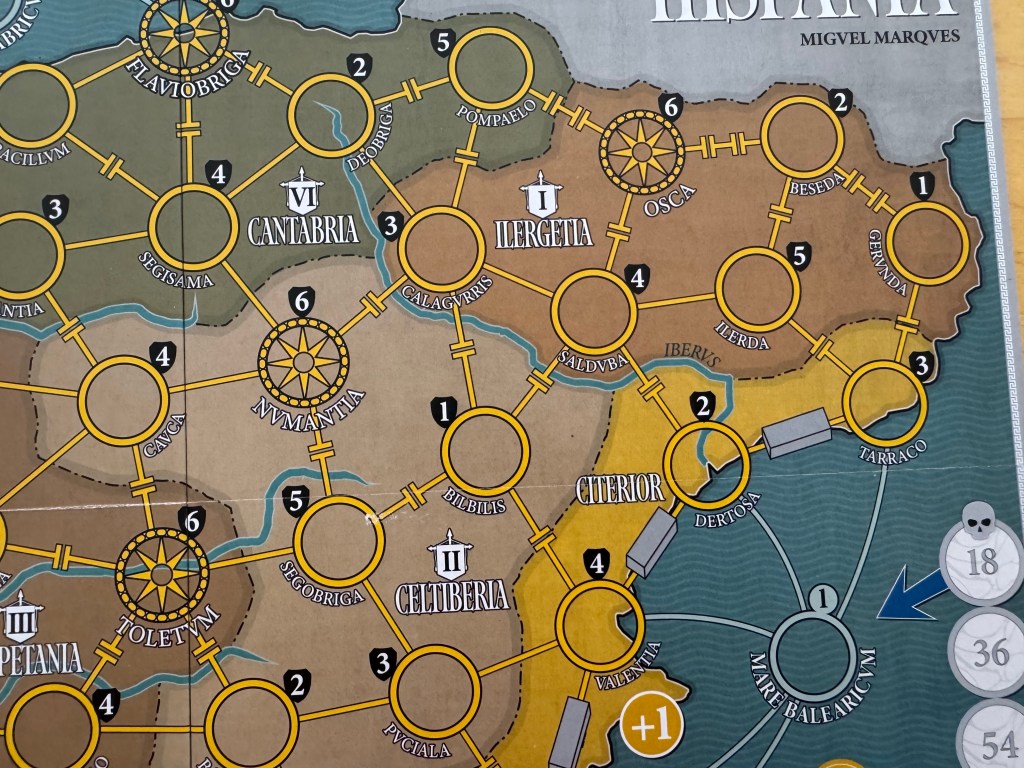
You will also notice that there are road segments (signified by a gray block like line) drawn on the board located in the Roman Provinces of Citerior and Ulterior. These Roads facilitate more efficient Roman movement across the Links and can see the Roman Praetors moving along the entirety of the Mediterranean Coast from east to west with only the cost of a single Denarii if all of the Road segments are connected.
There are sea spaces that can be used by the Praetors to more quickly move around the Iberian Peninsula when Roman Triremes are present in those spaces represented by white discs. The cost to move from one connected sea space to the adjacent sea space is 1 Denarii and is a much quicker means of moving around the peninsula than marching overland having to pay the costs to cross rivers and mountains. The Roman Praetors can also Besiege and Attack from the Ships at sea into any coastal land space.
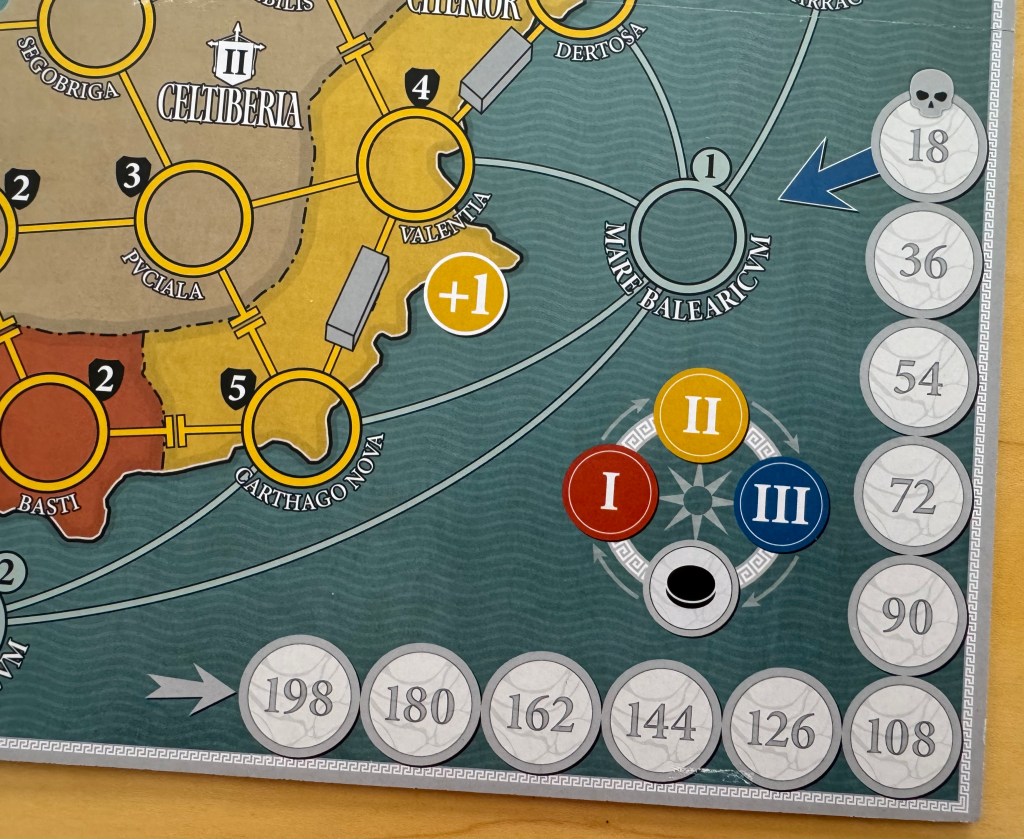
Finally, in the bottom right hand corner of the Board we have 2 administrative game tracks including the Turn Track, which indicates the structure of each round and the Time Track, which begins in 198BC and ends in 18BC and roughly represents the progress of the historical conquest during the last two centuries BC. Each of the spaces on the Time Track represents approximately 18 years. The Turn Track is broken up into 4 spaces and instructs the players which color Praetor acts each round with red going first, yellow second and blue last with the last stage of each round being simply adding a new black Revolt disc from the supply onto the Time Track. Once the last space on the Time Track (18BC) holds a Revolt disc, the game will be over and the Romans fail their mission and lose the game. As you can see the game is just 11 turns long and there is a lot of work that has to be accomplished in this short period of time in order to achieve victory. One final thing about the below picture, the blue arrow is nothing specifically game related but is a thematic inclusion signifying the arrival of the Roman Consul (blue Roman meeple) from Rome to assist the other 2 Praetors in conquering Hispania.
HISPANIA is a very fun and interesting gaming experience and I truly enjoy the mechanics used here. It resembles the first game in the series called Tetrarchia with some new tricks added and various Game Variants that can be tacked on to create a unique and interesting new experience. There also are lots of different combinations of difficulty which will do things such as lower the number of Denarii each Praetor receives each round, increase the number of starting Hispanic Armies on the board or reduce the number of Garrisons each Praetor has access to.
If you are interested, you can check out our interview with the designer Miguel Marqués on the blog at the following link: https://theplayersaid.com/2024/04/12/interview-with-miguel-marques-designer-of-hispania-from-draco-ideas-coming-to-gamefound-soon/
In Action Point 2, we will cover the Roman Phase and the various actions including Move, Garrison, Besiege and Attack.
-Grant
 The Players' Aid
Just started to play this game yesterday; great design as always by Miguel Marques – with some interesting, new twists!
LikeLiked by 1 person
Hi Grant,
This is a great looking game and these Action Points should prove rather useful to me in due course ( see NB below ). I look forward to your future efforts. One small issue I noted ( after a brief scan of your “article” : Re : “The Roman Praetors can also Besiege and Attack from the Ships at sea into any land space”. I think you mean “any coastal land space” here.
NB : Unfortunately, at present, I am still waiting for my game to be sent to me. Dispatching the parcels to / for the UK appears to have been left to last. And mine might well be the very last given the information gleaned to date*. Still, I have plenty of other games to play ( and things to do ), so it’s no great problem ; just so frustrating waiting ( since October ) !
[ * Final parcels should be sent by end of this week ( 10th Jan ), but no email confirmation sent to me to date… ]
LikeLiked by 1 person
You are correct. Into coastal spaces.
LikeLike
“Article” corrected already… Wow !
LikeLiked by 1 person
It took 5 seconds.
LikeLiked by 1 person
Why “luckyenthusiastically68b38b8aba” ?
Retorical…
LikeLiked by 1 person
Or even “Rhetorical” ( my bad ) !
LikeLiked by 1 person
I wish I could edit my posts here ( at all ), let alone that quickly !
LikeLiked by 1 person
Apparently, the last game packages to the UK are now being sent on Friday and Monday. I await my “sent” email with baited breath !
I wonder how long the post will take to get mine to me…
LikeLiked by 1 person