My favorite time of the year is the holidays! Thanksgiving and Christmas are always such a great time with food, family, friends, football and games around the holiday table. Around this time of year I start to put my list together for Christmas Wargames for that special wargamer in your life. I am going to change up the title of this post though as this year, we have secured several participating publishers who have provided us with special discount codes for your use in getting these great games at a better price (we get no kick back or sharing of these sales). I will keep the same format however and I am going to present the list in a few different categories, featuring 3-5 games in each. The categories will include good old fashioned Hex & Counter, Solitaire Only, Card Driven Games and Waro (Hybrid Euro Wargames). I will also throw in a few smaller format games and some wargaming supplies that can be used as stocking stuffers!
One thing that is new this year is that I have worked with 10 different publishers to offer a discount code ranging from 5-40% off the retail price of their great games! Merry Christmas! These publishers include Sound of Drums, Conflict Simulations Limited, Form Square Games, PHALANX, Nuts! Publishing, Capstone Games, Fort Circle Games, The Dietz Foundation, Draco Ideas and Catastrophe Games. We will highlight a few of their games below and then provide the codes for your use. We thank them for their participation and we hope you can take advantage of these deals.
Here are the participating publishers and their codes:
Sound of Drums – TPA2024 for 10% off at their online store (this code will work just one time).
Conflict Simulations Limited – PLAYERSAID for 15% off their online store.
Form Square Games – PLAYERSAID15 for 15% off their only available game (Bonaparte’s Eastern Empire).
PHALANX – 50% off for Iron, Blood, Snow & Mud but also deals on other games at the following link: https://gamefound.com/projects/phalanx/phalanx-store?refcode=HxZEf5aVFE2uFo_-iAMjRw
Nuts! Publishing – TPA20#2024 for 20% off of the following games: Phantom Fury 2nd Edition, Italia, Port Arthur, 300: Earth & Water, I’m Not Afraid, We are Coming, Nineveh!, Stalingrad Roads, Saigon 75 and FITNA only.
Capstone Games – TPA2024 for 30% off of Watergate only.
Fort Circle Games – Votes15 for $15.00 off Votes for Women only.
Draco Ideas – aid20 for 20% off everything on their site.
Catastrophe Games – TPA2024 for 15% off at their online store only on Catastrophe Games items.
Happy shopping!
This year again, we have a sponsor for this post in Sound of Drums, the maker of fantastic (and extremely well produced) wargames such as Battles of Napoleon – Eylau, History of the Ancient Seas Series (I – Hellas, II – Dies Irae and III – Mare Nostrum), 1793 – Patriots & Traitors and more. They have a lot of great games upcoming and we highlighted one of their newest below in the post but they have many others that you should check out. You can follow the link to their site by clicking the below image.

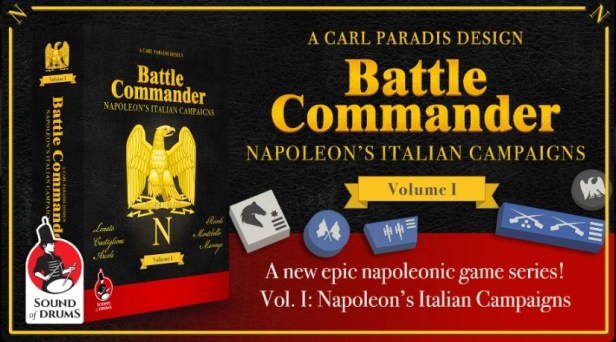
They also have a game currently on Gamefound designed by Carl Paradis called Battle Commander Volume I – Napoleon’s Italian Campaigns. The game is the first in a planned series with the intent to recreate historical 18th-19th century battles. The system features a fresh framework focused on two key aspects: command decision and maximum playability. In Volume I, the player will act as Army Commander in a series of six dramatic Battles fought during Napoleon’s two Italian campaigns. Volume II will cover engagements of the Second and Third Coalitions, including Austerlitz and the Battle of the Pyramids.
We posted an interview with the designer Carl Paradis on the blog and you can read that at the following link: https://theplayersaid.com/2024/07/17/interview-with-carl-paradis-designer-of-battle-commander-volume-i-napoleons-italian-campaigns-from-sound-of-drums-coming-to-gamefound-july-20th/
You can visit the Gamefound page to back the project by clicking the image below.
If you are interested, here are links for the previous year’s editions of this list:
One more thing before we get to the games. If you are looking for something different for your wargamer for Christmas, then check out our The Players’ Aid merchandise available from Spring at the following link: https://the-players-aid.creator-spring.com/?
You can find t-shirts, sweat shirts, coffee mugs, fleece blankets and die cut stickers featuring our very fashionable logo. We even have a few new offerings with a leopard print logo and some other goodies. Take a look!

So, with that business out of the way onto the games!
Hex & Counter
The classic wargame that we all think of includes lots of counters, combat results table and gorgeous hex based maps.
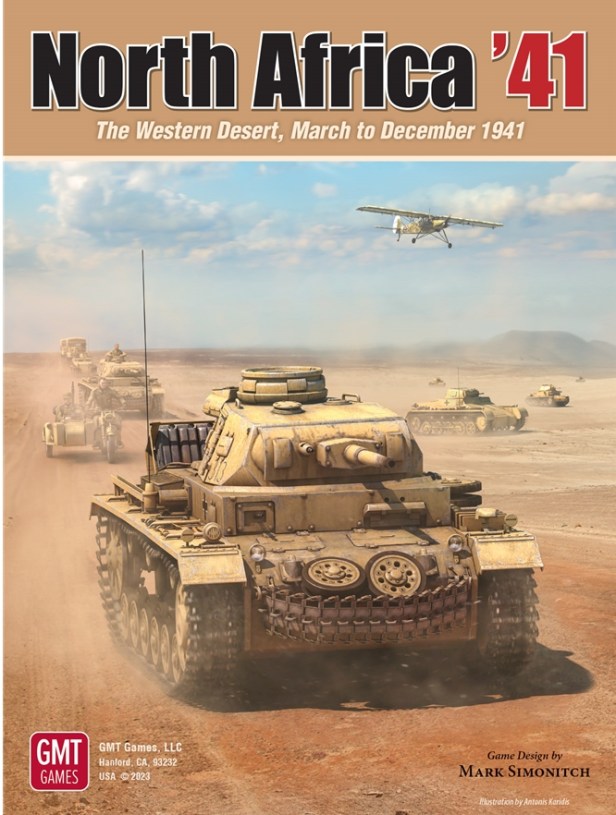
North Africa ’41: The Western Desert, March to December 1941 from GMT Games
I always love a good North Africa wargame! To me, the reasons that I love it are several but the focus on supply and how difficult it was in this theater as well as the various elements of infrastructure used to perform that supply, such as shipping, ports, trucks, etc. are always good fun. I also love the scope and scale of the North African Theater. The front covered an area over 2,000 or so miles stretching from Morocco on the western coast of the Atlantic, through Algeria, Libya and onto Egypt. Names such as Tunis, Kasserine Pass, Tripoli, Benghazi, Tobruk, El Alamein, Malta (I realize not a part of Africa but an important cog in this theater) and Alexandria. There is something about this theater and the games we have played we have absolutely loved.
Well, when you pair this interesting theater with a great system in the ’40X Series and a great designer and artist in Mark Simonitch, you have a recipe for a really tasty treat! And after playing the game in 2023, I was amazed with how much I loved it even though many of the systems and hallmarks of the ’40X Series, such as the infamous ZOC Bonds, were not really present but there were other interesting things to take their place.
One of the major additions to this volume was the concept that in order to attack, you have to have supply to feed that attack. This statement is not totally correct as players are able to do small attacks that amount to no more than 9 Attack Factors. If the attack is to included more than this 9 Attack Factors of if the players is using any panzers or tanks in the attack they will need to be able to spend a Supply Point from an HQ unit or Supply Force that is in range of the attack. This is an amazing way of handling this as the game is focused on supply and without it the players will be unable to mount large attacks or even sustained offensives. This is one of the most limiting factors of the game but it limits both players and the players that master the use of their truck units and keep their ports clean will do well. I really enjoyed this focus on attack supply and really enjoyed having to think about my upcoming attacks and how to priorities them to make them count.
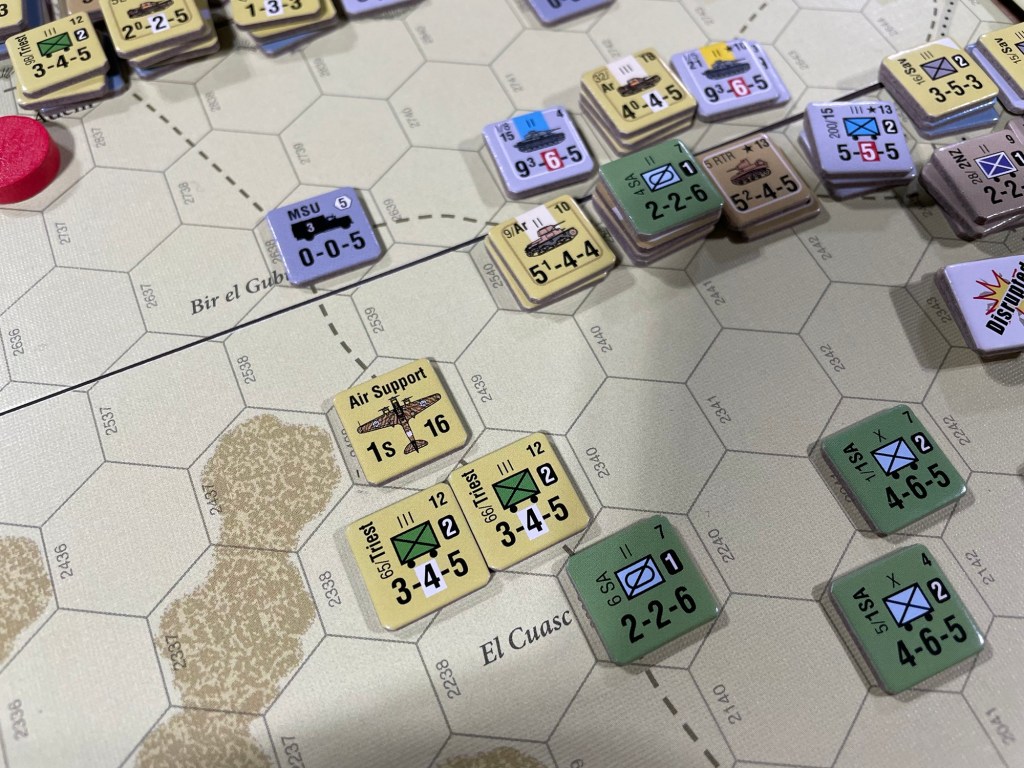
In any North African Theater wargame, supply will always be a major focus. The distances involved, including the difficulty with shipping across the Mediterranean Sea for both the Axis and Allies and Fortress Malta and the battle over this central point. The only way for the Axis player to get their units from Italy and across the Mediterranean Sea is through the port of Tripoli. They have to send all replacements, supplies and reinforcements that come on the board by the convoy routes from Italy to Tripoli. They can also send them to Benghazi but it is a bit more difficult. The Axis player will be able to supply a finite number of units on the board via these ports and will have to make the tough decisions to keep some units undersupplied if they are not needed at that very time. You cannot however allow the same units to be out of supply for consecutive turns as they will then begin to take Supply Attrition and lose steps so you have to do a macabre dance back and forth prioritizing how you use your limited supply. Also, in order for the ports to receive and keep units in supply, they have to be kept in good shape.
Both players will have to decide how to spend their scarce Resource Points as they can be used to bomb ports thereby reducing the number of units that can be supplied. This is especially important for the Axis player as they have to get Tobruk’s port down from its starting position of 4 to at least nor more than 2. The number showing on the port is its Port Capacity and is then multiplied by 2 to determine the number of units it can keep in supply. Port Supply is identical to regular supply except Ports may only supply these limited number of units. The player controlling the port must then decide which units are in supply and which are not during each of their friendly Supply Phases. The Axis player will get to supply a number of units on the board that totals the supply they derive from their various ports.
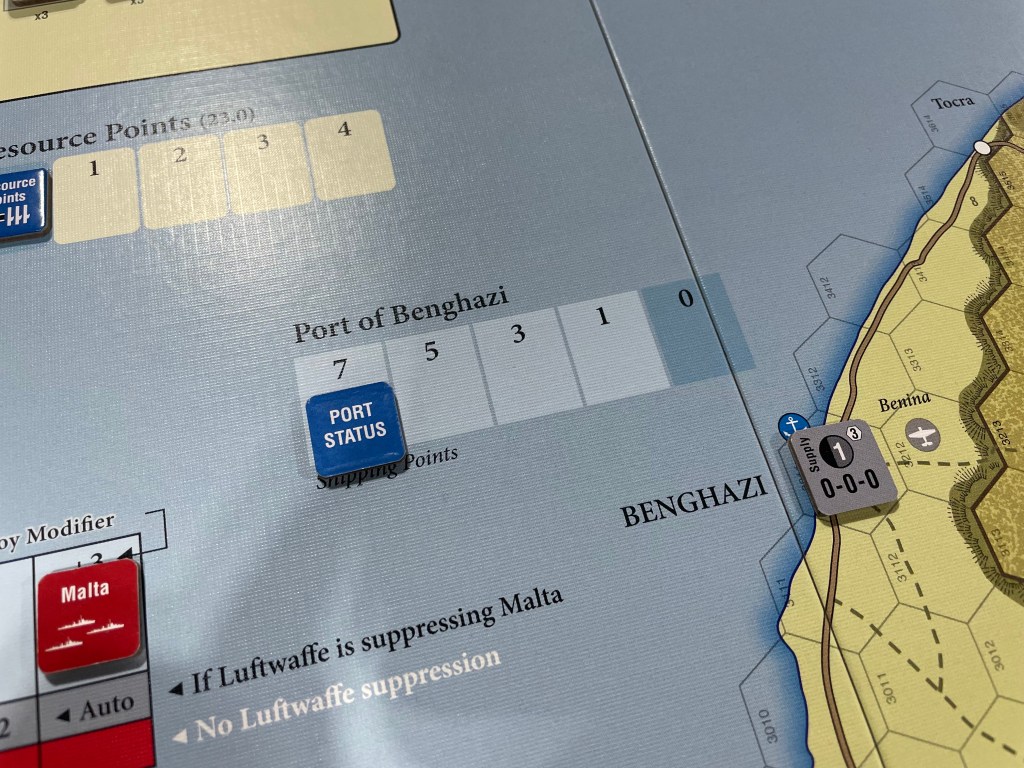
Ports may be damaged by the owning player (if in the case of having to vacate but not wanting the invader to benefit from the port) or the enemy player. No matter the case, the process to damage a port is the same and involves rolling one die and consulting the Port Demolition and Bombing Table. Each hit scored will move the Port Capacity marker one to the right on the Port Track. This is very important to the game and I really enjoyed this action. It was a bit unique for me but I readily accepted it and tried my best to damage his ports while repairing mine.
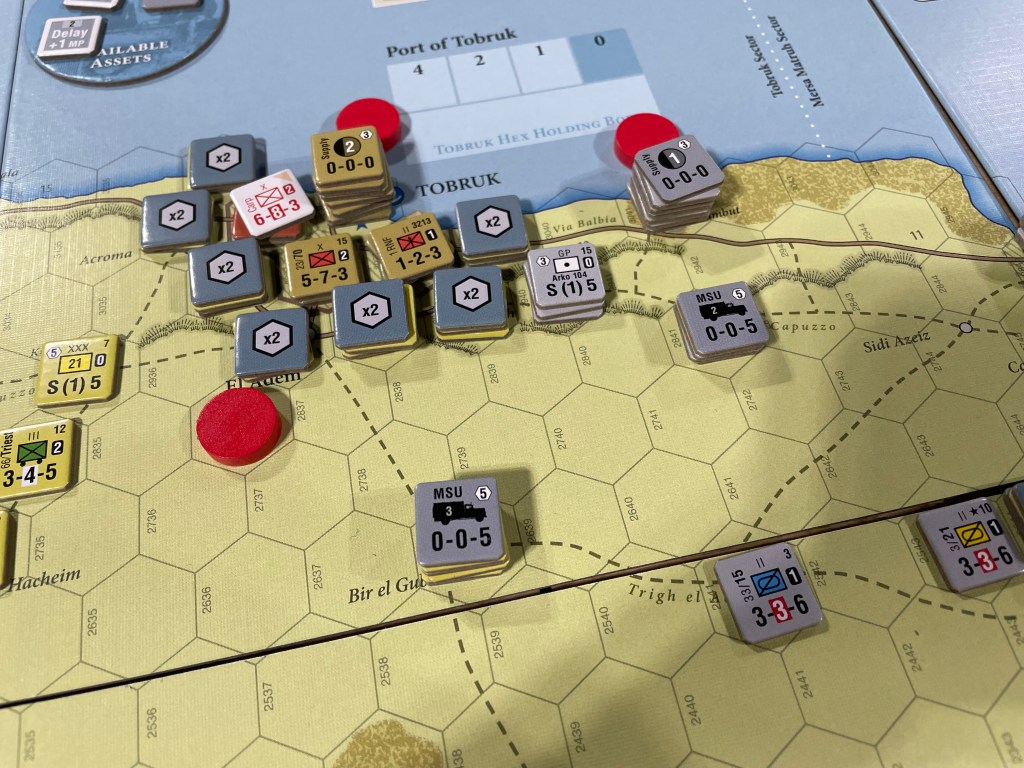
One of the major additions to this volume was the concept that in order to attack, you have to have supply to feed that attack. This statement is not totally correct as players are able to do small attacks that amount to no more than 9 Attack Factors. If the attack is to included more than this 9 Attack Factors of if the players is using any panzers or tanks in the attack they will need to be able to spend a Supply Point from an HQ unit or Supply Force that is in range of the attack. This is an amazing way of handling this as the game is focused on supply and without it the players will be unable to mount large attacks or even sustained offensives. This is one of the most limiting factors of the game but it limits both players and the players that master the use of their truck units and keep their ports clean will do well. I really enjoyed this focus on attack supply and really enjoyed having to think about my upcoming attacks and how to priorities them to make them count.
In any North African Theater wargame, supply will always be a major focus. The distances involved, including the difficulty with shipping across the Mediterranean Sea for both the Axis and Allies and Fortress Malta and the battle over this central point. The only way for the Axis player to get their units from Italy and across the Mediterranean Sea is through the port of Tripoli. They have to send all replacements, supplies and reinforcements that come on the board by the convoy routes from Italy to Tripoli. They can also send them to Benghazi but it is a bit more difficult. The Axis player will be able to supply a finite number of units on the board via these ports and will have to make the tough decisions to keep some units undersupplied if they are not needed at that very time. You cannot however allow the same units to be out of supply for consecutive turns as they will then begin to take Supply Attrition and lose steps so you have to do a macabre dance back and forth prioritizing how you use your limited supply. Also, in order for the ports to receive and keep units in supply, they have to be kept in good shape.
Both players will have to decide how to spend their scarce Resource Points as they can be used to bomb ports thereby reducing the number of units that can be supplied. This is especially important for the Axis player as they have to get Tobruk’s port down from its starting position of 4 to at least nor more than 2. The number showing on the port is its Port Capacity and is then multiplied by 2 to determine the number of units it can keep in supply. Port Supply is identical to regular supply except Ports may only supply these limited number of units. The player controlling the port must then decide which units are in supply and which are not during each of their friendly Supply Phases. The Axis player will get to supply a number of units on the board that totals the supply they derive from their various ports.
Ports may be damaged by the owning player (if in the case of having to vacate but not wanting the invader to benefit from the port) or the enemy player. No matter the case, the process to damage a port is the same and involves rolling one die and consulting the Port Demolition and Bombing Table. Each hit scored will move the Port Capacity marker one to the right on the Port Track. This is very important to the game and I really enjoyed this action. It was a bit unique for me but I readily accepted it and tried my best to damage his ports while repairing mine.
If you want to know more, you can check out our video review at the following link:
I also wrote an in-depth look at the game and its systems in my First Impression post and you can read that at the following link: https://theplayersaid.com/2024/01/24/first-impressions-north-africa-41-the-western-desert-march-to-december-1941-from-gmt-games/
If you are interested in North Africa ’41: The Western Desert, March to December, 1941, you can order a copy for $65.00 from the GMT Games website at the following link: https://www.gmtgames.com/p-962-north-africa-41.aspx

Shiloh: The First Day – Crisis in the West (April 6, 1862) from Revolution Games
We had never played the Blind Swords Series until recently when we had an opportunity to play the newest game in the series called Shiloh: The First Day – Crisis in the West (April 6, 1862). This game is Volume 11 in the series and is designed by Steve Carey. The battle focuses on the first day of the 2 day battle where the Union, lead by Ulysses S. Grant clashed with the CSA lead by Albert Sidney Johnston. It is the largest game in the Blind Sword Series and includes two large 22″ x 34″ maps and 3 full counter sheets. The game includes seven scenarios, one of which is played on a smaller 8.5″ x 11″ map.
This system is a true marvel as we have played it in a few other games including At Any Cost from GMT Games and the modified system in A Most Fearful Sacrifice from Flying Pig Games both designed by Hermann Luttmann. The system emphasizes the three FOW’s (I normally get these wrong when I discuss) of military conflict: fog-of-war, friction-of-war and fortunes-of-war. The system mixes events with activation chits and does not guarantee that each unit on the board will be able to activate each turn or that each unit will only activate once. The system is designed to force players to make tough decisions with each chit pull. The chit pull is very well done and creates a real sense of the difficulty in command on the battlefields of the American Civil War. The other part about the chit pull is that there are several chits that the players get to choose to include in the mix which are specific events that can either help their own units or hinder the command and activation of your opponent’s units. The decision about which chits to include in this mix are always difficult and you really have to think about the situation, what you need to accomplish that turn and where you are either weakest or the strongest to capitalize on the benefits granted by these events.
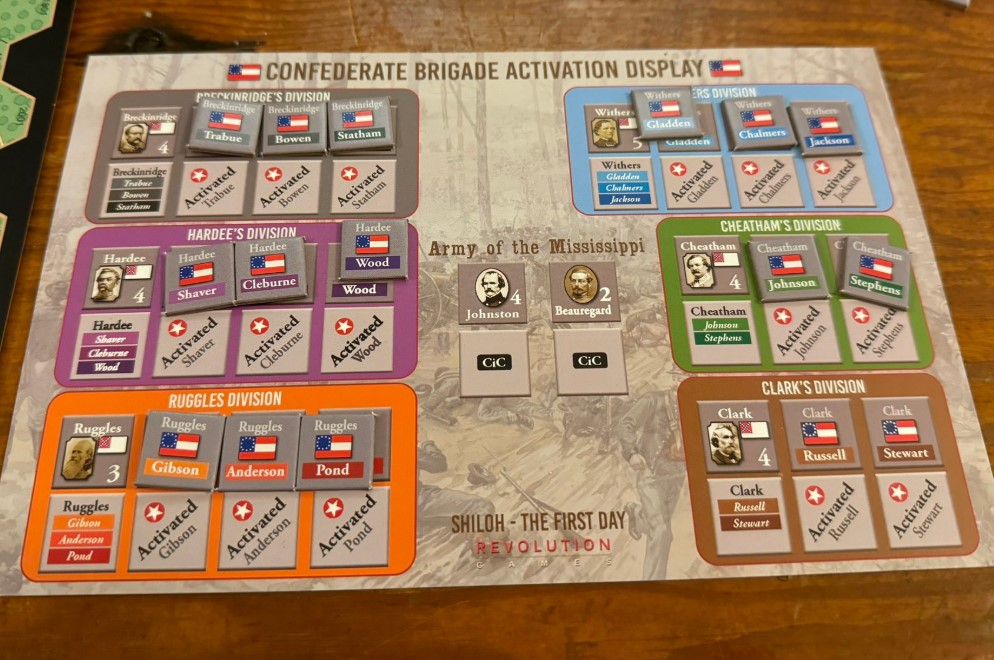
I also really liked that the Commander in Chief (CIC) chit was also included in the mix and when drawn the player has a lot of agency about which of their various Divisions they can activate. This CIC chit is somewhat of a wild card and allows the player to activate any Division that has not already been activated. This flexibility creates some very interesting tactical and maneuver diec9ision as you can respond to enemy incursions into your lines, launch a surprise 2nd attack for the round or fall back before the enemy can attack you.
The combat is very tactical in nature and relies on the use of 2d6 to be rolled, one of the dice being red and the other white, and then a table is consulted using the red dice first followed by the white. The red die is typically whether or not you have hit the target with your attack and the white die determines the results. The combat is pretty interesting and utilizes cohesion of units to determine how much they are effected. The tougher troops are they will be harder to hit and the weaker or more exhausted they are they will be easier targets. This system is very granular and felt right as we were playing through the game.
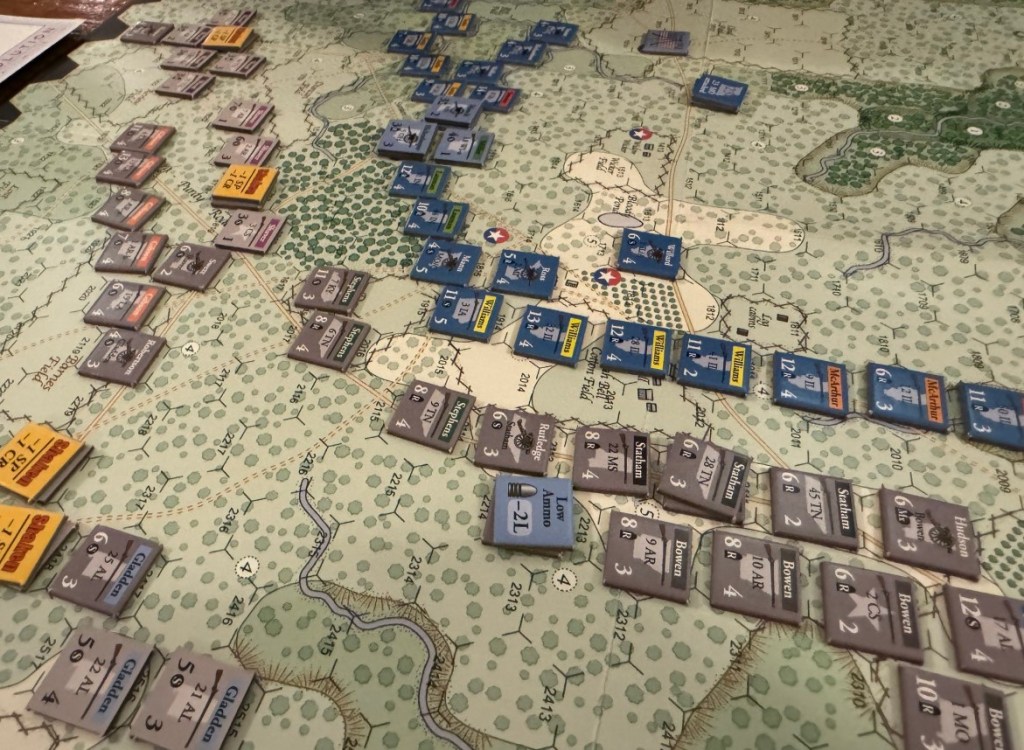
We only played the smallest scenario as we wanted to get the rules down and the game flow but we had a blast with the system. Our game ended in a Confederate victory as they were able to activate a weak division on the far left flank to take an exposed automatic victory point which had been vacated by the Union in response to some really good attacks and breaking of their lines. This is a game that we are going to revisit by the end of the year but I am pretty sure that this one will appear on both of our Top 10 Lists for 2024 in the spring. It was just that good!
We played the game while attending SDHistCon in San Diego in early November and really had a great time playing it with Grant Linneberg from Pushing Cardboard and with the designer Steve Carey hovering helping us with rules. We shot the following video at the convention:
If you are interested in Shiloh: The First Day – Crisis in the West (April 6, 1862), you can order a copy for $80.00 (the game is currently on sale so act fast) from the Revolution Games website at the following link: https://www.revolutiongames.us/
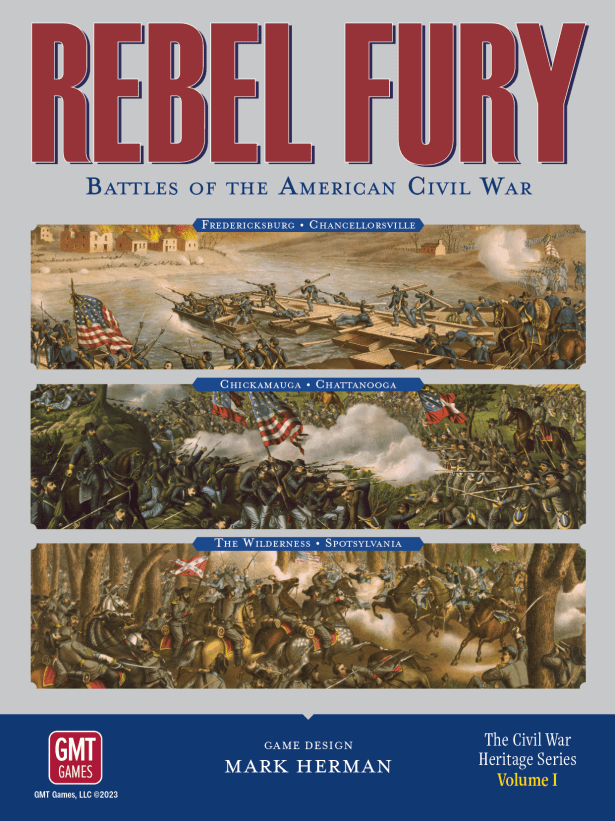
Rebel Fury: Battles of the American Civil War from GMT Games
A few years ago, Mark Herman designed a small scale low counter density simple system game for a magazine wargame called Gettysburg found in C3i Magazine #32. We played the game at the World Boardgaming Championships in 2019 and really loved the focus on maneuver and positioning of forces. Fast forward a few years, and Mark was dabbling with that same system to establish a new American Civil War series of games called the Civil War Heritage Series with its first entry called Rebel Fury from GMT Games that takes a look at 6 battles from the Chancellorsville and Chickamauga campaigns in 1863-1864. These battles include Chickamauga, Chattanooga, The Wilderness, Spotsylvania, Chancellorsville and Fredericksburg. We have played a few of these scenarios (including Chickamauga and Fredericksburg) and very much enjoyed the focus of the series and how the game worked.
One of my favorite parts of the system is the focus on maneuver and how Zone of Influence work as units approach each other. Each of the unit counters have a movement side and a combat side and as they are moving about the board to get into position when the come in contact with an enemy unit’s Zone of Influence. I really like the concepts of how your forces naturally break into battle formation, where they then maneuver the last short distance to cross the battlefield and engage the enemy. Unlike most other hex and counter wargames, this system allows you total freedom to move units in any order multiple times, unleashing the full range of historical tactics in a simple and clean format. The activation is I-Go-U-Go but each side only is allowed to move one unit. This creates some back and forth, and in some ways stalling, as players try to think about their movement objectives and where they wish to end up in relation to the enemy. For such a small, low counter density game, the maneuver is really quite good in this system.
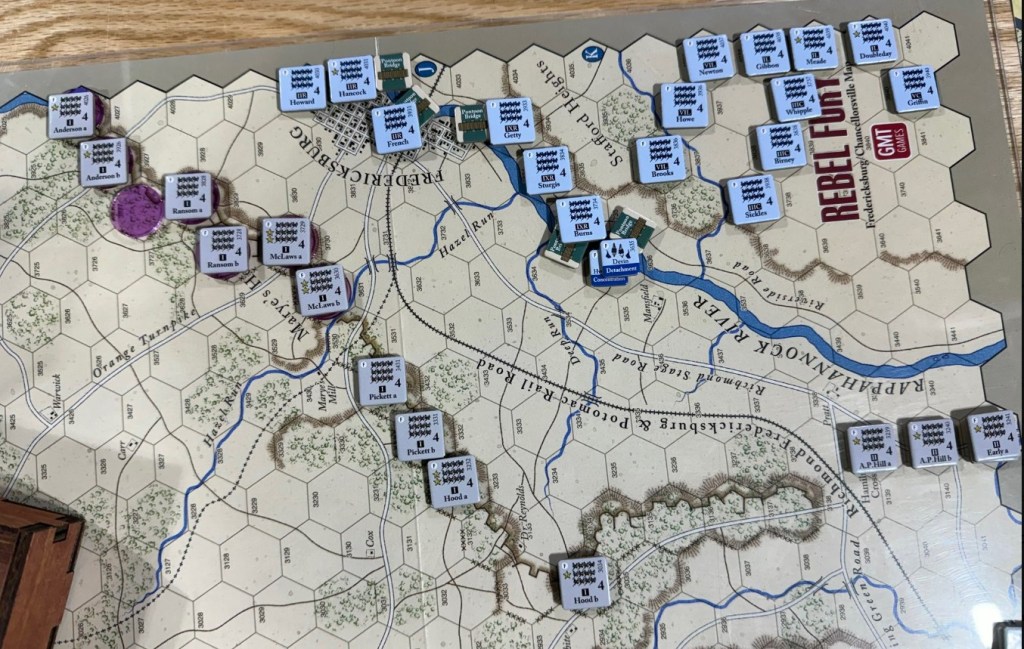
Combat is also very good and pretty simple as it features a differential combat system with few but significant factors that capture the key features of Civil War division level combat. Units are rated for quality using a number of stars, artillery support, supporting units and terrain that they are fighting in. You add up your total values with these factors, roll some dice and consult the CRT to see the results. Really pretty easy to grock and the system just feels really well done and clean. The game also features artillery duels with the occasional Exploding Caisson result, which is always a blast! In my discussions with Mark Herman while at WBC, he feels that the Civil War Heritage Series combat system accurately depicts the ability of units to launch multiple waves of attacks on the same position, capturing the back-and-forth nature of many famous combat duels and also takes into account the limitations of formations and ability to focus fire. This system is really very good and I enjoyed our few plays very much.
If you want to know more, you can check out our video review at the following link:
We also shot a playthrough video for the Chancellorsville scenario and you can watch that at the following link:
If you are interested in Rebel Fury: Battles of the American Civil War, you can order a copy for $58.00 from the GMT Games website at the following link: https://www.gmtgames.com/p-747-rebel-fury-six-battles-from-the-campaigns-of-chancellorsville-and-chickamauga.aspx
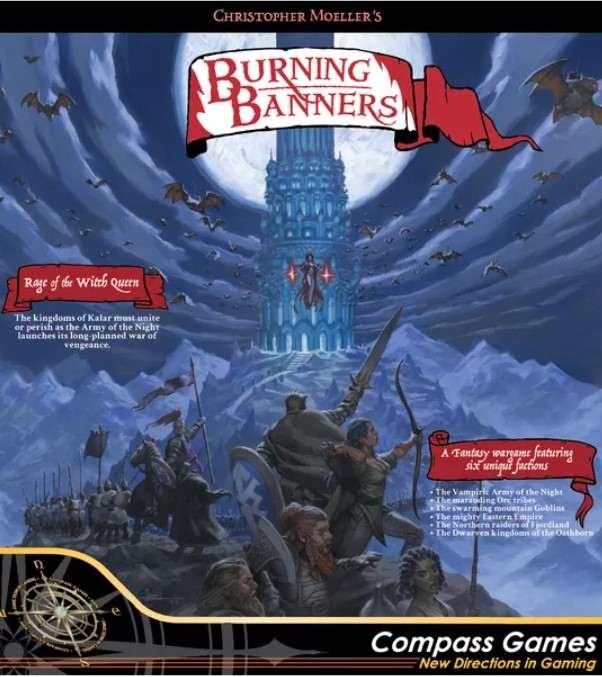
Burning Banners: Rage of the Witch Queen from Compass Games
Thematic immersion is very important in any game. The designer being able to create a setting and get us indoctrinated to its particulars helps us to understand the motivations behind the sides that we are playing. Burning Banners is a fantasy wargame, with an emphasis on immersive artwork, exciting storylines and opportunities for role-playing. Roleplaying in a war-game? What does that mean? It means that players’ imaginations allow them to become immersed in the game’s alternate reality. They can identify emotionally with the characters they command, and they care about what happens to them, whether good or bad. Burning Banners works hard to be both a wargame but also to remain a game with reliance on dice, special ability cards and spells to create a battle royal on the fields of a fantasy land dripping with theme. Also, did I mention the art? Wow this one is a beauty. We were able to play a 4-player game and then just a 2-player game and everyone at the table had a blast.
Burning Banners is set in a world called Kalar. The map in the game focuses on the eastern continent of Kheros, which was colonized by the human Eastern Empire (an extension of an older Western Empire across the sea). Over the years prior to the game, the Empire has fallen on hard times, losing its northern provinces to a rebellion (resulting in the kingdom of Fiordland), its eastern marches to the Orcs, and its southern provinces to a plague (creating a matriarchal kingdom called Mara Mitai). Magic is a significant player in this world. Sorcerers on Kalar long ago discovered that there is a mirror world called Meji, a reflection of Kalar, bound to it by a flow of creation energy called the Silent Tide. Tapping into the Silent Tide is what allows mages to cast spells…the more powerful the spell, the more current from the Silent Tide must be diverted. Depending on which way the currents used are flowing, powerful spell casting can cause damage to Kalar or Meji, by preventing creation energy from reaching its destination. Storms, plagues, disease may all be caused by spellcasting in either of the two worlds. Between the worlds is a realm of gods, powerful beings who exist within and alongside the Silent Tide and guide its currents to the places it is needed. Struggles for power between these beings can influence what happens to the tide, and to the twin worlds that it nourishes.
This one was a blast and we absolutely loved what we were doing moving about the board doing combats and taking over towns and cities for plunder while also attacking monsters for gold and extra treasures that would grant special abilities.
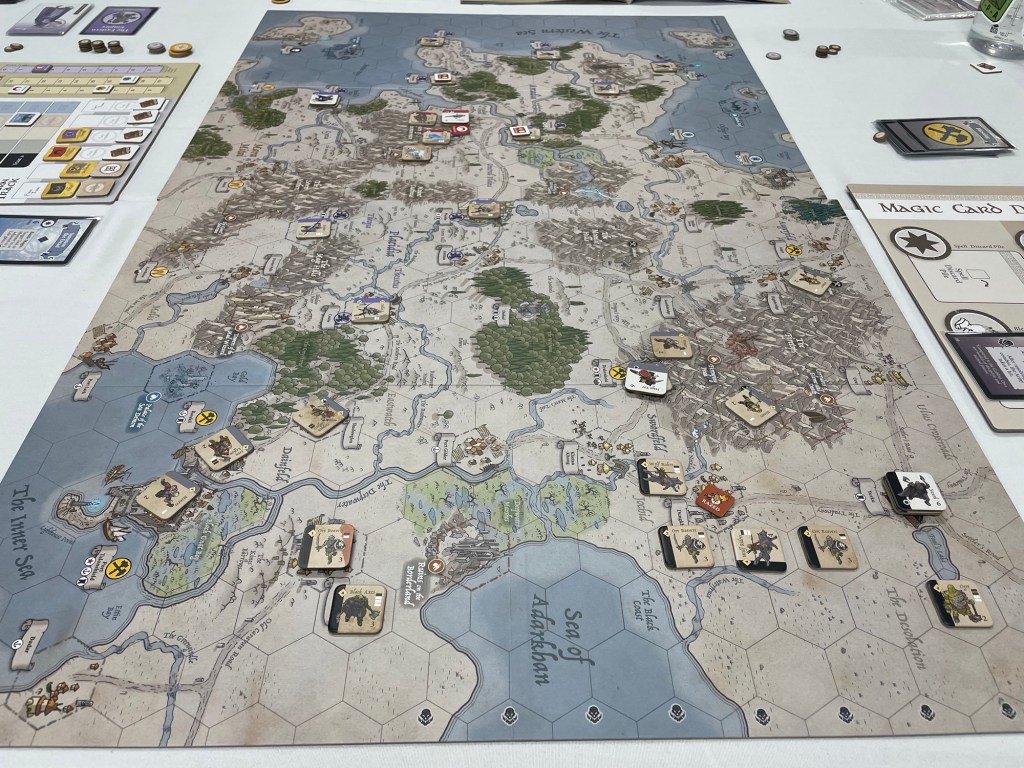
One of my favorite parts was that there are a number of elements that make playing each Kingdom a unique experience as every kingdom has its own armies, heroes and special rules. For example, the Empire have a significantly larger economic base than the other kingdoms, but it has special rules that cause its settlements to revolt during the game, harming their economy. The Empire can ignore the revolts, but if they accumulate unaddressed, they will wreak more and more havoc with the Empire’s income.
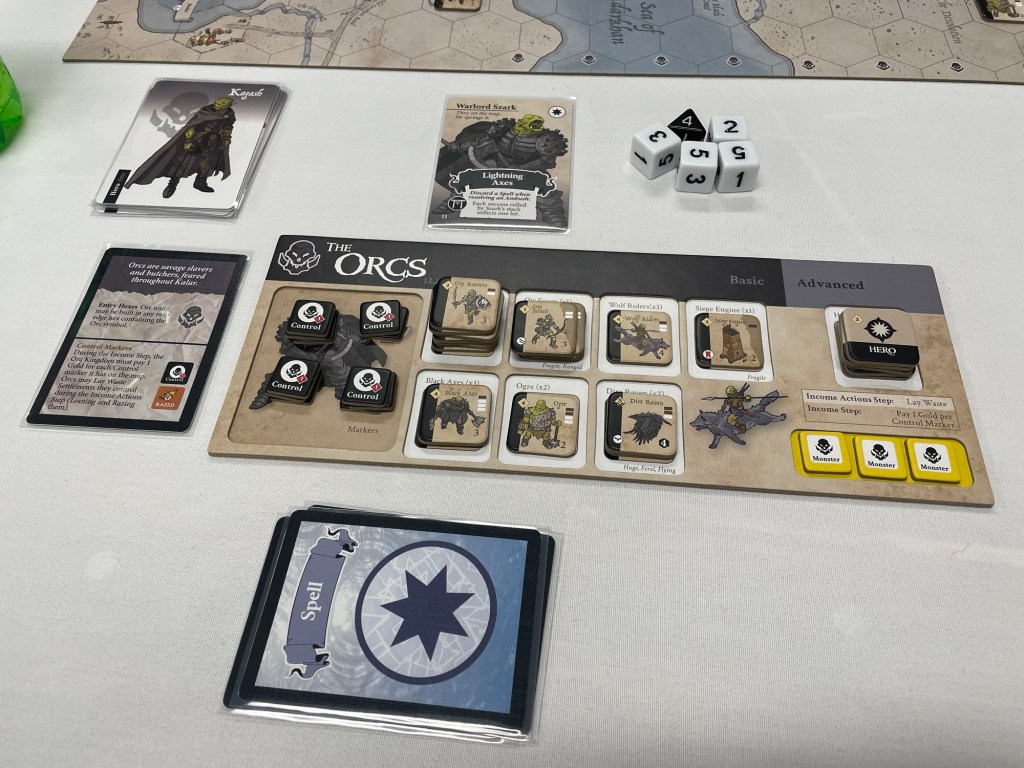
On the other hand, the Orcs are unique in that they have no economy at all! They must loot enemy towns and cities in order to get money, so their posture must be one of constant expansion. They must literally conquer or die. The Army of the Night was small and stealthy. It can establish secret covens in enemy settlements, making them vulnerable to attack and giving the vampires additional income. Just really a great and unique gaming experience. We can’t wait to play it again soon!

If you want to learn more about Burning Banners, you can check out our interview with the designer on the blog at the following link: https://theplayersaid.com/2023/06/13/interview-with-christopher-moeller-designer-of-burning-banners-rage-of-the-witch-queen-from-compass-games-currently-on-kickstarter/
If you want to know more, you can check out our video review at the following link:
If you are interested in Burning Banners: Rage of the Witch Queen, you can order a copy for $90.00 from the Compass Games website at the following link: https://www.compassgames.com/product/burning-banners-rage-of-the-witch-queen/
Long Century Operations Series: Risorgimento from Conflict Simulations Limited
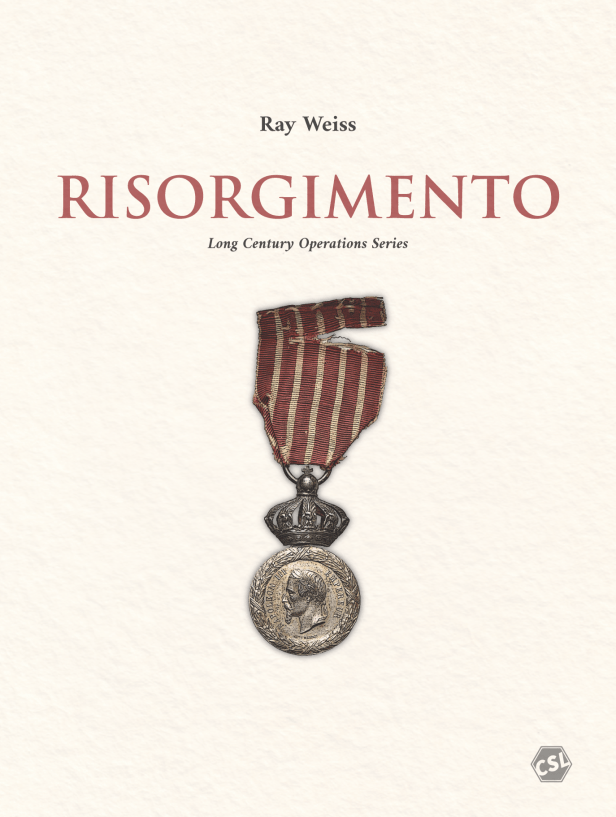
Ray Weiss with Conflict Simulations Limited is a bit of a lightning rod for some interesting things but he is a good designer and he always comes up with interesting looking games that tend to push the boundaries of design. This new Long Century Operations Series deals with various battles in the Second War of Italian Independence and the newest stand along game focuses on Risorgimento. This game is intended to be a standalone variant of the campaign game for the Solferino Quad, which is a separate game that you can purchase as well.
For Risorgimento, the game engine used was originally introduced years ago with 1870 – The War Against the Empire. It is an operational system focusing on command, resource management and force projection. This game includes 2 scenarios, one covering the 1859 campaign and the other shorter scenario covering the campaign starting at Magenta.
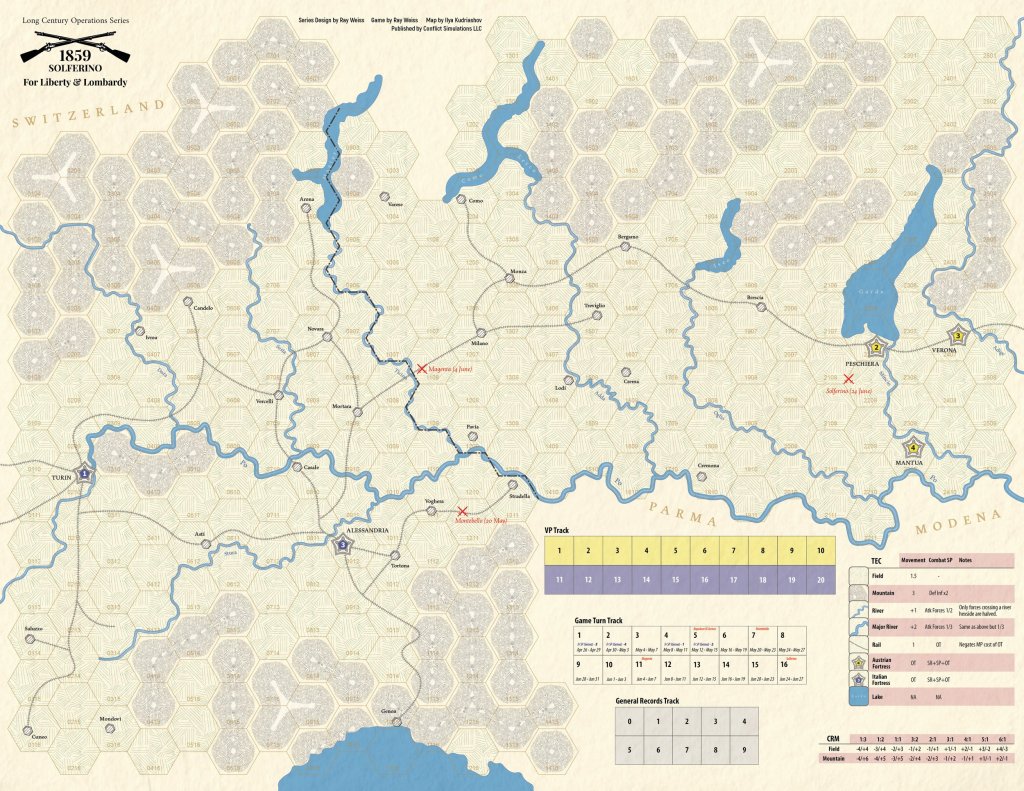
Conflict Simulations Limited has graciously provided us with the following discount code. Discount Code: PLAYERSAID for 15% off their online store.
If you are interested in Long Century Operations Series: Risorgimento, you can order a copy for $49.99 (if using the code just $42.49) from the CSL website at the following link: https://www.consimsltd.com/products/long-century-operations-series-risorgimento

Iron, Blood, Snow & Mud from PHALANX
Not every hex and counter wargame covering the East Front of World War II has to be an 8-12 hour campaign game. Some can be smaller and play in 90 minutes and still give you the feel of the titanic struggle between Germany and the Soviets. Such is the case with a new game from PHALANX called Iron, Blood, Snow & Mud, which is a quick and easy to learn 2-player hex and counter strategic level wargame simulating the Eastern Front. Will the vaunted German blitzkrieg prove its invincibility once again? Or will the Soviet Union endure the onslaught long enough to rebuild its might and push back the enemy? The fate of the war is in your hands!
Players will get to lead the combat-hardened forces of the Wehrmacht through mud and snow and unimaginably vast territories of the enemy, all the while trying to protect their overstretched supply lines. Or players can take control of the initially outnumbered, but slowly building its might, Soviet Red Army to attempt to slow the lighting quick Panzer attacks, harass the enemy’s supply lines with partisans and bide their time for a bloody and devastating counteroffensive. This is the war of iron, blood, snow and mud.
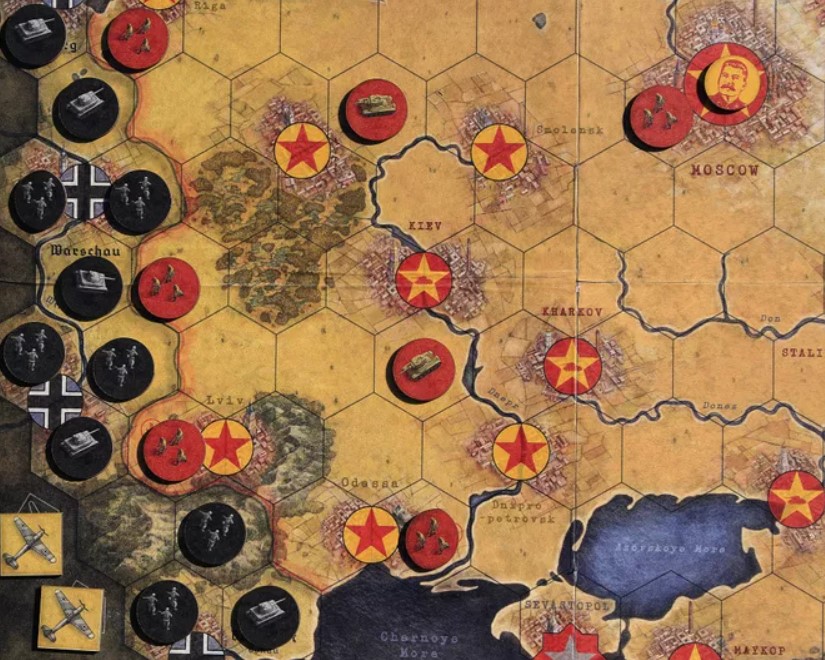
Iron, Blood, Snow & Mud is both asymmetrical in its overall design and simple yet surprisingly unique in its approach to the Eastern Front. The game is played over the course of four years, each consisting of three different seasons, two of which – the aptly named Mud and Snow – inhibit the use of some actions and units. The movement of units and their range is predicated on the current season, unit type and the ability to create and maintain a chain of units. The Germans have to either hold a set of objectives by the end of 1944 or capture the Soviet leader, Stalin himself. The Soviets too can achieve a sudden victory, but only if they manage to seize one of three initially German-held cities.
If you want to know more, you can check out our video review at the following link:
Conflict Simulations Limited has graciously provided us with the following discount list. https://gamefound.com/projects/phalanx/phalanx-store?refcode=HxZEf5aVFE2uFo_-iAMjRw
If you are interested in Iron, Blood, Snow & Mud, you can order a copy for €30,00 ($31.78 US Dollars) (if using code €15,00/$15.89 US Dollars) from the PHALANX website at the following link: https://gamefound.com/projects/phalanx/phalanx-store?refcode=HxZEf5aVFE2uFo_-iAMjRw
Solitaire Only
Solitaire Wargames are a real thing and they don’t mean that you don’t have friends. These games are specifically designed for one player and as such the games have a well developed AI running your opponent. I like solitaire gaming for many reasons, including the challenge as they are often very hard to win, going at my own pace and trying to strategize my way around the opponent.

Gift of the Nile: The Rise & Fall of Ancient Egypt from White Dog Games
I have really enjoyed my plays of several solitaire games designed by R. Ben Madison. He has a knack for including elements of the history into the gameplay while placing the events into the framework of his chosen system, which is usually the States of Siege Series…but not necessarily always. His newest offering is called Gift of the Nile: The Rise & Fall of Ancient Egypt from White Dog Games and is a solitaire only game that uses the States of Siege Series System and delves in Ancient Egypt and the rule of the Pharaohs covering over 30 dynasties starting with the Old Kingdom in 2,600 BC to the Late Period starting in 700 BC and ending with the intervention of Rome. This is a long and involved game (ranging from 36 turns to something less based on certain conditions happening or a player loss) that really gives the player a good feel for the might and power of the Egyptians, as well as the various threats and enemies they had to deal with to survive for nearly 3,000 years.
One of my favorite games designed by Ben Madison is the fantastic and interesting Mound Builders published by Victory Point Games in 2014. Mound Builders tells the history of 2 of the largest pre-Columbian Indian “mound builder” cultures that dominated eastern North America from before the time of Christ until the coming of the European colonists in the 17th century. The player’s empire represents the earlier Hopewell culture and the later Mississippian culture that derived from it. This game focuses on the building up and expansion of these cultures while then having to survive the oncoming Spanish and other cultures trying desperately to keep hold of what their society means and its identity.
That model was used in this game as well and borrows many of the same elements with the most important being the way resources are used to earn Action Points. See as the player expands and builds their kingdom during the Old Kingdom, they conquer or incorporate established Sepats (chiefdoms) into their fledgling empire. As the empire expands, if you happen to have 2 different Sepats with the same Trade Good, you can count that as having that Trade Good to build your economy during the Nile Phase as it will earn an Action Point from the Trade Goods List if the dice say you will. These Sepats each have a different type of Trade Good that they are good at procuring and once that Sepat has become a part of your empire the player can Temple it (spend Action Points to build a temple in the area) and it will be more valuable as it will create a Trade Good on its own without having to rely on having two of that Trade Good to create an Action Point.

The Old Kingdom is about expanding your empire’s reach into the various lands located on the Tracks surrounding Men-Nefer so you can earn more Action Points in order to take more Actions each turn to build your empire including things such as building Monuments, attacking interloping civilizations called Khastis who have wandered into your kingdom, hiring mercenaries and troops to aid you in this fight and improving the education and literacy of your people. Each of these different Actions are each important and the player must make many decisions about how to spend their scarce resources over the course of the game to build and expand.
I love this game and have really enjoyed my 4-5 plays at this point. I have done better than I expected as sometimes the dice don’t hate me. But that doesn’t mean that I didn’t have to work for those victories. They were very hard fought and the decision points are really intense as you have to consider what to do each and every turn. This game rewards planning as well as thinking ahead and not just about the problem in your face.
If you are interested, we posted an interview on the blog with the designer Ben Madison and you can read that at the following link: https://theplayersaid.com/2024/03/11/interview-with-r-ben-madison-designer-of-gift-of-the-nile-the-rise-fall-of-ancient-egypt-from-white-dog-games/
I also wrote a full first impressions style review and you can read that at the following link: https://theplayersaid.com/2024/04/03/first-impressions-gift-of-the-nile-the-rise-fall-of-ancient-egypt-from-white-dog-games/
I shot two separate 1-hour playthroughs of the Old Kingdom (3rd Dynasty through 10th Dynasty) and the Middle Kingdom (11th Dynasty through the 17th Dynasty) and you can watch those at the following links:
If you are interested in Gift of the Nile: The Rise & Fall of Ancient Egypt, you can order a boxed copy for $57.00 (Print and Play copy for $30.00) from the White Dog Games website at the following link: https://www.whitedoggames.com/gift-of-the-nile

Manila: The Savage Streets, 1945 from Take Aim Designs / Revolution Games
In 2023, I was expose to a very cool area activation/impulse solitaire wargame system designed by Mike Rinella called Stalingrad: Advance to the Volga, 1942. This game was a pretty big hit and they then began work on the follow-up effort called Manila: The Savage Streets, 1945. I have played this game many times this year and really love how it works and the narrative that it tells.
Manila: The Savage Streets, 1945 puts the player in charge of the attacking and far more mobile American side while the game system handles the defending and largely static Japanese side during the liberation of Manila in the Philippines in 1945. No 2 games will ever be the same due to the systems reliance on chit pull and placement of enemy units each with special defensive abilities. Each turn presents new and unique challenges for the player in the form of random events, uncertain supply deliveries, and unknown Japanese area strengths and defensive strategies.
The primary game is a 9-turn campaign covering the American assault on the city during February and March 1945. The deeper American forces advance, from the city’s less developed periphery to its urban business district and fortress-like government buildings, the greater Japanese resistance becomes. The number of American units fought to exhaustion, effectively out of action, mounts. American determination to secure a rapid victory for Supreme Allied Commander General Douglas MacArthur, represented as morale in the game, gradually decreases. The player wins by equaling or exceeding historical American gains and loses if they fail to do so, or if morale falls too low.
Manila: The Savage Streets, 1945 from Revolution Games/Take Aim Designs is a winner! Mike Rinella hit a home run with this one. Easy to understand rules, great combat, fantastic production, great decision points and a lot of dice rolling, which I really like and expect from most solitaire wargames. This one has it all and plays fast and furious and just feels so satisfying, whether you win or lose. I always had that feeling of just one more game and I think I can crack it….and I just kept on trying and trying. I loved this one and I look forward to the other volumes in this new Solitaire Area Movement Series including the upcoming game on Berlin.
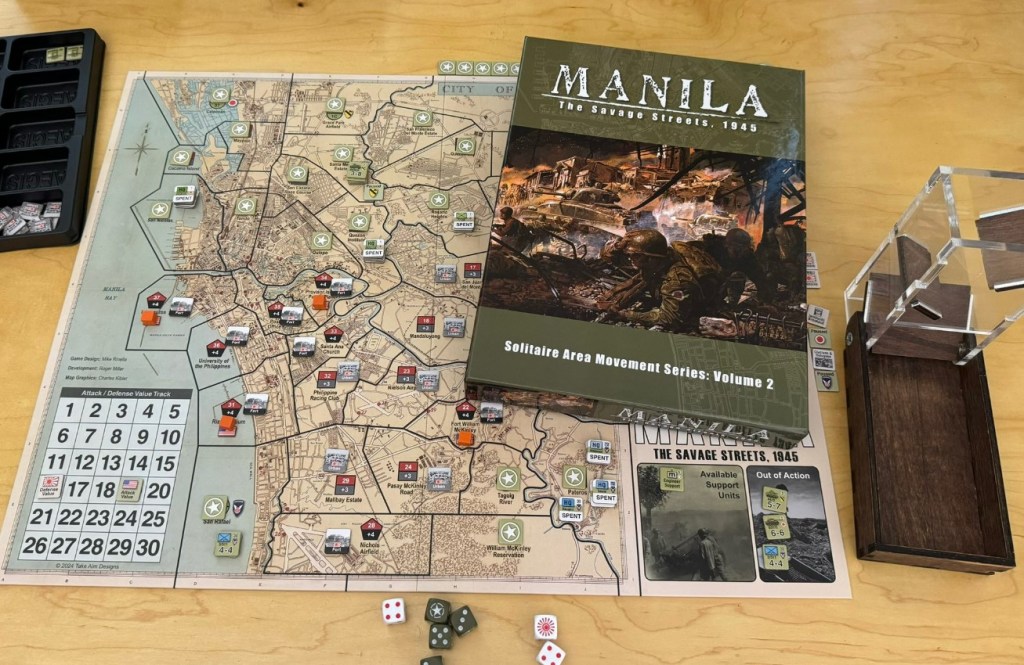
Here is a link to my unboxing video to give you an idea about the components:
I have shot a playthrough and review video but it has yet to be uploaded to the channel.
If you are interested in Manila: The Savage Streets, 1945, you can order a copy for $55.00 from the Revolution Games website front page at the following link: https://stores.revolutiongames.us/manila-the-savage-streets-1945/
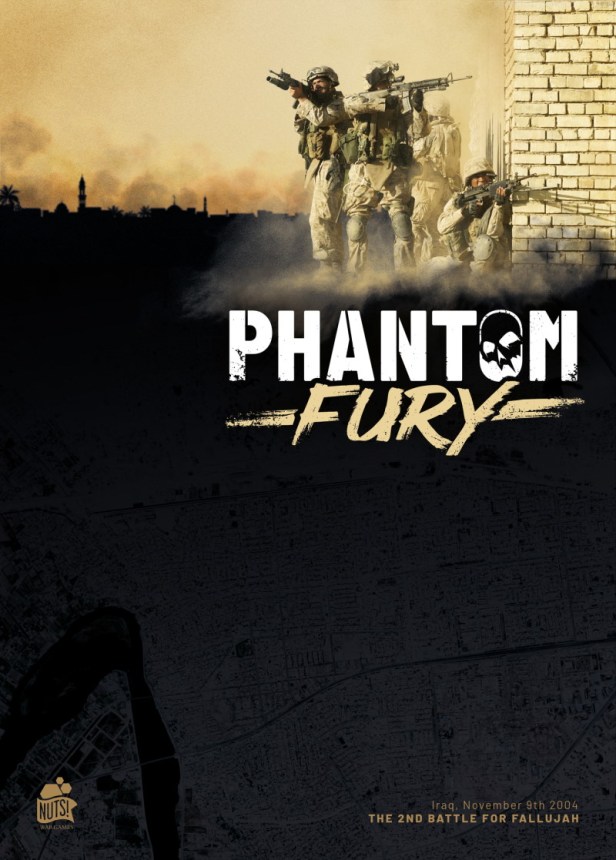
Phantom Fury 2nd Edition from Nuts! Publishing
I have not really played that many modern wargames. Particularly not many on the wars in Afghanistan or Iraq over the past 20 years. But, Phantom Fury is one of those games that many people speak very favorably about. Phantom Fury: Second Edition is a solitaire game of tactical urban combat set in the Second Battle of Fallujah, November 2004.
In the game, the player controls a Battalion of US Marines attempting to clear city zones of insurgent control via bitter close quarters fighting. To assist the assaults you’ll have access to a range of stand off elements, such as UAVs and close air support, and close combat support in the form of Combined Anti-Armor Teams and Abrams tanks.
Hidden insurgent elements will appear as you advance further into the city and get tougher to dislodge as your attacks create rubble and other impediments to your success. Snipers will target you as you move street to street and you will generally not know the makeup of the units that you are facing until you directly assault them and uncover the hidden insurgewnts. They may be Guerrillas, ready to evade you with pre-planned escape routes or they may be Martyrs, who will fight to the death and are extremely difficult to dislodge. Sometimes, you will find that your intel was bad and there is no one there.
If by the game’s end the USMC does not control all the zones on the map, the game will end in a loss. Otherwise you calculate victory points based on the time taken to clear the city and friendly and insurgent losses to determine if you achieved a major, minor or costly victory. The game really focuses on real life urban warfare tactics, including different modes of assaulting a building and positioning of assets to hinder enemy sniper fire or reinforce key positions, and also utilizes the Iraqi forces on your side to assist the effort.
The game is very involved and will definitely take you a few plays to get comfortable with but I have really enjoyed the system and look forward to playing it again in the future.
If you are interested, I shot a short RAW video on the game during my first play and you can watch that at the following link:
Nuts! Publishing has graciously provided us with the following discount code. Discount Code: TPA20#2024 for 20% off.
If you are interested in Phantom Fury 2nd Edition, you can order a copy for 50.00€ ($53.00 US Dollars) (if using the code just 40.00€/$42.40 US Dollars) from the Nuts! Publishing website at the following link: https://www.nutspublishing.com/eshop/our-games/phantom-fury-v2-en
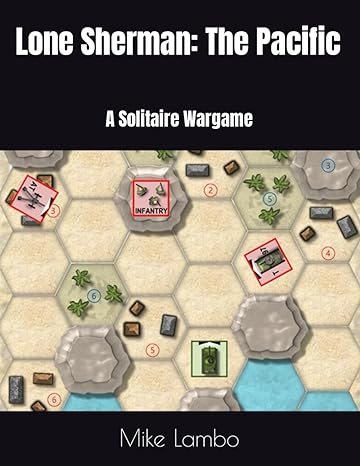
Lone Sherman: The Pacific from Mike Lambo
I gave this system a try earlier this year and has since purchased a few of his additional titles. I just had to find out what all the fuss was about. Mike Lambo has created a system of simple tactical level solitaire book wargames that have done very well over the past couple years and have many devotees. The best volume I have played is in the Lone Sherman Series and is called Lone Sherman: The Pacific. This game is a sequel to Lone Sherman, which is set in the European Theater of Operations and is not an expansion. It is a standalone game.
Lone Sherman: The Pacific puts you in charge of a single Sherman Tank and its crew on several Pacific Islands in World War II, and tasks you with navigating your Sherman through challenging Scenarios. While this game is not a ‘narrative driven’ game as such, with a little imagination it will provide memorable stories and really keeps you on the edge of your seat as you roll your dice, choose your actions and hope for the best. Some events are randomly generated in the game, but the player always has at least some degree of control over the level of risk they wish to take and how vulnerable they leave their tank to these Events. This typically manifests itself in your position on the board, how near you are to enemy units and what condition your tank is currently in.
The aim of this book wargame is to present a clear, accessible, and quick to learn game, so that players can get into the action quickly. Each of the 12 Scenarios can be played in around an hour, although sometimes a scenario will last a much shorter time if your tank is destroyed! Each Mission provides plenty of replayability due to the random set up of the initial forces and the many events and decisions in the game.
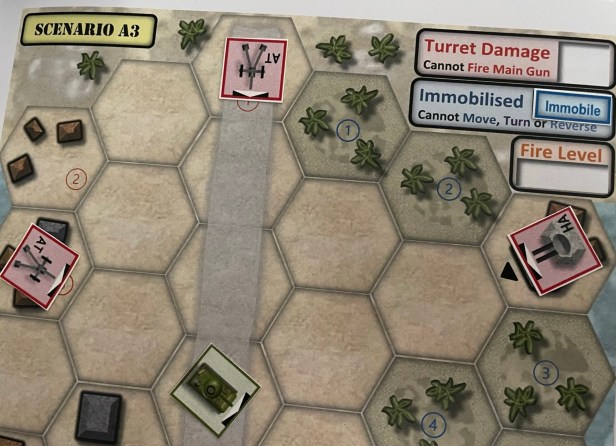
I have very much enjoyed my experience with this game and the best part is the price as it is very affordable and can be carried with you to any occasion.
If you want to know more, you can check out our video review at the following link:
I also shot a playthrough of a scenario (#B-4 Saipan Landing) and you can watch that at the following link:
If you are interested in Lone Sherman: The Pacific, you can order a copy for $18.99 from Amazon at the following link: https://www.amazon.com/Lone-Sherman-Pacific-Solitaire-Wargame/dp/B0CY4WT5WH

The Landing: Gallipoli 1915 from Catastrophe Games
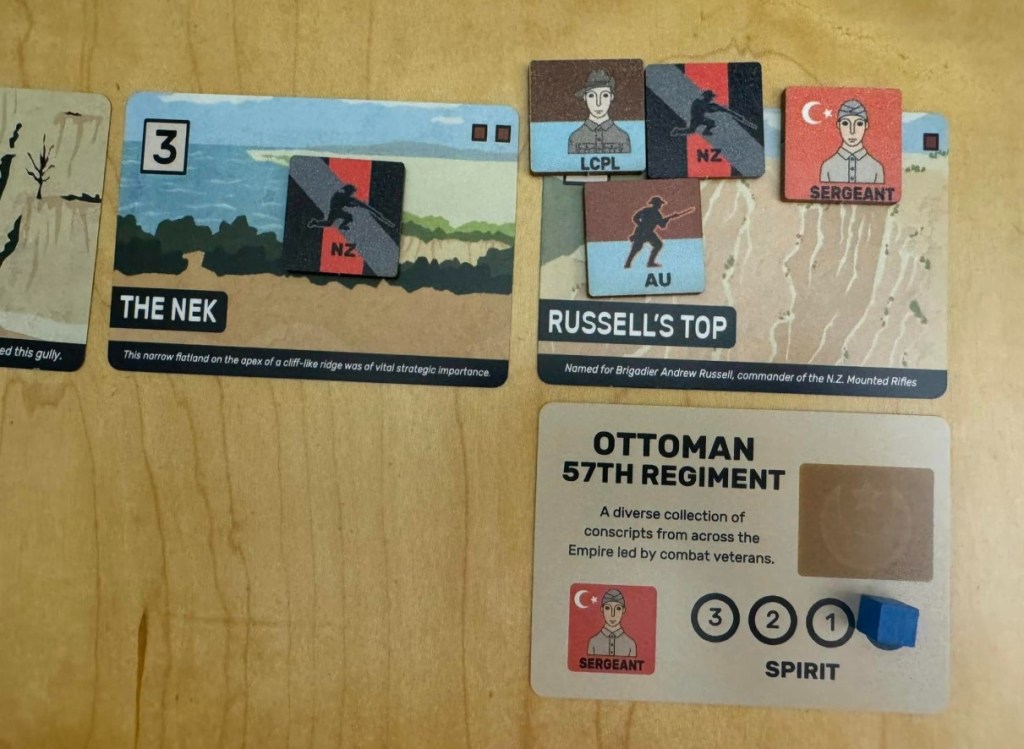
The Landing: Gallipoli 1915 is a narrative solitaire wargame that tells the story of the Australian and New Zealand Army Corps (Anzac’s) and their landing on the beaches of Gallipoli in the early morning of April 25th, 1915. The game is a simple and fast playing take on the situation and is designed to cause the player to reflect on the event and how it effects those brave soldiers who fought in this campaign. The mechanics are pretty simple and use combination of card-driven gameplay and action economy, where the player has to make choices about how to use their few troops most effectively to move up the beach. The game doesn’t use a traditional board but creates the game board through the random drawing and layout of the Site Cards to provide the player with a new and unique approach each time. The victory conditions in the game are simple and the player must occupy and control the Third Ridge (7th Map Card) by the end of the Dusk Round. If you do, then you are victorious. Anything less is a loss and will result in a descent into the horrors of trench warfare.
I recently played the game several times and very much enjoyed the time I spent with The Landing: Gallipoli 1915. While it has yet to be posted on our YouTube Channel, I did just shoot a 39-minute playthrough video (which I lost…again!) & a 24-minute review video. Great little solo card game that plays in 15-30 minutes.
We did however post an interview with the game’s designer Joe Schmidt on the blog (when the game was being called Anzac Cove mind you), and you can read that at the following link: https://theplayersaid.com/2020/01/13/interview-with-joe-schmidt-designer-of-anzac-cove-self-published/
Catastrophe Games has graciously provided us with the following discount code. Discount Code: TPA2024 for 15% off at their online store only on Catastrophe Games items..
If you are interested in The Landing: Gallipoli 1915 2nd Edition, you can order a copy for $25.00 (if using the code just $21.25) from the Catastrophe Games website at the following link: https://catastrophegames.net/the-landing-gallipoli-1915/
Card Driven Games
The Card Driven Wargame uses cards to provide points to build and activate units and also provides historical events that effect things throughout the game. I chose 3 games using the mechanic.
1793: Patriots & Traitors from Sound of Drums
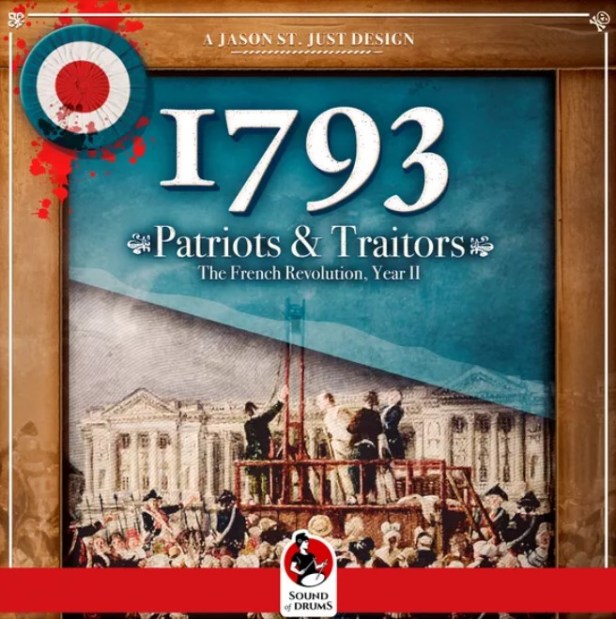
If you are looking for a really well produced and beautiful game covering the French Revolution, you don’t need to look any further. 1793: Patriots & Traitors is a new offering from Sound of Drums and is simply gorgeous. The components appear to be top notch and the game looks very interesting as it is a Card Driven Game.
1793: Patriots & Traitors recreates the chaos that tore up France in the years 1792-1794 as it has never been done before!
Each of the players belong to a political faction, each with their own objective. Although engaged in a brutal political tug-of-war, they WILL have to work together to prevent the armies of Austria, Prussia and Sardinia-Piedmont from reaching Paris, thereby crushing the Revolution and ending the game prematurely…for everyone!
1793: Patriots & Traitors is a very compact CDG game that makes use of multi-functional playing cards to allow the players a broad range of decisions…and rest assure that every decision made has its consequences. With them, the players will be able to influence a number of areas in Paris (National Convention, Palais-Egalité, the Paris streets…) or the provinces. Each controlled area offers certain benefits…or will help them to perform a Coup d’Etat or Civil War if things turn for the worse…
Also included are the various revolutionary protagonists such as Robespierre, Danton, Marat, Brissot who can help their faction to achieve their objective IF they are not arrested or assassinated in the meantime!
Core mechanic is the possibility of making of laws for the new Republic which will change the game rules or even alter the board…of course: it’s a Revolution!
Be prepared for a warm and asymmetrical game of high replayability that will allow you and your fellow patriots to relive the French Revolution: from the heated discussions in the National Convention to the angry streets of Paris and from the cheering crowds around the bloody guillotine to the gun smoke filled battlefield of Fleurus!
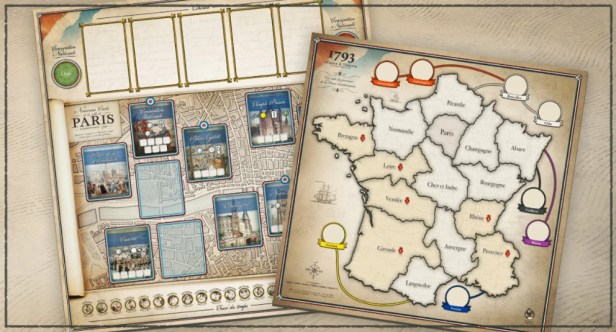
Also if you prefer your games solo, 1793: Patriots & Traitors includes a solitaire mode. In the mode, you will be able to play the Conservative Feuillants or the Radical Jacobins. The non-active moderate Girondins and Ultra-Radical Cordeliers will function as the ‘AI’ which you must try to influence in order to make them your political ally…In both systems, the actions and events during the course of the game are determined by the symbols at the bottom of the cards, offering a faster paced game, but with the same pressure and challenges.
We published an interview with the designer Jason St.Just and you can read that at the following link: https://theplayersaid.com/2024/04/08/interview-with-jason-st-just-designer-of-1793-patriots-traitors-of-sound-of-drums/
While we have not had a chance to play the game yet, Alexander did an unboxing that you can check out at the following link:
Sound of Drums has graciously provided us with the following discount code. Discount Code: TPA2024 for 10% off at their online store (this code will work just one time).
If you are interested in 1793: Patriots & Traitors – The French Revolution, Year II, you can order a copy for €79.00 ($83.71 US Dollars) (if using the code just €71.10/$75.34 US Dollars) at the following link: https://soundofdrumsgames.com/shop/1793-patriots-and-traitors-the-french-revolution-year-ii/
Votes for Women from Fort Circle Games
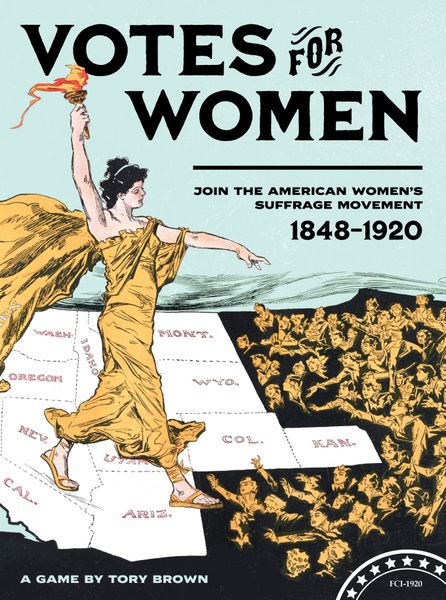
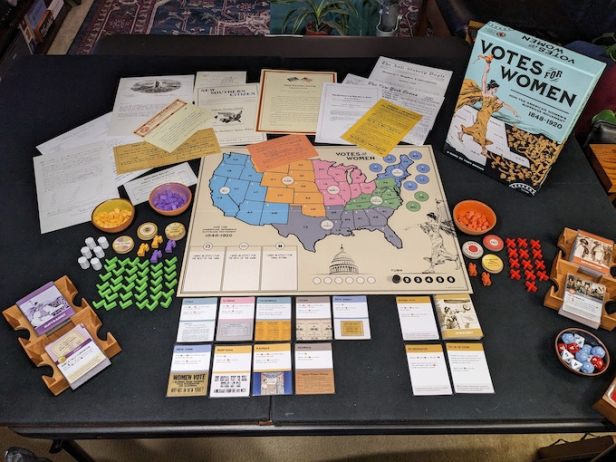
I love the Card Driven Game mechanic as it allows for designers to add in a lot of exceptions to rules without changing the rules because of the cards. I also love the ability to tell the great stories of all types of history. Votes for Women is a card-driven game covering the American women’s suffrage movement from 1848-1920, culminating with the ratification of the Nineteenth Amendment. The game provides competitive, co-operative and solitaire play, with co-operative and solitaire play against the “Oppobot.”
This game is really very good and tells about such a great moment in our countries history. The designer Tory Brown did a great job with this and it is truly a very fun game to play but also provides you with lots of opportunities to learn. The production is also top notch and the game is absolutely beautiful!
We published an interview with the designer Tory Brown and you can read that at the following link: https://theplayersaid.com/2020/09/07/interview-with-tory-brown-designer-of-votes-for-women-from-fort-circle-games-currently-on-kickstarter/
If you want to know more, you can check out our video review at the following link:
Fort Circle Games has graciously provided us with the following discount code. Discount Code: Votes15 for $15.00 off Votes for Women only.
If you are interested in Votes for Women, you can order a copy for $75.00 (if using the code just $60.00) from the Fort Circle Games website at the following link: https://www.fortcircle.com/
1979: Revolution in Iran from The Dietz Foundation
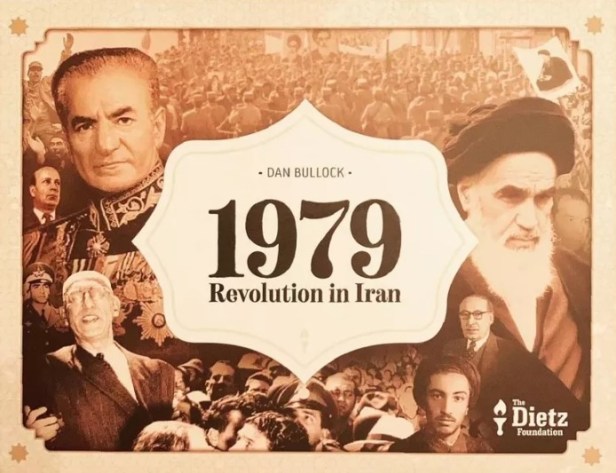
From the beautiful mind of Dan Bullock, this small card driven game on the 1979 Iranian revolution is just deliciously good. 1979: Revolution in Iran is a national-level strategic wargame covering the events leading up to the 1953 coup, the Islamic Revolution and the turbulent period in between. Players will play as either the Coalition, pushing to nationalize the oil industry and, later, rise to oppose the Shah and remove him from power or as the Royalist, fighting to keep the Shah, Mohammed Reza Pahlavi in power and protect American and British oil interests.
This game is fabulous and I cannot recommend it enough. Unlike many other CDG’s, each turn begins with a draft of event cards before alternating action rounds. Factional influence is each player’s primary resource. It is used to trigger events, take actions and most importantly, mount opposition to those in power. Scoring is not open information, keeping tension front and center from start to finish.
We posted an interview with the designer Dan Bullock on the blog during the Kickstarter and you can read that at the following link: https://theplayersaid.com/2021/04/15/interview-with-dan-bullock-designer-of-1979-revolution-in-iran-from-the-dietz-foundation-currently-on-kickstarter/
If you want to know more, you can check out our video review at the following link:
If you are interested in 1979: Revolution in Iran, you can order a copy for $60.00 from The Dietz Foundation website at the following link: https://dietzfoundation-org.square.site/product/1979-revolution-in-iran-2nd-ed-/9?cp=true&sa=true&sbp=false&q=false
Waro’s (Hybrid Euro Wargames)
Waros (from the fusion of the words “war” and “euro”) are games which can be described as a fusion of a Wargame and a Eurogame. Waro games include aspects of both types of games, including the use of colored wooden cubes to represent forces and the use of cards.

Conflict of Wills: Arabian Struggle from Catastrophe Games
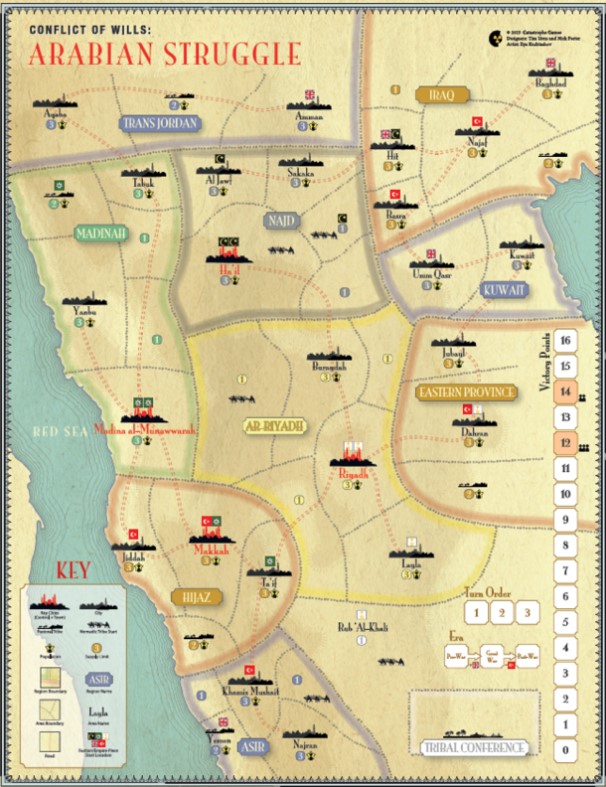
A couple of years ago we had the chance to play and do a preview video for a new series called Conflict of Wills from a new publisher in Catastrophe Games. The first game in the series was called Judean Hammer designed by Robin David and was a very interesting and unique card driven area control game. Now, this series is being expanded by a few new designers into a game called Arabian Struggle covering the conflict for the Arabian Peninsula in the early 20th century.
I had the opportunity to play the game with the development team, including owner Tim Densham and Jim, along with the guys from Legendary Tactics during Gen Con at my place. We had a great time and the game plays in about 90 minutes (quicker once you get the rules down and know the cards a bit better). The game play is fast and furious and it has many of the tenants of a Card Driven Game where players play the cards for the printed event if they are aligned with your faction or for the Operations Points if not and then the event will go off for the aligned faction. The unique elements to the game were two fold. You are not only competing against the other 2 players in the game, trying to come out on top among the various Arab factions, but you are also fighting against the convulsing and dying Ottoman Empire and their forces as well as the British as they come into the region looking to exert their control. Secondly, as an area control game, you are desperately fighting to control as many areas as possible to score Victory Points at the end of each round. But, there is a unique element of moving nomadic groups around the board to increase your population in areas you control which will give you more weight in the areas and push you over the top for ultimate control. Really slick little game and I had a great time. The LT guys also enjoyed it and even though Randy is not a big fan of CDG’s he also felt the game was very solid.
Catastrophe Games has graciously provided us with the following discount code. Discount Code: TPA2024 for 15% off at their online store only on Catastrophe Games items..
If you are interested in Conflict of Wills: Arabian Struggle, you can order a copy for $50.00 (if using the code just $42.50) from the Catastrophe Games website at the following link: https://catastrophegames.net/arabian-struggle/
Limits of Glory: Bonaparte’s Eastern Empire from Form Square Games
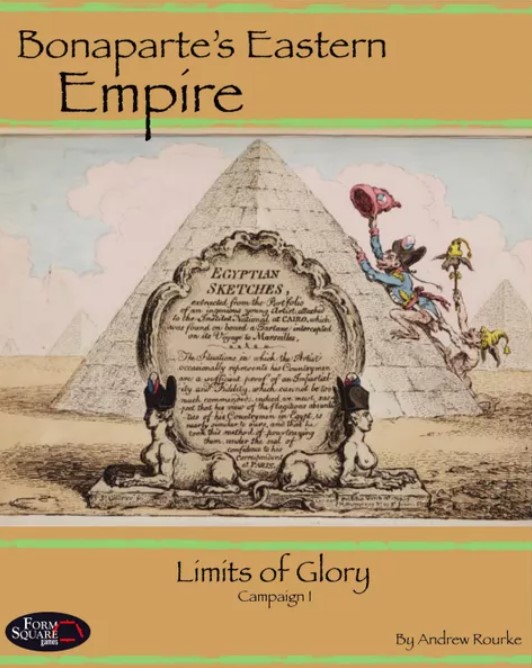
A few years ago, we became acquainted with Andrew Rourke through his Coalitions design from PHALANX that went on to a successful crowdfunding campaign. He has since been a busy guy with starting his own publishing company called Form Square Games and also starting the first design in a new series called Limits of Glory that will take a look at the campaigns of Napoleon. In Campaign I, which is called Bonaparte’s Eastern Empire, the game is focused on the campaign of the French in Egypt between 1798 and 1801. It covers everything from the invasion fleets leaving France trying to avoid Nelson and the British Navy, to the final surrender of the remnants of the French Army to an Anglo-Ottoman force in 1801. The game is very interesting and uses some new ideas to focus on the luck and skill of commanders through a mechanic called the Glory Rating. This Glory Rating can be used as a type of currency by commanders to do several things such as reroll dice for movement or in battle. This becomes a sort of push your luck and resource management aspect and the players who more wisely use this scarce resource will find themselves victorious.
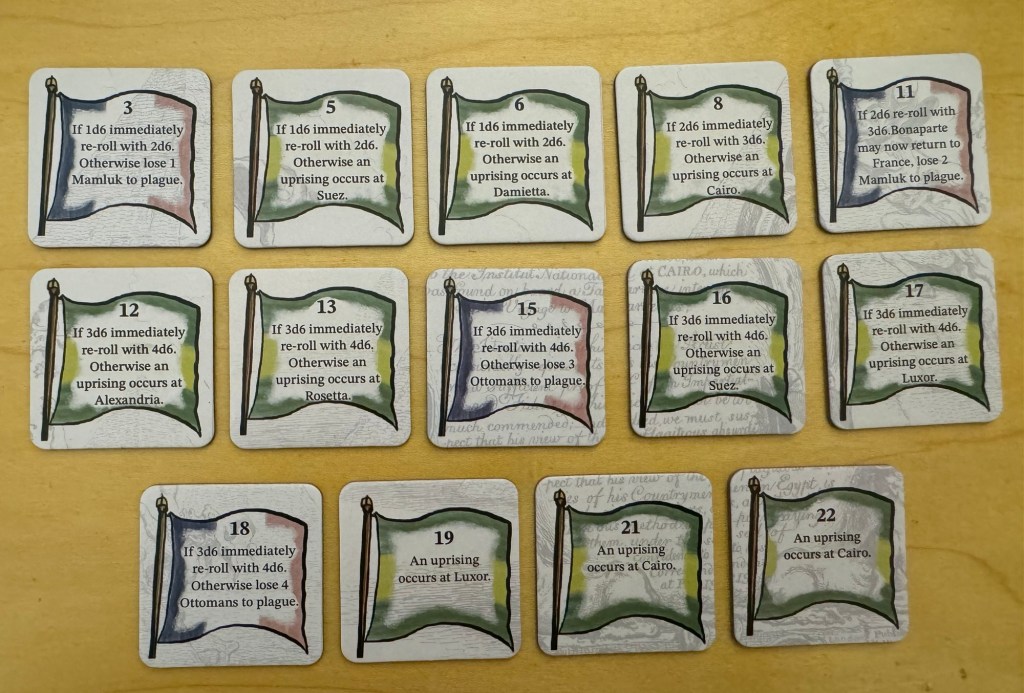
One of the most unique and interesting parts of the design was the Event Clock. This Event Clock is the mechanic that drives the game and keeps things moving along. The design of the Limits of Glory Series doesn’t use things like traditional Event Cards and instead the Event Clock is the means to introduce various events that create some semblance of chaos and the unknown. But, this mechanic is not just about chaos as it will also provide both sides with things such as reinforcements, bring in the British to the struggle, add new previously unavailable leaders that can change the game and other effects. First, let’s take a look at the makeup of the Event Clock.

The Event Clock is a separate thick cardboard board that has 24 numbered flags, which each have a different unique event written in the space. The flags are tied to the nations that are involved in the conflict including the French, British, Ottoman and Mamluks and the flag in the space represents which of the nations will benefit from the event. You will notice that there are Event dice markers found along the left edge of each of the rows. The first event of the game is always determined by rolling a single D6 and consulting the Event Clock. Once the first event is determined by this die roll, the players will have to place the one (1) dice marker over the space for it on the left edge of the Event Clock. The number of dice to be used and totaled to decide the event changes from 1 die to up to 4 dice as the game progresses. The two (2), three (3) and four (4) dice markers are placed on their spaces as reminders when the number of dice to be used for the determination changes. This process and the number of dice that are to be rolled can determine what events can be played this game and will eliminate the occurrence of some events. At first, I didn’t really like how this worked but after playing, and then discussing and thinking about the mechanic, it really makes for a very uncertain outcome and can drastically change the fortunes of players. This keeps the game a bit chaotic and also changes the possible outcomes and improves replayability.
In the Limits of Glory Series, each named commander, whether they are military or naval, has a Glory Rating. This Glory Rating is a concept that the designer Andrew Rourke based this system on and it involves a look at history and the abilities and victories of commanders as a combination of skill, training and forces but also including the luck factor into the equation. You know the old saying “Better to be lucky than good”. This Glory Rating is a key focus of the game and is used as a resource by the players to effect the outcome of battles through a manipulation of the die rolls.

Each commander in the game has their Glory Rating established when they enter the game and after the appropriate circular Position Marker is placed out on the Map Board. The Glory Rating is expressed typically as a numeric value, which is considered the base Glory Rating, followed by a specified number of +d6 that will be rolled and then added to the base Glory Rating to calculate the commander’s Glory Rating for the entirety of the game. As you can see in the above picture, each commander is shown on their side’s Command Chart and below their name where their Position Marker is located is shown this Glory Rating formula.

The number of dice shown for the commander are then rolled and totaled and the indicated base fixed number is added together. The players then place the appropriate commander’s individual Glory Marker on the numbered track to show the result. Let’s take a look at a quick example. We will look at the Navy Commander Hood who has a base Glory Rating of 7 and then has +2d6 rolled and added to the total. The dice are rolled and result in a 3 and a 5 for a total of 8 which is then added to the base fixed Glory Rating of 7 to come up with the final Glory Rating of 14 (7 base Glory Rating +7 from 2d6 = 14). The marker is then placed on the 14 space on the numbered track.
So what is Glory used for in the game? It is a great resource to use to re-roll dice. Keep in mind that using Glory in this way represents a combination of a commander’s historical skill and how lucky they appear to have been in the campaign. As Glory is used up, a commander’s marker is moved down the number track to indicate their reduced rating. A commander’s Glory is reduced to re-roll dice during the game at the rate of one glory point per single re-roll. Any number of dice can be re-rolled once by the owning player and any successful combat dice of an opponent can be required to be re-rolled once. This was one of the parts of the design that was so very interesting. It made the process of combat very difficult for the Allied Command as they Mamluk and Ottoman commander’s Glory Ratings were very low as compared to the French and even the British values are not as goo das the French. And this isn’t necessarily surprising but once concern I had was that the rolls needed to hit for the Allies typically are much harder to come by than for the French. And I know that historically this is accurate based upon the fighting prowess and abilities of the commanders on that side but it did make for a very difficult prospect for the defense of Egypt.
If you want to know more, you can check out our video review at the following link:
Form Square Games has graciously provided us with the following discount code. Discount Code: PLAYERSAID15 for 15% off their only available game (Bonaparte’s Eastern Empire).
If you are interested in Limits of Glory: Bonaparte’s Eastern Empire, you can order a copy for £72.00 ($91.26 US Dollars) (if using the code just £59.50/$77.57 US Dollars) from the Form Square Games website at the following link: https://www.formsquaregames.com/shop/p/limits-of-glory-bonapartes-eastern-empire
War Story: Occupied France from Osprey Games
Who doesn’t love a good challenge? A game that causes you to struggle and feel the difficulty of the task before you. And also offers a bit of insight into the historical event. One of the things that I love most about Cooperative Games is that, more often than not, they are designed as a really challenging experience. In fact, we often say in our group, a good Cooperative Game must be difficult and if it is too easy then it is not a good one. You see if you win too easily or even on the very first play, the mystique of the game is shattered and you don’t necessarily fear or respect the game as much as you did. Also, its kind of like winning the Super Bowl. Once you have climbed that mountain, the desire and urgency to do it again lessens and your effort and desire suffers. But I also like the element of teamwork in these Cooperative Games. Thinking through the best course of action, providing support to other players, helping them out to help out the group and discussions of strategy and tactics. Always great fun and creates an atmosphere of cooperation.
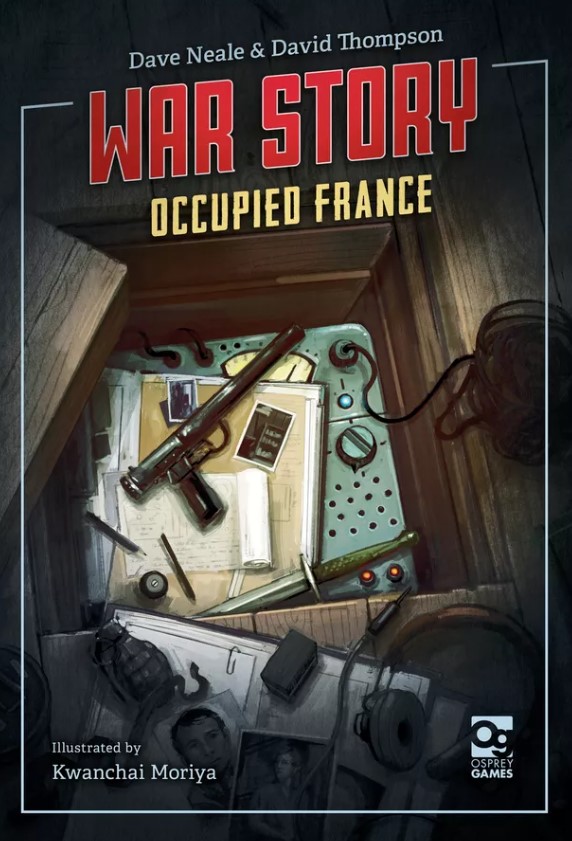
This past weekend, we had the pleasure of playing a new historical cooperative game called War Story: Occupied France from Osprey Games. We didn’t only play it but we had the chance to play it with one of the designers David Thompson. He partnered with Dave Neale on this game and it mixes a lot of great elements into a very smooth playing and interesting experience. War Story: Occupied France is a cooperative narrative game for 1-6 players set in World War II occupied France. The game is a scenario based endeavor where the players take on the roles of covert operatives from the Special Operations Executive (SOE), which is a British organization formed in 1940 to conduct espionage, sabotage, and reconnaissance in German-occupied Europe, to aid local resistance movements during World War II. The game merges narrative driven decisions that the players will have to make along with the management of resources and equipment all against the backdrop of a mission that has limited time to be completed before it grows too late to gain the objectives identified. The game was a fantastic experience and we really had a great time playing.
The game has no board and relies on smaller components such as maps, dossiers, orders and cards to draw out the narrative of each of the 3 scenarios included in the box. Each scenario has a fully fleshed out narrative that is driven by the players and their choices and uses a narrative booklet with well over 500 written encounters for each scenario. Players will simply make a choice, read a paragraph from the booklet, sometimes being asked to pass a test using their character’s skills and then being directed to another entry in the book where they will find out what happens and how it effects their ongoing mission. The simplicity of the system is that there are no dice to roll and you simply use the Attribute number shown on the character’s card to determine what entry you then move onto. The Attributes shown on each character card include Awareness, Influence, Stealth and Technical and they also have a Firearms Skill shown at the top of the Attributes. These Attributes range from 1-3, with 1 being basic and a 3 being considered advanced.

For example, a test might ask you to add up the total values of all character’s Influence Attributes and then compare that number to the 2 or 3 ranges of results listed to determine what paragraph to go to. The ranges might be 2 or less, 3-5 or 6+ and each of these will point the character to a paragraph to find and then read to find out what happens. We found that the low band of results is typically not great, as you either are spotted, don’t observe enemy movements, or upset those you are interacting with, while the middle band is a mixed bag with some good and some bad but the high end is almost always good. If your Attributes just aren’t great because of the Agents you chose, you can use your limited amount of Skill Tokens, Firearms Tokens or Advantage Tokens to increase your Attribute total to potentially achieve a higher band of results. But you only have a few of these and you will have somewhere between 30-40 different encounters and Checks throughout a game so you have to use them judiciously for those Checks that really matter. Now, after saying that I would say that every test matters but some seem to matter more as you are looking for a key piece of information or need to win over a contact to help you with something. And knowing when those are the key moments is a part of the mystery of the game but we found that after playing for a while we could feel something’s import. The management of these resources and the way these Checks come are just really well done and feel genuine historically as well as very thematic and interesting.
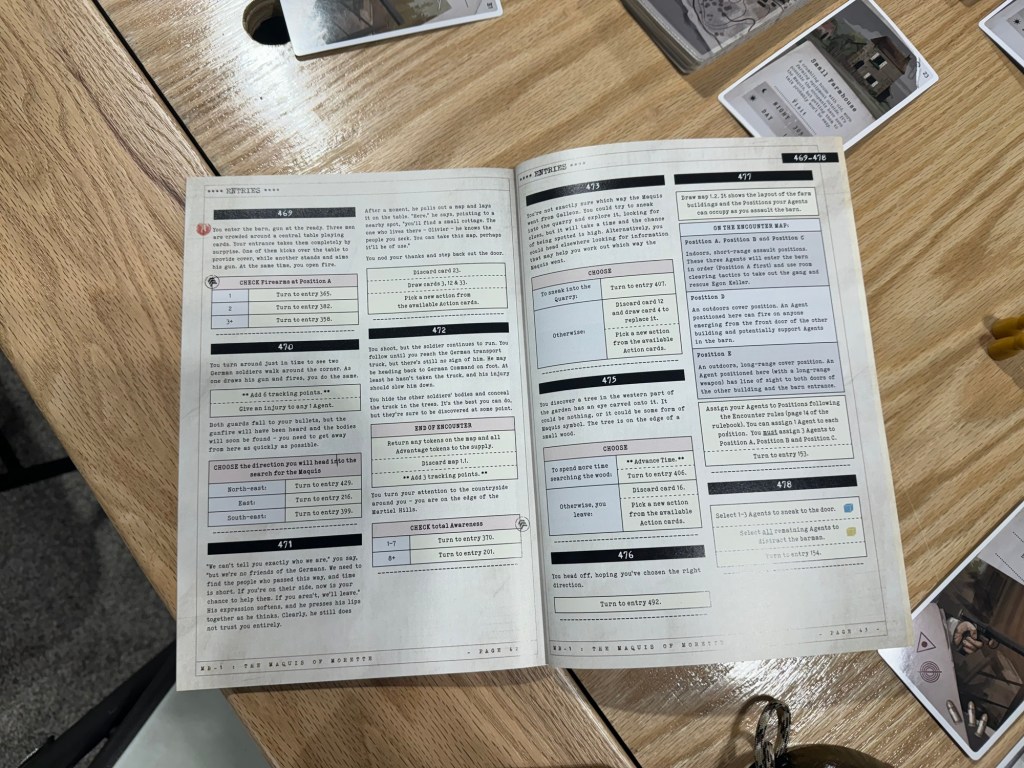
I will try to give a simple example of what I am trying to talk about. Early on in our scenario, we came to an area where there was a grouping of a few important buildings, including a few farmhouses and a suspected German listening post. As we were reading the paragraph, they described each of the buildings and I immediately caught onto something that seemed to be very important about the upkeep and look of the 2 farmhouses. I went with my hunch and we decided to approach the poorer maintained and less fancy of the 2 as we thought that maybe the farmer that was doing better, at least outwardly, was probably not going to be friendly and possibly even was a collaborator. This paid off and we had a key discovery at that time that lead us to the next step in our search for the hidden Maquis base. But, later on we returned to the uppity farmhouse only to find that they had left and the place looked like it had been ransacked. Maybe by the Maquis as retribution or by the neighbor who was emboldened by our visit and support of the Maquis. That leads me to another very interesting concept about this game…that of timing and how the passage of time will change the outcome of certain encounters.

The game is about trying to accomplish the most that you can toward finding out the hidden parts of the scenario you are playing. The world building and ecology here in this game is fantastic and very well done as an early encounter at the same location will be totally different if you visit that later on in the game. How did they accomplish this? Well, that is where Dave Neale and his writing talents came into play (now I know that David also had a lot to do with this as well). When they laid out the scenarios, they used a decision platform to literally plan out how the various parts and pieces of each of the encounters would work together and even separately. This took hundreds and hundreds of hours of copy editing, critical reading and thorough review to ensure that each part of the over 500 entries in these scenarios made sense and worked together in real time. I will refer to my DM experience here as when I put a dungeon or session together for my players in D&D, Pathfinder or any other number of roleplaying games, I always try to envision and consider how the occupants of the dungeon, castle, outpost or city will interact with the characters and also how they will react to stimulus created by the actions and decisions of the party that I am guiding through the dungeon. When they kill the inhabitants of a room and then they move on, who might wander in to discover the grisly scene and how will this knowledge of intruders change the actions that the other denizens of the dungeon will take? Will they prepare themselves for the marauding invaders by building defenses, setting traps, or even leaving an area of the dungeon to recruit other defenders? The same thing has been focused on in these scenarios and it really creates a very interesting and living interaction with this fictional situation in an historical setting and really is one of the best parts of the game. One other point about the Action Cards that used in relation to the passing of time. Each of the cards has two choices of where to go in the scenario booklet when the players interact with the location based on whether it is day time or night time. Time is tracked in the game and will progress as the players go through the different locations and search for these clues and contacts.
I wrote an in-depth look at the game and its systems in my First Impression post and you can read that at the following link: https://theplayersaid.com/2024/10/22/first-impressions-war-story-occupied-france-from-osprey-games/
If you are interested in War Story: Occupied France, you can order a copy for $55.00 from the Osprey Games website at the following link: https://www.ospreypublishing.com/us/war-story-occupied-france-9781472858740/

300: Earth & Water from Nuts! Publishing
300: Earth & Water is a simple 2-player card driven wargame where 1 player controls the Greeks, gathered around the Athenians, and the other controls the Persians, fighting for the hegemony of the eastern Mediterranean. Through all five expeditions or turns, each player aims to control more cities than their opponent. The Persians are a bit more powerful than the Greeks at the outset and it is important for the Greeks to plan well and also to take advantage of their enemy’s aggressiveness.
The game engine is a card driven and players will raise armies and buy cards during production. This buying of the cards is one of the real highlights of the design as you have to make this choice at the outset of the buying and not after you have already bought a card and seen what it gives you. Cards can be used to play an event or move an army or fleet. Events can provide advantages in battles or interfere with the enemy, but military action, especially for the Persians, is required to win. Each game will change dramatically according to the order the events occur and because of this the game is highly replayable.

Just a fantastic little wargame in a small package and is really my favorite of these type of games. The good news is that there are more battles coming to this Combat Rations Series and I cannot wait to see what they tackle in the future.
If you want to know more, you can check out our video review at the following link:
Nuts! Publishing has graciously provided us with the following discount code. Discount Code: TPA20#2024 for 20% off.
If you are interested in 300: Earth & Water, you can order a copy for 25.00€ ($26.47 US Dollars) (if using the code just 20.00€/$21.19 US Dollars) from the Nuts! Publishing website at the following link: https://www.nutspublishing.com/eshop/300-en
The Great Northern War from Conflict Simulations Limited
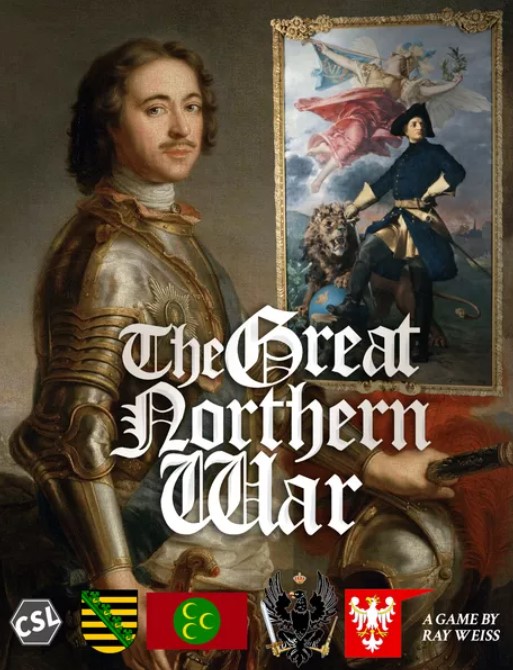
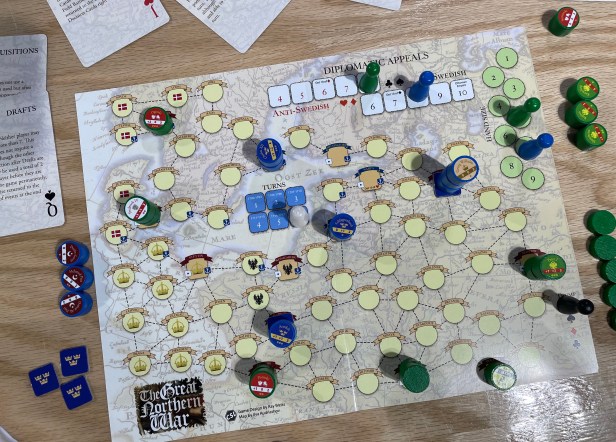
Raymond Weiss has designed some pretty solid wargames over the past few years including titles like SCS Rostov ‘41 from Multi-Man Publishing, 1950: The Forgotten War from Conflict Simulations Limited and 1914: At Villers Cottérêts also from CSL to name just a few. These games are pretty good and we have seriously enjoyed playing them. But recently Ray appears to be on a bit of a design journey. What I mean by this is he is playing all types of games not just wargames, including Euros, Roll and Writes, Card Driven Games and even some trick taking games, all in an effort I believe to see how these mechanics and forms fit into wargaming. He is experimenting and recently we played one of his new experimental games called The Great Northern War from Conflict Simulations Limited. The Great Northern War covers the conflict between Sweden and a coalition between Russia, Denmark, Poland and Saxony in the early 18th century. The conflict commenced once Charles XII of Sweden ascended to the throne and this struggle was over control of the region. As many of you may know, at the time, Sweden was a major player in the area and had a significant military presence known for their skill in battle.
The concept of trick taking is usually found in card games such as Euchre, Hearts, Pinochle and Spades or any other number of games. The players will use their cards to outduel each other to win a trick that will be held for points later in the round. Typically, these games have what is called a Trump Suit that can be used to overpower all other suited cards in a single trick to win unless someone else plays a higher valued Trump card over yours. The mechanic keeps a game lite but creates great moments of strategy as players have to decide how to play their cards and in what order when they are in control. If a player plays their cards properly, they can smoke out other Trump cards or can win tricks by simply having the highest valued cards of the suit that is played. Understanding the table and what cards the other players might be holding based on the contents of your hand and what has been played in the round is also very important and I see this as the single most in common element of trick taking games with wargames. I enjoy Euchre a lot and played tons of it in high school and at college but have gotten away from that type of game over the past 10 years or so.
The game utilizes a normal deck of cards, but there are namely 2 types of cards in the game. Normal cards in a player’s hand range from 2-10 and represent all 4 of the major suits including Hearts, Diamonds, Spades and Clubs, and then all the face cards and jokers are Decision Cards, which can be bought by either player and then be used to break rules within the framework of the game, and/or get modifiers for manipulating hand size, movement or combat. Decision cards are open to each player and can be bought at any time with some exceptions for various cards which require other things to take place on the map first, such as controlling an objective.
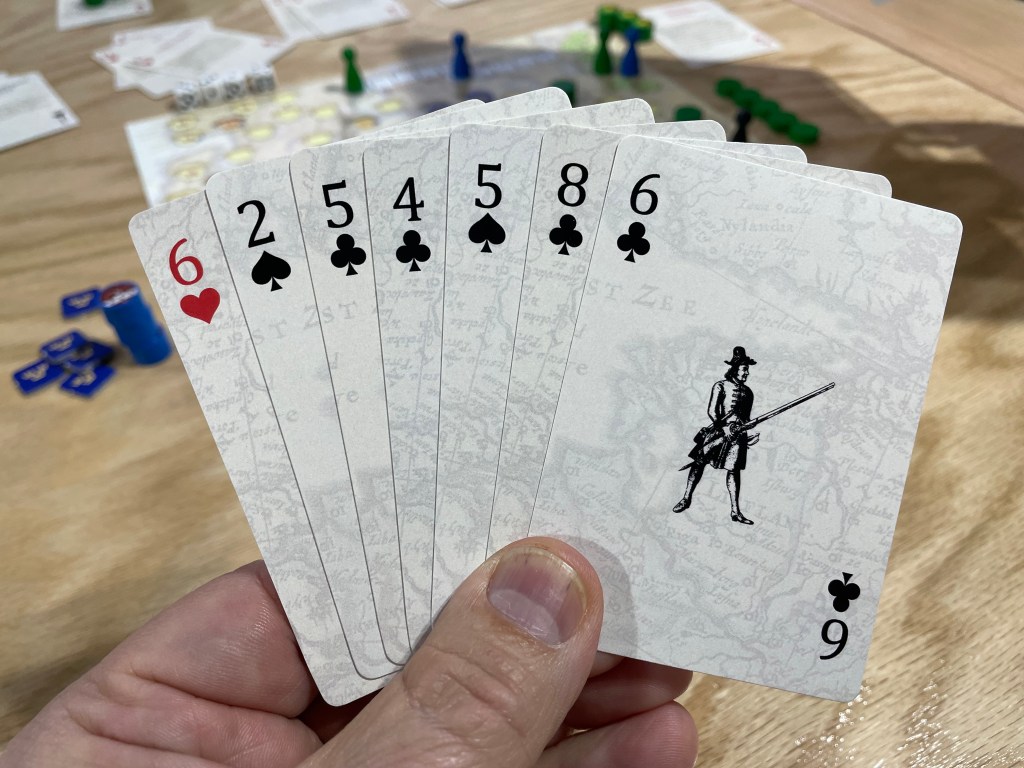
The main driving mechanic of the game involves trick-taking, so a vale/suit which a player leads with whenever taking an action is more about their tactics. The really interesting part of the game is that the current round’s Trump-suit is randomly determined each round which makes every turn truly unique. This happens as the first card of the round is turned over from the deck and then players take note of the suit as it will represent the Trump for the round. Players then are going to play a card from their hand against each other to win this card. This is called the Planning Tricks and is a very important aspect of the game to grasp. Winning the trick is great if the card that is showing is a good card, meaning the number value is high (either a 7, 8 or 9) or it belongs to the Trump Suit. This is really one of the great parts of the design and gets the players thinking and considering how they are trying to build their hand for the upcoming turn and for what purpose. This war off aspect is simply comparing the numbers of the played cards and the player who played the highest card or a Trump Card will win that trick and claim the faceup card. The loser will get to draw a random card off the top of the deck, which can be a blessing or a curse as you just don’t know what you are going to be getting. This is done 2 times and the players will add 2 new cards to their drawn hand. We very much enjoyed this one and have played it several times.
If interested, we posted an interview with the designer Ray Weiss on the blog and you can read that at the following link: https://theplayersaid.com/2024/04/15/interview-with-raymond-weiss-designer-of-the-great-northern-war-from-conflict-simulations-limited/
You can also read more into my first impression thoughts on the game at the following link: https://theplayersaid.com/2024/04/23/first-impressions-the-great-northern-war-from-conflict-simulations-limited/
If you want to know more, you can check out our video review at the following link:
Conflict Simulations Limited has graciously provided us with the following discount code. Discount Code: PLAYERSAID for 15% off their online store.
If you are interested in The Great Northern War, you can order a copy for $49.99 (if using the code just $42.49) from the Conflict Simulations Limited website at the following link: https://www.consimsltd.com/products/the-great-northern-war
Stocking Stuffers
Here are some additional smaller format games and items that are ideal for “Stocking Stuffers” or small gifts for your beloved wargamer.
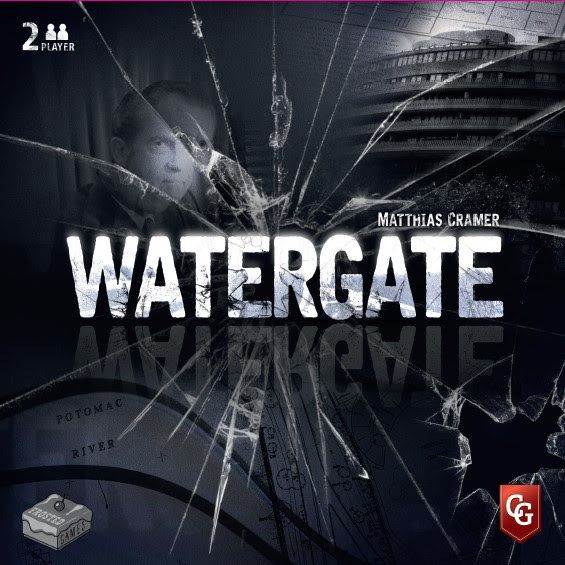
Watergate from Capstone Games
We love tug of war style back and forth struggles that deal with history. Some of our favorite games are in this category, such as Twilight Struggle and Fort Sumter from GMT Games, 13 Days from Ultra Pro International, etc. Watergate is also a tug of war card game that deals with the Watergate Scandal of 1972 when President Richard Nixon tried to avoid the investigations of The Washington Post who was looking for the truth that Nixon knew about the break-in at the Democratic National Convention HQ. This game is a really well done fast playing (but with depth) back and forth affair that brings light to an interesting time in the history of the United States Presidency.
If you want to know more, you can check out our video review at the following link:
Capstone Games has graciously provided us with the following discount code which is good for the purchase of Watergate only. Discount Code: TPA2024 and gets the game for 30% off until December 1, 2024.
If you are interested in Watergate, you can order a copy for $34.95 (if using the code just $24.46) from the Capstone Games website at the following link: https://capstone-games.com/board-games/watergate/
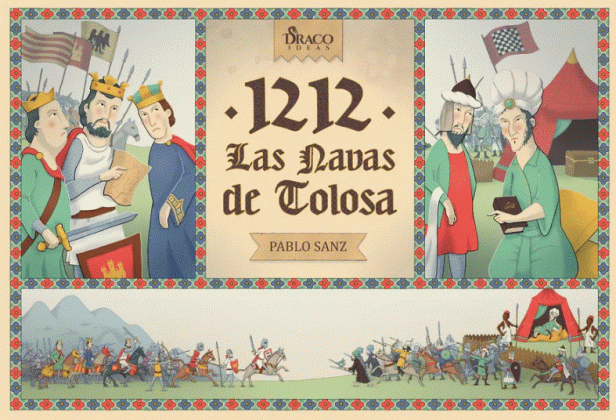
1212: Las Navas de Tolosa from Draco Ideas
After the defeat at Alarcos in 1195, the Castilian kingdom lost control over the Guadiana and Tagus valleys, and even the city of Toledo was in danger from the Almohad advance. After years of instability, Alfonso VIII finally reorganized his army and planned his revenge, persuading the Pope to declare his longed-for confrontation with the Muslims a Crusade. Finally, in 1212, the Christian troops of Castile, Aragon and Navarre, supported by the military orders and numerous knights from other kingdoms, engaged in battle against a far superior Almohad force in what would become known as the Battle of Las Navas de Tolosa. Today you can put yourself in the shoes of these brave fighters and rewrite their history.
1212: Las Navas de Tolosa is a small box format, asymmetric, two-player abstracted wargame in which Almohad and Christian troops face each other, reliving the emblematic battle of the Reconquista. The system creates fast playing games and a very contained deployment, in which the battle is decided in about 30 minutes, with a card engine to determine the initiative and the outcome of the combat.
If you want to know more, you can check out our video review at the following link:
Draco Ideas has graciously provided us with the following discount code. Discount Code: aid20 for 20% off everything on their site.
If you are interested in 1212: Las Navas de Tolosa, you can order a copy for €25.00 ($26.47 US Dollars) (if using the code just €20.00/$21.19 US Dollars) from the Draco Ideas website at the following link: https://dracoideas.com/editorial/en/1212-las-navas-de-tolosa-english/

SCOPE: Panzer from Draco Ideas
SCOPE: Panzer is a tank combat card game set in the European theater of WWII. One player leads a squad of American tanks, which faces a squad of German tanks commanded by the other player, in a battle of ambush tactics and close-range encounters.
The game is designed to play in 30+ minutes and is pretty well done and creates some real tension and need to good tactics. Games in the SCOPE Series are fast, abstract tactical card games that recreate, with easy and thematic rules, three exciting episodes of World War II, in which concealment plays a determining role. In addition, the SCOPE Series games also have advanced rules for the most demanding players in order to be more appealing to new gamers as well as veterans.
SCOPE are actually area games, played on a playing field formed by the cards as a game board. No shuffling, no cards in hand, no cards to draw. The cards actually represent areas and units on the playing field. We use cards because they allow very affordable products and because they are very appropriate for concealment for games like SCOPE.
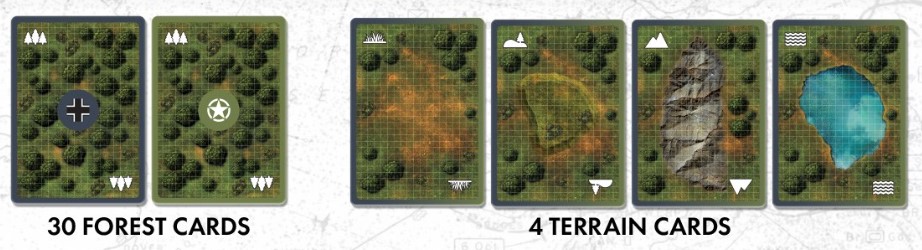
The game is pretty fun and I had a good time playing this with my wife this summer (we have a video review coming but it has not been uploaded to the channel).
Draco Ideas has graciously provided us with the following discount code. Discount Code: aid20 for 20% off everything on their site.
If you are interested in SCOPE: Panzer, you can order a copy for €15.00 ($15.89 US Dollars) (if using the code just €12.00/$12.71 US Dollars) from the Draco Ideas website at the following link: https://dracoideas.com/shop/en/scope-series/398-scope-panzer-0698142166403.html

General Orders: World War II from Osprey Games
Neat little fast playing games are always welcome on my table. Especially after we do a lot of big and involved wargames. David Thompson and Trevor Benjamin designed a simple game that is a worker placement wargame to simulate the struggles a commander has in attacking and defending against an opponent with limited access to various actions. General Orders: World War II pits competing commanders against each other in a tug of war for control over a crucial Second World War battlefield, either in the mountains of Italy or the islands of the Pacific. Players strive to seize crucial strategic assets that unlock special abilities, and prevent their opponents doing the same. Balance the desire to gain these advantages with the need to secure supply lines, ward off aerial assault and artillery barrages, and protect your vulnerable headquarters in this compact and elegant two-player game.
This game is pretty fun and is beautifully produced as well. I played this many times with my wife this summer and she very much enjoyed it.
If you want to know more, you can check out our video review at the following link:
If you are interested in General Orders: World War II, you can order a copy for $24.50 from the Osprey Games website at the following link: https://www.ospreypublishing.com/us/general-orders-world-war-ii-9781472859860/
Counter Trays from Cube4me.com
We are always on the lookout for good quality counter trays to assist us in taming our unruly components in our wargames. Recently, we became aware of Cube4me and looked into their products. They have customized trays for several main stream wargames.
Here is a link to the Cube4me website: https://cube4me.com/?r=playersaid
Here is a video showing off the trays from Alexander:
AEGIS Counter Trays from Flying Buffalo Games
We have been very impressed with the quality and size of these newer counter trays and have started buying almost all of our trays from Flying Buffalo Games from Amazon. These come in a 5-pack and they are very deep and hold a bit more counters than the typical GMT Games counter tray. Their lid sometimes pops off if you have the compartments too full so be aware of this or you might have a mess on your hands!
Here is a link to order the trays from Amazon: https://www.amazon.com/Flying-Buffalo-Organizers-Collection-AG_0001/dp/B09ZYPBB2D
In the end, no matter what presents you received under the tree or even whether you celebrate Christmas or not, both Alexander and I wish you a very Merry Christmas and hope that you have plenty of quality time to spend with friends and family, while staying safe and healthy, and are still able to get to roll some dice and consult some CRTs for the holidays! We feel extremely grateful for our associations with many of you, even though we have never met, and we consider each of you as members of The TPA Army and count you are friends! We have been extremely blessed in this venture of ours to share wargames with the masses and cannot believe that we have been doing it for nearly 9 years now!
I hope you also utilize the codes we have provided here and save money and also thank the publishers who participated.
-Grant
 The Players' Aid
Awesome write up Grant !Thx. Cheers – Neil Sent from my iPhone
LikeLiked by 1 person
On the subject of counter trays, a big thumbs-up to the Cube4me products, as well as the AEGIS counter trays with the extra space to hold wargame magazines in the same tray with their counters.
LikeLiked by 1 person
Yes. These 2 items are indispensable now and I am so glad for the improved storage solutions. Just makes playing big wargames so much easier.
LikeLike
Great suggestions, thank you!
LikeLiked by 1 person
What an incredible roundup of wargames and holiday gifting ideas! It’s great to see such a variety of titles and discount codes all in one place. I particularly appreciate your focus on the historical context of the games, as it adds depth to the gameplay experience. I’m especially intrigued by the “North Africa” games and their emphasis on supply lines—definitely a critical aspect of warfare that often gets overlooked. Looking forward to trying out some of these suggestions during the holidays!
LikeLiked by 1 person
Happy Holidays!
LikeLike
Thanks for including Lone Sherman on here Grant. So glad you enjoyed it.
Mike Lambo
LikeLiked by 1 person