There is always a need for introductory wargames in our hobby that can be used to teach the concepts of wargames to new players or that can be played fairly quickly as a change of pace. Very few designers focus on this area but Bill Molyneaux is one of those as he has designed several introductory wargames over the years including Bloody Mohawk, Savage Wilderness and Horns of the Buffalo to name just a few. He now has partnered with a new designer Kim Meints to create a game on the American Civil War battle of Wyse Fork in North Carolina in 1865. I reached out to Kim Meints and he was hesitant at first but eventually was more than willing to answer my questions.
Grant: Kim, welcome to our blog. First off please tell us a little about yourself. What are your hobbies? What’s your day job?
Kim: I’ve been retired for 15 years from the U.S Postal service after 30 years there as a Mail Handler on the loading dock working the late night shift. Before that I was in the Army (Vietnam/Cold War era). Day job now, if you can even call it a job, is running 12 Facebook groups and of course working with Bill Molyneaux and his BMG game company. Hobbies are reading military history and of course wargaming. I have a huge wargame collection in the thousands since I started in the hobby way back in 1969, so I’ve basically seen it all over the decades. I started so many wargame threads over on Consimworld and being on Board Game Geek (BGG) and in about every wargame group on Facebook I get lots of requests over the many years & decades for rules scans, magazine variants, etc.
Grant: What motivated you to break into game design? What have you enjoyed most about the experience thus far?
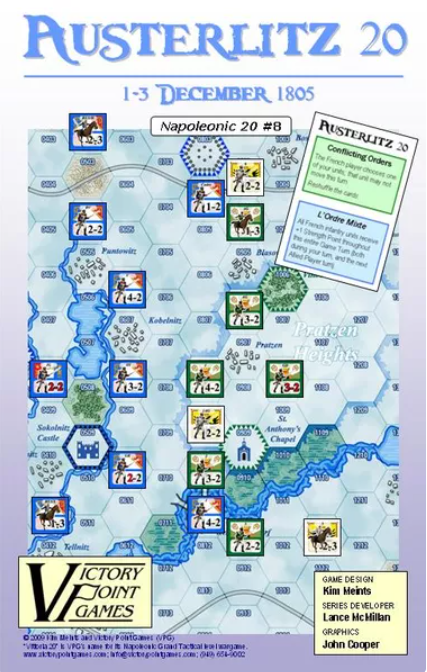
Kim: I was playtesting for various game companies in the early 2000’s. I was on the Against the Odds/ATO testing team, tested so many of the Great Battle of History titles for GMT Games and also for Richard Berg with his own BSO Company, GMT, and other companies. I was able to get in on the ground level with Victory Point Games and Alan Emrich when he was starting up VPG that I helped test on 7 of the first 9 titles they released. One being the Napoleonic 20 Series game Waterloo 20 that Joe Miranda created. I helped test so many of the VPG titles over the years but it was the Napoleonic 20 Series that piqued my interest the most as I love that period. So testing in that N20 Series led me into designing my first 2 games in 2009: Austerlitz 20 & Vittoria 20. And to my complete shock Austerlitz 20 was a Charles S. Roberts (CSR) Nominee in the final 5 for voting. I mean wow! Joe Miranda’s Zulus on the Ramparts won and I helped test that one. Designing is a lot of work, like a term paper but far worse. If you don’t have enough books on the subject then you need to buy more plus any other sources on the internet. Map making isn’t my strong point. I still hand draw my maps to this very day and then turn them into my developer who then would make a digital copy for the test team. Same with my game counters but I would just list what I need to the developer and he did the rest. I also hate writing up designers/historical notes. I’m not good at that.

Grant: What is your upcoming game The Battle of Wyse Fork about? What does the subtitle “The Second Battle of Kinston” refer to and what does it tell us about the game and what the player can expect?
Kim: Wyse Fork: Second Battle of Kinston is one of the largest battles (3rd largest I think) fought in North Carolina. General Grant wanted to initiate a broad operation to assist General Sherman in his junction with the Army of the Potomac. Grant ordered General Cox to have a functioning railroad working from New Bern to Greensboro so Cox moved his provisional corps towards Greensboro. In response, Confederate General Joseph Johnson ordered General Bragg to try and stop the Union advance and it was outside of Kinston, NC at Wyse Fork (also spelled Wise Forks) that Bragg built a defensive line and stood for 4 days delaying the Union advance. So in the game the Confederate player is going to need to balance between defensive play holding up the Union advance and also make any local counterattacks that he can without ruining his own forces. The Union does not have that greater of numbers where he can just bowl through the Rebel line as he will find himself short on troops. The 1st Battle of Kinston was fought in 1862 between a Union Division and a Confederate Brigade, so a somewhat minor battle.
Grant: Why was this a subject that drew your interest?
Kim: Well Bill Molyneaux picked the subject as there is the CSS Neuse museum with a full scale replica of the ironclad and the Battlefield park is also nearby and Bill helps out with raising donations to so many battlefield parks out in the Eastern United States that it piqued his own interest in the battle.
Grant: How did you get connected with Bill Molyneaux on this project? What skills and focus do each of you bring to the design?
Kim: Bill Molyneaux and I are friends. Connected first on Board Game Geek and then on Facebook. Bill had asked me to look over his Horns of the Buffalo game and I suggested a few items in the design so I got developer credit. I also worked with Bill in his dealings with his Battle of Brandywine game for Fastplay Wargames. So when Bill started his game on Wyse Fork he asked me to help out so I ended up as the games developer. Bill has many game designs under his belt first with Two Buck Games, Fastplay Wargames, Worthington and Lock ‘n Load Publishing and now Blue Panther.
Grant: What is your design goal with the game?
Kim: My developer goal was to give the game slightly more meat to it than the games Bill normally makes his games more geared to the many battlefield parks/museums that he donates his games to and where the buyers are basically non-wargamers but still interested in the history of the event. I wanted Wyse Fork to be more wargamer focused for when wanting something that was interesting but yet would only take maybe two hours to play.
Grant: What sources did you consult about the details of the history? What one must read source would you recommend?
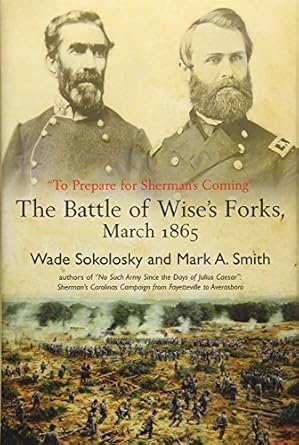
Kim: Well Bill had all the sources for the game but the major source and one that I even bought a copy of (author autographed too) was To Prepare for Sherman’s Coming: The Battle of Wise’s Forks, March 1865 by Wade Sokolosky & Mark A. Smith. It’s the only main book out on the battle as the others have it just in passing in histories of the North Carolina 1865 campaign. But I did look up other sources on the internet on the battle and in other ACW books.
Grant: What elements from the American Civil War were important to model in the game?
Kim: That’s somewhat hard as this game is really in the mold of the old SPI Blue & Grey Quads/Folio games. Simple but yet still models the battle it’s portraying during the ACW.
Grant: Who were the different commanders involved in this battle? What was the historical setting and constraints of the battlefield? What was the goal of each side?
Kim: For the Confederates General Braxton Bragg was overall commander with Generals Hoke & D.H. Hill as his divisional commanders. Union General Cox was the Corps commander and Generals Ruger, Palmer & Carter as divisional commanders. The Union goal was for Union General Cox with 13,000 men to ensure the railroad from the port at Morehead City to the railhead at Greensboro was open & operating. But Cox didn’t know after getting faulty intelligence that Bragg had concentrated his 10,000 men outside of Kinston at the Wyse Fork area to stop him. Bragg had built entrenchments along the higher ground along South West Creek and was defending the three bridge crossings over the creek. The Confederate Ironclad CSS Neuse was also on the River Neuse which was nearby for artillery support.
Grant: What area and terrain does the board cover? What strategic considerations does the terrain create?
Kim: The area is just outside of Kinston, NC (just off of the map) and west of there. Also north to the end of the Confederate defensive Line and south, south west to the Wyse Fork (just off the map). Lots of wooded terrain, swamps. marsh along the southern end of Southwest Creek. Another large creek to the west. The River Neuse is in the upper left corner. Rough terrain and Confederate Entrenchments are also on the map. Some of the more pronounced landmarks like a plantation, mill, church and a farmstead.

Strategic considerations are the Union must break through the Confederate Entrenchments to reach the main confederate victory hex leading off to Kinston on the Atlantic & North Carolina Railroad. The Confederates to take the main Union Crossing near Wyse Fork and for both sides to take the other victory point hexes (landmarks).

Grant: What is the scale of the game? Force structure of units? What is the anatomy of the counters?
Kim: Scale is around 300-500 yards to a hex. Units are brigade level and divisional artillery. Corps & Divisional leaders. Also African Spies (runaway slaves) and the CSS Neuse. Union has 3 brigades to a division plus artillery unit. The Confederates are the same but Hoke has 4 units. Also a cavalry unit per side. The Union also has 6 Entrenchments markers that he can build.
Grant: What role does the CSS Neuse play in the battle and the design?
Kim: CSS Neuse didn’t play any major part if any in the real battle but in the game it can provide artillery support up to 4 hexes away and the Union can garner victory points for its destruction or capture. Confederate player must roll a die if the Union player gets at any time in the game within 2 hexes of it to see the outcome. Either safe to keep fighting, captured or destroyed/scuttled. This can happen multiple times during the game.
Grant: How does combat work? What is the makeup of the Combat Results Table?
Kim: Combat is the normal Attacker vs. Defender with the defender’s terrain aiding in the defense. Some terrain adds from +1 all the way up to +5 to the defender. Attacking into swamps garners the attacker -2. The Combat Results Table is the age old Odds Based ranging from 1-3 all the way up to 6-1. Results are Nil (nothing), AR (Attacker Retreat) one hex, DR (Defender Retreat) one hex. AR #1, 2 or 3 means losing that many steps and retreats one hex. An already flipped unit gets eliminated. Same with DR with a #. Then AE and DE are eliminated. Leaders and the African Spies unit(s) can shift the odds by one.
Grant: How is victory achieved?
Kim: Victory is won by the point difference between the two sides. Ranging from a Draw, Pyrrhic, Minor, Marginal, Great victory. Points are garnered for units at half strength, eliminated, Capture of the Victory Rail Hex, Wyse Fork hex, Plantation, Church, Cobb House, Mill hexes, Capturing, Destroying or Keeping Safe the CSS Neuse.
Grant: What optional rules are included?
Kim: Optional rules include the CSS Neuse. The North Carolina Jr. Reserve unit made up of young boys who never saw combat (Seeing the Elephant) before this battle. African Spies (one unit) who can aid in a Union units defense (they scouted out the Rebs letting the Union know they were coming). Also Confederate Bragg & Hoke have special rules. Bragg because of his erratic behavior with a die roll either aids or detracts from a combat he is involved in. Confederate Hoke historically was ordered by Bragg to launch an attack at no matter the costs so on game turns 5, 6 & 7 the Confederates must move and attack Union units and to advance towards the Wyse Fork hex even if the attacks are at bad odds. I have another Hoke Optional rule that I was going to include in the game but it wasn’t working out as I envisioned it but if I can get it to work I’ll include it as an Optional Rule over on BGG. Leaders also affect combat and the Union has 6 Entrenchment markers where he can have a unit build an entrenchment as the Union historically did dig in stopping Hokes for mentioned attack.
There are also rules for Night Game Turns, Rally of units eliminated or at half strength during the night, Cavalry retreating before combat, Artillery effects and line of sight. The Union also has variable entry so each game will be different for where each Union Division will appear at one of three possible entry hexes. They might be grouped all together or separated wide apart. The Confederates all start on the map.
Grant: What is the playtime of the game?
Kim: Normal playing time is about two hours, maybe three at the very most.
Grant: What are you most pleased about with the outcome of the design?
Kim: I told Bill that we need to move away from the more simpler non wargamer design that he likes to have in the museums/historical sites that he supports so very well and more towards the true grognard wargamer looking for a fun game to wile away an afternoon or evening that has enough optional rules to make it interesting but not get too bogged down in detail. I think we hit it about right with this one.
This is also the very first game I’ve ever solely developed so I was really out of my element as I’m used to having a developer for my games and I had the very best in Lance McMillian with the Napoleonic 20 series. I would hear Lance in my ear during development saying what he would always say with my designs – Adding in too much is overdoing it and will bog down the flow of the game. You don’t need more chrome for chromes sake. So Lance, I did listen to you.
Game development is a completely whole different ball game than game designing is as the developer has to take the designer’s creation and make sure it works on all levels. And to make sure all areas of the game are looking good for publication. So if there are any issues and I’ve found a few already and I’ve been keeping an Errata/Corrections thread on the game with Board Game Geek to correct them, they are all mine.
Grant: What has been the feedback of your playtesters?
Kim: Feedback was good on the game. Games played seemed to be in the 50/50 range so balance was there right away. But luck of the dice rolling is really going to affect the outcome as the Union entry could be wide spread or grouped all together. My game and both sides get to have their share of offensive & defensive play.
My test games came out about 60/40 in the Union’s favor which isn’t all bad. Historically the battle would be a Union Pyrrhic win as the Confederates gave up the field but the Union suffered 1,000 men captured on that first day.
And this was another area that I learned was to make sure that both sides had a good chance to win the game even if the one side was outnumbered. I think Bill & I achieved that.
Grant: What other designs are you currently working on?
Kim: Well I’ll be developing two other ACW games that Bill designed. One was published a while ago with another publisher and the other was never published but finished. I want to go in and tweak the map and add more chrome to the rules-basically have them fall into the rules system that we have for Wyse Fork. I’m not sure about two WWII titles as the publisher said they had a developer in mind for them. One was published before. And then I’ll be designing two ACW games using this system and Bill will be my developer. I hope he can reign me in. But I’m keeping all these games a secret for now except for between me, Bill and Blue Panther.
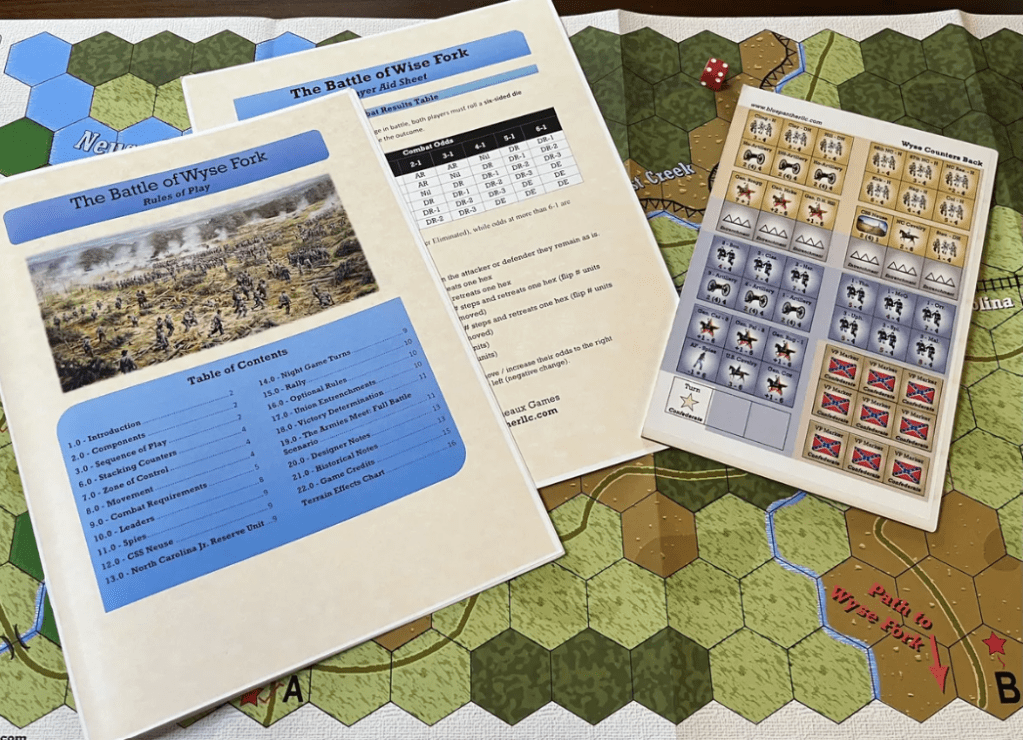
Thank you Kim for your thorough and well thought out answers. I am very much interested in playing this one and I have a copy of the game sitting on my table waiting for me to get the rules read and start playing. Now that I have done this interview, I may have to hurry that effort along.
If you are interested in The Battle of Wyse Fork: The Second Battle of Kinston from Bill Molyneaux Games, you can order a copy for $45.00 from the Blue Panther LLC website at the following link: https://www.bluepantherllc.com/products/wysefork
-Grant


Super awesome Sent from my iPad
LikeLiked by 1 person
Thanks Bill. I think that Kim represented BMG well and I think that you have a winner here.
LikeLike
Kim was a great help and Blue Panther is awesome with Steve and Trevor!
I hope a lot more historians will know a bit more about the battle of Wyse Fork
Bill
LikeLiked by 1 person
Kim was one of the main proponents behind the terrific Napoleonic 20 series (which had a top-notch developer in Lance McMillan, as Kim notes), so it should be interesting to see what he has done here!
LikeLiked by 1 person
We really enjoyed that Nappy 20 series and played a few of the games. I have been very impressed with Kim. I own a copy of Wyse Fork and need to get it to the table before the end of the year.
LikeLike