One of my favorite scales of wargames is the tactical level. There is just something to be said for small squad based action in a historical setting. The choices, the focus on the individual soldiers, their weapons and equipment, the tactics and strategy and most importantly the narrative that is created with each and every move. Most of the time, I really like my tactical level games to also be a bit pulpy as I really want to feel like I am playing in a movie and creating the story as we move along in the game. Well, recently there was a new Kickstarter released that takes the tactical level of World War II to new cinematic heights with its pulpy setting, simple rules set but with a very different focus on the tactical genre as the game is more of a stealth game than a straight up fire fight focused on behind enemy lines actions in Europe during World War II such as raids, sabotage and search and destroy missions. The game is called SAS: Rogue Regiment from Word Forge Games and it works hard to create a fun and exciting experience that is miniatures like without the plastic minis. In this first impressions style post, I would like to share my thoughts about this one after playing 2 missions with Alexander a few weekends ago.

Game Play
First, I want to give you an understanding of what the game is and a bit about how it is played. The game is a cooperative affair where players are working together controlling 1 or more operators on a team. There are no victory points to track. No individual scores of accolades. The missions are either won or lost by completing objectives and then getting of the board as a team and each of the members must pull their weight. Each turn will start with the Action Phase where every SAS operator who is included in the mission will have 4 Action Points (AP) that will be used to take various actions including moving, shooting and performing various tasks such as picking up and hiding bodies, taking aim, crouching and recovering lost hit points. After this phase, will come the Axis Advance Phase which will only occur if there is an operator who has been spotted. Then the Event Phase during which an Event Card will be drawn that tells the players what the guards and sentries are doing with their turns. Sometimes this will include patrolling units to move along their programmed patrol path, which is identified on the board with either a white or black dotted line in a specified area such as along and around a wall section, up and down a bridge or a circuitous route around the forest keeping an eye out for intruders. Sometimes the Event Card will reverse the direction of a patrolling unit or cause a stationary sentry unit with a good vantage point to turn one way or the other. This is a really well done part of the game and while it initially appears like you can plan for the movements and actions of the enemy units, you quickly learn that this is not the case and there is quite a bit of uncertainty.
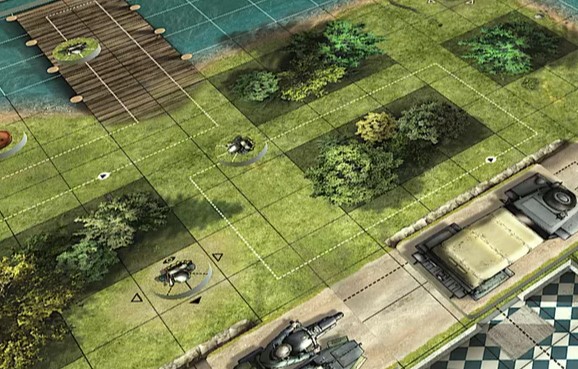
The other very important part of the game is the Stealth Meter. Each of the various missions will give you a specific amount of “time” to be heard by or spotted by the guards. This can happen because you have fired a loud weapon, basically any weapon that isn’t a knife, spear gun or other such non-gun powder fueled weapon, a guard has seen a dead body on the board that wasn’t removed or gets a site of an operator. There are also special Event Cards that will automatically advance the Stealth Meter because time is your worst enemy and the longer players linger the wiser the guards get. Each of these type of actions will cause the meter to drop by one tick and when it hits zero, the general alert has been sounded and triggers what is called the Battle Phase.
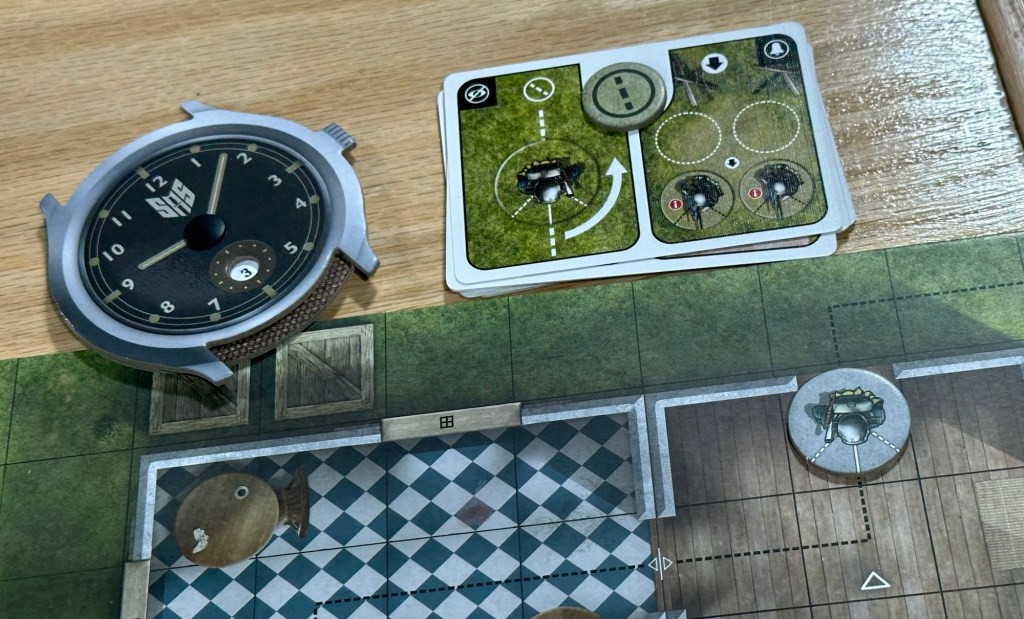
This means a few things as initially all guards and sentry units on the board are fully alerted to the team’s presence and will begin moving toward the closest units on the board attempting to shoot and kill them. But it also means that reinforcements stored just off the board in a sort of waiting area are now also alerted and will come onto the board moving toward the operators. These units are typically better than your average guards with better weapons allowing them to roll additional dice and hitting on a significantly lower number. The main goal of the game is to accomplish the objectives of the mission and ultimately escape the board alive. It goes without saying that the best way to accomplish this is to delay the general alarm by being silent and go about the mission in a planned out and sneaky way. No guns blazing and running right in….although you can do this and get lucky from time to time but it is not recommended the easiest way to do this is to avoid detection for as long as possible.
The players will control a team made up of up to 4 SAS heroes who each have their own abilities, weapons and special items such as a ghillie suit, medical pouch, cigarettes to distract guards, disguises and the like. It is critical that players choose their operators wisely and build a team that complements each other well. For example, several of the operators do not have things like knives, garrote or spear guns and will be unable to kill a guard at close range without making a loud noise by firing one of their weapons. While these guys do have good and useful abilities, mostly these type of operators are your run and gunners who you want to be around once the alarms are sounding and guns are blazing. The stealth part of the game is where it is at though and the players will find that when they play the game this way (the right way!) they will be able to dispatch guards and sentries easily as there will almost no dice rolls for these silent assassination kills from behind.
I was really impressed with the different types of operators available. From Anders, who is a frogman and can jump into the rivers to move silently, to Jock who has a grappling hook to move across rocky terrain or buildings and even Paddy who is basically an IRA soldier who carries a bear trap that he drops on patrolling paths where unsuspecting guards will trigger it and dispatch themselves and his all important timed explosives that make quick work of vehicles.

Enemy Activation/Event Phase
After the operators have all taken their allotted actions and done what they wanted to that turn, the real fun starts. The Event Phase is where the tension grows and you hold your breath to see exactly what is going to happen and what the guards are going to do. At the beginning of the Event Phase, the players will draw the top card from the Event Deck. Then the Patrol Token, which has a white and a black side, will be placed in appropriate space at the top of the card drawn. This will always start as the black lines up, which will mean that the black patrols will be the ones that will move first. After this turn, and in the next turn, another Event Card will be drawn and placed and the Patrol Token will be flipped and placed at the top of the new card. This means that the white and black patrols will be alternating so there is somewhat of the ability to anticipate what will happen as you know the white or black guards will activate. Initially, I thought this an odd design choice as I felt that you could somewhat game this aspect and try to use it to the operator’s advantage. But the more I thought about it, and recalled several old movies where soldiers are sneaking by or around patrols, there always is a pattern that develops and can somewhat be anticipated. This is the nature of us as humans. We get into a habit and do that thing over and over again, especially with such mindless activities as keeping watch at 2:00am in the cold, lonely, misty blackness of night.

But with that being pointed out, falling into the trap of anticipation can really get the players in hot water as sometimes the Event Cards will direct a patrolling guard to suddenly spin around, which can be really bad if the players are trying to sneak up behind the guard to take them out silently and are caught in the open. There also are Sentry units on the board and they can also have a card direct them to rotate left of right and their field of view will catch you and you will become spotted. This is one of the best parts of the sneaky part of the game as these unexpected changes will cause players to have to reconsider their approach or to change their planned route of advance quickly to get to cover. As they say, the best laid plans or mice and men!. I really like having to keep on my toes and sometimes taking calculated risks depending on what is going on and the situation at hand.
The other part of the game is how being alerted will change the way a guard will act. The first time during a turn that an operator performs an action within the line of sight of an alerted guard unit, the guard will attack them, which is referred to as a Reaction Attack. This attack is normally a 50/50 type situation where a hit will be scored on a roll of 4-6 on a D6 but when range is considered, and close range will add a +1 DRM, it can turn into a 66% chance of being hit on a 3-6. It is hard to take many hits as the operators all only have a starting health of 5 Hit Points and once they take damage, can take an action to Recover 1 HP but never again above 4 as they are still considered wounded. And once you get into the Battle Phase of the game, the sub machine gunners and more heavy troops like vehicles will be rolling 2-3 dice typically hitting on a 2+ with a distance DRM thrown in at close range and it can mean multiple hits from a single attack if the enemy rolls well. You will not able to stand toe to toe with these guards and their heavier units so you really have to play this game smartly to avoid total failure.
Varied Mission Types
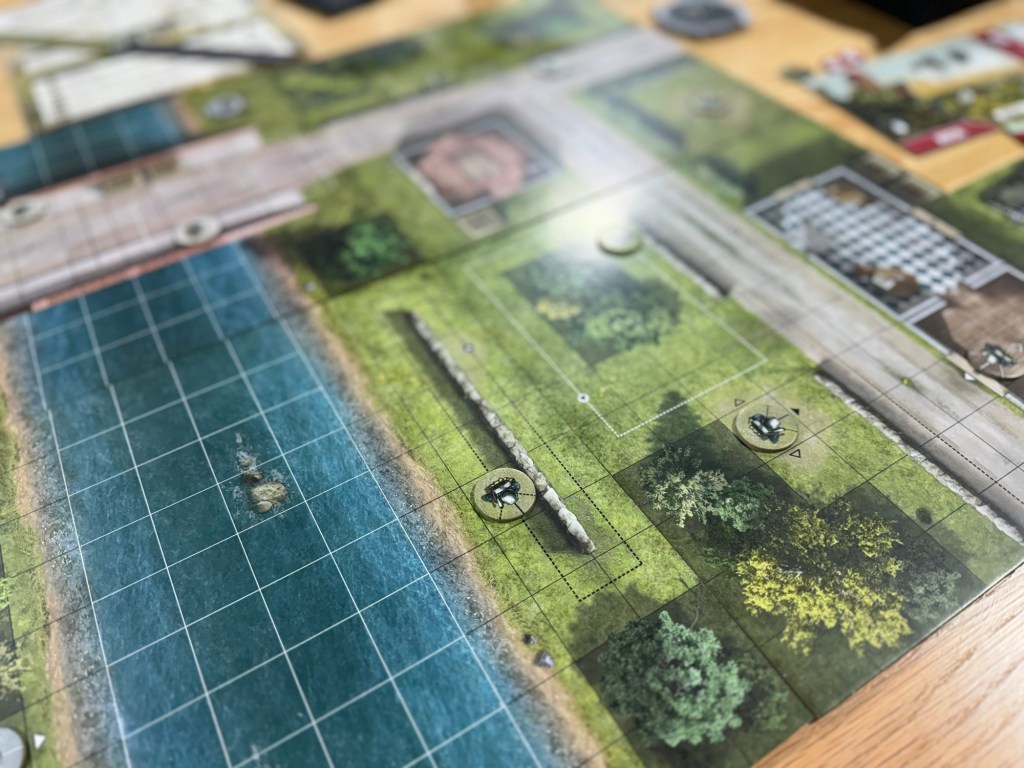
One of the things that was pretty impressive with the package was that the game contains like 27 different missions. Admittedly you had to get the whole shooting match to get all 27 missions but even the base game has 12 missions. And they all have their own focus. There are missions that require the operators to get across enemy territory and leave off the edge of the board. You don’t have to take out specific objectives or guards just move across an area and get off the board. Now this is easier said than done but that was a mission type. And they required the players to choose to use Anders who is a frogman in the game and had a wetsuit and scuba gear. This give you a tip that the river was a good point to access and get across the to the other bank a bit easier. Now the other operators on our team still had to move across the open bridge that was pretty well protected with several patrolling guards and a few sentries but it still gave us options and allowed us to attack the game from a few different angles.

We also played a mission that had the objective of setting an ambush for a large convoy that would roll through this sleepy little village around Turn 16. The convoy consisted of a lead motorcycle that had an MG34 mounted to the front followed by a heavily armored and beefy half-track with 2 MG crews and then a bunch of 2 1/2 ton transport trucks that were pretty squishy and then another half-track to bring up the rear. We chose to use Paddy (remember the guy with timed explosives and the bear traps) and he made his way to the grouping of buildings on the other side of the board where there were plenty of large fuel barrels that could also be used to create an explosive trap.

We did well the first 8-10 turns and made our way over to the buildings and then some cavalier behavior and poor rolls got us in hot water and we had to hurry to get things setup before the convoy arrived. But, we were successful and set the timed explosives perfectly to catch the convoy and destroy all of the vehicles while also rolling some barrels into the street and then shooting them to do loads of damage.
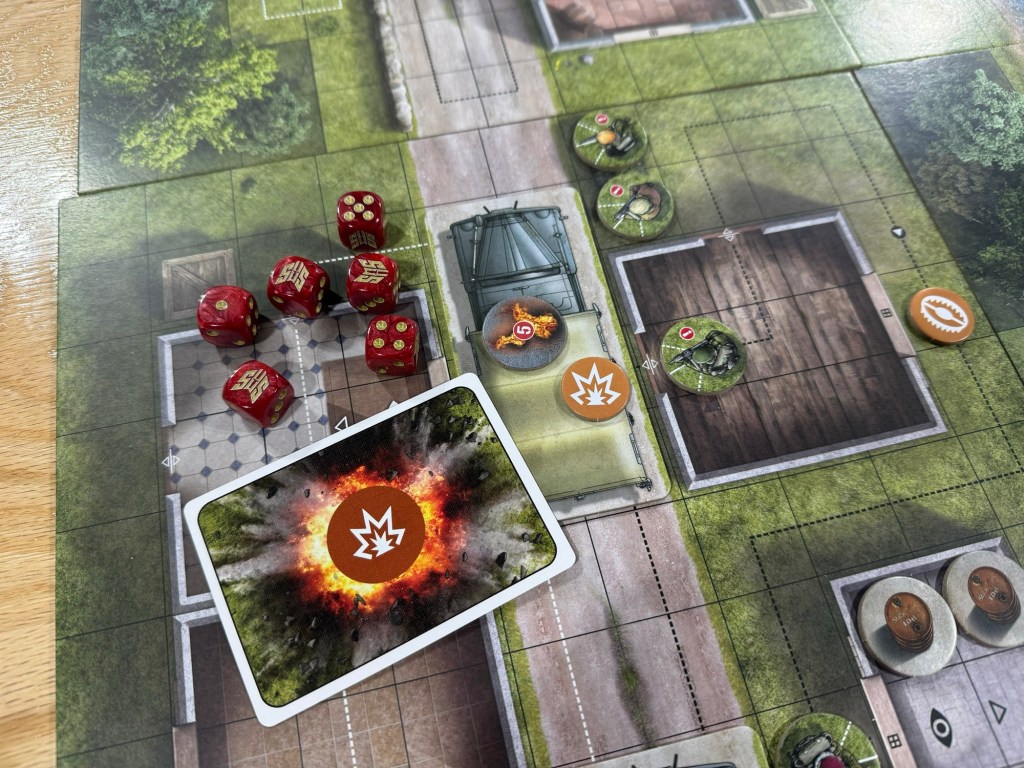
I was really impressed with the creative team and their creations as the missions all seemed to have their own unique style and approach. This was one of the best parts of the game and really makes for major replayability as you can do the different missions but also change out team members to get a new experience with new opportunities, assets and abilities.
Fun and Pulpy
In the end, this game is really fun and pretty simple to play. The game excels at creating a very living and varied narrative as the players move about the board tackling the various challenges the best they can. There were lots of shouts of joys, cursing under our breath as the dice failed us and tons of tension as we held our breath awaiting the draw of the Event Cards to see what guards would move and where. And in the end, that is why I love squad level tactical games. They are narrative generators and no matter the situation there is always some great story that comes out of it.
I would recommend this game to anyone that likes their tactical level gaming and who enjoys some dice chucking fun. The production is top notch and the variability in mission types and the use of different operators really keeps this one feeling fresh.
I can’t wait to get this one back to the table and want to explore even more to see how it holds up over multiple plays. My guess is that it will hold up well but I am relishing the opportunity to test that theory out.
-Grant
 The Players' Aid
I’ma be that guy and ask, have you played V-Sabotage? Another WW2 sorta-stealth game…
LikeLiked by 1 person
No I have not. Is it good?
LikeLike
It shares some of the same ideas with stealth, an alarm, etc. Many of the missions are multi-stage, and as long as one commando gets out after completing the objective it’s a win. The system was later used for their Assassin’s Creed game.
SAS seems to be a little more tactical, and the behavior systems more evolved. I’m curious to try it!
LikeLiked by 1 person
I see that just came out in 2016. I will have to add it to my list to check out. Thanks.
LikeLike