Over the past few years, the interest in solitaire book wargames has skyrocketed and there are a lot of different offerings out there. One that has really caught my eye is form designer Thomas Van Hare with his Historic Wings products. Thomas Van Hare has designed several of these solitaire book wargames recently and they have been well received by the solitaire community. In fact, Alexander and I recently purchased several of these games including Overflight!, Tally-Ho! and SOE Lysander. But we also sprung for the upgraded components from Blue Panther for the games and they are well worth the price.
I reached out to Thomas and asked if he would be interested in doing one of our signature written interviews for the blog covering his newest upcoming game called Achtung Jabo! and he was more than interested.
Grant: Thomas, please tell us a little bit about yourself.
Thomas: First of all, thank you for interviewing me! It is a real honor to be featured on The Players’ Aid!
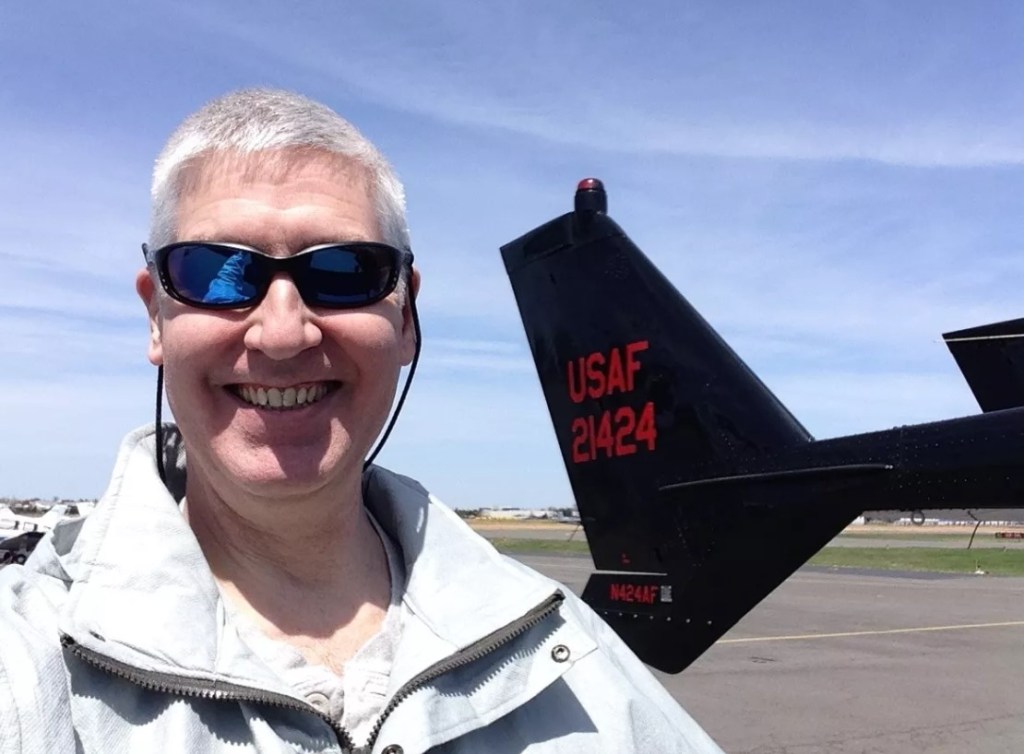
Before designing wargames professionally, my career was in politics and international operations. Over the years, I served in three different White House Administrations, most of the time in the Office of the Secretary of Defense. In private industry, I held various positions. I was the CEO of a specialist government-military airline that flew in war zones. I headed up a design and advertising firm. I worked in submarine communications security. I have long been an aviation historian. I am also an artist and a musician. Also, I have done musical theatre. I’ve lectured in universities on foreign policy matters. Finally, I was a search and rescue pilot – and for that work, before he passed away, Fidel Castro declared me an Air Pirate, which is my favorite title ever.
Grant: There aren’t a lot of wargame designers or “Air Pirates” who worked in the White House. What did you do there?
Thomas: In the 1980’s, during the Reagan Administration, I was involved in the Afghan War against the Soviets. If you know the book or movie “Charlie Wilson’s War” (the one with Tom Hanks), you know it was a wild time. Texas Congressman Charlie Wilson was the program’s key sponsor and we did a lot of operations. He was a real character and it was quite an exciting time. I flew him in and out a few times and worked closely with his staff, including his top aide, Charlie Schnabel, and “Charlie’s Angels”, his all-woman staff in Congress.
I directed and flew 25 special air missions, landing after midnight and taking off before dawn – “we were never there”, as we used to say. Besides flying in cargo to support the Afghan guerrillas in their fight against the Soviets, we did med-evacs of severely wounded Afghan guerrillas and civilians who were injured as a result of Soviet bombing. In all, I brought out over 600 Afghans.
Soviet Mi-24 Hind-D helicopters would raze entire Afghan villages. It was pretty rough stuff. For example, in the Panjshir Valley, the Soviets dropped stuffed animal toys fitted with small explosive charges so that Afghan kids would pick them up – just enough explosive charges to maim kids rather than kill them. The Russian idea was to take Afghan guerrillas off the battlefield by forcing them to stay and care for their badly wounded children. The Russian brand of war has its own special flavor. I saw that first-hand. It was a pretty dark time.
In the end, the Soviets lost their war in Afghanistan. Two years later, the Soviet Union collapsed and the Cold War ended. I remember the day well. I was in the Office of the Secretary of Defense and we were all standing around TV watching live as the flag went down over the Kremlin. I turned to the guy next to me, who was a top Soviet expert and asked, “Now what happens?” He replied, “No idea, but what am I going to do now?” We both laughed about that. As it happened, the Soviet experts had a future after all – Putin ensured that.
Grant: What other things did you work on during your time as a White House appointee?
Thomas: One of the highest honors was that I served in the White House Transition Team and the Office of the President-elect George H. W. Bush in 1988-1989. Subsequently, I was assigned to work for then Assistant Secretary of Defense, Richard Armitage (a former Navy SEAL and later Deputy Secretary of State), working for the man who was then the Secretary of Defense, Dick Cheney.
I was involved in Operations DESERT SHIELD and DESERT STORM, which defeated Saddam Hussein and liberated Kuwait. I planned, managed, and personally flew six highly classified special missions to support the war effort, so I have the campaign medal for that. What we accomplished on those missions is so classified that it wasn’t even shared with the others in the office, so they never knew. That’s what it was like. The Assistant Secretary of Defense challenged everyone to think “outside the box” – my idea got approved and I was told to carry it out.
My third round as a White House appointee came after the terrorist attacks on September 11, 2001. I was invited back to the White House to work again in the Office of the Secretary of Defense, supporting the Coalition Provisional Authority (CPA) in Iraq and the Afghanistan Reconstruction Group (ARG), and ultimately working for Secretary Don Rumsfeld as part of his 8-person “Executive Committee”. As a result, I was involved in both the Iraq and Afghanistan conflicts so I’ve spent quite a bit of time in both countries.
Grant: Do you still do work with defense-related projects?
Thomas: Although I have been out of government for over a decade and a half, from time to time, I am still involved in various projects. I ran a defense technology program that sought out breakthrough technology innovations to the Department of Defense. These were very special, advanced systems for aerial and space-based reconnaissance, extra-atmospheric propulsion, artificial intelligence systems, unmanned battlefield systems, advanced navy fleet communication systems, open-source intelligence programs (OSINT), and so forth. Very interesting work.
Then, after Afghanistan fell to the Taliban on August 15, 2021, a lot of Afghans were left behind in the chaotic withdrawal of American forces. That was a tragedy. I could not stand by to see them hunted down and killed by the Taliban. Therefore, I set up a program to rescue them. It was a lot of sleepless nights with midnight pick-ups by my teams on the dark backstreets of Kabul and then overnight runs in unmarked vehicles to the border. Then the challenge was to organize the crossing to safety into Pakistan. We did it successfully over and over, right under the nose of the Taliban. I had networks of safe houses in Afghanistan and Pakistan, and so forth. In the end, I was involved in saving 287 Afghans, many were leading women’s activists, senior government and military officials, and Afghan Air Force combat helicopter pilots.
Grant: You are also a pilot. What kind and was that ever your day job?
Thomas: Sadly, I never flew for a commercial airline though I have all the ratings to do that. I was a search and rescue pilot for a time and have quite a lot of experience in military operations. Flying SAR was very rewarding as it was a life-saving mission. I consider it one of the most important things I have done. In that role, we saved many thousands of lives, mostly Cubans fleeing to freedom in the USA. I was both one of the Command Pilots and I also served as the Mission Director (Director of Operations), so I ran the program day-to-day and flew the operations.
Being a pilot and an aviation historian helps ensure that my wargame designs are based in the realities of flight dynamics, air combat tactics, and so forth. That is important because my games are mostly aviation-related. My company, Historic Wings, has been around since 1997. You can see my website at historicwings.com and my video channel is at: www.youtube.com/@HistoricWings – please subscribe!
Grant: Is wargaming your only work now or do you have another job?
Thomas: My only work now is creating wargame books, though I publish aviation history videos from time to time on my YouTube channel. I’ve only been writing wargames for two years. My designs are a new kind of wargame – unlike the other so-called “book games”. They are more like half a history book and half a wargame, with the history in targeted, digestible bits that bring to light the key aspects of each conflict. The way I design them, the more history you learn, the better you will play the games. I have four games published and another three heading into publication right now.
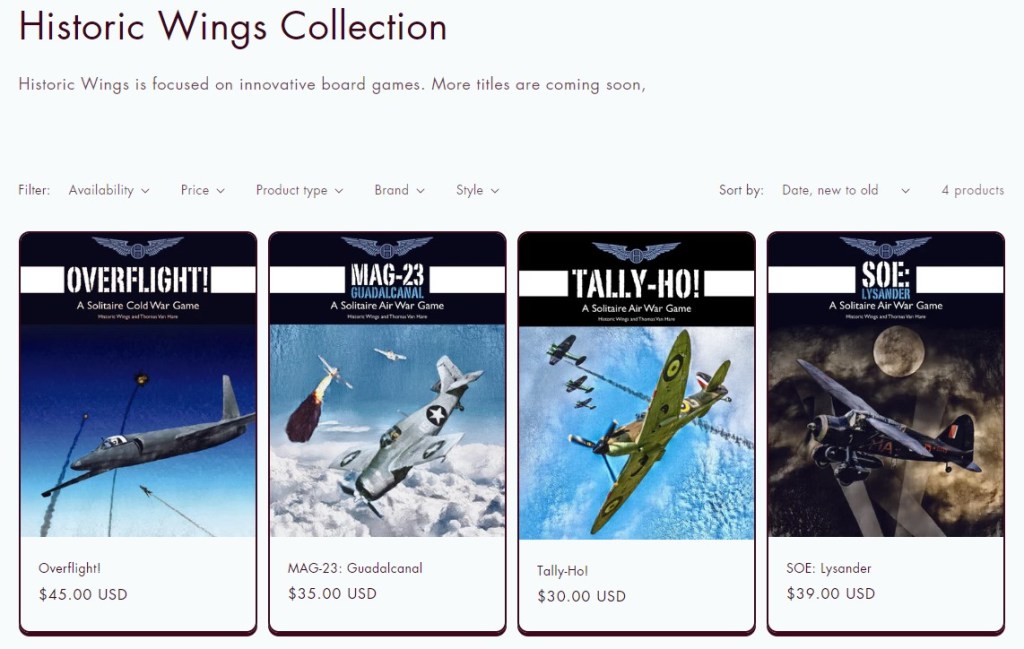
My published titles include:
Tally-Ho! – A Battle of Britain “hex-and-counter” game
MAG-23 Guadalcanal – Marine Air Power in 1942 against the Japanese
SOE: Lysander – Covert missions into occupied France
Overflight! – U-2 operations over the Soviet Union
Plus three more will be published very soon – two of these are being announced here in this interview:
Achtung Jabo! – P-47D Thunderbolt fighter bombers in action at D-Day
boardgamegeek.com/boardgame/396420/achtung-jabo
Game of Drones – Drone warfare in Ukraine during Summer 2024boardgamegeek.com/boardgame/426680/game-of-drones
Me 262 Experten – The Luftwaffe’s squadron of aces in Me 262 jet fighters
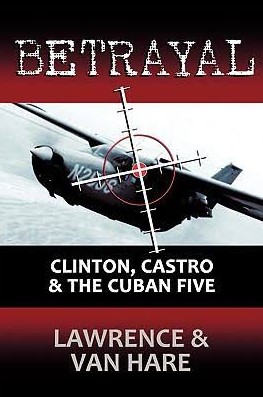
Additionally, fifteen years ago, along with co-author Matt Lawrence, I published a best-selling book about a major international espionage scandal involving Cuba and the United States called Betrayal: Clinton, Castro & the Cuban Five. That was translated into Spanish and ended up on the CIA’s suggested reading list for its field officers. Overall, writing wargame books is a lot harder than writing non-fiction history, particularly when it comes to writing the rules!
Grant: What motivated you to break into wargame design?
Thomas: I started wargaming back in the 1970’s. I guess that dates me as an old grognard of sorts. About two years ago, I decided it was time for a career change. A lot of people said that you can’t make it just by creating wargames and that it is better as a part-time weekend hobby. I guess I beat the odds as I make my living just doing this now.
This choice of work allows me to combine my knowledge and skills into a creative product – author, historian, graphic designer and artist, researcher, military operations specialist, pilot, and so forth. I can only hope that my wargames provide everyone with some enjoyment and an opportunity to learn more about history. Above all, I’m a teacher at heart. There’s an old saying that those who don’t know history are doomed to repeat it – I think that’s true. Wargames have the potential to teach history, perhaps better than many history books.
I focus on aviation topics, though I am working on several games about ground forces. For instance, working with my friend, Helen Patton (the granddaughter of General Patton), I’m designing a wargame about Army operations. Likewise, Daniel Niemi, who runs the WW2 Solitaire Board Game Channel on YouTube, challenged me to create a tank game – I’m working on that.
The hallmark of my game designs is that they’re all unique. Each one brings new systems, new rulesets, new ways of gaming through subjects that are often not well-covered. That seems to be one of the reasons my games are popular, even if I’m a new name in this industry.
Grant: What is your process? How do you go about creating one of your wargames?
Thomas: Above all, my process is based on history. That dictates the rules and mechanics. Thus, I start by writing the history section of the book and only then do I work on developing gameplay. Finally, I write the rules and do the graphics, maps, and counters. You could say that history dictates gameplay and the rules. It is not just an added theme sprinkled on top.
I want to offer players the potential opportunity to create a deep narrative, though writing their story of how they played it out is optional. The narrative is at the core of all my games. Even with Tally-Ho!, you are writing your own story of the Battle of Britain. You lead RAF Fighter Command and direct your squadrons of Spitfires, Hurricanes, and Defiants from the Sector Controller level. After you fly the missions, there is a political game that plays out. That is based on the personalities of the time, from Winston Churchill to Lord Hamilton. Whether you win or lose is not determined by how many victory points you earn but rather by a vote in Parliament. Based on your performance in the air, Britain will choose either to surrender to the Germans or to “fight them on the beaches”. Everything about the game is historically accurate, down to the precise balance of seats in Parliament by political party in November 1940.
So far, all of my games games are solitaire titles, which is a format I like very much. I am planning on investigating how to create cooperative-style and competitive narrative games. Those are both genres that nobody seems to have yet cracked the code on, at least to my knowledge.
Grant: Many solitaire narrative wargames involve a lot of rolling through tables so there isn’t much decision-making. How are your games different? How do you address that?
Thomas: The narrative experience is at the heart of my game designs, yet there is a lot of player decision-making – some might say almost too much. Nothing is “on rails”. You have a lot of choices to make and how you fly makes a huge difference to the outcome. In my experience, narrative games are best when there are hard decisions to make. You face the consequences of your mistakes. However, that means you really can celebrate your victories! Win or lose, it comes down to your leadership, your decisions, and your actions. That’s a key element to the game, whether you’re commanding the entire Royal Air Force or just serving as a lone pilot flying secret espionage missions into occupied France in 1943 and 1944.
If you look online, many players post After Action Reports (AAR’s), mostly in the various Facebook wargaming groups. The AAR’s they write are almost indistinguishable from the real thing. You don’t need to be a brilliant author to create AAR’s either. Wartime diaries weren’t written by Ernest Hemingway after all. It was usually a young lieutenant or sergeant in a tent, sweating in the heat, battling malaria, and wondering whether the Japanese would shoot him down tomorrow. The game helps you do that.
This is an example of one AAR that a player wrote – this is from the game Overflight!:
“Our scheduled route will be as follows: Take-off from Wiesbaden AB, proceed North-East over Denmark and Sweden, penetrate Soviet airspace at Leningrad, then a big leisurely loop through Khimki, Moscow, Kursk, and Minsk, exit Soviet space via the Baltic States, continue onto Denmark and finally land back at Wiesbaden AB. Now, there are several reasons to be worried about this one. First of all, this is the first deep incursion of Soviet airspace for the Aquatone Program. Previous missions mainly dabbed at Soviet-controlled states, like Hungary or Romania, a couple short of incursions to Minsk or Leningrad, but this is the first full-on, deep penetration over the Motherland. This is the reason why this whole program was started, and everybody is eager to do his best. The second point of concern, and it’s quite a big one, is that this route is very long and will flirt with our U-2B’s maximum range. As per our calculation, there are great chances a gliding landing will be needed if we proceed through the whole route as planned, with no chance to proceed to our assigned alternate landing site at RAF Lakenheath. And finally, the last but not least of our concern, is that several of the WP that need to be covered have a potential high threat level, as per our intelligence.”
Here is a snippet from another one, the result of normal gameplay in MAG-23 Guadalcanal:
“When our combined force intercepted the Japanese raiders, they turned out to be a somewhat stronger force consisting of 9 D3A Val dive bombers and 9 A6M Zekes (or Zeros). As Maj. Shaw’s sighting report came in over the radio I turned to my aide to direct him to get an aircraft recognition guide dispatched to Mr. Kuper immediately. Our aircraft managed to down six of the nine Vals, four on the initial pass and two on the second, as well as one Zero when they finally moved to engage. In return, the Japanese Zeros managed to down only one of our aircraft, piloted by Lt. ‘Fluke’ Browning, who managed to bail out safely.”
Finally, here is one from SOE: Lysander, which many say has the deepest narrative:
“July 1943. Following a very successful month of June, I am given a relatively straightforward circuit. Operation Honey is assigned for July 14. I am to deliver two passengers (an SOE agent and a wireless operator) into Occupied France, along with documents and two boxes of Sten guns. Fortunately, the weather is excellent and we take off from Tangmere at 21:50. The flight over the Channel is uneventful, but we go off-course over some fields in northern France. Finally, we find the Landing Zone, and P/O Childs brings down the Lysander for a safe landing. The off-load of passengers and cargo goes without a hitch. We pick up two important passengers, “The Badger” and an Escape Line Director. There is a 20-minute delay on takeoff. I am worried about the return weather. Suddenly, we hear a whistle across the fields. It’s the gendarmes! No time to waste, I steer the plane around and start to get us out of there. The sound of gunfire….”
The goal of my games is for the player to feel like they’re there, whether that’s on Guadalcanal as the Japanese are heading in, sweating it out at Wiesbaden when a U-2 spy plane is delayed on the return flight, flying at the formation of P-47 Thunderbolts on patrol over the Normandy countryside hunting German tanks, or commanding a drone team as the Russians mount another “human wave” attack into the ruins of Krasnohorivka in Ukraine. The narrative has to convey the emotions and stress of the time – and it works. There’s no better way to learn history than to live it, even if just through the abstract experience of a wargame.
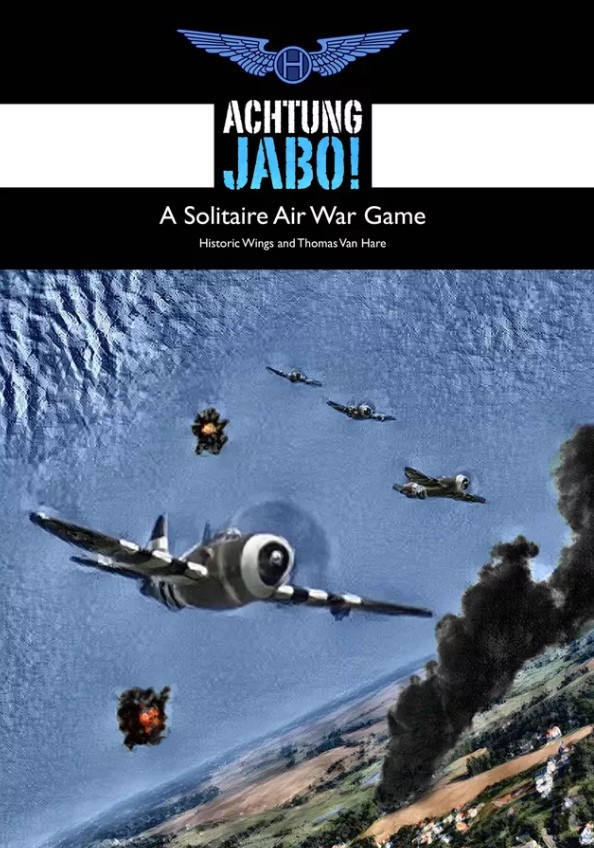
Grant: Tell us about the new game Achtung Jabo! What is that about?
Thomas: Achtung Jabo! is my newest release. It is a solitaire wargame book about the experiences of the 371st Fighter Group on and just after D-Day, June 6, 1944 – in other words, you lead formations of P-47 Thunderbolts over Normandy. The game recalls the challenges faced by the first generation of dedicated fighter-bomber pilots, those who invented air-to-ground operations in 1944.
The 371st Fighter Group flew the Republic P-47D Thunderbolt. You’re going to do a lot of damage on your patrols. Game balance, always a slippery thing, is pretty much out the window with this one. Still, it is far from a “shooting gallery”. The Germans shoot back, often with deadly accuracy. There are heavy concentrations of flak. The German ground units are not easy targets. You’re going to lose some guys and you’ll be writing letters home to their families.
Recalling history, fighter-bombers were one of the keys to victory in Europe. A single P-47 Thunderbolt – one pilot, one engine, and one plane – could deliver up to three 500 lb bombs with extraordinary accuracy against German ground targets from low altitude, rarely missing by more than a few yards. Compare that with the B-17 Flying Fortress, which generally dropped eight 500 lb bombs and had a crew of ten men in a four-engine aircraft, and flew at high altitude. Even with the Norden bombsight, their accuracy wasn’t good. Rather than hitting individual tanks, trucks, or buildings, they were carpet bombing of entire cities.
Both types of air assault were needed to win the war, however. Casualties were high in all front-line USAAF units. Statistically, you had a better chance of surviving on the beaches of Iwo Jima or Okinawa than in the cockpit over Germany.
Grant: Describe some of the gameplay in Achtung Jabo!
Thomas: The game has you managing three USAAF squadrons in the 371st Fighter Group with 25 pilots assigned in each. You can either use the historic pilot roster, as provided in the book, or you can make up your own. Many players will write in their own name as the Fighter Group Commander and take the names of their friends as pilots. As with all of my wargames, the history section of the book teaches you about the unit, the situation in the air and on the ground, the tactics of how to fly and fight, and the challenges the Thunderbolt pilots faced at the time. Unit scale is down to individual airplanes, tanks, trucks, and other targets – even Kettenkrad motorcycles are represented.
Achtung Jabo!, like all my wargame books, combines the best parts of a wargame and a history book. You will learn a lot about what happened there. The history in the book directly pertains to the wargame that you play – again, the more you learn about history, the better you will play and win. The maps, the tactics, the units, the situation, and the weapons are all historically accurate. Each target area depicted in the game is hand-illustrated based on actual reconnaissance images from late May 1944, in the weeks leading up to D-Day.
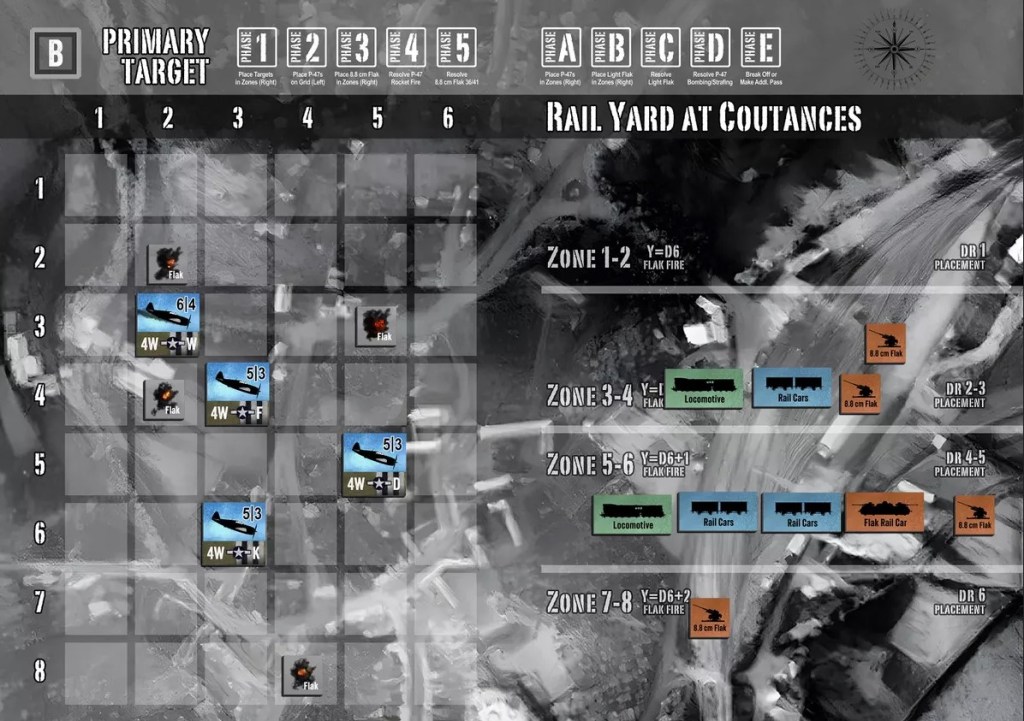
One of the most interesting game mechanics in Achtung Jabo! is how heavy flak and light flak are resolved that is new and interesting, a unique game mechanic that has never been done before. Daniel Niemi (WWII Solitaire Board Game Channel) did a series of videos about it on his YouTube Channel and we talked through an entire mission as he played:
The game mechanic for heavy flak in Achtung Jabo! works like this – you roll dice to place individual heavy flak bursts (German 88’s) on a grid, the dice giving you the X and Y axis positions. Thus, the flak bursts explode around your planes. Their proximity determines what potential damage is done, whether the pilot is wounded, and how badly, and so forth. It is very visual and gives you the impression of being there. I’m already working on a game that implements that for medium bombers. Your formation fly through the flak barrages. The flak bursts randomly appear around your planes.
Grant: Tell us about the other two new games – Game of Drones and Me 262 Experten.
Thomas: Both of those titles are a bit of a scoop for you. I’ve started partnering with others to produce a new series of games, so if you know any game designers who are interested in working with me, let me know.
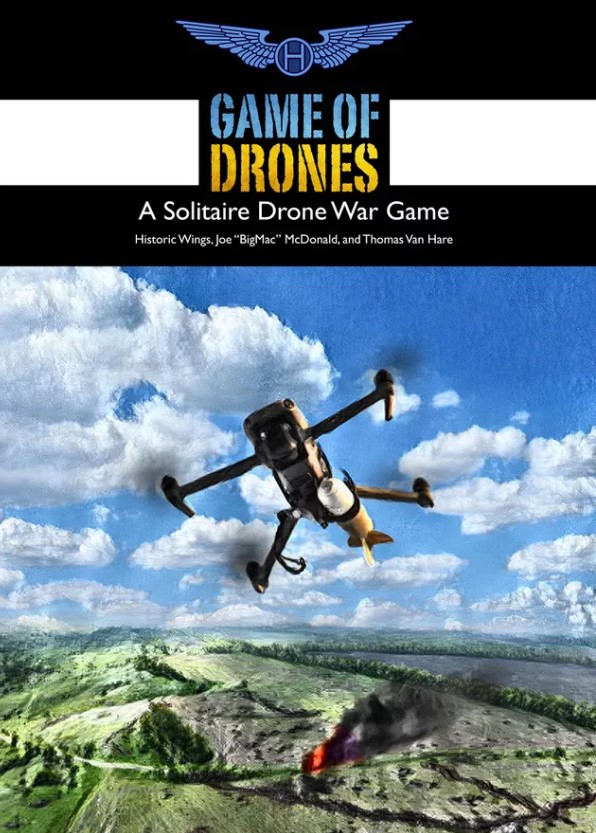
In Game of Drones, you are a drone pilot who commands a team in Ukraine as you fight off the Russians. It is a true-to-life experience of how they fly right now – today – and it teaches how Ukrainian drone teams are organized, how they operate, what challenges they face, and how deadly it can be – both for the Russians and for the teams, who face extraordinary risks. These guys aren’t sitting in air-conditioned rooms and managing the battle from high above through the camera of a Reaper or Predator drone while they drink coffee and order a pizza. There’s no sugar-coating it – this is deadly serious business. You’re in a front-line bunker with rats, facing Russian artillery fire and earlier in the morning, Grad rockets were streaming in.
Most wargames are based on history; this one is about current events. The game depicts the war in June, July, and August 2024. It is that up to date with what is happening. It reflects the technologies in use, how the missions are flown, and what the consequences are if you don’t perform well enough.
Game of Drones is co-written with Joe “BigMac” McDonald, a sapper and drone pilot who flies against the Russians in the Kherson region of Ukraine. Other drone pilots and drone team members also contributed to the design. As a result, the game captures a precise time and the real experience of this war – as it is happening. Drones are a major change in how war is fought. For instance, drone teams in Ukraine today are responsible for over 60 percent of Russian losses. As a result, they are top priority targets if discovered by the enemy – and the game reflects that. There is no more dangerous position in the war than being a sapper or a pilot on a drone team.
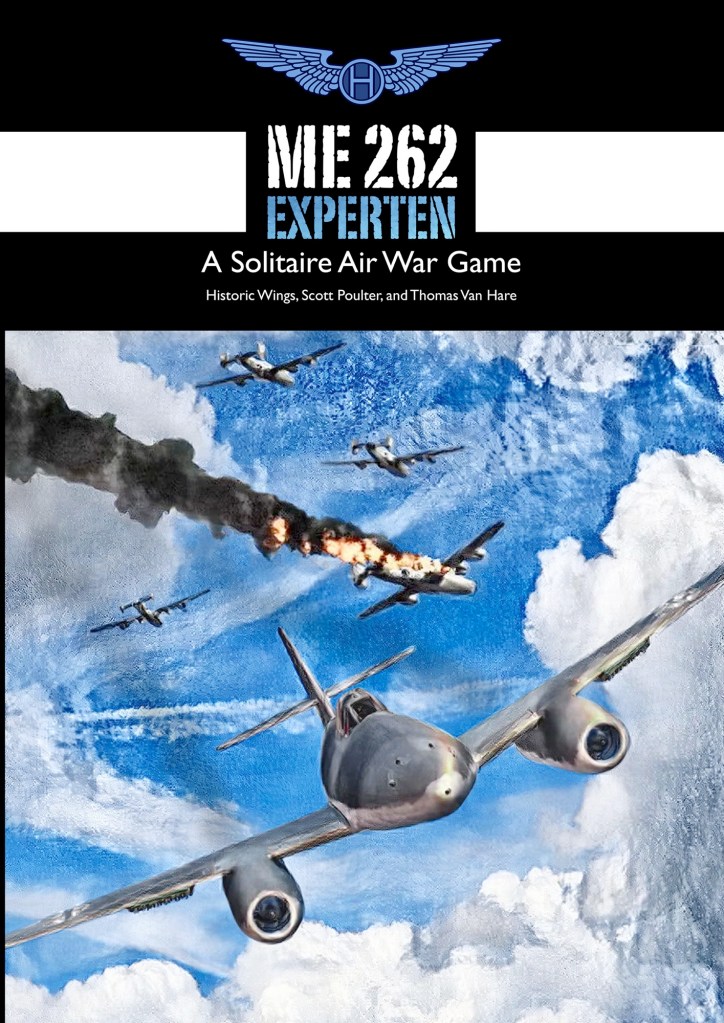
The other new title, Me 262 Experten, is being co-created with Scott Poulter, who some may know from his YouTube channel – www.youtube.com/@PoultergeistBoardGames – it is a joy to work with him. This game has you leading the squadron of aces, known as the Experten, during the final weeks of the Second World War. It is a deep dive into the history and tactics of Me 262 units in that time, the world’s first, truly combat-effective jet fighter. Historically, the unit – known as JV 44 – was led by Adolf Galland. It was manned by the top ace pilots of the war, men like Obst Johannes “Mäcki” Steinhoff (176 victories), Maj Gerhard Barkhorn (301 victories), Obstlt Oskar Heinz “Pritzel” Bär (220 victories), Obst Günther “Franzl” Lützow (110 victories), and Hptm Walter “Graf Punski” Krupinski (197 victories), among others.
These pilots were part of the relatively unrecognized “Luftwaffe Pilots’ Mutiny”, yet one other attempt by more professional officers to reverse the madness of Germany at the time.

In the game, you can either lead the squadron as it was or you can create your own “squadron of aces” with names you choose and ace records that you roll up for each. As you play, you learn about the Me 262, how it flew, what its strengths were – and about its weaknesses. It is one of the least understood aircraft of the Second World War. The Me 262 wasn’t the silver bullet that a lot of people think it was. Moreover, Allied tactics against them were pretty devastating. There are a lot of lessons to learn in that game. Players will find themselves struggling with the same challenges the first combat jet fighter pilots faced.
Grant: Our readers are probably not very familiar with the “Pilots’ Mutiny”. Can you tell us more about that?
Thomas: Recognizing that Germany’s leadership was mad, the top pilots in the Luftwaffe decided to do something. Some wanted to assassinate the leaders but that proved impractical because the tightening of security after the failed bombing attempt of Operation Valkyrie (Unternehmen Walküre). Force was no longer an option so they tried logic instead. That made the Pilots’ Mutiny all the more dangerous in the eyes of Germany’s leadership. It was easier to deal with an assassination attempt than with logic, sanity, and – above all – morality.
Hermann Göring was the first target. Thus, when the Mutiny failed, Göring removed the pilots from command and grounded them – this at a time when Germany was being hammered from the air by the combined might of the Allied air armada. Göring effectively took out the top management and talent in the Luftwaffe right when it was needed most. Göring vowed to have them all hanged for treason, but as most were considered national heroes, that proved a tricky thing. After a few months, the pilots were “allowed” fly, but only as regular line combat pilots – to the death. And thus, in Göring’s mind, the problem was neatly solved.
Yet Adolf Galland had a few tricks up his sleeve too. He successfully pitched that they should be allowed to fly together in a dedicated squadron of aces, equipped with new Me 262 jets. Göring agreed, probably only because he, like Hitler, was confident that the Me 262 was best suited as a “vengeance bomber”, not as a fighter jet. In the end, Galland received just twelve Me 262s and was allowed to recruit only about 16 pilots. While Göring was sure that they would all die in combat, the pilots had another idea – by flying together, they could survive the war – and they pulled it off, against all odds.
Another little-known story was that in late April, Galland attempted to defect to the Allied side with the entire squadron of Me 262s and all of Germany’s best aces. The plan to do that wasn’t just an idle discussion “over coffee” either. One of the JV 44 pilots, Maj Wilhelm Herget (a nightfighter ace with 72 victories) flew covertly across the lines at night in a Fieseler Fi 156 Storch – a light, high-wing observation plane – to make the arrangements with the USAAF. Afterward, he returned to JV 44’s airbase at Munich-Riem to finalize the arrangements with Galland. Once the date and time were decided, Herget set off on a second flight – again at night – to notify the Allies.
Fate is cruel, however, and Herget’s Fs 156 Storch was spotted and shot down by some crack American anti-aircraft gunners. It was a lucky hit as he flew low over the countryside, hopping from tree line to tree line and hedge to hedge to deliver the information. Luckily, Herget survived, but he could not get the message to the top brass of the USAAF – the capturing American Army units didn’t believe a word he said and he was shuttled off to a POW camp. As a result, what would have been the greatest mass defection of all time never happened. Less than two weeks later, the war was over.
The ultimate achievement of JV 44 was not measured in aerial victories, though the unit shot down approximately 45 USAAF aircraft, but rather the number of Luftwaffe aces who, having been “recruited” into its ranks, survived the war. The Experten pilots owed their lives both to Galland and to each other. They protected one another in combat. Along the way, JV 44 pioneered the principles of high-speed jet combat. The tactics they developed were employed later by the USAF and RAF during the Korean War and created a new foundation in the modernization of air combat as it entered the jet age.
All of this is recounted in the wargame book, Me 262 Experten and players will get to experience what it was like to command a Me 262 unit in the war and lead your pilots to attack massed formations of B-17 Flying Fortress and B-24 Liberator heavy bombers.
Grant: Please describe some of the gameplay in Me 262 Experten.
Thomas: In Me 262 Experten, just as in history, you tread a fine line – trying to survive to the end of the war while at the same time having to fly against the American “Viermots” (“vier” being the number “four” and “mots” being short for the German word for “motors”), the Jagdwaffe term for the four-engine bombers like the B-17 Flying Fortresses and B-24 Liberators. During April 1945, the USAAF and RAF were regularly flying 1,000-plane bombing raids. Germany’s cities were being burned out and reduced to rubble. There is a lot of debate among historians about the end of the war and why the Allies continued to bomb German cities right up to the last days of the war. The outcome was already clear, so why do it? A lot of civilians died as a result. Of course, the simple answer is that it was war.
Regarding the Me 262, its key advantage was its speed. Put simply, those jets could close on the Allied formations at speeds that were almost 200 mph faster (in level flight) than any of the Allied escorting fighters could attain. Surprising everyone, they would flash through the escorting screen of Allied fighters in a high-speed dive, usually head-on, to attack the bombers. The combined closing speeds were over 1,000 mph. The Me 262 pilots headed straight into the heart of bomber formations, firing rockets and then switching to their cannons. A few Allied fighter pilots would try to pursue them as they dove away after completing their firing passes.
The combined defensive firepower of the American bomber fleets wasn’t as effective against Me 262’s as it was against Luftwaffe Fw 190’s and Bf 109G fighters. The Me 262’s were simply too fast. For the Experten pilots, shooting down even one bomber meant potentially saving the lives of dozens of German civilians, if not more than that. As mentioned earlier, each B-17 and B-24 dropped eight or more 500 lb bombs. While Hollywood depicts bomb explosions more like they would be on a scale of just a single mortar round, actually just one 500 lb bomb is enough to destroy half a city block. The Experten were defending their homes to the end. One of the Experten pilots, Eduard Schallmoser, was shot down directly over his parent’s home. He parachuted to safety and landed in his mother’s back garden while she was outside taking in the laundry. She tended to his wounds personally until he was picked up and returned to the unit’s medical facility.
The Experten pilots saw it as their mission to save as many civilian lives as possible, meanwhile, they hoped that the Allies would join together to stop the Soviet threat from taking over all of Europe – they got that wish later on as most of them ended up as the founding members and commanders in Germany’s new Luftwaffe during the first decades of the Cold War. At the end of the Second World War, however, it seemed like everyone (on both sides) was waiting for the curtain to finally come down on the madman in his bunker in Berlin. On the very day that Hitler shot himself, the Experten flew their final mission, surrendering shortly afterward to advancing units of the US Army.
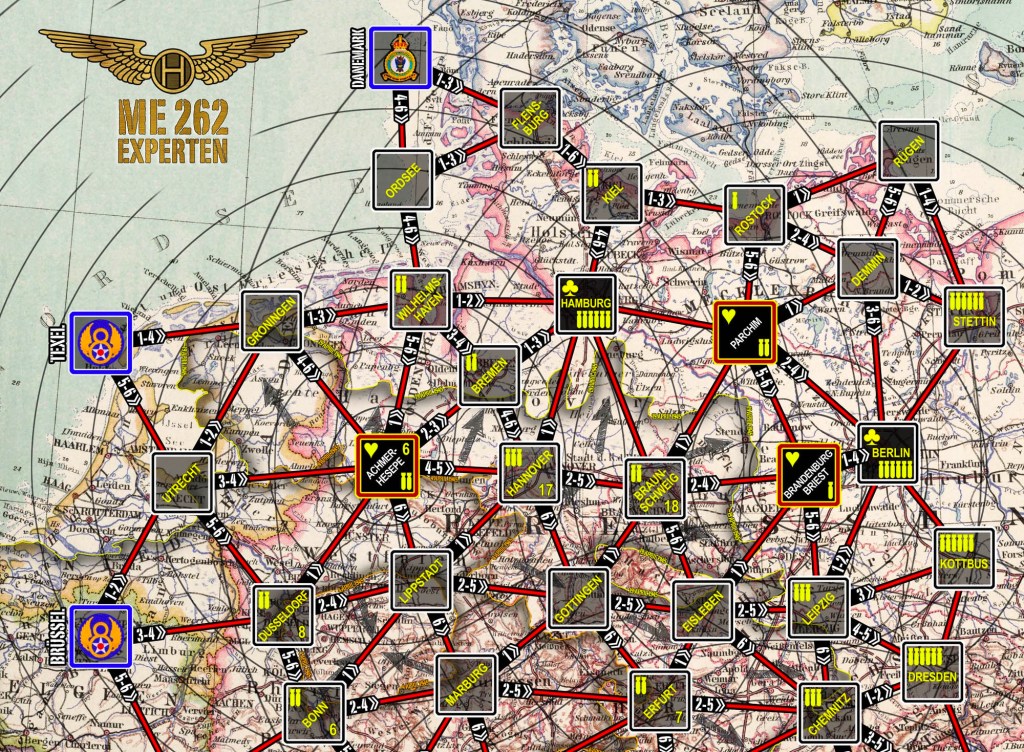
As with all my game designs, the history describes the gameplay. The maps, game counters, scale of the combat, tactics, odds of surviving on each pass, and so forth – all of that is carefully designed into the game. The main map depicts most of Germany. From the north to the south, based on the weather, formations of Allied bombers from the RAF, the 8th Air Force, the 9th Air Force, and the 15th Air Force fly steadily toward Germany’s cities. You have to decide which ones to attack.
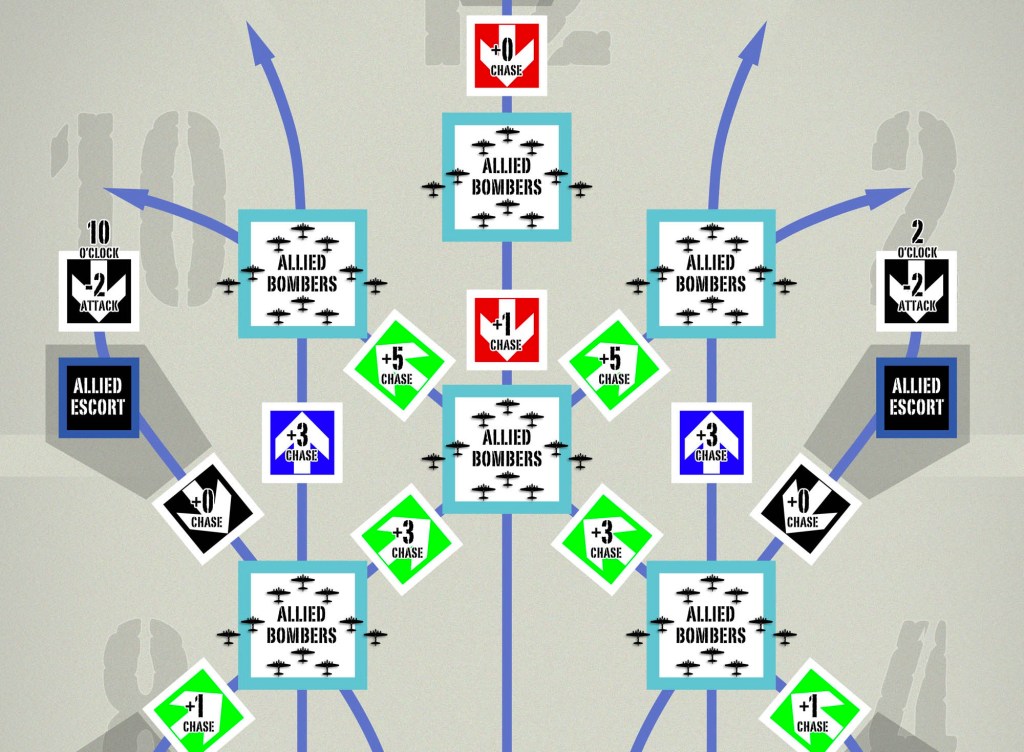
Your pilots climb into their Me 262s and take off. As they roll down the runway, Allied fighters, usually orbiting far above your airfields, would dive down to attack. Those Me 262 pilots who were lucky enough to get up to speed could accelerate away, then head toward one of the bomber formations. You plan your attacks, decide what angle to close on, and then dive through the Allied fighter escort squadrons patrolling above the bomber formations. You line up on the heavy bombers and try to down them before diving away – sometimes with your cannons, sometimes with your R4M air-to-air rockets.
Individual Me 262’s are represented, while Allied aircraft are shown at the Group level. You attack a portion of the bomber stream only. The bombers are placed at the center of the map and escorting fighters are placed around the edges along the various lines of approach. You roll in and attack either singly or in pairs. You might choose to engage the fighters or just press on with the attack into the heart of the bomber stream. Such is your speed that you can only fire at a single bomber on your firing pass. If your aim is good, you resolve what damage is done.
The more you press the attack, the more likely you will have Allied fighters “in the chase”, following you down as you dive away. Sometimes, you will have to turn to engage them. Other times, you will escape away cleanly. If a Me 262 gets damaged by the defensive fire from the bomber formation, particularly if it loses one of its two jet engines, the pursuing Allied fighters can easily catch it and shoot it down.
After your attack, low on fuel, you have to return to your airfield to land. However, most of the time you will have to run a gauntlet of Allied fighters waiting overhead to dive down to attack you as your Me 262 slows for landing. It was a rough time for the pilots of JV 44.
Grant: How do you “win” in a wargame that depicts a time when the war is already lost?
Thomas: The natural tension in the game is that there are two victory conditions. First, you have to fight and shoot down as many bombers as you can – thus saving as many civilians as possible from the relentless Allied bombing campaign. Second, you need to keep as many of your pilots alive to the end. The victory conditions in the game reflect the historical motivations of JV 44’s pilots.
Grant: I’ve played Overflight! and I’ve seen Tally-Ho! and MAG-23 Guadalcanal. The rules of all of your games are completely different. Each game has new mechanics and plays quite differently – there is no cookie-cutter formula, even in the games that are in a series, like your “Special Missions”. Are there unique mechanics in Me 262 Experten too?
Thomas: First of all, thank you for your interest in my games! To answer, yes, there are many new mechanics in it. One example is the way that damage is addressed. The core concept was put forward by some friends of mine in Denmark and it is used with permission, though I have taken it farther along. It works like this – when you are attacking an enemy airplane, you roll first to see if you hit – for this, D20 are used – and that might sound familiar, but there is more to it. With various modifiers (DRM’s), let’s say you need a base of a 12 to hit with your cannons. If you roll a 19, that’s seven over what you need, so you add +7 DRM on your roll on the Damage Table. In most games, you hit or you miss – not in Me 262 Experten. You can score some minimal hits or you can absolutely blew him to pieces, with a wing flying off and the remnants spinning down to a crash.
Likewise, the Damage Tables are unique to each aircraft. Unlike other games, the aircraft that takes fire determines the kind of damage done, not the aircraft that is firing its guns. In other words, how much damage results and what is hit is based on the target aircraft. No other game does this. If you step back and think about it, however, it seems like the most obvious thing in the world.
For instance, if you fire at a B-17 Flying Fortress and hit the wings, you’re likely to hit the fuel tanks because that’s where they’re located. That’s not the case on a P-51 Mustang, where the fuel tanks are located in the fuselage, directly in front of and behind the pilot. Likewise, imagine when you score hits on a P-38 Lightning. You might knock out one of the two engines and destroy the supercharger located behind it on the right boom – but you’re not likely to injure the pilot with hits there. Also, you might knock out the elevator controls (causing the pilot to make a control check) because they’re located in the twin booms.
Consider the same die rolls against a P-47 Thunderbolt. The radial engine is a lot tougher to knock out, but if you did, it would be catastrophic – unlike a P-38 Lightning, the Thunderbolt is a single-engine airplane! Similarly, knocking out an engine on a B-17G Flying Fortress just means that one of four on the wing is no longer working. It isn’t generic Wing Hits, Fuselage Hits, or Engine Hits against little tables for how many of each a plane has either – the damage from a hit in the fuselage will vary widely based on the design of the target plane. For instance, there is a high probability of an engine fire inside the cowling on a B-17. That can spread to one of the in-wing fuel tanks located just behind the engine. That’s how the fuel system was designed.
Everything is distilled down to a simple Damage Table for each aircraft, however, so it plays really quickly. The Me 262’s MK 108 cannons were deadly enough on their own, however. Generally, it only took four rounds hitting to shoot down a heavy bomber. The cannons fired explosive shells with delayed action fuses. Each cannon round was like dropping one and a half hand grenades (high explosive, fragmentation) into the inner workings of the airplane. Whether it hit the fuselage, wing, tail, or cockpit, even a single MK 108 cannon round could end your day.
On the downside, the rate of fire and muzzle velocity were both so low that it was pretty hard to get rounds on the target. With combined closing speeds measured in perhaps nearly 1,000 miles per hour, you were lucky to get off a well-aimed, one-second burst before you flew past. Getting four rounds to hit was a challenge.
The R4M air-to-air rockets were salvoed off two dozen at a time. A single rocket hit would be fairly catastrophic – even against a B-17 Flying Fortress. There is a special column for the damage done by the variant of the Me 262 fitted with a 50mm auto cannon. One of those was in the inventory of JV 44 at the end of the war. Apparently, it had arrived as a replacement aircraft in mid-April. Postwar Allied testing proved the auto cannon was mounted really well and the recoil was handled perfectly in the design. It is essentially like having a tank gun mounted in the nose of a high-speed jet fighter, firing HE rounds, one after another due to the autoloader. It is pretty darn hard to aim it, but one hit was all it took to down a heavy bomber.
A lot of people don’t really understand that – Hollywood is the worst when it comes to this kind of thing. They’re always depicting bullet holes stitching along in a line across the surface of the fuselage or wing. It was more like pulling the pin on a grenade and dropping into the back of the fuselage of your trusty P-51 Mustang, right behind your seat and directly into your half-empty extended range fuel tank. Do you think you’re going to keep flying after that?
Whether the attacks are by machine guns, cannons, or rockets determines which column on the Damage Table applies. In other words, explosive cannon shells do a lot of damage, but not as much as a hit by one of the air-to-air rockets. This is where the ace pilots in the Experten really shined – they could line up their aim perfectly and absolutely hammer a B-24 or B-17 with devastating fire.
Grant: Please describe some of the gameplay in Game of Drones, your Ukraine War title.
Thomas: In Game of Drones, you begin by forming up a new drone team. You are in command of the unit and serve as its primary drone pilot. Today in Ukraine, drone teams are composed of four members – a drone pilot, who flies reconnaissance drones, drone bombers, and FPV kamikaze drones; a navigator, who helps the drone pilot find the targets and communicates by radio with the brigade headquarters; a sapper, who is the unit’s explosives expert who prepares the drones for flight and makes the improvised munitions that they carry; and the driver, who drives the team’s vehicle and provides security while deployed at the Forward Position. All of that is reflected in the design of the game. Each member of your team will have an individual skill level. As you play, you develop their skills, so there is a strong narrative element to it. Based on your successes, you will take your drone team from a novice level to becoming experts.
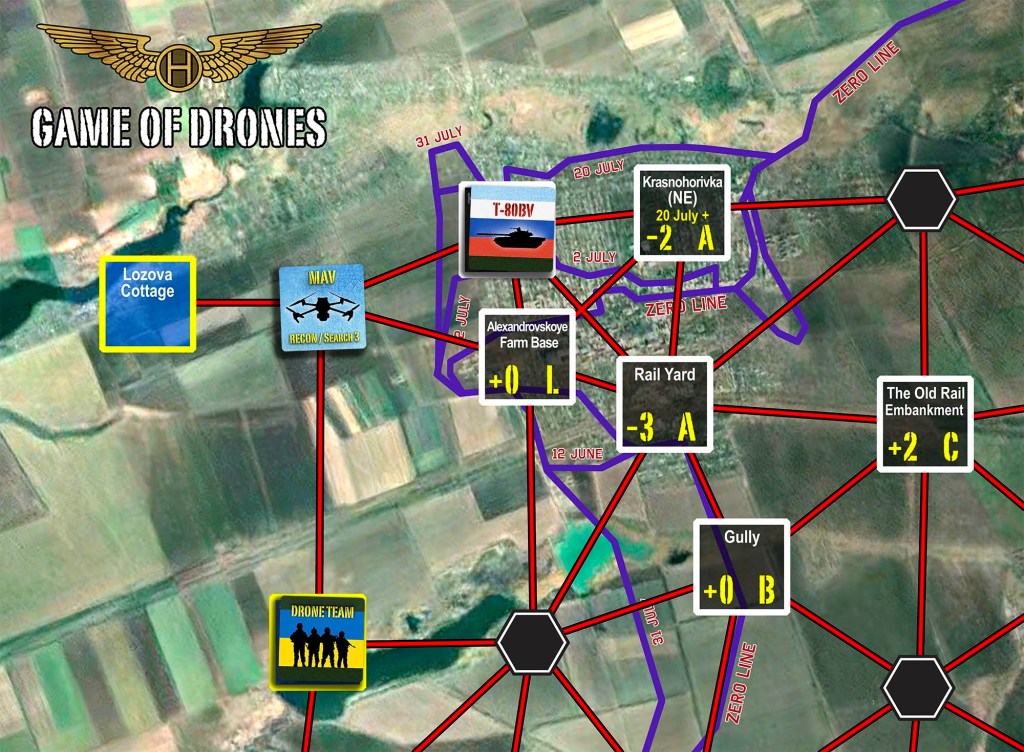
In June 2024, at the start of the Campaign Game, you deploy into the Krasnohorivka sector to support Ukraine’s 59th Separate Motorized Infantry Brigade “Yakiv Handziuk”. In this role, you are temporarily assigned to work alongside the brigade’s four existing, veteran drone teams – “Michigan”, “Key”, “Baltic” and “Eyes of Retribution”, as well as with the Aerial Reconnaissance Unit called “Airships” that supports the 59th‘s 9th Motorized Infantry Battalion “Vinnsytsia”. Among the various units assigned to the 59th are three well-known units – the 11th Motorized Infantry Battalion “Kyivan Rus”; the Separate Infantry Battalion “Da Vinci Wolves”, commanded by Serhi Filimonov; and the Assault Platoon “Chosen Company”, which was formerly part of the International Legion and is commanded by “Ryan”.
At first, in June 2024, the sector is only moderately hot, but then in July, things really pick up. The Russians begin a major push into Krasnohorivka. You are going to be hard-pressed to stop them. By then, hopefully, you will have gained enough experience and skills to get the job done. As well, you will have upgraded your vehicle, added some special equipment, and gotten better at flying FPV drones into their tanks, BMPs, and MT-LBs. You will have mastered dropping bombs from your Baba Yaga drones. You’ll see Russian motorcycle infantrymen, others riding in Chinese golf carts, and a host of armored vehicles in columns as they conduct massed attacks along the Zero Line. You’ll hunt artillery pieces, Grad rocket launchers, Russian command posts, and special equipment that is well-hidden in the forests and ruined buildings of the towns in your sector. You’re facing the whole inventory of Russia’s military at work in the war.
Finally, in August 2024, you are reassigned to support Ukraine’s 22nd Mechanized Brigade. You will report in under the unit’s Attack Drone Company, known as “Demons of the Storm”. After about a week off for rest and recuperation – and you’re going to need that after the high operational tempo you experienced during July in the Krasnohorivka sector – you’re sent up to Sumy to prepare for the invasion of Kursk Oblast in Russia. In short order, you’re going to be back on the Zero Line, but this time near Sudzha as Ukrainian forces press ever deeper into Russia after their surprise attack in the first week of August.
Grant: How does gameplay work with drones?
Thomas: The challenges you face are just as they are in Ukraine (and Russia) right now. The game has you taking the daytime shift (another team operates at night) and you begin in the morning with your first reconnaissance flights. Sometimes, you’ll get targets handed off to you from the night drone team, but most of the time, you have to fly out to find the Russians as they prepare for the day’s actions.
Daily, you get taskings from brigade headquarters based on intelligence reports about Russian plans. Some days, you’ll be focused on finding Russian artillery units, other days on interdicting supplies. Other times, you’ll be searching for Russian command bunkers. Sometimes, you’ll face massed “meat wave” attacks of Russian soldiers as they try to break through Ukrainian defenses. Those kinds of intelligence reports are very important and you have to abide by them – it is a military organization after all, even if drone teams have been (until August in Kursk) a pretty free-wheeling bunch.
Once you’ve identified some targets, you alone decide how to attack. Maybe you’ll see if the brigade artillery can do the heavy-lifting for you. Maybe you will use a small drone bomber to drop explosives on their vehicles, trenches, bunkers, or buildings. You might want to bring your larger drone into the fight, one of your Baba Yagas. Other times, the targets might be better addressed by flying repeated attacks with kamikaze FPV drones. Of course, you’ll face Russian Electronic Warfare (EW) and jamming as well. The farther afield you fly, the more difficult it will be to hit targets with your FPV drones, since the electronics are line of sight and the curvature of the Earth blocks your signals once you are over the horizon – you might have a signal as you orbit the target, but you know you’re going to lose it as you dive down low.
It is not as easy as most people think it is. On YouTube, you generally only see videos of the “kill shots”, where a drone blows up a T-72 tank in particularly spectacular fashion, with the turret flying high into the air. In reality, it can take up to a dozen FPV drone hits to destroy a tank. The tables that you roll on to attack in this game are accurate to the real numbers. There’s a lot to learn in this game.
Likewise, the Russians shoot back. You’ll face incoming artillery, Grad rocket barrages, mortar rounds dropping in around your position, Russian drone teams that hunt you (even as you hunt them), and sometimes their most deadly weapon, FAB-500 aviation bombs, which are powerful enough that if one hits anywhere near you, you’re going to be injured or maybe even killed. Even if you survive, your combat stress is going to skyrocket. Maybe you’ll be rendered ineffective. Maybe you’ll lose some team members. Maybe your only option will be to conduct an emergency evacuation of the position.
Just as Ukrainian drone teams do today, you’ll rotate forward into the battle for a three or four-day deployment, then rotate back for some rest. Managing your combat stress and unit morale is going to be key to victory. It will take quite a bit of leadership on your part to keep the team together and effective. Sometimes, things don’t go well and you’ll end up delayed instead of returning on the planned rotation schedule. Sometimes you’ll have to remain on post for a fifth, sixth, or even seventh day before you get to come back.
It’s always a balancing act and your drone team’s morale will drop off sharply if you don’t have enough food and water – but which do you carry forward? More food and water or more FPV drones to get the job done against the Russians? Of course, you can always send your driver and sapper back to get more drones or supplies, but that means that they’re potentially going to be spotted, exposed, and at risk while moving back and returning with the additional supplies. War is unforgiving.
There’s a lot of choices to make – and all of them are reflective of how it is right now in Ukraine.
Grant: It sounds like an interesting game. Is there anything else you can say about the design?
Thomas: One thing that a lot of players will find surprising is that almost every drone team has a mascot – a dog or cat that goes with them to the front-lines. Most of those are abandoned animals that are picked up in the field. Having a dog with you – or a cat – helps keep your drone team’s morale up and reduces your combat stress. So that’s key to the game. That’s how it really is along the front-lines. You need to find your own mascot, however, so that’s one of the things that is built into gameplay. I’m thinking of allowing my supporters to have their pets featured in the game as individual game counters.
My co-creator of Game of Drones, Joe “BigMac” McDonald, keeps his team’s mascot with him, a one-year-old pup named “OneSock”. He’s very popular with the team. If you look up BigMac’s YouTube Channel, you can get a sense of how things are – www.youtube.com/@BigMakBattleBlog – and I highly recommend you subscribe to his channel as well! He’s a real soldier’s soldier and calls it like it is.
Grant: How do you design for game balance?
Thomas: That’s an interesting topic. To my mind, the concept of “game balance” is popular but it isn’t really historic. Seldom in history are the sides balanced in war. Game designers, however, often want to equal the odds in their games. This stems from the old two-player game metaphor – you don’t want the Marines to win on the beaches of Okinawa every time and leave the player running the Japanese without a chance. Likewise, do you really want to play the Polish side in 1939 and watch as, no matter what you do, your forces are overwhelmed, collapse, and you lose outright to your opponent, who is running the Germans? That’s reality, however.
In solitaire games, however, we have an advantage as game designers. It doesn’t matter if one side or the other has a better chance of “winning”. The experience for the player is going to be interesting no matter what happens. You don’t even have to play the winning side every time either. Ultimately, what matters is how you define victory.
As designers, I think that our mission is to come up with games that present interesting challenges and victory conditions to the player. They should get to experience history in a new way – even if there isn’t “game balance”.
My four keys to game design are fairly straight forward. First, the game has to be fun to play; second, it has to teach history by immersing the player in the era and conflict; third, the game must be replayable with new experiences each time you play it; and finally, it should be challenging to win. How challenging? My answer is just this – as challenging as it was in history. My game, SOE: Lysander, reflects that. A lot of pilots who flew those missions didn’t make it home. Of course, how it all goes bad is always interesting. There’s a lot of narrative content in that kind of thing, with the plane stuck in the mud as the Gestapo closes in on the farmer’s field just south of Lyon. As one of my players said “the narrative is through the roof”.
Additionally, my goal is to spare no effort on the development, design, art, and gameplay. History deserves that. I do all of the art, maps, and counters. I hope I’m up to the task – it is the best I can do and people seem to like it.
Grant: Prior to Game of Drones and Me 262 Experten, you’ve always worked alone as designer. You’ve been the writer, artist, production manager, and even done the customer service. How has the experience been so far working with someone else designing games?
Thomas: The experience of working with Scott Poulter has been really excellent so far. The same can be said for Joe “BigMac” McDonald. I could not be more pleased. With these new partnerships, I can put more time into the historic details and into designing gameplay. For instance, in Me 262 Experten, just on the art, the Bomber Stream game counters depict all of the Bombardment Groups flying with the USAAF in April 1945. Each one is done with accurate tail markings, so there’s nothing generic on the board. You know who exactly you’re attacking, whether it is B-17 Flying Fortresses flying with the 100th Bombardment Group (Heavy) – the “Bloody 100th” – or A-20 Havocs assigned to the 409th Bombardment Group (Medium).
Likewise, the game map is based on an actual German map from the end of the war, overlaid with sectors that the planes fly through on their way to their targets. The mechanic for how Allied bomber streams move is obvious and intuitive. You are never certain what their targets are as the raids develop. If you hit the bombers before they drop their bomb loads, you gain more Victory Points. However, doing that involves flying farther out from your airfield, which opens you up to greater chances of being intercepted by roving squadrons of Allied fighters along the way. As with all of my other games, we will have boxed sets offered through Blue Panther. The main map will be large canvas one like you find in the boxed set for Overflight! – measuring 17” x 22”.
In Game of Drones, there will be two canvas maps plus an additional seven A4-sized card maps that depict each of the forward positions that you fly from. The events of the war are carefully researched down to how many tanks you’ll likely see in a massed attack, how Russian motorcycle infantry accompanies the advancing forces, and so forth. The types of drones you fly are realistic and there are a lot of sections in the wargame book that get you up to date on how things work in this war. Your team is going to be drinking NON STOPs, which is Ukraine’s equivalent of Monster or Red Bull energy drinks, and so forth.
There’s a lot of detail, even a glossary of current wartime slang used in Ukraine right now – “Roger that” is simply “Plus”, while “Roger wilco, on it” is reduced to “Plus plus”. If you’ve been listening to Ukrainian language videos you’ve probably picked up a lot of that already.
Grant: Would you like to work with other designers as well?
Thomas: Yes, I would look forward to work with other designers on future games. In fact, I’m planning on it. Most probably, quite a few game designers will want to work under the Historic Wings brand, perhaps even some of the most well-known names. The reason I say that is because of the percentage of profits that I share is higher than they are used to seeing. I will be selective, however, but a good idea is a good idea. As a historian, I will work with the designer directly on the game from start to finish and my focus will be on ensuring that the history is right and that gameplay properly reflects that.
In wargame design, you’re only as good as your last title published, so quality is everything. Again, if you know anyone who would like to publish with me, please pass on the names. I’m easy to reach.
Grant: Why do you produce wargame books rather than traditional boxed games? Will you stick with wargame books as the format or go into boxed games only at some point?
Thomas: All of my games so far have been designed first as wargame books, with boxed sets to support gameplay. I’m planning on continuing to do that. Our industry is changing, though boxed games are still in the most demand. My wargame books are completely different from the usual concept of a “wargame book”. My goal was to set a new, higher standard in this format. I hope I’ve achieved that. There isn’t anything like “If you turn left, turn to page 127”, etc., nor are these titles quick-and-easy “light game books”. In those types of games, which are popular in their own right, it is all about simple tables and charts. A lot of them are meant to be quick “travel games”.
My designs are full-featured wargames, however – it’s just that they are offered in book form.
The reason I do this is that it gives players options depending on their budget. First, those who are “crafty” and can make their game counters, maps, and play aids can just purchase the wargame book and get to work with paper and cutting knives. That is an affordable way to get started. Some of my games, like MAG-23 Guadalcanal, don’t even need maps or game counters to play – at all. You can just write the gameplay out on paper, or you can buy the MAG-23 Logbook, which gives you a good format to keep your wartime diary. Of course, having game counters and maps helps a lot with the “theatre of the mind”, so a lot of people want to make their own counters anyway.
Second, for those who “want to go whole hog”, they can purchase premade, boxed sets of all of the components needed. Those are published together with Blue Panther. The boxed sets include all of the key assets needed in a ready-to-play format – maps, counters, play aids, etc., everything but the dice are included in the box. What’s more, the box is sized to fit perfectly so that the wargame book fits neatly inside so it looks really good on your shelf.
If you get the boxed set, you still need to buy the wargame book on Amazon so you have the rules and tables. The combined cost of both the wargame book and the boxed set from Blue Panther is about the same as you expect to pay for a regular wargame – or even less – so if you’re a boxed-set collector, that’s the way to go. The quality of the components is really high, some say it is far above what they’re used to seeing in a lot of regular boxed games.
One thing to add is that my wargame books are proving to be very popular in schools. The school library can carry the wargame book on the shelves. As well, sometimes entire classes learn the wargame together, a few books are passed around the class. Then they play at home and come in the next week with a write up their experiences – those become the “school papers”, whether for history class or for creative writing. The format is better attuned to the interests of the younger generation than an old standard, the 300 or 400-page history book. While wargames still struggle a bit with the younger generation, regular boardgames sell at higher volumes than ever in history.
With these wargame books, an unexpected effect is that I’m introducing wargames to the next generation. That’s something that wouldn’t happen if I did only boxed games. I found out that there are even a few players who have been playing MAG-23 Guadalcanal with small airplane miniatures – the old sets that you can purchase at 1/700 scale from Tamiya. I have to admit they look really good. As well, I have had a few players message me about 3D printing and so most of my wargame books include links to .stl files to download and use. Between BigMac and I, we’re planning on releasing a complete line of Russian miniatures and drones to use in gameplay of Game of Drones, each one customized with the types of modifications that you see in Ukraine at this time – reactive armor, “sheds” built over the tank turret, and EW systems mounted on top, etc.
Grant: Looking farther into the future, are there any other designs and projects that you are currently working on?
Thomas: For many months, I have been working on La Fière, which recounts the story of the 82nd Airborne during D-Day. Specifically, that wargame book covers the battle at La Fière Bridge, which opened the way for the Allied advance to liberate the Cotentin Peninsula and secure the harbor at Cherbourg. That title is being done with Helen Patton, General Patton’s granddaughter. Next year, we’re planning on setting up a wargame weekend gathering at the La Fière guesthouse in Normandy, so standby for that!
I have two expansion games in the works right now, both of which I have mentioned in other forums. One carries forward with the story of the Marine Air Group on Guadalcanal and the other about additional US spy plane overflight missions. Additionally, there is A.V.G.: The Flying Tigers, which I’d like to finish this year. We’ll see, however – I’m very busy! Finally, as I mentioned earlier, there is a wargame design about flying B-26 Marauders in Operation CROSSBOW, taking down German V-1 and V-2 sites – that’s the one where you fly through heavy flak barrages.
Farther ahead, I am working on a Vietnam era air war game, a World War I title, and another Battle of Britain game. All three will have you managing a squadron of pilots on the front-lines – the challenges are vastly different at that level. You’ve got to carry out the mission, but also ensure that your guys make it home at the end of the day so they can fly tomorrow.
Grant: Do you have any final comments for our readers?
Thomas: Let me end by saying two things. First, I would like to thank the wargaming community for their interest and wonderful support for what I’m doing. Designing these games in book form is risky. It is a format that some others haven’t done so well with, so a lot of people are uncertain about what they’re getting. Many get confused and think that these are just glorified Print and Play (PnP) titles – nothing could be farther from the truth.
Second, I would like to say a big thank you for the opportunity to do this interview with you guys! It is a great honor to be featured on The Players Aid. My hat is off to you both – you’ve really built a central hub for wargame reviews, discussions, and community. That’s amazing. What makes wargaming fun, even solitaire wargaming, is the experiences we have with our fellow gamers! What you do builds that community for the betterment of the hobby – and for us all. Keep it up! Thank you!
Grant: One more question – where would people go to purchase your wargames online?
Thomas: Thanks for asking! My wargame books are available from Amazon at:
www.amazon.com/dp/B0BN2932W9
Add-on boxed sets of the components only are available from Blue Panther at: www.bluepantherllc.com/collections/historicwings
Thanks again for having me!
It has been a real treat to have you on the blog and thank you so much for your time in answering our many questions about Achtung Jabo! and your other Solitaire Book Wargames. I am really glad that we gave Historic Wings a try and I am really looking forward to playing those volumes that we already have and those that you have spoiled here and which are coming out shortly! Thank you also for your tireless service in defense of our nation’s freedom and for all the great work that you were a part of in the 1980’s and 1990’s and beyond.
-Grant


I think you may have just interviewed the most interesting man in the world. Does he drink Dos Equis?
LikeLiked by 1 person
Hahaha. Maybe. I’ll ask him.
LikeLike
Great and interesting designs by a fantastic designer. Thanks for the awesome interview.
LikeLiked by 1 person