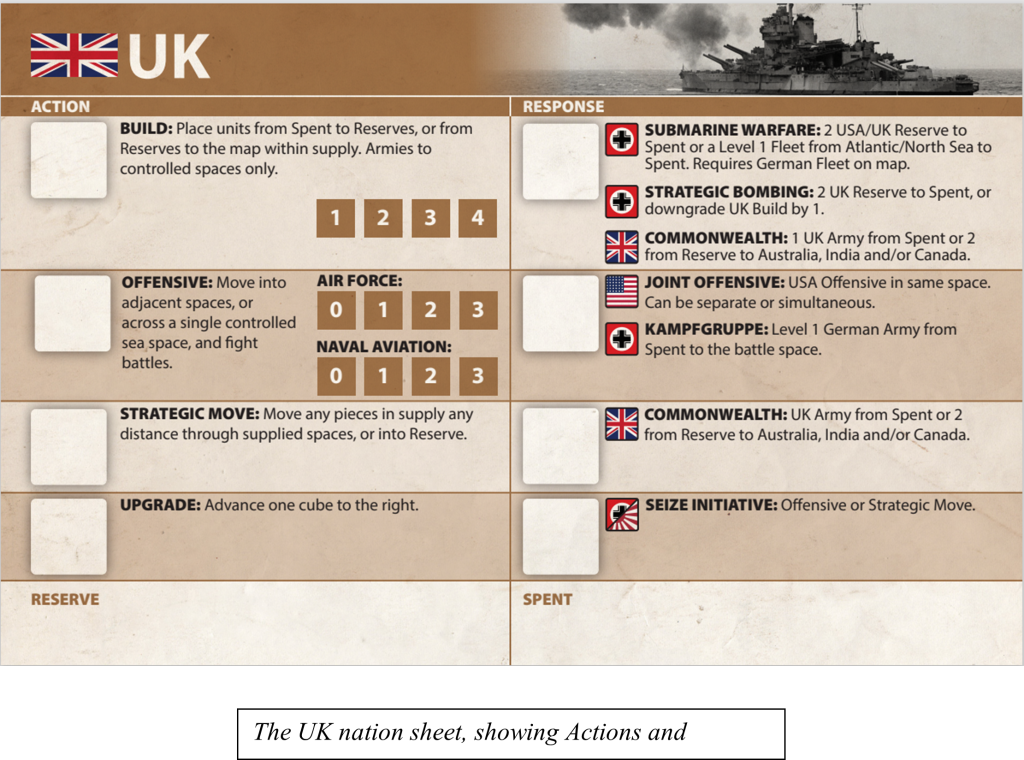
In this series of articles, we are looking at the overall strategy recommendations for the very interesting and unique strategic level wargame One Hour World War II from Worthington Publishing. This is general tactical consideration advice for the various factions in the game and will be of interest to anyone who might want to better understand the framework of the design around which the game focuses. The images used here are prototypes and not necessarily the final product. For this 1st article, we are focusing on the United Kingdom.
United Kingdom Strategy Guide
The United Kingdom is faced with direct threats to its empire from both Germany and Japan from the very first turn of the game. It has a single Army in the UK itself, far from the action, and a beleaguered French Army awaiting the German onslaught. There is one UK Army in Reserve, all the rest are several turns away from being fully mobilized. The only place the UK has an initial advantage is the sea. The Royal Navy has uncontested control of the North Sea and Atlantic, with ample Reserves. This gives the UK player some options – the Atlantic Fleet provides a link to North Africa and the empire beyond, while the North Sea Fleet allows access to Scandinavia and a supply line to France. But the UK is going to be feeling the pressure throughout 1940 and 1941. The Soviets and USA are low on actions early in the game and are unable to take the offensive in any meaningful way. For the first third of the game, only the UK can really contest victory spaces and make counter-attacks against the Axis. This is not an easy task. Every single UK Action marker that is spent needs to be weighed up against the chance of an Axis auto-win. Allied Political Will can be reduced to zero with surprising ease. Britain must hold the line!
The Battle of France
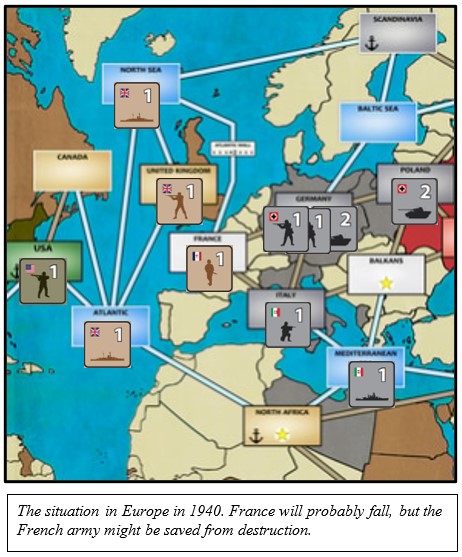
The first crisis to deal with in the 1940 turn is the situation in France. The French Army is under UK control and it will most likely be attacked with overwhelming force by Germany on the very first action of the game. Because the Germans will usually have a 3:1 ratio, the French Army will be permanently destroyed unless you commit the single UK Army in Reserve. This is a big decision – if you commit the UK Reserve (which represents sending the BEF to support France) you will save the French Army from permanent destruction. It will go to the Spent pile and from there it can be brought back later – the Free French!
However, this commits the only British Reserve and severely limits options on the first few turns. When it is time for the first UK turn, you will only have a single Army (the one in the UK itself) and none in Reserve. This is not even enough to fight the Italians in North Africa. So, saving the French comes at a high cost. And this decision comes before you have even taken a single Action! Now, sometimes the Germans will not hit France on their first action. They may decide to go all-out against the Soviet Union, sending their panzers smashing into Ukraine, Leningrad and possibly Moscow in 1940. If this happens, the UK will get a critical 1 or 2 actions with the French Army intact and a foothold on the European continent. There are a few ways to handle this golden opportunity.
The first is to commit to the Western Front. Build a UK Army there as your first action. For your second action, you are now in position to invade Italy or Germany itself. The Germans will realize this and be forced to keep back some forces to defend themselves. This takes some pressure off the Soviets. If the Germans don’t reinforce Italy, you may be able to take it and permanently destroy the Italian Army during the first turn – a nice move if you can pull it off. Your other main option is to evacuate the French from the continent using a Strategic Move. They could be placed into Reserve or sent to a crucial victory space like North Africa or India. By doing this you are giving up France to the Germans but preserving your forces. One final note about the French. If you are playing with the Special Actions optional rule (see the rulebook, section 8) you may have the “French Resistance” marker. Like all Special Actions this is a one-time use only and still costs an Action marker. It allows you to place the French Army back in France, regardless of supply or control. If you possess this marker, it is definitely worth saving the French Army by committing the UK Reserve or evacuating them as described above. Placing the French Army back in its homeland using the French Resistance marker should be done when the Germans are so over-stretched, they cannot counter it. It can be a great accompaniment to an Allied landing in France, or simply provide a distraction in the middle-game when the Germans are totally tied up on the Eastern Front.
Opening Moves
Aside from the question of the French, there are a few broad directions you can take in the critical first 2 turns. You are the only Allied country which can take the fight to both Axis powers early in the game, and the other Allies will be relying on you to slow down the enemy. Here are some basic approaches:
-North Africa: This is an absolutely critical space for the UK. It is a victory space and effectively controls access to the Mediterranean and to your empire in the east. Germany will often send the Italian Army to take North Africa (ferried over by the Italian Fleet in the Mediterranean) in 1940. If this happens, your first 2 actions of the game should be focused on retaking it. You could spend your first action upgrading Air Force or Building to get more units over from Spent to Reserve, and then spend your second action launching an Offensive from the UK into North Africa. Now, you may still lose this if Germany commits some of its Reserves in the ensuing battle. But at least you are taking pressure off the Soviets and weakening the Germans from the very beginning. Now, if the Axis have NOT taken North Africa before you get a chance to act, it is best to Build an Army there on your first action. This means the enemy will have to fight for North Africa instead of just marching in to take it. Securing North Africa from the get-go means you have a supply line to your colonies, access to the Mediterranean and a staging ground for an invasion of Italy.
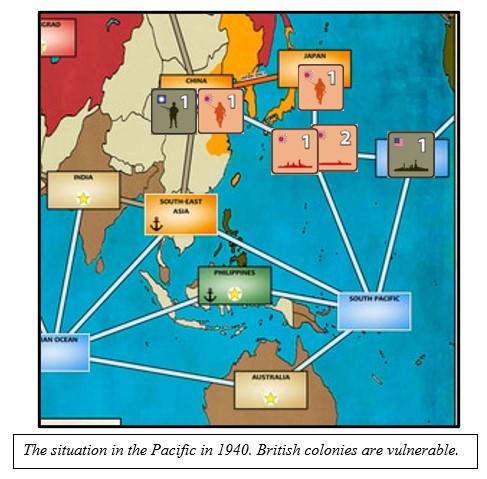
-Defend the Colonies: If the Germans have not gone hard for North Africa in 1940, then other options open up. You control two spaces which will be very juicy targets for Japan – India and Australia. Both start the game undefended and far from any UK units. If Japan is allowed to take these spaces and sit on them for several years, the loss of Political Will for the Allies will be crippling. In other words, Britain cannot afford to just abandon the Pacific Theatre. Luckily, it is possible for the UK to scrape together some defenses on the very first move, before the Japanese have even moved. You can use a Build action to place an Army in India and then follow up with
the Commonwealth Response to place another Army in either Australia or India. Notably, this Response does not require supply – this is why you could place an Army in Australia without first placing a Fleet in the Indian Ocean.
There is another way to defend Australia, but it involves the USA. If the US player is willing to spend one of their precious few action markers early in the game, they can place a Fleet in the South Pacific. This will temporarily shield Australia and make Japan really think twice about going south. After all, if they attack the USA, the sleeping giant will awaken and be gifted with a free action marker – disastrous for Japan in the early game. So, if the US is willing to place a Fleet in the South Pacific, you could use Build + Commonwealth to place 2 Armies in India. The empire will be quite secure, and the Japanese will have to build up their own Armies or upgrade their Air Force track before coming after you. There is another way to drain Japanese resources, again involving consultation with the other Allies. It is a very common first move for Japan to attack China with both starting units, killing the single Chinese Army there and having two Japanese Armies occupying the space. Now, all three Allied Nations can Respond to this by funding their respective factions in China, represented by the Chinese Nationalists and Chinese Communists Responses. If the Soviets use Chinese Communists, while the UK and the USA both use Chinese Nationalists, it is possible for the two Japanese Armies in China to be removed to Spent, and a single Chinese Army to be placed back in China. This earns the Allies control of a victory space and will severely slow down Japanese momentum. The Japanese may be so enraged by this that they spend the rest of 1940 and 1941 crushing the Chinese. Of course, all three Allied Nations are spending an Action marker
here – so it is costly.
-Scandinavia: This is a high risk but high reward strategy. On the very first UK move, you have the chance to do an Offensive into Scandinavia. This is not a victory space, but it does give you access to the Baltic and therefore a direct invasion route to Germany itself. By the start of 1942, you can have an invasion force sitting in Scandinavia and a Fleet in the Baltic, ready to transport it to Berlin. If the German player is napping, this is a potential way to win the war very quickly. But most German players will see it coming and respond. They might build up their own Fleets in the Baltic or build up Armies in Germany itself. They may even launch their own attack into Scandinavia to clear out the threat. Now, while this is happening you are not securing victory spaces and you are giving Japan free rein. The only advantage is that Germany is also throwing resources into this new northern front, dramatically easing pressure on the Soviets. You may decide to use this strategy purely to let the Soviet Union build up its strength and invade Nazi-occupied Europe as soon as possible, but it is a delicate balancing act. The Allies may be down to 0 Political Will by the time this hammer blow can fall. As such, the Scandinavia option should only be reserved for players willing to take a bit of a gamble.
Never have so few…
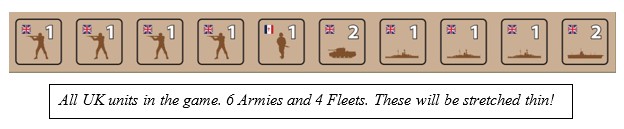
In One Hour World War II, aerial matters are abstracted – there are no “Air Force” pieces that move around like Armies and Fleets. But that doesn’t mean air power is insignificant! The Royal Air Force is represented in the game primarily by the Air Force track and the Strategic Bombing Response. The Air Force track ranges from 0 to 3 and can be improved by the Upgrade Action. The level of the Air Force track is added to that Nation in every land battle. The UK will be relying on this more than other Nations because it is very thin on the ground. There are only 6 UK Armies in the game, and one of them is the French. You cannot rely on building up large numbers of units on the front line or in Reserve like the Soviets and Americans can. For this same reason it is often not worth upgrading the Build track as the UK – you just don’t have enough forces to justify it. Building up the Air Force track will give you a permanent bonus, unlike Reserves which must be spent to add their strength. An upgrade to Air Force on turn 1 will pay dividends through out the whole game and provide the crucial edge needed to kick the Italians out of North Africa and to defend India from the Japanese.
Strategic Bombing is another way the RAF shows up in the game. This is a Response to German Build or Strategic Move Actions and either downgrades the German Build track by 1 or shifts 2 German units from Reserve to Spent. The USA can also do this Response, at the same time if desired. A concerted Strategic Bombing campaign done with the Americans from 1942 onwards will utterly crush the German economy. They will simply never have enough Reserves and will be unable to place fresh Armies on the map in a single Action. It costs you actions and it means you are not putting boots on the ground in victory spaces, but it relieves a huge amount of pressure on the Soviet Union. Indeed, using lots of Strategic Bombing should be seen primarily as a way for the UK to contribute to the Eastern Front. Trust me, the Soviet player will be thanking you every time the Germans get bombed!
Victory in Europe
Assuming the Allies are still in the fight by 1942 and 1943, the UK must now focus on a clear strategic path, in consultation with the other Allied countries. Generally speaking, the UK will maintain a defensive posture in the Pacific Theatre. If India has been taken then by all means retake it, but it really should be the USA doing the heavy lifting against Japan. There are exceptions, but most of the time the UK should be focused on bringing the fight to Germany and Italy in the middle game. There are two main ways to do this:
-Mediterranean Theatre: Taking out Italy and thereby providing another approach into Germany is an operation that will require several steps. First, you need to make sure North Africa is secure. Hopefully this was already achieved in 1940 or 1941. Then, you need to build a Fleet to take out the Italian Navy. The single UK Level 2 Fleet is usually up to the job, though it may need an upgrade on Naval Aviation or some Fleet Reserves to help. Build the Level 2 Fleet in the Atlantic or Indian Ocean, then sweep through either Strait (North Africa or Middle East, both British territory) to hit the Italian Fleet and sink it. Once control of the Mediterranean is secured, you can build up a few Armies in North Africa and then strike either Italy or the Balkans. Germany will not be able to defend both. Usually Italy is the best target as the Balkans can be left to the Soviets. With Italy itself taken, the Italian Army will be permanently destroyed – one less thing to worry about. Plus, the path to Germany is open.
-D-Day: Crossing the sea from the UK to France is a tough job. The Germans will get a +2 bonus to their strength when attacked from this direction, and this is not even counting their Air Force track or Reserves. To take and hold France will require a large build-up of UK and preferably also US forces. Upgrading the Air Force track to 2 or even 3 is also advisable before embarking on the great crusade to liberate Europe. As was historically the case, you might be waiting until 1944 to pull it off. When you do decide to go into France, conducting a Joint Offensive with the USA is perhaps the best way to do it. Both Nations can contribute their Air Force bonus and can unite their strength. Remember that the stacking limit in the game only applies per Nation, not per side. So, you could have up to three UK units AND up to three USA units in the same space. Taking France with such large, combined Allied forces is a smart move. France is a neutral victory space which benefits whichever side controls it – taking it away from the Germans is actually a 2-point swing in terms of Political Will. It also places you right next to Germany itself. Due to the turn order, it may be possible for the UK and USA to conduct a Joint Offensive into France during the UK turn, and then for the USA to conduct its own Offensive into Germany during the USA turn. This denies Germany a
chance to recover and possibly gets you Berlin without too much of a slog.
Conclusion
The British Empire is the bulwark of the Allies in the early game and must soldier on through the dark years of 1940 and 1941. Do not let the Japanese take your colonies and do not let the Germans cut you off in North Africa. Build up the RAF, bomb the hell out of Germany and claw your way back to a dominant position in conjunction with your more powerful allies. By the middle and late game, you should be in position to come out swinging against the Axis and launch major operations in the Mediterranean and France. Fight on the beaches, fight on the landing grounds, fight in the fields and in the streets, and never surrender!
In our next Strategy Guide, we will take a look at the Germans.
If you are interested, you can read our interview with the designer Clint Warren-Davey on the blog to find out more about the design at the following link: https://theplayersaid.com/2024/06/04/interview-with-clint-warren-davey-designer-of-one-hour-wwii-from-worthington-publishing/
And if you are interested in One Hour World War II, you can back the project on the Kickstarter page at the following link: https://www.kickstarter.com/projects/1456271622/one-hour-world-war-ii?ref
The campaign concludes on June 15th at 4:00pm EDT.
-Grant
 The Players' Aid
Intriguing little game. Did not back on KS, but will likely pick-up a copy at Prezcon ’25. A question Grant – how well do you think this game would work in a tourney format?
LikeLiked by 1 person
I think it would definitely be one you could make a tournament. Playing in an hour would be perfect.
LikeLike
Good analysis! Looks like something I would be interested in.
LikeLiked by 1 person