
Deterministic Combat is a bit of a polarizing term. Gamers either really seem to like it or cannot stand the concept. Deterministic Combat is a system where the outcome of any battle is determined by the inherent strengths and weaknesses of the opposing forces, without any element of chance or randomness involved such as dice. This approach to combat offers both advantages and disadvantages, shaping the gameplay experience in unique ways. I feel that it forces players to focus on strategic deployment and movement of their units and the need to plan those actions out over the course of the game. This also takes luck out of the mix and forces players to play smartly rather than to rely on the dice. But, I admit, I really do like rolling dice but understand that they are fickle and can really rain on your parade if they don’t cooperate. Even good, well thought out strategy can be foiled by the luck of the dice. But deterministic combat can also get a bit mundane and seem to be too repetitive and also doesn’t take into account any luck at all. And we all know that throughout history, there have been many underdogs who have won the day due to some lucky breaks here and there. In this entry in the Best 3 Games with… Series, I want to take a further look into a few games where I found that the Deterministic Combat was not a problem and was done very well.

3. Cry Havoc from Portal Games
Cry Havoc is an asymmetric, card driven, area control game, where players battle for control of regions on a planet. These regions are valued by the number of crystals on the region. Each player controls one of four unique factions including the Humans, Trogs, Machines and Pilgrims with special abilities and tactics that suit their strengths. The game comes with 54 custom plastic miniatures that are beautifully sculpted, a large format board and over one hundred unique cards. So what does asymmetric mean in Cry Havoc?
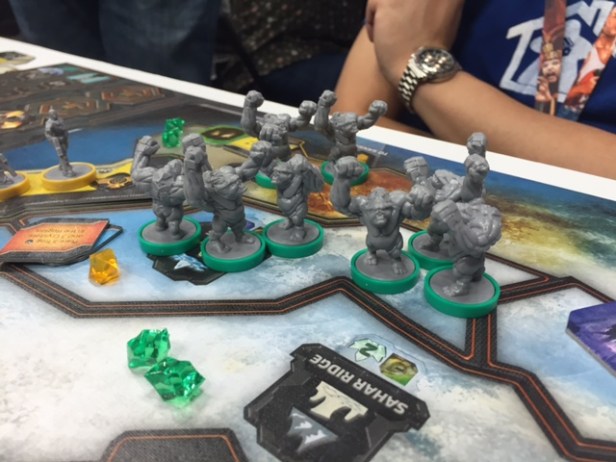
Asymmetric means by definition not the same but in gaming it is much more than this. It means that each faction starts with different setups and has very different end goals for victory and generally will take different routes to get there. This can make the process of balancing a game very difficult for a designer but creates a gameplay experience that is unique and varied and can be experienced from many different viewpoints. It can also create a very tense play experience as well as you don’t always know how your opponent will act during the game.
The combat system in Cry Havoc is the best part. As I have looked at the game over the years, this aspect was the real draw for me. When one player enters another players controlled region a combat is initiated but doesn’t resolve until later. The attacker gets an attack token. When it is time to resolve the combat at the end of the turn, each player takes all of the units in that region, and first the attacking player followed by the defender, places all of their units on the Battle Board in the areas that you have an interest in. The Battle Board is broken into 3 separate Objective areas. At the top of the board is the Region Control Objective, in the middle is the Capture Prisoners Objective and at the bottom is the Attrition Objective.
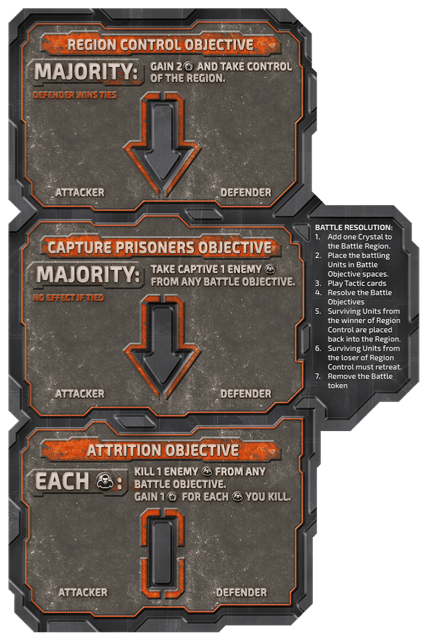
Once both players have placed their pieces, both players can then play cards with battle abilities to move their units around, add units to one of the Objectives from their supply or another part of the board or even change the order in which the boxes are resolved. Finally, the Battle Board resolves from top to bottom. First, whoever has the most units in the Region Control Objective box gains control of the region on the game board where the battle is occurring and will get to place a control marker forcing the other player to retreat after the battle. Next, whoever has the most units in the Capture Prisoners Objective box gets to capture one opposing unit on the Battle Board which depletes the other player’s available forces and scores one point per turn. Finally, for each unit placed in the Attrition Objective box, you will kill one other unit and score one point for each unit killed.
This concept is revolutionary! A way to adjudicate battle in some other manner than who has the numbers superiority or the most powerful units or who rolls the highest numbers on dice. This battle mechanic is the “bees knees” and makes this game amazing! I love that you can play cards to add or remove units or even change the order that the Battle Board resolves in. You will never actually know the outcome of the battle based on the situation at placement. You may have 4 units to your opponents 1 and still not win the objective you want to win. This makes for a very tense and unsure position during each battle. This mechanic sold me on the game!
2. Arrakis: Dawn of the Fremen from Gale Force Nine
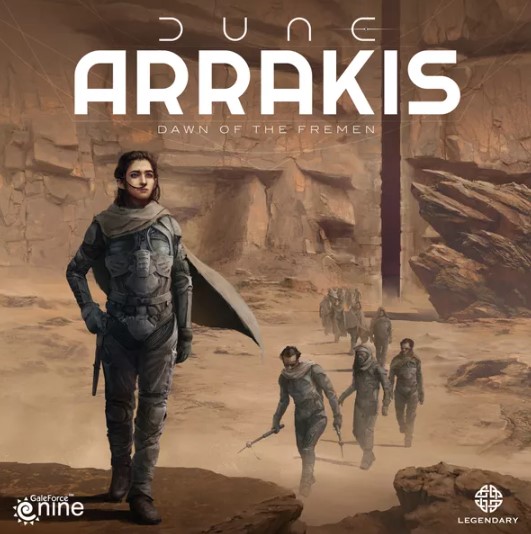
Arrakis: Dawn of the Fremen is a very interesting and simple area control game where the players play as a tribe of Fremen warriors who are gathering resources from Arrakis in order to develop weapons and sietches to win the game. The players can conquer Arrakis and win the game in one of two ways, either by controlling the winning number of sietches at the end of the action phase or by unanimous decision of the council when all players agree that you cannot be prevented from winning.
The best part of the game was how combat worked. Attacking an enemy held area is very simple as the player identifies their target by placing out the attack token in the region that is the target. Players’ combat strength is calculated by adding their counters in that region to their counters in adjacent regions which will be offering their support in the attack, with the exception of those separated by rock barriers. Each different counter provides a different combat value and come form things like warriors, weapons and sand worms. Neutral players that are in the area will be asked if they want to join the defender or the attacker or even sit out the attack. After all combat strengths are compared, the winner is the player with the higher total. There is no dice rolling and no cards that will be used to add in strength. Just straight numbers. This might sound as if it is not that interesting but there are so many elements to consider.
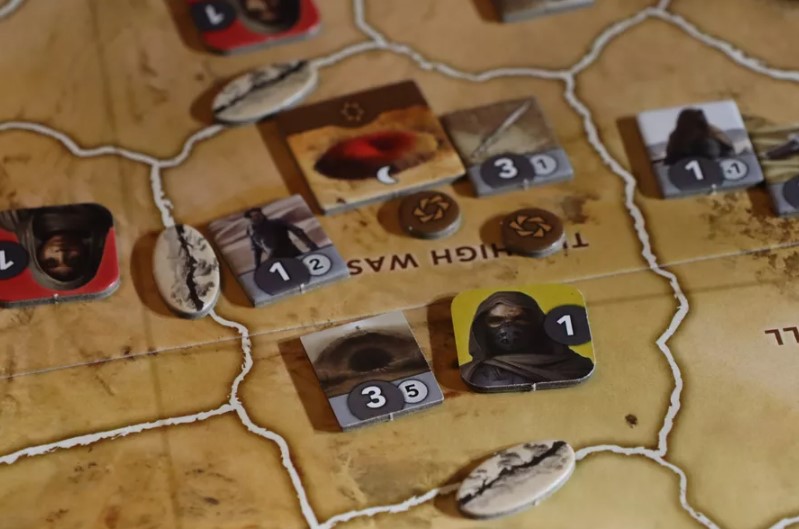
Adjacency of controlled areas is huge and players have to plan out their attacks to maximize this aspect in order to win. Taking a specific area will swing the balance of power in that area as it might set up the player to win the next few combats when they occur. It is important for players to also consider their allies and how to make those alliances to make sure that your “friends” don’t turn on you when the moment is most dire. But this will happen and that is fine. They will be repaid in the future with someone else betraying them. Attacks can be cancelled with a player spending 2 water tokens of the player attacking. This is a fantastic addition to the combat system and really makes of ran interesting choice as these tokens ultimately help with winning the game as you have to have a certain amount of each player’s color to build sietches.
I was not expecting much from Arrakis: Dawn of the Fremen. It was a Dune product that looked fun and was very cost effective (I think it cost me $45) so I bought it and took a chance. And that chance paid off as we all loved it very much and the game is still in my collection. A really great implementation of deterministic combat that adds in some nice bits of flavor.
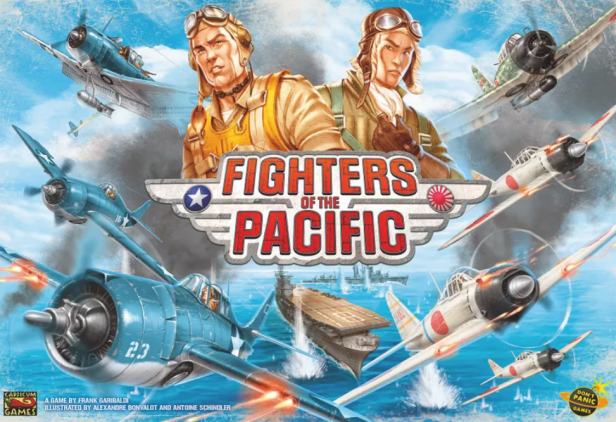
1. Fighters of the Pacific from Capsicum Games/Don’t Panic Games
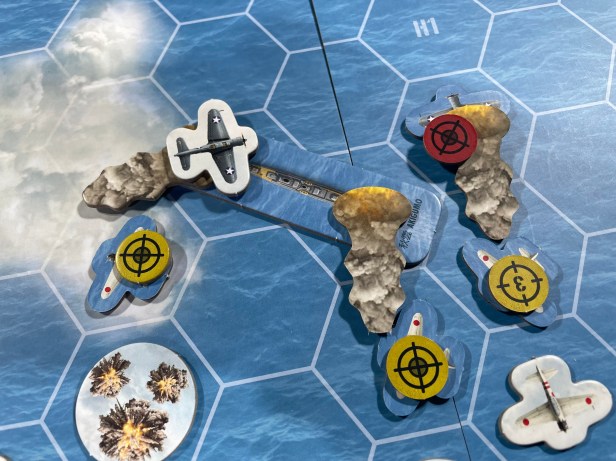
In Fighters of the Pacific, the design tries to break everything about the planes down into just a few factors and special abilities called Traits that differentiates them on the battlefield. Each plane has a Field of Fire shown in the front and rear (only if they have tail gunners) of the plane with red hexes. These red hexes coordinate with the hexes on the board in the front and rear of each plane. The planes also each have a value provided for their Speed and Armor. For example, the TBD Devastator has a Speed of 2 (shown with 2 propeller symbols) and 2 Armor (shown with 2 shield symbols). The Speed is how many hexes or maneuvers a plane can take. In fact, this is the minimum movement that is required each turn and players can never move more or less than their values. Certain maneuvers, such as Climb, take multiple Speed icons in movement points while Dive is a free maneuver that lowers the planes altitude and actually moves them forward 1 hex. The key to the game is understanding how your Speed (movement) can be used to place your plane and its Field of Fire into position to take out enemy planes on the board.

The planes are not activated individually but in groups. When a plane is activated, it must complete its entire movement while focusing on their possible maneuvers and their cost in movement points. If a plane has an enemy plane in its Fire Zone at the end of its movement, the plane can take a shot and the target plane has an opportunity to dodge only if it has not yet activated in the turn. If it can’t dodge due to already having been activated this turn, it takes damage automatically. There is no dice rolling. No CRT’s to consult. This game is about positioning and maneuver and not about the luck of the dice. Damage is based on the type of Traits the planes have such as the 20mm Gun found on the Zero. This 20mm Gun will do 2 Damage if it has an enemy plain in its sight and the x2 red hex in their Field of Fire is lined up on the target plane. This was my favorite part of the game and I love that the real challenge lies in getting into the right position to shoot, and if possible at a target that has lost its combat potential or in other words has already been activated. The dodge attempt might be automatic, but in order to succeed, it is necessary to be well placed, because once a first plane has been dodged, a second one may very well be maneuvered by your opponent to take advantage of your activation. Everything on the battlefield boils down to choices having been made and how those choices either set you up for success or place you in harm’s way!
I even really enjoy the fact that there are no dice. You either hit or your opponent dodges you. There is no chance. No dice luck. And no frustrating reliance on luck. You make decisions and those decisions seal your fate based on a simplified view of the aerial battlefield. Just a really great experience that I know we will come back to in the future!
I hope you have enjoyed my list of the Best 3 Games…with Deterministic Combat! I will admit that I have played several games with this type of combat and have not liked them all. But ultimately, Deterministic Combat is not for everyone and the choice for you will depend on your preferences. Please let me know your thoughts on these games as well as those that I might have left off the list.
-Grant


Deterministic Combat is cool. I like it in certain games, for sure.
However, everybody loves a good “dice-chucker”!!
I’m glad many combat-systems exist. It would be a boring gaming world otherwise.
LikeLiked by 1 person
I think “The Lamps are Going Out” has a Deterministic Combat system….but, it has been a long time since this one was on the table.
waaaaaaaay too long!!!
great game.
LikeLike
interesting. My single play of Fighters of the Pacific (as Japanese) would not have put it at the top of my list — the US having 2 hits per plane, it was easy to math out at a certain point I had no way of winning. Random combat may have swung it.
my favourite deterministic combat would be the government factions in COIN. Ie Andean Abyss. You know how many units will activate or be killed by how many cubes you in a space. Feels POWERFUL and cool because other insurgent factions have to roll a die to maybe hit.
Another great thought provoking blog Grant!
LikeLiked by 1 person