I really enjoy Grand Strategic Level wargames. There is something to be said for an experience that attempts to simulate all, or at least more than usual, various aspects of warfare other than just combat including politics, economics, diplomacy, technology development, etc. In a Grand Strategic Level wargame you are making long term decisions on a nationwide, some would say even continent-wide or global scale. Grand Strategy wargames are meant to simulate actual historical events and what it would be like to attempt to maneuver the highlighted war in the real world. I have heard it said that at the Grand Strategic level of wargaming, you’re going to be making major decisions with long-term impacts without getting caught up and bogged down in the micromanagement of aspects that are found in smaller scale wargames. Certain aspects can be glossed over, or better yet, abstracted to create the ultimate attempt to practice overall strategy and the approach to waging war. We have played our share of Grand Strategic Level wargames, but not all of them mind you as there are many that we still need to get to the table, and have really had a lot of fun at this scale! In this Best 3 Games with… post, I wanted to share 3 such wargames that I have really enjoyed.
3. War Room from Nightingale Games
Spectacle. Over produced. Novelty. Form over substance. These are all statements that I have read on various message boards around the internet regarding the game War Room designed by Larry Harris, Jr., the designer of the classic Axis & Allies. War Room is a deluxe global World War II game for 2-6 players that relies on some very interesting mechanics to simulate the war of all wars that involved every country in the world and lead to the ruin of many nations while others rose from the tumult to lead the world into the 1950’s and beyond. This game is huge, there is no other way to say it! The board is a top down world view of the entire conflict and really is an impressive site. In fact, when I first saw pictures of the game a few years ago, that was what drew me in.
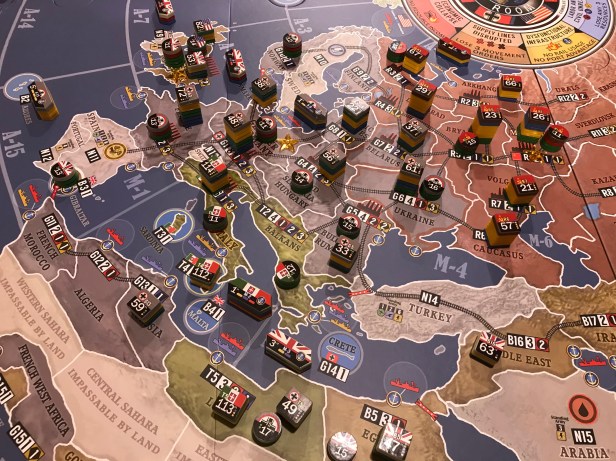
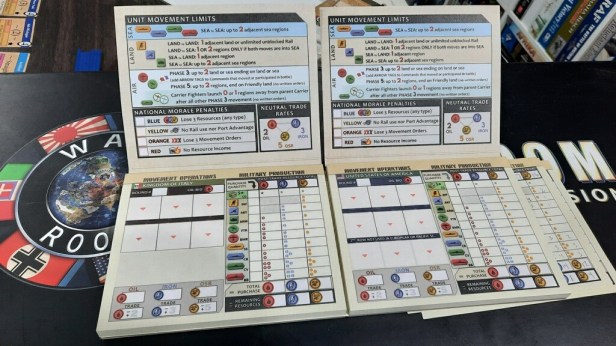
One of the best parts of the game is the order writing as it really caused some fatigue and consternation for all the players, but in a good way! During the Strategic Planning Phase, players have to look over their situation and secretly record their unit movements on a scratch pad. There are generally two different numbers of orders. Smaller countries, like Italy and China only have 6 order spaces, while the larger countries including the US, Germany, Russia, England and Japan, have 9 order spaces. Each of these orders will activate just one stack identified by a formation number, 1st, 17th, 82nd, etc. and then identify a space, either an ocean space or a land space, that the unit will be moving into or attacking if adjacent. So an order will look something like this: 82nd (US land unit located in London) –> A-15 (ocean space west of Spain). Each player records all of their orders and then hands their sheet to an opposing player (Axis player hands to Allied player and Allied player to Axis player). An important part about this step is the recording of the players bid for turn order on that sheet, which requires them to write down a number of units of their Oil resource that they are sacrificing to try to go first). This is a very expensive part of the process as oil is a precious and difficult resource to obtain and is vitally important to the player as any mechanized unit, such as Tanks, Battleships, Aircraft Carriers, Fighters and Bombers, require a few Oil to build.
After turn order is determined, the players then read those written orders out loud in turn order and movements are made. The kicker here is that if an order is now unable to be completed, it is cancelled. If there is another way to get from point A to point B through other friendly controlled areas within the units movement limit the order can be carried out but if an enemy has blocked that route or moved into the space from where the unit was planning to move from, that unit is now pinned and will have to engage in combat there. This is great fun as you can see the strategy of each faction playing out in real time as those units are moved. Sometimes the movement choices are obvious and don’t generate much furor, but sometimes an unexpected movement or attack is taken and it really creates some buzz and players Ooh and Aah audibly. This part of the game is really great and I loved the orders segment. Several times, I actually wrote down the wrong space I was moving to, or I actually wrote down the same movement twice! Don’t ask how that happens but there is some angst and deep thought in this phase and each move is so vitally important because you only have a limited number of orders. Also keep in mind, that each unit that you move must use an order. Not each destination space but each unit you want to get into that space. With this limitation, you can imagine that there are many more movements and attacks that could be done but you don’t have an action to take. This is the main focus of the game in the concept of a global theater with each faction having units in multiple theaters with multiple goals and objectives. You cannot do all that you want to do each turn and your opponent’s hidden actions will sometimes create new goals and objectives that you must attempt to meet in the next Strategic Planning Phase.
The only other comment I will have about the game is that we really liked the Economic management side of the game. This comes during the start of each turn with the Direct National Economy Phase. It was not difficult, in fact it was very simple as your resources are shown on territory cards that you have while your forces control the areas, and you track them on a nifty card with holes punched in it where you place color coordinated pins in the number of each resource that you have (Red for Oil, Blue for Iron and Yellow for OSR or Other Strategic Resources). If the territory you are gaining the resource from is contested during the Direct National Economy Phase, meaning an enemy force is currently there along with your troops, you will not gain that resource this turn. You actually have to outright control the area and opposing troops and the skirmishes that will be ongoing disrupt your resources and cause issues. Simple, easy to understand, but a challenge to master as you have to understand what it is that you are trying to do and how you might be able to afford that.
I found that the trading aspect of the economic side of the game was also very cool and provided additional opportunities to trade for the resources that your nation is short on. To trade, you need to have units adjacent to a trade zone on the map or have a connection to an ally that has an adjacent resource. This is the easiest way to get the scarce resource of Oil and we found that this was a major motivation early in the game with players as they were trying to get the Oil they needed to build mechanized units, aircraft or naval units. Not having what you need, when you need it is very challenging and it was great to have this extra layer of worry as it made me think more strategically about some of the attacks I was making and how they would gain me resources or in trying to figure out ways to protect those resources that I already had. I also had a real motivation to make sure that if an opponent invaded a territory that had resources to finish them off and not let them linger to deny me that resource.
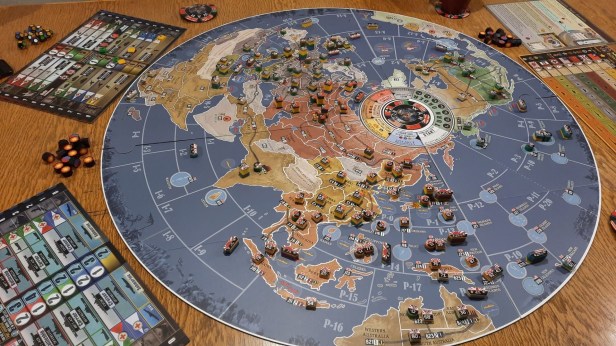
For some of the warts that the game has, mainly from a historical side and from a lack of technology side (that was always one of the things that I really enjoyed about Axis & Allies was that throwing away 5 IPC to roll a d6 and watch your money go down the drain!), we really enjoyed our experience with War Room. And I would state vehemently that the game is an experiential wargame. You will live it for the better part of two days and it really is a great time. I found that I thought about the game long after we had finished and considered various alternative strategies to get around certain difficulties that are present on the map.
If you are interested, I wrote a full First Impressions post on the game and you can read that at the following link: https://theplayersaid.com/2021/05/07/first-impressions-war-room-from-nightingale-games/
We also shot a review video and you can watch that at the following link:
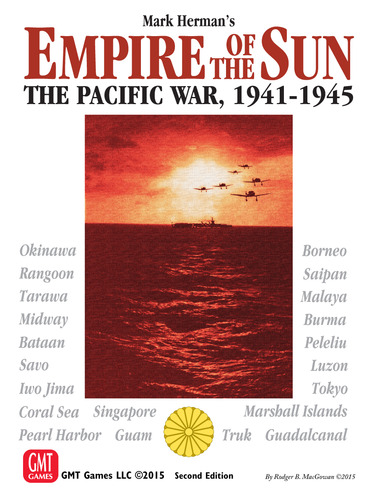
2. Empire of the Sun: The Pacific War, 1941-1945 from GMT Games
We have mentioned many times that we really like Pacific Theater WWII Games. I’m not exactly sure what it is that appeals to me about them, but I think that air naval combat and operations as well as the distances and scope involved are very intriguing. I also really love the naval combat as well as the use of aircraft carriers and the like. And as a Grand Strategic affair, there are lots of issues to worry about including combat, supply, amphibious landings, island hopping, bombing and even things such as building roads (the Burma Road), repairing and improving port facilities, building air strips on islands and other things. There also is always the political aspects as well as the public opinion about the war, especially after it got more and more brutal as it was obvious the Japanese would fight to the last man and where the ETO was wrapped up how that affected the thinking.

One of the best Pacific Theater of Operations Grand Strategic scale wargames out there is Empire of the Sun: The Pacific War, 1941-1945 from GMT Games. Mark Herman’s beast is a deep, rich, and crunchy wargame. There’s a lot to digest, and a lot of places to trip up on the rules, but the freedom this title provides as Supreme High Commander is astounding considering that at it’s core it’s a Card Driven Game (CDG). The card driven component really presents the players with really tough decisions about how to use those cards to get the most out of them during that turn. CDG’s can take the edge off daunting hex and counter games for new players by adding card play, which feels like a more euro style mechanic. For me personally it’s through CDGs that I really got into wargaming, with titles such as Labyrinth: The War on Terror, Twilight Struggle, Wilderness War and others. But, Empire of the Sun uses a bit of a different take on the CDG format (a creation of Mark Herman, FYI).
Some obvious differences from other CDGs is that each player has their own deck of 84 cards that is fixed and only they can draw from. What this means is that you won’t have a hand clogged up with enemy events, etc. that you’re freaking out trying to not play to your own disadvantage.
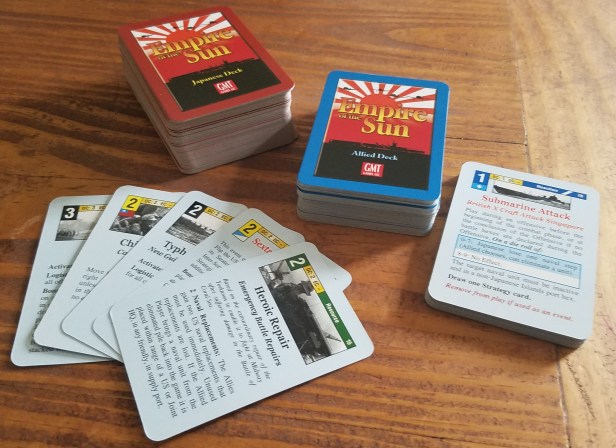
In this way Empire of the Sun feels very different, from the card management perspective at least. There’s not that damage mitigation aspect where you’ll be handing over things to the enemy just to squeak out a small offensive. But there is a form of tension in the cards that are dealt to you, because if you draw a hand of very few military events early, it can really change the type of strategy you have to employ in order to expand as the Japanese, or respond as the US (early on).
I find that the game is great and will be a fantastic adventure for anyone new to wargaming. But, take note. This one is a bit daunting and can be overwhelming as it has a very sandbox type feel with lots of player choices and agency. Once you can get past the thick rulebook and understand what it is that you are supposed to be doing, you can then begin to really experience the problems of World War II such as public support, revolts in India and China that put lots of pressure on the Japanese player can are great opportunities for the Allied player, lack of reinforcements and attrition of units over the course of the war. We have played EotS about 5 different times over the past 8 years, and I always think about breaking it back out and giving it another go. The game is just that good and shines as a great example of a Grand Strategic Wargame done right.
If you are interested, Alexander wrote a series of tutorial pieces on the blog and you can read those at the following links:
A Brief Introduction to Empire of the Sun
Rules & Tactics Intro: Zones of Influence
Rules & Tactics Intro: Strategy Cards
Rules & Tactics Intro: Air Naval Combat
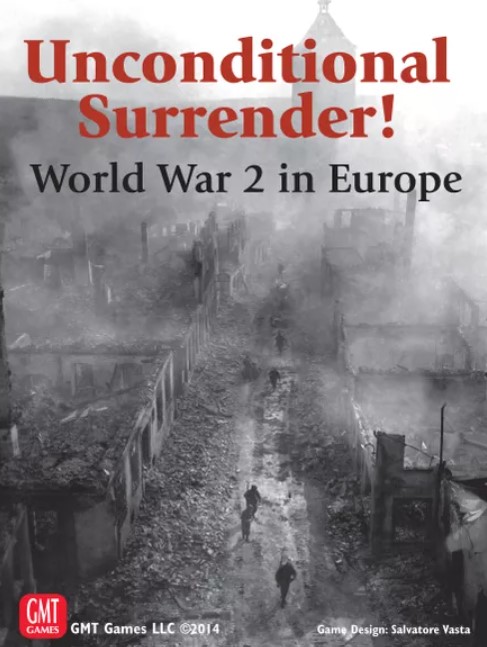
1. Unconditional Surrender: World War 2 in Europe from GMT Games
Some would say that this game is Grand Tactical but I don’t care, it still has the term Grand in its description and that is simply what this game is….a Grand Experience! Any Grand Strategic WWII game that I play now will always be compared to Unconditional Surrender! Sal Vasta designed a classic. It’s a perfect game in my opinion and has so very much to offer players and keep them entertained and engaged.
This game is a long game though and you’ll need table space to keep this one set up, as it’s a two mapper and uses some play aid cards for a lot of different holding boxes. But my goodness. This game covers the entirety of the war, and can even go on a little longer if certain things do or don’t happen, but the first portion of the game where Germany is trying to strong arm, or court minor nations to aid them in the war is beautifully done. A simple political system that can have massive ramifications. A really interesting part of the design is the Political Phase where players can pay 5 resources to draw a chit out of a cup that has been seeded with several different types of chits such as a Political Success, which allows the drawing country to place a friendly political marker in a neutral country such as Hungary, Yugoslavia, Italy, Spain, Sweden and Norway to name a few, Political Failure, which allows the drawing player to remove one of their opponent’s political markers on the board, a No Event chit which means nothing happens or a friendly political marker that can be placed out. The goal is to get two such political markers in neutral countries to have them join your side in the war by adding their factories to your total and providing you with a few minor combat units to use in the game. This was a great part of the design but can be really difficult for the Axis.

As such you can play entirely a-historical games (Spain activates as a power, Italy joins the allies from the start, etc.) meaning you can have endless possibilities of game states. OR you can just play it straight. The stacking limit of 1, and the movement and combat action point system keep the game moving at a great pace, and is never overwhelming. The game uses a singular CRT for all combats, with a great play aid for all the modifiers you can get. It’s such a streamlined system that is a joy to play.
Another part of the design that I thought was well done was the determination of weather and its effects on the game with things such as movement and combat. A lot of the progress that can possibly be made by the Axis early on depends on weather and as you may or may not know in Unconditional Surrender!, weather is determined with a random die roll with certain types of weather, such as Poor in January, February and March, are more likely than Fair weather in those same months. The reason weather matters so much is that an attacking unit will take a -2 DRM to their attack rolls in Poor weather, which can make the difference between success and utter failure.

There also is a fairly unique and interesting way of dealing with things like air power, and how they can or cannot attack, as well as ships as they work to provide transport and supply across major bodies of water. When these units are used, you will place a Sortie Marker on them and this will reduce their effectiveness as they will have to roll lower and lower to activate or be used. If a unit accumulates too many Sorties, you will have to take a moment to rest them and remove some of the markers which I thought was a very neat way of handling the stress and damage of combat and transport.
USE! is just so good and so very playable. Since our play of the game last year, I returned home and immediately added a P500 order for the 3rd Edition copy as well as the mounted mapboards. I am eagerly looking forward to having a copy of the game that I can setup and play solo.
Here is a look at our review video:
So those were my 3 Best Games with…Grand Strategic Level! and I hope that you enjoyed what I shared and also got into the spirit of the post and started thinking about games that do Grand Strategy well. What are your favorite Grand Strategic Level wargames?
-Grant
 The Players' Aid
Are there any Grand Strategic Games that you recommend that have a smaller footprint, lower rules overhead, and shorter playing time?
LikeLiked by 1 person
Downfall of the Third Reich from doit Games is pretty good. You can read about that on the blog.
LikeLike
I would love to have all of these games, but I settled on Unconditional Surrender. HOWEVER, that thing has been in P500 forever, and it’s even been “Made the Cut” for over a year I think? I don’t understand how P500 works I guess, this one is really languishing.
LikeLiked by 1 person
It is all about availability of print skits and timing. They have so many games going it pushes reprints down on the priority list.
LikeLike
Have you heard of Axis Empires: Ultimate Edition? Looks like a grand game!
LikeLiked by 1 person
Yes I have.
LikeLike
Yes there is that special something about playing the big picture strategy games. You need to add A World At War to your ‘One Day’ list, as I know it’s on your ‘Scary’ list. Empires in Arms is another that deserves special mention. The conundrum is Paths of Glory, to me it’s top of the list grand strategy but not in the traditional hex and counter way. Quite a few of the CDG’s I would class as strategic, your thoughts?
LikeLiked by 1 person
I would say most CDG’s are strategic but several, like Empire of the Sun and Paths of Glory, are grand strategic.
A World at War is so big and daunting. Would love to have someone teach us.
LikeLike
Should mention the electronic version of these games on Vassalengine.org can give a gamer a good feel for the mechanics of play before buying the product.
LikeLiked by 1 person
Europa Universalis The Price of Power would be on here for me.
LikeLiked by 1 person
And that is why I love doing these lists to see what others opinions are. Thanks for sharing.
LikeLike