Worthington Publishing is a small publisher that just makes great games. They do about half a dozen or so games each year and their production values are amazing and the game play is legitimate. A few weeks ago, I saw an announcement for a cool looking little block wargame that covered not the Siege of Quebec in 1758 during the French & Indian War but rather the Siege of Louisbourg in 1758 that opened the way for the British to move up the St. Lawrence River to attack Quebec. We reached out the designer Mike Wiley and he was more than willing to respond to our questions about the game.
If you are interested in Louisbourg 1758, you can back the project on the Kickstarter page at the following link: https://www.kickstarter.com/projects/1040417273/louisbourg-1758?ref=3fh3p6
Grant: Why were you interested in designing a game on the Siege of Louisbourg during the French & Indian War?
Mike: Everyone knows about the Siege of Quebec (we and many others have done games on it) yet Louisbourg may have been more important and just as interesting of a situation. Its siege was similar to the Siege of Quebec yet also somewhat different. Bombardments, sorties from the fortress, naval beach landings and harbor control all played a key part of the siege. How could a smaller and isolated French army and navy contend with a massive British one? How could the British attack the fortress without massive losses? These and many other elements of the siege/campaign we wanted to create within this design.
Grant: Why was Louisbourg such a key defensive point for the French?
Mike: Louisbourg was the key to Quebec and Montreal and the interior of New France via the Saint Lawrence River. As long as the French held the fortress they could prevent the British from invading New France along this route. Most folks remember the Siege of Quebec in 1759, but that would not have happened had Louisbourg not been taken in 1758. The French actually did a good job of holding out long enough at Louisbourg to prevent a campaign against Quebec in 1758.
Grant: Does this game use a system similar to your French & Indian War title from a few years ago?
Mike: Yes but mostly no.
Yes in that blocks are used with hidden strength and step reduction. Group movement from one location. Also, standard dice rolling based on strength and point to point movement. It is a 2-player game with traditional block game movement and combat.
No in that the game uses cards that in small ways can alter standard movement and combat which can keep players on edge about the capabilities of their opponent. Louisbourg also has an invasion with beach landings to start the game. This is when the British are most vulnerable. French ships can exit the harbor and attack the British ships landing the troops. British ships can enter Louisbourg Harbor and win the game if they control the harbor entrance. A key new concept is bombardments. This can occur when units are adjacent to Louisbourg or Louisbourg harbor. Another big difference is that roads have road limits. Another new feature is that units can raid adjacent locations for a quick 1 round battle and then return to their location.
Grant: How did you carefully model the siege of the bastion?
Mike: Using contested landings, bombardments and raids are what make the game model the siege. Road limits help in that they reflect the terrain around Louisbourg which slowed movement of troops and siege guns into position to bombard. Controlling the harbor entrance while protecting Louisbourg itself comes into play as they are independent of each other.
Grant: What was most important to include in the game from this important battle of the French & Indian War?
Mike: The beach landings by the British was a close run thing. Making sure this was dangerous and included was important. Also, bombardments needed to be handled correctly. The British had many more troops, ships and artillery than the French but the French had enough of both to sting the British. Bombardments and raids within the game have elements that reflect this situation. Time was also important to the campaign and game. The British plan for 1758 was to take Louisbourg quickly and then proceed up the Saint Lawrence to attack Quebec in 1758. They failed in this goal because Louisbourg held out longer than expected. Time is not on the side of the British and the victory conditions account for that.
Grant: What is the general Sequence of Play?
Mike: The general Sequence of Play is as follows:
Operational Phase:
Player order is determined, one card drawn by each player on odd turns and a weather roll on even turns.
Bombardment Phase:
If units are in place, each side can conduct a bombardment of Louisbourg or Louisbourg harbor.
Player Action Phase:
The active player for the turn can choose one action; land move, raid, amphibious move, or ship move.
Combat follows the player action if units are in the same location.
Grant: How do Bombardments work?
Mike: Louisbourg, Louisbourg harbor and locations adjacent to them can be bombarded. The French generally bombard British occupied adjacent locations from Louisbourg and Louisbourg harbor while the British bombard Louisbourg and the harbor from those adjacent locations. Each side can bombard in the bombardment phase if they have units in place. It is done during the Bombardment Phase by picking one location and rolling a die and applying any modifiers. Results are compared to the bombardment table.
Grant: What is the makeup of the Bombardment Table?
Mike: It causes a result from no effect to a 3 SP loss. The British add modifiers that will increase French losses if they bombard from multiple locations. The French receive negative modifiers on the bombardment tables if their ships in the harbor are reduced.
Grant: Who has the advantage with their artillery?
Mike: The British have the advantage with artillery. They can bombard from multiple adjacent locations and receive hit modifiers that can increase damage if they occupy multiple adjacent locations. The French do not receive these modifiers when bombarding from Louisbourg or with their ships in the harbor. And if there are less than 2 French ships in the harbor they receive a negative modifier which reduces damage on their bombardments.
Grant: What actions can players take during their turns?
Mike: During the player action phase they may do one of the following: Land or move one group of units, raid with one group of units, amphibious move with one group of units and ships or move one group of ships in sea areas.
Grant: What limitations or pre-requisites are there on these actions?
Mike: Land moves must follow road limits, 8 units on solid roads and 4 units on dotted roads. Ships can only transport 1 army unit and the ship itself defends at only 1 SP if attacked, regardless of how many SP it is. Raids are limited to 4 army units. Ships can only move into or out of Louisbourg harbor if they have land units occupying both Island Battery and Lighthouse Point locations. Cards can modify these limitations though.
Grant: How does the game use cards?
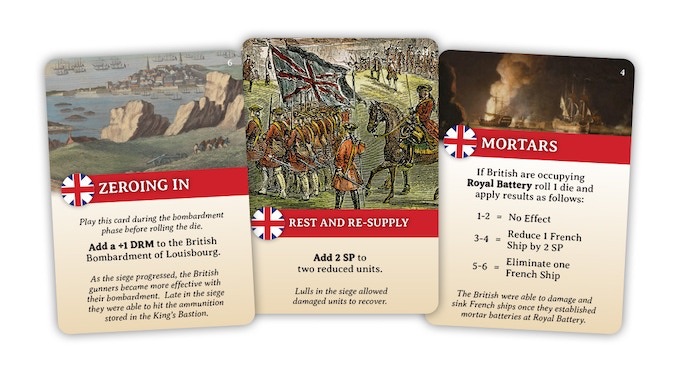
Mike: Sparingly. It is not card driven, just card enhanced that provides more fog of war. We did not want the cards to dominate game play. They act as an important factor in not being able to predict what your opponent can and cannot do within the constraints of the game rules. For example, regulars can only move one space per turn normally, HOWEVER there are a few cards that allow them to move TWO spaces in a turn.
Grant: What can players do with a card affiliated with their opponent?
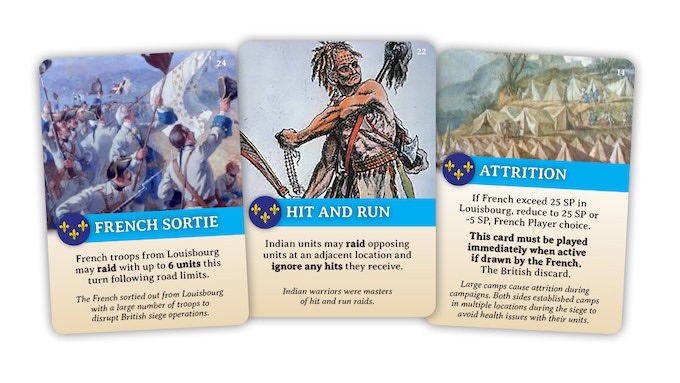
Mike: Nothing and lots. It can only be discarded and discards are not shown to an opponent. That does not sound like much of an advantage but KNOWING that your opponent will not be able to use that card (say like moving regulars an extra space) can be a big advantage. Further, your opponent does not know what you know about his cards.
Grant: Why did you feel a shared deck was important to your design?
Mike: As mentioned we wanted to the cards to contribute to reducing the predictability of all units yet at the same time provide some limited intelligence to each side. The shared deck creates this in that you cannot count on any card showing up. But you can count on what is in your hand, even your opponent’s cards which also provides you some limited intelligence.
Grant: What are the makeup of units?
Mike: Regulars which are strong but slow.
Light infantry which are fast.
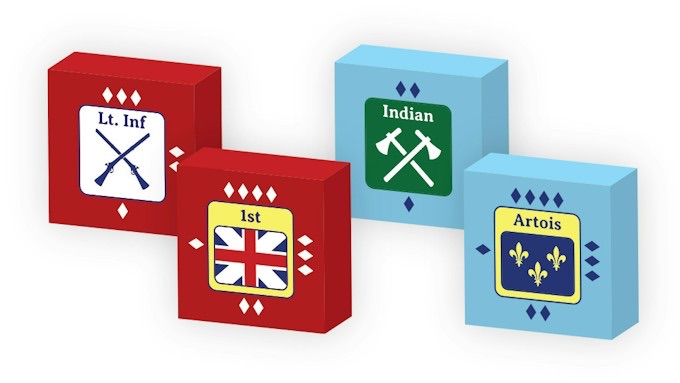
Rangers and Indians which are not strong but are fast and attack and defend strongly in raids.
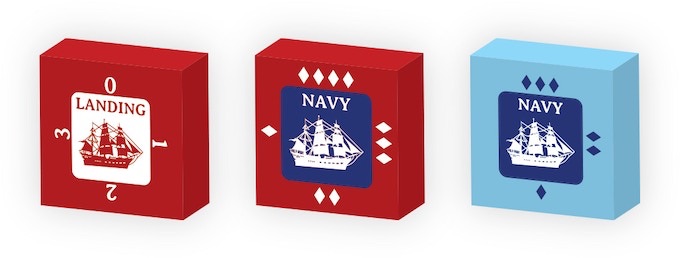
Ships that can transport army units and battle other ships.
Grant: Why does the block wargame work best here?
Mike: Louisbourg 1758 is an asymetrical campaign and it takes full advantage of hidden troop types and strengths with blocks. It works great because the British have overwhelming strength while the French have the advantage of strong positions and hiding their limited strength in these positions.
Grant: How is combat adjudicated?
Mike: Combat occurs in several ways. First is simultaneous bombardment if a side has units in place. Bombarding occurs at the first phase of each turn. Each side can bombard once against one target. They may have several choices. A die is rolled and the Bombardment Table is used to apply results which are strength point losses. After bombardment each player does one action in an alternating turn and which player goes first can change each turn. These actions can cause army battles and naval battles. The defender rolls first and applies hits to the attacker. Die rolls are based on strength points of the units involved and applied modifiers. Normally sixes cause hits but some locations allow the defenders to hit on double (5 and 6) or triple fire (4, 5, and 6). Both sides must stay for at least one combat round, though there is a raid that can be done where the attacker only stays for one round then retreats without enduring further rounds. This is an effective tactic when the French sally out from Louisbourg or the British want to test a strong position that is lightly defended by the French.
Grant: What is the role of naval combat?
Mike: Sink ships. The British ships greatly outnumber the French ships but the French are protected in the harbor while the French hold the harbor entrance. The French ships can leave the harbor to disrupt British landing operations and then return to the harbor for safety. Any ships that transport units defends poorly against ship attacks.
Grant: What are some key points and areas found on the game board?
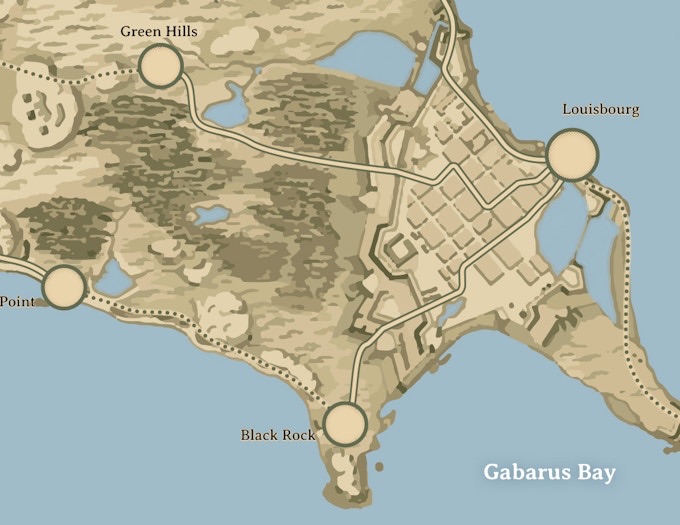
Mike: The initial British landing in Gabarus Bay (Kennington Cove, Flat Point and White Point) are very difficult. Louisbourg was a great fortress. All French units in that location defend at triple fire. The approaches to Louisbourg go through swamps and this channels the attacks and somewhat limits how quick and how many units can get into the siege and combat.

If the British capture Louisbourg they win. The harbor entrance is very important. It is anchored and controlled by the Lighthouse Point and Island Battery locations. Both must be controlled to allow one’s ships to enter or exit the harbor. The French must control at least one of these locations at all times because once the British ships enter the harbor the French lose.
Grant: How important are roads?
Mike: The terrain around Louisbourg was rough. Roads limit how many units can move along them. Eight units can move on a solid road and four units can move on a dotted line road. However there are a limited number of cards that allow these limits to be exceeded.
Grant: How is victory achieved?
Mike: The British win if they enter Louisbourg with troops or Louisbourg harbor with ships by the end of the game. They must still have at least 24 strength points with their troops. The French win if they hold out and prevent a British victory by the end of the game.
Grant: What do you think the design excels at?
Mike: Active siege warfare involving army and navy units during this period of time is modeled well and creates some very interesting decisions for both players. The game plays fast and is pretty rules lite so it can be used an introductory wargame but also has enough there to keep the attention of seasoned wargamers. Plus this is one of the few games out there that deal directly with the Siege of Louisbourg.
Grant: What other games similar to this are in the works?
Mike: The sieges of both Charleston and Savannah set during the American Revolution. We are hoping to have these games ready for later in the year but a lot depends on how well this is received.
Grant: What other games is Worthington currently working on?
Mike: We are knee deep into the Battle of Gettysburg using our Chancellorsville System. Also, Stalin’s Favorite for the Band of Brothers Series, Iwo Jima using our Tarawa System. A new one is One Hour World War II designed by Clint Warren-Davey, which is a cool game on the whole war in under an hour. We are also into Franklin from our Civil War Battle Brigade Series, Boots on the Ground reprint and update, Caesar’s Gallic War reprint and update, Dropzone designed by Dan Fourney, which is about the paratroopers of WWII in southern France and finally Blood of Lions a game about World War I the Battle of the Somme.
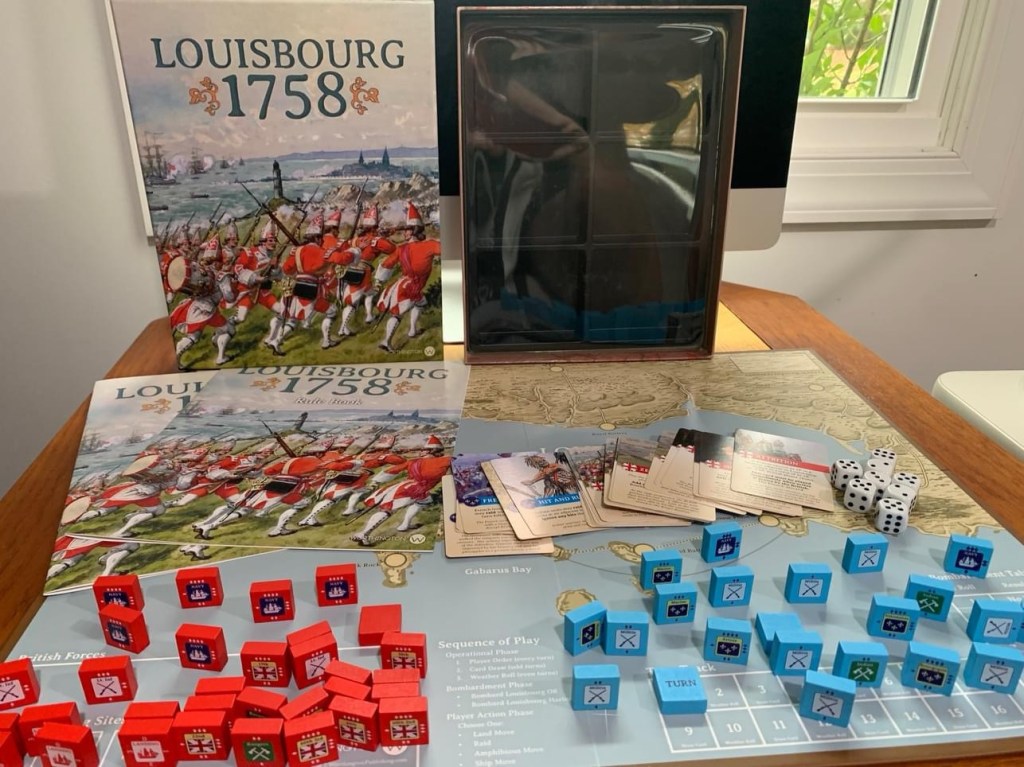
Thanks so much for your time in answering our questions Mike. I am very much looking forward to this one as well as the many other games you shared with us.
If you are interested in Louisbourg 1758, you can back the project on the Kickstarter page at the following link: https://www.kickstarter.com/projects/1040417273/louisbourg-1758?ref=3fh3p6
-Grant


You rat-b______d! You forced me to back another Kickstarter, against my will! Ow, ow, OK.
LikeLiked by 1 person
HAHAHAHAHAHAHAHA!
LikeLike
I ended up backing this one as well.
To be fair, being a block wargame and a gorgeous map already half sold me…
LikeLiked by 1 person
It does look real perdy!
LikeLike