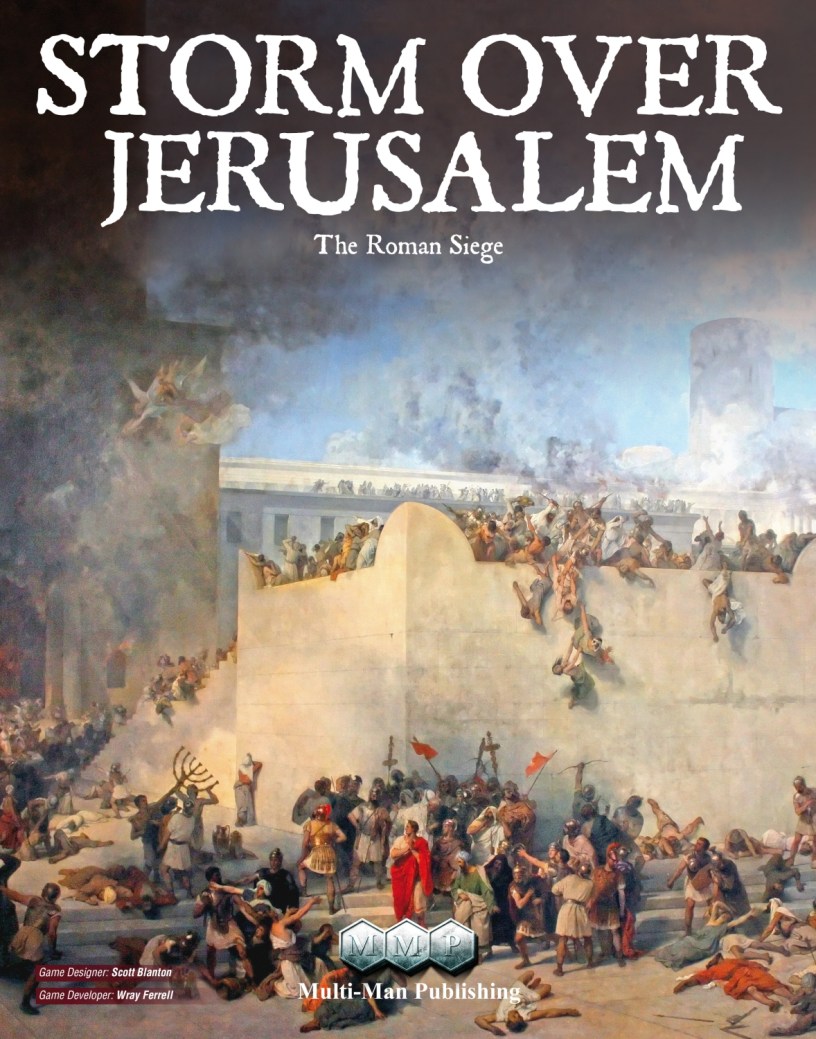
Last year, we saw a prototype copy of Storm Over Jerusalem: The Roman Siege while attending WBC. We have heard good things about the Storm Over Series and really liked what we saw leading us to pre-order the game. This year the game was printed and shipped in early April. I immediately clipped it and got it ready to play and we really enjoyed the game. I wanted to reach out to the designer Scott Blanton to get his insight into the design and wanted to also give you guys more information to make a decision about whether the game is for you or not.
If you are interested in Storm Over Jerusalem: The Roman Siege, you can order a copy for $86.00 from the Multi-Man Publishing website at the following link: https://mmpgamers.com/storm-over-jerusalem-p-355

Grant: First off Scott please tell us a little about yourself. What are your hobbies? What’s your day job?
Scott: Well, I stay pretty busy but still have time for some fun. I’ve got a game group that meets every other week and a D&D group that tries to meet a couple times a month. If I get free time, I’ve been reading presidential biographies over the last several years.
My day job…I seem to have a couple. I work full time for Multi-Man Publishing as their Business Manager; I take care of the website, the warehouse, and anything else that helps move things along. My wife and I also own The Gamer’s Armory, a FLGS located in Cary, North Carolina. I’m usually there on Fridays. To keep our weekends busy, my wife and I are also Realtors and have our real estate business to take care of on Saturdays and Sundays. So, as you can see I stay quite busy.
Grant: What motivated you to break into game design? What have you enjoyed most about the experience thus far?
Scott: As my friend Wray has always said…the money and groupies. Ok, so not really. I guess I just enjoyed the Storm Over Series and thought that Jerusalem would be a good game. Seeing how people are willing to help with a project like this has been fun to experience.
Grant: What historical period does Storm Over Jerusalem cover?
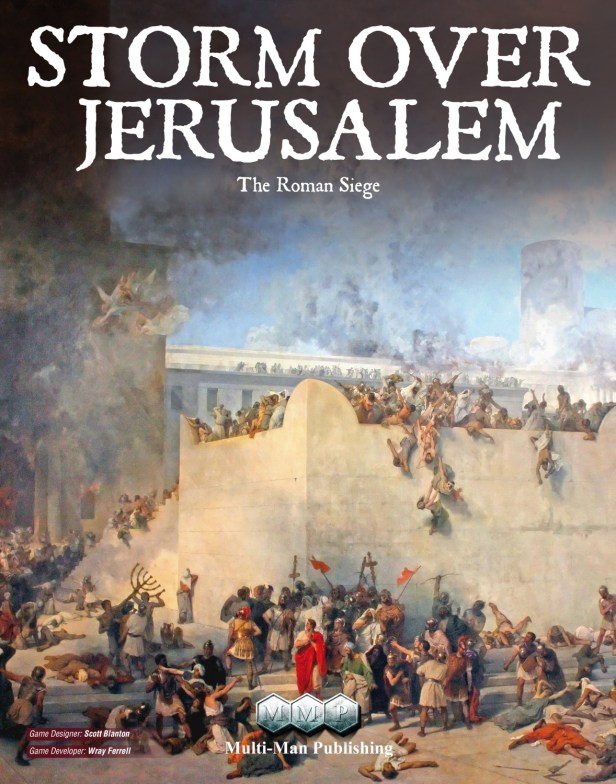
Scott: It covers the Roman siege of Jerusalem in 70 CE, somewhere between April to August. The fall of the city marked the effective conclusion of a four-year campaign against the Jewish insurgency in Judaea. The Romans destroyed much of the city, including the Second Temple.
Grant: Why was this a subject that drew your interest?
Scott: Roman history has always had my interest. I have also had Avalon Hill’s Siege of Jerusalem game but never got around to playing it. I wanted to see if I could come up with something a bit more playable.
Grant: How did you have to change the Storm Over System to fit the historical setting and confines of the siege of Jerusalem?
Scott: Most of the base rules for the system worked fine from the beginning and didn’t require any major changes. The Siege Towers were an evolution of the trenches found in Storm Over Dien Bien Phu. The walls were such a physical presence in the city, and were a major impediment to the Romans efforts, I had to come up with rules to cover them. The Judean leaders were something new that got added to the system.
Grant: What research did you do to get the details correct? What one must read source would you recommend?
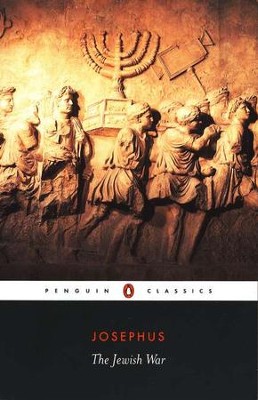
Scott: Well, there is not a ton of pictures or first-person accounts of that time. I used a couple of books including The Jewish War by Josephus. A new one was released about a year ago, after most of the work on the game was complete. I want to try and read it now, it seems to have great reviews. For the Freedom of Zion: The Great Revolt of Jews against Romans, 66–74 CE by Guy MacLean Rogers.
Grant: As an Area Impulse system how does the game work with a siege?
Scott: The Storm Over System works very well to depict a siege. Using areas, you don’t have to worry about creating a tactical level experience, you have the ability to do a higher level view of the siege. The placement and location of areas on the map though is key to the design as it shows where the walls were attacked and where an advantage or disadvantage can be found by both the attacker and the defender.
Grant: What are the various units available to both players? How do they compare?
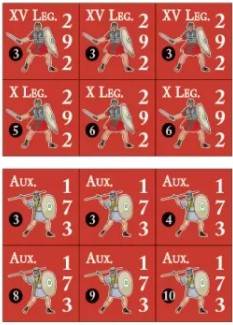
Scott: The Roman have Legions, which are the heavy hitters of their army. They have great attack and defense values. Roman Auxiliary are the light infantry guys that support the Legions with a little better movement but worse attack value. Cavalry units can be used primarily to hold the outer areas of the siege but are generally weak when fighting inside the city as there is little room to maneuver.
The Judeans have a mix of heavy infantry and light infantry, that are not quite as good as the Roman units as is expected. Their light infantry also have ranged attack capabilities, which are important in picking off exhausted Roman Legions when vulnerable after a failed assault on a wall.
Grant: What advantage do the walls give the Judean defenders?
Scott: The walls provide a defensive modifier against Roman Attacks and Assaults. This starts at +4 and can be reduced over time by Roman Assaults. Since Judean units have a defense of 7 or 8 the bonus of +4 really helps hold areas. Once a wall is damaged from an attack, the defensive modifier can be rebuilt by the Judean player but can never be increased to its full value of +4.
Grant: How are the walls damaged? Also how are they then repaired?

Scott: When the Romans Assault across a wall section they can damage it if they inflict damage on units in the area they are Assaulting. The Roman player also has cards (Catapult, Onager, and Battering Rams) that can be used to damage or breach the walls. Once breached, the walls don’t provide any defensive bonus and allow Roman troops to flood into the city.
The Judean player can discard a card and use the Repair Value of that card to repair walls in an area, this also requires a fresh unit in that area to be flipped to spent. Walls can only be repaired back up to +3, not the original +4. You can’t rebuild them completely.
Grant: How are cards used in the design? What different type of cards are available?
Scott: Cards are used to introduce events and other assets that were at the siege. For example, the Roman player has Siege Engine cards (Catapult, Onager, and Battering Rams) that don’t have to be tracked with a counter. Judeans have Sortie Out cards that allow them to Assault an adjacent area and then move back behind the walls for protection.
Cards also provide the element of surprise; you never know what cards your opponent is or is not holding.
Grant: Can you show us a few examples of cards and tell us how they work?
Scott: The Romans have Battering Rams cards that allow the Romans to roll a 1d6 before an Assault. If the result is 3-6 then the wall is breached (and provides no defensive bonus) and the Assault continues.
The Judeans have Firebrands. This card can cancel the play of a Battering Rams card. It can also be played during an Assault to try and destroy Roman Siege Towers. Depending on the results of a 1d6, Siege Tower values will be reduced which helps defend the wall.
Both sides have Onager cards which allow for a 4 firepower attack against an adjacent area, this does not require units to be flipped to spent.
Grant: What area does the map cover?
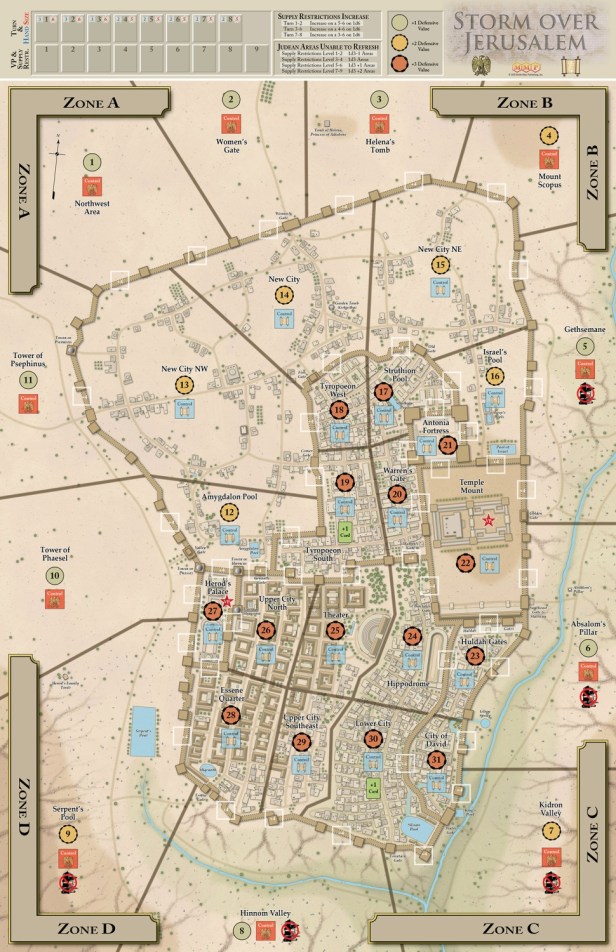
Scott: The map shows the ancient city of Jerusalem and surrounding areas. Each of the areas on the map represent a specific geographic section of the city and is assigned a number. This number is contained in a circle with a different color representing the defensive value of that area to troops defending there. Each area has a control box.
Grant: What are the key highlights of the map?
Scott: First, I think Charlie Kibler did an amazing job on the map. It is just beautiful! The map highlights the impact of the walls as the Romans had to break through several lines of defense. It also does a good job showing the two main targets of the Romans which are VP areas.
Grnat: Where are victory point areas?
Scott: Herod’s Palace in the western part of the city and the Temple Mount on the eastern side.
Grant: What is the force structure of the units, scale and time covered by turns in the game?
Scott: Roman Legion units represent about 500 men per unit, other units are 800-1,000 men per unit. Turns represent roughly 10-14 days. Part of a siege is waiting around for things to happen, so there is some time represented in the end turn phase as well.
Grant: Who are the Judean Leaders? How do they get placed on the map?
Scott: During the Judean Revolt against Rome there were many factions fighting amongst themselves in Jerusalem. When the Roman Legions approached the city, they decided to have a “truce” between themselves and banded together against the Romans.
The two main factions were lead by Simon bar Giora and John of Gischala. They were not friends, but they had a bigger enemy to worry about.
Leaders are kept off board and placed by the Judean player as an action. At the end of the turn, Leaders are removed from the map. This gives the Judean player the ability to “come out of hiding” and impact their troops.
Grant: What abilities do the leaders have?
Scott: They can be placed during an attack to add +2, they can also be placed to help with defense and add +1 to the defense of a unit. They can also be placed to rally spent units in an area. Their last ability is Common Enemy, which allows units from the two factions to activate together.
Grant: How does combat work in the game?
Scott: Like other Storm Over Series games, units have a firepower value. The total firepower of units in an Attack or Assault are added up and then added to a 2d6 roll. This is the total attack points.
The defender takes the highest defensive value of a unit in an area, if they control the area they get the defensive value of the area, and if the assault crosses an un-breached wall section they get the bonus from the wall. All of these are added to get the total defense points.
Total attack points minus the total defense points gives the damage points that the defending player must apply to their units. Negative numbers are ignored.
Grant: How is victory achieved?
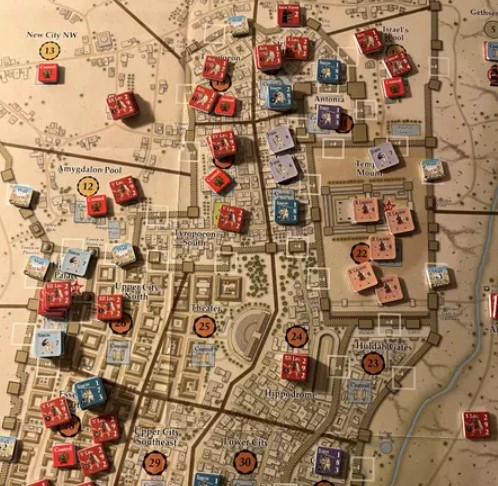
Scott: Victory Points are earned each turn for the side controlling the VP areas (Herod’s Palace and Temple Mount). The Judean player gains a bonus point for each turn they control the entire city. Both players earn VP’s at game end for eliminated enemy units.
At game end, whoever has the most VP’s wins. The Romans can also achieve a victory by controlling Herod’s Palace and the Temple Mount.
Grant: What type of an experience does the game create?
Scott: I hope it creates a fun experience that lets both players see the strategic differences between the two sides and provides for good replay value.
Grant: What are you most pleased about with the design?
Scott: Overall, I’m really happy with how everything came together. The art and production values are outstanding. I think it is a game that can be played in an evening or an afternoon that people will enjoy.
Grant: What other designs are you working on?
Scott: Currently I am actively working on a solo system for Storm Over Jerusalem that controls the Judean side while the player controls the Romans. Early testing has gone well and I’m getting ready to release it for more public playtesting.
I’ve also had a Storm Over the Ardennes (Battle of the Bulge) game that I’ve been working off and on for a several years. I’ve not been able to get it where I want it just yet but have some ideas that seemed to work and just need to test them a bit more.
I’ve got an idea for another Storm Over Series game and a game based on A Victory Lost, but they are not far enough along to really mention.
As part of my day job, I’m doing some development work on a three-player CDG game on the invasion of Sicily in WWII. I’m also doing development work on Crown & Crescent, a game using the Angola System to cover the American Revolution in South Carolina.

Thanks for your time in answering our questions Scott. The game is very good and we were excited to get it played, even though Alexander’s Romans had their way with my Judean forces. Lessons were learned and next time will be different!
If you are interested in Storm Over Jerusalem: The Roman Siege, you can order a copy for $86.00 from the Multi-Man Publishing website at the following link: https://mmpgamers.com/storm-over-jerusalem-p-355
-Grant


Hello, I’ve been following your reviews for a while now and I’ve already tried to contact you several times without success. Could you give me an e-mail address that you use regularly? Thank you very much. Jules from Devil Pig Games.
LikeLiked by 1 person
theplayersaid@gmail.com
LikeLike