Day 4 was our site visiting day and we planned out an all day trip that would take us to 4 different American Revolution battlefield sites including Waxhaws (Buford’s Massacre), King’s Mountain, Cowpens and Musgrove Mill.
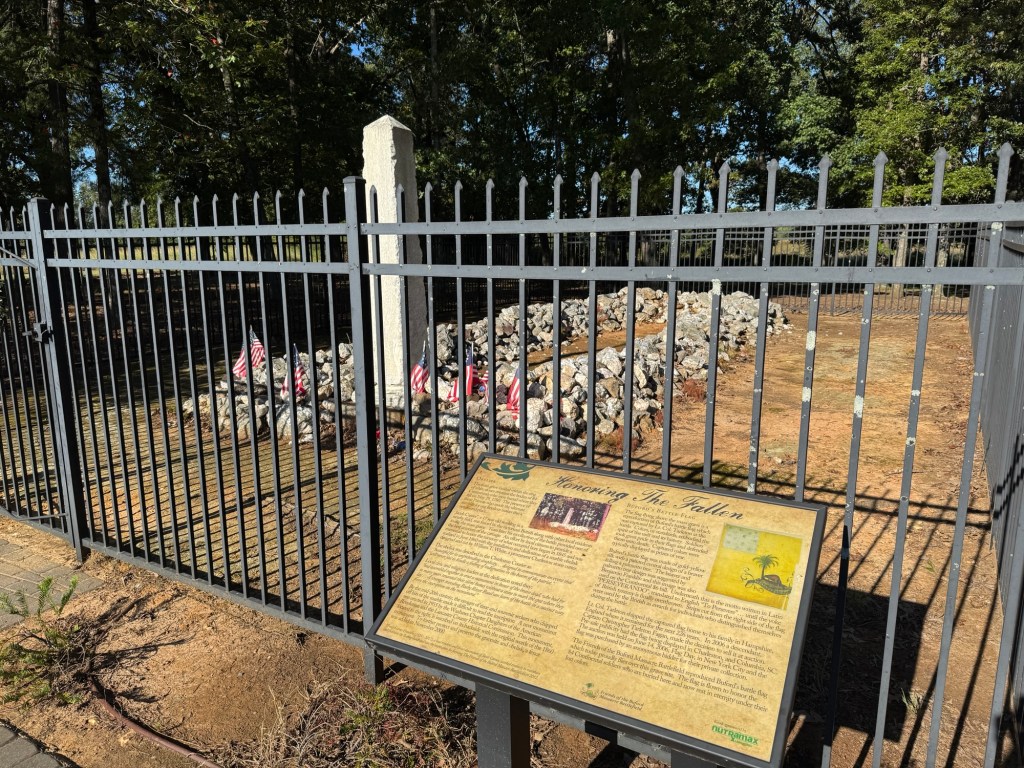
But first we visited the Battle of Waxhaws also known as Buford’s Massacre in Lancaster, South Carolina. The Battle of Waxhaws took place on May 29, 1780. British Lieutenant Colonel Banastre Tarleton overtook Colonel Abraham Buford’s regiment of 350 Virginian Continental troops as they were attempting to relieve Charleston. The battle was short lived and saw over 113 Patriot soldiers killed in a brief but brutal engagement after a breakdown in surrender communications as the Patriot soldiers were attempting to give up under a white flag and the British bayoneted and sabred many of them earning Tarleton the infamous nickname “Bloody Ban”.
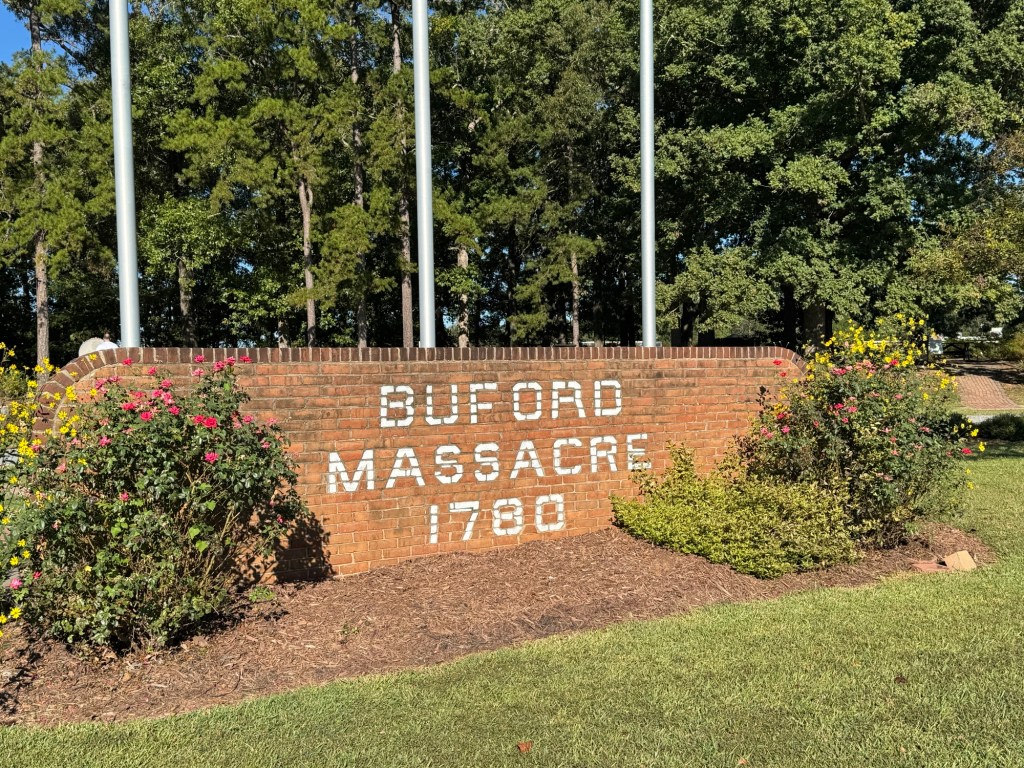
The site was very clean and well done with lots of landscaping and hardscape features and they had a sign board showing the timeline of improvements over time. The central ficus is the mass grave of the men who were killed there.
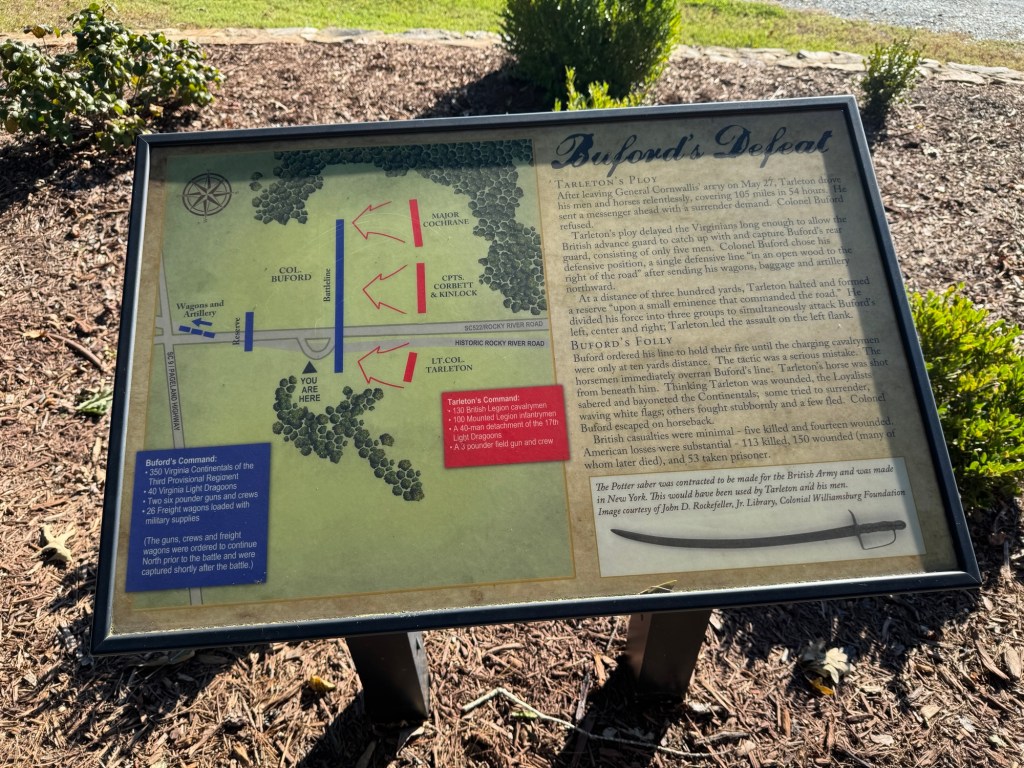
I very much enjoyed the various interpretive signage and especially those showing the battle lines and disposition of troops as it helps me to place the event on the site and better understand how it unfolded.
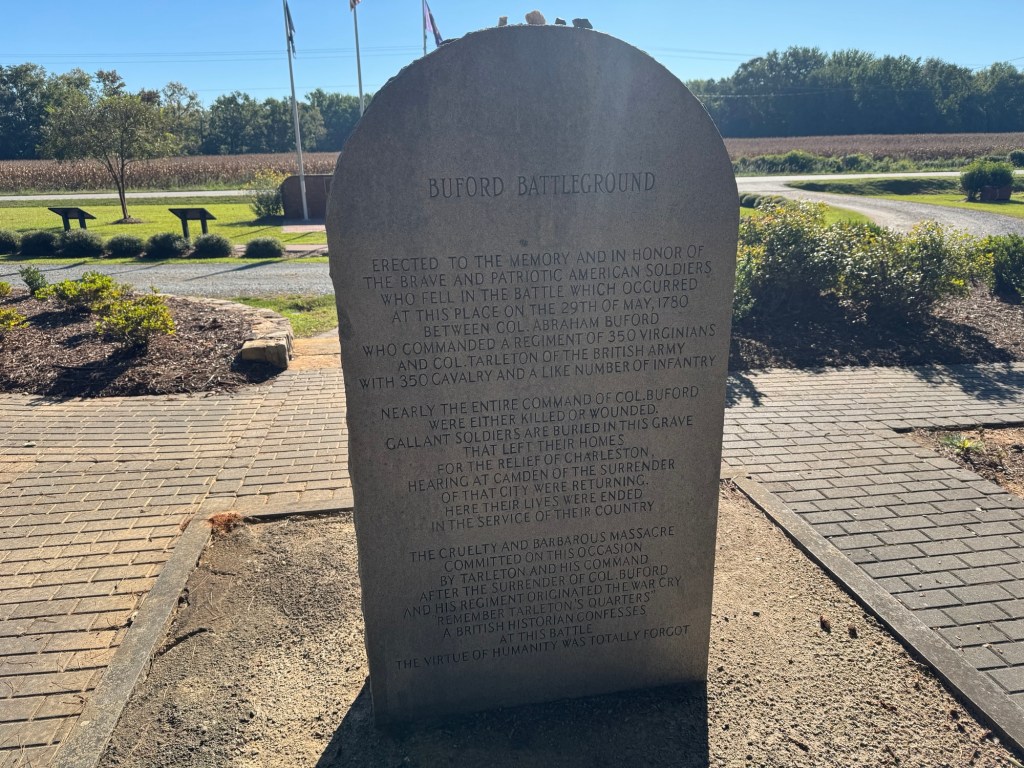
The mass grave memorial was very well done and has been improved over the years to its present day condition. The mass grave is marked by a large 10-foot tall white marble obelisk marker originally erected in 1860 and later replaced in 1955.
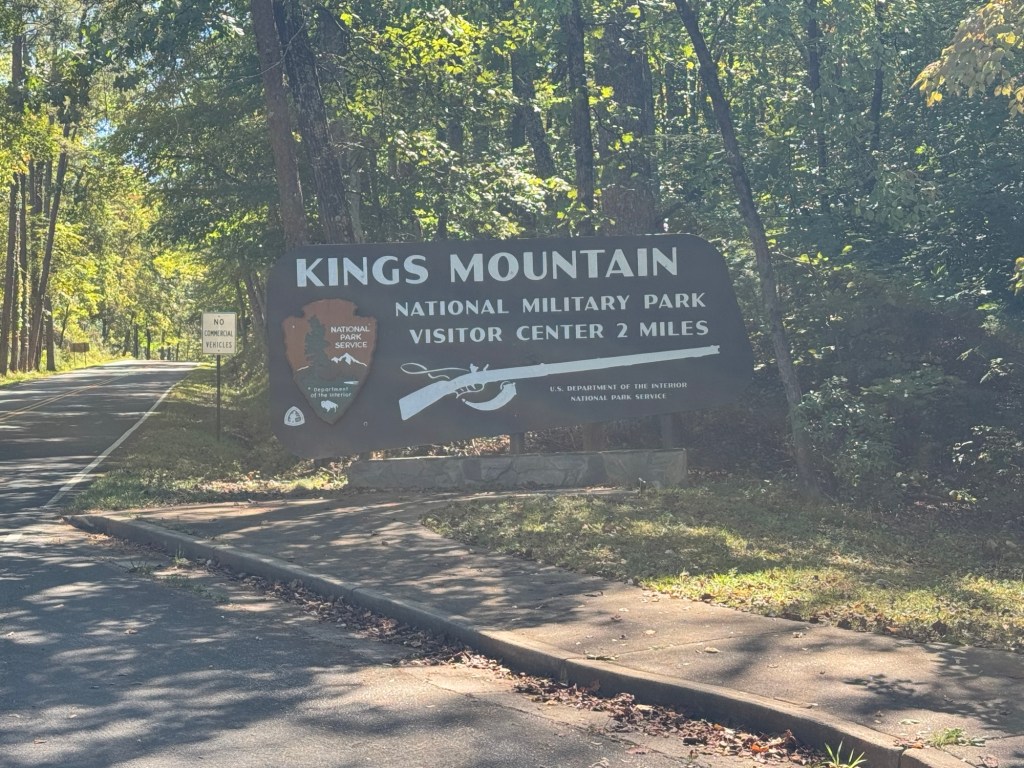
We then made our way to King’s Mountain and very much enjoyed this site which commemorates a Patriot victory over the British on October 7, 1780. The battle was fought on a very rocky ridge in western South Carolina, near the North Carolina border. Around 900 Patriot frontier militiamen known as the “Overmountain Men” were against an equivalent force of Loyalist militia led by British Major Patrick Ferguson. The battle lasted only 65 minutes.
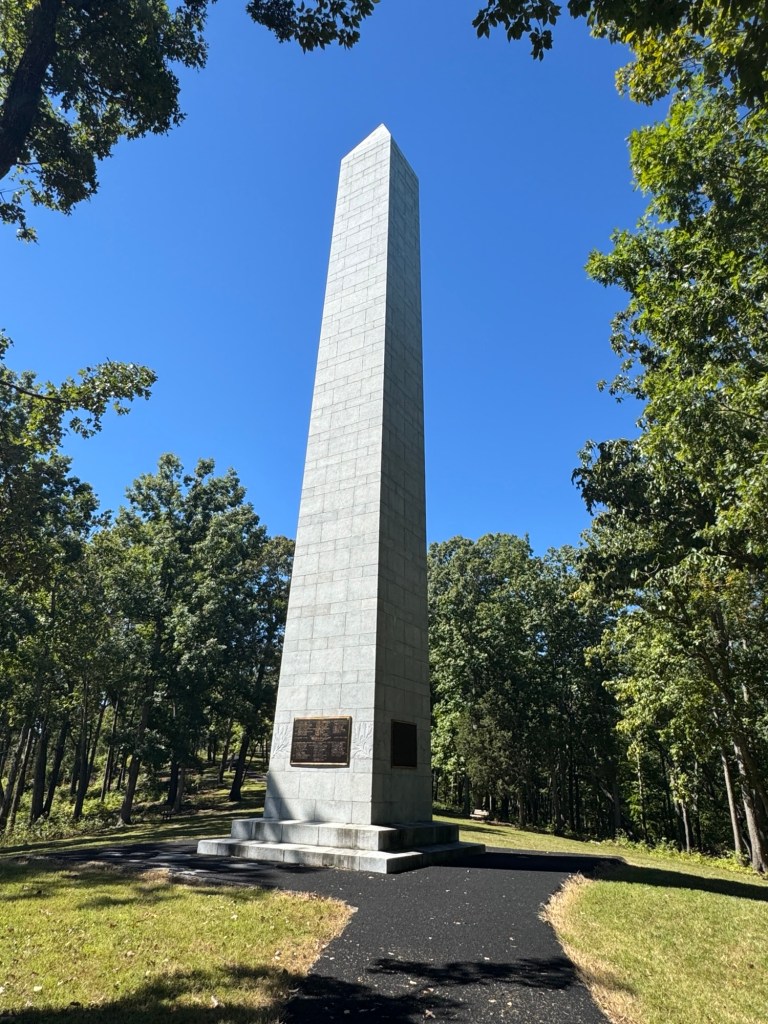
The Patriot forces consisted of frontier militia from the Carolinas, Virginia and Georgia who had tracked Ferguson’s Loyalist force to their camp on the protected high ground. The Patriots used their hunting skills and knowledge of the terrain to surround the hill and while moving up the rocky slope, Patriot riflemen picked off the exposed Loyalists.
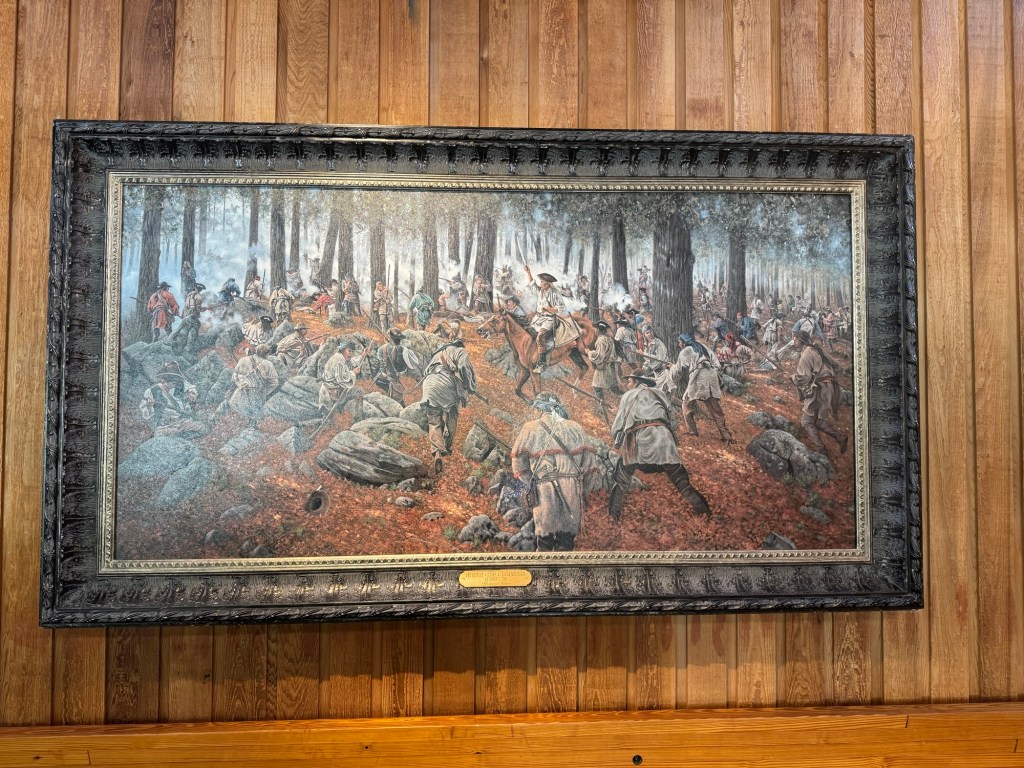
The Patriots had fewer than 100 casualties (around 28 milled and 90 wounded) while the Loyalists incurred over 1,000 total casualties, including roughly 240 killed or wounded and more than 600 captured.
The Loyalist leader Major Ferguson was shot and killed after trying to lead a desperate charge and the remaining Loyalist forces quickly surrendered.
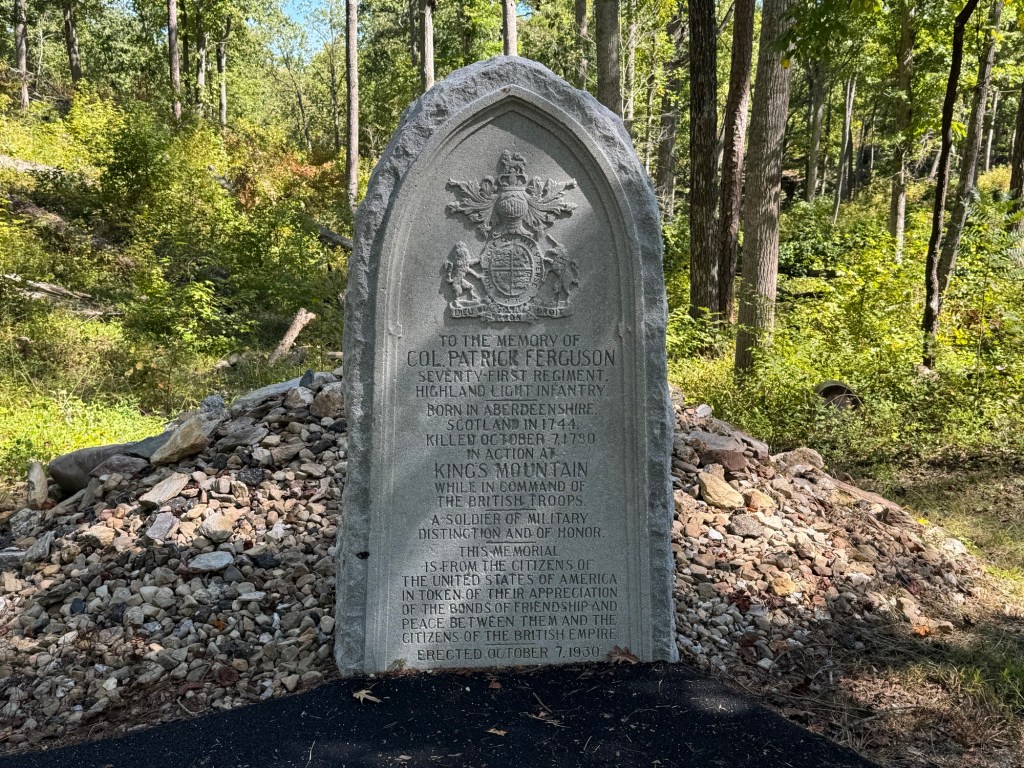
This one took me by surprise as the Loyalists had the high ground and superior positioning but were unable to overcome the Patriots. Just very interesting! The defeat halted the British invasion of North Carolina and forced General Charles Cornwallis to retreat from his forward positions.
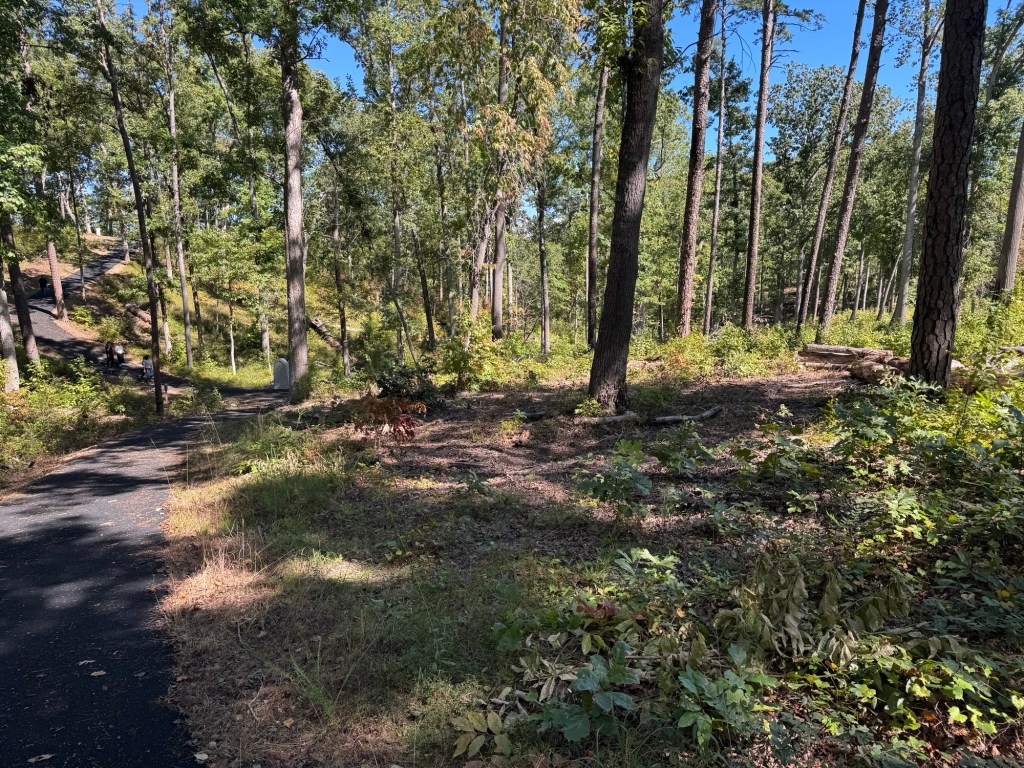
We then made it over to Cowpens which was the battlefield that I was most interested in seeing especially since we just had played the game and were somewhat familiar with the situation.
The Battle of Cowpens occurred on January 17, 1781 near the town of Cowpens, South Carolina. A Patriot army of nearly 2,000 regulars and militia under Brigadier General Daniel Morgan defeated a force of about 1,000 British and Loyalist troops commanded by Lieutenant-Colonel Banastre Tarleton and was the worst defeat suffered by the British in North America during the conflict following the 1777 Saratoga campaign.
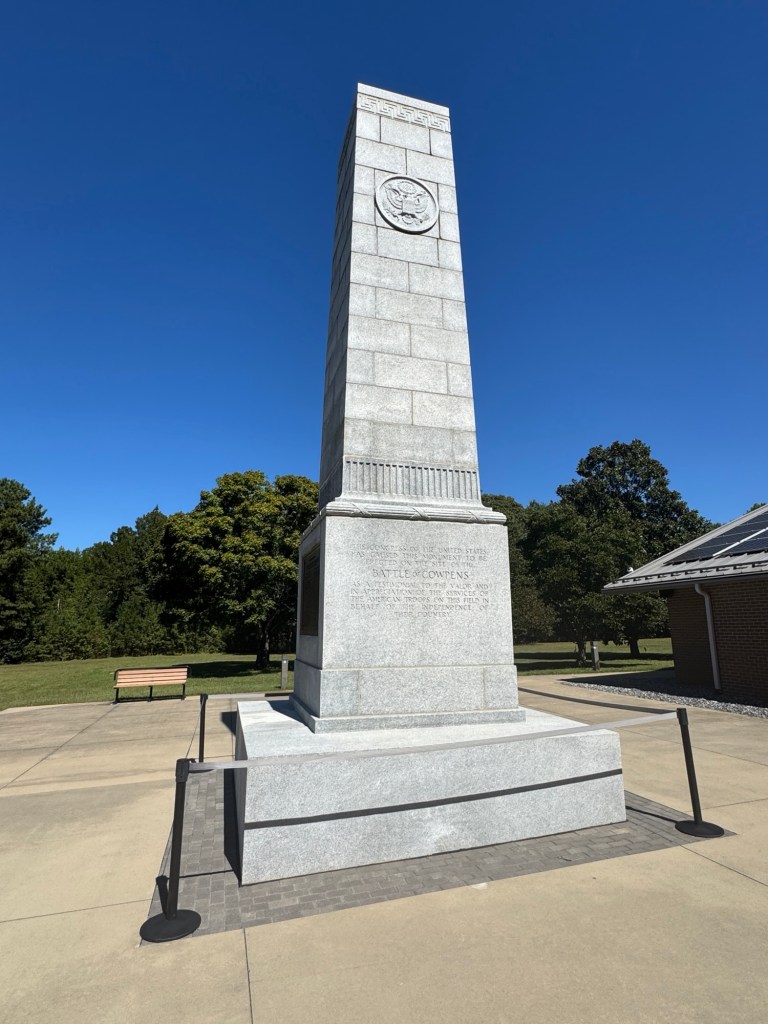
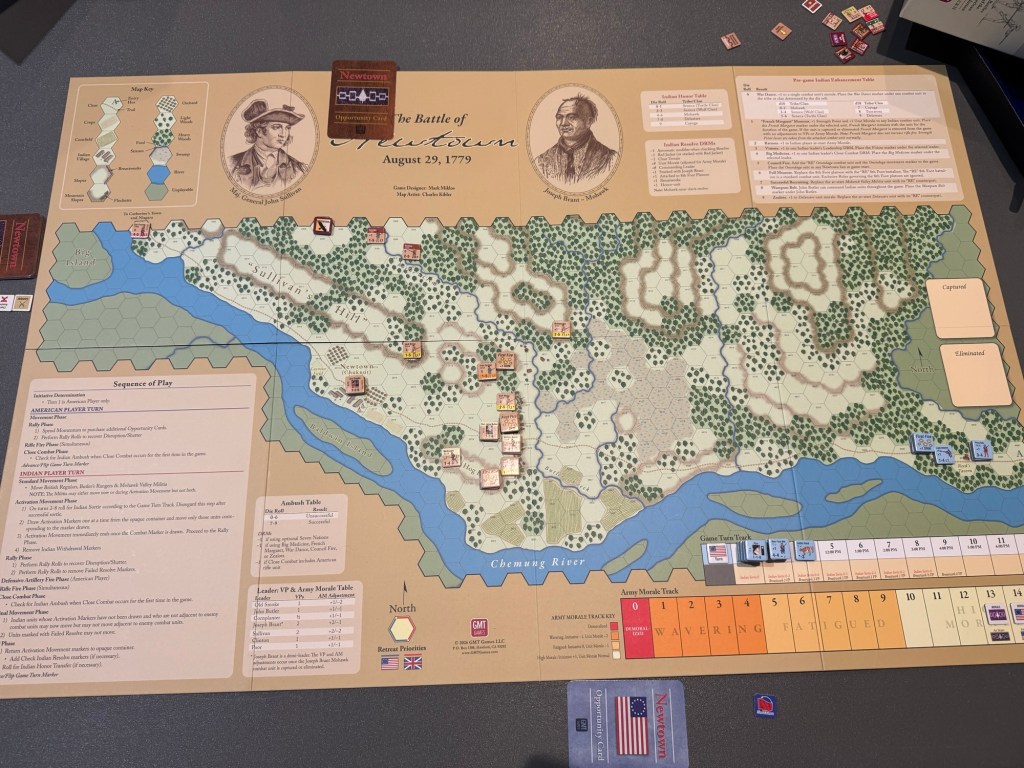
After playing Small BoAR Cowpens, I was anxious to see the battlefield and the terrain to see how it compared. The setup of the units was spot on to what was shown at the site and I was guard to see that.
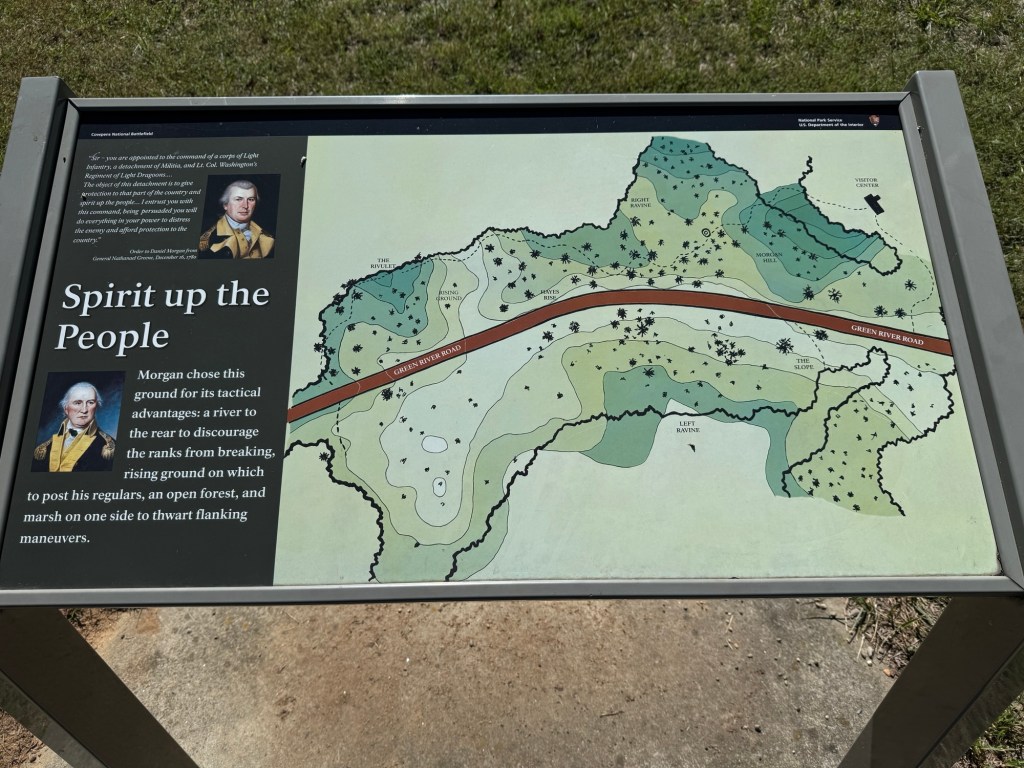
There were 3 lines of Patriot forces including skirmishes at the front, maim Continentals in the center and reserve cavalry in the back.
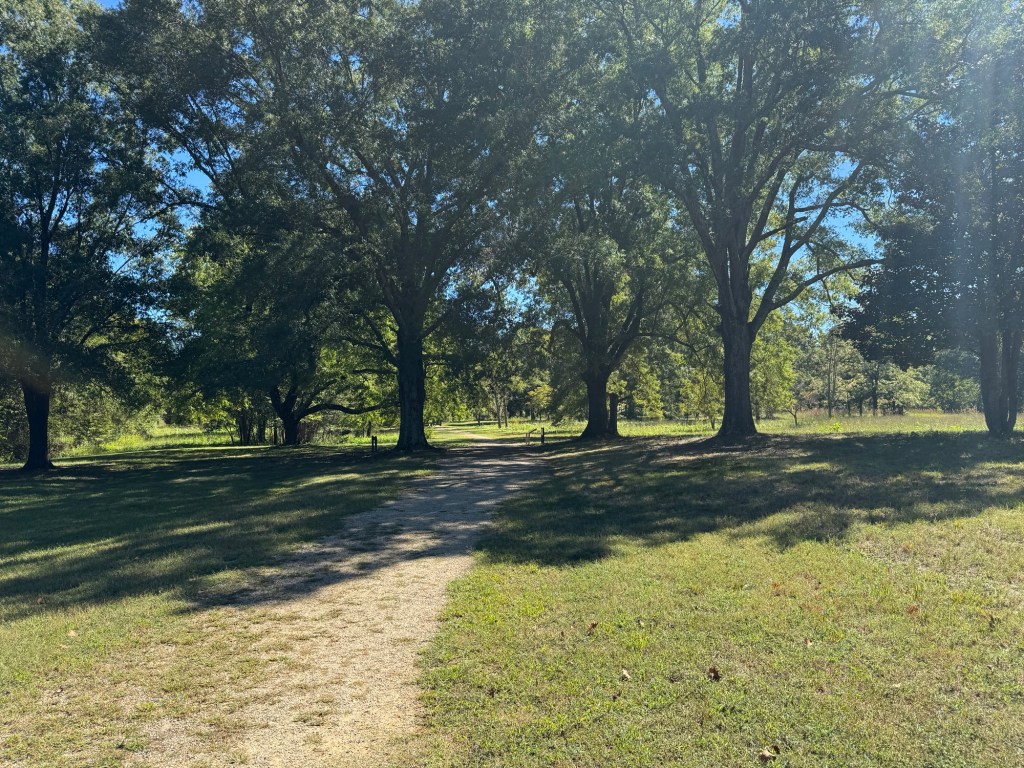
Then there was the actual terrain with the barren pines being somewhat present but most importantly the elevation change that would have obscured the Patriot trap.
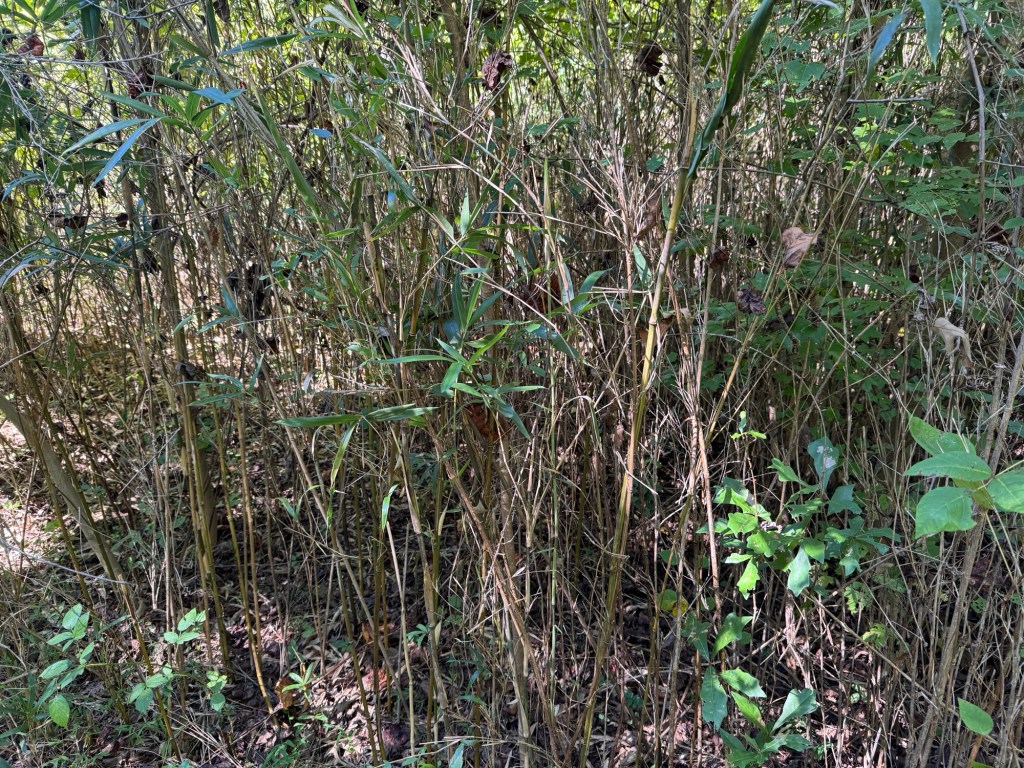
There also was the came break terrain that was found at the edges of the battlefield and that was pretty cool to see as it is very thick and darned near impassable.
A very enjoyable experience and we were able to walk the entire site in about an hour.
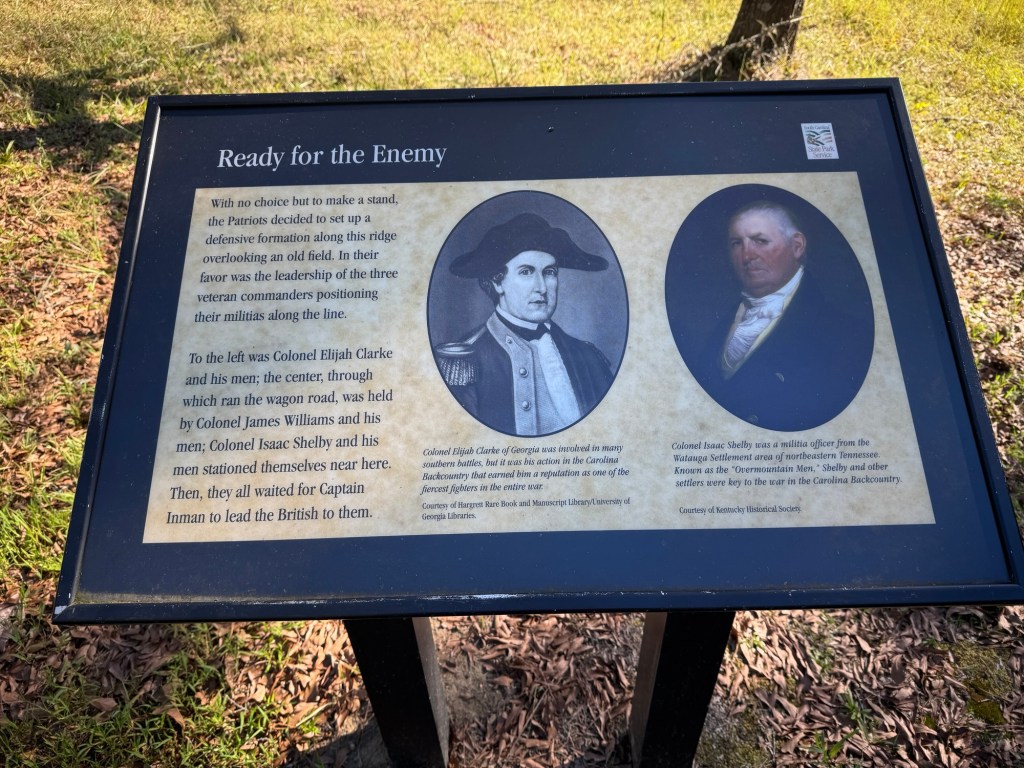
The final site we visited was the small battle at Musgrove Mill. Here Patriot forces outmaneuvered a larger Loyalist force and setup an ambush to even the odds. On the morning of August 19, 1780 mounted Patriots arrived near Musgrove Mill, the key to the local grain supply and the site of a Tory outpost. The Patriot force consisted of Georgians under Colonel Elijah Clarke, South Carolinians under Colonel James Williams and a group of “Over Mountain Men” from present-day Tennessee commanded by Colonel Isaac Shelby.
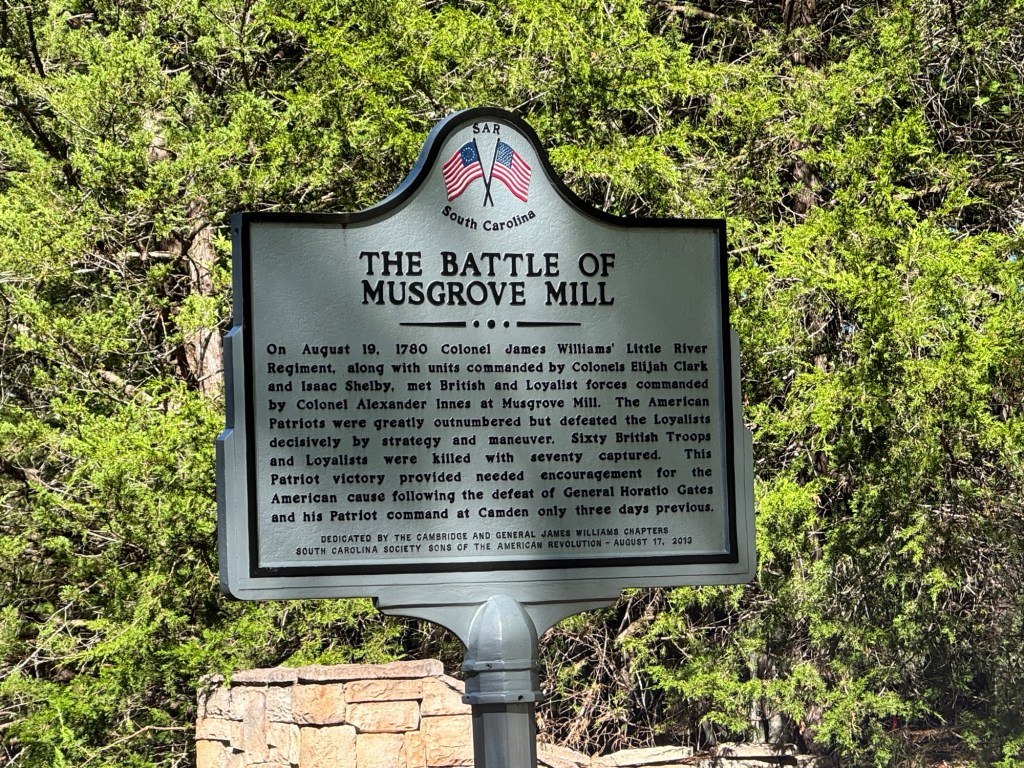
The Patriots revealed their presence when several of their scouts clashed with a Loyalist patrol. Two Rebels were wounded in the brief clash. Falling back, the Patriots encountered a friendly farmer who informed them that, contrary to their initial intelligence, the Tory garrison had been reinforced and now consisted of 500 men.
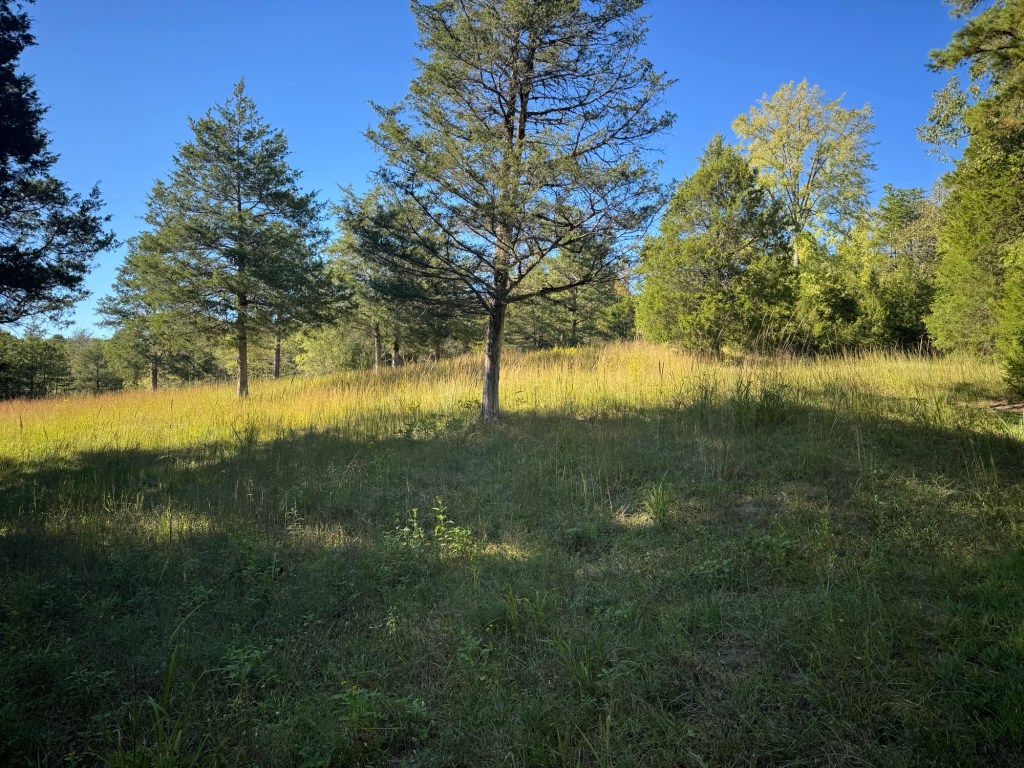
Outnumbered, and having lost the element of surprise, the Patriots formed up on a ridge top overlooking the road to Musgrove Mill and threw up a make-shift breastwork. A small detachment under the command of Captain Shadrach Inman was dispatched to lure the enemy into an ambush.
We walked the trail that followed the action ending in what was called an Indian hill where the Patriots drew in the Loyalists and waited to fire until they were within 30 yards to devastating effect. They could wait because of the elevation of the hill and the thick trees they were hiding behind.
Although the battle only lasted for an hour, the Loyalists suffered heavy casualties while the Patriots’ losses were fairly light. Before they could follow up on their success, however, the Patriot commanders learned of Horatio Gates’s defeat at Camden and decided to disperse their forces. The Battle of Musgrove Mill signaled that resistance to British rule had not been snuffed out.
That was it. We did a ton of stuff in just 4 days including playing 4 games, visiting a total of 6 battlefields, shooting 4 videos and enjoying our time with other wargamers. It was a great convention and my thanks go out to all those that made this possible including Mark Miklos, Gene Billingsley and GMT Games as well as the good folks of the Camden Visitor Center and the South Carolina Battlefield Preservation Trust.
-Grant


Hey Grant, I had to leave early as my lab puppy was getting a little tired of going
LikeLike