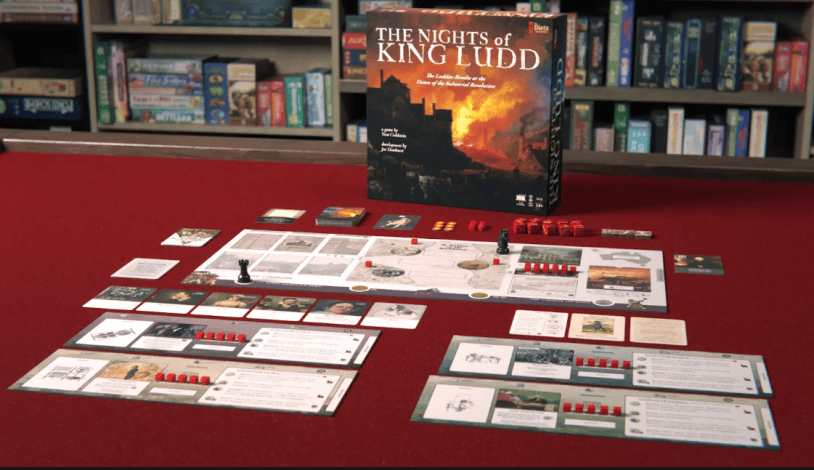
The Dietz Foundation has a new game from Yoni Goldstein on Kickstarter called The Nights of King Ludd: The Luddite War on Industry, 1811-? (the game has already funded). The Nights of King Ludd is a 2-4 player game that deals with direct oath-sworn secret societies of English Luddites at the dawn of the Industrial Revolution in the English Midlands. Working together, players will build a secret network of saboteurs, ferry provisions and weapons on the black market, assemble raiding parties, and if all goes as planned, smash those “dark satanic mills” to cinders. Here is Part II of our interview with Yoni.
If you are interested in The Nights of King Ludd, you can back the project on the Kickstarter page at the following link: https://www.kickstarter.com/projects/dietzfoundation/the-nights-of-king-ludd
Grant: What is the layout of the board and the different locations?
Yoni: The board is divided into three panels. On the left, you will see the two card pools. The top row is where you place the “Regency” Cards, reactionary forces from London sent to quash the Luddite revolts. Below London are three cards representing the “Commons,” a shifting market of dual-use cards helpful to the players.
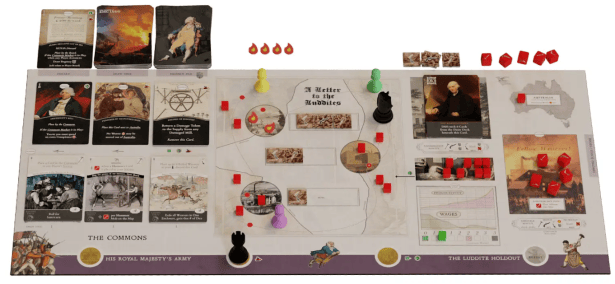
The central panel features the mills and enclosures. This is where players place their pieces (Weavers sympathizing with the Luddite cause), and the local Militia (the knight piece). The map depicts the “Luddite Triangle:” the West Riding of Yorkshire, Nottinghamshire, and Lancashire.
The right panel holds the Manufacturer’s House (and the current Manufacturer), the pool of Employed Weavers, and the Stocking Market to track wages and productivity in the mills. On the far right panel, is the Australia space for weavers punished by transportation, and the “Saboteur Dice Pool.”
A ribbon at the bottom of the board displays His Royal Majesty’s Army progress toward the Luddite Holdout. This is effectively the round track, if the Luddites are unable to sabotage the three mills by the end of the third round, the game ends in collective defeat.
Grant: How does the game use cards? What different type of cards are included?
Yoni: In The Nights of King Ludd players build a collective card engine by acquiring dual use cards from the “Commons” to upgrade their actions (aka “Conspiracies” – more on those below). The main pool of cards is called “The Commons” which, as the name suggests, represents a mutual aid network of provisions, tactics, and personalities that the Luddites may draw from in the course of their clandestine operations.
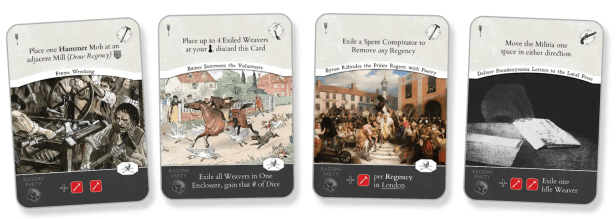
“Commons” cards are dual use and drawn from the Draw Deck. They are beneficial in two ways: the top of the card displays a persistent upgrade to any Conspiracy action and is locked into the player board to form a tableau. The bottom of the card displays a “Raiding Party” effect, a one time effect that can be triggered when a Raiding Party is formed and dispatched to a local mill.
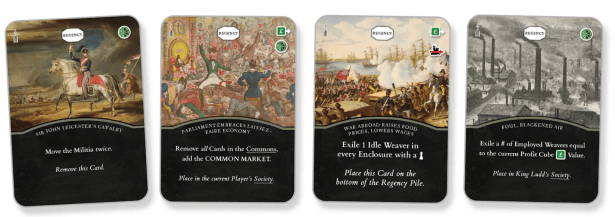
The antithesis of the Commons is the “Regency,” a deck of cards reflecting the alignment of the aristocracy in London with an ascendent industrial class against the Luddite cause. They are drawn whenever the Luddites make themselves known in public: fomenting a mob, carrying out an assassination, or setting a factory on fire. When drawn, they set the machines of industry into motion; driving up productivity, plummeting wages, and calling the local constabulary to police the countryside.
Once more than three cards are in the “London” track above the Commons, a nasty event is resolved. These effects will intensify the game’s challenges. Sympathetic weavers will be exiled to Australia, the militia will sweep into the local mill to root out hidden raiders, and the Commons will be parceled off and sold to the highest bidder.
Grant: What is the role of the Persona Cards? Who are these figures?
Yoni: As mentioned in Part I of this interview, each player represents a secret society of Luddites organized around a particular “persona.” These personae introduce a special ability, as well as their their own victory condition, aka a “Motivation”, and a unique “Woe” – a card shuffled into the Draw Deck at setup that will, inevitably, undermine their efforts. There are six persona to choose from.
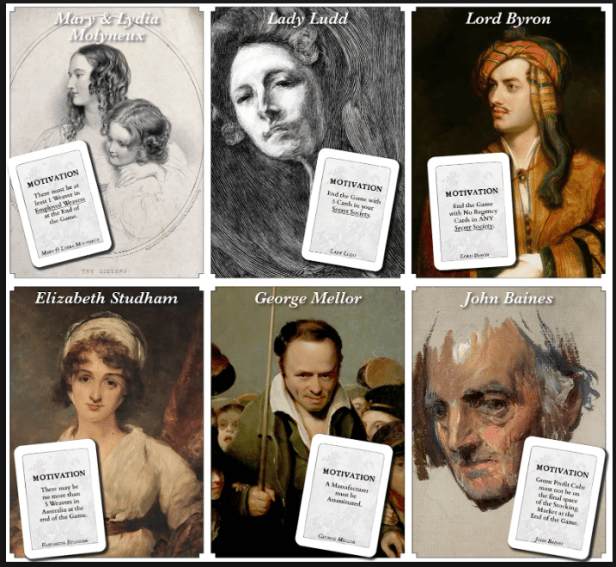
In clockwise order, they are:
- Mary Molyneux, 19, and Lydia Molyneux, 15, were two sisters who, in 1812, stormed a steam-driven cotton mill outside Bolton shouting, “Now Lads!” – encouraging the mob to set the building afire (and they steadfastly did so).
- Lady Ludd: “The “Lady Ludd Riots” took place in 1812 when a group of women and young lads – “distressed” by the precipitous rise in corn prices – marched through Leeds, assaulting merchants and “beating up for a mob.” They were led by a disguised person “who was dignified by the title of LADY LUDD.”
- George Gordon Byron, 6th Baron Byron, “a young poet with the chiselled good looks, the oddly deformed club foot, and an obscure and very prestigious peerage,” was an eloquent Romantic dandy who rose to defend the Luddites before the House of Lords in 1812. Byron sympathized with the weavers near his home north of Nottingham; “the real cause of their misery [was] the destructive warfare of the last eighteen years, which has destroyed their comfort, your comfort, all men’s comfort.”
- Elizabeth Studham was one of seven women tried for arson during the Swing Riots of 1829-30, an echo of the Luddite rebellion. At the age of 19 she set fire to an East Kent workhouse, demanding a wage increase for farmers threatened by threshing machines. Studham was deported and served 14 years and two months in Van Diemen’s Land (Tasmania) during which time she gave birth to two children of whom records are sparse. She would later be sentenced for 10 offences, primarily for bad language.
- Lt. George Mellor was a Cropper and Yorkshire Luddite known to the movement as General Ludd’s Right-Hand Man. A strong willed and roguish machine-wrecker, he eventually faced a hanging sentence for the murder of a wealthy mill owner whom he shot in the groin. Eventually, Mellor was arrested in October of 1812. It is said he raised his hands in shackles and shouted “Three cheers for General Ludd!”
- John Baines the elder was an “intelligent Hatter” and president of the local Republican Club of St. Crispin. Baines dreamt that Luddism would one day blossom into a democratic revolution; “Let the people now rise and rid themselves of this vile brood who flung upon them the sole taxation of the country and reduced them to the condition of galley slaves!” He was found guilty at the York Special Commission of administering illegal oaths and died on board a prison hulk in a Portsmouth harbour, on December 21st, 1814.
Grant: What is the purpose of the Manufacturer Card?
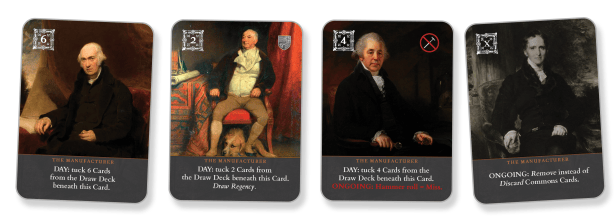
Yoni: At the beginning of each game, one of the three Manufacturer Cards is selected at random and placed face up in the “Manufacturer’s House” space on the board. The initial effect (tuck 6 cards from the draw deck beneath the manufacturer) represents the nascent industrial class’ emphasis on extracting from the commons, resolving at the start of each round. In practical terms, this prunes away the players’ available card pool over the course of play as well as ambiguates the composition of the draw deck. When a manufacturer is assassinated, all the cards tucked beneath are discarded (and will shuffle back into the Draw Deck) and the Manufacturer Card is flipped to reveal a more reactionary and dangerous side.
Grant: What are Conspiracy Actions?
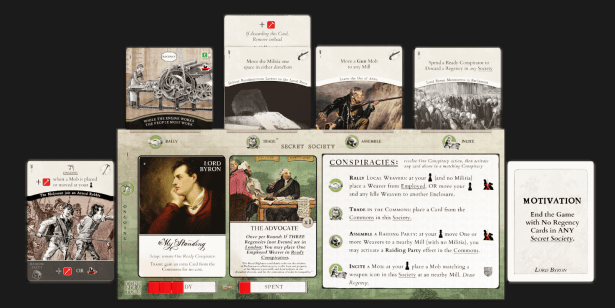
Yoni: At the beginning of the game, each player has five conspirators (four for Lord Byron) at their command. Spending a conspirator allows the player to activate one of the four following Conspiracy actions (per turn):
Rally Local Weavers: either place a weaver from the supply pool at your presence pawn, or move your pawn and any weavers to another enclosure on the map.
Trade in the Commons: pick up a card from the Commons and tuck into one of the columns on your player board. That card allows for secondary actions whenever that matching Conspiracy is activated.
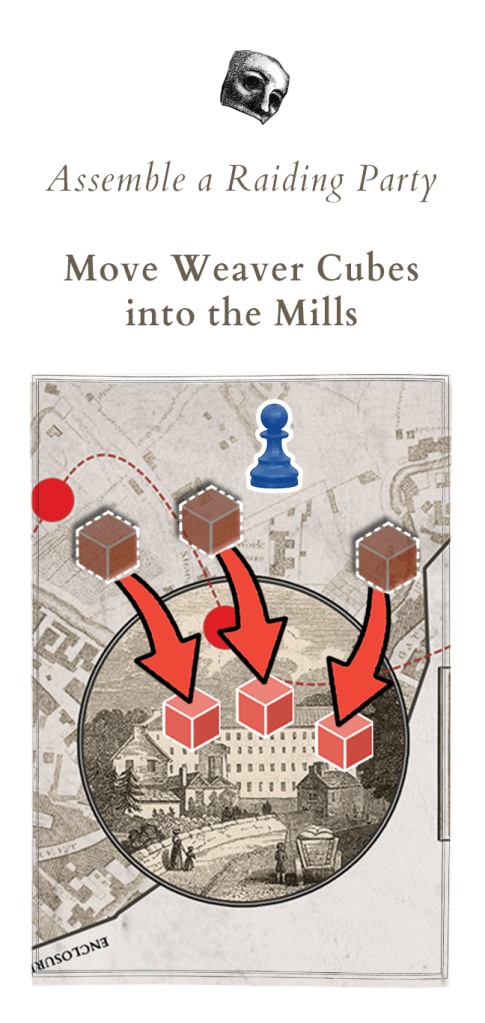
Assemble a Raiding Party: a two step action, move one or more weavers from an Enclosure (spaces on the map adjacent to Mills) into a Mill. This sets up a future sabotage action. Then, activate one of the Raiding Party effects in the Commons. This is the primary means of building your Saboteur Dice Pool. The more raiders you have at the Mill, the more dice you are permitted to roll during a Sabotage operation.
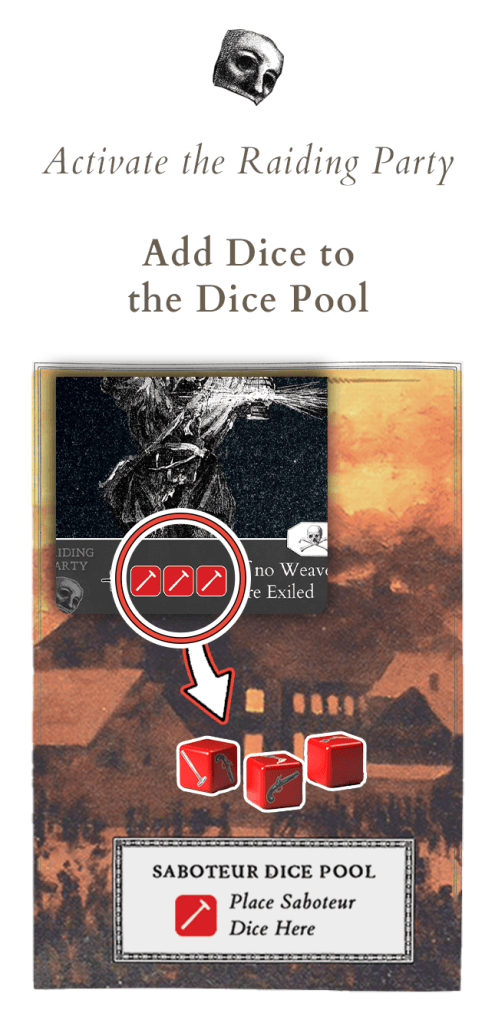
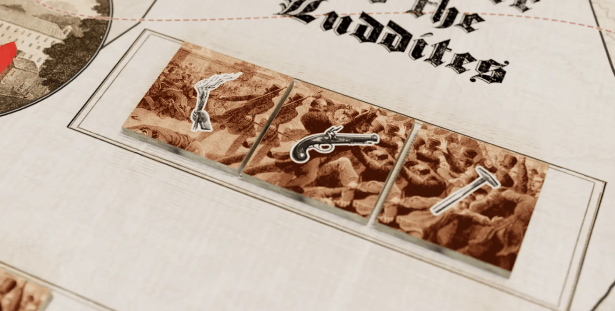
Lastly, you may Incite a Mob, placing a Mob Tile next to an adjacent Mill. For a sabotage roll to be successful, the die rolls must match an icon depicted on the Mob tile – hammer, gun, or torch.
Grant: What type of secondary effects come from cards tucked into the Column on Player Boards?
Yoni: Once you use a Trade conspiracy to move a card from the Commons to your tableau (your “Secret Society”), you can activate it, along with any other card in that same column on your player board, every time you resolve that conspiracy action. This allows for chaining and sequencing a series of effects that may have significant impact on your objective to destroy the mills.
Grant: Can you show us a few examples and explain their use?
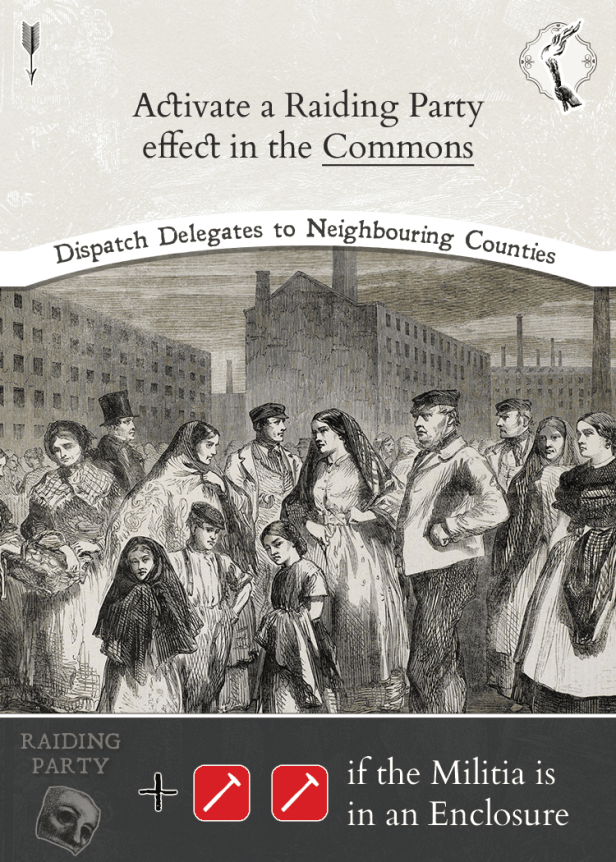
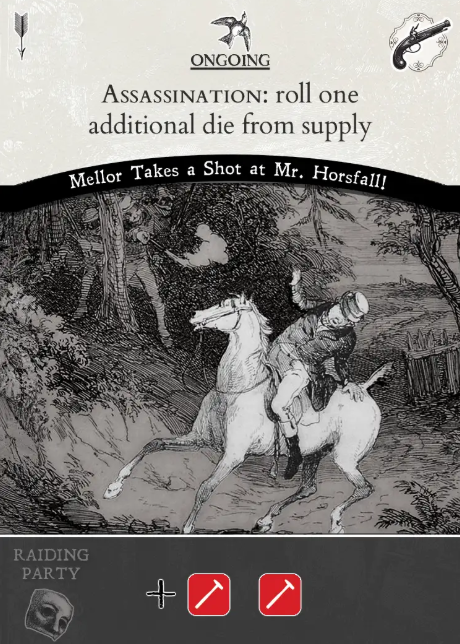
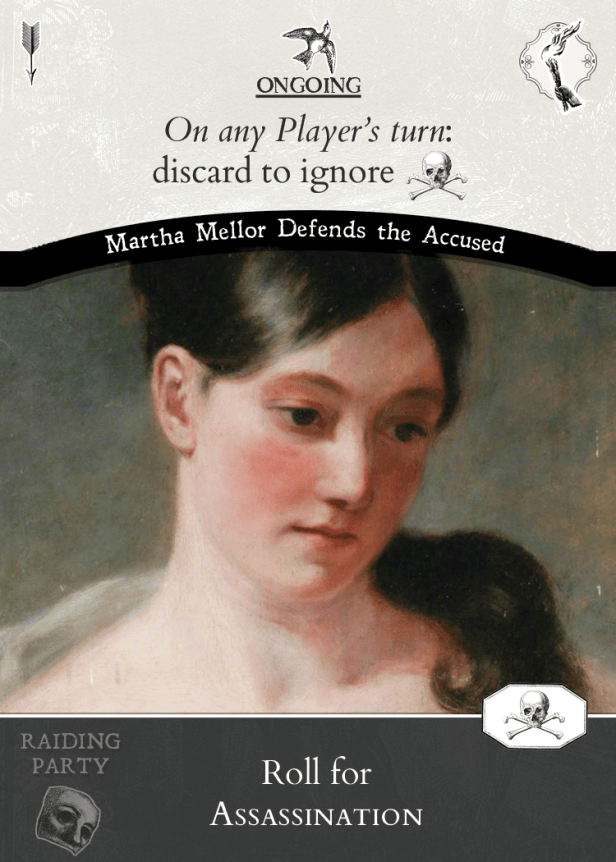
Yoni: For example, let’s say you are George Mellor and you are seeking to assassinate the manufacturer. You resolve the Trade conspiracy to take “Dispatch Delegates to Neighbouring Counties” and place it in your Trade column, meaning it will be available to you immediately after this primary action. In previous turns you’ve already acquired an ongoing ability, “Mellor Takes a Shot at Mr. Horsfall!”, giving you an extra die for Assassination roles (helpful, since these operations are so risky!). You activate “Dispatch Delegates…” to activate a Raiding Party effect (the bottom of the card) in the Commons, which happens to be your partner in crime, “Martha Mellor Defends the Accused.” She allows you to roll for Assassination, but will be removed from play once that effect is resolved.
Grant: How does Sabotage and Assassinations work in the game?
Yoni: At various points in the game, players may elect to roll for Sabotage or Assassination. Of course, certain maneuvers must take place for these brazen attacks to succeed. Sabotages are larger scale events and are aimed at the Mills. You must have assembled a raiding party at the Mill and incited a Mob to spurn them on. As mentioned above, you roll one die per weaver cube at the Mill and attempt results matching the icons on the Mobs you’ve placed. The dice are D6s with the following faces: 3 blanks (a miss), 1 Torch, 1 Gun, and 1 Hammer. So with one Mob tile matching one of those icons, each die you roll has a 1 in 6 chance of hitting. If all three Mobs are in place, the odds climb to 1 in 2 per die.
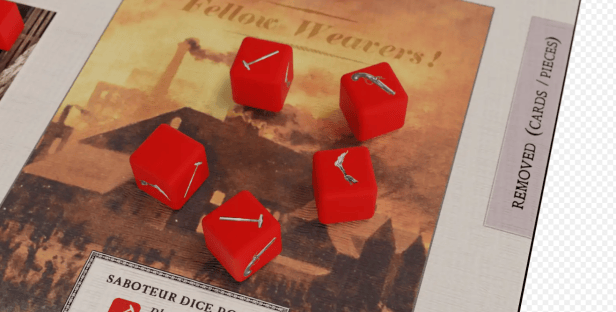
An assassination is a similar roll, but only one die may be cast and hits are only the gun or hammer. Beware, the Regency will respond with a draw from its deck for both sabotage and assassination rolls!
Grant: What are you most pleased about with the design?
Yoni: As Dan Thurot noted, “The Nights of King Ludd points toward a more experimental direction than Chicago ‘68 and I feel it reflects a degree of growth and maturation as a designer. It’s a game that seeks to capture both the panoramic view of a people’s struggle as well as sketching out the personal incentives that motivate individual participation in (and sometimes sacrifice for) a collective cause”.
Grant: What other games are you currently working on?
Yoni: I am currently working on a commission for an international art exhibition on “sociopolitical freefall.” This will be a smaller box game and will also be developed by Joe Dewhurst. I’m also co-designing a project about Mai ‘68 with Fred Serval. This game is about the French experience of student and labor riots in 1968. While it shares the themes of Chicago ‘68 it’s driven by a completely new system.
If you are interested in The Nights of King Ludd, you can back the project on the Kickstarter page at the following link: https://www.kickstarter.com/projects/dietzfoundation/the-nights-of-king-ludd
-Grant

