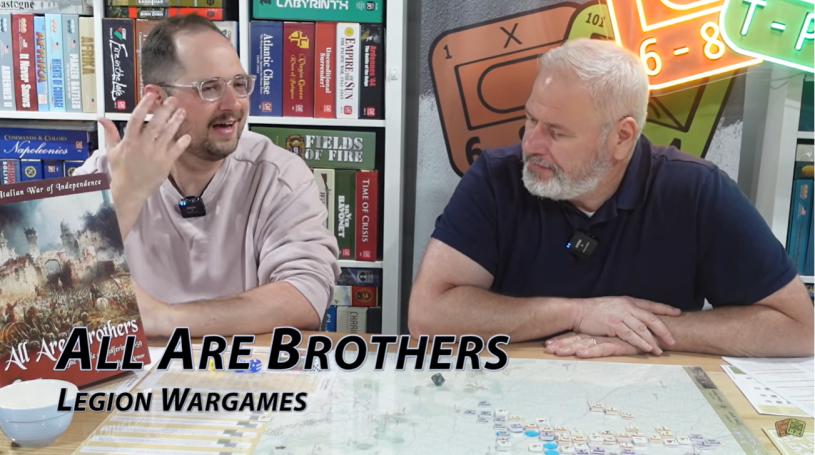
All Are Brothers: Solferino, 1859 simulates the decisive battle of the Second Italian War of Independence at the Brigade-level, with some additional Regimental-size and smaller detachments included. National and corps-level leaders are represented, on a map at 500 meters per hex, with 1-hour turns. Five scenarios are included: three that separately cover the north, central, and southern sectors of the battle, as well as a combined full battle scenario, along with a small introductory scneario. The combined scenario is suitable for up to four players (France, Sardinia-Piedmont, Austrian 1st Army, and Austrian 2nd Army).
The battle itself was a grinding slugfest often described as a “soldier’s battle” – a deliberate slight to the often uninspired leadership of the generals and a tribute to an allied victory gained only at the tip of the bayonet. Villagers in the surrounding region would do their best in the days after to treat the myriad wounded, and answer as to why Austrians, Hungarians, Czechs, Serbs, and Slovaks were treated as well as the Italians: “Tutti fratelli” (All are brothers). The battle pits two Austrian armies against the combined forces of France and Sardinia-Piedmont, and features the full panoply of colorful period units – Jagers and Grenzers, massed cavalry divisions of all types, Bersaglieri, French Imperial Guard, and the French African Zouaves and Turcos. Advances in infantry and artillery firepower would soon make the tactics of the time obsolete, and the carnage at Solferino reflected the start of this paradigm shift, soon to be highlighted bloodily by the Austro-Prussian and Franco-Prussian wars.
This treatment of Solferino features an adaptation of Hermann Luttmann’s Blind Swords System (At Any Cost, Hammerin’ Sickles, Stonewall’s Sword) as the core ruleset. The system is heavy on unpredictability and fog of war due to the chit pull mechanic. The chit pull mechanic also very much aids in solitaire play, as does variable activation rules and reinforcement tables. A number of other features help make face-to-face play attractive, including a number of scenario variants and optional rules, a free-setup full battle scenario, and the move-and-countermove of event chit play. Nation-specific event chits also inject some period flavor.
-Grant
 The Players' Aid
I am enjoying this game and time period. The 1850-1914 era could use some more attention. Wars of the Italian Independence, Prussia-Austria, and Prussia-France come to mind. Crimea and Italian campaigns in Abyssinia are interesting as well.
I have a number of Blind Swords games of the American Civil War and this is a somewhat simpler version of that.
I TOTALLY agree with your observation about the color contrasts between various formations. The graphic designer wanted to stay with a bluish palette for the Austrian/Lombard-Sardinians and an orange palette for the Austrians.
I have similar issues with a lot of MMG (OCS/BCS/SCS) formation colors. as well.
But I have a great solution. I picked up an infrared flashlight for a special project and it really helps differentiate the various formation colors.
Maybe the publishers should include an IR flashlight every time their graphics designer insists on variations of the same color! LOL
Great work.
LikeLiked by 1 person