
Rinse and repeat with the after gaming sleeping and eating of breakfast. I was very tired this morning when the alarm went off at 7:30am. I knew I had a big day and hoped that I’d have the energy to do all that I had planned.
First up was a learning game of the brand new The Weimar Republic from GMT Games. The Weimar Republic is a Card Driven Game of political struggle in interwar Germany where 4 unique factions compete for dominance including the democratic Coalition, the Soviet-backed Communist Party, Hitler’s National Socialists and the far-right Radical Conservatives. The game covers the Interwar Years between 1919-1933 and represents all of the different fighting factions trying to gain control in Germany’s regions and major cities, to maneuver the political landscape of the Republic, and to dominate through a combination of propaganda, parliamentary elections, street violence, economic influence and ideological zeal. This situation sets itself up perfectly for a game to explore the various parties involved. I was able to get into a game with the Hoosier Herd gaming group from Bloomington, Indiana.
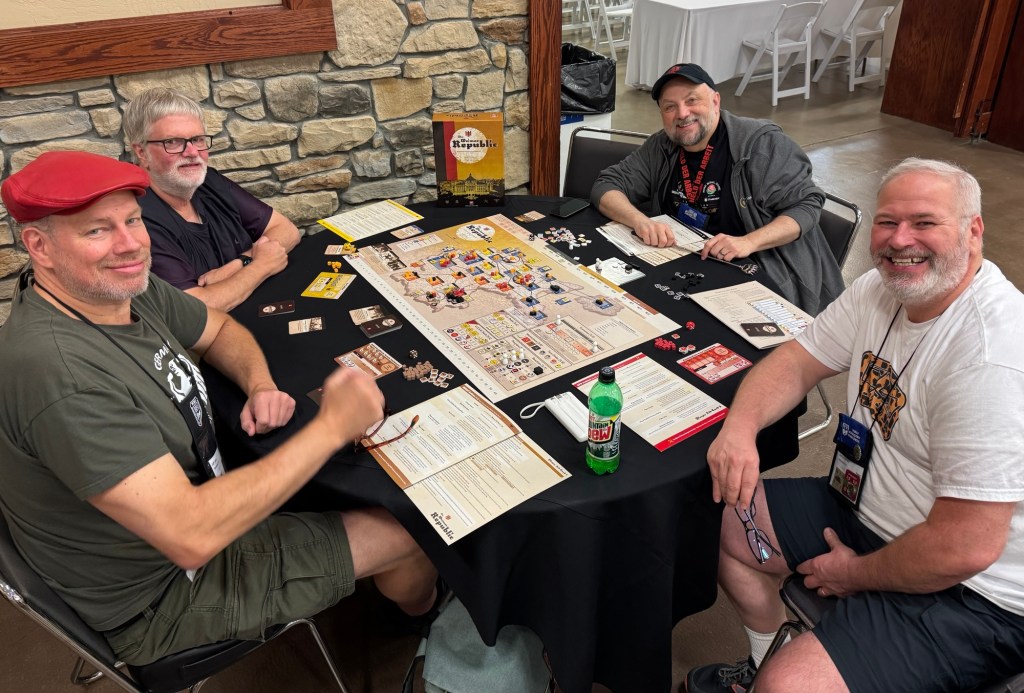
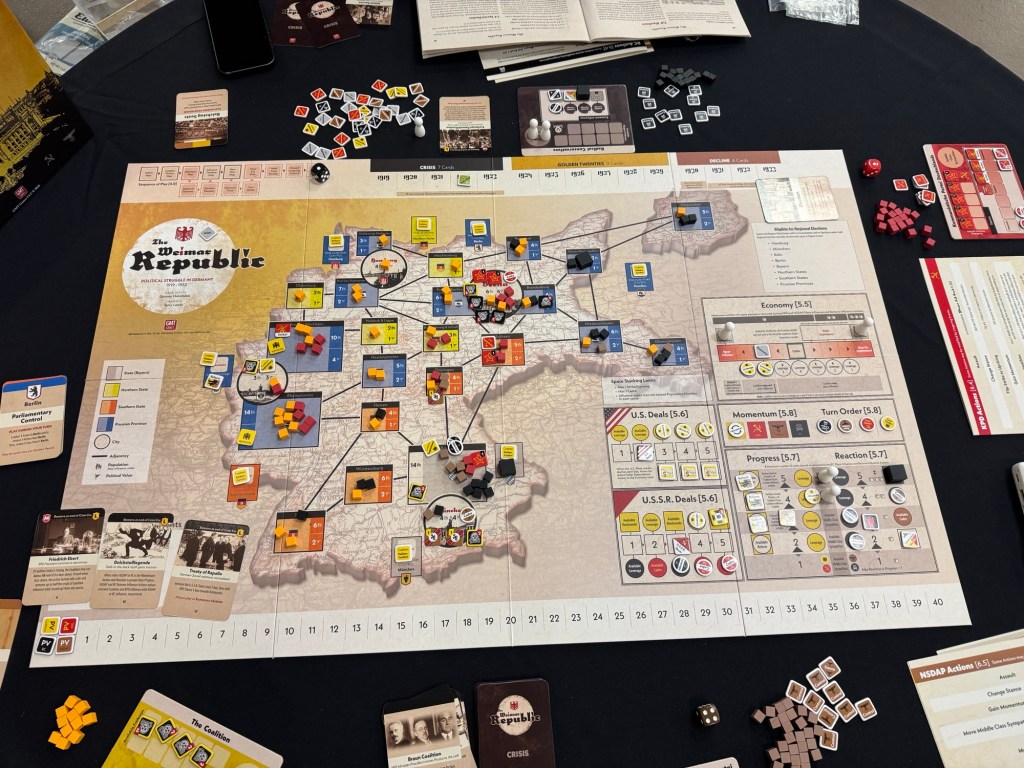
The game appears to be a COIN Series like game as each faction has their own unique abilities and powers but also win in their own way. The game also visually looks like a COIN game as it uses multi-colored wooden cubes to represent influence in the various districts of pre-WWII Germany.
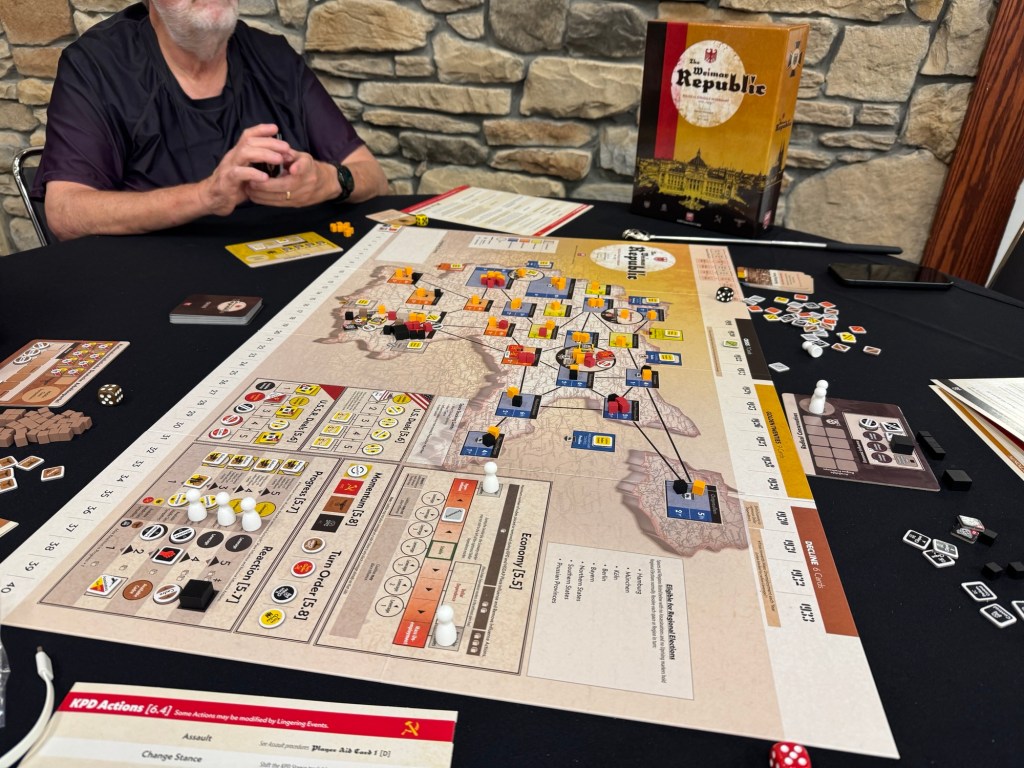
A major focus of the game is the concept of Elections. Each Era has a number of Election Cards (based on the historical number of Elections) that are shuffled into the Event Card decks. When an Election Card is played, both a Regional and a General Election is held at the end of that round. Election scoring is based on players’ Dominance over spaces and Regions, with modifiers such as Middle Class Sympathies, Cadres, military Supremacy, etc. Regional Elections gives Parliamentary Control over the game’s Regions while a General Election can potentially end the game – if anyone but the Coalition wins a General Election, that player also immediately wins the game.
Players draw a hand of cards for each Era and use their AP to conduct Actions. You don’t chose between AP and Event as when you play an Event Card the Event always takes place, unless there are some requirements that aren’t met. You don’t need to play a card every turn – in fact you can’t, as there are fewer cards in a hand than turns in an Era and you may only play one Event Card per turn. However, you always have a basic 1 AP that may be used by itself or in combination with any Event Card played, so during some turns you will be using only that basic point. You can also pass which allows you to discard a card and draw a new one.
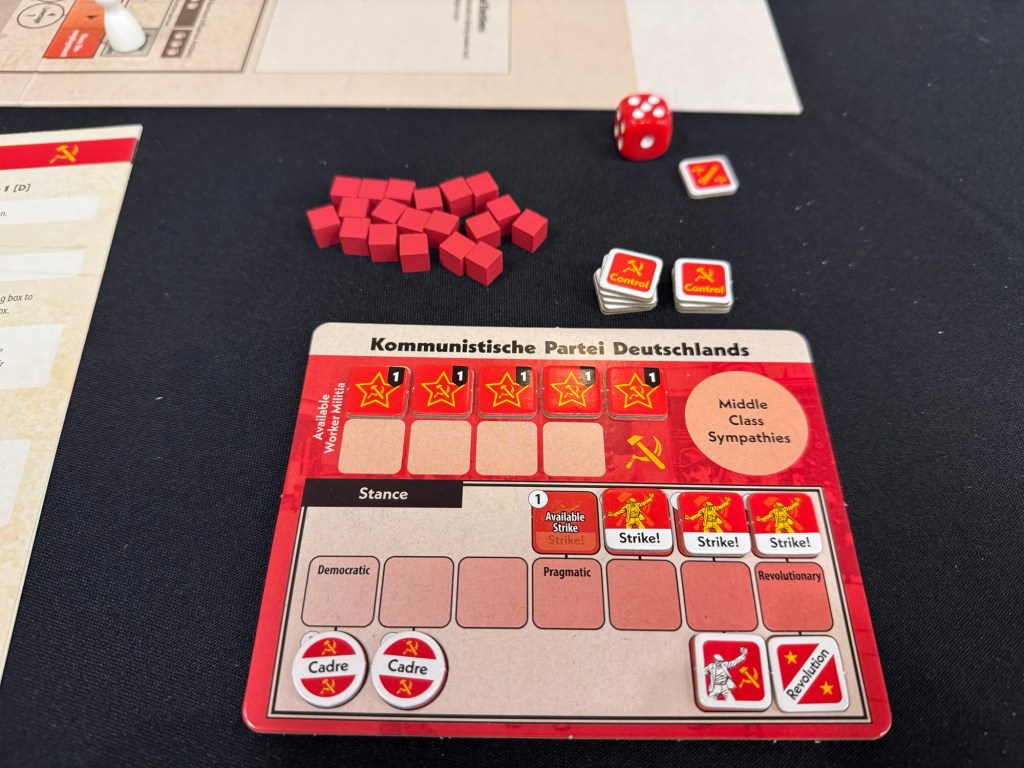
I very much like what I was doing but need to grok the rules so I know what I should be doing. We had a good time and I look forward to another play in the near future.
Next up I sat down with Greg Smith to play the upcoming Korean Tide from Compass Games. I took Greg to the woodshed with the Chinese and had a great time with the game. This one is a very good addition to the Tide Series and adds in some new tricks.
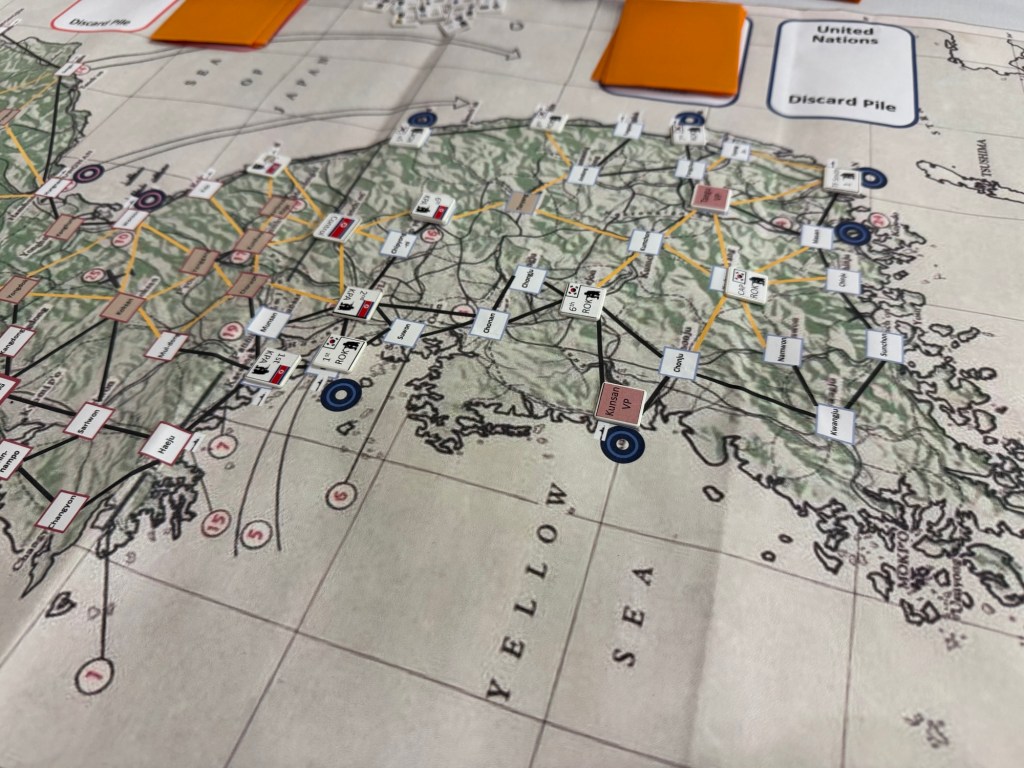
One of the things that I liked was the addition of new Divisional Displays which hold the strength points and assets of each division. The player will track the strength points as they are lost and gained but also will keep track of their reserves which is a new concept. Reserves can be used to force a reroll of your opponents dice during combat or to reroll your dice. The reserves are created by reducing the division’s strength points by 1. There are also tank counters that are attached to units, particularly the North Korean units at the start of the game which add a single strength point but also cause the defender to retreat after being attacked regardless of outcome. Both of these additions are very nice changes.
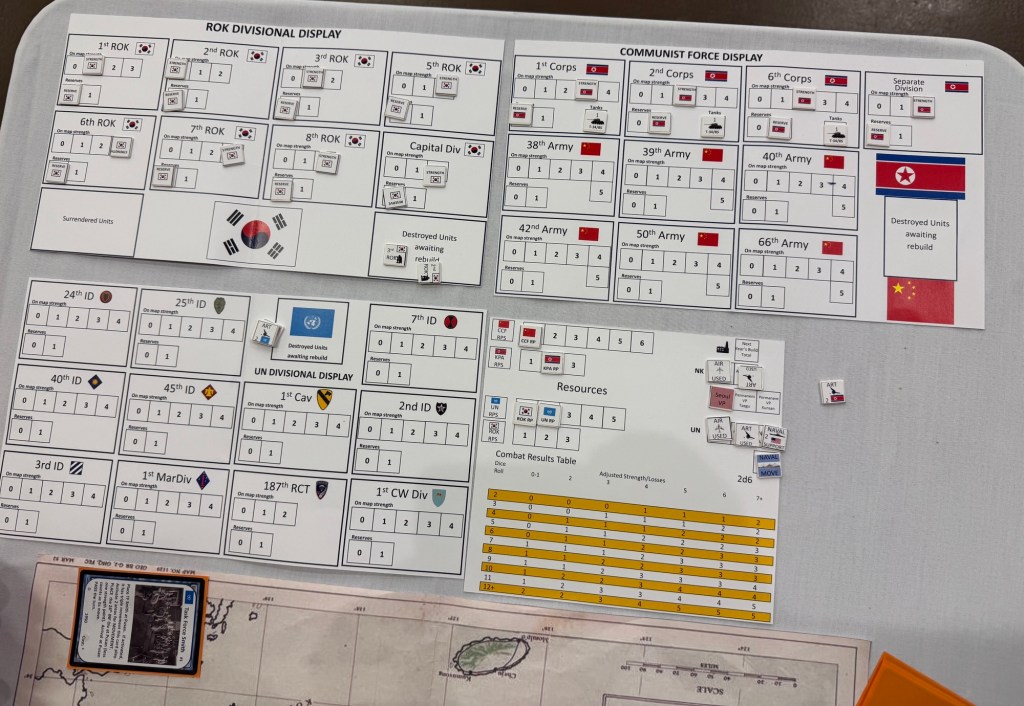
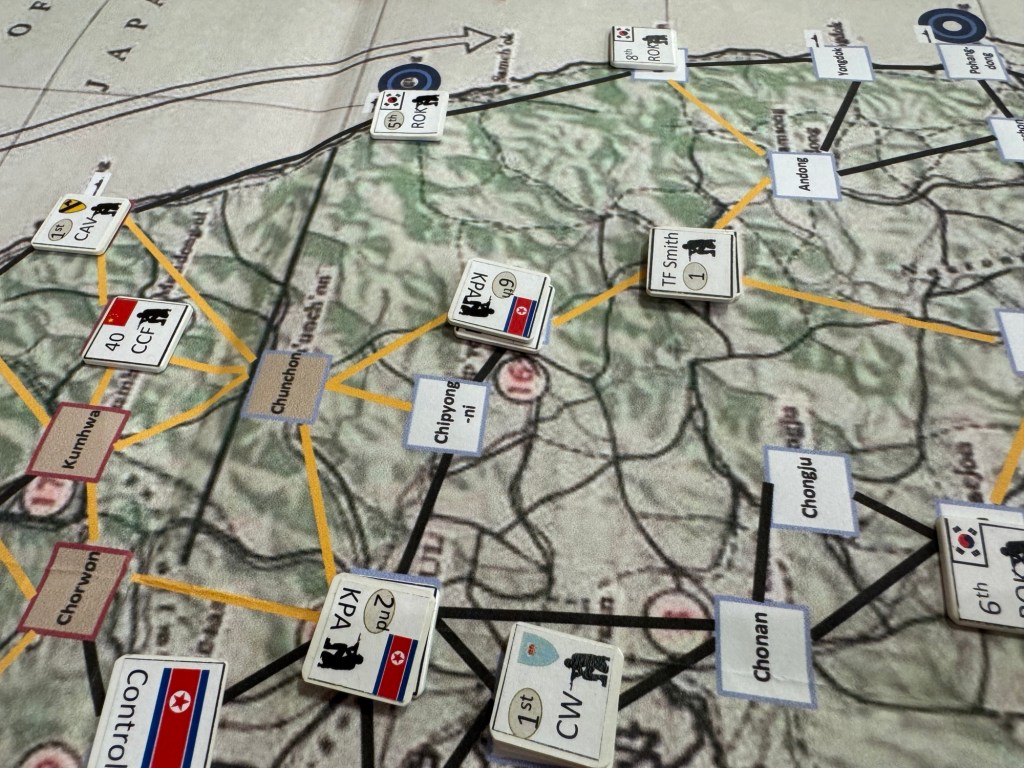
Greg and I played for the first 2 years of the war including 1950 and 1951 and I was able to break his units and destroy several American divisions. But the real thorn in Greg’s side was my 6th KPA unit who was dug in and just wouldn’t die. I was able to continually feed them reinforcements and their combat rolls were amazing inflicting 2-3 losses on the UN forces while taking no more than 1 loss. Such an interesting system and I very glad that I was able to play it.
Next up was a game of Baltic Empires from GMT Games. Baltic Empires covers the tumultuous period in the Baltic region from the collapse of the Teutonic Order in 1558 to the end of the Great Northern War in 1721. The game really focuses on representing both the mercantilist economic thinking of the time, the very limited resources at hand on the state/ruler level and the destructive nature of warfare and its effects on the local economy. When war occurs in spaces infrastructure can be destroyed and it is very expensive to keep replacing units that just die on the battlefield.
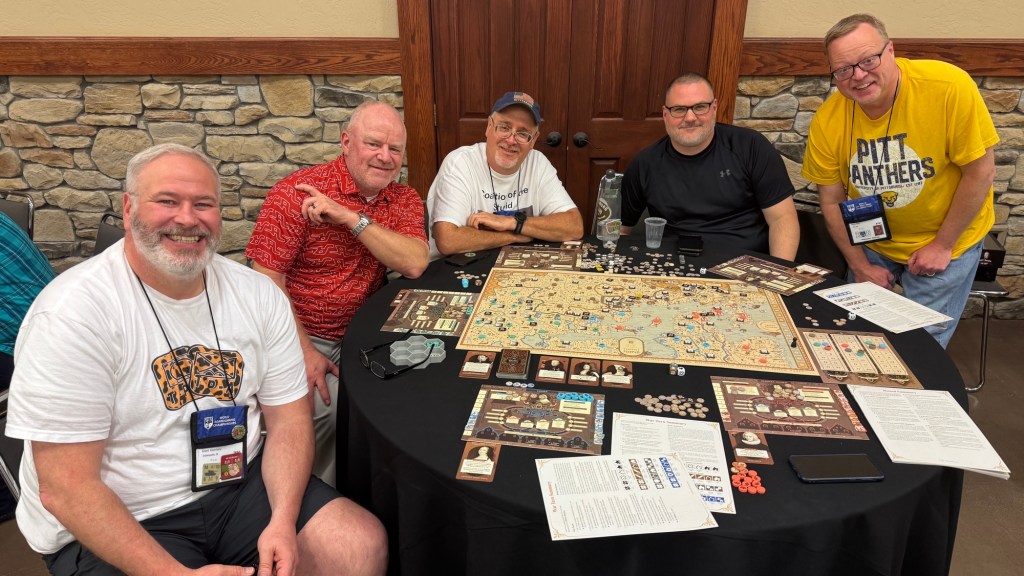
The game has 5 factions including Denmark-Norway, Sweden, Poland-Lithuania, Prussia-Brandenburg and Russia. Each power has 2 common victory conditions and 1 or 2 that are specific to that power. The shared victory conditions are either control of 2 custom houses or being the hegemon on all 3 tracks at the same time.
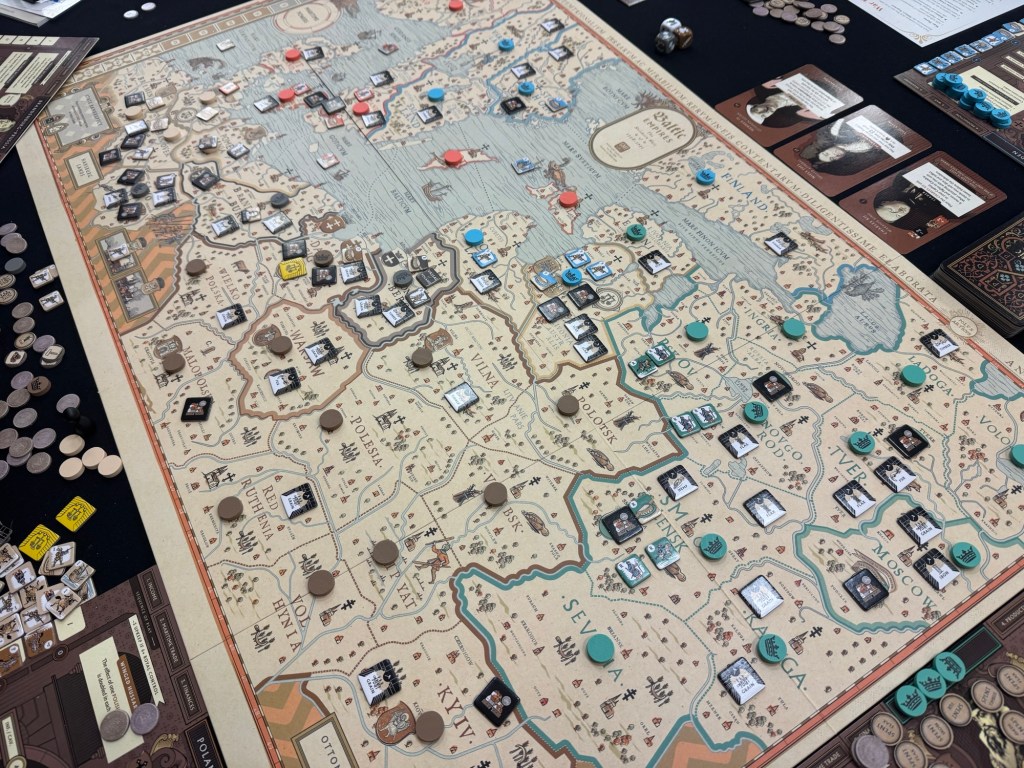
One of my favorite parts was that each turn, 5 Dramatis Personae Cards are randomly drawn from the deck and become available for purchase by the players in the Production phase. These cards have a wide variety of effects, but can be broadly divided into 4 types: those that have permanent effects, those that have one-time effects, those that affect victory conditions and those that provide a special leader unit.
These cards are excellent fun and really create somewhat of a race to purchase the best cards before others can acquire them.

I loved the game and was doing quite well with Sweden as I had captured Riga and Kurland in the Baltics and had built up quite the nice economic engine.
The economic system is simple, but manages to capture a lot of key elements of this period. Each province has between 0 and 3 resource icons and between 0 and 2 city icons. If a workshop marker is present on a resource icon the province produces 1 of that type of resource and if a city marker is present on a city icon the province produces 1 thaler (the currency of the game). There is one twist though, as provinces under noble control will contribute a maximum of 1 of the resources and 1 of the thalers produced in it to the central administration while the rest is discarded as it goes into the coffers of the local nobility. Only provinces where royal control has been imposed will contribute their full income to the player. In addition to this there are 3 trade center provinces on the map, and these generate extra income for their controlling player as they are able to tax the trade there. Just a great little game that I hope to explore further later.
My final game of the evening was a look at The Emperor’s Voice and The Emperor’s Choice coming to Kickstarter soon from Worthington Publishing. I was able to sit down with Wes Crawford to play his game The Emperor’s Voice which covers midnight until noon on August 15, 1945 when an attempted Army coup occurred against the Emperor of Japan in order to stop the surrender. The Emperor’s Choice is about the week leading up to the attempted coup, where the Imperial Cabinet debated over the issues concerning the ultimate decision by the Emperor to surrender. The two games may be joined together to create one longer legacy game that may be played in about two hours, although each may be played separately as a complete game, too.

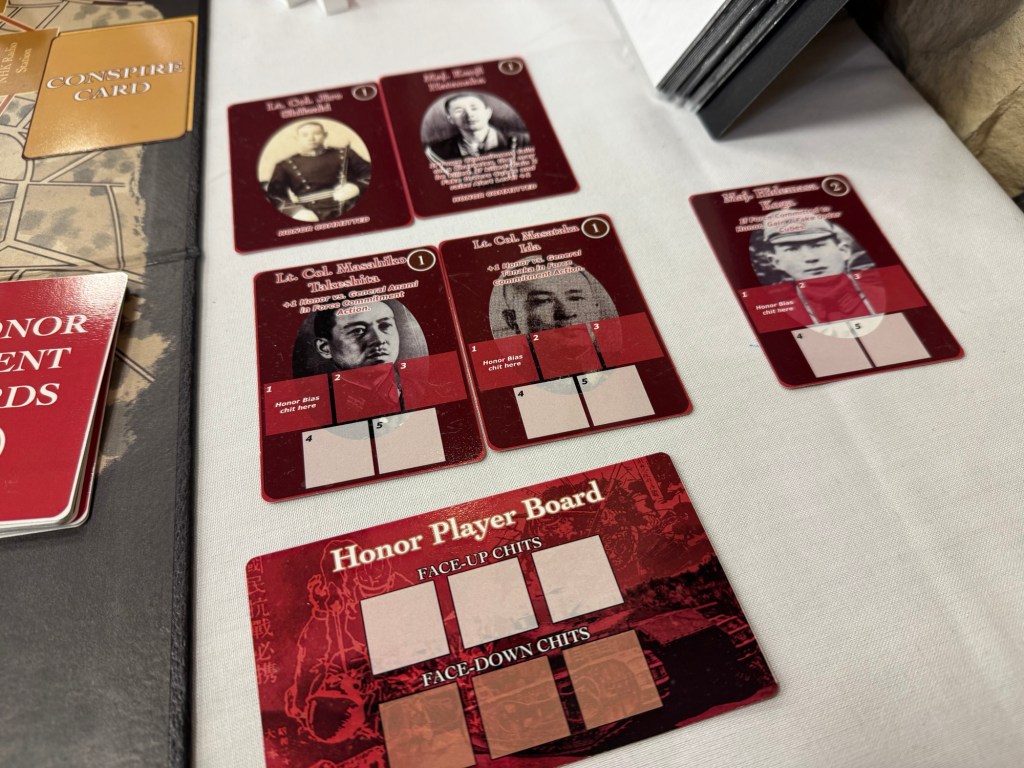
I played The Emperor’s Voice as the Honor player who is trying to convince the Emperor to call off the surrender. The game is played with each player having a set type of action cards with things like move, plot, force commit, attack and persuade. Each of these actions is used to move into position to influence key figures and generals to sway them to your side with the draw of random chits and event cards to overcome your opponents total influence of the figures.
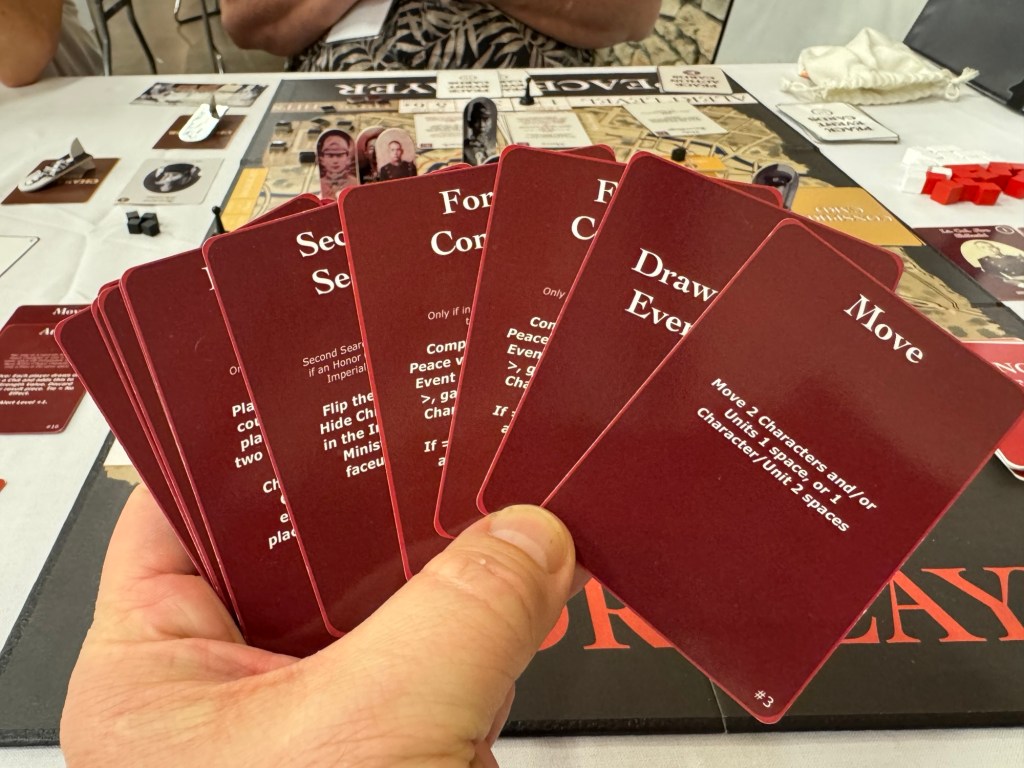
It’s all very tense and planning is key as you only have a few turns of 4-5 card plays to sway the generals, find the recording to destroy it, pressure the emperor and take out resistance against you. It all works well to create a very interesting and thematic game. I was able to win the game by convincing several of the key generals to my side and then successfully moved the emperor. I ended with 11 total cubes or VP’s to 5 for Wes.
I also played 1 round of The Emperors Choice where players are moving 1 of 6 issues up a track to their side to score VP’s and to gain special abilities from the won issues to assist in their next turn.
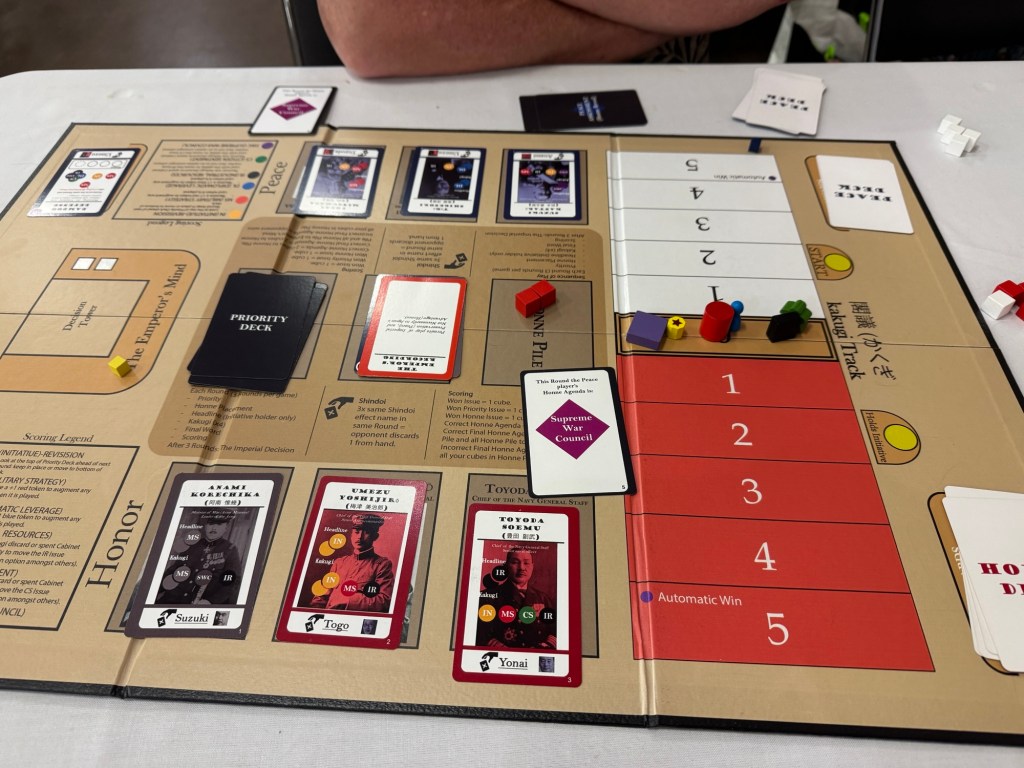
Both are great fun and will be coming to Kickstarter in the 4th quarter.
I had a great time today and got in a total of 5 games. I’m a bit beat and my mind is mush but I’m really looking forward to tomorrow as we have a full 6-player game of Imperial Elegy from VUCA Simulations planned and a look at an upcoming WWI aerial dogfight game called Above the Trenches from Flying Pig Games.
See you tomorrow night!
-Grant


Thanks for this report Grant despite exhaustion you must feel. I am going to very soon play Baltic Empires and really looking forward to it!
LikeLiked by 1 person
Another great report! Baltic Empires and Imperial Elegy on back-to-back days. Surely one of those two will be the game of the year. Very interested to hear your preference between those two.
LikeLiked by 1 person
Sounds like you had a great day!
The Baltic Empires map looks very period-appropriate, but also pretty busy. Is it easy to distinguish between the important pieces of information and the purely decorative parts during the game?
LikeLiked by 1 person
It’s beautiful but I think everyone felt it’s hard to distinguish key features on the board. Borders, colors and the like. .
LikeLiked by 1 person