We met Akar Bharadvaj while attending SDHistCon in 2023 and played his award winning design Tyranny of Blood: India’s Caste System Under British Colonialism, 1750-1947 and very much enjoyed the experience and talking with him about game design. Since that time, he has been working on another designer called Chalice of Poison: The Iran-Iraq War, 1980-1988 from GMT Games, which was announced in March on their P500. Chalice of Poison is the first volume in a new series that models complex conflicts not only as clashes between adversaries in the air, land, and sea, but also as political struggles within the regimes and military forces fighting it. We reached out to Akar and he was more than willing to share.
*Keep in mind that the design is still undergoing playtesting and development and that any details or component pictures shared in this interview are for prototype purposes and will definitely change prior to final publication as they enter the art department.

Grant: Akar welcome to our blog. First off please tell us a little about yourself. What are your hobbies? What’s your day job?
Akar: Thanks, Alex and Grant! It’s great to be here. I live in sunny Arlington, Virginia, just across the river from our nation’s capital. Besides board games, I enjoy travel, museums, graphic design, bad movies, comedy shows, and nice meals. As for my day job, I work as professional wargame designer. I work on teams that make analytic games and tabletop exercises to help policymakers think through challenging issues related to international relations. That said, Chalice of Poison is solely a personal project, and does not reflect my day job or the views of my employer.
Grant: What motivated you to break into game design? What have you enjoyed most about the experience thus far?
Akar: I’ve always enjoyed board games since I was a kid, and have gotten into historical games in the last 15 years or so. I flirted with the idea of designing my own for years, but then I actually decided to design one in 2020 when I heard about the Zenobia Award, which is a competition and mentorship program for historical games on underrepresented topics. I was looking for a good project to distract me from the ongoing pandemic, so I entered the contest on a lark, not expecting it to go anywhere. But Zenobia did a great job of helping me walk gradually through the game design process, and before I knew it, I was hooked. When the award project finished, I learned that I had won first place. But more importantly, I had discovered a new passion.
My two favorite things about game design are the creative process and the people. I find the creative process immensely satisfying. I get to analyze systems, experiment, and iteratively solve problems and improve a process, and there’s few consequences to failing! If I find that a design doesn’t work, I can just move on to another one, and hopefully return at some point in the future. It’s a beautiful process, and one that actually feels a lot like playing a game.
I also love the people I’ve met through game design. I’ve made lots of designer friends through various cons, and it’s always a delight playing games with them, talking about game design, and just chatting. I always leave cons full of inspiration and ideas, and it’s largely due to all the great people in this field.
Grant: What was it like winning the 2021 Zenobia Award for Tyranny of Blood? Where does this game stand at the present time?
Akar: Winning the award was one of the greatest moments of my life. As I mentioned earlier, I started designing the game just to see what it was like, and I didn’t expect it to go anywhere. (If I knew there would eventually be interest, I would’ve designed a simpler game as my first one!) So, I was pleasantly surprised when I learned that I won, and was excited at how much interest it received.
For those who do not know, Tyranny of Blood is about changes to the Indian social structure under British colonialism, through the lens of the caste system. I designed a fully playable game during the Zenobia Award process, but like so many first designs, it had a bit of a “kitchen sink” approach, and had far too many layers placed on top of each other.
I realized that the game had lots of great elements, but it had some flaws at its core, and so I needed to redesign lots of it. The topic is a difficult one, both ethically and in terms of complexity, so I needed to get the game right to do justice to the subject matter and avoid creating something offensive. On top of all that, the rapid prototyping during the Zenobia process left me exhausted (in a good way). So, I decided to take a break from it, and work on other games in the meantime to improve my game design skills before I can return to Tyranny. Now that Chalice is in development, I can return to that project. That said, it’s been a while, so I need to read through my notes and remember all the nuances of the topic.
While attending SDHistCon in November 2023, we played Tyranny of Blood with Akar and had a great time. We shot the following video interview at the time and you can watch that at the following link:
Grant: What is your upcoming game Chalice of Poison about?
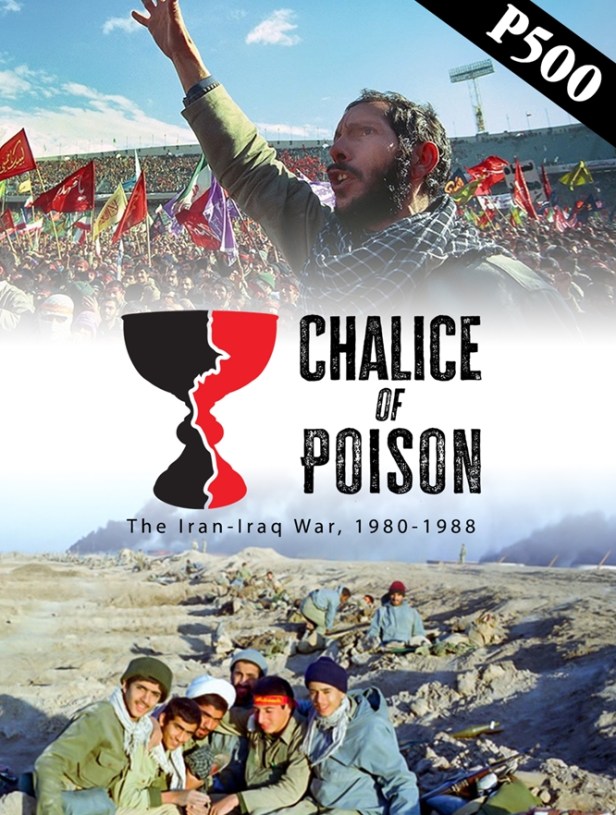
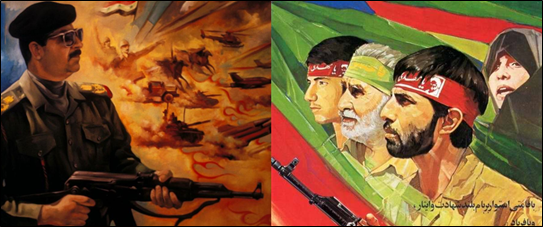
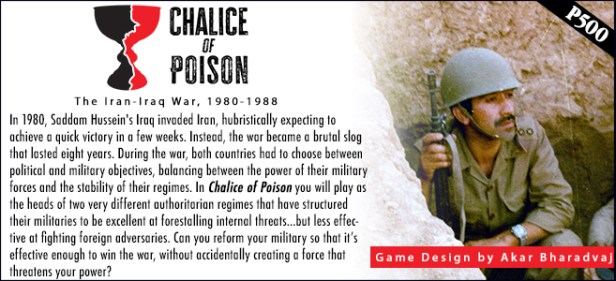
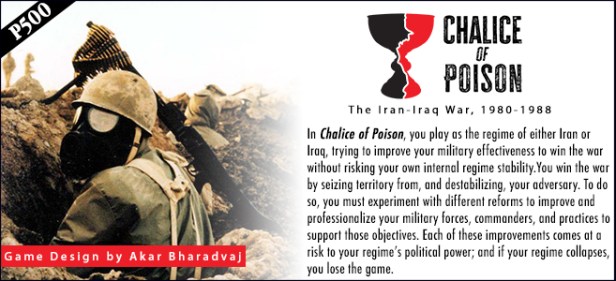
Akar: Chalice of Poison is about the Iran-Iraq War, which took place in the 1980’s. The game focuses on the interplay between external conflict and internal regime stability. You play as one of the two countries, and you are trying to improve your military effectiveness so that you can win the war, without making your military so effective that it becomes a threat to your own regime. Players can win the game if they capture certain objectives in the war, or they can lose if their regime collapses due to political challenges.
The actual combat resolution and prosecution of the war is only one part of the game; the other part is managing your regime and ensuring it does not fall to internal threats, whether that be generals who instigate a coup d’etat or dissident groups fighting against your government.
Grant: What should the name convey to players about the history of the Iran-Iraq War?
Akar: The phrase “chalice of poison” comes from a quote from Iran’s then-Supreme Leader Ayatollah Ruhollah Khomeini. When he signed the ceasefire agreement in 1988 that ended the war, without any major concessions despite all the bloodshed, he described it as “more deadly than drinking from a chalice of poison.”
Additionally, I found the evocative phrase to be an appropriate name for a game about accepting risk and making sacrifices to achieve objectives. The game is full of hard decisions that seem enticing at first, but end up doing internal damage.
On a lighter note, ever since Tyranny of Blood, I’ve been trying to give each of my designs a name that sounds like a heavy metal album.
“Taking this decision is more deadly than drinking from a chalice of poison.”
~ Ayatollah Khomeini, on accepting the ceasefire that ended the Iran-Iraq War
Grant: What is the new series called? What type of games might be included?
Akar: I haven’t been able to find that perfect name yet, despite coming up with a long list of ideas. So, the series doesn’t yet have a name. If anyone has an idea, I would love to hear them! Please sound off in the comments.
The system best models historical conflicts where major dynamic changes occurred within the halls of state power and the military command structure, rather than with territorial exchanges on the battlefield. So, future games in the series could model other conflicts where weak states fought each other while dealing with significant internal tensions. There are no shortage of those throughout history, from the modern Middle East to 1960’s Vietnam to Ancient Rome.
Grant: What games have you used as inspiration for your design?
Akar: I tend to prefer historical games that include strong political dynamics over straightforward wargames. So, a major point of inspiration has been the Great Statesmen Series, to include Congress of Vienna, Versailles 1919, and Churchill. Those games do an excellent job of demonstrating the interplay between peace negotiations and warfare, and it inspired a lot of the ideas I had about war being played in two phases, and how the two interact with each other. Instead of the connection between fighting war and negotiating peace, I focused on the connection between fighting war and improving military effectiveness. From a purely user experience perspective, I enjoy the tactile feel of placing cubes on cards that was in Versailles 1919, and the mechanic seemed to work well in this game.
Additionally, the war mechanics are loosely based on the States of Siege Series, though with a lot of complexity added. That system offers a simple push-pull model for combat, which I employed for a 2-player tug-of-war. I needed a fairly simple mechanism at the core, so that I could layer many other mechanics on top of it without overwhelming players.
Lastly, one of the solitaire modes is inspired by Mark Herman’s Peloponnesian War, a genius solitaire game where players face off against a bot, but if they begin to defeat the bot by too much, they then switch sides and have to fight against everything they set up in previous turns.
Grant: How have you used and followed the academic research of Dr. Caitlin Talmadge?
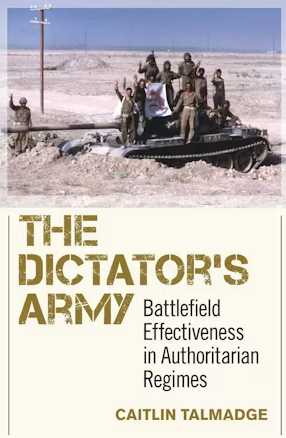
Akar: Dr. Talmadge’s 2015 book The Dictator’s Army explores the question of why some authoritarian regimes, especially so-called “strongman regimes,” are ironically so bad at fighting war. Her research delves deeply into 2 case studies: Iran versus Iraq, and North versus South Vietnam.
Her argument is that the factors that reduce the threat of coups also reduce military effectiveness at fighting adversaries. The ideal military promotes based on merit, trains troops robustly, incentivizes open and honest communication, and empowers junior officers to improvise within reason. Conversely, strongman regimes tend to do the opposite: promoting based on sycophancy, avoiding training, incentivizing lies and secrecy, and making all decisions through an inefficient centralized command structure. These traits help dictators feel more secure, but they make militaries less flexible to deal with changing circumstances.
This argument underpins the core argument of Chalice of Poison. The main thrust of the game is reforming your military to improve each of those four factors, but at a cost to your own political power.
Grant: What is important to model or include in a game about the Iran-Iraq War?
Akar; A game on the Iran-Iraq War needs to provide a very specific incentive structure, by which players feel the hubris of thinking a quick victory is possible, but also a deep sense of desperation when things go poorly. It also requires mechanics for dealing with internal stability within each country, and being able to affect stability in the adversary’s country. Lastly, such a game must afford players the latitude to take a wide variety of actions; the story of the Iran-Iraq War is two countries quickly falling into a stalemate, and then experimenting with a large number of strategies and unsavory steps to break the stalemate and achieve victory.
Grant: What challenges did you encounter in the design? How have you overcome them?
Akar: I had to design the game carefully to reflect some misperceptions that the actual historical figures had. We know now that the Iran-Iraq War was an enormous catastrophe for both countries, but the game had to give players some false hope that the game could end at any turn. As such, I had to implement a variable game length, with victory conditions that contract as the game progresses. I had to pace the game well so that players always feel like they’re on the verge of victory (or collapse), and I think the game is nearly there.
The early iterations for the game were very mathy, with a lot of dice roll modifiers and additions to provide bonuses for military reform. It wound up not being fun; either players would have their eyes glaze over due to the excessive math, or they would try to calculate every little decision and descend into analysis paralysis. Instead, I replaced all the bonuses with card play mechanisms, which thematically worked, because it gave players more flexibility to deal with bad situations. I replaced most of the math with a simple card color-matching system.
The game has a unique action costing system that requires players to push their luck, carefully budgeting their political power or else risk losing it all (and the game). I learned that most players instinctually spend their full action allotment, so if I give them 10 points, they want to spend 10 points! So, I had to add in some “brakes” to stop new players from losing the game immediately.
I had 2 additional in-game challenges that I needed to solve. One was how to depict the more unsavory aspects of the conflict, such as chemical weapons and human wave attacks, which were historical atrocities, but necessary to tell the story of this conflict. Typically, a game would have a penalty or cost for doing such things, but in the actual historical case, neither country actually suffered a penalty for these actions until well after the war. Additionally, I needed to balance the game a bit more, to give the losing side a chance. I quickly realized that both of these challenges could actually solve each other. I created a “Desperate Measures” mechanic that allows the losing side to catch up a bit, but at a moral cost.
Grant: What is the scale of the game? Force structure of units?
Akar: The game plays at the political and strategic level, so it is pretty abstract. It models the conflict along up to six fronts: the air, three or four different ground fronts, and the naval front. Each one has an abstracted military strength represented by zero to six wooden chevrons. Each side has one air force, one navy, and three different ground forces: the elite guard, the regular army, and the paramilitary. Each of these five forces has a commander in charge of it. That is as complex as the game’s force structure gets; it does not model more specific units or officer ranks.
Grant: What is each player’s overall goal in the game? What does this mean?
Akar: Each player is trying to win the war while preserving their regime.
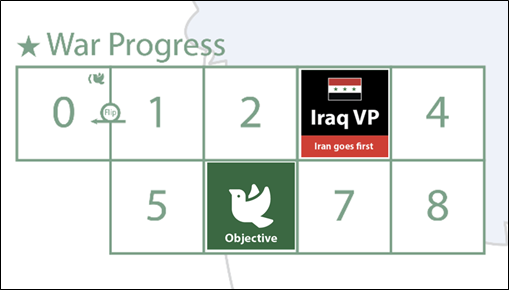
Winning the war means capturing a certain amount of territory. Most spaces on the map contain stars representing the relative importance of that space. A player advances on the War Progress Track one space for each star captured. Additionally, the War Progress Track includes an Objective counter that starts at 10, but decreases as the game goes on, representing war-weariness and a reduction in expectations for what players define as “victory.” If a player’s War Progress meets or exceeds the current Objective, that player wins the war (and the game). Of note, a player can potentially win even with zero points, which reflects what happened in real life.
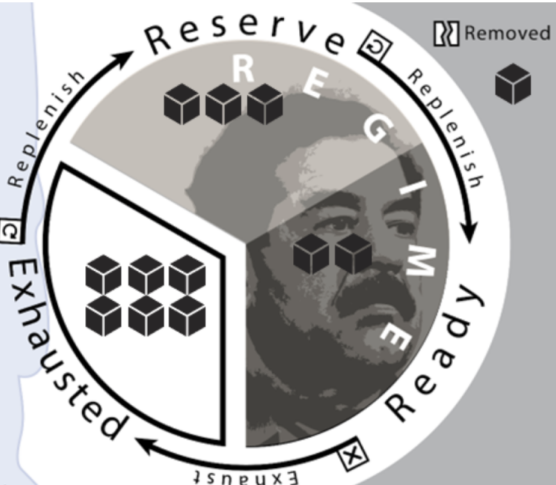
Preserving the regime means holding onto political power cubes within the Regime pool on the board. If the Regime pool has zero cubes in it, the player’s regime falls and that player loses. Cubes move out of the Regime pool when players reform their military, improve their commanders, face problems with dissidents, or fight against a coup d’etat. The fewer cubes in the Regime pool, the higher the risk of internal problems erupting.
Grant: How do players go about developing a professional army that values competence and skill?
Akar: Players start with a “coup-proof” military that is pretty ineffective at fighting, but they can expend political power, and thereby accepting risk to their regimes, to make reforms.
Grant: What actions are available to players to reform their military?
Akar: Players have four major actions they can take. They can coordinate to allow commanders to communicate openly with each other and their underlings, empower their forces in the field to make decisions for themselves, promote commanders based on competence instead of personal loyalty or family ties, and train existing commanders to be better at fighting. Each of these actions has four different levels; players can upgrade the actions to improve their effectiveness, but at a cost of political power.
Grant: What are the costs of this process? How do players manage these threats?
Akar: The costs of each action comes in political power cubes. Each action starts at level zero, which does not cost anything, but is not very useful. Players can make reforms, which essentially upgrades each of these actions one step at a time, up to level four. Upgrading to a higher level requires placing that number of cubes on that card. Actually taking actions usually has an additional cost in power cubes.
Players need to “push their luck” to best achieve reforms gradually. Doing too much too fast is a recipe for disaster. Players can spend a large number of cubes each turn, but they will not necessarily get them all back at the end of the turn. Reforming too quickly can threaten regime stability. To protect against these threats, players will need to go slow, keeping enough political power behind to stabilize their regimes, but inaction can also be risky if it means losing the war.
Grant: What is the Turn Sequence?
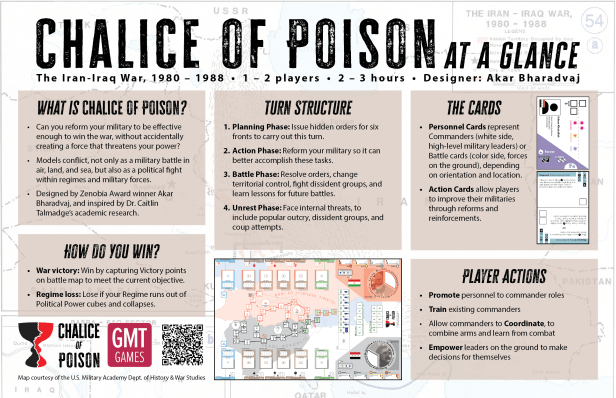
Akar: The game has up to 9 turns, each representing a year from 1980 to 1988. Each turn has 4 phases:
- In the Planning Phase, players issue hidden orders for six fronts to carry out this turn.
- In the Action Phase, players reform their militaries so that they can improve the likelihood that these orders are successful.
- In the Battle Phase, players resolve orders, change territorial control, fight dissident groups, and learn lessons for future battles.
- Finally, in the Unrest Phase, players face internal threats, to include popular outcry, dissident groups, and coup attempts.
Grant: How are hidden orders issued?
Akar: Each front has a space for an order tile, which players place face-down during the Planning Phase, so that they are secret from the other player. Each order tile has four options, which are chosen by how players rotate their tile:
- Attack allows players to start a battle against the adversary, and to advance into their territory if they have a stronger force after the battle.
- Defend allows players to fight against an attacker at an advantage, and to bring in a small amount of reinforcements, but does not permit advancement.
- Subjugate (Air and Ground only) allows players to fight a battle against dissidents.
- Attack Tankers (Navy only) allows players to threaten the adversary’s political power.
- Regroup allows players to bring in a large amount of reinforcements, but not to fight in any battle that occurs.
Air and Naval forces have one order tiles each, but Ground forces have three different order tiles, representing the three different ground forces in the game: the Guard, Regular Army, and Paramilitary. The more elite the ground force, the earlier it gets to execute its order and deal damage, which gives it a slight advantage in combat.
Grant: How is combat handled?
Akar: Combat strength is a function of 3 different factors:
- The Order tile, which represents orders from on high, determines whether a battle occurs, and if it does, which order the forces use to deal damage.
- The Commander card, which represents high-level military leadership, determines the damage the front will do that turn. Each commander has a hit value for each of three battle suits: Fervor, Discipline, and Leadership.
- The Battle card, which represents forces in the field, determines which suit on the Commander is used to deal hits on the opposing force. A new Battle card is drawn during each battle.
For each hit defined in the previous step, players remove one military strength, represented by wooden chevrons, from that front. If an attacking front is stronger than the opposing front, it may advance and capture enemy territory, for some bonuses.
In each battle where one side deals more damage than the other, the active Commander learns a lesson about how to fight, which changes his stats. Of note, not every lesson is a good one; some lessons can actually make the Commanders worse at fighting; for instance, if it makes them complacent or arrogant.
Grant: What elements of unrest confront the players? How do they handle these challenges?
Akar: Unrest comes in 3 forms, during the Unrest phase:
- Public outcry occurs if a player does not attack in a given turn. This removes a political power cube from the game.
- Dissidents represent groups that threaten the regime’s power. The strongest dissident group on the map each turn has a massive negative effect, the second strongest has a moderate penalty, and the other three have a slight penalty. If left unchecked, the dissident groups can cause major chaos, but any troops dedicated to fighting dissidents are necessarily not fighting the adversary, so balance is important.
- Coup attempts may break out if a commander has more political support than the regime. Each commander has a number of cubes on the card, which corresponds to his risk to the regime and typically corresponds with his competence. If a commander (or a group of commanders allowed to coordinate) has more cubes than the regime, a coup attempt may break out, and then the player will have to fight battles against the rebellious commander(s).
Grant: How does the design use cards?
Akar: The game has 4 types of cards:
Action cards allow players to choose from among four different military changes each turn, as listed above. Players can “reform” or upgrade these actions to have more of an effect, at the cost of political power.
Personnel cards represent the major figures involved in the conflict. They are dual use cards:
- When horizontal, they are Commander cards, meaning that the person on the card now Commands forces. These Commanders each have different strengths across three suits (discipline, fervor, and leadership), which dictate how much damage they do each turn.
- When vertical, they are Battle cards, meaning that they are forces in the field who are actually fighting the enemy. Battle cards dictate which suit on the Commander deals damage in a given fight.
- Dissident cards represent the negative penalties from the five dissident groups that are in the game. Each turn, during the Unrest phase, players draw one of these cards, which determines what effect they have. The strongest dissident group this turn has a major penalty, the second-strongest has a moderate penalty, and the other three groups have a small penalty.
Grant: What is the layout of the board? What do the point to point tracks represent?
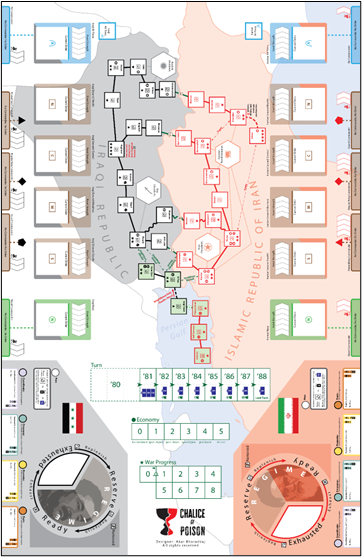
Akar: The War Map is a point-to-point map, which was a necessary design choice because the terrain along the Iran-Iraq border only allows approaches through specific narrow corridors, to avoid marshes, mountains, and other rough terrain. Additionally, the amount of land that each side managed to capture in the war was miniscule, so having a map to scale made little sense.
The map has different squares representing ground territory and sea locations. Black squares are Iraqi-controlled at game start, and red ones are Iranian-controlled. Each space has icons: stars are Victory Points, representing strategically and symbolically important areas; circles are Economy, representing oil infrastructure and sea lanes, and hexagons show the presence of dissident groups.
Beyond the map is a series of tracks representing the current turn, the strength of each country’s economy, and the current war progress (i.e., the winning side’s victory points and current objective).
Additionally, each side of the board has an area to show each regime’s current political power and active military commanders.
Grant: How is victory achieved?
Akar: The most important spaces on the board have stars on them, which represent victory points. Every time a side captures a starred space, the War Progress counter advances that many spaces. (Of note: this value is zero-sum, so only the War Progress of the winning side is marked; if the winning side flips, the counter flips to show that the other side is winning.)
Additionally, an Objective counter, marked with a dove, represents the current victory condition. The game begins with the Iraqi side having maximalist objectives, but as the game progresses, each side is willing to scale down their goals and definition of “victory.” So, the Objective counter moves left each turn, and additionally moves due to player actions.
If the War Progress counter ever meets or exceeds the Objective marker at the end of the Battle Phase, the game ends and that side is the winner! Of note, a side can even win with zero victory points, which probably was the real-world historical outcome.
Additionally, if a side ever runs out of Political Power cubes from their pool at the end of the Unrest Phase, that regime collapses and loses the game. If the other side still has cubes, then they win the game! If both regimes collapse on the same turn, then both players lose and Henry Kissinger wins the game.
Grant: What do you feel the game models well?
Akar: The game does a great job of building tension, fostering an alternating sense of hubris and desperation, and encouraging experimentation through trying different combinations of actions until one comes out ahead. All of these factors were present in the actual history, so I am excited that the game design reflects these traits.
Grant: What are you most pleased about with the design?
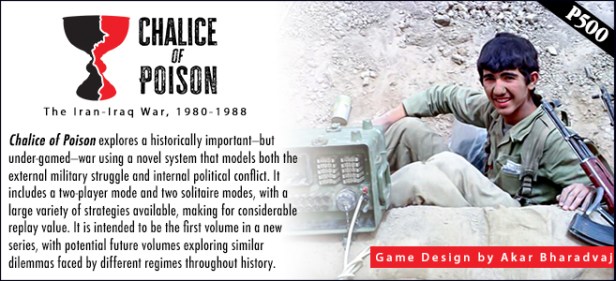
Akar: I am pleased about the game’s originality. I don’t know of another game that shows the competing priorities of internal political stability and external military effectiveness quite in this way. I would be most excited if I (and eventually, other designers) could employ this system to explore other conflicts through history, or perhaps even outside of history.
Grant: What other designs are you contemplating or already working on?
Akar: As I mentioned earlier, I’m hoping to return to Tyranny of Blood, my game about the Indian caste system, and finally finish it. This one is the furthest along, but I have other games that I’m in the early stages of designing.
I’m hoping to adapt the Chalice of Poison system for a 3-4 game about the Vietnam War, tentatively called Riding the Tiger. My idea so far is to add some more asymmetry to the system. The South Vietnam player will likely play similarly to the two sides in Chalice, as an unstable strongman regime prone to coup attempts. The United States player will not face coup attempts, but will have to deal with popular support and an election every four turns. The North Vietnam player will have to manage its politburo, attempting to exert influence over the southern revolutionaries and balance between its Chinese and Soviet patrons (and their competing priorities for Vietnam).
I have another game concept, tentatively called Iron and Cardboard, about intra-alliance dynamics and competition among the Warsaw Pact nations as they rebuild from the destruction of WWII under Soviet domination.
Lastly, I have a concept called Pillars of Fire about competition and conflict among Iran, Iraq, and Saudi Arabia from 1979 to 1991. It will be asymmetrical, based on the 3 different systems of government (revolutionary theocracy, strongman dictatorship, and conservative monarchy), which will vie for dominance of the region. Chalice actually began as the military module of Pillars before it took on a life of its own, but I think the grand strategy of this rivalry is worth exploring in its own game.
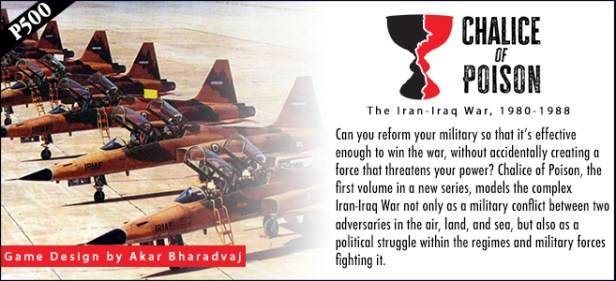
If you are interested in Chalice of Poison: The Iran-Iraq War, 1980-1988, you can pre-order a copy for $69.00 from the GMT Games website at the following link: https://www.gmtgames.com/p-1225-chalice-of-poison-the-iran-iraq-war-1980-1988.aspx
-Grant


Thats an interesting topic, and an interesting approach
LikeLiked by 1 person
I wonder if there is an east front game here?
The Russians professionalised, but the Germans went the other way.
LikeLiked by 1 person
Haha, excellent. Can’t wait to see more of these. Riding the Tiger, Pillars of Fire, and Iron and Cardboard all sound interesting.
LikeLiked by 1 person