While attending Buckeye Game Fest in spring 2024, we met with a new designer named John Lapham. John had with him a new game called A More Perfect Union and we got a chance to play the game and chat about it with him. A More Perfect Union is a 2-player card driven game that simulates the public debate over the ratification of the Constitution that took place across the United States from 1787-1789. The game uses the same system as Twilight Struggle and 1960: The Making of the President but felt very fresh and unique to the situation. Catastrophe Games is planning a Kickstarter campaign in the near future and we reached out to John to see about getting some more insight into the design and he was more than willing to share.
If you are interested in A More Perfect Union: The Struggle to Ratify the Constitution, you can back the project on the Kickstarter page at the following link: https://www.kickstarter.com/projects/campaign-fall-blau/a-more-perfect-union-a-game-about-the-us-constitution?
Grant: John welcome to our blog. First off please tell us a little about yourself. What are your hobbies? What’s your day job?
John: Thanks so much for having me, Grant. My main hobbies will surprise no one – gaming and history. I also enjoy hiking, cooking, and theater. As for my day job, that is in the past. I’m retired now. Before that, I had jobs in both the legal and educational professions.
Grant: What motivated you to break into game design? What have you enjoyed most about the experience thus far?
John: I wanted a game on this topic and no one else seemed willing to oblige me—although Jason Matthews and Christian Leonhard came close with Founding Fathers. I enjoyed the beginning and end of the experience. I love historical research and pondering messy interpretive narratives and historical hypotheticals. So, I was not surprised by how much I enjoyed the front end of the design process. What surprised me was how much I enjoyed the collaboration that occurred near the end of the project, and the practical and artistic challenges of turning an idea into an actual, physical game. I had no experience with that process and enjoyed learning about it.

Grant: What is your upcoming game A More Perfect Union about?
John: A More Perfect Union is about the political struggle to ratify the U.S. Constitution in the thirteen states from 1787-1789. The game employs the popular card-driven mechanics of such well-known games as Twilight Struggle and 1960: The Making of the President.
Grant: Why was this a subject that drew your interest?
John: It was the subject of some of my earliest graduate school research in the late 1980’s (yeah, don’t ask, I’ve been around the block more than a few times). As a history educator, I was drawn to less well-known stories, involving people and events that popular and school histories have neglected. This is one such story, and it is an important one that has enduring relevance for understanding much of American history and our current turbulent moment.
Grant: What is your design goal with the game?
John: I had two main goals. I wanted the game to offer a window into the history of that moment and to spark interest in the topic. I also wanted it to be a fun, tense game that could be played in a couple hours but with enough complexity and variability to invite repeated plays.
Grant: What from the Constitutional Convention was most important to model?
John: Ok, that’s a hard one. I cannot give you just one. Several things were important to me.
First, I wanted the game to capture the intense war of words that occurred in the nationwide debate. America was on the leading edge of the first wave of mass media made possible by high literacy rates and the printing press. Americans of the period were highly literate, avid consumers of news, and intensely interested in politics. Ninety different newspapers and hundreds of presses across the country printed thousands of essays, letters, and pamphlets over the course of the debate.
Second, I wanted the game to capture the importance of political strategy in terms of grabbing and holding onto the initiative in the debate through the scheduling of the thirteen state conventions, as well as exploiting the momentum gained from successful outcomes in those conventions.
Third, I wanted to express the tension and uncertainty felt by the delegates during the actual conventions themselves. Delegates often went into these conventions uncertain of their outcomes.
Finally, and perhaps most importantly, I wanted players to come away with an understanding of the immense challenges faced by the new nation to come together and form a strong union that did not threaten the individual liberty that Americans prized at this time. It is in large part the work of the Anti-Federalists that delivered the country its Bill of Rights, a fact that is perhaps too often overlooked or forgotten by modern Americans.
Grant: What sources did you consult about the details of the history? What one must read source would you recommend?
John: Tremendous digital resources are available on the ratification debate thanks to the phenomenal work done by the Center for the Study of the American Constitution at the University of Wisconsin-Madison (https://csac.history.wisc.edu/). I encourage anyone interested in this topic to explore their website and the treasure trove of material available there.
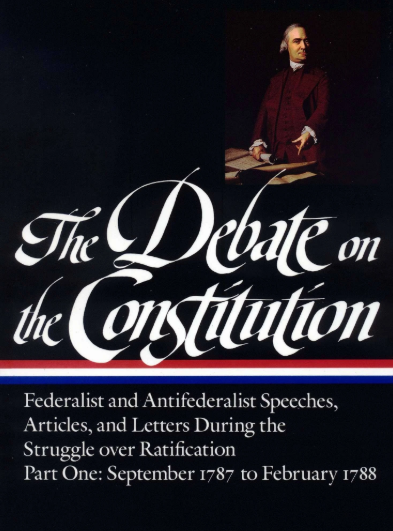
For a more curated collection of primary source material, the Library of America has published an excellent two-volume collection of many of the most important essays, speeches, newspaper articles, pamphlets, and private letters, The Debate on the Constitution, which also includes a detailed chronology and biographical information on the participants in the debates.
For a single, narrative history of the entire series of events, the best choice is Pauline Maier’s Ratification: The People Debate the Constitution, 1787-1788, published in 2010. Reading that book was the last nudge that I needed to start designing the game.
Grant: What is the goal of the game? How do players go about trying to sway States to their way of thinking?
John: Fortunately for me as a designer, the main goal of the game was set out for me in the Constitution itself, which required nine states to ratify it to become binding on those states. Thus, the Federalists win the game immediately if nine states ratify the constitution without recommended amendments, and conversely the Anti-Federalists need five state conventions to reject the Constitution to win immediately. If enough states thread the needle of compromise and ratify the Constitution with recommended amendments, then victory is determined by the weight of the states on each side of the ledger.
The primary tools to convince voters in the states are direct campaign efforts, which involve the use of the campaign points in particular states, and the play of publication events. Publication events address one of three broad sets of issues that animated the debate – commerce, states rights, and individual rights. Each state in turn has a rating that reflects how important each of those sets of issues is to its voters. As a result, the effect of a publication will be more or less, depending on the state in which it appears.
Grant: What is the layout of the board?
John: The board includes several broad features – a map of the thirteen states with a state information and holding box for each state, turn and round tracks, a convention track, a state status track, and a table of information.
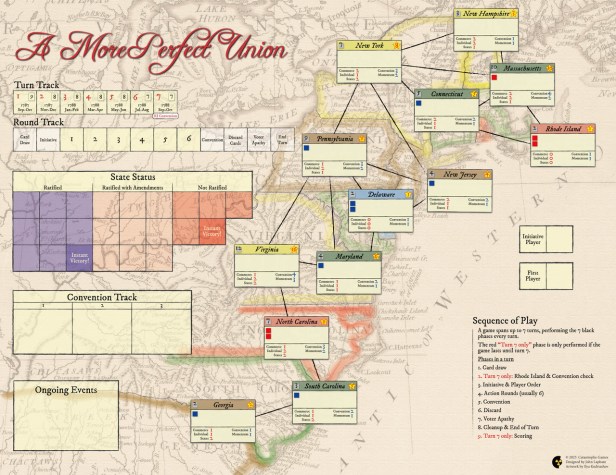
Grant: What information is contained in each State Box?
John: Each State Box has a number that reflects the maximum number of combined player cubes that can be present in the state, icons showing if either player starts with cubes in the state, numerical ratings for each of the publication issues, the convention value, and the momentum value of the state, and a spot for the state’s status marker, which shows if the state has scheduled or held its convention. Finally, the state boxes are color coded to show the section of the card deck in which the state’s convention card is seeded.
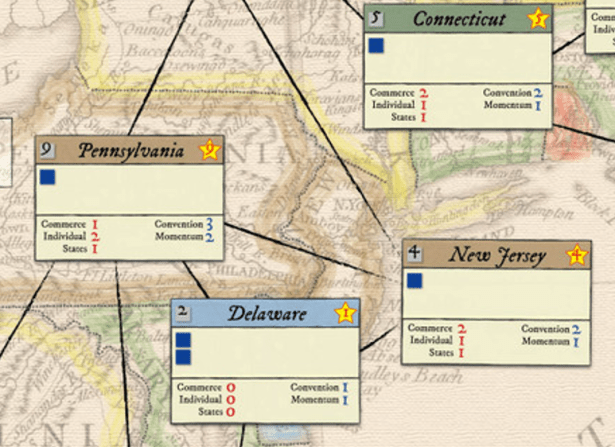
Grant: What are the 5 different words and corresponding values in these boxes mean? How are these elements connected to the cards?
John: The words “Commerce, States, and Individual” relate to the three publication issues and the numbers (0,1, or 2) next to them reflects the effect that a publication on that issue will have in the state – either adding or removing that number of player cubes in the state. The word “Convention” refers to the convention value of the state and the number next to that is the number of campaign points (CP) a player must expend either to call an early convention in the state or to attempt to take control of the State Status Marker through legislative maneuvering. The word “Momentum” refers to the campaign bonus a player will earn if they win the state’s convention.
The issues ratings connect directly to the publication event cards. The Convention ratings connect to the expenditure of CP gained from card play. The Momentum rating does not connect to the cards but instead relates to the outcome of the convention in the state.
Grant: What is the purpose of the State Factors Table and the State Issues Table?
John: This table summarizes in one place the information contained in the individual State Boxes, and it groups the states by their color codes to show players when they will draw the State Convention Cards over the course of the game.
Grant: What is the Back Room? What role does this play in the game?
John: Each player has a Back Room in which they can place a maximum of two cards. Cards in the Back Room are not part of a player’s hand, cannot be played during a player’s action round, and are not discarded at the end of the turn. Players can access the cards in their Back Room at three times – (1) during the card draw phase of each turn, when they can freely remove or add cards to the Back Room, (2) at the start of any convention, when they can remove, but not add, cards from their Back Room, and (3) during an action phase by playing a card for the sole purpose of adding or removing cards from their Back Room.
The Back Room plays two main roles in the game: (1) it provides a means by which players can hold onto powerful events that are not yet ripe to play – often convention events for conventions that will happen on a future turn, and (2) it provides a way to avoid playing a strong opponent’s event at an inopportune time.
Grant: How does the game use cards?
John: This a classic Card-Driven-Game. Each player is dealt a hand of cards each turn and plays one card each round either to spend the Campaign Points provided by the card or to implement an event described on the card.
Grant: What different types of cards are there? What is the purpose of these different types?
John: There are five different types of cards: State Convention Cards, Publication Events, Convention Events, Reaction Events, and General Events.
Each state in the game has a State Convention Card, which are mandatory events that must be played in the turn in which they are drawn. They grant the player cubes in the state and control of the State Legislature, and they schedule the state’s convention by placing the state’s status marker on the Convention Track.
Publication Events publish and distribute a publication addressing a particular issue in a particular state that and a few of its neighbors. Most of these events will specify the state in which they originate and the issue that they address. A few allow the player to pick the state and/or issue for the publication.
Convention Events can be played for their event only during a convention and will have some effect on the outcome of that convention.
Reaction Events are played in response to some other game effect.
General Events are a catch-all for any other type of event.
Grant: Can you share a few examples of cards and explain their use?
John: Sure, here is an example of a State Convention Card:
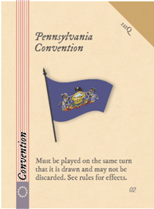
Each state has one of these cards and they all work the same way.
- These cards trigger the scheduling of State Conventions.
- They must be played on the same turn they are drawn and cannot be discarded or placed in a player’s Back Room.
- They are seeded in a particular quarter of the draw deck at the start of the game, as indicated by the colored banner in the upper right corner of the card.
- When played, you move the indicated state’s Status Marker from the map to Box 1 on the Convention Track and mark it with a cube of your color. This represents that you are in control of the state legislature and can spend CP to call an early convention in this state on a later turn. In addition, you may add or remove 2 cubes in the state.
Here is an example of a Publication Event:
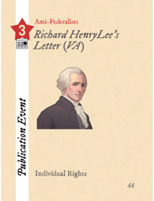
These are the most involved events in the game but like the State Convention Cards they all work the same way. So, once you’ve done it a few times, it becomes straightforward.
- The red star identifies this card as an Anti-Federalist Event.
- The “3” in the star shows that this card is worth 3 CP.
- The newspaper icon under the star shows that this card is a publication event, as do the words in the white banner running along the left side of the card.
- When played for the event, publications are distributed in a number of states equal to the CP value of the card. In this case, that means 3 states. The first state the publication must be distributed in is the state identified by the postal code in the title of the card. In this case, it must be distributed in Virginia. In addition, the publication may be distributed in two additional states that are adjacent to Virginia for a total of 3 states.
- The issue addressed by this publication is individual rights, which is indicated in text at the bottom of the card. The issue controls how many cubes the player will add or remove from each state based on that issue’s value (from 0-2) in each state. The individual rights value in Virginia, Pennsylvania, and North Carolina is 2, but it is only 1 in Maryland. That means that this publication with add or remove 2 cubes in Virginia, Pennsylvania or North Carolina, but will only add or remove only 1 cube in Maryland.
Grant: What happens if you play an opponent’s event? What type of thinking and strategy does this create?
John: Generally, the event triggers, although the player gets to decide whether the event happens before or after they use the card for campaign points. There are two ways to mitigate powerful opponent events. They can be played during the Initiative Phase of the turn to bid for initiative without triggering the event, although doing so often reduces the player’s chance of winning the initiative for the turn, which is costly in its own right. They can also be stored in the player’s Back Room for possible play on a future turn when the event might be less damaging. This too is costly as the Back Room can hold only two cards and those spaces can also be used to save your own events for a future turn when they will be more effective. Thematically, in both instances you are spending time and energy managing a potential problem rather than advancing your own agenda.
Grant: What is the general Sequence of Play?
John: Each turn has the following phases:
Card Draw – Slightly more involved than a standard CDG because each turn you can change the cards in your backroom, which is often a challenging decision.
Initiative Phase – This phase sets the initiative and the first player for the turn.
Action Phase – The heart of the game when players alternate playing cards from their hands.
Convention Phase – State Conventions are resolved or move closer to resolution.
Voter Apathy Phase – Some voters lose interest and players remove some cubes from the map.
Grant: What is a Convention and how does it work? What is the outcome of this process?
John: A Convention is when a state makes its final decision as to whether it will ratify the Constitution. Thematically, this is the moment that elected delegates meet, debate, and vote on the Constitution. To model the drama of these events, players have a final opportunity to play cards that can affect the outcome. After that, the player’s cube totals in the state are compared. If the Federalists have the most cubes, the state ratifies the Constitution. If the Antifederalists have the most, the state does not ratify. If the two factions have an equal number of cubes, the state ratifies with recommended amendments.
Grant: How does Campaigning work?
John: Each state has a set number of voters. This number puts a cap on the number of combined player cubes that may be placed in that state. Players can think of it this way: the voters in each state can have one of three states of mind – undecided, Federalist, or Antifederalist. At the start of the game, most voters are still undecided, which is reflected by the fact that only a few cubes are placed on the board during setup. Campaigning involves the expenditure of Campaign Points (CP) to persuade these votes to change their mind, represented by placing or removing cubes in the states. It costs 1 CP to place a cube in a state. It costs 2 CP to remove a cube from a state. If a state is already at its cube limit, the player will first have to spend points to remove an opponent’s cube before they can place their own cube. Thus, to replace an opponent’s cube with one of your own costs 3 CP. Cards range in CP from 1-4. So many cards will not grant the player enough CP to replace an opponent’s cube with one of their own.
Grant: How is victory achieved?
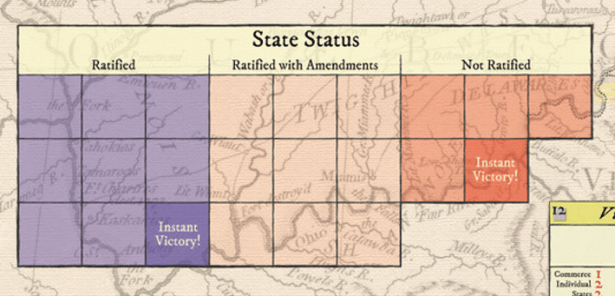
John: The Federalists gain an immediate victory if nine states ratify the Constitution without amendments. Conversely, the Antifederalists win if five states reject the Constitution. If neither player achieves these conditions before the end of the final turn of the game, at least one state has ratified the Constitution with recommended amendments. Victory at that point is determined by comparing the values of the states in each section of the State Status Track. Each state has a value that represents its political and economic importance – the larger the state the more it is worth. Each player gets full credit for each of the states in their column and the Antifederalists get partial credit (the Convention value) for each state that ratified with recommended amendments. Thematically, this represents a compromise situation, where the Constitution is ratified but with amendments. The stronger the opposition to the original Constitution, the more impactful those amendments will be. Strong amendments represent a partial victory for the Antifederalists. Historically, the Antifederalists efforts resulted in the adoption of the first ten amendments to the Constitution, including the Bill of Rights.
Grant: Which side has the tougher challenge to meet their goal?
John: The challenges faced by the two sides are different, but I hope they are roughly equal in difficulty.
Grant: What are some basic strategies the Federalist and the Anti-Federalist players?
John: The Federalists need to strive to win states quickly and build on that early momentum. They may need to consider making aggressive moves early in the game to take states off the board. They also must stay competitive is as many states as possible. They can only afford to lose four states, and the deck is stacked against them in two states – North Carolina and Rhode Island. The Antifederalist player has a wider range of strategic choices. They can focus on winning outright victory in one or two of the early states in an effort to reach the five states they need for an automatic victory, or they can build up their strength in several of the more valuable states that hold their conventions later in the game and improve their chances of winning the game on the basis of points at the end of the game. They cannot afford to compete with the Federalists in every state. They need to pick their battles carefully.
Grant: What type of an experience does the game create?
John: My hope is that it offers players challenging strategic and tactical decisions and creates dramatic moments of high tension where careful planning or bold action can alter the course of the game.
Grant: What are you most pleased about with the design?
John: Overall, I am pleased with the way it models the challenges and choices faced by the historical actors. With respect to the game play, I particularly like the Initiative, Back Room, and Convention mechanisms.
Grant: What other designs are you working on?
John: I’m working on a four-player game about the labor movement in Chicago, during the late 19th-century, and a solitaire game about the Civil War in which the player takes on the role of Lincoln and has to prosecute the war as commander-in-chief, while also navigating the challenges of domestic policy and political campaigning.
While attending Buckeye Game Fest in spring 2024, we met John Lapham and shot a video interview discussing the game and its mechanics:
If you are interested in A More Perfect Union: The Struggle to Ratify the Constitution, you can back the project on the Kickstarter page at the following link: https://www.kickstarter.com/projects/campaign-fall-blau/a-more-perfect-union-a-game-about-the-us-constitution?
-Grant


The KickStarter campaign launched today (07/14/26).
KS Campaign for A More Perfect Union
LikeLiked by 1 person
Thank you.
LikeLike