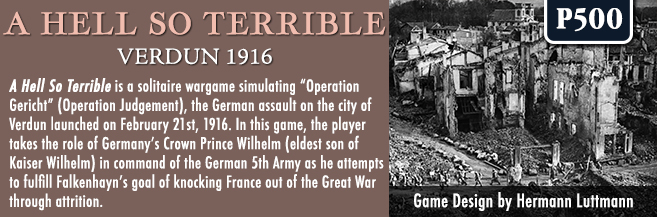
Hermann Luttmann is a great designer and I just love his solitaire takes on historical battles. His newest design is a solitaire game called A Hell So Terrible: Verdun 1916 from GMT Games that focuses on the German assault on the city of Verdun in 1916 during World War I. Keep in mind that Hermann is a very creative designer and uses lots of very interesting and chaotic design elements to create a very interesting and satisfying gaming experience. Also, most of his games are just that, with very engaging gameplay and a lot of the unknown that will hit you in the face from time to time! I just love his games. We reached out to Hermann and as always he was more than willing to share more about the design.
*Keep in mind that the design is still undergoing playtesting and development and that any details or component pictures shared in this interview are for prototype purposes and will definitely change prior to final publication as they enter the art department.

Grant: Hermann welcome back to the blog. What is your upcoming game A Hell So Terrible about?
Hermann: Thanks so much for having me back again! This is getting to be a bad habit. 😉 A Hell So Terrible is currently on the GMT P500 list and covers the German assault on Verdun during World War I. The offensive was launched on Feb. 21, 1916, and its ultimate goal was, as Chief of Staff Erich von Falkenhayn infamously stated, to “bleed France white”. This design sets up the solitaire player commanding the German army at Verdun. The player must push the various German Corps forward along nine different tracks across three main sectors, all of which converge on the city of Verdun and its last ring of fortresses. But the player only has a limited amount of time to close the noose around Verdun, as at the start of July, the Allies will be launching their huge offensive along the Somme River and vital German resources will need to be diverted to defend that front. So, this game design combines a little bit of push-your-luck with a little bit of tower-offense (reverse States of Siege, if you will), and a dab of historically-weighted chaos, to give you a nice flavorful stew of military simulation and game play fun.
Grant: What is the meaning of the title? What did you hope to convey about the game to the players?
Hermann: We actually went through a number of different titles, and I had this one neat quote I found:
“Humanity is mad! It must be mad to do what it is doing. What a massacre! What scenes of horror and carnage! I cannot find words to translate my impressions. Hell cannot be so terrible. Men are mad!”— Second Lieutenant Alfred Joubaire in his diary during the Battle of Verdun (May 23, 1916).
The BBC also used a version of this quote for the Verdun chapter of their special Great War TV series – “Hell Cannot Be So Terrible”. Gene Billingsley came up with the final, truncated version for the game’s title. I take great pride in my game’s titles, and this is no exception. I want the titles to be poetic, artistic, and memorable and thus are usually portions of famous quotes, book chapter titles, etc. By doing so, the title has a meaning and conveys to the player a hint of what the game is about. In this case, as you may surmise, it is supposed to be a bit depressing and gloomy, preparing the player for a difficult Great War grind. The player will experience, in abstract and harmless form of course, the tough slog and frustrating pace of a WWI offensive against an entrenched enemy.

Grant: I see that you described it as a “tower offense” game. What does this mean?
Hermann: This clever twist on the “tower defense” label was created by the game’s developer, Marco Poutre, and I just love it. A tower defense game traditionally means that a player is located in the relative center of the game board, and they are required to defend that center from a foe advancing from multiple directions. Lose the center and lose the game. A Hell So Terrible flips that dynamic around 180 degrees. You are the approaching German attacker moving along multiple axes of advance and the French enemy “bot” is the central defender, trying desperately to keep you away from Verdun.

Grant: Furthermore, the player takes on the role of the attacker. How did this change your design focus?
Hermann: Primarily, the game design must provide the player with strategies of offense and exploitation, rather than that of defense and blocking. The game’s mechanics are structured to offer ways and means for the Germans to conduct actions against the enemy, rather than offer just reactions to enemy moves. You are the instigator and thus drive the action with your play. But that’s not to say that the French “bot” sits idly by…it will counterattack and it will generally do that in the spot which least suits you and your plans.
Grant: Why was this a subject that drew your interest?
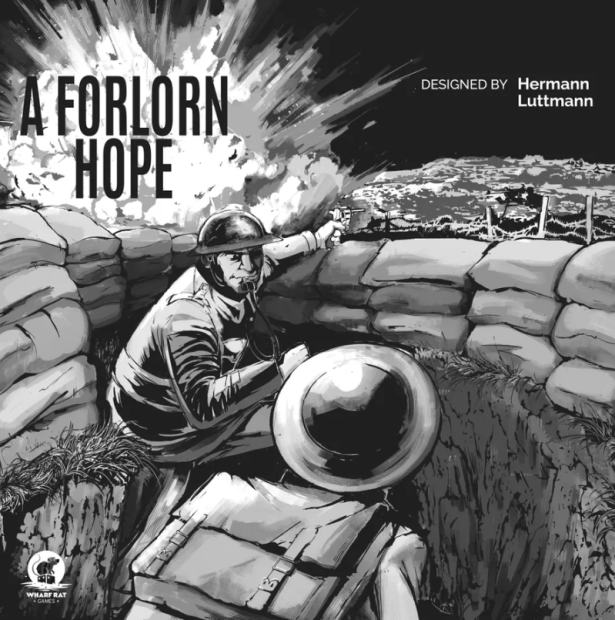
Hermann: Well, as you may or may not know, World War I has always been a primary interest of mine. It is just so rich with gaming opportunities because there are so many interesting fighting fronts featuring many different armies. The war is loaded with fairly obscure yet fascinating battles and campaigns and making them each “gameable” is a real challenge. Designing a playable game out of trench warfare was one of my earliest self-inflicted gaming challenges and that all lead directly to the In Magnificent Style push-your-luck style system, which has now come full circle to A Forlorn Hope from Wharf Rat Games (which actually does cover trench warfare). In the A Hell So Terrible game design, that aspect of pushing your troops ”against the wind” of enemy fire (but at an operational scale now) seemed to fit really well with what a game about Verdun should simulate.
Grant: What is your ultimate design goal with the game?
Hermann: Simply, to provide the player with as much angst and anxiety as possible! 😊 This operation is perfect for the push-your-luck and tower offense approach. The player is placed under a severe time constraint, so the requirement to not only keep moving forward (even when it seems unwise to do so) but also the need to harbor the few resources you have available in the game (more on that later) is a perfect combination of game play juggling. The player must pick the best spots to attack, when to attack, and with what expenditure of assets. And to keep all these moving parts in a playable, accessible format that doesn’t overstay its welcome is the design goal.

Grant: What from trench warfare during WWI and the numerous attacks on Verdun was most important to model?
Hermann: Well, there are quite a few factors that I really wanted to get into the design to make it feel right. Obviously, the French defensive positions are deep, layered, and unpredictable. There are multiple chains of trenches, forts, and terrain features that must be overcome. How do you, as the attacking Germans, go about penetrating these defenses and inflicting as many casualties as you can on the defending French? Well….planning, logistics, bombardment, flanking, reconnaissance, and determination are the tools to overcome those traditional WWI obstacles. Using a design-for-effect principle, there are simple mechanics built into the game that allow the player access to each of those tools, but at the same time, they are not always available and certainly aren’t limitless.
The player must assess each phase of the game and play it to their best ability, utilizing these historic tools to pry loose the French defenses. So, all these factors are important to model to get the best full experience of attacking in WWI.

One other critical thing I wanted to model is the unknown. What I mean is, the French defenses were mostly hidden and they were deep. Though the player can see the French units on the game board, their strengths are unknown until engaged and even the effect of your artillery bombardments is unknown until you actually have units enter those spaces. This is a huge aspect to WWI trench warfare – you are just never sure what the enemy is doing nor what kind of shape they are in. This fog of war really creates a high level of tension and requires the player to try their luck sometimes, even when it might not seem advisable. And the game will constantly be changing the state and makeup of the French defenses, including allowing them to hit back at unexpected times with counterattacks. All these aspects of WWI warfare are critical to include to give the proper experience, and they are all found in this game.
Grant: What sources did you consult about the details of the history? What one must read source would you recommend?
Hermann: The Price of Glory by Alistair Horne is my “must read” source.
Verdun 1916: They Shall Not Pass from Osprey Publishing.
Verdun: The Longest Battle of the Great War from Oxford University Press by Paul Jankowski.
And in addition to published books, I reviewed various online articles and video documentaries.
Grant: What other games did you draw inspiration from?
Hermann: Honestly, none. I know you guys have covered a number of the other Verdun games and I know that there are some really good ones. But A Hell So Terrible is, I feel, a unique wargame approach to this campaign and as such, I don’t like to be influenced by other games when I begin a design. That goes for most of my other designs as well, by the way. Again, that’s not to say that other game designs aren’t great games – most are. But I don’t want to allow myself to be subconsciously swayed one way or the other by another designer’s approach, unless I’m actually using an operating system as my core engine (like States of Siege, for example). That’s not to say that I won’t read the background and historical information that is contained in other games or read the associated historical articles in a game magazine. But for the most part, I do not consult other games to get design ideas.

Grant: What are the Activation dice and how do they work?
Hermann: One of the driving inspirations for this game’s design approach was the idea of using an activation dice mechanic in a wargame. This is a relatively new game mechanic, at least in my experience, and I first encountered it in the Claustrophobia game series. I’ve come to appreciate the fact that it is an almost perfect blend of randomization and player decision making, all in one simple mechanic. You roll a bunch of dice – the random part – and you must then assign those dice to particular tasks – the decision part. My twist on that concept is that I marry that idea with the ability to change the kind of dice you roll and then apply the entire push-your-luck concept on top of that. There are two types of dice – Movement and Casualty – and after all dice are rolled, one of each is assigned to an activated unit. This will tell you how far a unit can move and how many casualties it will suffer just from moving (i.e., representing the constant enemy “wall of fire”).
Grant: How has the dice activation streamlined the game? Why does this work so well?
Hermann: The dice activation system not only tells you how you can move your units but also resolves the persistent enemy fire without needing the player to resolve a dozen separate combats. There are two categories of activation dice – Movement and Casualty. The Movement dice come in two types – Advance (green dice) and Infiltration (black dice) while the Casualty dice also come in two types – Friction (orange dice) and Suppression (red dice).
The Advance die allows normal movement results and is the default movement die unless the player opts to spend Command Points to upgrade one or more of these dice to Infiltration dice. The Infiltration dice represent the deployment of Stosstruppen, highly skilled and specially equipped assault troops, and as such these dice allow more movement. Because Command Points are a limited resource, the player must make that critical decision whether to spend those points to get the more efficient Infiltration dice.

The Friction die is assigned to a unit to represent the amount of enemy fire it is receiving and it is the default die unless the assigned unit has its Support marker (representing the supply trains and supporting local artillery) nearby. If the marker is with or adjacent to the activated unit, the player may automatically substitute the Suppression die for the Friction die. The Suppression die represents the tactical artillery (present with the Support marker) bombarding the enemy and thus suppressing the enemy troops and their defensive fire. The problem is that Support markers are hard to move and rarely are able to keep pace with their associated German unit.
Thus, the player is left with some interesting command decisions, even though a unit’s movement and vulnerability is randomly determined by a simple die roll.

Grant: What time pressure is felt by the player?
Hermann: Like all game designs that have any kind of push-your-luck aspect to them, time has to be of the essence. If there is no time pressure, there is no reason to push and take chances. In this game, each turn is half-a-month and the player must accomplish the German goals by the end of the 10th Game Turn, which is the end of June, 1916. The Somme offensive starts at the beginning of July and this marks the point where the Germans must have achieved a victory at Verdun in order to compromise that offensive. The player will find that it is a long slog to capture the ring of French fortresses and get to the outskirts of Verdun in time. So, they will be compelled to push hard and take risks to get to the inner sanctum before the end of the game.
Grant: What type of experience does this create? What are the toughest decisions forced on the players?
Hermann: The experience will hopefully be, as I said before, one of anxiety and fun all mixed into one package! And despite the random events and numerous dice rolls, there is a parade of tactical and strategic decision-making the player must navigate each and every turn. Just to list the toughest and most critical…
- Which Activation dice do you assign to which unit?
- In what order do you activate the units? This matters because you can maneuver your units to create flank attack benefits.
- How do you spend your limited Command Points?
- Where do you place your Bombardment and Big Bertha markers?
- How far do you push your combat units forward before you have to slow them down to allow the Support markers to catch up?
- Do I spend precious time to do a Reconnaissance before attacking?

Grant: How does the solitaire bot for the French function? How does the AI prioritize its decisions?
Hermann: The French bot works mostly through the Event Cards, though as stated before the French firepower is also inherent in the Casualty dice effect. The events are almost all based on things that actually happened or could have happened during the Battle of Verdun and though they won’t occur in exactly the same order chronologically, many are weighted to have different effects depending on the month in which the card is drawn. The French are always tenaciously defending, but the cards dictate when reinforcements arrive, the deployment of fighter aces, the bombarding of German units, the appearance of random patrols, and the launching of counterattacks. And the location of many of those counterattacks is often influenced by how much progress German units are making on their tracks… r in other words, how close they are to Verdun itself.
Grant: What is the flow of the game?
Hermann: Each Game Turn begins with the draw of an Event Card and this card can affect any position or area across the game board. The player determines if they receive any additional Command Points and then resolve a dogfight procedure to determine which side has Air Superiority this turn. Then the player conducts any desired Artillery Bombardment, placing such markers face down on French units. The player selects which of three sectors to activate – left, center, or right. Before activating units in each sector, another Event Card is drawn and often, its effects apply just to the chosen sector (but not always). Units of the chosen sector move and fight until all are Spent for the turn. Then another eligible sector is chosen, another Event Card is drawn, and its units move and fight until Spent. Once all units on the map are Spent, the player calculates any Victory Points earned, and resets for the next turn.
Grant: What are the Events that start a turn? What are some examples of these events?
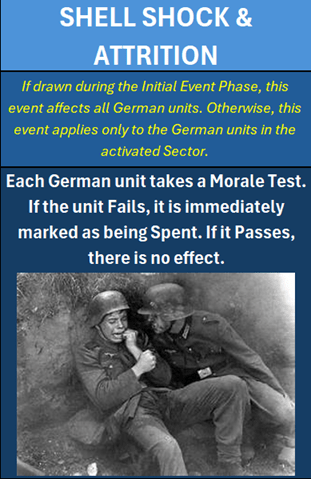
Hermann: The Event Card that is drawn to start the turn (during the Initial Event Phase) is the same as the others – they all come from the same deck. But this first card may affect the game differently. If it does, it will say so right at the top of the card. So, for example, the “Shell Shock & Attrition” card is especially devastating if drawn as the Initial Event. If drawn at the start of a Sector activation, it requires the German units of that Sector (only) to each take an immediate Morale Test (which could result in their becoming Spent before they even get to activate). If this card is drawn during the Initial Event Phase, it affects all the German units on the game map and every unit must take an immediate Morale Test!
Grant: How are Command Points used? How are they earned?
Hermann: Command Points (CP) are the currency with which the player can do some really cool bonus actions or get gameplay benefits. Using CP to the best of your ability is a key to winning the game. The player gets 15 CP to start the game and then earns some more each turn, but fewer and fewer as the game progresses. This is an abstract way to simulate the breakdown of communications between German headquarters and the troops, as well as reflecting the degrading of confidence in the operation, especially by Crown Prince Wilhelm himself. Certain Event Cards also grant additional CP. Command Points are used throughout the game to do a number of special actions, including purchasing Infiltration dice, re-rolling combat dice, replacing losses, using Attack Momentum (see below), redeploying units, etc. All powerful tools when used at the right moment in the game.


Grant: What is the need for the dogfighting step? How does this play out?
Hermann: The Dogfight Step is a part of the Air Campaign Phase, which just generally reflects what is happening in the skies above the Verdun battlefield.
The Dogfight is a simple competitive dice roll, with the side who has Dogfight Advantage at the time (as listed on the Turn Record Track) getting to roll two dice and use the higher roll. The winner gets to bump the Air Superiority marker one box in their direction. Who has Air Superiority at any point in the game can affect some events, but most importantly for the player, if the Germans have Air Superiority, they have more Bombardment and Big Bertha markers available to use in the turn (simulating that the German Drachen – balloons – are free to fly to observe and guide artillery fire). Again, a simple thematic mechanic that reflects a complex issue.

Grant: How does heavy bombardment work?
Hermann: During the Heavy Artillery Bombardment Phase, the player deploys a certain number of Bombardment and/or Big Bertha markers onto the game map. At the very start of the game, there is a special step called the Trommelfeuer Step which allows the player to place 20 Bombardment and 5 Big Bertha markers around the map. This is to simulate the massive preliminary barrage the Germans conducted before the assault. During all the other game turns, the player gains a certain number of Bombardment Points, based on where the Air Superiority marker is located. Bombardment Points are spent to purchase Bombardment and Big Bertha markers to place face down on French units or into the special Voie Sacree (Sacred Way) area, which was the logistical lifeline for the French forces. The markers each have variable effects on their back sides, ranging from no effect to utter destruction. But these markers are randomized and the player does not know what effect applies to the targeted French units until a German unit enters their space for combat or the player takes the time to conduct a Reconnaissance action to reveal and apply the marker immediately. A Big Bertha marker placed in the Voie Sacree area can interdict that area and delay French supplies and reinforcements, which is enacted by nerfing certain Event Cards.

Grant: What is the layout of the board?
Hermann: The boards shows the entire area around the Verdun fortress complex. There are nine movement tracks and each track has a dedicated German unit and Support marker. Each of these tracks are made up of a series of eight spaces. Most spaces have a terrain feature associated with them – clear, forest, hills, fortress, or trench. There are also a number of landmark spaces that have special game effects (ex: Fort Douaumont). The tracks are also divided into three Sectors, each representing a major segment of the German army attack zone. The left Sector has only two tracks, the center Sector is the main attack zone with four tracks, and the right Sector has three tracks and is the left bank of the Meuse River, which was manned by the Bavarian Corps. Every German unit starts in its own trench area and must move up the track toward Verdun, encountering and hoping to defeat French units along the way.

Grant: What dangers are present for the advancing Germans?
Hermann: My goodness…there’s a myriad of dangers for the German player. The French can not only offer a stubborn defense of their trenches and forts, causing you casualties and loss of time, but they can also bombard your units and whittle them down from afar. Logistical considerations are numerous, as the player needs to carefully use the Command Points in the right spots and must have the Support markers keep a steady pace to support their associated German fighting units. The air war has to be won consistently to maximize artillery bombardment. The player is going to be severely curtailed by Event Cards and coping with those while also taking advantage of the few good Event Cards is essential. Finally, the most dangerous factor of all is the passing of time. The player only has ten turns to accomplish a lot and every minute lost during those ten turns can make all the difference between victory and defeat.

Grant: How does Fog of War work? Why was this important to include?
Hermann: Well, as with most of my games, I love dabbling with the three F’s of War…the Fog of War, the Friction of War, and the Fortunes of War. And this design has all those elements in it. The player of course has to deal with the uncertainty of the Activation dice rolls and the unknown of the combat dice rolls (see below). Along with that, the Event Cards are always throwing a new, unexpected wrench into the works. In fact, the player does not even know definitively how effective their artillery bombardment has been! On top of all that, French units are deployed face down and their exact strengths are not revealed until contact is made or until the player spends time to scout out the units with the Reconnaissance action. These are all important elements to include in the game because these are exactly the same challenges the German army and its commanders had to face at Verdun. And as with all games that lean on the historically-weighted chaos theory of design, having this level of Fog of War in a game design not only makes it more realistic, but it makes it a more fun game as well.
Grant: How does combat and losses work?
Hermann: Combat in this game is pretty straightforward. Each side in a combat totals up their SP and rolls a D10 which is added to their SP to get a Combat Score. The French get an extra die to roll (using the higher result) and/or additions to their Combat Score if located in certain terrain. The German units can get re-rolls and/or an extra die if they are using an Infiltration die for their activation, or spend a Command Point, or have a flanking unit. Some Event Cards can affect combat as well. Each side gets a total Combat Score and inflicts Hits on the opponent based on that score…the higher the score, the more casualties are inflicted. This yields interesting combat results as both units scoring high means huge casualties for both sides, regardless of who wins. Then the side with the higher score wins the combat, and the opponent must retreat. The actual difference in scores can affect units differently. For example, if a German unit wins a combat by only one point, it will hold the position as the winner but it will become Spent, meaning it is done for the turn! Too many of these kinds of wins can spell doom for the German player. A large margin win will allow the German unit to choose pursuing the enemy and continuing forward or consolidating and bringing its Support marker up one space. Tough choices!

Grant: What is the concept of Attack Momentum?
Hermann: Ah, that’s my sly little “gamey” mechanic for this design. I wanted to add another twist to the Activation dice assignment mechanic that also acts as a mitigation against bad luck – or in this case, technically a mitigation for good luck. So, the idea is that if the player assigns two good Activation dice to a unit, instead of having to re-roll those dice the next Game Turn, the player can instead spend a Command Point and keep those dice with that unit but must count down each die by one number. So, for example, if you assign a “6” Movement die and a “5” Casualty die for a unit, you could spend a CP and activate that unit again with a “5” Movement die and a “4” Casualty die (assuming the unit was not Spent during its first activation). So, good dice stay with the unit, but lose their potency over time. Historically, this simulates a commander seeing a unit performing well and then directing assets and leadership to that unit to exploit their superior performance.

Grant: How do you model German Command Efficiency?
Hermann: Well, in games where there is significant dice rolling, I do like to use the “doubles = something special” mechanic, because you know that the odds will produce a certain number of doubles rolls during the course of the game. As such, I like to make something special happen when they are rolled that the player can exploit, and in this game the use of a doubles Activation dice roll is actually more in the control of the player because the doubles can be “created”. What do I mean? For example, if you are rolling Activation dice for the right Sector (three tracks, so three German units), you’ll roll a total of six dice – three Movement dice (Advance and/or Infiltration) and three Casualty dice (Friction and/or Suppression). This creates a pool of dice results from which you will assign two dice per German unit – one Movement and one Casualty die for each. Thus, if you have two matching dice, you can grab those two and create a doubles result for that unit. An assigned doubles result triggers German Command Efficiency and it allows you some options for activating that unit. You have one of three options you can apply – increase the Movement result by one type (ex: change the result from Move 1 to Move 2); reduce the strength point loss from the Casualty die by one; or move the unit’s Support marker up one space. The chosen benefit is applied, along with the normal dice roll results, when the unit is activated. Again, a simple bonus to reflect the superior abilities of the German officer corps.

Grant: What type of an experience does the game create?
Hermann: I’m hoping that the game creates an intense gaming experience. One in which the player can exercise tactical and strategic options in an effort to carry out a particular plan, but coupled with the excitement of the unexpected challenges by – and sometimes, assistance from – the Gods of War. This should be a gaming experience of tough decisions and of taking calculated risks. And ultimately, I think this will inevitably come down to a nail biting ending.
Grant: What are you most pleased about with the design?
Hermann: I’m really proud of the fact that I think I got almost every crucial element of simulating the early stages of the Battle of Verdun down to workable and accessible mechanics. The game’s core mechanics and use of historically-based Event Cards drives a narrative that draws the player directly into this era and into the drama of this particular battle. To be able to do that and still keep the game accessible and easily playable is, for me, the ultimate goal and I think A Hell So Terrible achieves that goal.
Grant: What other designs are you working on?
Hermann: My, my… t’s a busy year for sure! Here we go:
- They March Against Us: Leipzig 1813: This is the first game in the Bonaparte’s Sword Series, which will essentially be Napoleonic Blind Swords. Roger and Richard at Revolution Games are playtesting it right now and so far, so good. It should be available this year.
- A Forlorn Hope: This game is Wharf Rat Games’ first published design and just finished a very successful crowdfunding campaign. We’re now working on getting it all finished up and designing the stretch goals that were achieved. This one is going to be a real beauty and I can’t wait until people actually get to play it.
- Dawn of the Zeds: Designer Edition: Yes, Dawn of the Zeds is back and this is the newly redesigned version of the classic. I’ve updated the mechanics, especially the combat system. It will have the traditional map layout and characters of the previous three editions, but I’ve also added a ton of new stuff as well. This is published by Blue Panther and I think (hope) will be a huge hit.
- A Primitive Madness: Antietam 1862: The third Black Swan Series game by Flying Pig Games will indeed cover the Battle of Antietam. This one will be a bit different, as the scale has changed to accommodate the smaller battlefield. This will have the same huge maps and elite production of the other games.
- At Any Cost: Metz 1870: This game will be republished by Hexasim sometime this year. I am reviewing the original game and probably updating a chunk of mechanics to allow the game to play more smoothly and quickly. And it will have all new artwork.
- Kill All Fermitians!: A republication of an older game (Volters Lead the Way!), this is going to be published by Flying Pig Games as a deluxe push-your-luck science fiction game. The new artwork with this one is amazing!
- Nemto: A big, multiplayer, cooperative science fiction wargame that will be published by Nuts Publishing. This is going through all original artwork right now and even some professional background story telling to add to the game. It tells the story of human mercenary companies sent to an alien planet to lay claim to its powerful natural element – pinnaclium.
- More Brains!: Have you ever wanted to play as a zombie? Of course you have! Well, here’s your chance. Another new company, Jackl Games (run by Randy Lein from Legion Wargames) is going to publish this multiplayer game that I co-designed with Ryan Heilman. Each player controls a team of Alpha Zeds, zombies who are accumulating brain power and with each new brain, a new skill. Very different and very fun.
Thanks so much to Grant and Alex for allowing me to write about A Hell So Terrible! I hope gamers enjoy it. All the best! Hermann

As always it was a pleasure speaking with you Hermann. I am very excited about this one as it sounds very interesting and is a gaming subject that I have a great interest in as you mentioned. I am looking forward to our next opportunity to meet up and play some games!
If you are interested in A Hell So Terrible: Verdun 1916, you can pre-order a copy for $75.00 from the GMT Games website at the following link: https://www.gmtgames.com/p-1192-a-hell-so-terrible-verdun-1916.aspx
-Grant

