
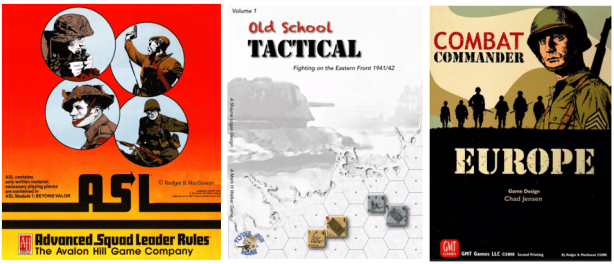
The Tactical level wargame is a staple in my collection and in our hobby. I have played a lot of the various offerings out there over the past 10 years including Advanced Squad Leader from The Avalon Hill Game Company, Lock ‘n Load Tactical from Lock ‘n Load Publishing, Combat Commander from GMT Games, Fields of Fire from GMT Games, Conflict of Heroes from Academy Games, Old School Tactical from Flying Pig Games, Assault from Assault Games, Fighting Formations from GMT Games, Combat Infantry from Columbia Games, Valiant Defense Series from Dan Verssen Games, 2GM Tactics from Draco Ideas and Squad Battles from Flying Pig Games to name just a few. Tactical level wargames are just so gritty, action packed, bloody and in your face and I love that about them. But, there are some things that I don’t love, as with all games. In this edition of The Love/Hate Relationship, I want to share what I love and hate about Tactical level wargames.
Love
I love tactical squad level combat. I will say that I am partial to World War II tactical games but am always open and willing to play other time periods. There is just something about the strategy, the tension and fear inherent in the game that really draws me in. What is going to happen when I run my squad out from their comfortable and relatively safe building to cross an open field, offering little to no cover, in order to get into position to eliminate the enemy? I don’t know but whatever it is it will be fun!
I love that tactical level games focus on individual units, which can range from vehicles and squads all the way up to platoons or companies. These units are assigned rating factors based on what types of individual weaponry the units carry, reflected in firepower, range and usually movement. Tactical games are usually designed so that a rudimentary knowledge of military tactics will facilitate good gameplay. But this personal vantage point, as you control an individual soldier or small squad of soldiers, really feels personal to me. As opposed to larger Operational or Strategic level games where I am making decisions about 1,000’s of men and machines and it feels more generic and removed from the action, in the Tactical level game I get to put myself in the shoes of a soldier named “Joe”.
One of my first experiences with Tactical level games was Combat Commander. I remember sitting down and doing the Example of Play scenario laid out in the playbook where I was paying as the Russians going up against the Germans. The Russians had the initiative and immediately began taking shots at the Germans using an infantry gun controlled by a Weapons team. The first shot was a miss and I was disappointed. I wanted to see their aim be true and do some damage to the Germans but it wasn’t meant to be. I will say that it was amazing to see the range of the gun, which showed me the power of this type of ordinance. The Russians then finished their first turn by moving forces north from the orchard through the forest on a path to be within striking distance of the Germans holed up in the buildings. I saw the power in leaders as well as by activating a single leader, you can control the actions of the units within their command radius.
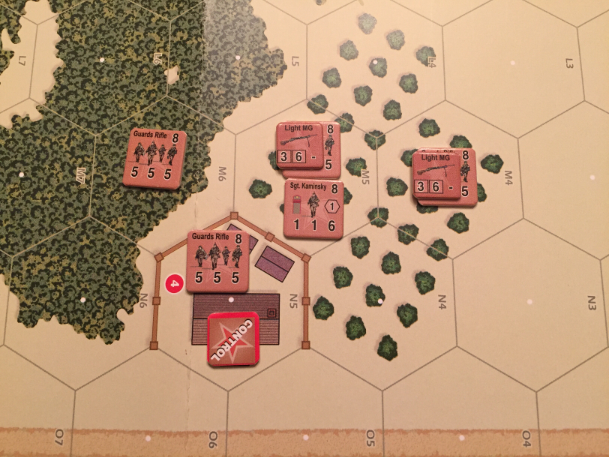
I remember feeling the angst and weight of the role of Sergeant Kaminsky who was desperately trying to inspire his men to move up on the buildings to engage the enemy and knock them out of that fortification. I also experienced the disappointment of the German leader Sergeant Ganz as his troops were forced to retreat to the north to try to repel the Russians who were threatening the German troops in the buildings. I felt the disgust in my unit’s performance when the very powerful infantry gun continued to miss its targets! I was relieved when the random event put a blaze marker in between my troops and the German forces in the woods obscuring their line of sight and not allowing them to effectively fire. I love this aspect of Tactical level games because it is personal.
Another favorite part for me is the narrative that is told as the battles unfold! As I have played Tactical level games such as Combat Commander, I imagine that I can feel what the squads felt in combat. The narrative is always the best part and allows my mind to participate in the battle, even though I am not there. It is a similar feeling to a well written book that forces you to take the role of characters and experience their feelings as you read the story as it unfolds on the written pages. If a game can do all that, it is definitely good!
I do love the strategy and tactics at play when playing a Tactical level wargame! Scoot and shoot, fire from cover, suppressing fire, using smoke to obscure movement, group fire, flanking, use of off-board artillery and fire support and all of the various elements of this level of fighting. I am in control of the game and have the tools and abilities of my troops at my disposal to try and best solve the tactical puzzle laid out before me and to plan how best to go about reaching my goal. Sometimes in these tactical games there are unit abilities that can be called upon. An example of this is found in the Squad Battles Series from Flying Pig Games. Special abilities or “Powers” that different types of units and Leaders have can be activated by playing the right type of card (see below pictured card with the word POWER shown) and really pay off when you can get them played. This element really adds some variety to the game play and always has me really thinking about how I need to effectively build my squads.

Finally, I really like the granularity and realism of some of the Tactical systems out there. One of the best games in regards to this aspect is Advanced Squad Leader. Admittedly, I have only played the Advanced Squad Leader Starter Kit #4, but got a real taste for the gritty minutiae that the system demonstrates. I have asked many people what the appeal is for them with Advanced Squad Leader. They typically all refer to many aspects of the game, including things like its depth, rules complexity (not I am just joking with this one!), granularity and realism as well as the thought that anything worth playing should be hard to learn. But, I would agree that the granularity of the game and its focus on realism are two of its greatest advantages.
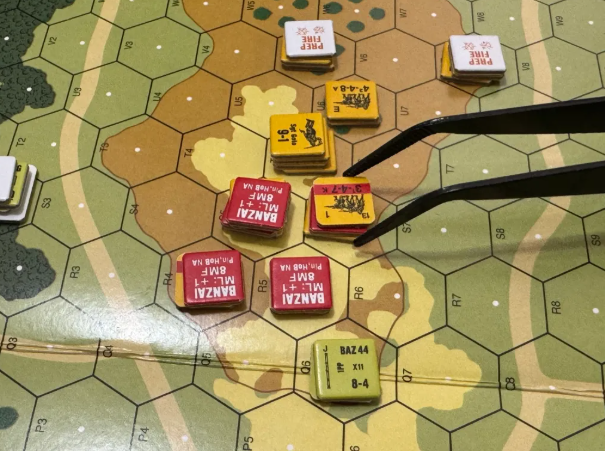
But I think that the systems used in ASL and the rules that prop them up are really quite realistic and provide you the player with a good understanding of the factors involved in these small tactical engagements and their pitfalls. I do really think that the system mimics the process and actions of soldiers in many ways. Does it do this perfectly? Probably not but I am unsure that I can’t definitively say at this time in my journey but I want to learn more and understand the answers to those questions. And hopefully I can play it again to get a better feel and understanding. I also think that people really enjoy the bits and pieces of chrome that are injected into the system. I bring this up as I experienced the chrome of banzai charges as we played ASLSK#4 The Pacific Theater of Operations.
Hate
Hate is such a strong word for me but there are things that are very displeasing about the medium of Tactical level wargames. First off, sometimes a Tactical level game can feel pretty generic, meaning that we have just thrown a scenario together that isn’t necessarily realistic or tied to a specific historical event. As a player of historical games, and an admitted lover of history, I really like playing games that are rooted in the events of the time portrayed. If I am just covering a generic run across an open field or an assault on a fortified line of trenches, I am not necessarily as interested or vested in this situation. But if you throw a name to it, such as the Marine defense at Alligator Creek, the British defense at Rorke’s Drift or the chaotic Battle of Castle Itter, then I sit up, take it a bit more seriously and can dive into the details of the fight. I just wish that more of the systems out there did a better job of integrating the actual small scale battles into their scenarios.

Sometimes Tactical level games are not necessarily realistic as they are games and they always have some gamey elements such as the activation system, dice or the use of cards to determine results. Now before you blow me out of the water, my use of realism here isn’t to say that these Tactical games are simulations. Sometimes systems, such as ASL, gives the players a sort of God’s eye view of the whole battlefield and the omnipotent understanding of the situation and of what can and will happen. This allows for the players to somewhat plan around any difficulties or traps and make the best of a situation. And I think that any battlefield commander will tell you that this is not the case as you never know exactly who you are fighting, their makeup, their numbers and capabilities nor their support. But, keep in mind that one of the keys to any battles is the use of reconnaissance and scouting of the terrain and battlefield before committing so maybe there is more to this than I think.
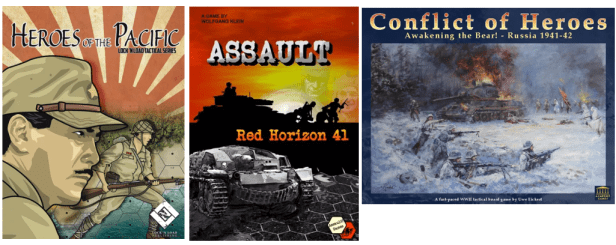
Well, in summary, I love Tactical level wargames. They are the best and I love them for many reasons including those I have listed above but also because they are fun and exciting to play. Part of the reason that I play games is to be stimulated and to have to exercise my brain to come up with a workable plan and then to execute that plan in the face of adversity and poor dice rolling. Tactical level games give me this and I will always want to play them.
What do you love and hate about Tactical level wargames? What are your thoughts on my observations? Please share.
-Grant


Ooh, great idea for a post here. I’ve played a fair number of tactical ones as well, although not nearly as many as you guys. I love seeing how things play out, knowing that I can take risks with a squad (sometimes) and just see what happens without it crippling me for the next X hours on a larger scale game. Many of them encourage a more aggressive style of gameplay, blended with careful planning and tactics employed in response to what arises.
LikeLiked by 1 person
Yep. Just like a commander you can order your men to probe, feint and draw fire to ferret out the enemy.
LikeLike
For me it’s about recapturing the feeling I got watching Hollywood war movies or reading old Commando comics as a kid.
There’s something deeply visceral when your hero charges across an open field, dodging bullets and takes out an enemy machine gun nest with a grenade. Of course, the good thing is even if he gets cut down it still makes a good story and as he’s only cardboard he can be back for the next game!
LikeLiked by 1 person
Tactical is definitely cinematic.
LikeLike
I am a retired Army Officer. Worked as a Press Offr for 20+ years.
As part of training missions for our civilian journalists I followed FIBUA training each year.
I have to say that the best Tactical wargame experience for me was … Up Front.
The sheer confusion, unexpected events, the tension can not be simulated in a board game but actually Up Front came close 🤪.
While Fields of Fire wants to be a realistic simulation it tries too hard to portray the command system on the tactical field. Less is often more.
But sadly ASL does not portray these tactical fights well. It lacks command control and is embedded within a terribad sequence of play. The result of the old “I go – You go” syndrome of older wargames.
These days “activation” mechanics are better suited for wargames.,
I love the grand tactical scale on a more operational map. GTS in Race for Bastogne or Strike Counter Strike are great historical board wargames for me. They offer a broader overview and use newer activation systems.
Panzer is great too but you have to use all advanced rules up to and including staggered initiative.
LikeLike
The trouble with all tactical games is that they are inherently unrealistic and can’t reflect actual tactical combat in any era. Even ASL with it’s mega rule books could not solve this. More abstracted and simpler systems sometimes feel more ‘realistic’.
LikeLiked by 1 person
Excellent take on this. My favorite tactical system is probably Old School Tactical. It has a mix of realism and ease of play that I love. After that it would be ASL and Assault. I used to love Conflict of Heroes but got tired of them releasing the same game to update the series rules.(Awakening the Bear) They could have released some new scenarios at least. Regardless this got me to pull out some tactical games and set up a time to play with my friend.
LikeLike
I tried OST but there a couple of things that irk me – the massive map which you only usually play on a tiny portion of and the allocation of impulse points being luck based meaning a couple of bad rolls in a row can mean you’re stuffed.
I still find Combat Commander is my gold standard – it really simulates the chaos of the battlefield whereas OST simulates luck.
LikeLike
With a couple of gaming group buddies (who have a lot more experience than me) I’m slowly trying out a few different WW2 tactical systems to see what hits the sweet spot (for me anyway).
Enjoyed Conflict of Heroes (SofS)- great components, minimum down time between goes with the back and forth single unit activation system. Enjoy the push your luck ‘spent die roll’ – enjoy the excitement of pulling the damage chits out of a bag and keeping them secret until having to reveal.
Enjoying Band of Brothers Ghost Panzer – wasn’t sure about the aesthetics of the components/maps but pleasantly surprised after seeing the Deluxe version in the flesh. Like the ‘proficiency’ system that aggregates a whole host of things – crew training, experience, turret space, optics etc. into a single d10/percentage type roll with a few plus or minus drms (moving, op firing etc.) to calculate whether a tank or gun crew gets a shot off. Then a straight forward armour penetration hit/kill roll for possible damage. Really like the infantry/fire suppression system to slowly pin units down before going in for the kill, but with a small chance that they’ll still be able to final op fire when swarmed if ‘used’.
Was also unsure about the very large mounted map board for OST. But after hearing ID Jester rant about the same thing on his show and showing the print and play digital file versions he downloaded off Wargame Vault, I thought I’d maybe try that avenue. Am currently printing and sticking counters/unit cards to various thicknesses of mount board and will have manageable smaller map tiles to lay out for the various scenarios. Will hopefully get this to the table in the coming weeks to see what we think of this system and see what we think of the impulse point die roll allocation that TeufelHund has commented on. Maybe there are some house rule suggestions to try out if we also find this irks.
Will also soon try out Last Hundred Yards, Combat Commander and maybe even Assault if somebody takes a punt on one of those mega boxes. Some of my fellow club members are rolling out GTS Hells Highway this weekend at PunchedCON so I’m sure that I’ll get to try that out as well at some point!
LikeLike