
Form Square Games has recently offered their next several games on Gamefound, one in their Limits of Glory Series called Jersey New Jersey and the 2nd game a stand-alone non-series game covering the French & Indian War called A Strong War. I think that these games are well timed with this year being the 250th Anniversary of the signing of the Declaration of Independence and I look forward to playing and exploring all of these games. I reached out to the designers of A Strong War named Mark and John Kwasny about an interview to give us a look inside the design and get more information and they were interested in answering our questions. One point about the game before we get into the interview, the title, A Strong War, refers to the type of war the Abenaki Nation threatened to unleash on the land-grabbing British in 1753. The sparks of war, ignited in 1754 near Fort Duquesne by an obscure colonel of Virginia militia, George Washington, spread quickly; soon, flames engulfed the entire globe as England and France vied for control of empire. Over the next 5 years, Regular regiments from the French and British armies, American and French-Canadian provincial units, and Native warriors all fought in a chaotic and violent series of campaigns and frontier raids that culminated in the British conquest of French Canada and the defeat of the Native Nations, most of which had sided with the French.
If you are interested in A Strong War: The Conflict for North America 1755-60, you can back the project on the Gamefound page at the following link: https://gamefound.com/en/projects/form-square-games/jersey-new-jersey–a-strong-war
Grant: Mark & John welcome to our blog. First off please tell us a little about yourselves. What are your hobbies? What’s your day job?
Mark and John: First of all, thanks for inviting us to do this interview. We appreciate the interest in us and our game! I have watched many of your videos and learned a lot about different games that I have purchased or have considered buying.
We are both retired. John taught Middle School and High School history for 36 years and I taught American and Military history at the college level for 33 years. One hobby we share is playing wargames purely for fun! We have been wargaming since we first made our own game (60 odd years ago) out of a dozen decks of cards. John is an avid fisherman as well, we both read a lot, especially history, my wife and I do a lot of babysitting with our little grandchildren, and we share the unending quest for the perfect chocolate donut (we live 100’s of miles apart and whenever we can get together, we consume a generous amount of such donuts, trying different ones!).
Grant: What is your relationship to each other? How has this aided you in your design endeavor?
Mark and John: We are brothers and share similar historical interests in military history (he has an MA in Military History, and I have a PhD in Military History). But when it comes to wargames, we have vastly different views on what we like and what works for us in a game. That helped us try to incorporate different styles of play into the design. And John’s pro-French leanings and my pro-British sentiments helped us with the pursuit of play balance!
Grant: What motivated you to break into game design? What have you enjoyed most about the experience thus far?
Mark and John: About 15 years ago a person contacted us about making a game for a new game company he wanted to form. We chose the French and Indian War as the subject. Ultimately that fell through, but by then we had a game we really liked but it is a long game and thus was difficult to play a lot. We were both still working full time and had very limited gaming time. So we decided to boil it down to its essence – we wanted to make a game that gave the same feel for that war but was playable in a short time so we could actually play and complete it! (I don’t know about others, but the percentage of games I have played that I actually finished is not very high!) The key, we decided, was less resources and thus more tension for each decision. Our goal was simply to make a game we loved and could play together or with our other gaming friends. We already had all the research for the French and Indian War, so we took that earlier game and stripped it to its bones. We put ten years into this process of stripping it down: fewer rules, less units, to create more difficult decisions to use what little you have. The current version is the result of that decade of work.
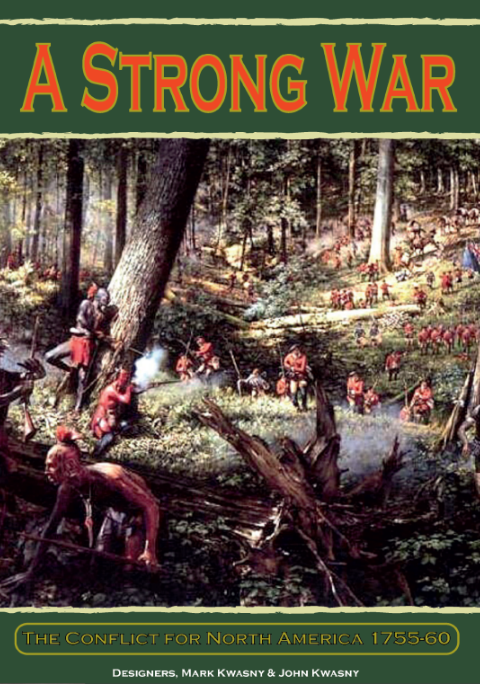
Grant: What is your upcoming game A Strong War about?
Mark and John: As mentioned, it covers the French and Indian War, focusing on the fighting in North America between 1755 and 1760. The game takes a grand strategic approach with the players directing the entire war effort of the two sides through those six years.
Grant: What should the title convey about the French & Indian War?
Mark and John: Between the title, and the quote it comes from, it indicated a war to the end between British expansion, Native American defense of their lands, and French efforts to maintain control of French Canada. Either the French and their allied Native warriors would stop British expansion or they would lose everything. And therefore it was a strong war, no holds barred!
Grant: Why was this a subject that drew your interest?
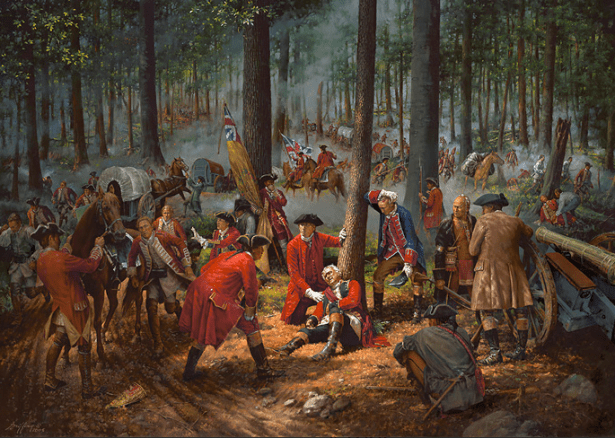
Mark and John: Braddock’s Defeat has always been a subject of fascination for both of us. Childhood visits to Fort Michilimackinac, Old Fort Erie, Fort George, Presqu’ile, and other places around the eastern Great Lakes (we grew up in Cleveland and we traveled around the area back in the 1960’s), these sparked our imagination early on. The characters involved deepened this interest: Washington, Braddock, Pontiac, William Johnson, Montcalm, Langlade, St. Luc de la Corne, Robert Rogers. We have both read numerous books over the decades on the war and these people, and I studied it while in graduate school for my focus on 18th Century and American warfare.
Grant: What is your design goal with the game?
Mark and John: History is important to us, even in a small quick game such as this one. We wanted a good feel for the war and the overall situation, and we wanted a game that sets up quickly, plays quickly, with rules that we believe can be learned relatively easily without lots of charts and details. Also important to us are the types of decisions a player makes. We want those decisions to feel reasonably plausible for that war. Too many games play like WWII no matter their actual subject. We also wanted to be true to the geography of that area of North America – deep, unending forests, rivers and lakes, paths through the woods, limited avenues of approach to the other side, the feel of the constraints imposed by the geography had to be present. And finally, we wanted to create a game that we enjoyed playing over and over and over!
Grant: What elements do you feel are most important to model in a game set in the French & Indian War?
Mark and John: We considered the key to the war were the limited movement opportunities and the limited resources available to both sides. We also wanted to show the contrast between the formal military campaigns of the regular armies, and the frontier style of raids and destruction by the partisan forces. The need to balance these two very different types of warfare and differing types of forces was key in our opinion.
Grant: What sources did you consult fur the historical details? What one must-read source would you recommend?
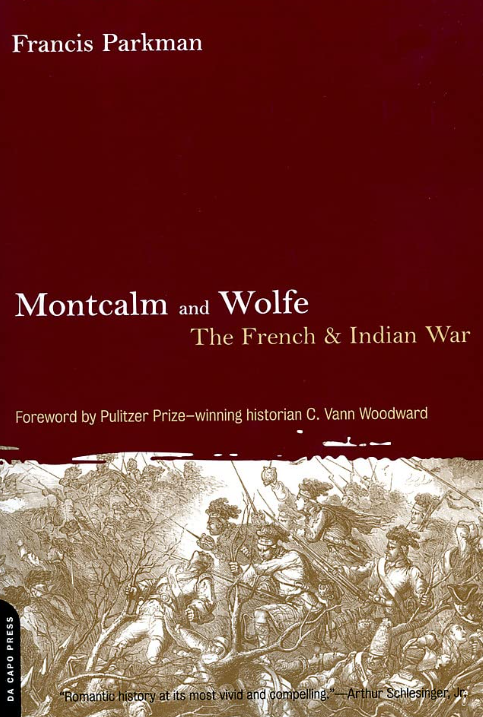
Mark and John: We would suggest two. First, we recommend Francis Parkman’s Montcalm and Wolfe, published in 1884. It has a wealth of information, including the use of sources no longer available. One has to be ready for the 19th century prose, of course, which can help give a true feel for how people saw each other back then but can be difficult to read here in the 21st century. The other book is Fred Anderson’s Crucible of War: The Seven Years’ War and the Fate of Empire in British North America, 1754-1766, published in 2001. It is a comprehensive study of the war.
[Editor’s Note: I own and have read Montcalm and Wolfe and very much enjoyed the overall vantage point it gave of the war and its inner workings. I also very much enjoyed the ending of the book, including a very dramatic and detailed depiction of the Battle of the Plains of Abraham and the fall of Quebec in 1759.]
Grant: What is the scale of the game? Force structure of units?
Mark and John: The game is deliberately very abstract but the forces available are modeled on the relative strengths of each side. There are yearly turns with multiple activations during each turn/year. It is a game about the Grand Strategy of the war. The focus is on the overall command of the entire theater and the allocation of your limited resources to achieve one of several possible goals. Thus, the force structure is based mostly on what we defined as five different types of combat forces available to the two sides.
Grant: What different units are available to each side? What special capabilities does each type bring to the battlefield?
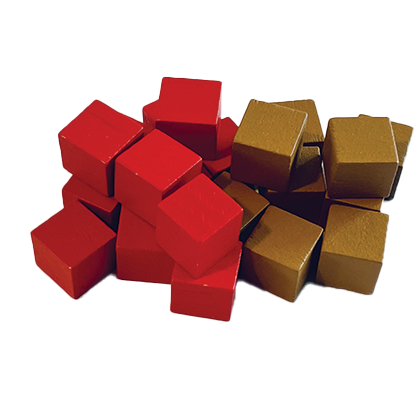
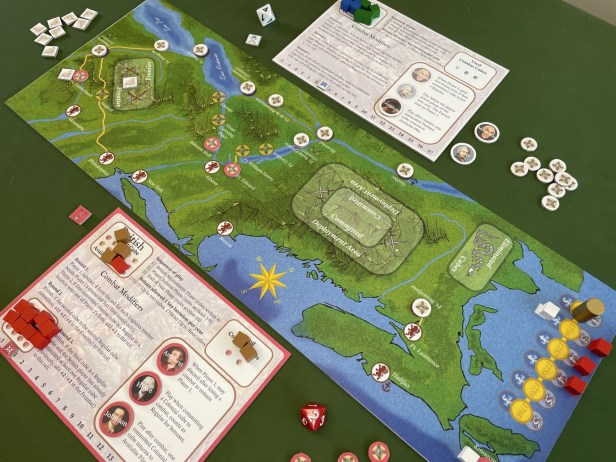
Mark and John: The French player has French regular units, Canadian militia and Marine forces (referred to as Marines in the game), and frontier partisans representing Native warriors and the French Bush Rangers such as Charles Langlade. The British player has Colonial units and British regular units. Individually, each cube is equal to another cube, but the key is combining the proper types of units to maximize the bonuses in combat. For example, if a French Marine cube attacks a British Colonial cube, both sides roll a 4-sided die and high roll wins. But if the French player has a Partisan cube with the Marine, he gets a +2 bonus to his roll. Meanwhile, the British player gets similar bonuses for massing his regulars in combat. Regulars do not fight as well on the frontier, making the French Marines and Partisans even more effective out there. The most numerous forces are the British Colonial units who offer no bonuses but are present in many of the battles. Colonial units can also be used to recruit extra regular units.
Grant: What is used to represent the soldiers in the game? Why was this your preferred medium?
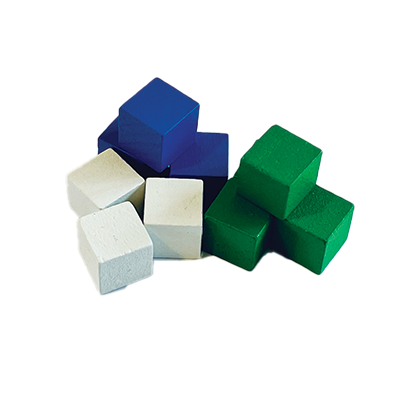
Mark and John: We use small wooden cubes. We like the feel and look of wooden cubes and the material feels appropriate for 18th Century warfare. Since there are so few units, wooden cubes seemed the most aesthetically pleasing and easiest way to handle the game’s needs.
Grant: How many soldier pieces does each side have? Why so few?
Mark and John: The French get three regular cubes, four Partisan cubes, and three Marine cubes, thus ten total. The British have nine Colonial cubes and four regular cubes, thus thirteen total. However, Colonial cubes can be converted into regular cubes at the risk of running out of Colonial cubes. We made it with as few units as possible so each decision on how to use each individual cube becomes critical and difficult. Overall, it gives the right feel of British army numerical superiority, the reliance of the French on their Canadian and partisan forces, and the important role of the British Colonials. Each cube is not meant to represent any specific number or specific units. It tries to represent the overall resources available to the commanders of each side.
Grant: What area of North America does the board cover?
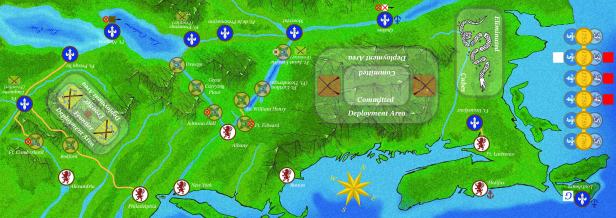
Mark and John: The board covers from Alexandria in Virginia to Québec and the St. Lawrence River valley in Canada, and from Louisbourg and the east coast to Fort Duquesne (Pittsburgh) in the west. Thus, it covers the northeast corner of North America.
Grant: Why did you feel that point to point movement was the best choice for the design? What advantages does this give the game?
Mark and John: More and more, we like the simpler feel of point-to-point movement. We have played many hex games but as we get older and less able to manipulate stacks of units in small hexes, we find point-to-point movement physically easier to play. It was also easier to represent the difficult terrain between the two sides, and the very limited avenues available to get at each other. In effect, there are three main land routes (through Duquesne, through Oswego, and along Lake Champlain) as well as the naval option for the British. Using hexes or even areas for so few actual paths between the two sides would have created a lot of dead space. This approach fit with our goal of limited resources, limited avenues of attack, and thus tougher decisions.
Grant: What is unique about the combat system?
Mark and John: Players have very few units and thus have to use each one carefully. There are no real charts needed and though there is some luck, the players can mitigate it to a degree. This is perhaps one of the keys. You commit cubes one at a time in a battle and can call off an attack to save the remaining cubes for use later if the initial rounds of combat go badly. Perhaps the real unique aspect for us is the need to create combinations between which cubes you commit to a battle. And there are only so many combinations possible in a yearly turn, so you have to judge when to use the bigger combinations and when to cut and run. For example, the biggest combination for the French is a combined force of regulars, Marines, and Partisans. But in the first year, the French player has only one regular, so he can only use this super combo (as we always call it!) once in that year. Where does he want to commit this strong force? Does he prefer to defend a critical fort, or to raid the frontier to eliminate Colonial units, or to attack to secure control of a border location? These are the kinds of decisions we enjoy most in our combat system.
Grant: What type of strategy is needed with this focus?
Mark and John: A very careful use of the very limited resources. All games have that to an extent, but with so few units, players have to hoard their units and use them sparingly. You have to look at the whole year (one turn). You can only use each cube once a year. Committing your best forces early might gain an initial advantage but could then leave you with nothing to defend or attack with later in the year. Each battle, each combat round, and each activation has to be weighed carefully with what needs you might have against an unexpected disaster or opportunity later in the year.
Grant: How does the actual combat play out?
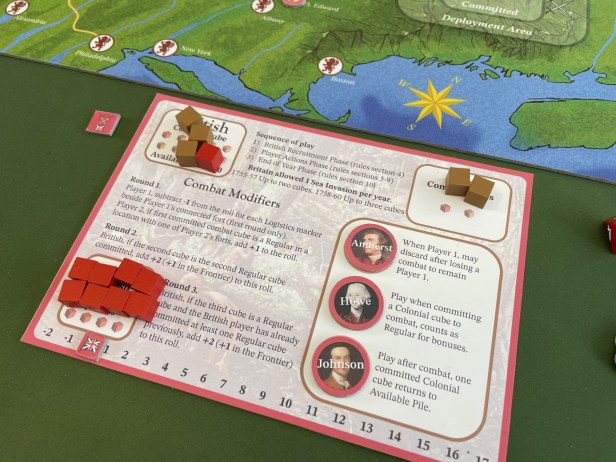
Mark and John: Perhaps an example is the best way to give a feel for combat. The British player declares an attack on a French fort at Oswego. He then commits three of his cubes (the maximum you can ever commit to one combat) to make the attack (two British regulars and one Colonial cube). Now the French player has to decide whether he wants to use precious resources to defend Oswego. It is not a home location, but it is next to two vital home locations, Fort Niagara and Fort Frontenac. He decides to defend with the maximum of three cubes as well (one regular, one Marine, and one Partisan). Round 1, the British player has to decide which cube to commit to the battle. He chooses one of his regulars. He could lead with the Colonial and save his regulars in case it goes badly early but leads with his power! The French player then decides which of his cubes to commit first and he starts with his Marines. Now both players roll the 4-sided die and the number rolled is the Strength gained from that cube for this combat. So if both players rolled a 3, then it is 3 to 3 after the first round. That is a tie and therefore if the combat is ended there, the defender wins ties. Instead, the British player commits his second regular and the French player decides to commit his Partisan. Both players again roll a die to determine what Strength they get for these newly committed cubes. In addition, the British player gets a +2 bonus to this roll because he has committed a second British regular. The French player gets +2 to his roll because he has two different types of cubes in this combat. The British player rolls 2 and adds his bonus to get a total of 4 Strength for this second committed cube. The French player rolls a 4 and adds his bonus to get a total of 6 Strength for this second committed cube. After two rounds, the British player has a total Strength of 7 and the French player has a total Strength of 9. If the combat ends now, the French player has a greater total Strength and would thus win. Still, the British player might at this point choose to call off the attack because he will not get any bonus for his remaining Colonial cube whereas the French player will get another bonus when he adds the regulars to the fight. The British player accepts defeat, saves the Colonial cube for use later in the year, the French player saves his regular cube, and the combat is ended.
Grant: Why did you choose to use a 4-sided die for combat?
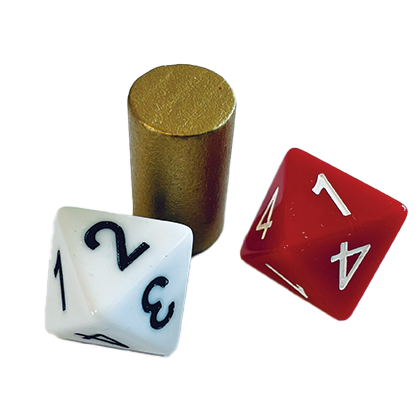
Mark and John: We wanted to have some randomness in combat so that it was not just a math game. But we wanted to avoid wild swings of results between high and low rolls. We experimented with 6-sided dice, 4-sided dice, 3-sided dice, and 2-sided dice. Ultimately after hundreds (literally) of games, we determined for us the 2- and 3-sided dice did not offer enough randomness and combat was almost reduced to mathematics. The 6-sided dice provided too wide a variance of results. A difference between a roll of six and a roll of one overshadowed any strategy or skill in using the combinations and bonuses. Thus, we settled on a die that I personally hate, the 4-sided die (the triangular shape is hard to pick up!), because it gave us the best feel for some randomness but still allowed players’ skill and strategy to have a large impact on the results as well. Form Square Games has brilliantly come up with a way to generate a result of 1 to 4 using an 8-sided die, and that resolves my hatred of our chosen dice!
Grant: I see that each player has several paths to victory. What does this look like?
Mark and John: The multiple paths to victory offer the players strategic choices during the game and between different games. But these paths are not always compatible with each other, and thus players have to choose which to pursue and if/when perhaps to switch to another approach. The British player has two main options, either go for points gained by capturing enough French home forts to win without having to conquer all of Canada, or if his losses on the frontier become too heavy or the French gain too many points in the border locations, he has the option to switch to an all-or-nothing conquest of Canada and ignore points. The French player can also win on points early on by attacking border locations, but he can instead choose to focus more on frontier raiding to eliminate Colonials and win through the destruction of the Colonial military. It is difficult, however, for the French player to do both. Thus, the competing needs of the different paths to victory create tension for each player when determining his strategy year by year and over the course of the entire war.
Grant: What type of an experience does the game create?
Mark and John: We wanted an experience that becomes so nerve-wracking that you might just forget to drink your newly opened beer. John did this in one of our test games and it became our litmus test for how good the game was or was not. He opened a beer, we sat down to play, it was one of the better nail-biting contests, and when it was over, he declared he needed another beer. He picked up the open bottle and it was still full! He had become so immersed in the game that he had completely forgotten about his beer. That is the kind of experience we hope people get by being drawn into the excitement of a tense, quick playing game of nerves.
Grant: What are you most pleased about with the design?
Mark and John: First, we set out to create a game we enjoyed playing. Once we had done that, our next goal was for somebody else to play it and enjoy it. When Form Square Games expressed interest and said they had had others play it and respond favorably, we were ecstatic. Having them publish our game is the ultimate goal we had pursued for years. For the game itself, as mentioned above, we wanted a game that is quick to setup and play (a typical game lasts an hour or so and can be set up for a rematch in a couple minutes), and that creates tension and tough but meaningful decisions. We have played this game to completion more than any other game we have played, and still look forward to playing it again!
Grant: What other designs are you working on?
Mark and John: We have tinkered with the idea of using this system to create a game covering the American Revolutionary War. We think it would work pretty well but we have not gone very far with that. We have also designed and played a game on the Battle of Ligny in 1815, which we enjoy but it is not fully finished or tested either. We want to represent aspects of tactical combat that we have not seen in other games and have had some good results. But ultimately, these two were designed again for our own enjoyment and we have not put in the serious work yet required to transform them into publishable games.
If you are interested in A Strong War: The Conflict for North America 1755-60, you can back the project on the Gamefound page at the following link: https://gamefound.com/en/projects/form-square-games/jersey-new-jersey–a-strong-war
-Grant


Great interview–it sounds like an interesting game, and the designers sound like good people to play a game with. I, too, hate four-sided dice, and I like the solution Form Square Games came up with.
LikeLiked by 1 person
They are like caltrops. Them and legos should be banned from the face of the earth to ensure foot safety for all!
LikeLiked by 1 person