Over the past couple years, we have played a few venerated and respected series games from Multi-Man Publishing for the first time that frankly I had initially turned my nose up at for various reasons. These reasons were not really anything important or truly about the design or mechanics but included things like price, graphic design, style and somewhat because of the complexity and reputation of complexity of those systems. These series included first the Standard Combat Series (SCS) with our first game being Rostov ’41 and now the Battalion Combat Series (BCS) with our first game being Arracourt and since we have played several other volumes including Brazen Chariots and Baptism by Fire. I must admit here that I am actually embarrassed that I hadn’t played those series and readily admit that I just discounted and dismissed them out of hand. I am so very glad that we repented of our stubbornness and found this system because it really is very, very good at what it is trying to teach and demonstrate about warfare at this scale.
So what is the Battalion Combat Series? The Battalion Combat Series is a system designed to model combat at the grand tactical scale from late World War I to the present day. The system has seven published games including Last Blitzkrieg: Wacht am Rhein The Battle of the Bulge (2016), Baptism By Fire: The Battle of Kasserine (2017), Brazen Chariots: Battles for Tobruk, 1941 (2019), Panzers Last Stand: Battles for Budapest, 1945 (2021), Arracourt (2022), Valley of Tears: The Yom Kippur War, 1973 (2023) and now Inflection Point: The Battle for Kalach and the Battle of Chir (2025) and was created to in some ways fill the gap that existed between the operational and the tactical. In my limited experience, the system truly feels much like a smaller scale game, as it deals with various support units and stacking limits are enforced to just a few combat units. The system is fairly crunchy, meaning there are lots of DRM’s and combat modifiers, and attempts to model accurately combat and the importance of both supply on the one hand and command and control on the other. The hallmark of the system is that the games in the series are very playable. I am no expert but this system is made for the gamer while some of the others from MMP, such as OCS, appear to be more for the accurate modeling of warfare on an operational scale. Still playable, but maybe only after the gamer has gained experience with other systems to draw upon that knowledge to assist in digesting the more complex nuances. In this post, I would like to cover some of the basics of the system and deal with things like the way it handles supply, combat, combined arms, activation and air power as well as give you a taste for what this volume in the series has to offer. Overall, I have been very impressed with BCS and have very much enjoyed playing it. In fact, I am really starting to love the series and believe it might be taking over my love of the Standard Combat Series from MMP.
One of the best parts about this new volume in the series is that it is actually 2 games in the same box. One game which is smaller, with fewer counters and formations and that uses a smaller version of the board included in the game and one that is the full campaign with more counters and formations, a larger board and is much more involved. Overall, I would say that the BCS is a fairly straightforward series even for someone who is a beginner and has less experience with the BCS system like me. I think that I thought they were designing Arracourt as the entry to the series, and I still think that is the case, but this volume has some of the same flexibility and approachability that some of the larger titles don’t necessarily have. I feel that players can cut their teeth on this one using the smaller scenario while getting comfortable with the rules and system before you attempt the larger scenarior or even other larger games in the series. I also feel that the game requires somewhat of a paradigm shift before playing. What I mean by that is really two fold.
First, I really feel that usually these big hex and counter wargames are set in their combat methods, namely focused on odds based Combat Results Tables and counting up combat factors to get the perfect odds, and require a bit of calculation. But BCS doesn’t use a traditional CRT but breaks the combat down into more of a collection of DRM’s based on many factors.
Second, the game also has very low counter density, with the scenario we played having about 40 counters per side on the map at any given time, and stacking limits are just 2 combat units with other counters also allowed such as support units or HQ’s. There are not enough counters here to create the long contiguous line or wall of units that are typical in some of the larger systems, which lends this one to a bit more maneuvering of units to get into good position while using terrain to attempt to isolate and cut off units from supply or to prevent the enemy from doing the same to your units. This created somewhat of a back and forth dance for us that kept my focus and attention and was really quite entertaining. Supply is important to the system but not as focused on it as say the Operational Combat Series (OCS). The players must manage their HQ’s and their combat trains to keep their units in full supply and this becomes somewhat of a different type of dance that sees players cautiously keeping their units in a loose perimeter to prevent a freak breakthrough or run around to get to the back of the formations to take out supply sources and cut off units. I really liked the scale and feeling of this BCS system and had a very good time in trying to learn and understand it and also trying to figure out the best strategies to engage.
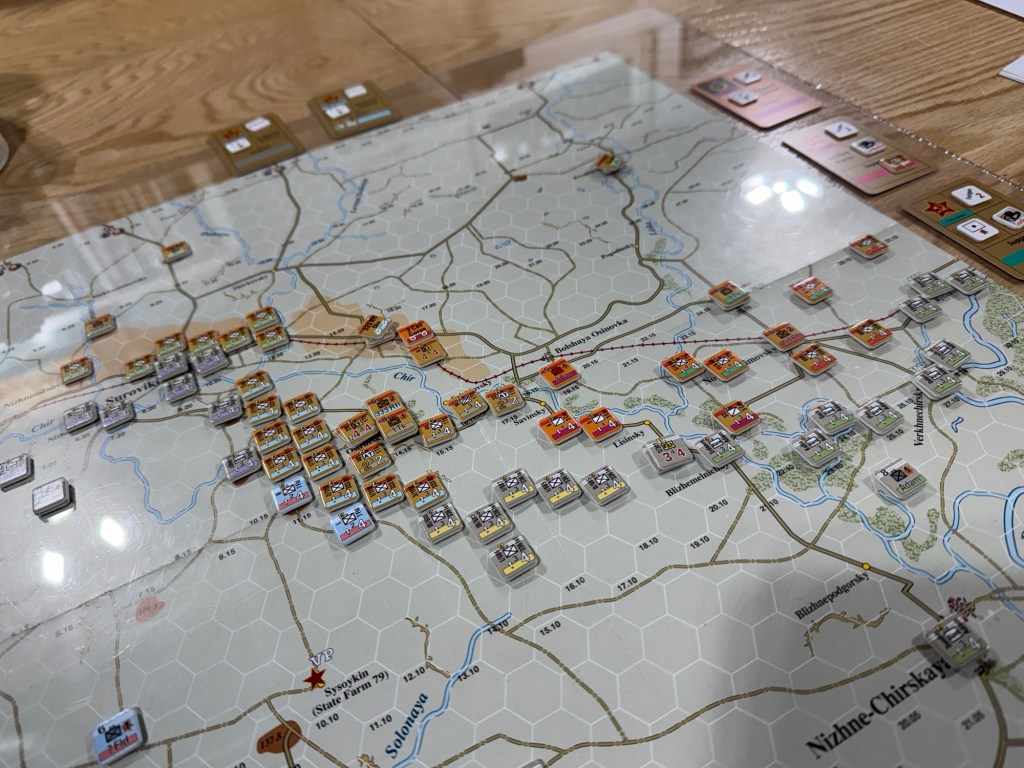
The counters included in BCS Inflection Point are dual sided but the back side is not to show a reduced unit as is normal with these wargames. The front side is the unit’s move side while the back side is its deployed side. Each of these stances is very important and must be used by each player to get the most out of their units and to take it to their opponent.
Let’s take a closer look at a few examples of counters involved in the game. First off you will notice that the counters are pretty standard using NATO symbols to identify units type with various numbers listed on the top of the counter to include their Battalion, as well as whether they are a two step unit and have breakdown units that are held off map. The units have a colored band shown at the bottom of the counters that identify them as units of a certain formation which will be activated when their activation marker is chosen by the player as this game is Chit-Pull. The 3 numbers printed on the bottom of the counter include from left to right Combat Factors, Action Rating and then Movement, which consists of three different values and two different types. The Red value shown on the armor and mechanized units is the TAC (Tactical) movement, which is significantly better than other movements. White value movement (not shown in the picture below) represents leg unit movement and Black movement is truck movement. Truck movement can get 1/4 movement on primary roads so they can be used to get units up to the front quickly to react and fill holes or vulnerable spots on the front.
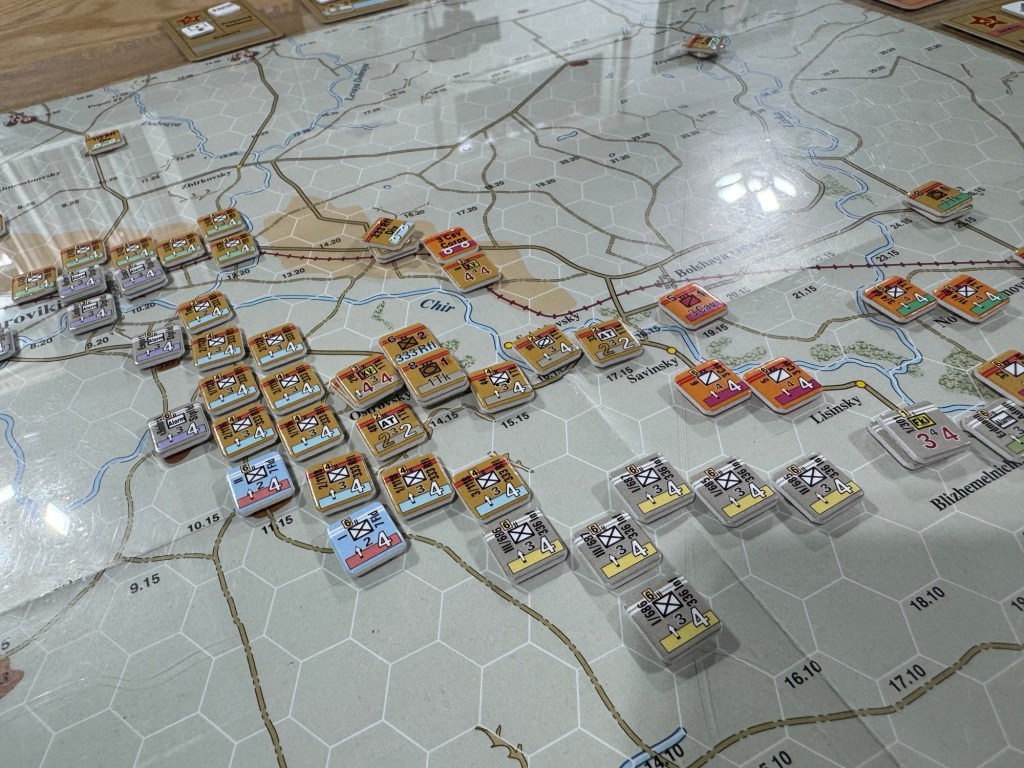
Another very important numeric value shown on the counters is their Action Rating, which is shown under the NATO symbol above the combat and movement values. This value represents such items as the unit’s leadership, training, morale, and other soft qualities. On some counters the Action Rating doesn’t change when the unit is flipped for movement or deployment. This value is compared against enemy units in combat and provides a DRM if the attacker is superior to the defender’s value. This rating is very important and we learned quickly to make sure our good units were leading our most important attacks. One other point of note, armor units typically have their Engagement Range increased when they flip from Movement to Deployed. This is a very specific armor on armor combat bonus.
One other important aspect of the counters is the concept of a Combat Train, which is each of the Combat Commands’ mobile supply source that stretches back to the identified main supply source. In BCS, these Combat Train counters are represented by an individual formation counter that has wheels shown on the bottom and then lists the Combat Command number. The placement of these Combat Trains is a very interesting and somewhat precarious part of the design that we really enjoyed. Each Combat Command can only place their Combat Trains in or adjacent to hexes of the various yellow highlighted roads shown on the map. Their resulting Main Supply Route or MSR must then follow along the highlighted road back to one of the various Supply Sources shown on the map and identified in the specific scenario setup. This concept is very important and in my mind really shows the focus of supply on combat and activation as this will add a DRM to the activation SNAFU roll that precedes each unit’s activation to see if they can perform a full action or just a partial.
The really interesting thing about activation in the game was this concept of Fatigue. A formation will track its Fatigue Level with a set of numbered Fatigue markers. The Fatigue level will progress from Fresh through various Fatigue Levels including 0 (which is not considered Fresh), 1, 2, 3 and 4. Fatigue 0 is considered normal (but remember that this is not considered Fresh as Fresh is better than normal) while Fatigue 4 is considered to be exhausted. These Fatigue levels will affect the players SNAFU rolls and will equate to a negative DRM equal to its level. For example, Fatigue 2 is a -2 DRM. Fresh Fatigue gives a +1 DRM but don’t expect much help here as combat and even movement can wear your soldiers down effecting their coordination and cohesion resulting in the addition of a higher number Fatigue marker which will cause a much more difficult time in activating. This Fatigue is tracked by keeping the appropriate Fatigue level marker with the HQ counter so you know where you stand.
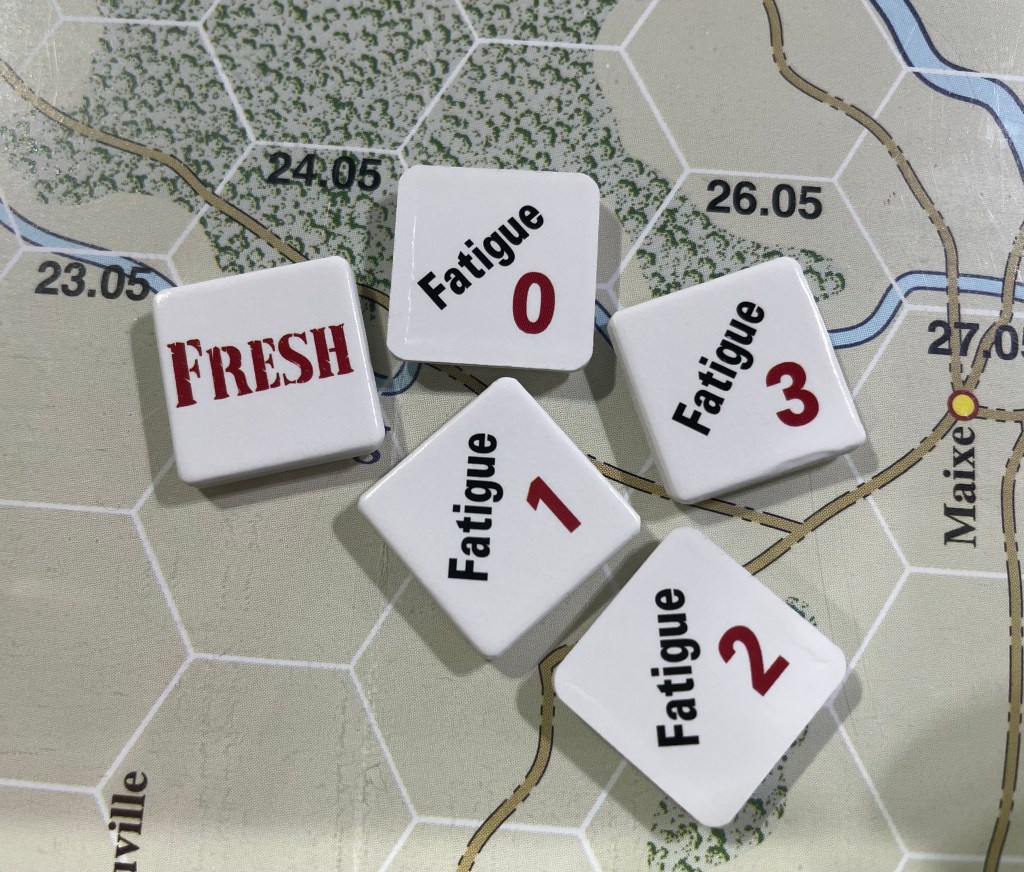
The way you will increase Fatigue is interesting as it takes a roll of the die only when certain actions are taken. Each of these actions that can cause Fatigue to increase include placing an Objective Marker (which is like choosing what you are going to attack, barrage or to take control of Victory hexes), conducting any type of engagements or fire attacks, executing a second activation or a full or partial SNAFU. Basically, everything that a formation can do can cause Fatigue. You get to roll a die and consult the Fatigue Increase Table and this table is based upon what type of action you just took as to how likely it is that the result will cause additional Fatigue counters to be added to your HQ. I really liked this part of the system as it just felt really interesting and was a very unique way of handling this concept of battle weariness and effectiveness. As we know, as soldiers fight, they get wounded, run low on ammo, get tired and ultimately become combat ineffective and all commanders must monitor this and make sure that their forces are not pushed beyond their capability. When Fatigue gets too bad, the formation can simply commit to conducting a Fatigue Recovery action when it is activated. No roll needed. The player just reduces the fatigue number down one spot toward Fresh.
I know that a lot of you really love the dense and involved hex and counter games and love your stacks of units lined up in neat lines stretching across the board forming the front. I am not in that group and would much prefer a tight and low counter density game because of the reasons of playability. See my fingers are like small smoked sausage links and I have the finger dexterity of an elephant so playing around stacks of 4-10 counters really makes me nervous ad invariably I will lose grip on my tweezers or just brush up against a stack and cause pandemonium. For me, I really liked the lower counter density of BCS and the scenario of Inflection Point that we chose to play.
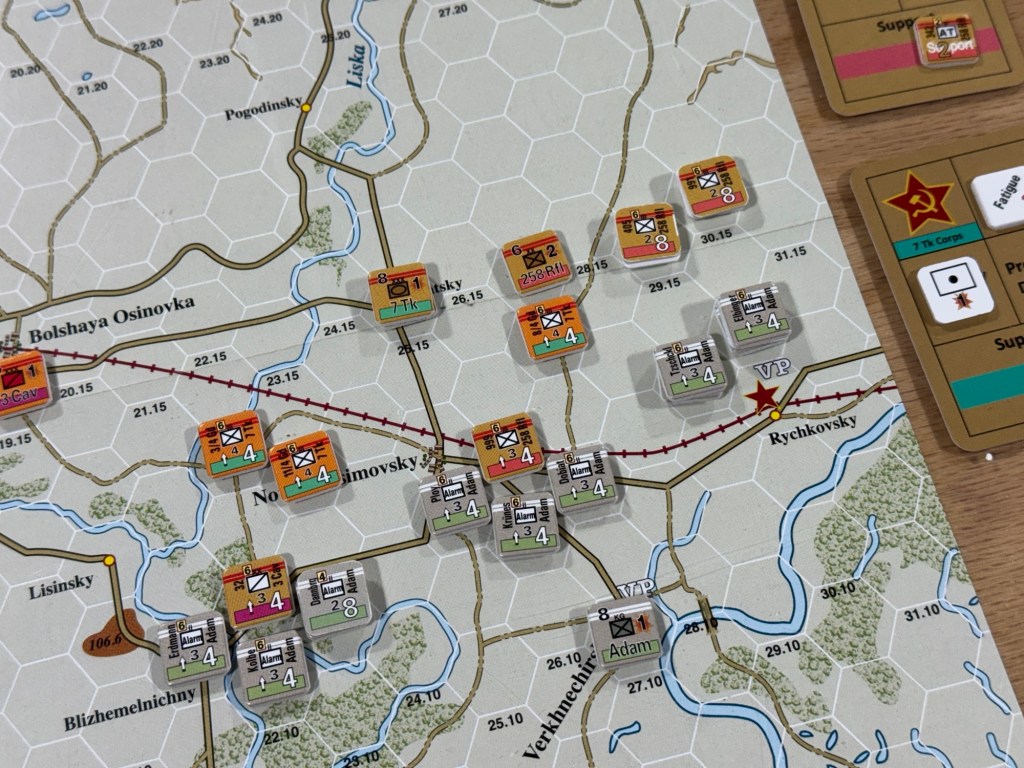
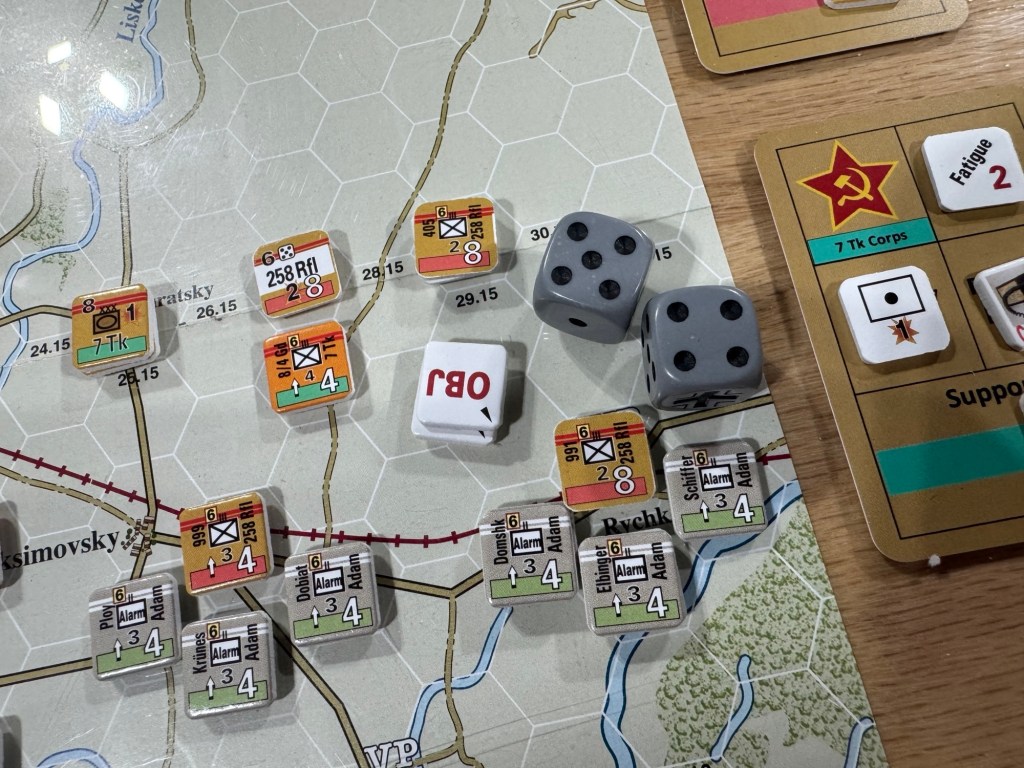
The other benefit that I saw from this lower counter density was the concept of trying to scrape too little butter over a large piece of bread. There just never seemed to be enough counters at my disposal to truly cover the battlefield from all avenues of approach and angles and I really found myself searching the terrain and crossroads to select the perfect spots to intercept advancing Soviet units as they moved on the victory hexes that I was tasked with defending. It really caused me to study the board and situation to find the weak or vulnerable parts of my defensive plan and look for ways to improve or back up those weaker areas with reserves or a second line of defense.
To also combat this counter density issue and to keep your formations and stacks all organized, we have purchased counter sled cards that are available online to buy or you can find them on Board Game Geek for several of the volumes that you can print off. These typically hold your conditions like your Fatigue counters, your Prepared Defense posture counter and and any available Support Points. These are a life saver and I highly recommend them. You can get a glimpse of the cards in the above and below pictures. You can purchase these at Make Playing Cards dot com: https://www.makeplayingcards.com/search/search.aspx?ne=inflection%20point
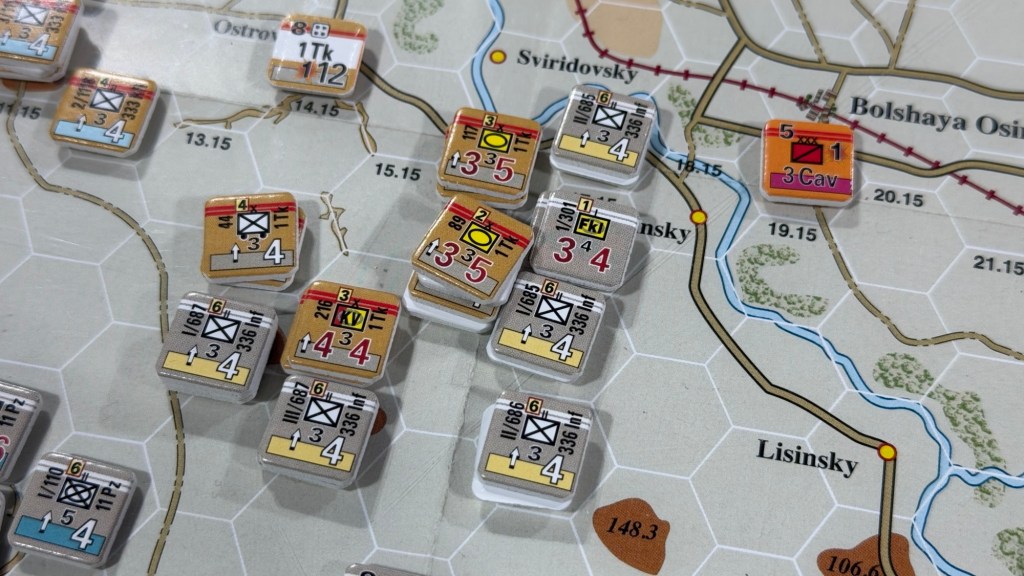
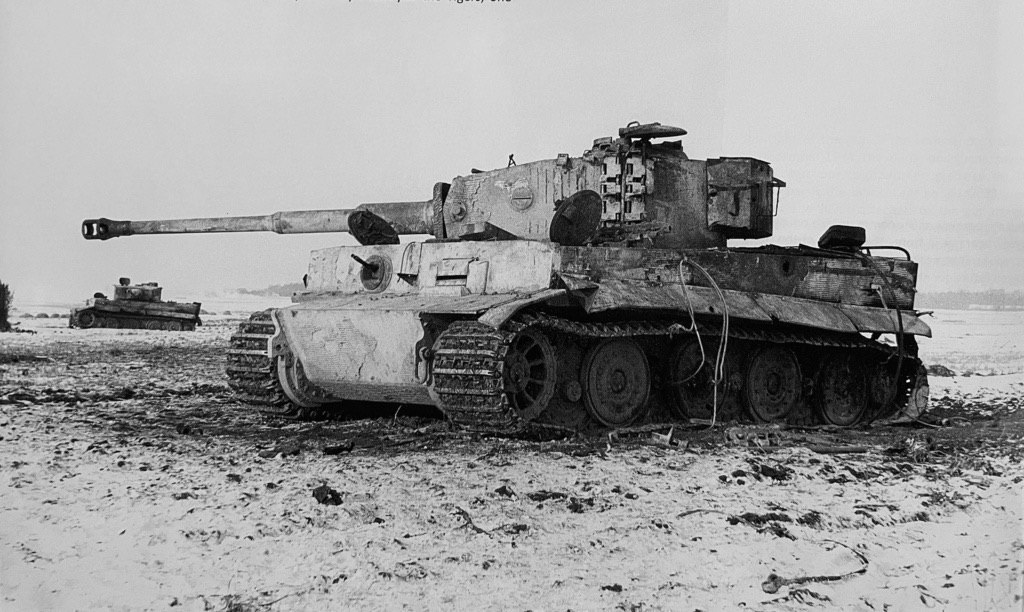
Chrome. We all like it when it is included in the games and this is the case with Inflection Point. In the game, there is a single German tank unit that is radio controlled and is somewhat of a glass cannon as it does some damage but if attacked will not stand up for long. The counter represents a Funklenk Tiger, which was a radio controlled tank that was remotely operated to drive up to a target and open its bins that had a bunch of explosives then drive away and the explosives would be remotely detonated. Mid-war Tigers were used because of their thick armor (prior to that Panzer III’s and StuG’s had been used). Characterized by additional bins, and large radio antennae, the interior of the Tiger would be stripped of heavy ammunition and other unnecessary equipment to make room for the explosives and RC controls.
Finally, I really liked how this game in the series was presented. There are actually 2 separate but related games contained in the box. A smaller game covering Kalach and then the larger game covering both Kalach and Chir River.
Quoting from the game page, we read the following:
Inflection Point is a BCS game depicting two important but relatively unknown battles before and after Stalingrad. The Battle for Kalach was fought in July 1942 following Case Blue, the successful drive into southern Russia. Paulus’ Sixth Army intended to encircle and destroy the Soviet Armies and walk into Stalingrad. The Soviets were still recovering from Operation Barbarossa the year before. The result of the battle set up the epic urban fight that was the turning point of the Eastern Front. By December 1942, the Sixth Army was trapped at Stalingrad by a more capable Red Army. In the Battle of Chir River, the Soviets looked to exploit their gains and prevent German relief operations over a portion of the Kalach battlefield. Initial success along the Chir River changed when the energetic 11th Panzer Division was thrust onto the scene. These two battles show the progression of the Red Army into an offensive army that could start fighting toe-to-toe against the invaders. For the Germans, the days of blitzkrieg successes were waning and were being put on the defensive. There was a marked inflection point around Stalingrad.
They took this history and designed a smaller mini-game on the Battle of Kalach and then the larger game dealing with the whole enchilada or the Battle of Kalach and the Battle of Chir River. The smaller game uses counters that represent the same units that you will find in the larger game but that have special markings on them identifying them as belonging to this game. You will not use these specific counters in the larger game, as it has its own set of counters and a larger map that contains the area of operations around Kalach. I thought that this approach was sheer genius and really hope that people can use this game as a jumping on point for the series. I still think that Arracourt is the prime first game in the series but this one also provides that in a novel and very attractive way.
As is usually the case with these posts, there are a lot of additional parts of the game and series that I didn’t get to cover, but I wanted to give you my first impressions and identify the parts of the design that really spoke to me. This game was a real wargame. An enjoyable wargame at that. A game that used lots of familiar concepts, along with some that were new, such as the dreaded SNAFU roll, but created a game that was very playable yet meaty enough to fulfill my hunger for a good old fashioned hex and counter game. The combat was not odds based so that was also very different and it was really refreshing to be able to play a system that I feel wasn’t simply a clone of other successful systems out there but that attempted to try some new things and do them in a unique and interesting way.
If you are interested, we posted the following unboxing video on the YouTube Channel a few months ago:
Thank you so much for following along and I hope that I was able to do this game the justice it deserves.
-Grant
 The Players' Aid
Thanks for sharing Grant! I actually also passed on MMP series in the beginning mainly due to price reasons but since I first time played BCS – Panzers Last Stand – I really fell in love with the system. You actually now mobilized me to get this last volume as smaller, quicker scenarios is exactly what I was looking for.
LikeLiked by 2 people
The 2 games that I would recommend to a beginner for the BCS system are Arracourt and then Inflection Point.
LikeLiked by 2 people
Seems I will invest into Inflection Point 🙂
LikeLiked by 2 people
minor corrections: you wrote “this game is Chit-Pull” which I don’t think is correct, you wrote “White value movement (not shown in the picture below)” but it does seem to be shown in the picture below the text, you wrote “effecting” instead of “affecting”
LikeLike
“Funklenk Tiger, . . . RC controls.”
That paragraph reads like an AI hallucination. None of it is true.
LikeLike
Great article.
The BCS is a superb system that needs all attention.
Certainly in these times of almost hollow euro wargaming times.
It is odd that you only recently discovered its incredible potential.
Arracourt is acmust have!
Btw … there is another MMP system out there that is equally a gigantic wargame simulation.
The Grand Tactical system with even better counter Art and deeper tactical insight.
Its introduction game is called Strike and Counter Strike and to me personally certainly Race for Bastogne where you simulate the advances of 2 Panzer and Panzer Lehr towards Bastogne.
So many superb wargames, so little time…
😔
LikeLike