With this My Favorite Wargame Cards Series, I hope to take a look at a specific card from the various wargames that I have played and share how it is used in the game. I am not a strategist and frankly I am not that good at games but I do understand how things should work and be used in games. With that being said, here is the next entry in this series.
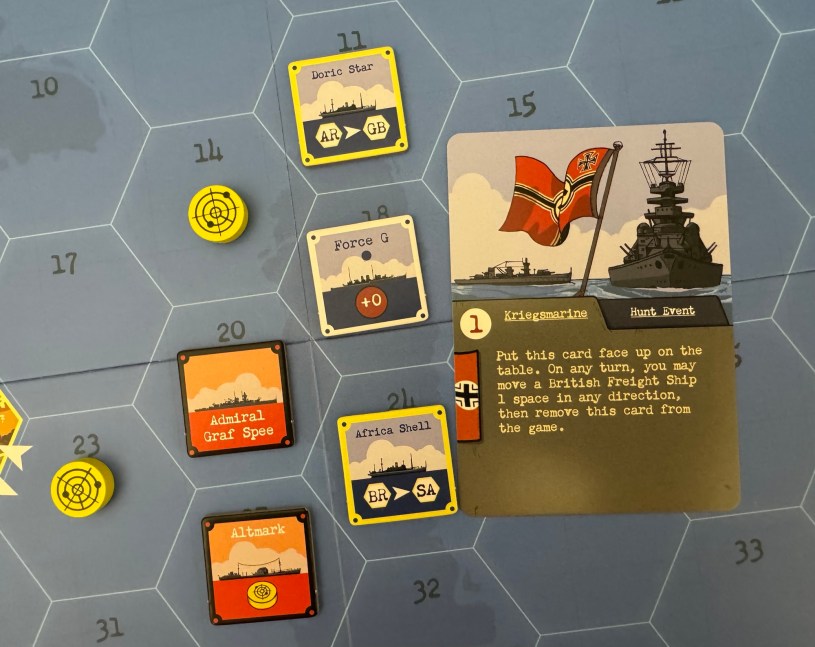
Card #57: Kriegsmarine from The Hunt from Salt & Pepper Games
I have played several hidden movement games over the years and enjoyed them all. Some of these titles have included wargames such as They Come Unseen from Osprey Games, Sniper Elite: The Board Game from Rebellion Unplugged and Bomber Command from GMT Games as well as a few board games including Hunt for the Ring from Ares Games. The concept of moving cautiously, attempting to evade pursuers, all while trying to locate and acquire or destroy objectives makes for a very interesting gaming experience. These situations can make for some really tense games that cause your head to ache and your wits to be tested. But they rely on some bluffing as well. Trying to force your opponent to anticipate where they think you should be and then trying not to be there. A really great mechanic in board games but not always easy to pull off and make for a very playable and interesting game. In 2022, we played a new design from Matthias Cramer and Engin Kunter that took this hidden movement concept and put it into a historically based game about the struggle over control of the South Atlantic between the British Royal Navy and the German Kriegsmarine during the early years of World War II called The Hunt from Salt & Pepper Games.
The Hunt is a Card Driven Game where the German player has to attempt to stay hidden while trying to sink merchant shipping as the Royal Navy hunts for them throughout the South Atlantic. The players each have asymmetric actions to use to accomplish their missions and each has a tough time doing what they have to do. But, if they manage their cards wisely, using them as effectively as possible, they can successfully either evade their pursuer or catch their prey.

The Kriegsmarine card is one of the few cards that are played to the table and remain active and available for the German player to use when they so choose. The card gives the German player the opportunity to use the card on any turn to move a British Freight Ship 1 space in any direction. This card is best used to bring a Freight Ship into a space that can be easily reached by the Graf Spee or even into the space occupied by the pocket battleship.
The thematic connection here is strong as the overall maneuvers and positioning of the Kriegsmarine has an effect to draw away British warships to respond to other action in the North Atlantic and take precious assets away from the hunt.
The Kriegsmarine, translating literally to War Navy, was the navy of Nazi Germany from 1935 to 1945. It superseded the Imperial German Navy of the German Empire (1871–1918) and the inter-war Reichsmarine (1919–1935) of the Weimar Republic. The Kriegsmarine was one of three official branches, along with the Heer and the Luftwaffe, of the Wehrmacht, the German armed forces from 1935 to 1945.

In violation of the Treaty of Versailles, the Kriegsmarine grew rapidly during the German naval rearmament in the 1930’s. The 1919 treaty had limited the size of the German navy and prohibited the building of submarines.
In January 1939, Plan Z, a massive shipbuilding programme, was ordered, calling for surface naval parity with the British Royal Navy by 1944. When World War II broke out in September 1939, Plan Z was shelved in favour of a crash building programme for submarines (U-boats) instead of capital surface warships, and land and air forces were given priority of strategic resources.
In the next entry in this series, we will take a look at Siege Engines from Stilicho: Last of the Romans from Hollanspiele.
-Grant
 The Players' Aid