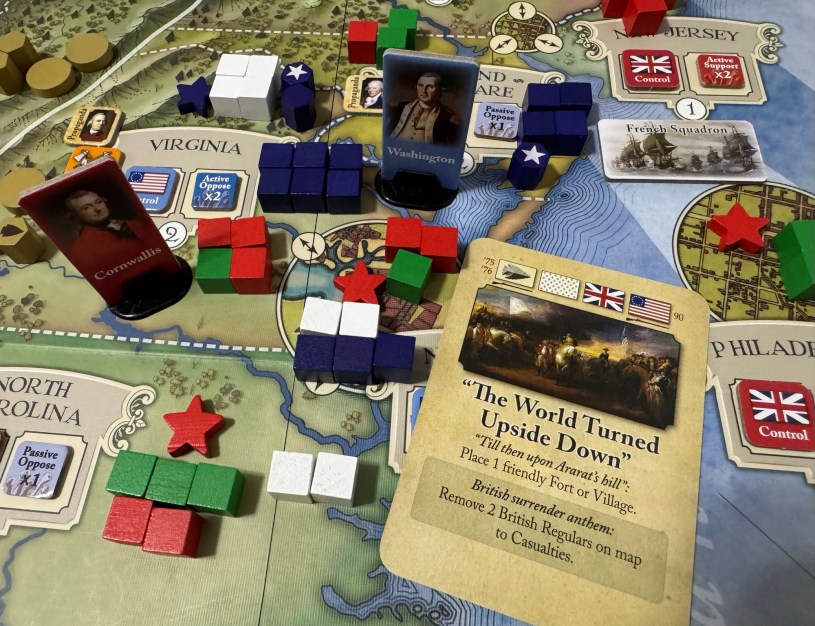
With this My Favorite Wargame Cards Series, I hope to take a look at a specific card from the various wargames that I have played and share how it is used in the game. I am not a strategist and frankly I am not that good at games but I do understand how things should work and be used in games. With that being said, here is the next entry in this series.
Card #53: The World Turned Upside Down from Liberty or Death: The American Insurrection from GMT Games
In case you didn’t know, I love Liberty or Death: The American Insurrection! This is my 2nd favorite volume in the COIN Series and is such a fantastic game filled with the history of my favorite historical period the American Revolutionary War. Liberty or Death was the COIN Series’ first foray into non-modern warfare and takes us to the 18th Century and the days of the Brown Bess musket, the 18 pound siege cannon and nice and tidy formations better suited for a gentleman’s war. The focus of the game is the struggle of the American Patriots against their mother British government as they have made their intentions clear to become independent with the Declaration of Independence. The game is a multi-faction treatment of the American Revolution, which includes the Patriots and their allies the French against the British and their reluctant allies the Indians.
Liberty or Death is a 1 to 4 player game focused on all aspects of the struggle including financing operations with Rabble Rousing, infiltrating British held cities to Skirmish, blockading major cities with the mighty French fleet, Raiding the frontiers with the Indian nations, the spread of propaganda to build support for the revolution, fort building and small scale battles. So, with this short description you can see that this game is not a “traditional” wargame but does contain some armed conflict. So a game about the American Revolution that isn’t focused on battle you say? How can that be? Well, I will tell you that this game is probably a perfect representation of the multifaceted struggle that wasn’t necessarily decided on the field of combat, but by the little actions of many behind the scenes characters. Yes battle will decide the control of major areas of the board and decide the fate of troops as they must be concerned about being in supply through a network of forts but the game is so much more than just rolling some dice and consulting a CRT!

With this card, I am mainly highlighting it because of the impact of the event on the war, which brought it to a conclusion and forced the British to come to the negotiating table to get out of the conflict. The event is somewhat underpowered and when it comes up in the game, it is a crap shoot as to whether I would take it or not, either as the British/Indians or the Patriots/French. It is very circumstantial and can be good if the situation warrants it but frankly for an event that was this impactful I would have liked to see something better. But, that is beside the point of the post.
For the top portion of the card, which is to benefit the British/Indians, they will get to place one Fort or Village out on the board. I mentioned that this was underpowered but being able to directly place a Fort or a Village, under the right circumstances, can be be very beneficial as this is normally a multi-step and multi-turn process of Gather/Muster to then place out a Fort or Village by removing a specific amount of units. And if you use the event at the right time, possibly prior to a Winter Quarters Round and a Victory Check, you could find yourself gaining the number of Victory Points needed to tip you over the top and win the game. Placing out a Fort or Village is very powerful….just maybe not as powerful as this event would have been if the British had somehow fought off the Patriots and French to escape Yorktown and live to fight another day.
One side note. I very much like the mention of the phrase “Till then upon Ararat’s hill…”, which is a lyric found in an English ballad, likely originating in the late 19th or early 20th century. The line is found in a collection titled A century of ballads, and the context of “Ararat’s hill” likely alludes to the biblical Mount Ararat, where Noah’s Ark landed after the flood (Genesis 8:4), symbolizing a place of safety, new beginnings, or an end to a long struggle.
The bottom part of the card is designed for the Patriots/French and can also be used at the right time to tip the scale and push the French into a position to win as removing 2 British Regulars to Casualties will move the CBC (Combined British Casualties) to greater than CRC (Combined Rebellion Casualties), which is one of the 2-part Victory Condition for the French. This card doesn’t necessarily offer the Patriots much in the way of victory but removing a few British troops from a key battleground can definitely make it simpler to defeat them in a future battle and sway the battle for the hearts and minds of the people their way with a Win the Day. This event is very situational and must be treated as such as taking a full boat of Command and Special Activity can be more beneficial than these offered benefits.

The World Turned Upside Down is an English ballad. It was first published on a broadside in the middle of the 1640’s as a protest against the policies of Parliament relating to the celebration of Christmas. Parliament believed the holiday should be a solemn occasion, and outlawed traditional English Christmas celebrations, which were seen as too closely associated with Catholicism. There are several versions of the lyrics. It is sung to the tune of another ballad, “When the king enjoys his own again”.
Its origin is in the Scripture: “But the other Jews which believed not, moved with envy, took unto them certain lewd fellows of the baser sort, and gathered a company, and set all the city on an uproar, and assaulted the house of Jason, and sought to bring them out to the people. And when they found them not, they drew Jason and certain brethren unto the rulers of the city, crying, ‘These that have turned the world upside down are come hither also; Whom Jason hath received: and these all do contrary to the decrees of Caesar, saying that there is another king, one Jesus.” Acts 17:5–7
And according to American legend, the British Army band under Lord Charles Cornwallis played this tune when they surrendered after the Siege of Yorktown on October 19, 1781. Customarily, the British Army would have played an American or French tune in tribute to the victors, but General Washington refused them the “honours of war” and insisted that they play “a British or German march.” Although American history textbooks continue to propagate the legend, the story is almost certain to have been apocryphal as it first appears in the historical record a century after the surrender.

I guess that is an example of the victors writing history and frankly I don’t care! This is an amazing painting, an amazing story and the culmination of one of the greatest events in human history (IMHO). The end of the American Revolutionary War, the besting of a major world power in England and the defeat of one of the largest and best trained militaries in the world by a gaggle of poorly trained and outfitted revolutionaries consisting of merchants, craftsmen, traders, farmers and everyday average folk is certainly deserving of such a grand and fitting song being played, whether it actually was or not.
In the next entry in this series, we will take a look at Barbatio from Barbarians at the Gates: The Decline and Fall of the Western Roman Empire 337-476 from Compass Games.
-Grant
 The Players' Aid
I love this game. I need to get it on the table more often. I hope Rally the Troops or Board Game Arena can get it online (though I’d prefer Fire in the Lake). As for the card, I take the unshaded portion most of the time. The shaded portion isn’t super powerful, IMO.
The board for LoD is just a beauty to look at.
LikeLiked by 1 person
It is pretty. I do wish they would put Liberty or Death on Rally the Troops! but also want Fire in the Lake.
LikeLiked by 1 person