
I love well designed solitaire wargames and have played many of them over the past 8 years or so. My first experience with a White Dog Games product was with Solitaire Caesar designed by David Kershaw. This was a very good game that I played dozens of times over the pandemic when I was locked away at home for those 4 months. Since I have played more of his games including World War Zeds: USA, Irish Freedom, The Night: A Solitaire Zombie Attack Board Game and The Mog: Mogadishu 1993 to name a few. David’s games are always very engaging, interesting and well put together and create a very good play experience. Recently, White Dog Games announced a new solitaire wargame set during the conquests of the Mongol Empire led by Genghis Khan called Empire of Grass: The Conquests of Genghis Khan. I am very interested in this one, and have already purchased a copy, but I recently reached out to David to see if he would share some information about the design and he was more than willing to accommodate the request.
Grant: Thank you so much for being willing to come back to the blog David. What is your new game Empire of Grass about?
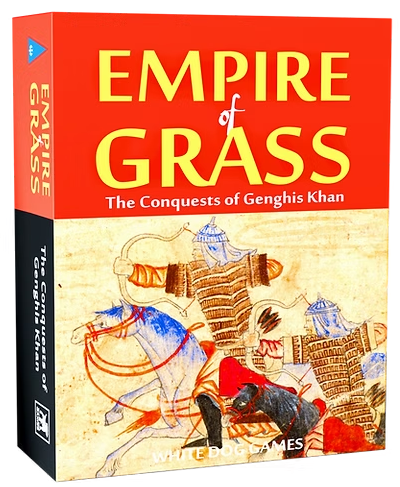
David: Empires of Grass is a solitaire game about the conquests of Genghis Khan (sometimes spelled, phonetically, as Chinggis Khan). You play the role of the Khan who subdues, first his steppe rivals, and then the “civilized” nations beyond the great grass steppe.
Grant: Why was this a subject that drew your interest?
David: Someone put up a thread on BoardGameGeek asking what games there were about the Mongol Empire. Very few it turned out, and none solitaire. I had always had an interest in the various Steppe empires and so this got me thinking about the subject and how it could be approached. I thought solitaire was best because otherwise someone just gets to play a bunch of disparate nations who are quite short-lived as soon as the Mongols turn their attention towards them.
Grant: What is your design goal with the game?
David: The key goal was to put you in the shoes (stirrups?) of the Khan, making decisions in the same way. Therefore, the goal is not a portrayal of the various tribes, kingdoms and other nations that made up the world around the Mongols, but rather the focus is on your goal, which is to create your own Empire of Grass.
Grant: What other designs inspired you in making this game?
David: Maybe something like Carcassonne where you lay tiles to create the city? Also, diceless combat probably comes from my development work with Clint Warren-Davey and his Gallipoli: Ordered to Die game.

Grant: What sources did you consult to get the historical details correct?

David: Most important was the The Historical Atlas of the Great Khans by J. C. Nelson. It has maps, and maps are very useful when you are designing a game which is hugely driven by the building up a map of the Mongol Empire.
Grant: What elements from the conquests of Genghis Khan did you need to model in the design?
David: The following were the key things I wanted to get in the game:
• The terrain – the grassland (steppe) biome is distinct in determining the kind of forces to be encountered on a card and whether you can raise more troops. Other terrain is also critical for determining the size and type of force you are likely to encounter – from utter wastelands through to heavily populated urban areas or huge nomadic forces.
• You see things as the Khan did – each card you choose is the direction you want to go to expand the empire. But other cards can get added by the game system – these are enemies, probably foolish civilizations who executed your ambassadors and will soon learn what such folly will reap.
• The ability to recruit other nomadic tribes into your forces. This was one thing Genghis did well, subverting the traditional internecine clan rivalries into a single force. But it didn’t always work and the rise of his empire is littered with rebellions and desertions from tribes that just didn’t see it his way (at least not until they were “persuaded” otherwise).
• Taking cities is messy and not without losses for Nomads until they can get siege engines – although catch 22 is that they need a city and the engineers there to help them build one.
• Diceless combat. If the enemy is known then you can pretty much plan around it, but whenever you move to a new card the enemy is unknown so you have to take a calculated risk with what forces you use to take it.
• An uncertain ending. The Khan will eventually die, but you cannot be sure exactly when. Victory is determined at this point, so you cannot throw everything at a last turn, because it might not be the last turn.
Grant: As a solitaire game how does the AI function?
David: The game system uses the following areas of unpredictability to guide what happens:
• Laying of new cards creates units which, while can be guessed at based on the card’s terrain type, are not certain.
• An events phase will select a card at random which will then cause an event based on the status of the card in the empire – could be good, could be bad.
• Your allies are not reliable – there are 3 colors and one of them each turn will misbehave. You can manage this, but at a cost.
• Enemy forces, if left unchecked, will increase and once at a certain threshold will invade your lands.
Grant: What goals drive the AI?
David: The game system’s goals are to throw up different challenges which you have to overcome. This drives the players experience, which is to create the biggest empire you can while overcoming these challenges.
As an example, you might decide to invade a card which you know will likely produce a large force of enemy nomads. Do you send in lots of heavy cavalry to overwhelm them, or tailor your force with a mix of light cavalry and hope that there will be enemy forces that are willing to come over to your side.
Grant: What type of experience does it create?
David: The early game can be quite fraught with peril because your forces are small and you have to push your luck when taking on new cards. Also, you have little income so allies can be very unpredictable and you might have to spend a lot of precious time putting down revolts. The game settles a bit towards the middle game and the empire gets quite spectacular. However, the size means that events are more frequent and this can give you a real challenge if, for example, your army is fighting in Europe while a Chinese empire rises up and decides to overthrow your empire there.
During the end game, you are starting to conquer the highest value cards for victory, but also the Khan might die at any point, so you have to really think about priorities.
Grant: What is the scale of the game? Force structure of units?
David: See the map question below for area scale. The units are about 5,000 troops per counter – or half a Tumen, to use Mongol terminology.
Grant: What is the anatomy of the unit counters?
David: There are two pieces of information on most counters:
• A color, which can be used to indicate which ally is which (counters which can ally with you are flipped over to show whether they are hostile or allied).
• A symbol which shows the type of counter: City, Siege Engine, Infantry, Light Cavalry, Heavy Cavalry, etc.

Example – a Light Cavalry, which is on its red side and so is one of your allies:
Grant: How is the game map made? Why do you believe this was the best alternative?
David: The map is made by the laying of cards, each one of which represents a real historical region of Eurasia. This is not random: the newly laid cards must go adjacent to any existing card(s) connected to that region.
The reason this was chosen, rather than using an area-based map was:
• The empire only represents what you, the Khan, are interested in (although aggressive enemy nations can be placed as cards during the event phase of the game).
• It gives you, the player, a good visual impression of how your empire is expanding.
• I had bought some cards for another game I was designing and had a lot left over!
Grant: What different type of geographic areas are represented in the cards? How do they aid the game play?
David: I wanted each card to have a number on it that could be determined by a randomized roll. Eventually I settled on a D66 (this is a two-digit number created by a roll of one D6 followed by another to create a two-digit number. For example, a roll of 4 then 6 would create 46), so this gave me 36 cards, plus one for the starting card of Mongolia for a total of 37 cards.

This shows the planning of the cards (not the final, but it gives an idea of the geographic range):
Grant: What advantages does this format give you?
David: One big advantage is setting up the game – you only put down one card, Mongolia, and your own forces that you start with including the Khan, a Heavy Cavalry and a Light Cavalry:

Also, it gives the options for cards to give different forces and units on them which you have to face. This is determined by the terrain types. For example, this card, Kori Tumet:

As the player I can see that it has 4 terrain squares on it. Two are swamp, one is grassland (steppe) and the other is forest. The game will generate forces/units based on this terrain. Swamp is pretty much barren, so as the player I know that this card will not have any cities, and what forces it will have will be small and probably nomadic cavalry due to the grassland.
A card with lots of cropland on it will likely have one or more cities and a large infantry army. And there are all sorts of variations in-between.

Grant: Are the cards laid out historically? What options are there to shake it up?
David: They are laid out historically in the main game. However, the game has an optional version I call “4X” because I don’t really know what that means but it sounds good. Basically, it means that the cards are shuffled and when you move in a certain direction you draw a random card – so the world evolves in an unexpected way.

Grant: What are the different phases of the game?
David: There are seven phases per turn, in this order:
Resolve Sieges: If your forces are besieging cities the defenders are whittled down (as may be the besiegers). When the defenders are all eliminated you can raze (for gold) or garrison cities.
Income: You gain income from garrisoned cities. Income can be spent in this phase to raise more Mongol or Allied forces.
Enemy Increases: In this phase, unconquered enemies will be building themselves up to fight you, and may launch their own expansion into your lands.
Allies Waver: Your Allied Cavalry may choose this phase to desert, or to rebel. You can spend gold to “persuade” them to stay.
Movement: You can move all your Mongol and Allied forces. If you move to an unplaced card then the units/forces on it are generated based on the terrain of the card. You must face this enemy in combat.
Event: A D66 roll will select a card and an event will happen based on the present status of that card in your empire.
End of Turn: The game ends if Mongolia is conquered or the Khan dies. As the game goes on, it is increasingly likely the Khan will simply die of old age. If the game doesn’t end, a new turn starts with the “Resolve Sieges” phase.
Grant: How does combat work in the design?
David: Combat is diceless and follows a strict order: Your Heavy Cavalry; Enemy Heavy Cavalry; your Light Cavalry; Enemy Light Cavalry; Enemy Infantry.
Heavy Cavalry and Infantry destroy a single enemy unit. Light Cavalry do the same but are also destroyed themselves, with one important exception: Your Light Cavalry have the option to convert an Enemy Nomad Cavalry (although some cannot be converted) into an allied unit instead of eliminating them. The key thing though is that when you move onto a new card you cannot be sure what exactly will be there to face you.
Sieges are a different kind of combat. They are simply the besieged forces loses one unit and so do you. Siege engines make this more flexible by either doubling the enemy losses, or reducing your own – your choice, so you can make the siege faster, or reduce casualties, but not both.
Grant: How is victory achieved?
David: You, the Khan, are a mere mortal. When you die then your achievements are assessed. Firstly, the value of the cards – all cards have a number on them which is used to select them at random and also victory points. Next you have the number of cities you kept intact and did not raze. Finally, there is a bonus if the Khan dies early, to balance things out a bit. This score is used to give you a rating from “Ultra-Khan” (better than Genghis) through to levels where your name is forgotten or only used as an insult in Chinese and Indian histories.
Grant: What optional rules and alternative scenarios are included?
David: The game had a “WIP” (“Work In Progress”) thread on BoardGameGeek which helped with playtest and feedback. Some optional rules came from there. These include “the Golden Horde” which gives you some extra units at the start which cannot be rebuilt, useful for beginners; an option to play on after the Khan’s death, with the empire much reduced by a process of rebellions and desertions and your task is to restore it.
Grant: How do these change the game?
David: I always like my games to have the ability to be a kind of “sandbox” where the owner of the game can push the design in whatever way they want. As such, these options empower the player to take the game where they want it to go. I encourage anyone who comes up with something that works well for them to publish it on the game’s forum page on BoardGameGeek.
Grant: What type of experience does the game create for the player?
David: I think the Great Khan is best placed to answer this question:
“To crush your enemies, to see them fall at your feet – to take their horses and goods and hear the lamentation of their kin.”
Grant: Who is the artist for the game? How has their work connected with your design to create an improved theme?
David: José Ramón Faura did the cards and counters. He has done a lot of art for my previous games and we get on well. Whenever I visit Spain I think we can meet up, but then I remember that he lives in the Canary Islands! José certainly took my bloody awful art and turned it into the stylized approach that I wanted.
The box art shows horse archers, which nicely ties into the theme, but it is an unknown artist from the fourteenth century.
Grant: What do you feel the game design excels at?
David: The sense of achievement and accomplishment as you watch your empire expand from a single card to a mighty bespoke empire – with all the setbacks and triumphs along the way.
Grant: What other designs are you currently working on?
David: In no particular order:
• The Charge of the Light Brigade at Balaclava – a solitaire game I’m doing with a co-designer: I’m doing the battle and they are doing the charge.
• Spain 1936: The Spanish Civil War – two player game using the same system as my Israel 1948 game (I also have a Russian Civil War game in the works too).
• Wolfe Tone’s Rebellion – uses the same system as the Limits of Glory Series (e.g. Bonaparte’s Eastern Empire) for the 1798 United Irishmen Rebellion.

If you are interested in Empire of Grass: The Conquests of Genghis Khan, you can order a copy for $52.00 for the boxed edition or $30.00 for the Print and Play option from the White Dog Games website at the following link: https://www.whitedoggames.com/empire-of-grass
-Grant
 The Players' Aid
I’ve played this game a number of times since I got it and really enjoy it. So far the best I’ve done is a good empire a few VP short of a Genghis Khan empire. Lot’s of fun and challenge to this one.
LikeLiked by 1 person
Good to hear. I played it once over the weekend and liked what I was seeing but really couldn’t get my mind around the flow. I will give it another go this week and hopefully it will start to click for me.
LikeLike
This looks very good. It is on my radar to purchase!
LikeLiked by 1 person