With this new My Favorite Wargame Cards Series, I hope to take a look at a specific card from the various wargames that I have played and share how it is used in the game. I am not a strategist and frankly I am not that good at games but I do understand how things should work and be used in games. With that being said, here is the next entry in this series.
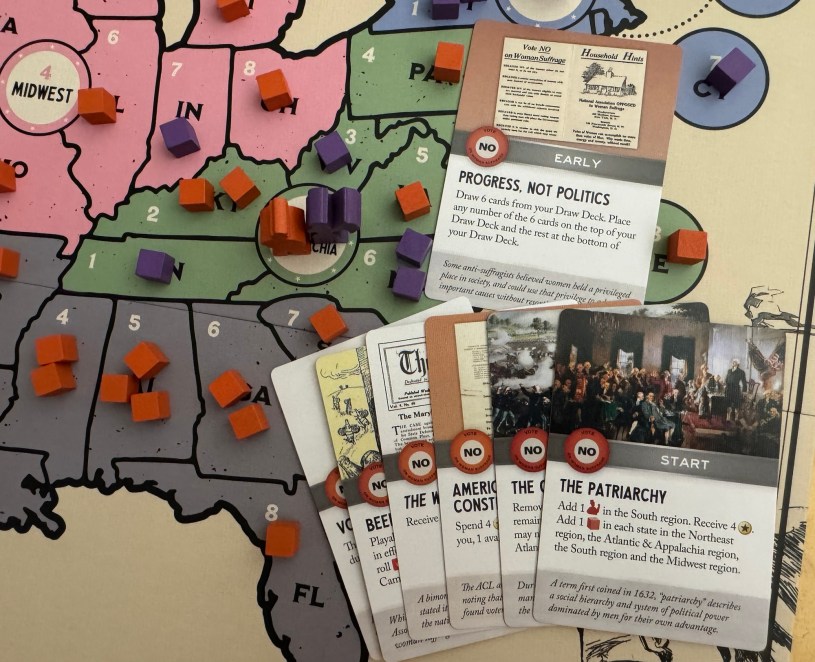
#45: Progress, Not Politics from Votes for Women from Fort Circle Games
Votes for Women is a very interesting card-driven game that covers the American Women’s Suffrage Movement from 1848-1920, culminating in the ratification of the Nineteenth Amendment which granted women the right to vote. The game is a 2-player game, that has a fully developed solitaire mode with an “Oppobot” and offers a cooperative mode for those who don’t wish to play as they Opposition. The Suffragist player will have to push Congress to propose the Nineteenth Amendment, and then focus on campaigning to have a minimum of 36 states to ratify the Amendment. The Opposition side will try to prevent Congress from proposing the amendment and failing that to have 13 states reject the amendment.
The game uses cards in a fairly traditional CDG way as there are events that can be be taken or the cards can be played to do things like Campaign, Organize or Lobby Congress. Each card has a specific Card Era that is used to create of the each players’ Draw Decks. Late cards will be on the bottom of the deck, Middle cards will be in the middle of the deck and Early cards will be on the top of the deck. The Suffragist and Opposition decks each have one Start card that will be placed in the player’s hand at the start of the game. Some Event Cards have a prerequisite and some of the cards require a player to roll a 6-sided die and only take the the action on a roll of 3-6. Otherwise, the Event Card is discarded with no effect. The cards in this game are also steeped in historical details, from the name of the events that tie back to specific individuals or happenings, to major moments in the struggle. This game is about the history of the struggle for the right to vote and it is very good!
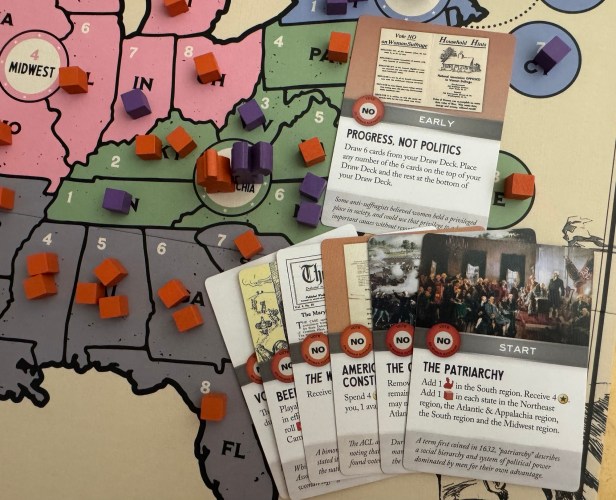
In this post, I want to take a look at a very important Early card in the game for the Opposition called Progress, Not Politics. This card is key for the Opposition player as it allows them to search their deck by drawing 6 cards of of the top and then placing any number of those cards back on the top of the deck and then placing the remaining cards on the bottom. There are a total of 17 Early cards in the deck and several of them include important events such as placing a Campaigner out in the Northeast allowing the Opposition player to begin taking Campaigning Actions to place out influence cubes in this area or remove those of the Suffragists or attempting to remove Congressional Markers from Congress to attempt to stop the ratification of the 19th Amendment to the Constitution. Getting to take a look at your upcoming cards in any game is very important and allows the Opposition player to better plan and prepare for how to go about winning the game.
But a very important and often overlooked aspect of this “deck burning” element is that this can allow the Opposition player to simply tear through their early deck attempting to get at the more powerful and utilitarian cards found in the Middle and Late period of the game. After all, you cannot play the cards that you never see and this game is about timing and a bit of luck as you have to be able to get your best cards when needed to stop the Suffragist player from garnering the benefits of taking Strategy Cards or in winning over the mind of Congress.

The concept of “Progress, Not Politics” was a slogan used by the anti-suffrage movement and was a phrase adopted by groups who opposed women’s right to vote, such as the New York State Association Opposed to Woman Suffrage (NYSAOWS), to frame their position as non-partisan and focused on social betterment rather than political reform. The phrase was a deliberate attempt to frame the opposition as a principled position focused on “progress” for women through non-political means like philanthropy, rather than through the “politics” of gaining the ballot.
It was used in campaigns against suffrage referendums, including the 1915 campaign in New York state. After its defeat there, the organization moved to the federal level and became the National Association Opposed to Woman Suffrage (NAOWS).
Here is a link to our full video review of the game:
We also published an interview on the blog with the designer Tory Brown and you can read that at the following link: https://theplayersaid.com/2020/09/07/interview-with-tory-brown-designer-of-votes-for-women-from-fort-circle-games-currently-on-kickstarter/
In the next entry in this series, we will take a look at Clean Operatives from Labyrinth: The War on Terror, 2001-? from GMT Games.
-Grant
 The Players' Aid
I love the deck-churning events, too – especially as the suffragists, for every early event burned means a late event of the power of “Plop down 20 cubes” or so!
LikeLiked by 1 person