James Buckley is a name we all know in the wargaming space. He has worked with publishers like PHALANX and Nuts! Publishing and also is now a burgeoning designer as he has announced his first game called Battlegroup Clash: Baltics along with his new publishing company called Sapper Studio. With his new game being announced, we reached out to him to ask some questions about the design to give you a better idea about how the game is played and what it is focused on.
If you are interested in Battlegroup Clash: Baltics, you can pre-order a copy for £89.00 ($119.00 in US Dollars) from the Sapper Studio website at the following link: https://www.sapperstudio.com/product-page/battlegroup-clash-baltics
Grant: James welcome to our blog. First off please tell us a little about yourself. What are your hobbies? What’s your day job?
James: I live in south-east London with my wife and young son. My hobby is my day job! I provide board game design, development and production consultancy services for hobby and professional games through my company Sapper Studio. And I’m now moving into publishing. My other main hobby is sailing.
Grant: You have worked in the board gaming industry for a few years. What has inspired you to start your own publishing company in Sapper Studio?
James: I saw what I think is a gap in the market: bringing the design and development rigor, and focus on player experience, of hobby gaming to the professional gaming space. I also am happy to help out hobby game publishers, for example I do a lot of work with Nuts! Publishing and more recently Neva Wargames, but I’m really motivated by the goal of ‘professionalizing’ the design and production of professional games.
Grant: What motivated you to break into game design? What have you enjoyed most about the experience thus far?
James: I was a developer for several years with PHALANX. I love development, probably more than design. At heart I am an ‘editor’. But in the case of Battlegroup Clash: Baltics I had the vision for the game, and I had a clear idea of what was required, so I started designing it. It’s been hard work. I’ve done everything myself, creating the rules and scenarios, managing the play testing, managing the graphic designers, artist, the production, sales, marketing, tax and fulfilment. Lots of work! But it’s been very rewarding.
Grant: What lessons have you learned from designing and developing wargames?
James: “The waste basket is the writer’s best friend.” This is a famous quote I was required to memorize when I was training to be journalist (a previous career of mine). I apply it as much as I can to game design and development. Cut off as much fat as you can. A board game can’t do everything. So focus on a few key areas that you want to emphasize, and abstract away or simplify everything else. In most cases it will improve the game.
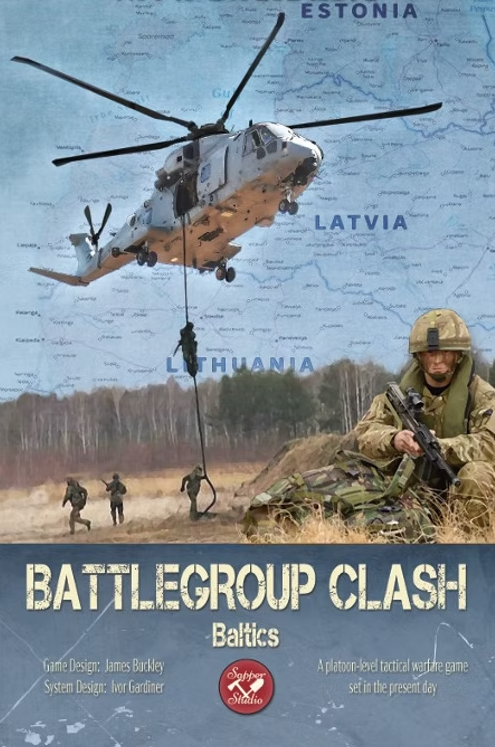
Grant: What is your new upcoming game Battlegroup Clash: Baltics about?
James: The theme is a very near future invasion by Russia of Estonia, and NATO’s response to it. While such an attack would be multi-domain, the focus of the game is the land battle element, considered at the level of a Battlegroup, which is essentially a reinforced Battalion. The individual unit sizes are platoons or sections (called squads in the USA).
Grant: Why was this a subject you wanted to focus on?
James: It’s obviously very salient. I see the game as an educational exercise as much as anything; I want to show what such a battle could be like, taking into consideration the geography of the country, the likely available forces, and the impact of electronic warfare and drones.
Grant: What are the unique features about Battlegroup Clash: Baltics?
James: Pre-battle planning, real-world mapping, and electronic warfare and drones. The game has its roots in a game I helped develop for the British Army; where the emphasis is on making a plan, and then executing against it. I’ve carried over a simplified version of this planning process into Battlegroup Clash: Baltics. The game has standard, if generally simple, rules for morale, modifier tables for firing and so forth. But the challenge is to try to meet your objectives based on a plan you created before anything happens on the map. You need to be able to read the map, think about what your enemy may be trying to achieve, and then plan accordingly. You should be rewarded if your plan is realistic and achievable, though of course the enemy always has a say.
Grant: What is your design goal with the game?
James: That players come away from the game with a greater understanding of the challenges involved in preparing and executing a battle plan on the modern battlefield; one where reconnaissance drones see almost everything, and indirect fires make moving in open space without armor protection near suicide.
Grant: What other games did you use as inspiration?
James: The game is based on a game I helped develop for the British Army called Battlegroup Wargame System. That game requires an umpire and just has a generic setting; but I took a simplified version of the sequence of play and combat tables from it to create Battlegroup Clash: Baltics. Other than that it’s pretty unique; I don’t know of any other modern commercial wargame that addresses land combat in the same way.
Grant: Is this the beginning of a series of games? What should we expect from the series?
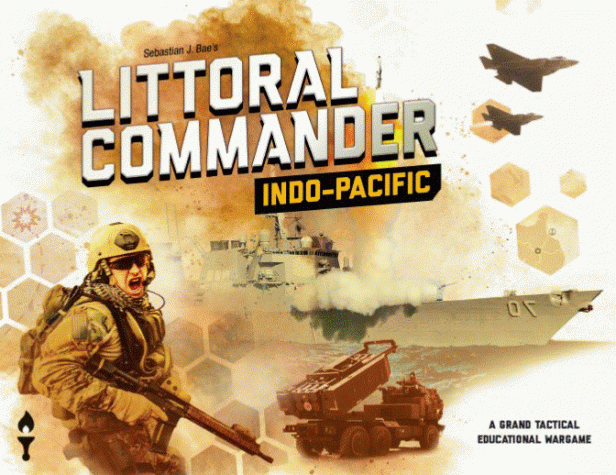
James: It depends how successful it is. You could certainly port the concepts and mechanics to other settings. I really hope the same thing happens as happened with Littoral Commander from The Dietz Foundation and designed by Sebastian Bae – that people come up with their own iterations of it; which could become expansions or new editions. I’m publishing it under Creative Commons for that purpose.
Grant: What is the force makeup of each side?
James: Each side has essentially two infantry companies and a tank company. These are reinforced with various supporting elements such as recce (reconnaissance) and anti-tank sections, fire support teams, HQ’s, Mortar, Artillery, First Person and UAS drones, and some scenarios have some more esoteric units like mine-flailing tanks and Russian storm motorcycle sections. The Order of Battle obviously varies between scenarios.
Grant: Where did you do the research regarding the Orders of Battle?
James: As it’s hypothetical, it’s largely based on what both sides are likely to able to field. Resources will be scarce; European NATO armies are under-strength and the Russians will take time to recover from Ukraine. The forces on both sides are generic in the sense that they represent a generic platoon in a generic company; I don’t specifically identify a unit as being part of particular NATO or Russian army.
Grant: What sources would you recommend to those interested in learning more?
James: Most European NATO members publish aspects of their current land warfare doctrines, so that is a good – if detailed – starting point. The US Army publishes a lot of good stuff on how Russia fights based on observations from Ukraine. Because everything is changing so fast at the moment, I’ve found that Substack is a great place for very up-to-date expert analysis. Also think tanks like RUSI and resources like War on the Rocks.
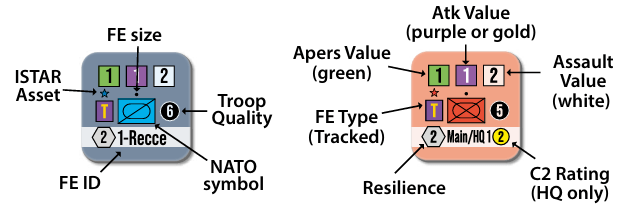
Grant: What is the anatomy of the counters?
James: It’s fairly standard for anyone used to tactical hex and counter games, as the image (taken from the rulebook) below shows.
Grant: How do players command and issue orders to their troops?
James: Units – known as Force Elements – are assigned into Task Groups in the ORBAT. Players will draft a set of high-level orders for each Task Group for each turn at the start of the game, using a form called a Sync Matrix. Then players alternate Activating their Task Groups. When a Task Group is activated, each Force Element within it is activated in turn. The Force Elements can take a range of actions such as move, fire, assault, etc. but ultimately the action taken must correspond with the orders the Task Group has.
Grant: How does combat work in the design?
James: I’d say it’s fairly standard. You draw an imaginary Line of Sight to the target; then assuming it is within range and you have a weapon type that can affect the target you roll 2D6 to determine how many hits, if any, you achieve. The difference compared to other games is that there are no map hexes, you draw LoS a bit more like you would in a miniatures games. The map has been designed to support this in terms of layout and borders around different terrain types. The other difference is that, with UAS reconnaissance drones flying overhead, there’s very little that is hidden from indirect fires.
Grant: What is the makeup of the CRT?
James: You can achieve between 0 and 3 hits, and with direct fire you may be able to achieve a Suppression. The better the roll, and the higher the weapon’s firepower, the more hits you achieve.
Grant: How have you worked in modern technologies to the game?
James: There are two types of drones: UAS, which represent reconnaissance drones, and FPV’s, which represent kamikaze drones or bomber drones. The UAS linger on the battlefield, providing unhindered line of sight over four adjacent grid squares. The FPV’s are abstracted as off-board indirect fires. There is also electronic transmissions and Electronic Warfare. Whenever a side takes an action that would generate significant radio or electronic transmissions – for example calling in Artillery outside of a specified fire plan area, or issuing new orders – the opponent intercepts this. On the next turn, for each electronic transmission intercepted, you receive a targeting marker to increase your DRM when Firing. This represents those transmissions giving away location information. Electronic warfare is also captured by EW Chits. These can be played for effects such as jamming an opponent’s UAS or FPV’s, screwing with their GPS, boosting your command range, and so forth. Tactical electronic warfare is now a critical feature of modern warfare, which Battlegroup Clash: Baltics seeks to demonstrate.
Grant: What is different about the maps used in the game?
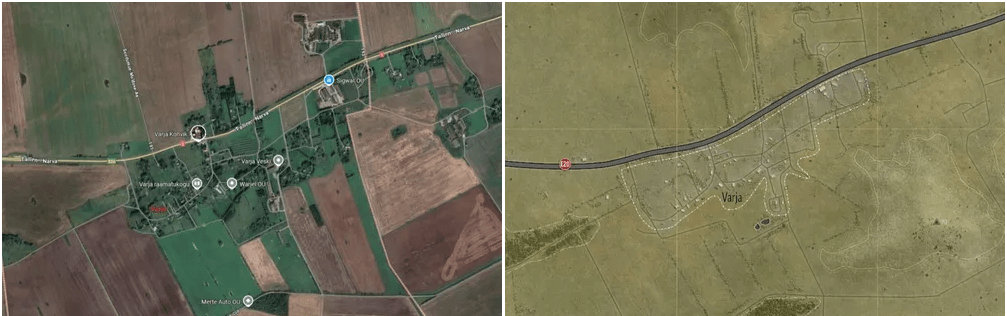
James: The maps are based on real world satellite imagery from Estonia. This has then been transformed into game maps using computer aided design. Like a standard map, the maps feature grid lines, known as eastings (the vertical line) and northings (the horizontal line). Just as happens with real-world army planning; you plan your force deployment by the grid lines – which are 1km by 1km in size (10cm x 10cm on the map). Terrain that impacts on the game, such as woods or urban areas, has a border line around it to show where the effect applies. In the image below you can see how we transformed the satellite image (left) of part of a key road – the E20 which leads from Russia all the way to Tallin, the capital of Estonia – into a useable map (right) for the game.
Grant: Who is your artist and how has their style affected the design?
James: The artist was Shayne Logan. He’s actually the designer of the Old School Tactical Series, as well as an awesome map artist and graphic designer. I think the quality of his work speaks for itself in the maps used in the game. They are stunning, and not like anything else out there.
Grant: What optional rules are available?
James: There aren’t many. The most important relates to allowing players the flexibility to alter the make up of their Task Groups, giving them a lot more choice over force structure. There’s one for weather, and some others related to the effects of smoke, and line of sight. These latter ones add more complexity, but were requested by some playtesters from the professional space who wanted a bit more realism. It’s also important to add that the game comes with three play modes: Basic, Standard and Advanced. The Basic mode, equivalent to a light complexity wargame, does not require any planning or orders; it’s like a standard hobby wargame. The Standard mode introduces the orders system and morale effects. The Advanced mode adds on top of that ammo management and rules reflecting NATO and Russian doctrine.
Grant: What type of experience does the game create for players?
James: Everyone that has tested it has spoken of the level of immersion that you get from the game, particularly due to the planning aspect, and the use of the maps. This is a recent comment from one of the playtesters: “Battlegroup Clash: Baltics is an outstanding tool for understanding contemporary warfare at the tactical level. Its emphasis on manoeuvre, electronic emissions control, and drone integration sets it apart from more conventional wargames, making it a compelling choice for those who want their gameplay grounded in modern military realities.”
Grant: What are you most pleased about with the design?
James: How the use of real world maps within a more conventional counter-based system creates a truly unique experience. You would think that dropping the hexes would make things harder, but it’s actually very liberating. All the playtesters commented how easy they found using it. I wonder if grid -and-counter will now become ‘a thing’!
Grant: What has been additional the feedback of your playtesters?
James: That’s not unusual. It’s all very positive. All of them have ordered the game on the back of testing it, which I think says something (albeit at a discounted rate I gave to playtesters).
Grant: When can we expect to see the game released?
James: If all goes to plan it should be with customers that pre-ordered it in November this year (Yes! Three months, not three years!).
Grant: What other designs are you currently working on?
James: I have plans for a Falklands game, again based on a professional game system I’ve been helping to develop a bit. And maybe a modern naval war game, again based on an existing professional game, but that’s very early stages.
If you are interested in Battlegroup Clash: Baltics, you can pre-order a copy for £89.00 ($119.00 in US Dollars) from the Sapper Studio website at the following link: https://www.sapperstudio.com/product-page/battlegroup-clash-baltics
-Grant
 The Players' Aid
Great interview. I was lucky enough to get James involved in BGWS for the Army and his development ensured we delivered an excellent product.
The commerical version, which he is desinging, looks fantastic and will give players the chance to use a system based on a design used to train and educate British Army Officers.
As James hilights, this game gives players exposure to the real-world constraints that govern the conduct of military operations. You will be constrained by your orders, boundary and no-fire lines – but within those constraints, you will exericse mission command to achieve your objectives.
I think players are really going to love this system!
LikeLiked by 1 person
I know I am definitely looking forward to this one.
LikeLike