
With this new My Favorite Wargame Cards Series, I hope to take a look at a specific card from the various wargames that I have played and share how it is used in the game. I am not a strategist and frankly I am not that good at games but I do understand how things should work and be used in games. With that being said, here is the next entry in this series.
Card #43: Joseph Stalin from Churchill: Big 3 Struggle for Peace from GMT Games
The players in Churchill: Big Three Struggle for Peace take on the roles of Churchill, Roosevelt, or Stalin during World War II as they maneuver against each other over the course of 10 Conferences that determine who will lead the Allied forces, where those military forces will be deployed, and how the Axis will be defeated. The player whose forces collectively have greater control over the surrendered Axis powers will win the peace and the game.
Churchill is not necessarily a wargame, but more of a political conflict of cooperation and competition. Over the course of the 10 historical conferences from 1943 till the end of the war this mechanic and much of the design should not be taken literally. Before and after each conference small groups of advisors and senior officials moved between the Allied capitals making the deals that drove the post war peace. These advisors and senior officials are represented by cards with an assigned numeric value that represents an amount of influence. Each conference sees one of a group of issues nominated for inclusion in the conference for debating and discussion. The issues categories include: Theater leadership changes, directed offensives, production priorities, clandestine operations, political activity, and strategic warfare (A-bomb). Each of the historical conference cards independently puts some number of issues, such as directed offensives or production priorities, metaphorically on the table, while the players nominate an additional 7 issues.

There is power in going first and using the big boy in the deck Joseph Stalin on the A-Bomb Research Issue. If the A-Bomb Research Issue is moved using Stalin, it will reach his chair location and will be captured without the ability for the other two opponents to debate this issue as the text on his card reads as follows: …if Stalin used to advance the A-Bomb Research Issue, be cannot be debated by another leader.
You might ask why should I do this? Well, the answer is simple; victory points. The USSR will score 3 VP’s for each space achieved for the Manhattan spy ring marker, which means this area could potentially be worth 12 VP’s for the Soviets. More importantly than the outright VP though is the fact that the Soviets can prevent an easy 5 VP for the United States by depriving them of the A-Bomb and the ability to force a Japanese surrender by simply having the A-Bomb marker in the Trinity Space and a B-29 base in one of three spaces including Iwo Jima, Kyushu or Formosa.
If the Soviets win the issue, they will get to automatically advance one space on the track without a die roll, which is a huge benefit. But, simply winning the issue is not a guarantee that the Soviets will stay ahead in the race however, as the Western Allies still get a die roll and on a roll of 4-6 will be able to advance one space. Any player can also spend Production Markers for a +1 modifier per marker used. It would be great if the Soviets get out far enough ahead that the Allies either begin pumping their resources into trying to make sure they catch up, as this will mean that other areas and issues will be neglected, or they simply give up on the A-Bomb. Remember, if the US doesn’t reach the Trinity space, this is worth another 3 VP’s for the Soviets!
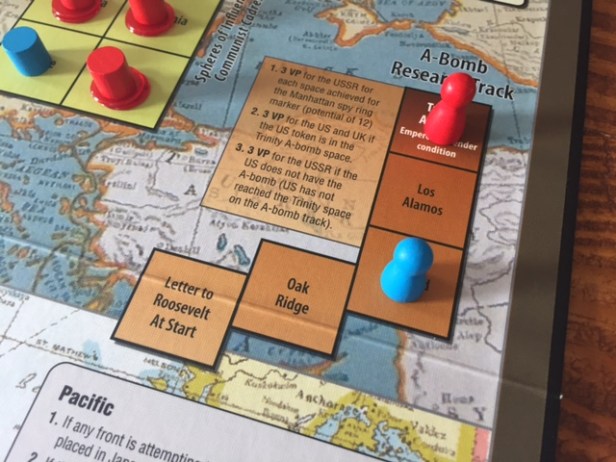
The one downfall for Stalin in the game though is the Paranoid roll. When he is used, you must roll 2d6 and on a result of 2-4, for the remainder of the turn all of your played Soviet Staff Cards will be -1 Strength. If played early as discussed, this could mean losing 4-6 points in the important matter of debating issues. But I do love this thematic connection with the history and feel that Mark Herman did such a good job of incorporating that into the game.
Joseph Vissarionovich Stalin (Stalin’s birth name was Iosif Vissarionovich Dzhugashvili) was born on December 18, 1878 and was a Soviet politician and revolutionary who led the former Soviet Union from 1924 until his death in 1953. He held office as General Secretary of the Communist Party from 1922 to 1952 and as the fourth premier from 1941 until his death. Despite initially governing the country as part of a collective leadership, he ultimately consolidated power to become an absolute dictator by the 1930’s. Stalin codified the party’s official interpretation of Marxism as Marxism–Leninism, while the totalitarian political system he created is known as Stalinism.
His legacy is a difficult one as he was one of the reasons that the Allies were able to defeat the Germans in World War II as he mobilized and lead the Russian people and demanded their total effort but also was responsible for mass genocide as well as many political killings to gain the power he needed to rule as a total dictator. Before the dissolution of the Soviet Union and the archival revelations, some Western historians estimated that the numbers killed by Stalin’s regime were 20 million or higher. The scholarly consensus affirms that Soviet archival materials declassified in 1991 contain irrefutable data much lower than Western sources used prior to 1991, such as statements from emigres and other informants. Based on these records, scholars have estimated that 1.8 million people were deported to remote regions of the country during Stalin’s dekulakisation campaign, in addition to 1 million peasants and ethnic minorities deported in the 1930’s, and 3.5 million people (mainly ethnic minorities) deported in the 1940’s and 1950’s, for a total of 6.3 million. The Soviet archives also contain official records of 799,455 executions from 1921 to 1953, around 1.5 to 1.7 million deaths in Gulag camps (out of an estimated 18 million people who passed through), some 390,000 deaths during the dekulakisation forced resettlement, and up to 400,000 deaths of persons deported during the 1940’s, with a total of about 3.3 million officially recorded victims in these categories. According to historian Stephen Wheatcroft, approximately 1 million of these deaths were “purposive” while the rest happened through neglect and irresponsibility.
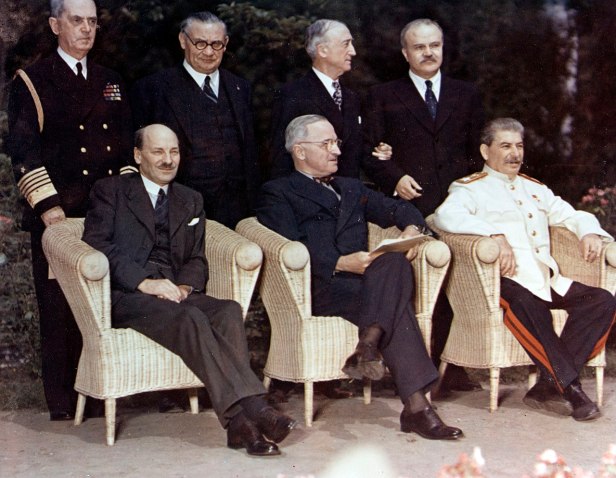
In the next entry in this series, we will take a look at Roxelana from Here I Stand: Wars of the Reformation 1555-1571 from GMT Games.
-Grant
 The Players' Aid
Greatest board game reactionary move: Nyet!
LikeLiked by 1 person