
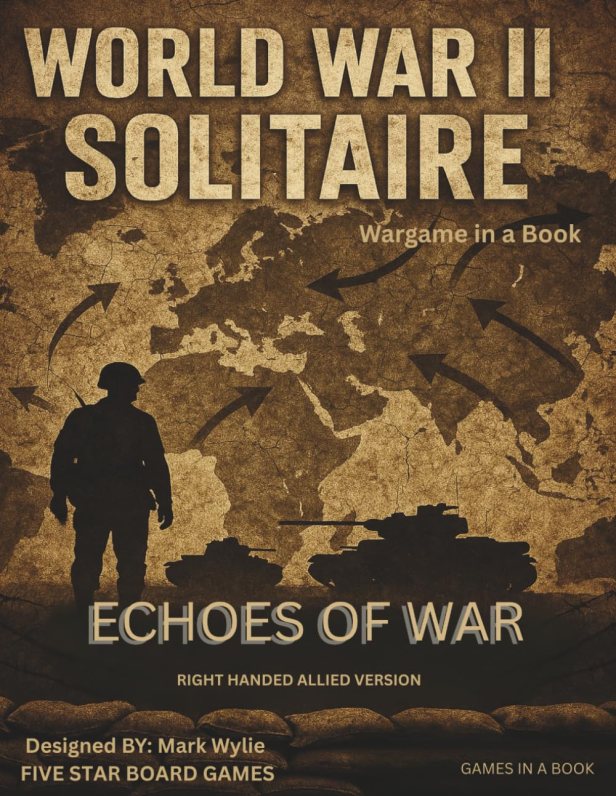
I love it when I find a new solitaire game offering from a new to me company and recently I was introduced to Five Star Board Games and their new game called World War II Solitaire: Echoes of War designed by Mark Wylie. This is a book wargame and all you need is the book, a pen/pencil and a single die. I reached out to Mark and he was more than willing to answer some of our questions on the design.
Grant: Mark, welcome to our blog. First off, please tell us a little about yourself. What are your hobbies? What’s your day job?
Mark: Thanks for having me! I’m Mark Wylie, born and raised in Virginia Beach, Virginia, and I’ve lived here my whole life. Growing up, I was a sports fanatic with a strong competitive streak—something that definitely carried over into my love for board games.
I started playing games around the age of eight. My brother Grant, my uncle Mike, and neighborhood friends Brian Grimstead and Dave Crawford introduced me to the hobby. Avalon Hill titles were our go-to—War at Sea, Axis & Allies, Battle of the Bulge—you name it, we played it. We also loved sports games like Paydirt and Status Pro, and when Dungeons & Dragons first came out, we dove into that too. We had a great neighborhood for gaming, and I was always an aggressive player—pushing my teams or units to the limit. I didn’t know how to retreat or play it safe—just full speed ahead. Those were great times.
I played sports all through high school, which honestly was the only thing that kept me in school. My mind was mostly focused on girls and partying back then. I didn’t go to college—grades weren’t really my thing—and I spent the next six years after high school bouncing around jobs, gambling, partying, and figuring things out.
In my early twenties, I met my beautiful ex-wife, and my son Dylan was born when I was 22. After my father passed away around the time I was 25, I knew it was time to change something. I joined the military and served for eight years as an airborne medic. That was a meaningful chapter in my life, even if I hadn’t fully turned things around yet.
After the military, I moved to Northern Virginia for a while, but eventually came back home to Virginia Beach in 2007. For years I worked various sales jobs to make ends meet, but I’ll be honest, most of my time over the past 17 years was dominated by drinking and gambling. Life felt like it was on autopilot.
Fortunately, during that time, my brother and uncle launched Worthington Publishing, a company that’s gone on to become a major name in historical board games. I stayed involved behind the scenes; playtesting, helping break mechanics (in a good way!), and occasionally tossing in design ideas. More recently, I’ve taken over their shipping operations as the business has grown.
Fast-forward to now, after finally quitting drinking and looking to rebuild my life, I started Five Star Board Games about four or five months ago. Launching my own publishing company and creating solo book games has given me a renewed sense of purpose. Between continuing to support Worthington and building my own line of fast, replayable solo book games, I feel like I’ve finally found my path and I’m excited to share it with others
Grant: What motivated you to break into game design? What have you enjoyed most about the experience thus far?
Mark: What motivated me to break into game design was the drive to create the perfect game. That idea fuels me. I’m especially drawn to solo wargames and the challenge of crafting a truly believable and engaging AI system. There’s something fascinating about making the AI feel like you’re playing against a real opponent; someone who’s thinking, reacting, and strategizing against you.
That’s the beauty and complexity of it. Designing AI for board games is incredibly tough because you have to anticipate every decision a real player might make, then translate that into a system that feels intuitive and challenging, but also clear and playable. Writing those rules in a way that players can easily understand is both one of the hardest and most rewarding parts of the process.
What I’ve enjoyed most so far is how game design has opened up so many creative ideas and possibilities. And honestly, the feedback I’ve been getting lately from players has been incredible. Hearing that people are enjoying my games, connecting with them, and playing them over and over again—it’s been more rewarding than I ever expected.
Grant: What lessons have you learned from designing your games?
Mark: One big lesson I’ve learned is that simplicity is hard, but it’s powerful. As a designer, it’s tempting to pack in every great idea you have, but making a game clean, clear, and replayable takes real discipline.
Another thing I’ve learned, especially about myself, is that designing a game takes serious focus. And I’ll be honest, focus hasn’t always been my strong suit. I’ve got a lot of creative ideas bouncing around in my head, but getting them down, structured, and into a finished product is the real challenge. I used to think making a game was easy. Coming up with the concept is easy. But turning that concept into something complete, balanced, and playable? That’s the hard part.
It’s been humbling, but also incredibly rewarding. I’ve gained a lot of respect for the process, and I’m learning how to take all those ideas and actually shape them into something real
Grant: I understand that you are connected to Worthington Publishing. What is the relation, and how has this connection helped you in your design journey?
Mark: Yes, I’m connected to Worthington Publishing. I currently handle all of their shipping, and I still work closely with them. They’ve been incredibly kind and supportive over the years.
My uncle, Mike Wylie, and my brother, Grant Wylie, co-founded the company, and along with their longtime graphic designer, Sean Cooke, they’ve built something truly respected in the board gaming world. I’ve watched them grow Worthington into a name that stands for quality and customer care. Every decision they make puts the player first, and that’s something I’ve always admired.
They’ve been a huge influence on me, not just in game design, but in how to run a business the right way. Seeing how they operate gave me the confidence to take the leap and start my own company, Five Star Board Games. I wanted to step out from the background, put my own name on something, and try building a brand with my own style (goofy little logo and all). But if I’m being honest, none of this would’ve happened without the example they set.
Grant: What is your new game World War II Solitaire about?
Mark: World War II Solitaire is actually two separate games on Amazon. One version where you play as the Allies, and one where you play as the Axis. In each version, you take on the role of that side’s high command and fight through the entire war, from 1940 to 1945.
The beauty of the game is its simplicity and portability. It plays in about 30 minutes, though depending on how things unfold, it can end earlier. There’s no setup, no cleanup—you just open the book and go. It’s perfect for solo players who want a rich, strategic experience without a big time commitment.
And I’ll be honest, one of the best parts? If you want to play it again, all you have to do is make a copy of the map page, lol. It’s designed to be fast, replayable, and super easy to take with you wherever you go
I truly feel it’s the best WW2 solitaire game out there and it is coming out in a boardgame edition quite soon.
Grant: As a book wargame, what type of experience do you believe this game offers?
Mark: This game is surprisingly immersive. It offers the same kind of strategic depth and decision-making you’d expect from a traditional board wargame—but without the setup or hassle. You can pick it up, put it down, take it with you, even start a game one day and finish it two weeks later. It’s designed for flexibility and convenience without sacrificing the fun.
I’m a strong advocate for book games. You can own 20 book wargames and they’ll take up less space than two traditional boxed games. And the replayability is huge, you can play them as many times as you want, with different results each time.
Sure, some people prefer pushing around physical pieces on a board—and I totally respect that. But for players who value portability, ease of play, and a solid solo experience, book games are an incredible option. I think designers like Mike Lambo, Worthington Publishing, and now Five Star Board Games have done a fantastic job showing just how great book games can be.
Grant: Please explain the right-handed and left-handed versions and how they are different.
Mark: It’s funny you ask that! Worthington Publishing set the standard with their book wargames by turning the book sideways, so you have one page on top that drives the action and a page on the bottom where you write your results. It’s a clever design that makes it easy to play, even on small surfaces, and you can prop the book up comfortably.
Me? I wanted to be different.
I decided not to go with the sideways layout. I wanted to keep the book in a regular upright position (portrait mode) and have players record everything with their dominant hand. So I created a right-handed version—where the map page is on the right, and a left-handed version, where the map page is on the left.
In theory, it sounded like a great idea. In practice? Total nightmare.
I’ll never do it again. I learned the hard way that Worthington had it right all along. Printing got mixed up, tables were swapped between the Axis and Allied editions, and I had to post corrections on my website for people who got the early versions, including the one you probably bought, LOL.
Lesson learned! Going forward, I’m sticking with the sideways layout. It works for everyone, lefties, righties, and anyone in between.

Grant: Also, I know there is another game where the player plays as the Axis. why is this an approach you wanted to take?
Mark: I wanted players to experience the war from both sides, to see how different the challenges and strategies are depending on your perspective.
As the Allies, you’re getting hit hard early on. You’re on the defensive and have to slowly build momentum to push back and win. It’s a grind, but it’s rewarding.
On the other hand, when you play as the Axis, you’re the one doing the damage early. You’ve got to strike fast and take ground, but then you’ve got to hold it, and that’s where the tension really kicks in. You’re constantly trying to keep the Allies from turning the tide, and in most cases, you’re hanging on for dear life toward the end.
Creating both versions gave players a chance to experience the full arc of the war, from two very different vantage points, and I think that adds a lot of replay value and depth.
Grant: How does the game play out?
Mark: I find the game plays out true to history, but in a fast, streamlined way. The Axis powers start off strong and aggressive, making big gains early on. Meanwhile, the Allies are usually on their heels, trying to hang on and turn the tide. And that’s generally how the game plays out: fast-paced, tense, and with a natural momentum shift that mirrors the real war.
It captures the ebb and flow of World War II, but in a way that fits into a 30-minute solo experience.
Grant: What is the general Sequence of Play?
Mark: Each game turn represents a slice of the war and follows a fast, structured sequence:
- Advance the Turn Track
Mark off the previous turn to track game progress. - Roll 1d6 – Determine Phase Type
- On a roll of 1–4: You’ll consult a Table. Roll another d6 to trigger a specific Action Event Box, which could contain an Event, an Alternate instruction, or default gameplay guidance.
- On a roll of 5–6: You’ll consult a Major Conflict Box, representing large-scale battles or turning points.
- End of Turn
- On certain key turns (6, 10, 14, and 18), you’ll perform a Campaign Check (CC) based on Axis victory points.
Failing this may trigger an early defeat depending on a final die roll.
Turns continue until the war ends, or you don’t survive to see it.
That’s the simple version…it’s a complex and deep game. There are historical events that are built into the game and the player has to make many decisions on what to do with their actions or how to respond to the BOT player.
Grant: How are each of the 24 spreads in the game book used?
Mark: Each two-page spread in the book is its own complete game. One side is the ActionBot page, which drives the gameplay with events, tables, and decisions. The other side is the map page, where you record all the action—your progress, battles, and outcomes.
So basically, every spread equals one full game. There are over 20 of these in the book, giving you a ton of replayability.
Now, after you buy the book, you do have the right to make copies of the map page and keep playing… but of course, I’d much prefer you just grab another book, LOL. Either way, the goal is to give you a great solo experience every time you open it.
Grant: What type of information will the player be marking on these pages?
Mark: On the map page, players will be marking several key pieces of information during the game. First, they’ll track where each side’s units are on the six regional campaign tracks. This is done by marking boxes to show control, and then comparing your position to the enemy’s to determine your current status and victory points earned.
Players will also mark things like die roll modifiers (DROs), bonuses, and any changes caused by events or actions. Some tracks or events might shift your advantage or force a penalty, and that all needs to be recorded to keep gameplay smooth and accurate.
It’s a living record of your campaign—and by the end, you can look back and see how the entire war played out
Grant: How do the events work in the game?
Mark: Originally, this game was going to be a board game—and it still will be! So I started by creating 24 event cards based on real historical moments from World War II. Each event is designed to reflect how it actually impacted the war, whether it favored the Axis, the Allies, or was more neutral.
For example, if Pearl Harbor comes up, the Japanese automatically advance on the Pacific Track without needing to roll, because that moment gave them a clear advantage. On the flip side, events like D-Day or Battle of the Bulge tend to favor the Allies. If the Axis launches a major offensive into Russia, they might get early benefits, but if the Russian Winter shows up, it can be brutal for them.
Sometimes, the event results are determined by a die roll, but even then, it might be weighted slightly toward one side depending on the historical outcome.
I also had to think about timing. Each turn in the game represents a year, from 1940 to 1945, but you can’t tie an event to just a single year. So I gave each event a time window. For example, Pearl Harbor might only appear between 1940 and 1942. If it’s outside that window, you skip it and go to a more generic action.
It was a fun challenge figuring out how to reflect real events in a way that’s both historically respectful and playable
Grant: How does combat work?
Mark: Combat in World War II Solitaire is handled through six regional tracks on the map page—each representing a key front in the war. These tracks simulate the back-and-forth struggle between the Axis and Allied forces over time.
Each region has two sets of strength values: one for the early war (1940–1942) and another for the late war (1943–1945). For the first half of the game turns, the Axis generally holds the advantage, they’re stronger, more aggressive, and advancing. But starting in 1943, everything flips. The Allies gain strength and begin to push back, just as it historically,
Combat is basically rolling equal to or higher than the opponents current strength adding in die roll modifiers. The cool thing is though, that no matter what year or strength the enemy is, you have to roll a 6 (DRM is included) to enter a capital.
The strength shift in 1943 is one of the key dynamics in the game. It forces the Axis player to push hard early, knowing that time is not on their side, while the Allied player has to hang on and survive the early onslaught until their advantage kicks in.
Grant: What type of decisions does the player have to make?
Mark: I’ll speak for both the Allied and Axis versions here, because the core decision-making is the same, even if the context shifts.
The player has to constantly choose how to use their available actions and attacks each turn. Actions might let you adjust your die roll modifie tracks or the track that allows the USA to enter the war in Europe. So you’re always weighing risk vs. reward.
Another big decision is which track to attack. Each of the six tracks represents a different region of the war, and not all gains are equal. Some tracks only give you one victory point per advancement, while others might give you two. So you’ve got to pay attention to where the most value is—and when to go for it.
Timing is also huge. You need to keep an eye on when a Confidence Check (CC) is coming up, because those checks can end the game early if you’re not in a strong position. So sometimes you’re not just thinking about where to attack, but when.
Grant: How does the AI work? What priorities does it use to drive its decisions?
Mark: The AI is a ruthless SOB, I built it that way on purpose! I wanted the AI to feel relentless, constantly attacking, probing your weaknesses, and keeping the pressure on.
In both the Allied and Axis versions of the game, the AI doesn’t sit back. It’s aggressive, and it often has the advantage. I actually want the AI to win more often than not, because that’s what makes the game intense and rewarding when you do come out on top.
The AI’s decisions are driven by event tables and conflict boxes that dictate where and how it attacks. It uses historical momentum and regional priorities to apply pressure in realistic and challenging ways. Whether it’s pushing deeper into Russia or making a late-game Allied surge across Europe, it feels like you’re up against a living, breathing opponent.
I wanted players to feel like they were facing a worthy adversary every time they play and based on the feedback, that’s exactly how it plays
Grant: What is the purpose of the Major Conflict Boxes?
Mark: Funny enough, the Major Conflict Boxes are kind of like a breather in the middle of all the chaos—but they can still swing the game in a big way.
Mechanically, they’re pretty straightforward: both sides roll, apply their die roll modifiers, and whoever wins gets to advance, sometimes on one, two, or even all three tracks. It’s a quick and simple resolution, which makes it feel like a break from the more detailed event-based phases.
But don’t let the simplicity fool you. These moments can have major impact. You could be making steady progress, and then suddenly take a big hit from a lucky enemy roll, or vice versa. It keeps the tension high and the outcome unpredictable, which I love.
It’s a clever way to simulate large-scale, high-stakes battles without bogging the game down, and it reminds you that in war, sometimes a single moment can shift the tide.

Grant: What is the purpose of the Confidence Chart? How does the player affect this chart?
Mark: The Confidence Chart is all about creating urgency, and pressure. It’s there to make sure you can’t just coast through the game. If you’re getting your butt kicked, whether you’re the Axis or the Allies, the game can end instantly.
If you’re playing the Axis and fall behind, you could face a coup or internal uprising. If you’re the Allies and things are going badly, the public could demand an end to the war or force concessions. Either way, it’s game over, and not the kind you want.
That’s why your decisions really matter, especially when choosing which track to attack. Some tracks only give you one victory point per advance, while others offer two or more. Picking the right battles at the right time can be the difference between passing a Confidence Check or facing a sudden collapse.
It adds a layer of strategy and tension that keeps you constantly aware of how close you are to the edge.
Grant: How is victory achieved in the game?
Mark: Victory can be achieved in a few different ways. If you’re aggressive and strategic, you can win early by capturing enemy capitals. That’s the fastest and most decisive path to victory.
Otherwise, if the game goes the full distance, victory is determined by your total victory points and whether or not you control any enemy capitals at the end.
But don’t get too comfortable, because you can also lose early if you fail a Confidence Check. If the public loses faith in your side’s progress or morale collapses, the war could be over in an instant.
Grant: What are you most pleased about with the designs?
Mark: I have to be honest, I’m totally satisfied with how these games turned out. What I love most is the intensity. From the first turn to the last, there’s constant pressure. You’re always thinking, always adjusting, and that tension never really lets up. That’s exactly the kind of solo experience I was going for.
I’ll also admit, these games aren’t super simple. There’s a learning curve. There are a lot of abbreviations, a good bit of detail, and it takes a little time to get into the flow. But once you do, I really believe you’ll fall in love with it. When players start to see how much was packed into each page, and how the mechanics all tie together, it clicks, and that’s when the real fun begins.
Grant: What has been the response of playtesters?
Mark: The response from playtesters has been overwhelmingly positive. People really appreciate how the game incorporates real historical events in a way that feels meaningful, not just decorative. They also love the quick playtime—being able to sit down and finish a full, strategic solo game in 30 minutes is a big win for a lot of player
Grant: What other designs are you working on?
Mark: I’ve got a few exciting projects either already released or in development.
First, I released a book game called Cold War: Restless in Peace, which covers the Cold War from 1945 to 1989. That one was published through Worthington Publishing and focuses on global influence and tension in a solo format.
More recently, I launched a solo book game called Apocalypse: Doomfront. It’s a post-apocalyptic, Risk-style game where you control one faction battling against two AI-controlled factions. You’re trying to survive, expand, and eliminate the others, it’s strategic, clever, and a lot of fun to play.
The game I’m currently working on is The 13th Disciple. It’s a Bible-themed solo book game where you take on the role of a fictional 13th disciple helping Jesus gather followers while facing growing opposition. It’s a character-driven game where your personal stats, like faith, wisdom, and courage, affect your journey and how you support Jesus in fulfilling His destiny. It’s different from anything I’ve made before, and I’m really excited about it.
Also, as a thank you to everyone who supported my first four games, I’m giving away a free print-and-play game on my website, Five Star Board Games. Anyone who signs up for my email list can vote—starting July 15th—on whether the next free game will be The Civil War or The American Revolutionary War. Just like my World War II game, both will cover the full span of the war and offer a complete solo experience. It’s my way of saying thanks—and giving back to the community that’s made this journey such a blast
I want to truly thank you for the thoughtful and insightful questions you’ve asked me. This interview gave me a chance to reflect—not just on how I made these games, but why I made them, the journey it took to get here, and where I am in life now because of it.
Seeing the response to my games, and watching them show up on Amazon and in the hands of players, has been an incredible experience. It’s awakened something in me—a drive to keep creating games that people genuinely enjoy and talk about.
My goal is to design games that are fun, replayable, and full of meaningful decisions. I want every choice a player makes to feel important, and I want each game to have real depth that keeps players coming back.
And just so you know—I’m not stopping with book games. World War II Solitaire is currently being developed as a full board game, and I have more titles on the way in both formats.
Thank you again for this opportunity!

If you are interested in World War II Solitaire: Echoes of War, you can order a copy for $29.99 from Amazon at the following link: https://www.amazon.com/dp/B0F92GHS1W
Remember, that there are actually 2 versions of the game, one that allows you to play as the Allies and the other as the Axis and also each of the games are designed for right handed gamers and the other for left handed gamers. So, make sure you order the correct version and handedness!
-Grant


Thanks for this interview. A lot of material here, but it introduced me to book games. I wonder if this is going to be a big trend in future wargames and history games.
LikeLiked by 1 person
It already is a big trend as there are dozens of these type of book wargames already out there.
LikeLike
Are they all solitaire, or are there any two-player book games?
LikeLiked by 1 person
All solitaire I believe.
LikeLike
Thanks.
LikeLike
Will I be able to find this product at an airport or train station?
LikeLiked by 1 person
I believe it is only available on Amazon.
LikeLike
For those of you who enjoy discussing online games from various angles, try visiting https://waktogel.livejournal.com/. Lots of interesting information!
LikeLike