This month for the Wargame Watch I was able to find 35 games (including 9 games from our sponsor Neva Wargames in their section below)! Of that total, 6 games were offered on Crowdfunding.
Again this month, we have a sponsor for the Wargame Watch post in Neva Wargames. This is Neva’s 3rd time sponsoring this post and they are very busy as they have a ton of new games upcoming. Neva Wargames is a new publisher who appeared on the scene last year. When I started seeing their posts on Twitter and Facebook, I was immediately impressed with their interesting topic choices for their upcoming games as well as the fact that they are trying to make small footprint wargames that pack a punch. And the art is also very appealing and brings an aesthetically pleasing and attractive look to their games!
Here is a message from Neva:
This summer, we’re all about getting games into your hands faster. We know your time is precious, so expect our updates to be just as quick and to the point.
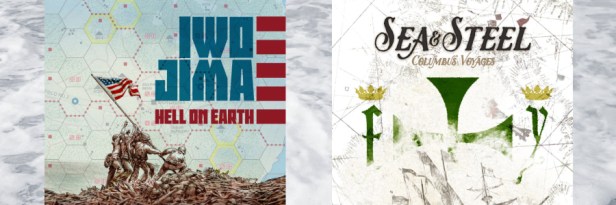
Upcoming Pre-Orders: Good news for Iwo Jima: Hell on Earth and Sea & Steel: Columbus’ Voyages fans! Printing begins early August, with potential shipping before Christmas. Thank you for your support! If you haven’t pre-ordered, there’s still time.
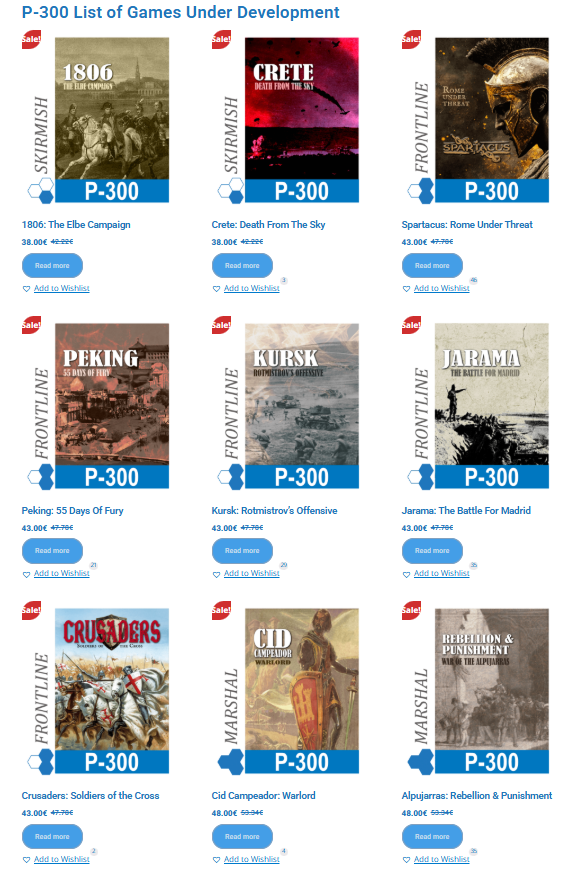
There are also 9 other titles in development under their P-300 System:
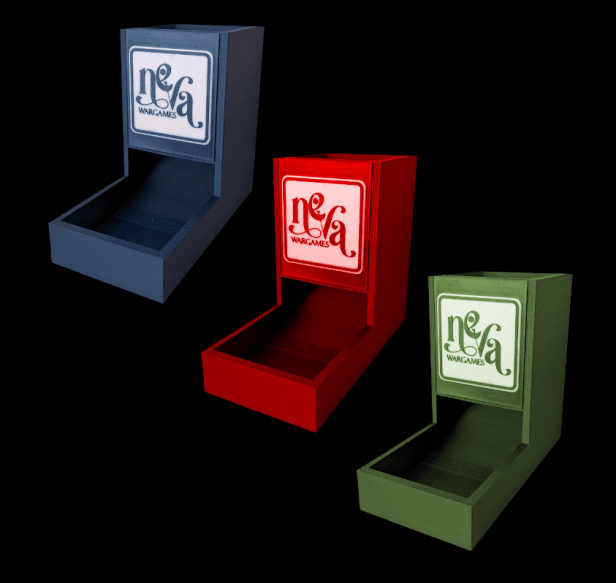
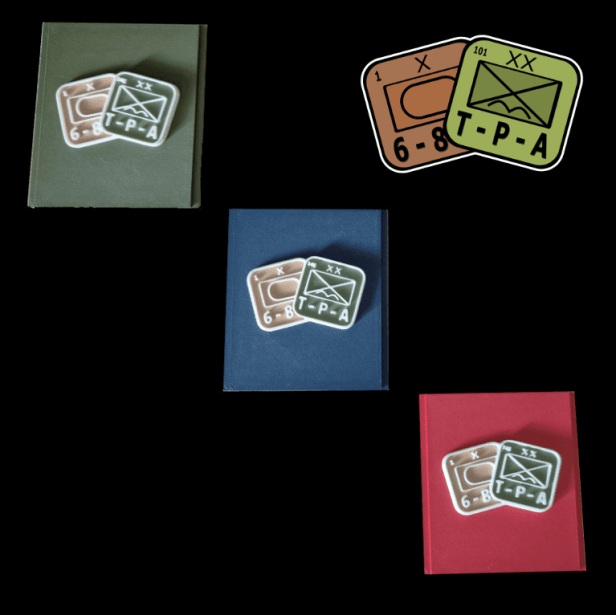
Neva also is offering 3D Printed Dice Towers that are really, really nice….and the best part is that they are customizable with removal logo panels. They even have a deal with us and offer The Players’ Aid logo as an option.
The Dice Towers come in 3 beautiful colors (blue, red and green) and each looks great with our logo and complements the color scheme well.
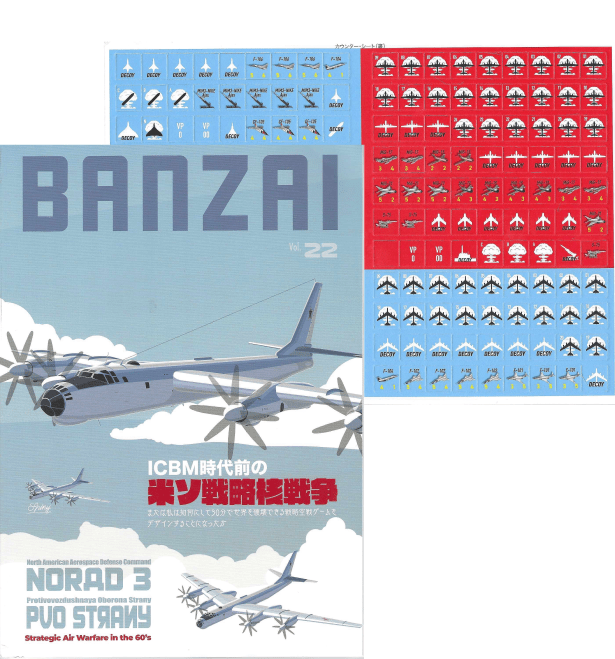
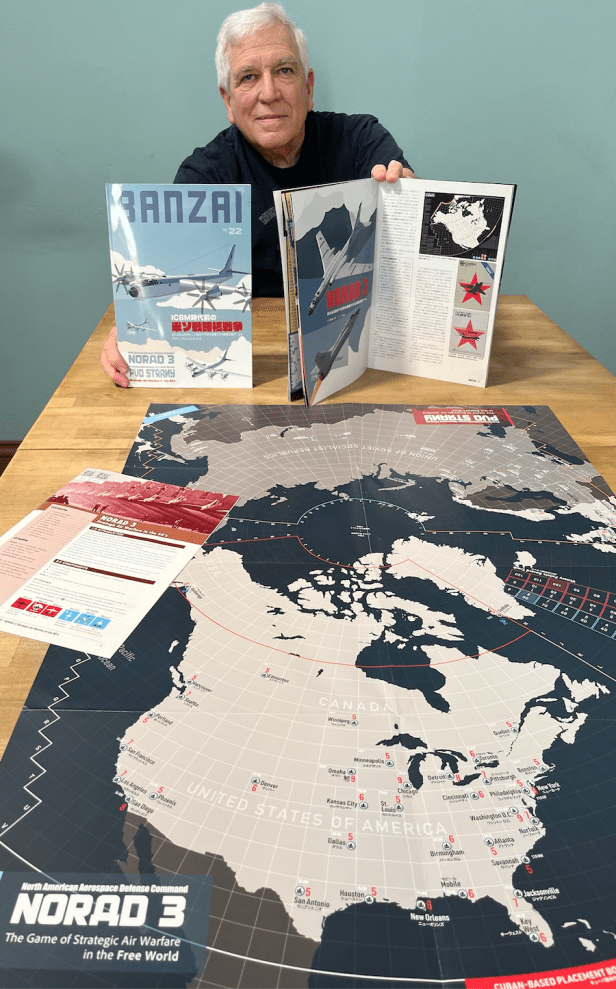
Not often does a game get a 3rd Edition printing! But, sometimes the classics are given this treatment and the games are well received and even much anticipated. Well, the classic NORAD designed by legend Dana Lombardy has been recently given a 3rd Edition treatment in the Japanese language wargame magazine Banzai. This new 3rd Edition game can be purchased from the Lombardy Studios website minus the magazine.
From the game page, we read the following:
The original 1973 publication of Dana Lombardy’s “nuclear checkers” has been greatly improved and enhanced by BANZAI magazine with:
Gorgeous new full-color graphics.
Expanded game map that now shows the USSR as well as the USA targets.
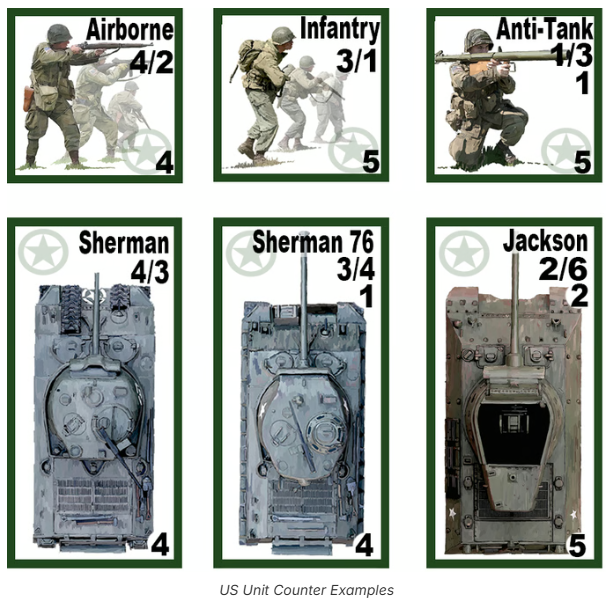
New playing pieces that represent USA bombers and USSR fighters.
Illustrated rulebook in English that includes optional rules for NORAD and Dana’s 1973 designer’s notes.
Plus new rules for the Soviet Home Defense forces and NATO expansion game by Yasushi Nakaguro
BONUS: Dana has written a backstory about creating the 1973 game and describes its 1977-2024 versions and a mini tournament held in the Basque area of Spain in 2020.
(BANZAI Japanese language magazine is out of print and not included).
Here is a link to an overview video from the designer Dana Lombardy:
If you are interested in NORAD 3rd Edition, you can order a copy for $40.00 from the Lombardy Studios website at the following link (BANZAI Japanese language magazine is out of print and not included): https://lombardystudios.com/norad-3/
*To get information about international shipping rates, please contact Dana by email at dana.lombardy@gmail.com.
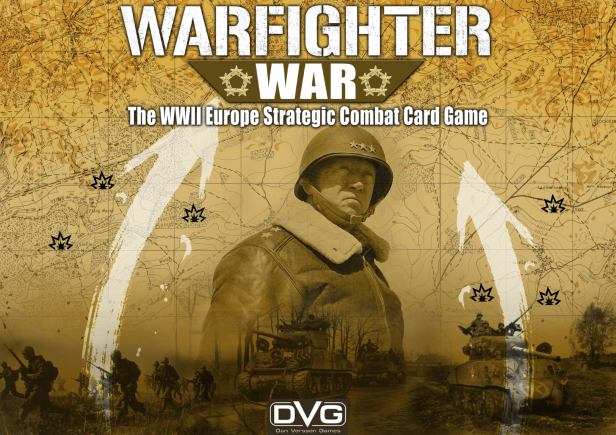
2. Warfighter War: The WWII Europe Strategic Combat Card Game Currently on Kickstarter
If you are interested in South Mountain 1862 / 1862 War in Virginia, you can order a copy for $the project on the Kickstarter page at the following link:
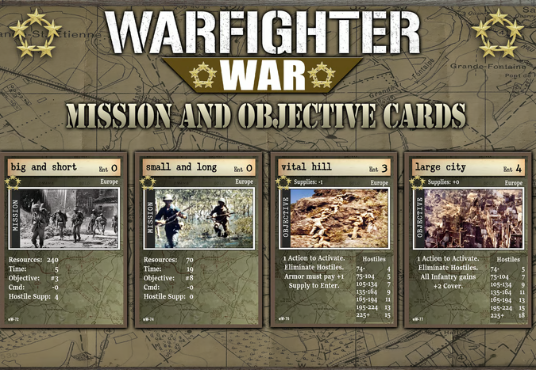
The Warfighter system from Dan Verssen Games is a card based game designed for 1 to 6 players. You can play solo or cooperatively against the AI to complete World War II squad-level combat missions set in the North Africa and Mediterranean Theatre of Operations. One of my favorite parts of the game is at the start of each mission, you will select one or more Player Soldiers, equip them with skills, weapons, and combat gear within the mission’s Resource limit. You then fight your way through hostile territory and engage enemy soldiers, as you attempt to reach and complete your mission objective. Every mission is a stand-alone game. You build your Soldiers, select your Gear, and then run your mission. Within 30 to 60 minutes you will have succeeded or failed. We simply love the system and prefer the WWII focused modules (we really hated Fantasy!) and are very excited to see this offering as I think that it will offer a new and expanded view of the history. Their newest expansion into the system takes it into the Strategic Warfare realm where you are looking at entire campaigns and the war as a whole in Warfighter War.
From the game page, we read the following:
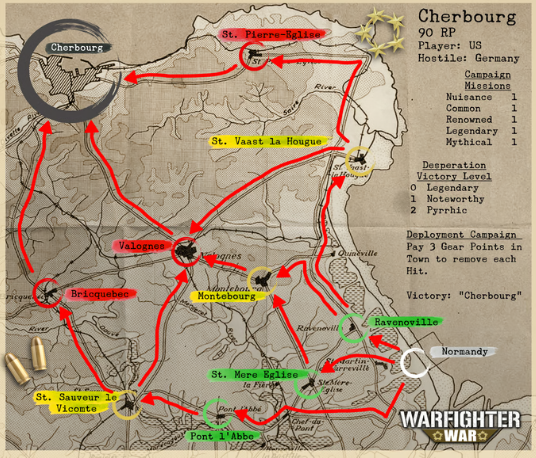
Warfighter War takes the solitaire (also plays great in cooperative mode with one or more other players) Warfighter tactical design to the strategic level. In Warfighter tactical, a unit card is an individual soldier. In Warfighter War, a unit card is a brigade, regiment, battalion, or company. In tactical, each location is roughly 50 to 400 yards. In War, each location is roughly 10 to 50 miles.
In the tactical game, you fought way through streets, buildings, and other tactical locations. In War, you’ll command your forces as they capture cities, forests, and other strategic objectives.
The general rule framework of War is based on the Warfighter Tactical System that has been in print, and refined, over the past decade. If you know how to play Warfighter, you’ll be able to jump right in to War.
So, what makes War different? What does War do that is beyond the scope of tactical?
War adds Supplies to both your friendly units, as well as to the Hostile units. Supplies play a key role in the success of your mission. You must expend supplies from units to gain the special abilities noted on their cards. In some cases you must expend supplies for a unit to perform specified actions. For example, armor units must expend supplies to move, and artillery units must expend supplies to attack.
War also streamlines the rules used for both friendly and hostile forces. Both sides now use the same move and attack combat actions. This means that if a hostile force starts within range of a friendly unit, it will be able to attack twice.
War has two types of friendly units: Player Armies and Support Armies. Player Armies are similar to Player Soldiers in that they hold a hand of Action cards. Support Armies are similar to Squad Soldiers, and they do not hold Action cards.
In War, both friendly and hostile forces have their attack charts built into their cards, there is no need to equip weapons.
Instead of equipping weapons and other gear, your forces will instead attach support forces, such as infantry, artillery, armor, or engineering units to aid them in their mission.
War uses a much more interactive Sequence of Play. In tactical, all friendly soldiers act, and then all hostile soldiers act. In War, one friendly unit acts, then one hostile unit acts, and so on. This gives a better feel of two large forces maneuvering and engaging in combat.
War Missions also offer more flexibility. You can now run Missions with a large force attempting to overcome an Objective that is only a few Location cards deep, as well as a small force going against an Objective deep in enemy territory.
In addition, we streamlined the rules be removing Hand-to-Hand combat, since War takes place on a strategic level.
War also adds the important role of engineers to the game. Some locations and hostile units present engineering challenges. If your engineering units are able to overcome these obstacles, you will gain advantages, or not suffer penalties.
Hostile forces are made up of a wide variety of unit types, including infantry, armor, mechanized, artillery, scout, engineering, and more
While the core aspects of War are same as traditional tactical Warfighter, War adds many new elements that make for an entirely different experience!
The core provides all the materials you need to play the game. The core game includes US friendly forces, German hostile forces, and the Missions, Locations, and Objectives for resolving battles following the D-Day landings in June of 1944.
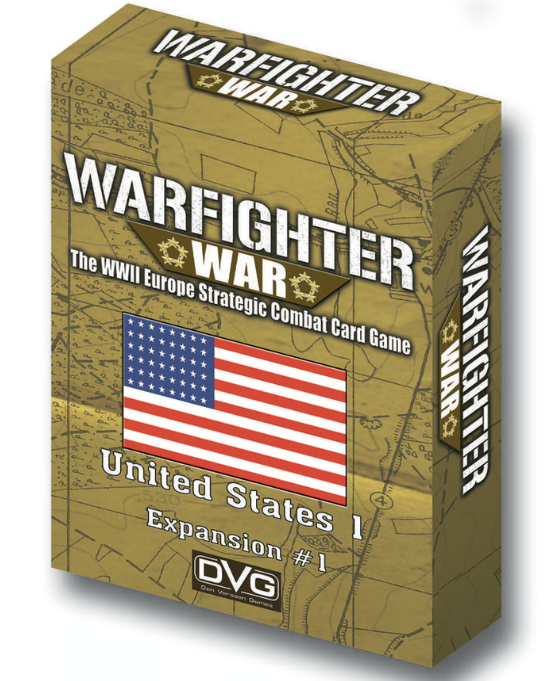
The campaign also offers 7 total expansion packs that can be purchased that typically include 56 cards including Player Armies, Hostile Armies and an assortment of Location, Attachment, Skill, and other cards.
As of August 1st, the Kickstarter campaign has raised $28,113 toward its $30,000 funding goal with 162 backers. The campaign will conclude on Thursday, August 7th at 3:59pm EDT.
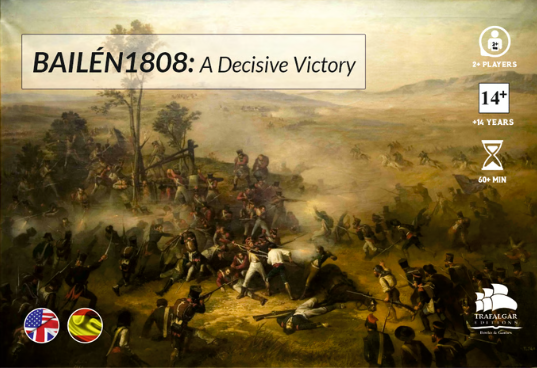
3. Bailén 1808: A Decisive Victory from Trafalgar Editions Currently on Kickstarter
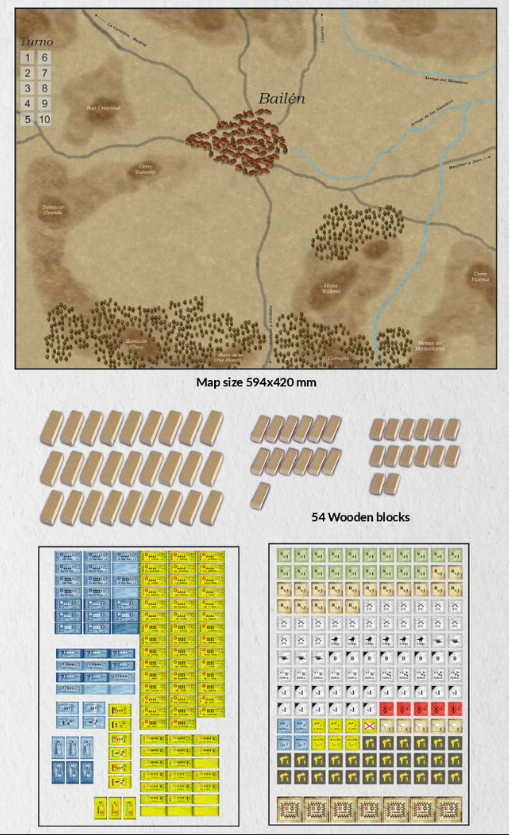
Recently, I noticed a new game from Trafalgar Editions that was being offered on Kickstarter called Bailén 1808: A Decisive Victory. The game covers the clash between the French and Spanish in 1808, which saw a defeat of Napoleon during the Peninsular War.
From the game page, we read the following:
Bailén 1808: A Decisive Victory, recreates this pivotal battle, an unexpected confrontation that marked a turning point in the struggle against Napoleonic domination. The game shares the same system as Trafalgar Editions’ other Napoleonic titles, such as Waterloo 1815 and Austerlitz 1805. Units are represented by wooden blocks, which not only offer a unique visual appeal but also facilitate a clear visualization of movements on the battlefield.
In this landscape of rolling hills and ancient olive groves, two armies prepare to collide: General Dupont’s seasoned French divisions, confident in their superiority, and the Spanish forces – a blend of regular troops and patriotic militiamen – driven by the fervent defense of their nation.
Feel the tension before the engagement, cunningly plan your movements, and strategically deploy your units to emulate or alter the outcome of this historic battle.
One of the things that I am most interested about with the game is the fact that they provide an artillery template that can be used when firing cannon to judge what units in the firing arc will be hit wit the attack. This is always a novel way of approaching this aspect of war and I love to see its inclusion.
As of August 1st, the Kickstarter campaign has raised $3,148 toward its $6,393 funding goal with 43 backers. The campaign will conclude on Monday, August 18th at 6:00am EDT.
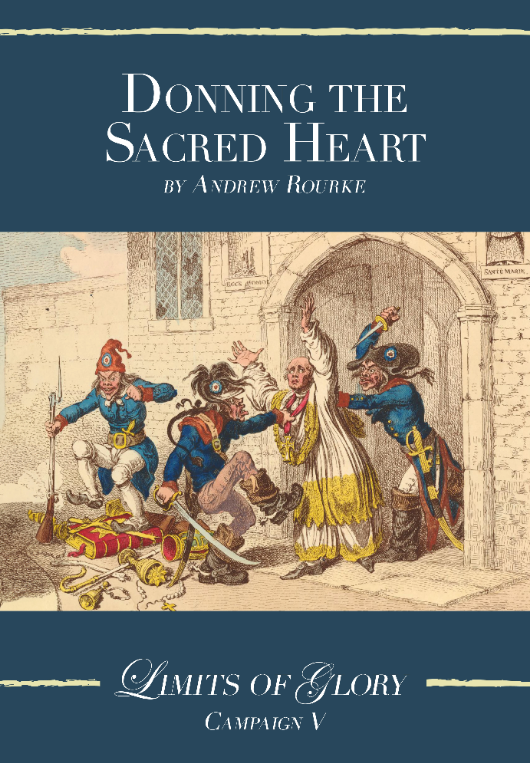
4. Limits of Glory Campaign V: Donning the Sacred Heart from Form Square Games Currently on Gamefound
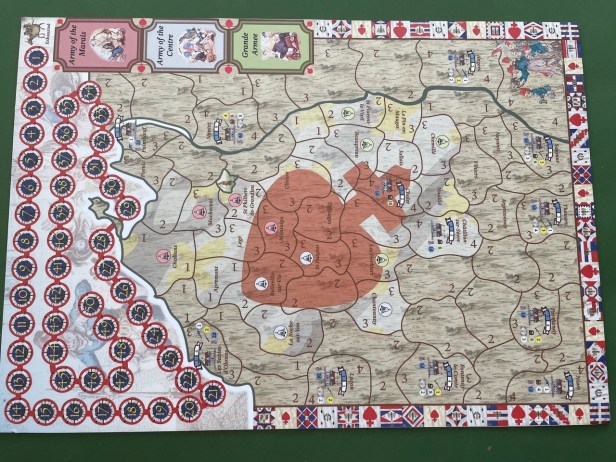
A few years ago, we became acquainted with Andrew Rourke through his Coalitions design from PHALANX that went on to a successful crowdfunding campaign. He has since been a busy guy with starting his own publishing company called Form Square Games and also publishing the first 3 designs in a new series called Limits of Glory that will take a look at the campaigns of Napoleon and other contemporary conflicts. In Campaign I, which is called Bonaparte’s Eastern Empire, the game is focused on the campaign of the French in Egypt between 1798 and 1801. Campaigns II, III and IV are Maida 1806 and Santa Maura & Capri. Recently, an announcement came out about the fifth campaign and it is set during the French Revolution and the Civil War in the Vendée in 1793 and is called Donning the Sacred Heart.
From the game page, we read the following:
The French Revolution was not welcomed by all in France. The staunchly Catholic and Royalist leaning Vendée Militaire was a region unwilling to sacrifice its youth to the voracious appetite of the Republic’s military conscription machine, and the people of the Vendée were prepared to fight to defend their beliefs. Donning the Sacred Heart covers the vicious Civil War in the Vendée from March until December, 1793. All combatants and significant commanders are included and the game causes Multiple strategic decisions every turn. Your decisions will decide victory or defeat, the easy to play mechanics produce a subtle game with full player agency. Complete player engagement throughout.
Tension builds as the Event Clock drives the game, neither player being able to depend on events going their way, or knowing when the game will end.
As of August 1st, the Kickstarter campaign has raised £3,895 ($5,123 in US Dollars) toward its £2,000 ($2,630 in US Dollars) funding goal with 46 backers. The campaign will conclude on Tuesday, August 26th at 3:00pm EDT.
5. Battalion S3: Operations and Training – A Battalion Combat Series MagazineIssue #1 from Multi-Man Publishing
If you didn’t know, we have become acquainted with the Battalion Combat Series from Multi-Man Publishing over the past few years and very much enjoy the system. In fact, we have played several volumes now including Arracourt, Baptism by Fire and Brazen Chariots; and also have acquired all of the other volumes including the newest release Inflection Point. So recently when I heard that there was a new BCS focused magazine in the works called Battalion S3: Operations and Training – A Battalion Combat Series Magazine we both got very excited! As a bonus, the magazine also includes a full game called Danger Forward: The Battle of Gela, July 1943.
From the game page, we read the following:
Battalion S3: Operations and Training is a magazine dedicated to the Battalion Combat Series. It includes the game Danger Forward: The Battle of Gela, July 1943, ideal for introducing BCS to new players while still offering a great experience for veteran players. The magazine is full of articles centered around Danger Forward to help players better understand aspects like activations, combat, and logistics.
Danger Forward is a complete game covering the Battle of Gela that took place between 10-12 July, 1943 in Sicily. Following the initial landings of Operation Husky, the Italians and Germans were determined to throw the American forces back into the sea. They launched a vigorous attack that nearly succeeded, shelling the beaches with tank fire. The American ground forces, supported by the Royal Navy and US Navy offshore, fought hard to prevent defeat. Not resting on their laurels, the Allied forces had to push inland to secure ports and airfields to ultimately take the island. Taking Sicily quickly led to the invasion of Italy and ultimately the downfall of Mussolini. All of that hung in the balance based on the results of the fighting at Gela.
The game showcases the unique forces involved at Gela, including the infamous Hermann Göring Panzer Division, the US 1st Infantry Division (“Big Red One”), US Rangers, and the Italian Livorno Division that acquitted itself well. The terrain depicts the unique Sicilian landscape, from the invasion beaches, the rough mountains inland, and the ubiquitous olive orchards that dotted the island.
Danger Forward is ideal for gameplay: a single map, a handful of formations, and a three turn game. Yet the situation and game variables allow for replayability. Veteran players will see dynamic situations as challenging for each side, and new players will learn the ropes of how to perfect strategy and tactics. The maps and counters use the larger format as in Arracourt. It’s ideal for setting up and completing in a single game session.
If you are interested in Battalion S3: Operations and Training – A Battalion Combat Series MagazineIssue #1 and the included game Danger Forward: The Battle of Gela, July 1943, you can pre-order a copy for $39.00 from the Multi-Man Publishing website at the following link: https://mmpgamers.com/battalion-s3-operations-and-training-p-434
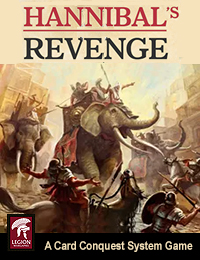
6. Hannibal’s Revenge: Card Conquest Series – Volume II from Legion Wargames
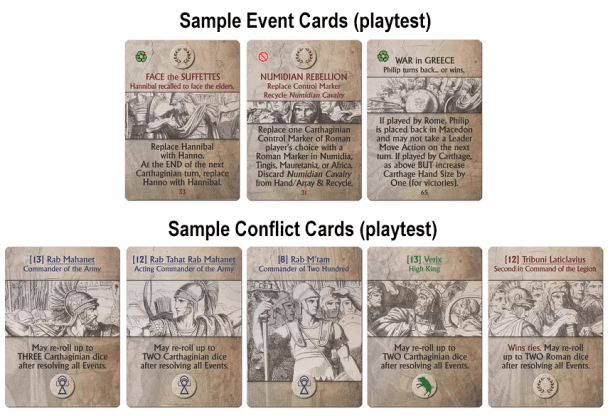
A few years ago, the Card Conquest System made its debut in a game called Hitler’s Reich from GMT Games. The system uses cards and dice to decide the outcome of battles and really creates a light and engaging strategic exercise. The only problem with Hitler’s Reich was the rulebook and I think that we will not see that problem again. The next game in that series is called Hannibal’s Revenge and has recently been picked up by Legion Wargames. The game pits the forces of Carthage against the mighty Roman Empire in the Second Punic War and is designed by Mark McLaughlin and Fred Schachter.
From the game page, we read the following:
Hannibal’s Revenge is the second in the Card Conquest Series in which players recreate epic military contests of history in short, comparatively simple, easy-to-learn but hard-to-master games. As with the first game in the series, Hitler’s Reich, Hannibal’s Revenge sets up in minutes and plays to a conclusion in one sitting of two hours (or less). These are not simulations but games, albeit ones packed with enough historical flavor and decision-making to give players the feeling that “you are there” at the highest levels of command.
In Hannibal’s Revenge, the 23 uneasy years of peace between the arch-rival republics of Rome and Carthage come to an end by Hannibal Barca. Son of the Carthaginian hero in their earlier conflict, he vowed since childhood to take revenge for his country’s humiliating defeat in that war. Now the time has come to redeem that pledge, and he laid siege to the city of Saguntum in Spain. Rome, incensed over this attack on their ally, mobilizes for war in response.
It is now 219 B.C. (or in the Roman calendar 534 Ab Urbe Condita -that many years since the founding of the city). As the Senate and People of Rome, will you succeed in making Carthage pay for this insult and once again force upon them a humiliating peace? Or as the elders of Carthage, will you restore your city’s rightful place in the Mediterranean world to bring honor and glory to your people through victories gained in Hannibal’s Revenge?
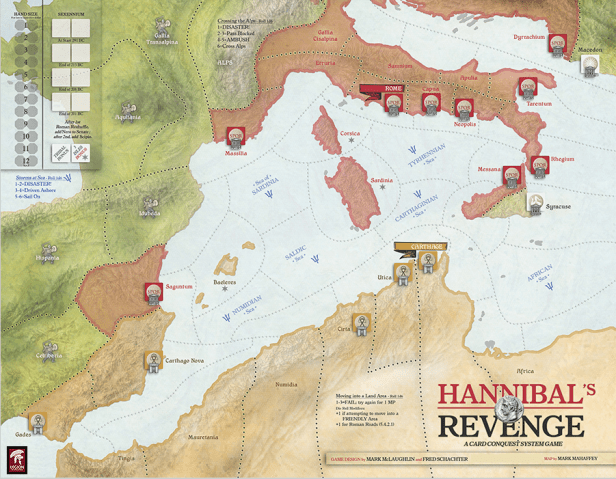
Hannibal’s Revenge mixes deck building mechanisms with area control on a map of the Western Mediterranean. There are several ways players can win: by capturing the enemy capital (without losing their own), reducing your opponent’s hand size to zero, or (as Carthage) holding out until the game ends. To accomplish all this, players can capture cities and/or play event cards that help them strengthen their hand, or weaken that of their opponent.
A player’s hand is composed of conflict cards ranging in strength from 1 to 13. Some of these cards have special powers, such as the ability to re-roll one or more dice. In conflict, the strength of these cards is complimented with the roll of the dice (standard 3, but up to 5 with events and leaders). Rome’s deck is divided into two “suits”: one for the Republic of Rome itself (e.g. “The Legions”) and another for its Latin Allies. Cathage’s conflict cards are similarly divided: one suit representing the core Carthaginian army and another for their Gallic, Spanish, and other Allies/Mercenaries.
Conflict cards can also be used to move leaders (e.g. Hannibal or his brother Hasdruble and a pool of Roman leaders of varying quality whom a Senate game mechanism assigns to command Rome’s field armies). These leaders represent their armies which move upon the game map, a map divided into sea and land areas (yes, Hannibal can again perform his legendary march across the Alps!) with some land areas identified as Roman, Carthaginian, or Neutral, some of which contain Fortified Walled Cities. Such Cities may be besieged…a sometime perilous and time-consuming enterprise.
Players may also use one or more Event cards to influence the outcome of the conflict. Conflict arises when a player tries to capture a territory or when he tries to acquire a new Event card from one of three available decks: Roman, Carthaginian, or mixed (available for both parties).
Hannibal’s Revenge includes a built-in solitaire bot system to enhance solo play. For those who want to play with more than two, it also includes optional rules for 3-4 players.
If you are interested in Hannibal’s Revenge: Card Conquest Series – Volume II, you can pre-order a copy for $62.00 from the Legion Wargames website at the following link: https://www.legionwargames.com/legion_HRV.html
7. Eastern Front Operational Battles Quad from Compass Games
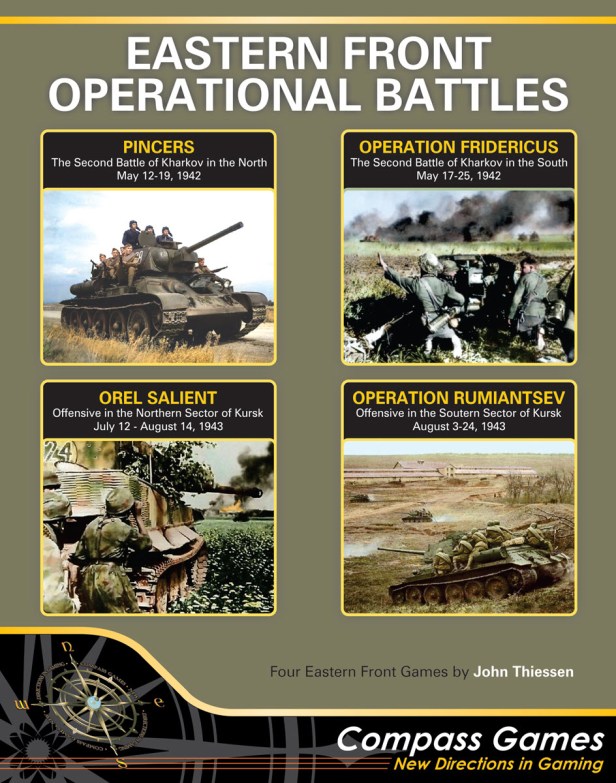
The classic qadrigame is a solid way of getting lots of content into a box and also packaging similar battles with the same rules set in an easy and accessible method. I love these quads and am very glad to see they are still alive and kicking. This month, Compass Games added a new quad designed by John Thiessen called Eastern Front Operational Battles to their pre-orders and it includes Pincers, Operation Fridericus, Orel Salient and Operation Rumaiantsev.
From the game page, we read the following:
In May of 1942, portions of the Red Army were to attack the German 6th Army, as mandated by Stalin. This was to be a pincers type attack, enveloping Kharkov. The Germans coincidentally were planning an assault in May against the salient which formed the southern base of the Soviet May offensive. The Red Army struck first, and five days later the German attack commenced. These double offensives are what are covered in “Pincers” and “Operation Fredericus”. As the German Zitadelle offensive of 1943 was winding down, the Soviets launched a major attack of their own on the northern part of the Kursk area. Then on August 3 the Soviets attacked the southern part of the Kursk area. “Orel Salient” and “Operation Rumiantsev” cover these actions.
Eastern Front Operational Battles use the same basic rule set in all four games as one would expect in a quad game. The rules are accessible and straight forward for playability, and at the same time, all aspects, such as movement rates, combat outcomes, and so on, are based on historical analysis. All of the games play at the operational level. Units are mostly regiments/brigades and divisions in the 1942 games, and divisions and corps in the 1943 games.
There are also a few interesting small units in the mix. In the 1943 games, the Germans have a small number of the “animal” units available: Hornisse, Tiger, Brummbar, as well as Ferdinands (later called Elefants). There are a few Hungarian, Romanian, and Italian units that take part in the action. Both sides have a number of armored, motorized, and cavalry units in their orders of battle, so that movement and breakthroughs are frequent possibilities. Headquarters allow units within range to benefit from a number of characteristics. Airpower is represented with players able to give CRT column shifts and to attack various ground targets. Some randomized special events affect play. The system isn’t complex, and there are a few optional rules that are available if players want to add some chrome.
Gamers should find that ease of play and realistic modeling coexist in this system. All four games in Eastern Front Operational Battles can be for two players, and they are also readily accessible for solitaire play.
I don’t have a lot of other information or even pictures to share but I am very much interested in this one and will keep it on my radar. I love a good East Front wargame!
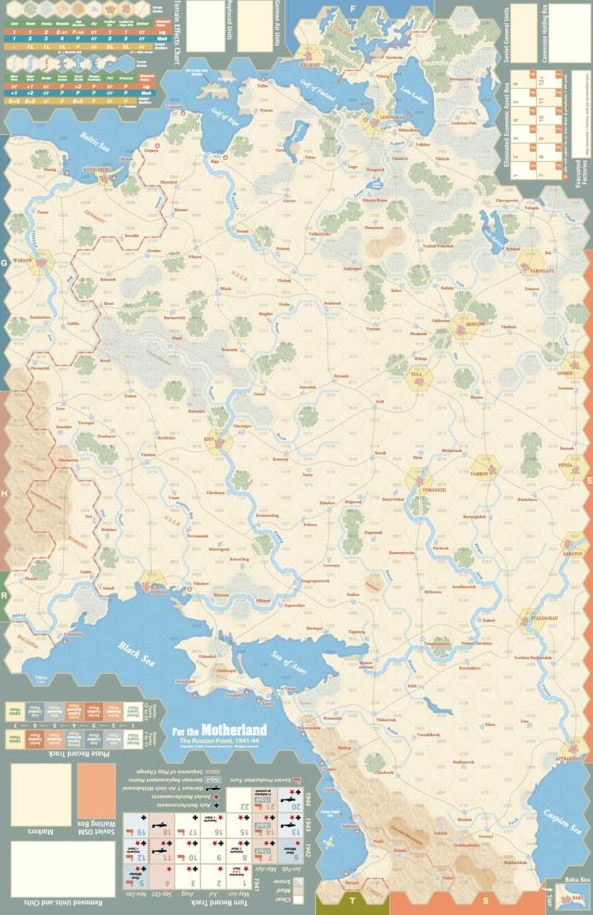
8. For the Motherland! The Russian Front, 1941-44 from Compass Games
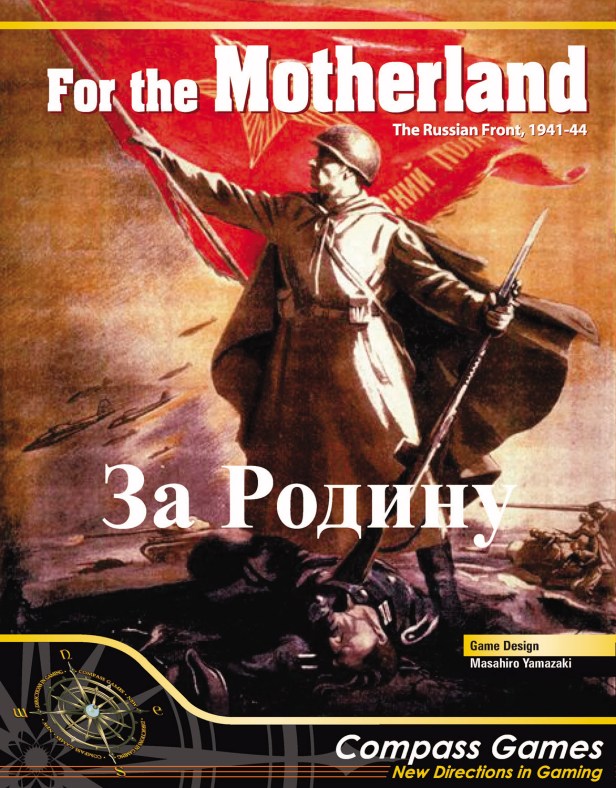
Another new game offered by Compass Games this month was also another East Front game called For the Motherland: The Russian Front, 1941-44 designed by Masahiro Yamazaki.
From the game page, we read the following:
For the Motherland! The Russian Front, 1941-44 is the all-new, single map game design by renowned Japanese game designer, Masahiro Yamazaki. This edition features a mounted map and delivers an eminently-playable version of his original, two-map War for the Motherland release that can be played to completion in a single sitting.
The game begins with Operation Barbarossa marking the German invasion of the Soviet Union, and culminates towards the end of the war when the Russians had effectively driven back the German forces and were entering the final stages of the epic struggle on the Eastern Front when the tide had completely turned. The game includes four variable turn scenarios: Operation Barbarossa (1 to 7 Game-Turns), The Road to Stalingrad (1 to 12 Game-Turns), Fall Blau (8 to 17 Game-Turns), and War for the Motherland campaign (1 to 22 Game-Turns). One of the nice new twists implemented for the strength chit system is the variable and increasing combat chit strength for the Soviets over time to model the increasing combat effectiveness of the Soviet Armies.
This all-new game design borrows from some of the lessons learned from the larger two-map game, War for the Motherland, and compacts the scope and design of the game into a very playable yet illuminating game covering the struggle for the Eastern Front that can be completed in a single sitting. For example, the larger War for the Motherland game involves more units and takes 40 turns to complete, whereas this compact design has fewer units and only takes 22 turns to complete. Players will also appreciate the upgraded components featuring a mounted game map and 9/16″ counters. For the East Front aficionado, this is a must-buy for those familiar with Yamazaki’s great contributions in covering the East Front who now delivers this sleek, new compact design.
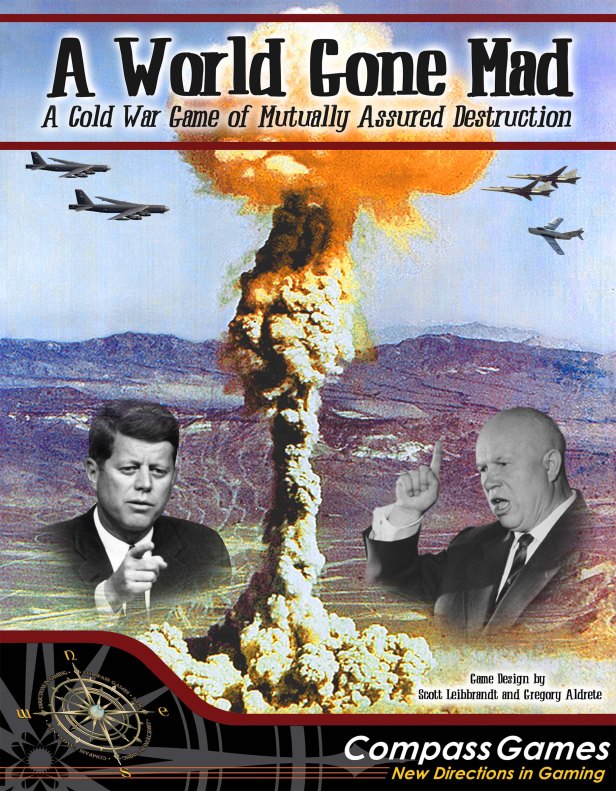
9. A World Gone Mad: A Game of Mutually Assured Destruction from Compass Games
The 3rd new game from Compass Games that I found this month (I actually think that it was added to the pre-order system a few months ago) was a very interesting looking game on the Cold War era where players are trying to destroy each other with some interesting random elements and no dice. A World Gone Mad: A Cold War Game of Mutually Assured Destruction is designed by Scott Leibbrandt and Gregory Aldrete and looks very interesting.
From the game page, we read the following:
It has finally happened; the world has descended into madness! The Capitalist Nations, led from Washington, D.C., are locked in mortal conflict with the Communist Bloc, controlled by an iron-fisted Kremlin.
Despite how eagerly the two sides have rattled their sabers, neither power is truly prepared for total war in the nuclear age. Tanks and missile cruisers, jet fighters and Kalashnikovs, roll off assembly lines and straight into one of a dozen war-ravaged wastelands strewn across the globe. Each side hopes for a quick victory, as neither can sustain the horrors of the nuclear age for long.
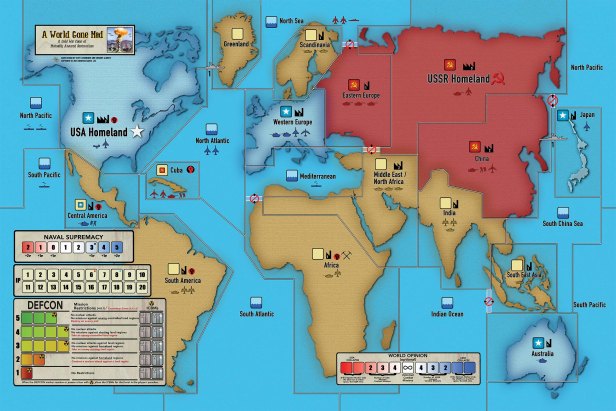
A World Gone Mad is a diceless wargame that simulates an apocalyptic nuclear war between the U.S. and the Soviet Union. The game assumes that neither nation’s economy is prepared for nuclear conflict. Production represents the sole element of chance in the game.
Each turn, players draw random unit tiles according to the size of their economy, and strategically deploy them across the globe. Both sides strive to achieve victory by taking their opponent’s homeland before their own country is reduced to charred, irradiated rubble.
In addition to the direct conquest of your opponent’s territories, the path to ultimate victory can be pursued by a variety of means, including strengthening your economy by controlling the seas, developing new technologies to enhance your military’s abilities, bringing neutral regions under your domination to increase your influence and power, and even fomenting revolutions in your enemy’s lands using guerrillas.
You’ll fight battles on land, in the air, on the water, and beneath the waves. You will need to be aggressive—but don’t leave yourself open to a sneak attack! And, looming over every move, is the ever-present threat of nuclear armageddon!
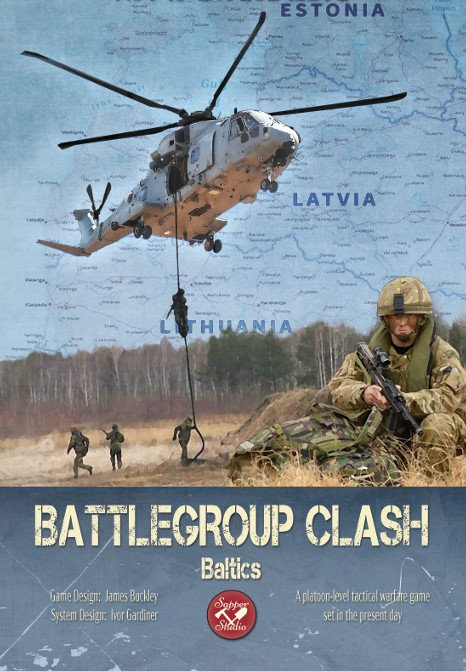
James Buckley is a name we all know in the wargaming space. He has worked with publishers like PHALANX and Nuts! Publishing and also is now a burgeoning designer as he has announced his first game called Battlegroup Clash: Baltics along with his new publishing company called Sapper Studio.
From the game page, we read the following:
Battlegroup Clash: Baltics is a two-to six-player tactical land warfare game that plays in two to three hours. It is a commercially-adapted version of a game recently developed for the British Army to help train its junior officers.
The game is set in Estonia and covers a hypothetical near-future Russian invasion of the country, and attempts by NATO land forces to repulse it. Each side has a maximum force size equivalent to a reinforced battalion, with individual unit sizes being platoons or sections.
It comes with six scenarios and has three play modes and optional rules, allowing for players to vary the level of realism and complexity of play. The Basic mode of play is equivalent to a light complexity commercial wargame. The Standard and Advanced modes are equivalent to a medium-light complexity game.
While the game mechanics and components will be familiar to anyone that has played a hex and counter wargame, there are several unique features about Battlegroup Clash: Baltics:
Preparation & Planning – In the Standard and Advanced modes of the game players will need to draft Orders for their forces. This happens at the start of the game. These Orders drive the actions individual units take in the game. This is a simplified version of the type of planning that would occur in real life. It presents both a challenge and opportunity to players, and greatly enhances the immersion of the game.
Drones and Electronic Warfare – Events in Ukraine have shown how much the use of drones has changed the modern battlefield. Reflecting this, in the game players use UAS drones for reconnaissance and FPV (‘kamikazi’) drones to attack enemy units. Each side can intercept their opponent’s electronic transmissions to improve targeting, and apply tactical Electronic Warfare effects such as jamming the enemy’s drone assets or crippling their GPS navigation.
Real World Mapping – The four maps in the game are based on satellite imagery from key locations in Estonia. Using computer aided design, that imagery has been turned into a highly realistic map. There are no hexes, just grid lines, the same as a real world map. Players must read the map terrain to determine key locations and terrain features, and assess how they fit into their battleplan and objectives.
I am very interested to learn more about this game and will be reaching out to James to do a designer interview soon.
11. Dice Commandos from Solo Game of the Month Currently on Gamefound
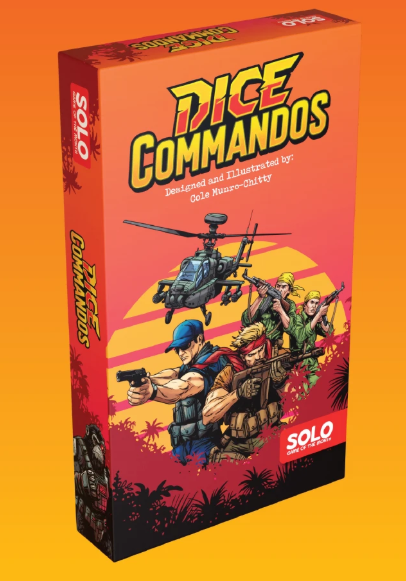
I have a bit of experience with a new company on the scene called Solo Game of the Month. They are a solitaire game publisher that has used crowdfunding to get their games out there. I have played 2 including Rome: Fate of an Empire and Okinawa: The Last Battle of World War II and these games are solid games with fantastic components. I love that they are true solitaire games as well and the designer Gabe Barrett just seems to get the process and how to make them good. Their newest offering is a squad based commando style dice game called Dice Commandos and looks really good.
From the game page, we read the following:
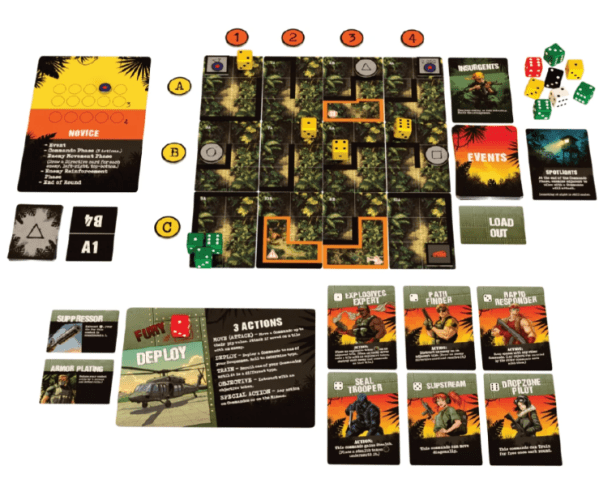
Dice Commandos is a tactical dice puzzle game where you control a team of elite operatives completing objectives through stealth, combat, and clever use of abilities.
Each round of Dice Commandos consists of 4 phases; Event Phase, Commando Phase, Enemy Movement Phase and Enemy Reinforcement Phase. After the 4th phase of the round, move the Round Tracker token forward 1 space, ready any exhausted cards and begin a new round.
EVENT PHASE Draw and resolve an event from the top of the Event deck, placing it in a discard pile next to the deck. Some events have Immediate effects and some events have ongoing effects that will last throughout the round. As the rounds advance there will always be a new active event in play.
COMMANDO PHASE During the Commando Phase, you will take 3 actions with your team of Commandos. There are 3 basic actions and numerous other actions indicated on your Commandos, the Mission Setup card, Load Out cards, some Event cards and the Map Icon Reference card. You may take any action multiple times in the round unless otherwise specified by the action.
3 BASIC ACTIONS:
TRAIN – Reroll 1 of your Commandos until it is a different value. It stays in the same space and keeps all Objective and Stealth tokens. Other common actions are found on some of the Commandos themselves and on the Mission Setup card. A very common action is to pick up the Objective tokens on the Board. In order to pick up an Objective token, you must have the dice that match the value (or values) on the Map Objective token.
MOVE/ATTACK – You may move a Commando a number of spaces on the map up to their pip value. A Commando may only move orthogonally unless otherwise specified. If you move onto a map tile with an enemy, you must immediately pause your movement and attack each enemy on that tile individually. After the combat is determined, and there are no more enemy dice on the tile, you may resume your movement action using any remaining movement. Combat happens both if you move onto a tile with an enemy, or if an enemy moves onto a tile with a Commando. Whichever die is moving onto the tile is the Attacker, and the die (or dice) already existing on the tile are the defenders.
To Attack an enemy die, choose an enemy die on the tile you just moved onto, then roll both Combat Dice. The black die is the Combat Roll for the attacker and the white die is the Combat Roll for the defender. Add the sum total of the Attacking die + it’s Combat Roll (black die) and then add the sum total of the Defending die + it’s Combat Roll (white die). Whichever is the lowest value wins the combat. The Attacker wins in the case of a tie.
If there are multiple enemies on a tile, you will repeat the above process for each enemy. You may choose the order in the case of multiple combats. When the winner of a combat is determined, remove the die that lost the combat from the map. If a Commando wins the combat and the enemy is defeated, increase your Fury die on your Player Dashboard by 1. If a Commando loses the combat, they are defeated and removed from the map and placed in the Deploy box on your Player Dashboard. Then decrease the Fury die by 1. When the Fury die reaches 6, reset it to 1 and draw a Load Out card. Some spaces on the map side B cards have special rules when moving onto them, consult the Map Icon Reference card for those rules.
DEPLOY – Deploy 1 Commando to one of your Drop Zones on the map. Choose a Commando die from the Deploy box on your Player Dashboard and roll that die once. Place the newly rolled Commando on one of your Drop Zone tokens on the map.
ENEMY REINFORCEMENT PHASE The Round Tracker card has an Enemy Limit value printed next to the level the Round Tracker is currently on. During this phase you will check to see if the current amount of enemy dice (not including Bosses) is more than, equal to, or less than the limit. If there are more than or equal to the limit, you do not need to add anymore enemies to the map. If there are less than the limit, you must add enemies until they are equal to the limit. When adding an enemy die, you will roll it and spawn it on the corresponding Enemy Spawn token that is showing on the back of the Enemy Directive deck (Circle, Triangle and Square). Then discard that Enemy Directive card, revealing a new enemy spawn point symbol. Repeat this process until the amount of enemies (not including Bosses) is equal to the current limit.
As of August 1st, the Gamefound campaign has raised $37,349 toward its $5,000 funding goal with 1,208 backers. The campaign will conclude on Saturday, August 9th at 12:00am EDT.
12. Seapower & The State: World War III at Sea from Compass Games Currently on Kickstarter
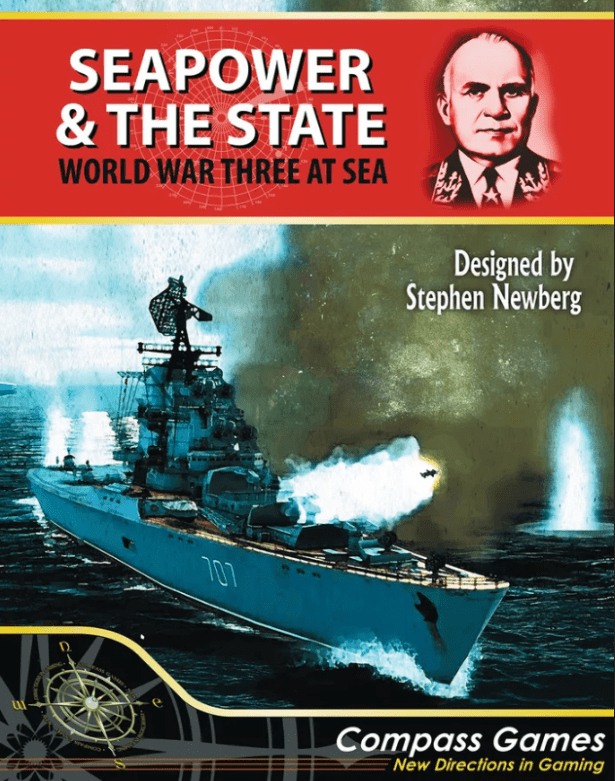
Naval wargames are always different and frankly really interesting to me. We have only played a few of them but this one definitely looks interesting to me and it is not because of the Cold War Gone Hot theme here with World War III. Seapower & The State: World War Three at Sea is currently being offered on Kickstarter.
From the game page, we read the following:
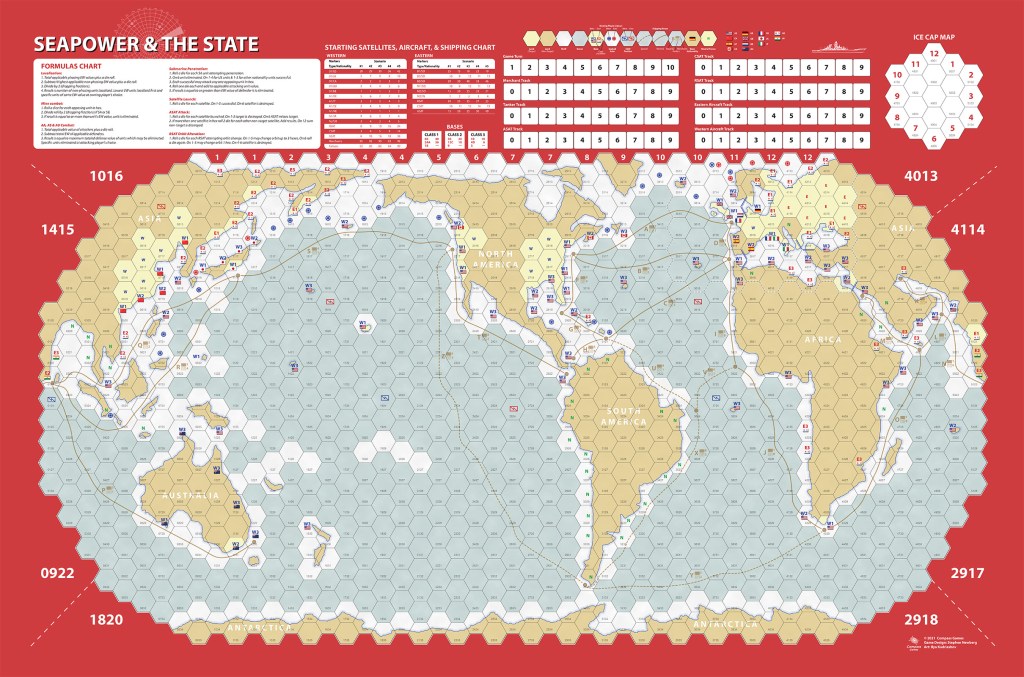
Seapower & The State is a strategic study of World War 3 at Sea. The game examines the worldwide state of naval affairs from 1984-1994 as related to major conflicts in this two-player simulation game of moderate complexity on the grand strategic scale. The viewpoint of the simulation is that of grand strategy and thus has the players acting as the overall commanders of the naval forces of the Eastern or Western alliances. Numerous scenarios are presented for various force levels for different time periods. Designed & developed by Stephen Newberg, this substantially upgraded 2nd Edition includes all of the aspects of the original with more components and all-new artwork.
If major war had broken out in the last two decades of the previous century, the oceans of the world would have been the scene of some of the most intense military conflict in the history of mankind. Since the Second World War naval science has undergone two major technological revolutions that have completely altered the types of weapons available to naval forces and the naval forces themselves. This has changed the interrelation-ship between the three major types of naval platforms, namely the aircraft over the sea, the warships on the surface of the sea, and the submarines beneath the sea. The first of these revolutions was the development of nuclear propulsion systems, leading to true submarines, for the first time untied to the sea’s surface. The second was the application of electronics and computer systems to all forms of naval platforms, resulting in enormous increases in the detection and destruction capabilities.
As of August 1st, the Kickstarter campaign has raised $13,291 toward its $2,500 funding goal with 144 backers. The campaign will conclude on Sunday, August 3rd at 2:02pm EDT.
13. Today Another BattlePrint and Play from Matt White Currently on Kickstarter
A few years ago, we posted an interview with Matt White, who is a very talented graphic artist and budding game designer, that focused on his artistic talents and love of tanks. He has since designed several very interesting small scale wargames, with his most recent series being a World War II tactical wargame series for 1-2 players pitting the British Airborne versus the German Wehrmacht called Until the Bitter End. He then designed the next entry in that series called Until the Bitter End – US Airborne followed by Until the Bitter End – Tanks. He has also done a few others including Would Be Aces and Operation Biting. His newest offering is called Today Another Battle and is being offered on Kickstarter.
From the game page, we read the following:
Welcome to Today Another Battle, a WWII solitaire wargame where you will face difficult choices and decisions in every part of the game. Under your command are units of soldiers and armor set against the Western Front Normandy landscape. In trying to reach your objectives you will encounter bitter enemies, obstacles, good fortune and crippling bad luck.
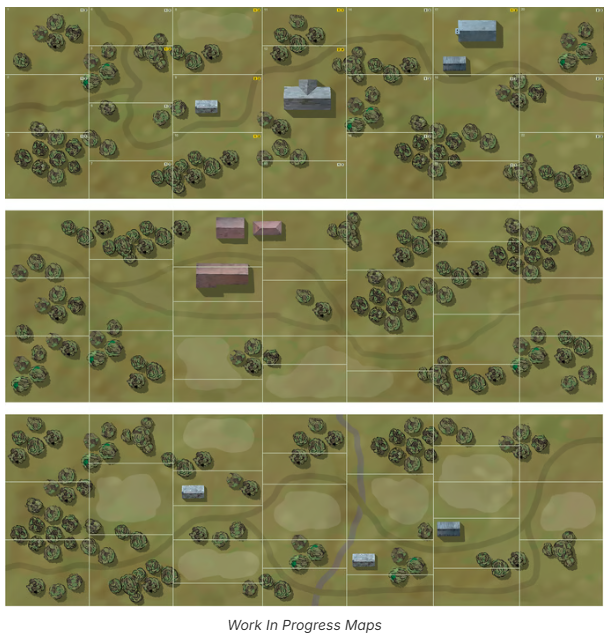
The game is quick to setup and play, it takes around 30 minutes to play a shorter game, to less than a couple of hours for a larger game and requires very little space.
During a game you will command both infantry, tanks and with the aid of artillery and air strikes progress across one (or more) of the maps on a chosen scenario. You will face unrelenting and determined opposition in the enemy forces who are not going to give ground easily. You will need to make hard, tough choices weighing up options with the information you have and attempting to account for the unknown.
This is a Print and Play game for solitaire (and can be played co-op with another player). All of the digital PDF files are included (you simply print it out, provide yourself with a regular six sided dice and a pencil).
I have played several of Matt’s games and they are fantastic! This one is very much a tactical squad based combat style game but looks really good. The art is also fantastic and being print and play the game is very affordable. You just have to be willing to plan for some arts and crafts time.
As of August 1st, the Kickstarter campaign has raised $3,111 toward its $134 funding goal with 100 backers. The campaign will conclude on Wednesday, August 20th at 3:30pm EDT.
14. ARC – The Underworld from GMT Games
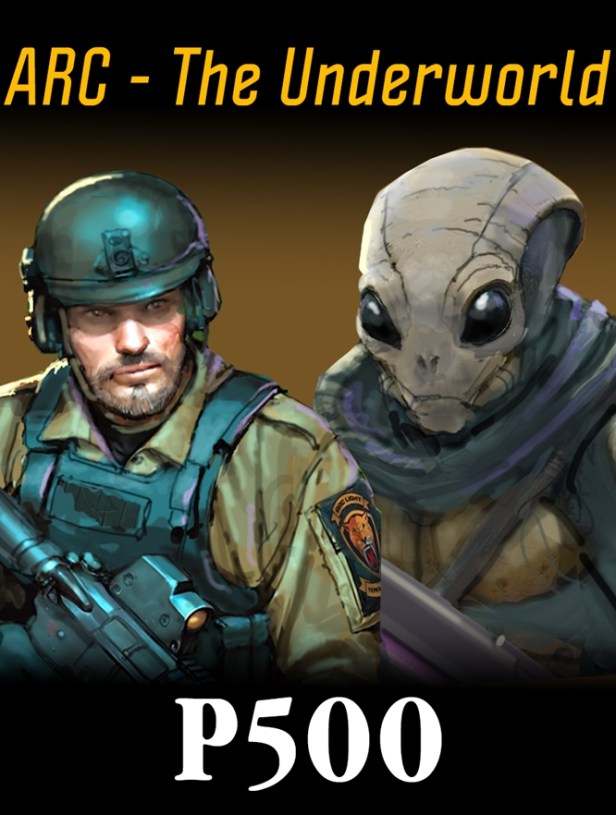
I am all for a new Sci-Fi focused game. There are not enough of them in my mind. I do love the Sci-Fi genre and have really very much enjoyed many of the games from GMT including Space Empires 4X and Talon. But a tactical level squad based game in the Sci-Fi space seems very interesting and I am very much excited about this new offering on the P500 called ARC – The Underworld.
From the game page, we read the following:
This is not the early 1930’s Untouchables vs. Chicago’s South Side Gang, but a squad-level, tactical game of Special Ops forces combatting an ancient race that clandestinely thrived underground, undetected…until now.
After erupting from the surface of a distant planet, one small fragment of rock orbited the Sun for 150 million years before colliding with the Earth eons ago. The alien organisms in the rock made a home on their new planet, evolving deep beneath the Earth’s surface and following a very different trajectory than the surface dwellers. After a catastrophic underground event destroyed their access to their main source elements, failing resources have forced them to venture openly to the surface.
Recently, a series of unexplained deaths and abductions, coupled with the total loss of communications from the small rural town of Crawford, prompted the ultra-secret Alien Response Command (ARC) to deploy an ARC-Light team to investigate immediately and, if necessary, control and contain the situation.
In the aftermath of the 1947 UFO Incidents at Roswell, New Mexico, and Maury Island, Washington, ARC was created as the covert component of the U.S. Air Force’s Project Sign. Followed by Project Grudge and the more well-known Project Blue Book, ARC continued as part of the Air Force until 1969, when the official programs were supposedly terminated.
As a quasi-independent force, answerable to only the highest levels of government, ARC operators are trained in black ops, concealment, containment, and unconventional warfare. Like the CIA’s Special Activities Center (SAC) Ground Branch, ARC Light and Heavy Teams are composed of Tier 1 operators drawn from various USSOCOM units, such as 1st SFOD-D (Delta, also known as the Unit) and DEVGRU (formerly known as SEAL Team Six). Within JSOC, these two units are commonly known as Task Force Green and Task Force Blue, respectively. True to their unique world, ARC operators are identified as Task Force Black in keeping with their unit motto, tenebris manet – Darkness Awaits.
They are experts in independent operations, small-unit tactics, close-quarters battle (CQB), and highly sophisticated man-portable weapon systems. Their ultra-quiet UH-60RK Blackhawk and MH-47G Chinook helicopters let them slip under the darkness, evaluating and responding to everything encountered.
Nearing Crawford, they discover a town that seems devoid of human presence. Instead, they find what initially appears to be “Off-Worlders” armed with simple weapons (knives, blades, and bows). However, it is quickly determined that they are dealing with a highly evolved society, a race of terrestrial aliens who call themselves the Rezex.
I know that this information is just a lot of backstory and narrative but I thought that it was important to share it. I will be honest. This game is a bit hard to get a read on from the information presented but here are the vital statistics about the game play that were shared:
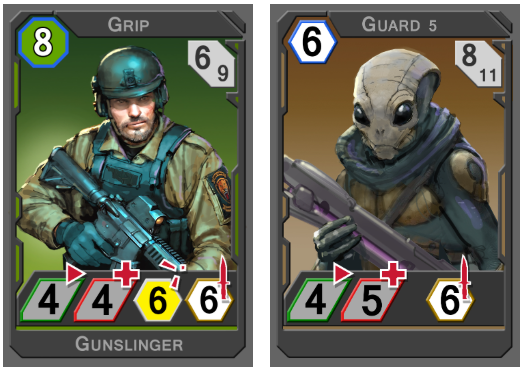
ARC – The Underworld presents a unique gaming experience that combines the small-unit combat of tactical games:
Utilizes character blocks w/labels and counters
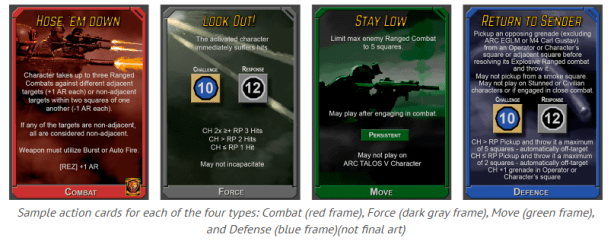
Card Assist gameplay with Action and Character cards
Two fully asymmetrical forces with different weapons, tactics, and strategies
Dynamic play with excellent replay value: 13 scenarios, playable individually or as a serial campaign game
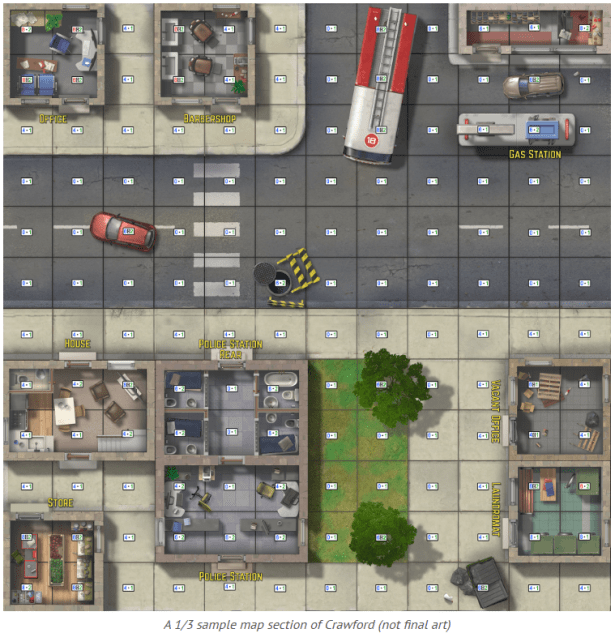
Maps representing three distinctly different play areas with street level (the town of Crawford), sub-level 1 (the town’s sewers), and sub-level 2 (the Rezex’s lair)
Active Terrain
Action cards include unique Combat, Defense, Move, and Force types
Utilizes a polyhedral dice-comparison system to resolve combat and game activities
Here is a look at the picture of the board which definitely reinforces the tactical nature of the game and looks pretty good as well, even for a prototype.
I want to learn more about this game. I just don’t know that I know what it really is or what the game is trying to do from this entry. I will plan to reach out to the designer Jim Day to get some more information.
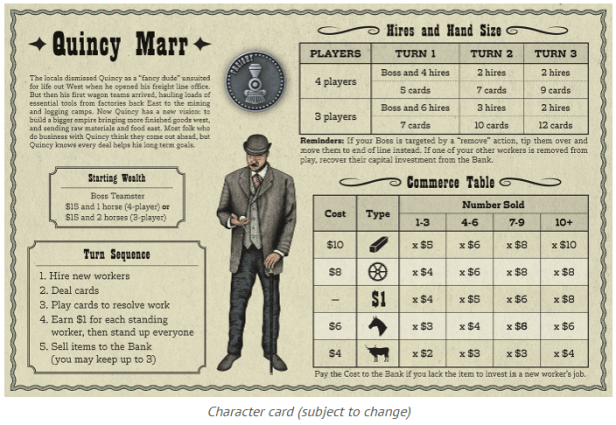
The next offering on P500 doesn’t appear to be a wargame at all but is more an economic simulation game focused on building a profitable business in the West. And I am fine with that as the topic is intriguing and is definitely something different that I can get behind. The game is called How the West Was Won and is designed by veteran Ben Knight.
From the game page, we read the following:
The complex and rich history of the American West is often explored by writers and filmmakers. From the dime novel Westerns to the latest Spur Award winners, from the silent black-and-white one-reels to the recent mini-series sagas, there seems to be no end to stories set in the West. And that’s just how it’s depicted in fiction. The reason Western stories have always flourished is because the actual history provides such fertile ground from which fictional stories can grow. The West invited people from all over the world to come and reach for the stars, and it rewarded anyone who succeeded on that path.
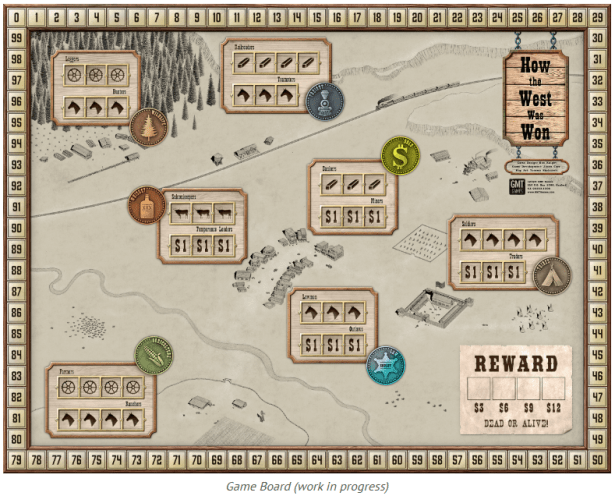
How the West Was Won puts players into several businesses that were typically present in the American West during the years 1845-1890. You are all young entrepreneurs competing in an economy created to exploit seven different markets. Your goal is to become the richest person in town, and you accomplish this by competing with other players for the local resources and by hiring workers to perform actions that hinder competitors or contribute toward your own wealth. The game’s theme makes it easy to recruit new players, and the short set of rules makes it quick to learn and teach.
Number of Players: The game supports 1 to 4 players but plays best with 3 or 4 because the decisions made by players generate the most interactions and amusement.
Playing Time: Typical playing time is 90 minutes, and the game lasts 3 turns.
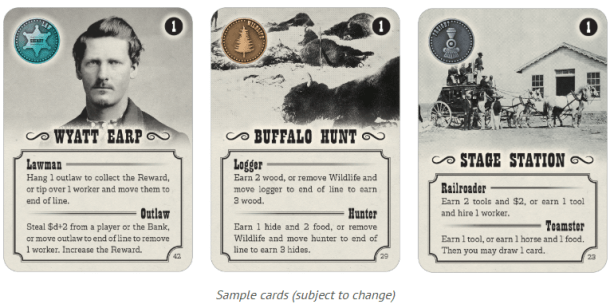
How It Plays: Gameplay involves a mix of worker placement and card-driven action. Each player starts with a boss and several workers. You place your workers into jobs of your choosing that are spread across seven separate “markets”: agriculture, freight, gold, wildlife, tribes, whiskey, and law. Each market has two job types, and those job types compete for the same market cards. For example, saloon keepers and temperance leaders compete for the whiskey cards, and farmers and ranchers compete for the agriculture cards. Within each of the 14 job types, workers line up in a queue, with the first worker in line getting activated before the next worker in line.
Every player also receives a hand of market cards each game turn. The market cards activate the workers, one card-play at a time. Everyone’s cards must be played, but there are fewer cards in hand than there are workers in jobs, so not every worker will be activated. The person who plays a card decides which side of the market to activate (for example, farming or ranching). Jockeying for a better position in a job queue increases a worker’s chance of activation when that side of the market is chosen. Furthermore, the cards in your hand may or may not include the markets where you have workers, so you must depend on cards other players play—and when—just as they may benefit from cards you must play.
The sequence of card plays combined with the arrangement of workers in each job line determines who gathers resources or earns money. There are five types of goods in the economy: food, horses, hides, tools, and wood. The more items you gather of a given commodity, the higher price-per-item you get when you sell that good. But diversifying your business across multiple job types improves your end game score. Furthermore, you might use some goods as capital investment when you hire new workers, else you must pay the maximum cost for that investment.
I am very much interested in this concept and how it will play out. It seems pretty straightforward and I look forward to learning more about the game as it develops. I think that my gaming group would enjoy this one!
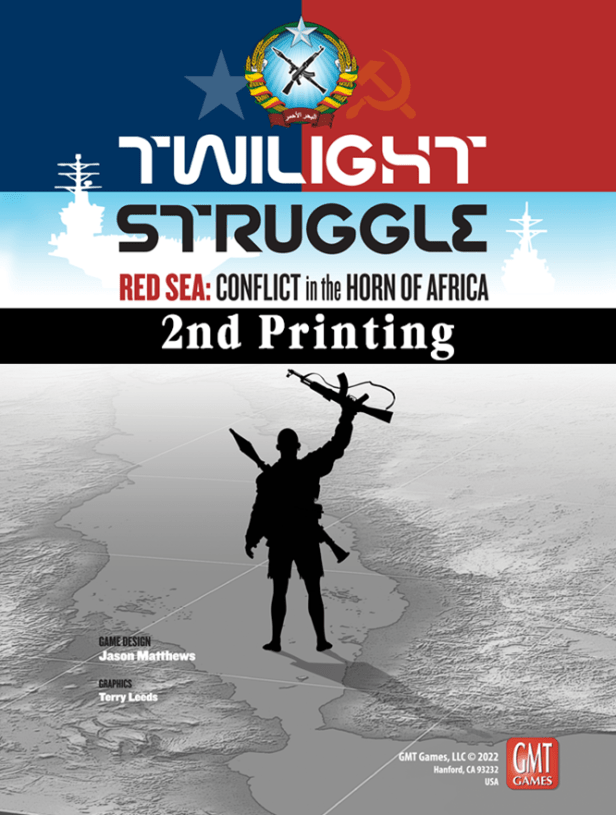
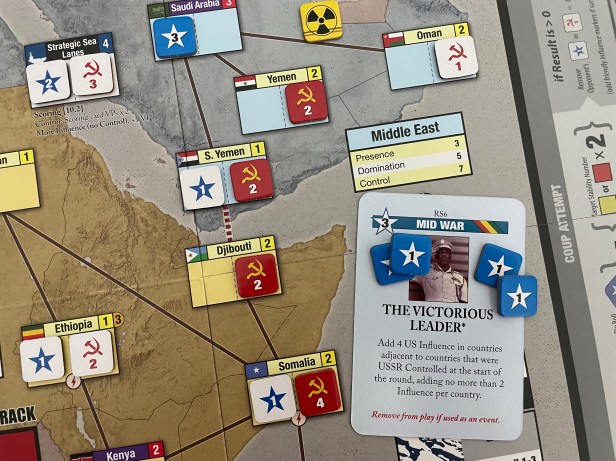
16. Twilight Struggle: Red Sea – Conflict in the Horn of Africa 2nd Printing from GMT Games
We all love Twilight Struggle….and if you say you don’t, you really do but just want to be different or are a contrarian! The game is phenomenal and has done very well for GMT Games with 8 Printings as well as the Turn Zero Expansion and now a series of smaller geographically focused spin off games starting with Twilight Struggle: Red Sea – Conflict in the Horn of Africa. Twilight Struggle: Red Sea deals with just two regions located in the Horn of Africa including Africa and the Middle East. The game uses the familiar Twilight Struggle formula of Cards with both Events and Operations Points that can be used by players to perform Coups, do Realignment Rolls or place Influence in an effort to gain control of the most Countries in the Regions to score Victory Points and win the game. The game is fast, furious and only lasts 2 hands of cards (unless you choose to play the special 3 Turn variant) so there isn’t a lot of time to mess around and players must be focused on what they are trying to accomplish. The best thing about the game is that it plays in 45 minutes as compared to 3-4 hours for Twilight Struggle.
From the game page, we read the following:
Twilight Struggle: Red Sea – Conflict in the Horn of Africa is a two-player, stand-alone, card-driven game that builds on the award-winning Twilight Struggle. The year is 1974, and the Soviet Union and the United States have been locked in a life-or-death struggle across the globe. As so often happened during the Cold War, a relatively obscure region of the world suddenly took center stage. Emperor Haile Selassie I of Ethiopia, a bedrock U.S. ally in Africa, had grown old and increasingly dictatorial. In 1974, a group of young Marxist officers staged a coup and took hold of the the reins of power. This revolutionary leadership sparked a chain of events that upset the regional balance of power and unleashed all the familiar elements of Cold War competition in the Horn of Africa.
Twilight Struggle: Red Sea asks players to once more answer the summons of the trumpets and bear the burden of a twilight struggle, this time centered around East Africa, the Arabian Gulf, and the vital sea lanes stretching between them. Twilight Struggle: Red Sea is an addition to GMT’s Lunchtime Series and packs deep decision-making into a time frame that allows players to get in a quick game or explore different strategies several times in one session. With a more limited scope and much shorter playtime, Twilight Struggle: Red Sea is the perfect way to introduce new players to the Twilight Struggle system. And yet, this game maintains all the tension, decision making, and theme of the original classic.
As an added bonus for a longer game, cards from Twilight Struggle can be integrated in TS: Red Sea and players can add new decisions and Cold War events to their games of Twilight Struggle by incorporating cards from TS: Red Sea.
I have written a series of Action Point posts on the game describing different aspects and how the game differs from its predecessor and you can read those at the following links:
One final note about this 2nd Printing edition. GMT One has updated the Solitaire Suitability rating for this game to a 9. The game will ship with full solitaire playability in the form of a solo bot created by Jason Carr.
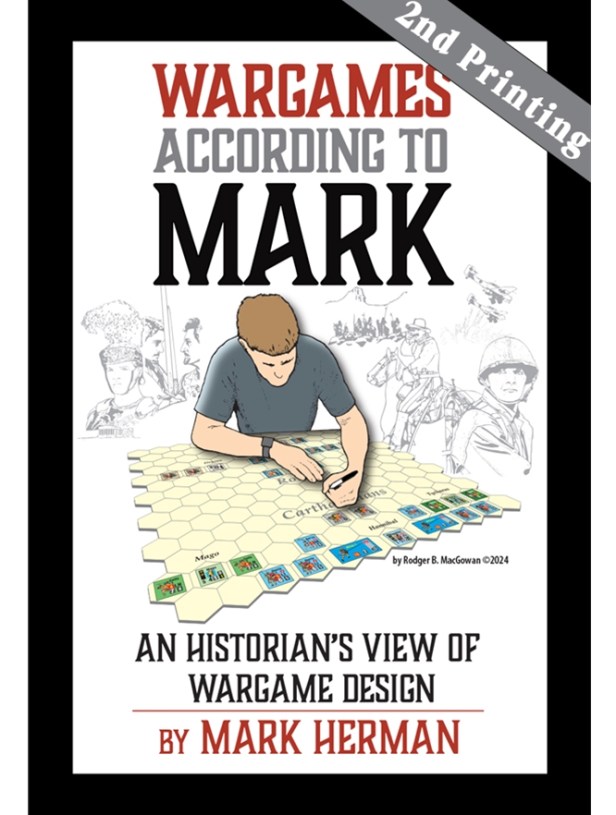
17. Wargames According to Mark 2nd Printing from GMT Games
I know that Mark Herman is a very talented designer and has a great ability to communicate in writing his thoughts and ideas about wargaming. He has written dozens of articles for wargaming publications including C3i Magazine and these are also very interesting and helpful. So it is not really all that surprising that Mark wrote a full book and it was offered on P500 last year. The book is called Wargames According to Mark and in my humble opinion is a must read! They are now doing a 2nd Printing of the book as it is sold out so now is your chance.
From the P500 page, we read the following:
Mark Herman’s book is back on our P500 list now for a 2nd Printing! As many of you know, Mark Herman is a giant in the wargaming hobby. Over his long and distinguished career as a game designer, Mark designed signature games for SPI, Victory Games, and with us here at GMT. Mark learned his craft beside Jim Dunnigan and so many talented designers at SPI before later running the company that created so many of my favorite games ever, Victory Games.
Beginning in 1991, he brought his design talents to GMT, often paired with his dear friend, Richard Berg. For over 30 years now of working with our teams, Mark has continually pushed the creative envelope in the wargame and strategy game spaces to create a succession of fun, ground-breaking, and award-winning designs like For the People, The Great Battles of Alexander and SPQR (and the entire Great Battles of HistorySeries), Empire of the Sun, Churchill, and Fire in the Lake (with Volko).
Mark is so much more than a designer to me. He is my friend. And he’s someone who has been hugely influential to me in the learning and growing process of running a wargame company over these 34 years. Often, even today, when I have a difficult decision to make, I’ll give Mark a call and ask for his counsel. His sage advice is always more than worth my time.
All that to say this: when someone as talented, experienced, and accomplished in our industry as Mark Herman writes a book about game design that tells stories about his experiences over a 45+ year career in our industry, that’s a book I’m going to read. When that author then asks me if GMT would publish it with him, there’s just no way I am going to say no. So, I’m thrilled that today we are adding a book to our P500 list for the first time! It’s so fitting, because of the many ways that his presence, talents, and leadership advice have graced GMT over the years, that our first-ever P500 book should be from Mark Herman.
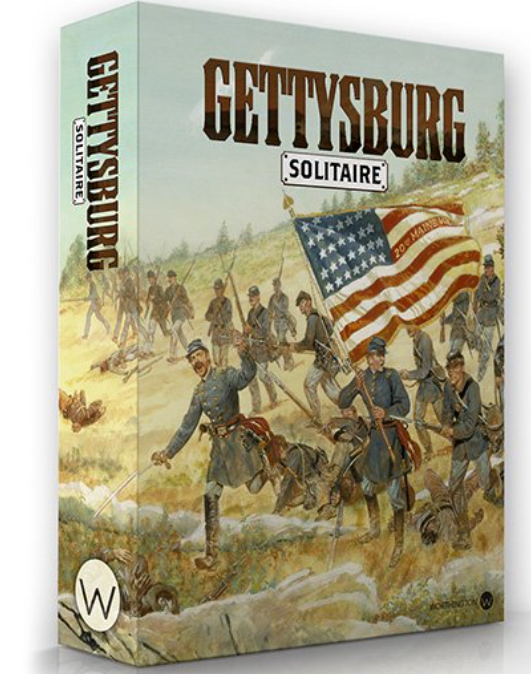
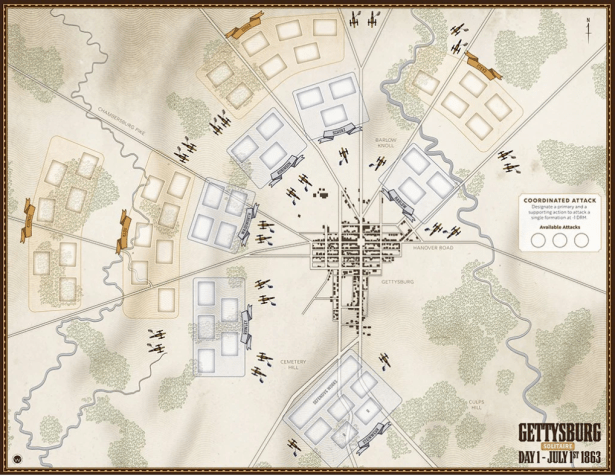
1. Gettysburg Solitaire from Worthington Publishing
Worthington has done a lot of these solitaire book wargames. But recently, they have started making these books into deluxe edition boxed wargames. Such is the case with Gettysburg Solitaire.
From the game page, we read the following:
Take command of the Confederate army at the battle of Gettysburg in the boxed fullsize board game version of our popular Solitaire BookGame (View the bookgame version here on Amazon). Refight the bloody 1st and 2nd of July as you try to break the Union defenses at Cemetery Hill, Culps Hill, and Little Round Top.
You receive a fullsize game board for July 1st and July 2nd (as a double-sided hard mounted board). July 1st is the easier of the two days as you try to crush the I and XI corps and drive the Union army from Gettysburg.
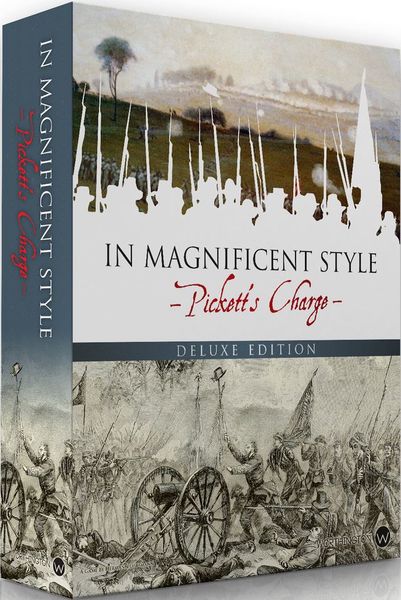
2. In Magnificent Style: Pickett’s ChargeDeluxe Edition from Worthington Publishing
Worthington Publishing signed on Hermann Luttmann and his famous solitaire experience In Magnificent Style and then launched a successful Kickstarter in late July 2020 for a deluxe version of the game with a mounted map board, custom dice, updated counters and all rules appearing on the board. That game has now got a 2nd printing and is available for purchase.
If you don’t know, In Magnificent Style is one of those White Whale games that everyone talks about but it was a bit hard to find as it was out of print. So now is your chance.
From the game page, we read the following:
In Magnificent Style is a solitaire game depicting the final desperate Confederate attack on July 3, 1863 at the Battle of Gettysburg. You command the Confederate brigades that made Pickett’s Charge.
General Lee’s Army of Northern Virginia has been fighting General Meade’s Army of the Potomac for two brutal days at Gettysburg. Lee’s army has garnered some successes but could not achieve that decisive break through of the Union lines. On the third day Lee, despite resistance from his trusted “Old Warhorse” General Longstreet, decided on a massive assault against what he deemed to be the weak spot in the Union battle line. This dramatic, infamous assault is popularly known as Pickett’s Charge.
The game system features some new takes on the traditional “push-your-luck” mechanic and applies them to a war game setting. As General Longstreet, you must decide how quickly to press your advancing troops across the deadly open ground before allowing the men to regroup themselves for another bound. But time is not on your side and the longer your stalwart soldiers remain in this maelstrom of enemy fire, the more dangerous it becomes and the less likely they will arrive with the verve and numbers required to carry the day. Good luck!
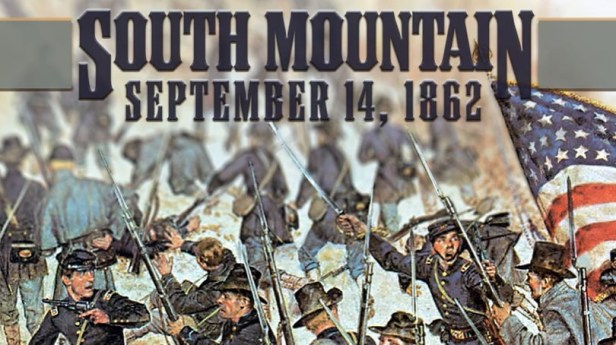
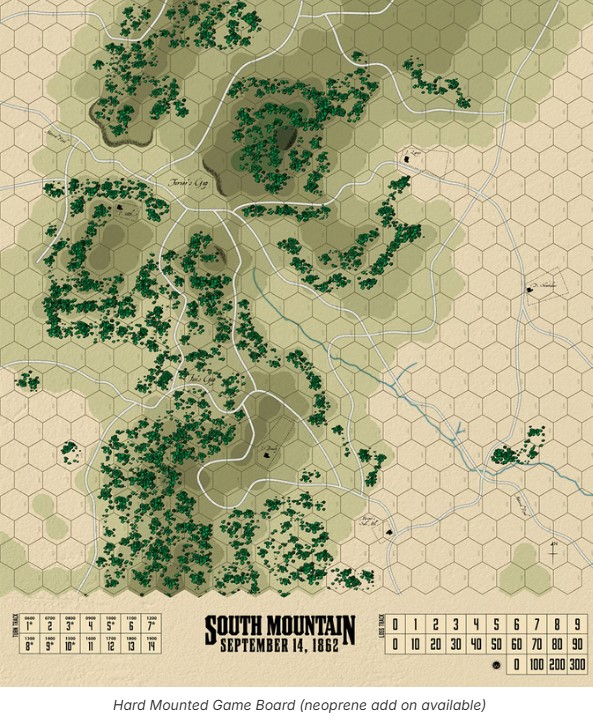
3. South Mountain 1862 / 1862 War in Virginia from Worthington Publishing
Worthington has just been on fire over the past few years and they have a new two-fer that is now available. The first is the newest game in their Civil War Brigade Battle Series called South Mountain 1862 and the other is a small solitaire travel friendly game called 1862 War in Virginia.
From the game page, we read the following:
South Mountain 1862 is a large box game for 2 players with a large game board. South Mountain 1862 is Volume VI in Worthington’s Civil War Brigade Battle Series. With streamlined mechanics the series rules, and battle specific rules, gamers can refight the Battle of South Mountain in 2 to 3 hours.
1862 War in Virginia is a travel sized small box solitaire game with the first DOUBLE SIZED mounted map in our travel series AND CARD DRIVEN. 1862 War in Virginia is a solitaire game on the Civil War campaigns in Virginia. You take the role of the Confederates against a card driven Union Artificial Intelligence (AI) player to determine the outcome of the Civil War in 1862.
Players will have to fight along the four major fronts during 1862, The Valley, Overland, The Peninsula, and The James. Can you hold the Union at bay — and possibly take the war north of the Potomac. The decisions are yours!
1862 War in Virginia was the decisive year of the Civil War, especially in Virginia. There was a real chance that the Union could have won the war early if Richmond had been taken. It was the only time during the conflict that the war could have ended in a Southern victory, had the Confederates been able to occupy Washington. Neither side accomplished these objectives, resulting in a draw in 1862.
1862 War in Virginia is a solitaire game on the Civil War campaigns in Virginia. You take the role of the Confederates against a card driven Union Artificial Intelligence (AI) player to determine the outcome of the Civil War in 1862.
Players will have to fight along the four major fronts during 1862, The Valley, Overland, The Peninsula, and The James. Can you hold the Union at bay — and possibly take the war north of the Potomac. The decisions are yours!
These little solitaire travel friendly wargames from Worthington are really quite good and fit that description aptly as they play in 15-30 minutes and are an exercise in chucking some dice. Very enjoyable and they are reported as “travel friendly” and you can take them along anywhere.
I am unable to find a link on Worthington’s page to order the games but I am assuming that this is in process. I will update this post once they get that up.
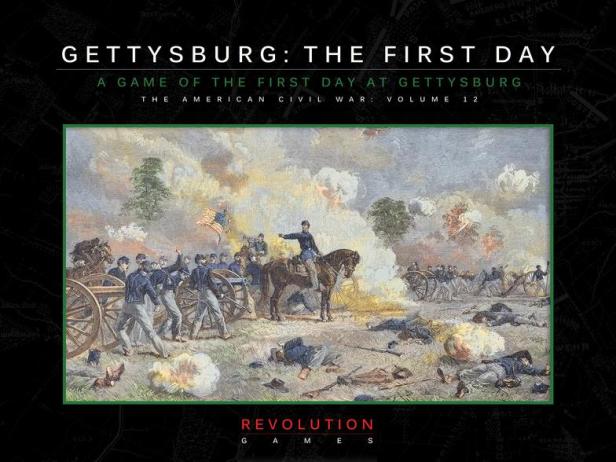
4. Gettysburg: The First Day from Revolution Games
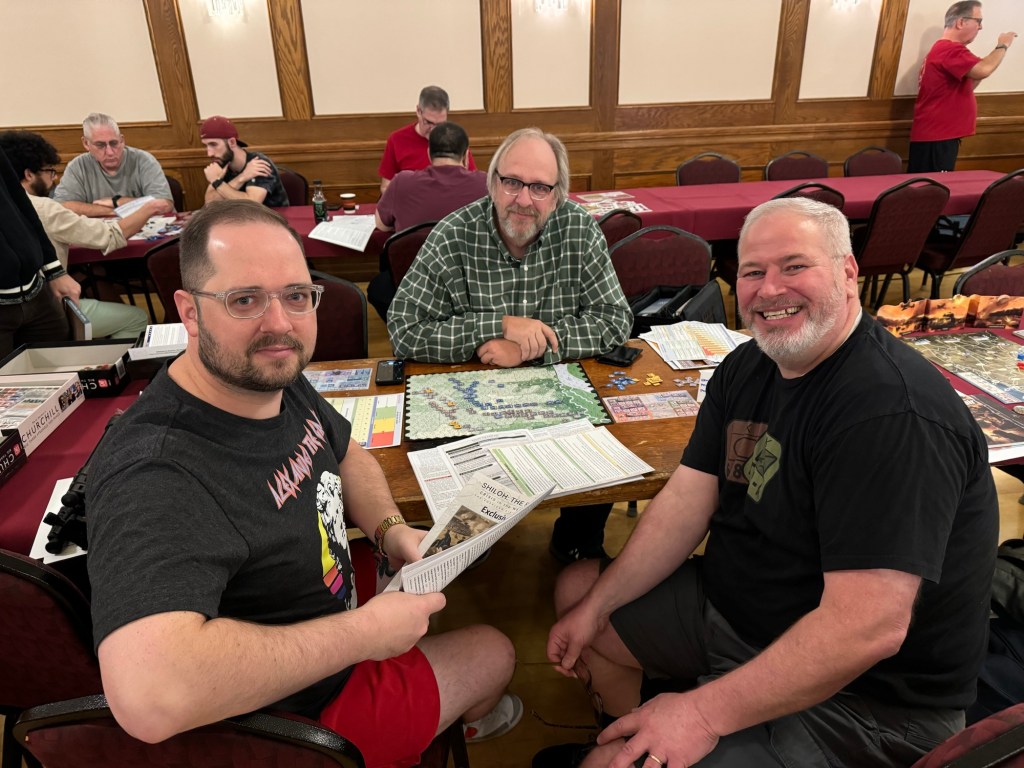
We have only played one of the Blind Swords Series titles from Revolution Games called Shiloh: The First Day, although we have played the series in several other games including A Most Fearful Sacrifice from Flying Pig Games, At Any Cost from GMT Games and most recently All Are Brothers from Legion Wargames. We played Shiloh with Grant Linneberg who runs Pushing Cardboard and he was an excellent teacher. We also benefited from the presence of Steve Carey who is the designer. We very much enjoyed the game and system and have since purchased multiple copies of the other volumes.
Playing Shiloh: The First Day at SDHistCon in November 2024 with Grant Linneberg from Pushing Cardboard!
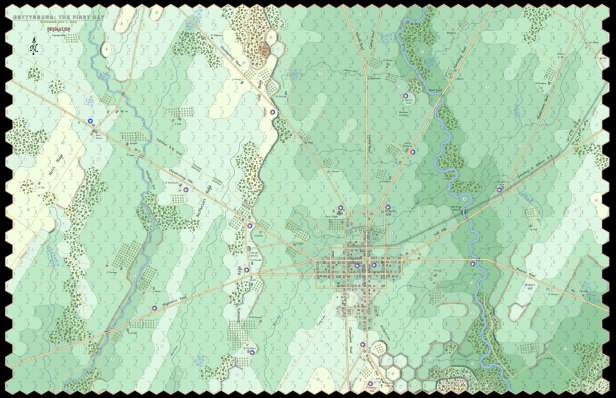
The Blind Swords Series is a chit pull system originally designed by Hermann Luttmann for Position Magnifique: The Battle of Mars-la-Tour, 1870. Since then several games have been published using it from several publishers, covering action in the US Civil War and the Franco-Prussian War. The system emphasizes the three FOW’s of military conflict: fog-of-war, friction-of-war and fortunes-of-war. The system mixes events with activation chits and does not guarantee that each unit on the board will be able to activate each turn or that each unit will only activate once. The system is designed to force players to make tough decisions with each chit pull. The newest volume in the series is called Gettysburg: The First Day and is now available for purchase.
From the game page, we read the following:
Volume 12 in Revolution Games American Civil War Series simulates the first day of the Battle of Gettysburg. Gettysburg: The First Day is an historical portrayal of one of the most monumental engagements of the entire American Civil War. It was a pivotal battle where leaders on both sides had to constantly grapple with a plethora of command and control challenges. Revolution Games’ highly-popular Blind Swords Series is perfectly suited to depict the extreme chaos of that fateful day.
This is a two player game where one side plays the Union and the other the Confederate. Using the Blind Swords chit pull mechanic to activate brigades randomly. The game also handles very well for players who play both sides as solitaire.
Gettysburg: The First Day adds to the Blind Swords Series by adding situational innovations such as; Artillery Barrages, Union temporary CIC’s, Rebel Sharpshooters, Buford’s dismounted cavalry, and Union breech-loading rifles. Also included is an optional variant for a variable march of two powerful formations, Confederate R.H. Anderson’s Division and Union Slocum’s 12th Corps. This is not a so-called “monster” game; instead, Gettysburg: The First Day was designed to be readily accessible for all players whether they are familiar with the game series or not. Tense and comparatively quick-playing, varied strategy options offer excellent opportunities for replayability.
We actually were sent a review copy by Roger from Revolution Games and we are very excited to get this one to the table soonish!
If you are interested in Gettysburg: The First Day, you can order a copy for $70.00 (currently on sale but the normal price is $90.00) from the Revolution Games website at the following link: https://www.revolutiongames.us/index.html
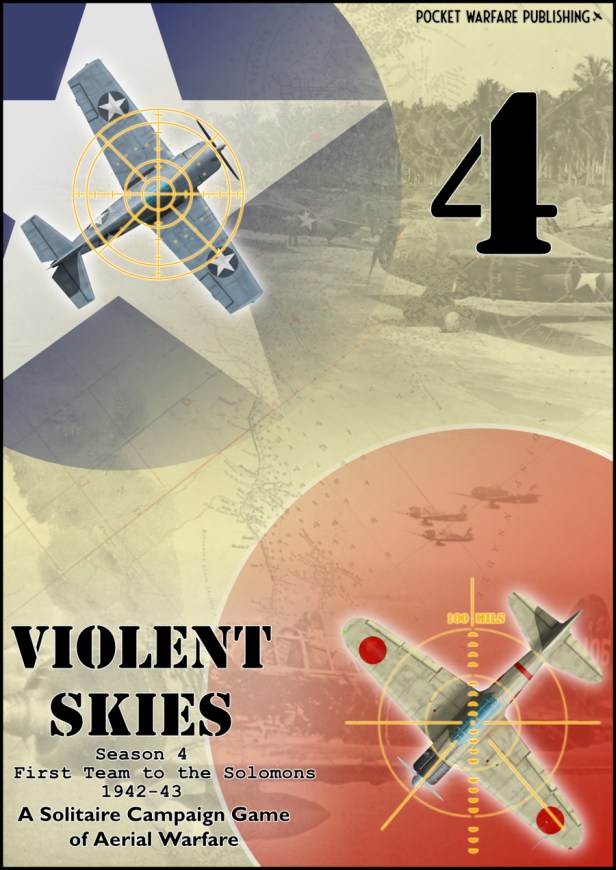
5. Violent Skies Season 4 – 1942/43 – The First Team to the SolomonsPrint and Play from Pocket Warfare Publishing
In the category of small publisher I previously knew nothing about, but a few years ago saw a game called Violent Skies from Pocket Warfare Publishing that deals with aerial combat during WWII. That game has done pretty well since then and they now are releasing a Season 4 edition called Violent Skies – 1942/43 – The First Team to the Solomons.
From the game page, we read the following:
Sat inside the cockpit with the engine rattling through your bones, you turn to engage. Managing your energy and fuel, can you gain position to get a shot off? Or will the Bandit get the better of you? Sometimes it is better to disengage than push a losing fight.
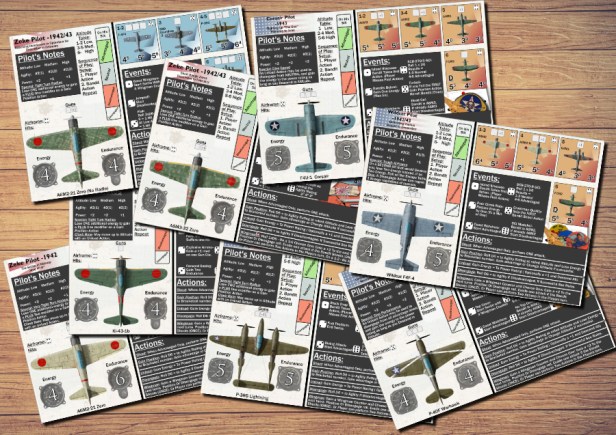
Violent Skies is a solitaire game of aerial combat in the Second World War. Using a game card that acts as your cockpit and also as a mission generator. The Player and Bandit take alternating actions to try and get a shot on the opposition’s aircraft.
This Fourth Season of the game puts you in the cockpit of the main fighters during the opening salvos of the Pacific War. From Thach Weaving Wildcats, nimble Ki-43 Oscars and deadly A6M Zeros, Players can forge pilot careers in some of the greastest aircraft of the Second World War. Including the Battle of the Coral Sea, the Battle of Midway, Operation Vengeance, the Solomons Campaign and the beginning of Corsair operations, Violent Skies 4 plunges you into the action.
6. Black Flight: A Solitaire Air War Game from Historic Wings
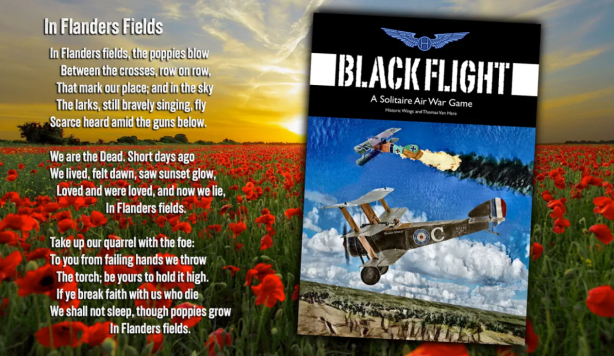
Over the past few years, the interest in solitaire book wargames has skyrocketed and there are a lot of different offerings out there. Some that have really caught my eye are from designer Thomas Van Hare with his Historic Wings products. Thomas Van Hare has designed several of these solitaire book wargames recently and they have been well received by the solitaire community. In fact, Alexander and I purchased several of these games including Overflight!, Tally-Ho! and SOE Lysander. But we also sprung for the upgraded components from Blue Panther for the games and they are well worth the price. Recently, Thomas released his new game called Black Flight which is a new series of wargames that can be played as either solitaire or in cooperative gameplay called The Great War Series.
From the game page, we read the following:
It is May 1917 and you are in command of No. 10 (Naval) Squadron. A few weeks ago, the Royal Flying Corps (RFC) experienced the disaster of “Bloody April”. Approximately 250 pilots were lost in combat against Germany’s best, including the famous Red Baron, Manfred von Richthofen. The RFC begged for relief and the Royal Naval Air Service (RNAS) stepped in to hold the line.
Everyone expected a massacre. The leadership of the RFC, expected that “Bloody April” would extend and “Bloody Summer” would follow as the hastily assembled relief squadrons from the Royal Navy, almost all Canadian pilots, were swept from the skies. Yet the Canadians of RNAS proved everyone wrong. Not only did they not get massacred, they turned the tide.
One squadron among them, Naval 10, as it was called, bore the brunt of the challenge. Within that squadron, one Flight – just five pilots and aeroplanes – known as “Black Flight” and lead by Flight Sub-Lieut. Raymond Collishaw, took to the skies over the Ypres Salient and set a record in aerial combat that stands to this day – in eleven weeks, Naval 10 downed 87 German aeroplanes, many of them drawn from among Germany’s finest.
Today, despite being the highest scoring naval aviator of all time, the name of Raymond Collishaw is little known. In skill, he rivalled the prowest of the Red Baron himself. Flying his Sopwith Triplane, over the course of those eleven weeks, personally he downed 30 of the Germans.
Black Flight is a solitaire air war game set in the Great War, often called the First World War. As with all wargames from Historic Wings, Black Flight is deeply researched. You learn about history as you play the game – not the Hollywood version, but the real thing. The rules are built to mirror history, carefully crafted to recreate the true circumstances faced by Collishaw’s Canadian pilots. Yet the outcomes are not guaranteed. You will be called on to fly historic missions across the trenches and over No Man’s Land – and beyond, where the Germans wait patiently with their Albatros and Halberstadt scout planes.
Your orders will reflect the actual patrols of the time – OPs, Offensive Patrols that penetrated deep behind enemy lines; LPs, Line Patrols that ran north and south over the trenches; escort missions where you protect bombers, reconnaissance aeroplanes, photo reconnaissance flights, and artillery direction missions. The routes you fly will be historically accurate – yet through the careful construction of weekly changing tables, each game will be a new and different experience, ensuing extraordinary replayability.
At the core of the game is that you manage your own Naval 10 squadron. You will recruit your pilots and each will have unique characteristics as defined by a mix of 45 Trait Cards and 45 Vice Cards that give each the very strengths and weaknesses that reflected the times. With they lived in. Each time you play, your squadron will be different, your challenges will be unique, and your struggles will be memorable. Unique among aviation games today, Black Flight recreates the diverse personalities of the pilots themselves – some may be reckless, others ruthless, in the wake of bad experiences, their condition will deteriorate. Your best ace pilot, seeing one to many of his friends shot from the sky, may take to alcohol. Your most trusted and reliable cornerstone of the squadron may suffer a nervous breakdown. Yet the orders keep coming. Just as experienced by the real Naval 10 from May through July 1917, your losses will mount and your men will become progressively exhausted and stressed.
Black Flight is the first in a series of solitaire Great War titles from Historic Wings that, as the series is published, will enable players to fly against one another – pitting the Canadians of the RNAS against the Imperial German Air Serice, taking to the skies with the RFC, or, between glasses of wine, kicking the tires of your Nieuports and flying into the teeth of battle. Each nationality will have its own unique Trait Cards and Vice Cards that reflect the times, the traditions, and the historic personalities of each.
If you are interested in Black Flight: A Solitaire Air War Game, you can order a copy for $43.12 from the Amazon website at the following link: https://www.amazon.com/gp/product/B0FJ8PNTY2?
7. Bloody Lane: A Solitaire Wargame from Vince Cooper
Vincent Cooper is a new designer on the scene and has several games in process. One of his more interesting and affordable options is a solitaire book wargame focused on the Battle of Antietam called Bloody Lane: A Solitaire Wargame. The game is available on Amazon.
From the game page, we read the following:
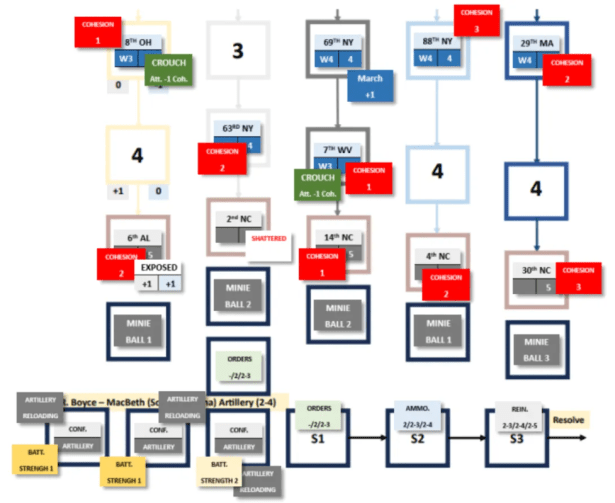
Bloody Lane is a solitaire wargame. The player controls the defending Confederate soldiers holding Bloody Lane, while the advancing Federals are controlled by an AI bot detailed in this rulebook. The player rolls six-sided dice to determine the results of chosen actions, which affect the situation on the Battle Sheet (the graphic representation of the area in which the defense of Bloody Lane took place). As the Union assault intensifies, the player will have to make increasingly tough decisions to ensure victory.
– You command five Confederate Regiments defending Bloody Lane. Each historical Confederate Regiment is represented by a Unit counter that occupies a Defensive Position.
– Union Regiments attack in four Waves, each getting stronger. Each historical Union Regiment is represented by a Unit counter and enters an Attack Track. That counter then advances from one Attack Position to the next Attack Position along that Attack Track.
– You must choose and resolve appropriate actions to defeat each Attack Wave.
– As both Confederate and Union counters suffer Hits, their Cohesion is reduced, making each Unit less able to carry out the assigned action.
– To resolve an action, make a Cohesion check. Roll 1d6, apply any modifiers to the Cohesion of the Unit and compare the result of the die roll to the current Cohesion of the Unit. If the roll is equal to or less than the (modified) Cohesion, the action is resolved successfully.
– In addition to resolving actions, the Union will also resolve Battle Events each turn. Events simulate off-board musket and artillery fire, attacks by sharp shooters, smoke that obscures the battlefield, and attempts to reform Union units. The severity of Union Events is determined by the Difficulty Level selected and are detailed on the Player Sheet.
– While battling each Attack Wave, you must carefully manage the Supply Line to ensure Orders, Ammunition and Reinforcements arrive in a timely manner. Skilled use of Confederate Artillery will help you achieve this goal.
– If a Union counter enters a Defensive Position occupied by a Shattered Confederate Unit, Bloody Lane is captured and the game ends in defeat for the player.
All you need to play – the Battle Sheet, Player Sheets, Unit Counters and Tokens and optional Battle Cards, along with the rules – are contained within this book.
8. Richthofen: The Flying Circus 1917 from Minden Games
I don’t have a lot of experience with Minden Games but they have a lot of very interesting offerings in their catalog. Their newest game this month is called Richthofen: The Flying Circus 1917, which is a solitaire wargame focused on the air war during World War I.
From the game page, we read the following:
Richthofen: The Flying Circus 1917 is Vol. 2 in the Eindekker Series. It takes the action into 1917, with the formation of Manfred von Richthofen’s famous Flying Circus. The game uses the same system as Eindekker, but with new warplanes and some modified rules that reflect the changing nature of air combat in the mid to late war period.
You (the player) fly German fighters–such as the Albatross D-III, Fokker Dr.1 Triplane, and Pfalz D-III–playing the role of famous, individually rated pilots such as Werner Voss, Ernst Udet, Johannes Klein, as well as the Red Baron himself.
This edition is 76 pages, illustrated and in full color. It includes full rules and options, Game logs, Plane Damage Displays, Daily Log Sheets, Pencil-Mode Instructions & Components. Importantly, Advanced Game rules are provided that give you the option of adding historical flavor–through the use of individually rated Allied planes, specific ratings for German and 14 Allied plane types, additional German pilots, and an advanced Random Events Table. Basically, you’ll now be fighting Spad VII’s, SE-5a’s, Sopwith Triplanes, Bristol F2’s, DH-5’s, and many more, each with individual characteristics. If you wish to print and create your own components from a digital file, a color PDF of this game is available for purchase separately.
The Eindekker Game System was designed by Bob Flood. Gary Graber edited Richthofen FC and is responsible for the scenarios, the Advanced Game, and new ratings. Once again, background commentary and airplane characteristic information are provided.
If you are interested in Richthofen: The Flying Circus 1917, you can order a copy for $24.95 from the Minden Games website at the following link: Eindekker-Series
As usual, thanks so much for reading along and sticking with me this month as I navigated through the many websites and game pages looking for new and interesting games to share.
Finally, thanks once again to this month’s sponsor Neva Wargames!
Some interesting games here. Hannibal (aka Hitler’s Reich in a different setting and hopefully better rules), East Front Quad Pack, and For the Motherland.













 The Players' Aid
Some interesting games here. Hannibal (aka Hitler’s Reich in a different setting and hopefully better rules), East Front Quad Pack, and For the Motherland.
LikeLiked by 1 person