With this new My Favorite Wargame Cards Series, I hope to take a look at a specific card from the various wargames that I have played and share how it is used in the game. I am not a strategist and frankly I am not that good at games but I do understand how things should work and be used in games. With that being said, here is the next entry in this series.
Card #40: Luther’s 95 Theses from Here I Stand: Wars of the Reformation 1555-1571 from GMT Games
Here I Stand: Wars of the Reformation 1517-1555 is an experience packaged in a game that attempts to boldly cover the political and religious conflicts of early 16th Century Europe. The game focuses on the struggle of religious reformers such as Martin Luther, John Calvin and Ulrich Zwingli as they battle the Papacy for changes in their views of God and religion. But it is more than just the Holy War as it deals with the other European countries involved in the affairs of the time including France, England, the mighty Hapsburg Empire and the Ottoman Empire in the east. They all played a role in the process of the Reformation and the design brilliantly weaves this all together into an interesting and engaging experience. The game also covers other plot lines and events of the period, including wars, marriages and ascendancies to thrones, using a unique Card Driven Game (CDG) system that models both the political and religious conflicts of the period.
Any game of Here I Stand, starts with the events of the Reformation and the playing of the Luther’s 95 Theses card. This process is rather involved and will be a tense and nail biting roll-off between the Papal player and the Protestant player. If it does not go well for the Protestants, it will set them back and make it very difficult to gain ground. Not impossible to come back, but much more difficult.
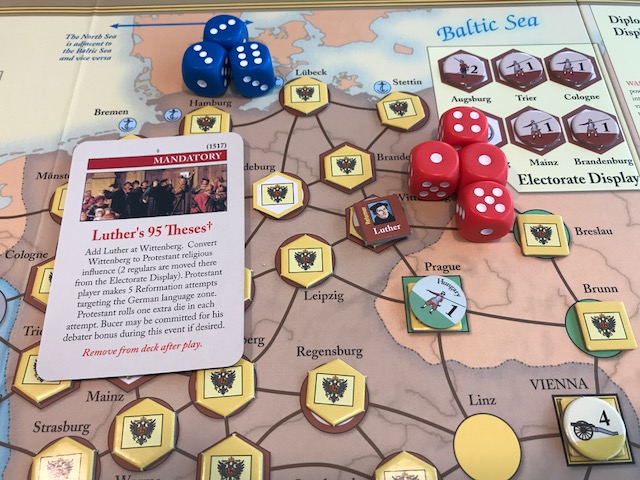
If you read the text of the Luther’s 95 Theses card, it states “Add Luther at Wittenberg. Convert Wittenberg to Protestant religious influence (2 regulars are moved there from the Electorate Display). Protestant player makes 5 Reformation attempts targeting the German language zone. Protestant player rolls one extra die in each attempt. Bucer may be committed for his debater bonus during this event if desired”. That is a lot but when taken piece by piece, it is really rather simple.

- Add Luther at Wittenberg. Convert Wittenberg to Protestant religious influence (2 regulars are moved there from the Electorate Display).
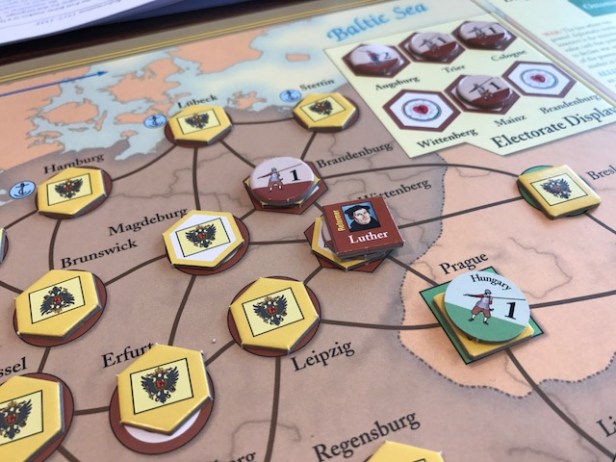
This is the easy part. The Protestant player simply takes the Luther square counter and places it in Wittenberg. Wittenberg was where Luther nailed the 95 Theses to the doors of the Castle Church, which started this whole process known as the Reformation. You then simply turn the hexagonal counter over to it white side to signify that is has been affected by religious influence and has changed from Catholic persuasion over to Protestant. This white side is so glorious! You then move the 2 regulars from the Electorate Display to Wittenberg. These forces are not used for fighting at this point of the game but will affect further Reformation attempts with a positive modifier.
- Protestant player makes 5 Reformation attempts targeting the German language zone. Protestant player rolls one extra die in each attempt.
This next part is a bit more involved and requires some strategic thinking to make sure that you choose the spaces to attempt Reformation in with the greatest odds of success based on their modifiers and based on the dice that adjacent Catholic spaces will grant.
First off, there is a slight dotted line that runs from the Electorate Display to the west of Prague and then swings over between Brunn and Vienna on the east and on the west goes from the North Sea to the west of Munster, Cologne and Strasburg. This line signifies the German language zone and these first Reformation attempts are limited to this area. You cannot make a Reformation attempt in the areas outside of this zone, including in the Ottoman’s sphere nor the French.
The Protestant player will now identify one at a time (no need to state the targets ahead of time) each city that they wish to try a Reformation attempt in. These spaces must either contain a Reformer or be adjacent to a space under Protestant religious influence or connected via a port under Protestant religious influence. These attempts are modified by various factors and include the following:
- Ties go to the Reformation player if the attempt is in the target language zone.
- Extra dice will be granted as follows: 1 die for each adjacent space under Protestant religious influence, 1 die for each adjacent Reformer, 1 die for each adjacent stack of Protestant land units, 2 dice if Reformer is in target space and 2 dice if there is a stack of Protestant land units in the target space.
- From the play of the mandatory event card Luther’s 95 Theses, the Protestant will roll one extra die.
The Protestant player then rolls the dice and doesn’t total up the number of hits, but simply remembers the highest single number rolled. Remember, that a 6 rolled by the Protestant player represents an automatic success and doesn’t grant the Papal player an attempt to roll as long as the roll is in the target language zone. One other key point is that only one Reformation attempt can be made in each space so if you fail on your first roll in a key city, you can’t simply try again this turn. A rule that would haunt me for the entirety of my first play of the game.
Next, the Papal player will add up their dice as follows:
- 1 die for each adjacent Catholic religious influence space, 1 die for each adjacent Jesuit university (none of these will exist at this point of the game), 1 die for each adjacent stack of Catholic land units, 2 dice if Jesuit university is in the target space (none exist in Germany at this point) and 2 dice if a stack of Catholic land units is in the target space.
- The Papacy will also get to roll at least one die (unless the Protestant has rolled a 6 in which case it is an automatic success).
Simple enough once you get the hang of it! But I very much like this starting aspect of the game as it really requires the Protestant player to begin strategizing where the best odds of success are.
And the last part of the card is as follows:
- Bucer may be committed for his debater bonus during this event if desired.
One other modifier that can be used is the Reformer Bucer who is available to the Protestant player at the start of Turn 1. He can add a +1 die modifier to Reformation attempts within 2 spaces of Strasburg, which is located at the very bottom left of the picture above. I never really was able to take advantage of his benefit as I never really made it that far south into the German language zone. These Reformers all have interesting, if not very specific, abilities that if planned for and used well, can be the difference in seeing the wave of reform spread throughout Germany.


I know that summary was rather long but this game is deep and can be very complex as there are many conditional rules that only come up under certain circumstances. This game is great fun though and I very much love the Holy War between the Papacy and the Protestants.
Martin Luther’s 95 Theses was a list of propositions for an academic debate that he posted on the door of the Wittenberg Castle Church on October 31, 1517. These propositions, primarily focused on criticizing the Catholic Church’s sale of indulgences, are considered the catalyst for the Protestant Reformation.
The 95 Theses was quickly translated into German and disseminated throughout Germany, sparking widespread debate and controversy. These tenets challenged the authority of the Pope and the Catholic Church, leading to the formation of various Protestant denominations. The theses was the genesis for the start of the Reformation and also a major turning point in Christian history.

In the next entry in this series, we will take a look at Sarmatia from The Wars of Marcus Aurelius: Rome 170-180CE from Hollandspiele.
-Grant
 The Players' Aid
LikeLike