Over the past few years, the interest in solitaire book wargames has skyrocketed and there are a lot of different offerings out there. Some that have really caught my eye are from designer Thomas Van Hare with his Historic Wings products. Thomas Van Hare has designed several of these solitaire book wargames recently and they have been well received by the solitaire community. In fact, Alexander and I purchased several of these games including Overflight!, Tally-Ho! and SOE Lysander. But we also sprung for the upgraded components from Blue Panther for the games and they are well worth the price. Recently, I reached out to Thomas to see if we could get an update on his games and an overview of the new Black Flight which is a new series of wargames that can be played as either solitaire or in cooperative gameplay called The Great War Series.
Grant: Thomas, welcome back – this is our second interview with you and we’re hoping you can catch us up on your latest projects and let our readers know what’s ahead for your game projects.
Thomas: Thank you for having me back! It is a real honor to be here with you again! There’s a lot going on! I’ll do a quick review of the games that are closest to publication first and then we’ll focus on the biggest title of the year, due out in a couple of weeks, which is called Black Flight – we’ll start with that one.

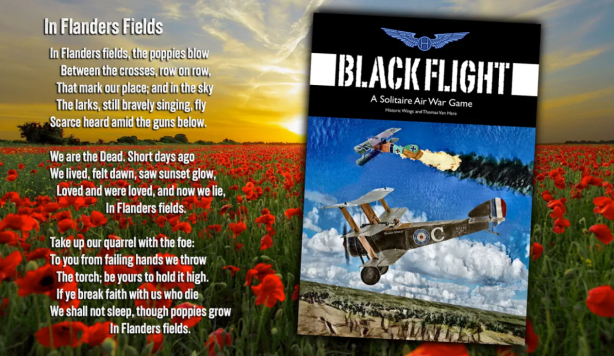
Black Flight is just about ready to be published. It signals a new direction for our games at Historic Wings. It is not just a single game but a series of titles that cover the epic dogfights of World War I, or “the Great War”. An alternate “base game” and entry point into the series will be the second game – that one will take players into German Jasta cockpits to command their own “Flying Circus”, while Black Flight, covers the Canadians in the Royal Naval Air Service (RNAS) with their Sopwith Triplanes in the Ypres Salient in the months immediately after “Bloody April”. As you probably know, my specialty is narrative-driven wargames. This title takes that up a notch.
Achtung Jabo! is my air war game about a P-47 Thunderbolt squadron on D-Day. Frankly, it could have been published several months ago as it is over 95% completed. However, I had to set it aside for a bit for Game of Drones to get published by the holidays and then Black Flight took over as my top priority. There is only one remaining counter sheet to prepare (for German targets, mainly Panzer tanks and the StuG III, and so forth) plus a final read-through of the rules and history section. As you know, all of my games include history, often including original research and this title is no different. Therefore, this game will be out soon after Black Flight is published, probably only a few weeks afterward.
Me 262 Experten is about the Luftwaffe’s squadron of aces in Me 262 jet fighters. This game is co-developed and co-written with Scott Poulter, whose YouTube channel is Poultergeist Board Games – www.youtube.com/@PoultergeistBoardGames – and this project is well along and will certainly be out this year, probably before the end of the summer.
In addition, there are five expansion games in the works right now and hopefully at least two or three will come out this year – MAG-14 Guadalcanal, Overflight: Red China, SOE: “B” Flight, and Game of Drones: Kherson – plus a final title, which is A.V.G.: The Flying Tigers.
MAG-14 Guadalcanal is the long-overdue expansion to one of my top best-selling titles, MAG-23 Guadalcanal. In MAG-14, the story picks up when the first Marine Air Group leaves the island. MAG-14 was the unit that Joe Foss flew with, one of the Marine pilots awarded the Congressional Medal of Honor for his service on the island. While not as desperate as the situation was for MAG-23, the game is interesting because the numbers of targets increase, the Imperial Japanese Navy pushes hard to destroy the twin airfields of Henderson and Fighter One, and there are seemingly unending numbers of Japanese planes coming down “the Slot” to attack. It is a shooting gallery for both the Americans and the Japanese.
Overflight: Red China is the expansion to Overflight! It covers the CIA’s Top Secret program that had Taiwanese pilots flying American-supplied U-2 spyplanes over Red China in the early 1960’s. It’s another one of those games that, had I published this a decade ago before the information was declassified, I would have gone to jail. Most people have no idea that we trained Taiwanese pilots to fly spy plane missions over China, so this is a really historic game. The situation is far more precarious than it was in the first game, which covered from 1956 to 1960. By the time the CIA’s Taiwanese program spooled up, the threat from Surface-to-Air Missiles (SAM’s) was well-established. Like in history, you’re going to lose quite a few spy planes and pilots. Unlike in Overflight!, however, when you suffer a loss, the program doesn’t end. That’s because the CIA maintains plausible deniability because the flights were supposedly not flown by America.
SOE: “B” Flight is another game that am pushing through and hope to publish this year. It covers the RAF’s airdrop operations into France and the surrounding occupied countries. You get to fly a variety of aircraft from the Lysander to the twin-engined Hudson. Since your pilots won’t have to land, your survivability rates are much higher than in SOE: Lysander, except when flying missions into the Netherlands. Unbeknownst to the RAF, the Germans had infiltrated and taken over the entire Netherlands resistance. It was so bad that every flight was actually being scheduled not by SOE agents but by the Germans themselves, who, while using captured code books were requesting additional agents and supplies to be brought in – then they awaited their arrival at every drop zone. Surviving a mission should be easier, but surviving the war might prove nearly impossible.
Game of Drones: Kherson is in the first stage of development. It provides new scenarios and an updated set of rules to reflect the rapidly evolving changes in drone warfare in Ukraine. Fiber-optic drones, AI-targeting in the terminal phases of FPV attacks, and Vampyr drones are featured. A new map features the area south of the Dnipro River with your missions flying south into Crimea. New organizational models are in place too, which affect gameplay considerably. Like Game of Drones, it is being co-developed with Joe “BigMac” McDonald. Drones are the most important weapon in the war at this time – over 90 percent of all Russian losses are caused by drones, either through artillery direction or by direct attacks.
A.V.G.: The Flying Tigers has been over two years in development. It has a lot in common with MAG-23 Guadalcanal, but with a completely different set of challenges that are unique to the situation in 1941 in China. You get to take on the Japanese in your P-40 Kitty Hawk and Tomahawk fighters, taking on the role of Claire Chennault as you command your men – three squadrons of mercenary American pilots who showed the world that the Japanese weren’t invincible after all.
I should mention that another long-awaited title, La Fière, which is about the 82nd Airborne on and just after D-Day, is back on the drawing board with a new approach to the design, easier to play and faster to the table with less complexity than the previous design. That one is being done in conjunction with Helen Patton, who is Gen. Patton’s granddaughter.
In addition, there is a huge new release that is in the works, something that I’ll reveal at the end of the interview. I’ll give you a hint now: AIR RACING.
I will add that one thing I’ve learned over the last year is never to predict final publication dates. Each game seemingly finishes up its development cycle on its own time, despite all. The big topic of today’s interview is Black Flight, which I’m hoping to have out this month. That’s pretty much on track, though I said that last month too.
Grant: Let’s talk about Black Flight then – tell me about it!
Thomas: Black Flight represents a new direction for Historic Wings. It is a series of wargames that can be played individually as either solitaire or in cooperative gameplay – or even combined with any of the others in the series for solitaire, cooperative, and competitive gameplay. This is The Great War Series. These games offer a strong solitaire experience, but you can also play with a few friends or large groups, even exceeding a dozen players per side, both at conventions and online in full campaigns using VASSAL with each player managing their own squadron.
Each title in The Great War Series features the experiences and aircraft of several different countries and types of operations. All the games are compatible. All are set in the Spring and Summer of 1917. Unlike other popular Great War air combat games, you don’t fly as one pilot in one airplane or as a small group. In The Great War Series, you command a Squadron, Escadrille, or Jasta. All of your pilots are individually named, each with his own narrative arc, skills, capabilities, and weaknesses. This creates a deeply personal, narrative experience.
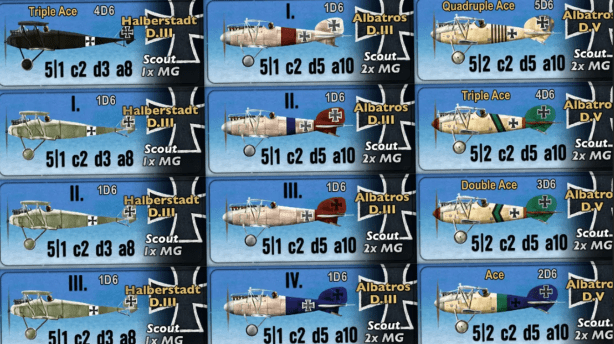
The Great War Series will include the German Imperial Air Service with their Albatros and Halberstadt scouts, the British Royal Flying Corps with the ever-reliable Sopwith Pup, the French in the Aéronautique Militaire with their heavy and powerful SPAD S.VII scouts, the Americans of the Lafayette Escadrille and their diminutive Nieuport scouts, the British and Germans with two-seater squadrons, and even a game about the air war in the Middle East – the air battles that supported Lawrence of Arabia, something I’ve never seen done as a game before.
As The Great War Series shares the same essential rules for all games, they will be coming out without much delay between each. Probably it will be one or two months between each release. In other words, it won’t be long before you’re commanding Germany’s Jasta 18 flying out of Houthem Aerodrome – or your own Jasta out of another Aerodrome near Comines. You might command 21 Squadron RFC with their Royal Aircraft Factory R.E.8 two-seaters parked alongside the aeroplanes of 23 Squadron RFC, flying its French-built SPAD S.VII scouts from La Lovie Aerodrome. Perhaps you’ll want to go head to head with the American Lafayette Escadrille. The plan is to expand the maps southward and possibly even northward to the English Channel. The map is spliced together from historic planning charts used by Field Marshal Douglas Haig, 1st Earl Haig, who commanded British Expeditionary Forces (BEF) from New Year’s Day on 1917 onward. The map names individual trenches, sometimes even individual buildings—making it very accurate.
Black Flight is both the first in the Series and the best entry title to learn how the game system and mechanics work. It is a dedicated air combat game, pitting aeroplane against aeroplane in dogfights over the Western Front. You command RNAS No. 10 (Naval) Squadron, also known as Naval 10 or N10. It had a very focused role – to find German airplanes and shoot them down. Today, we would call that an air superiority fighter squadron, but in that era, they were simply called scout pilots. Of course, with the flexibility built into the rules, you can choose to command another squadron from another aerodrome, such as Abeele, La Lovie, Bailleul, or Eeecke, among many others.
With each additional game in The Great War Series, expansion rules will be added to cover more types of operations beyond the scout pilot’s role. There will be trench strafing, rockets, and incendiary bullets fired at observation balloons, attacks on enemy aerodromes, and so forth. You will fly observation types, also called two-seaters, on photo reconnaissance missions, light bombing, artillery direction, and deep penetration reconnaissance patrols and get to command a bomber squadron. You will fly bombers too.
On the German side, you will command a Jasta of Albatros D.III or D.V scouts with the first game. Later, there will be an add-on that puts you in command of a Schlasta, a ground attack, close air support two-seater unit. In that unit, you’re equipped with the Junkers J.I and you’ll undertake trench strafing and attack missions. The Junkers J.I was so well-armored that the Allied pilots used to say that it was almost impossible to shoot down. I guess you could call it the world’s first A-10 Thunderbolt (the Warthog). Yes, you really can go “tank busting” over No Man’s Land, west beyond Polygon Wood, though with only a couple of machine guns, it probably won’t be enough to peel open a British tank.
Grant: How does gameplay in Black Flight work?
Thomas: Gameplay is based on Play Loops, each of which offers a set of rules and processes to cover different aspects of flight. You learn one Play Loop at a time as you get started. Even if it is a big game, it is easy to digest because it comes in bite-sized, quick-to-learn chunks. Dogfights are played in the Tactical Play Loop, which is what you start with, jumping straight into the action. Once you’ve mastered that, you can start flying patrols, which involves movement on the main map of the Ypres Salient – that’s the Strategic Play Loop. Finally, once you’ve mastered how to fly a complete patrol from take-off to landing, you take on the challenge of managing your squadron and its pilots. That involves patrol planning, scheduling the day’s operations, repairing your aeroplanes, and so forth – that’s the Operational Play Loop.
Gameplay shifts between each Play Loop seamlessly at well-defined transition points. In-depth examples of play are provided for each Play Loop. Those who don’t want to read the rules before playing can just read through those parts – and, more or less, they’ll be ready to go, only needing to use the rules to understand the finer points and exceptions. The examples of play offer some pretty exciting reading, so that’s a bonus.
You can play the game as you choose. Maybe you just want to fight a single dogfight by yourself. Maybe you want to fly a single patrol with a friend. Maybe you want to try out a full game day of patrols in solitaire play or cooperatively with three other players. If you play a whole game week, you’re playing the Campaign Game – and there are eleven weeks to choose from in the game. Each week has its own Encounter Tables, news, orders, and so forth, all precisely aligned with the history of the Great War in that sector. Finally, if you want to play all eleven weeks, you can play the Grand Campaign Game.
Grant: How does playing a single day of patrols work?
Thomas: Once you’ve learned the three Play Loops, your work as squadron commander begins. You set up your squadron at the start – maybe with the historic names of the real pilots who flew in Naval 10 or maybe with your pilots named after your friends and colleagues, or made-up names too.
After the sun sets, you prepare the squadron for the next day’s patrols. The higher-ups tell you what the weather will be in the morning and what the forecast is for the coming day. You have to plan around that. You receive daily orders from the Wing Commander, which have to be factored into your standing orders for the week. Based on those, you work up your squadron’s patrol plan, carefully selecting which pilots and aeroplanes to fly in the all-important dawn patrol and then the other patrols during the remainder of the day, such as the noon patrol, afternoon patrol, and evening patrol. That is all done in the Operational Play Loop.

At dawn, you prepare your pilots and airplanes for the first patrol. This is war, however, so sometimes things don’t go to plan. You might receive urgent special orders, forcing you to abandon your carefully planned dawn patrol and instead go after an emerging threat called into your squadron headquarters. The Germans are always full of surprises.
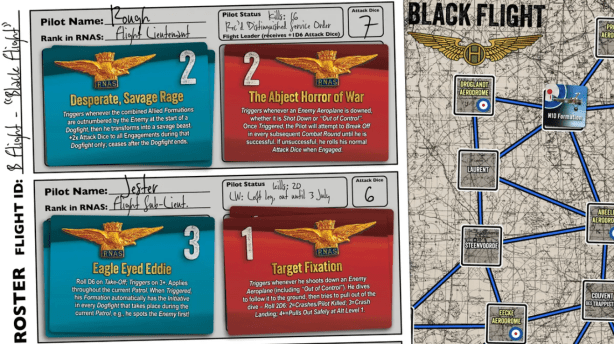
Gameplay shifts to the Strategic Play Loop. Your pilots take off and climb for altitude. You fly your formation across a detailed map of the Ypres Salient, flying routes between known and identifiable waypoints – this is area movement, but at a fairly fine scale. You might search for the enemy over well-known sites like Armentières, Ypres, and Lille. Perhaps you’ve been assigned an Offensive Patrol, or OP, which ranges deep behind German lines.
Perhaps you’re flying a Line Patrol, or LP, cruising up and down the trench lines to intercept any Germans that might be planning to come your way. Perhaps you are to rendezvous with friendly two-seaters or bombers and escort them as they carry out their missions. Or perhaps there are special orders – the famous German ace observation pilot in his Roland C.II, known as the “White Walfisch”, has crossed the lines and was spotted heading toward Ste. Marie Capell Aerodrome. That aeroplane is going to be a constant thorn in your side until you shoot it down – and after that, you’ll be pleased to never have to face him again, though he’s pretty snaky and has a rather bad habit of surviving a crash landing and sneaking back the lines to fly again.
When you encounter enemy aircraft, gameplay shifts to the Tactical Play Loop. Thus, a dogfight begins. Each dogfight is played quickly and easily. Since Great War era biplanes were notoriously underpowered, the Dogfight Map used in the Tactical Play Loop illustrates how altitude effects air combat. Thus, the map is a “side-view” of the airspace, with altitudes divided from Alt Level 0 to Alt Level 12 (the highest altitude is at the top of the map, the lowest at the bottom). It represents from the ground up to 24,000 feet high, divided neatly into2,000 foot bands of altitude.
Formations engage other formations. Yet the turning, twisting, chaotic mêlée of each dogfight is represented simply – gameplay recreates all the excitement of that without having to plot turns, loops, rolls, skids, slips, Immelmanns, chandelles, or anything else. You’re in the thick of it from minute one. It all plays out in your mind. It is sort of like the “good parts only” version of a dogfight, without having to laboriously plot out your moves or manage how many power factors you use or what angle of bank you employ in the turn, and so forth. The level of abstraction works really well.
Grant: That’s really interesting – can you give an example of how it works in actual gameplay terms?
Thomas: Ok, though you should know that “gameplay terms” is really more like realistic terms of how a patrol and a dogfight was flown. It’s pretty much indistinguishable from an account of a pilot in 1917. Perhaps you scheduled yourself, as the squadron commander, to fly the dawn patrol. Yes, even if you’re in command, you can take the risk and lead the Flight yourself. You schedule to fly with four of your best pilots in the squadron’s Sopwith Triplanes. The Wing Commander ordered an OP, or Offensive Patrol for dawn, so you have to comply with that.
With the first light of dawn, you take-off together. One of your pilots hears that his engine is running rough. He waves to you, points at the nose of his Triplane, and turns back to land. You lead your remaining three pilots continue onward and fly the patrol.
Together, you start climbing to altitude, heading up to 13,000 feet of altitude (Alt Level 6). To do that, you zigzag back and forth a bit on the Allied side. That’s smart because the Germans don’t usually come across the lines and it will give you an altitude advantage when you’re ready to cross into enemy territory. At Alt Level 6, you should be high enough. The weather is cloudy, but generally good, so you don’t want to go too high or you might end up not seeing something far below. There will be cloud layers at the various Alt Levels.
You pass over the city of Armentières, which is in Allied hands, because you’re hoping that some German two-seaters might be spotted there. If not that, since cities are almost always magnets for both Allied and German aeroplanes alike, maybe you’ll run across some other British or French aeroplanes who are also out on patrol. If so, maybe you can fly together – it’s always better to show up with more aeroplanes on your side.
No luck in meeting any other aeroplanes though, so you lead your pilots across No Man’s Land, crossing at the Brewery, a bombed out building along the front. Looking down at the shell holes and mud of the battlefield, they won’t be making much Belgian ale or beer there for some time to come.
You fly onward, heading east. Soon you find yourself over the German trenches at Deûlémont. The other three pilots flying behind you are thanking their lucky stars that you’ve kept them high enough to stay above German Archie (anti-aircraft artillery). It bursts harmlessly below. Generally, Archie is pretty ineffective, but you never know – it is one of the random killers that, if you don’t plan for it, can really ruin your day. Altitude is your friend in more ways than one.
Suddenly, one of your pilots spots what looks like a two-seater in the distance. He waves at you and points. You strain to see and, just there, flitting in and out of some light cloud, you see an enemy aeroplane. It’s a two-seater, out on a photo recon job. Perhaps he isn’t alone though. You can never tell from a distance. There might be some German scouts hiding nearby, keeping an eye on him. He’s over Warneton, about two miles away.
Just then, another pilot wags his wings and points straight ahead. You look closely and, in the distance, over the German-held Ste. Marguerite Aerodrome, you spot a formation of German scouts climbing upward to meet you from lower altitude. It seems that the German trench spotters have phoned in your crossing and they’ve come up to greet you.
Still, you have the initiative – you’ve spotted both the two-seater and the scouts first. Neither has seen you yet! The two-seater, even if it has an escort, is a better target. That’s always the case, so you point to the left and your pilots turn to follow you down into a diving attack.
Grant: Is this when you get to fight the enemy in a dogfight?
Thomas: Yes, exactly. You employ the Dogfight Map and Tactical Play Loop. The combat unfolds quickly and with a lot of compelling action. There are many decisions to make – and they’re consequential decisions too.
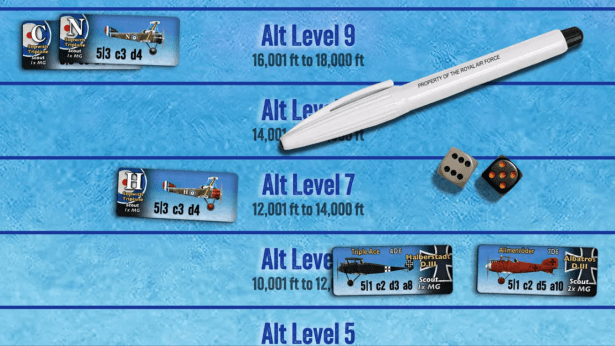
Imagine it like this, to continue the example above. Down at Alt Level 3, which is from 4,000 feet to 5,999 feet of altitude, a hapless Albatros C.VII is caught by surprise. Far above you, sure enough, all the way up at Alt Level 9, there are two escorting Halberstadt D.III scouts. They are unaware of your presence. You examine them closely. Yes, one of them is painted in all-black – that’s the famous “Black Halberstadt”, which is always flown by a top German ace….
The problem is that there’s a partial layer of clouds just below the Albatros C.VII two-seater and no clouds above. You could climb to engage the two Halberstadt scouts or dive on the Albatros two-seater. Which is better? Hold on, there’s a third option that comes to mind – you could split your Flight and send a pair of Sopwith Triplanes to attack both simultaneously. The problem is that if you don’t shoot down the Albatros C.VII quickly, he’ll dive down and slip into those clouds, getting clean away.
Another alternative comes to mind. You could chicken out right here and cautiously withdraw. The problem with that is you don’t want your men think you’re a coward.
You decide to take on the Albatros two-seater with all four of your Sopwith Triplanes. This has to be a single, devastating attack. You’ll dive down on the enemy and open fire before he even realizes you’re there. No doubt, the pair of Halberstadt scouts far above will dive on you afterwards, but you’ll have to endure that. You’re mindful too of the approaching scout formation that you had spotted over Ste. Marguerite Aerodrome. They’ll be joining the fight shortly too. Things could get out of hand quickly. You wag your wings and the other three pilots follow, your squadron commander streamers tied to the wing snapping back from the struts of your Sopwith Triplane. Everyone opens fire at once.
The fight is joined in Dogfight Round 1. Though the Sopwith Triplane is highly maneuverable, it has only one machine gun on its nose. Still, the concentrated fire from everyone together should score some hits. The Albatros pilot looks up in shock at the first sound of gunfire – in that era, the sound of the Vickers machine guns was audible over the noise of one’s own engine.
He’s hit badly! His engine is out, the observer is severely wounded – he never even got his machine gun turned to fire on you before the first bullets hit home. The two-seater is “Out of Control”, or OOC, in official parlance. That’s already a victory!! However, you’re already down at Alt Level 2, given the altitude loss from your initial engagement. The Albatros C.VII is spinning downward toward the ground, which isn’t very far below. Probably, he won’t recover but you never know.
You glance up at the pair of Halberstadt scouts. Sure enough, though you caught them napping at first, they’re coming down fast now in a dive to attack your Flight. The enemy above has a positioning advantage, being above you, so he moves first in Dogfight Round 2. They don’t enjoy the superior dive rate of the Albatros D.III types, so the two Halberstadts can’t yet reach you. They can dive only from Alt Level 9 to Alt Level 6. They’re still too far out of range to shoot at you in this Dogfight Round, but in Dogfight Round 3, they’ll be at Alt Level 3. If you climb to meet them, you’ll be in the fight. They’ll still have the advantage and bonuses from diving to attack. It is probably an even fight, head-to-head.
You have some options. It is your turn now in Dogfight Round 2. You could signal a couple of your pilots to dive and finish off the Albatros two-seater, but he might not pull out of his OOC spin anyway. Most likely, he’ll just augur it in, ending his flight in a fiery crash. Alternatively, you could climb upward to engage the pair of Halberstadt scouts, but one of them is a top ace – that’s the “Black Halberstadt” and you’ve heard talk about that aeroplane in the squadron mess. More troubling is that in Dogfight Round 3, the other German scout formation will arrive to join the fight, which will put you in a spot of trouble.
Given that you’re down at such a low altitude, they’re probably going to be diving in to attack you as well. Suddenly, you realize that this isn’t looking good. You’ll be outnumbered with probably another ace or two joining the dogfight with the advantage of altitude. You could lose a few aeroplanes and pilots in the next few minutes. You’ve gone from the feeling of elation at shooting down an Albatros C.VII to the realization that things are about to get pretty sticky.
At Alt Level 2, you’re not high over the ground. However, there’s a cloud band here. It’s only partly cloudy but it is enough. You can use it to break off and end the fight. You take the option and signal your men, then lead them into the cloud. Your Flight disappears just as another four Albatros D.III scout planes are arriving on the scene. The dogfight is over – you’ve gotten clean away without a single enemy bullet fired at your men.
After landing, your men celebrate. The weather, however, turns bad. The rest of the day’s patrols are cancelled as rain pounds the aerodrome. You’re not unhappy with this. It will be a good opportunity to catch up on some repairs and a few engine overhauls.
Grant: All of that comes from the game? Wow! How long would that kind of dogfight take to play?
Thomas: That would probably have been no more than ten minutes of gameplay, maybe not much more time than it took me to walk it through. In fact, you could play four formations with a half dozen aeroplanes in each in a dogfight against another five formations of German planes – that woud still play out in maybe twenty minutes. As you can see, that doesn’t mean it is simplistic. The results create a compelling, often powerful narrative experience that reads exactly like the old diaries of pilots from the era. In fact, it was those diaries that inspired every part of the game.
For example, perhaps one of your pilots will be “fanned down”. Another will take damage and struggle to reach the lines to crash land on the Allied side. Maybe a German Albatros D.V scout will explode into flames when its fuel tank is hit and its pilot will leap clear, preferring to die a faster death when he hits the ground instead of in the flames in the cockpit. At seeing that, one of your pilots might lose his nerve and run from the fight.
I should mention that it is pretty gutsy to lead patrols as the squadron commander. If you’re shot down, the game ends and you lose. Someone else will take over the squadron and you’re back to the drawing board, so to speak. A lot of players will only fly a patrol with the squadron commander periodically. Some might not fly at all – the squadron commander has that option. In the game, he’s an older pilot, maybe 24 years old, a veteran of the “Fokker Scourge” era the year before when pilots flew under-powered, rickety DH.2s and Morane Saulniers and Lanoe Hawker was the hero of the day.
Grant: Is there that much excitement and narrative when you’re flying patrols on the big map and the Strategic Play Loop?
Thomas: Of course, the peak experience is always going to come when aeroplanes meet aeroplanes in a dogfight. That can be one pilot flying against a half dozen enemies, a lone surviving two-seater photo recon plane struggling to get home against overwhelming odds, or when your pilots meet the enemy in an evenly-matched, head-to-head fight. You can play all sorts of combinations as you wish, exploring the full experience of air combat in the Great War era.
However, there is still a lot going on when you fly patrols on the main map. Remember that before and after each dogfight, gameplay is in the Strategic Play Loop. At take-off, you weigh the orders you have been given and do your best to follow them. If you don’t, as the squadron commander, you might be recalled to London “for consultations”. Trust me, you don’t want that. As they said in 1917, “Every man must do his bit.” You’re in command. Your flight leaders lead when you’re not flying. If they fail you, you’re still the one who is going to be recalled to London.
Of course, if your formation is too beat up after a dogfight to continue the patrol, you will have to abandon the rest of it and fly back to your base anyway. There’s no harm in that – your pilots did their best. You did too. Nobody gets recalled for that kind of thing. Of course, if you have to head home when you’re escorting some FE2d bombers, they might not fare so well – that will weigh heavily on your mind. It can also affect your outcomes.
How you fly, where you fly, and how much you press your luck when flying a patrol on the main map in the Strategic Play Loop matters a lot. You can fly all across the Ypres Salient, one of the hotspots of action along the front lines. The choices you make of where to fly and when make a huge difference.
There’s a lot of tension at this level too. You’re really only going to make it through to the end of a game week if you invest in your pilots, build their skills, and expand the number of victories each has – that only comes from flying the patrols, shooting down the enemy, and gaining the experience. At the same time, you’ve got to make sure that you don’t lose too many of your squadron’s pilots to the enemy by pushing it too hard at the wrong times. Sometimes, the better part of valor is to withdraw, as demonstrated in the description of the dogfight above.
You choose your fights carefully. If you’re flying over enemy-held territory, the encounters you have will almost always be more intense. If you stay on the Allied side of the lines, you’re going to spend a lot of time boring holes in the sky without accomplishing much. Perhaps you will run into a German two-seater trying to do reconnaissance from time to time. The Germans like to stay on their own side of the lines. Thus, you have to fly your missions aggressively, seeking out the enemy where he is found, and not plan on staying safe. Often, you don’t have a choice. You might be ordered to escort an artillery direction two-seater behind German lines. Things might get pretty rough.
Just as it was in 1917, the Germans have a lot of advantages. If they crash land, they’re in their own territory so they just hitch a ride back to their Jasta and fly again the next day. If you crash land, however, you’re coming down on the wrong side of the lines. You’re not likely to crawl your way past the German trenches, slither across No Man’s Land at night, and get back to your aerodrome. If you do, it is going to be some days or even weeks before you can rejoin your squadron. Most likely, you’re going to be captured and your war will be over.
In the Strategic Play Loop, you fly your patrols, choosing a route that will have you engaging with more enemy aircraft. Perhaps you prefer fewer encounters, especially if your patrol consists of less experienced pilots—the new recruits and replacements for last week’s losses. Those are choices you make in the Operational Play Loop. You only have so many pilots in the squadron. You never know, perhaps the guy who is a novice this week will be an ace by Wednesday. It can happen.
As you fly your patrol route, perhaps you’ll be jumped by a flight of Halberstadts or Albatros scouts diving out of the sun. Perhaps you’ll spot a lone Rumpler two-seater flying at high altitude. He’s attempting to make a run across the lines to photograph Allied positions, yet you’re too far below to catch him. He gets away. The story definitely unfolds as you fly, even in the Strategic Play Loop.
Ultimately, after your pilots land, gameplay shifts back to the Operational Play Loop. There are “end of patrol” steps to take. The weather might change, repairs might be needed to some of your aeroplanes, maybe some of your pilots are wounded. You need get ready for the launch of your next planned patrol. That night, you might receive word of promotions or awards of medals, though that’s fairly rare. Perhaps one of your Flights has its weekly, mandatory half day off tomorrow. That will complicate your patrol planning for the next day, for sure – and for the day after that because often not all of them will come back rested and ready to fly. Some will trundle in just before the dawn patrol, hiding the fact they’re still a bit drunk or hung over from the night before at a nearby Flemish town – there isn’t much to do except drink this close to the trenches.
Likewise, there is also an emotional impact for your pilots that is built into the game system. I’ll discuss more about that in a moment. In short, those who like narrative-driven games – ones with real decision-making and not just rolling your way through tables to see what happens as you go along – will love writing out the squadron diary based on this game. It is, by a wide margin, the most narrative-full gameplay experience I’ve ever designed.
Grant: You mentioned that the game focuses on RNAS No. 10 Squadron – why did you choose that specific unit for the first game in the series?
Thomas: Let me set the stage for you. As you probably know, April 1917 was nicknamed “Bloody April”. The reason was that the ace pilots of the German Imperial Air Service cleared the skies of British aeroplanes over the Arras sector, shooting down approximately 250 in that one month. As the pilots didn’t wear parachutes until 1918, those shot down were almost all killed. Some managed to crash land but, because the Allies were engaging in offensive operations, flying behind enemy lines, those who survived usually spent the rest of the war in prison camps.
During that time, the Germans lost only about 60 aircraft – a 4:1 kill ratio. Most of those were their novices and new pilots. Since they were mainly flying defensive operations, German pilots who crash landed could return to their units and fly again, as long as they weren’t severely wounded.
By the end of April 1917, the Royal Flying Corps (RFC) was decimated. Yet the demands put on it to support Allied offensives by Field Marshal Haig were unending. Allied photography and reconnaissance were essential to victory, something that many people don’t recognize when they think about the Great War. The RFC couldn’t fly the mission, however. It needed time to train new replacement pilots and to refit its squadrons with new airplanes. Therefore, the British called on the RFC’s rival service, the Royal Navy (RN), to bale it out (yes, bale out, not bail out, as the latter refers to tossing buckets of water out of a boat). The Admiralty, then led by the First Sea Lord, Admiral John Jellicoe, had earlier agreed to help the RFC, but now, facing a crisis, it formed up new squadrons from the existing coastal defense wings of the Royal Naval Air Service, or RNAS. Most of the RNAS pilots were not British, but Canadian.
Everyone expected the RNAS to be decimated, as happened to the RFC. Remember, this was only two weeks after “Bloody April”. Not only that, the Germans were upgrading to theirnew, “lighter” Albatros D.III scout model, which they called the Albatros D.V – an airplane that would be one of the top five most iconic designs of the war. What the Allies didn’t know was that the Germans had reorganized their Air Service into air wings. They had placed their best Jastas (the German term for a fighter squadron) into the first unit, what they called Jagdeschwader 1, or JG 1. This was under the command of none other than the Red Baron himself, Manfred von Richthofen.
You can picture just how terrible the odds were. Whereas in April 1917, German Jastas were a mix of pilots of various skills and the best was von Richthofen’s Jasta, now the Red Baron was commanding and coordinating multiple squadrons to fly together. They had built JG 1 by pulling all of the top aces from all across the German Imperial Air Service together under his command.
Despite this ominous picture, from 18 May when Naval 10deployed to its aerodrome at Droglandt, Flanders, to 28 July 1917, the pilots of that squadron – and this is an under-strength squadron of only 15 pilots (all the RNAS squadrons were under-strength in a bid to field more squadrons in the face of the crisis) – downed 84 German aircraft (some say 87 aircraft). Of those, 33 were downed by one pilot, a Canadian named Raymond Collishaw who was the leader of “B” Flight – what he called “Black Flight”, hence the name of the game.
Despite its extraordinary success, Naval 10 suffered losses too – three of them in “Black Flight” itself, which had only five pilots to begin with. On 22 July 1917, Flt. Sub-Lieut. JohnEdward Sharman, DSC, of Oak Lake, Manitoba was shot down and killed. Four days later, on 26 June 1917, Flt. Sub-Lieut. Gerald Ewart “Gerry” Nash, of Stoney Creek, Ontario, was shot down. He survived but was captured and sat the rest of the war as a POW. Just two days after that, on 28 July, Flt. Sub-Lieut. Ellis Vair Reid was shot down on a patrol over Ypres, probably by a pilot from Jasta 11. His remains were never found. After death, he was awarded the Distinguished Service Cross. Casualties in the other two Flights of Naval 10, “Red Flight” and “Blue Flight”, were equally high. Of the pilots who first deployed to Droglandt in mid-May, after just eleven weeks, half had been captured or killed.
The campaign game ends at that point, right at the end of July 1917, coinciding with when the leader of Naval 10’s famous “Black Flight”, Raymond Collishaw, was sent to Canada for two months of leave. On his return, though he requested to rejoin Naval 10, he was reassigned. Thus, the game, Black Flight, covers those eleven weeks of the air battle.
During its time flying in the Ypres area, Naval 10 and the rest of the RNAS enjoyed little publicity. Remember, they had entered the air war two and a half weeks after “Bloody April” had ended. The RFC was caught out by the extraordinary performance of the Canadians, who were flying what was arguably the hottest aeroplane on the Western Front at the time – the Sopwith Triplane, a design that the RFC had rejected and handed off to the RNAS, thinking it wasn’t as good as it was.
In light of this, the RNAS never enjoyed the credit they deserved except in Canada, where they were feted as heroes. What is interesting is that the German pilots recognized the achievements of Naval 10 and Black Flight. Around the tables in the Jasta mess halls, Black Flight’s reputation became as widespread as that of von Richthofen’s own “Flying Circus”. Their Sopwith Triplanes set off the “Triplane craze” in Germany, which resulted in the design of the famous Fokker Dr.I Triplane many months later.
You could say that the RNAS saved the RFC’s air war during those eleven weeks, but that wouldn’t be quite accurate – it really came down to one squadron, Naval 10, and within that squadron, it came down to one flight of five pilots – “Black Flight”. I can think of no other time in the history of air combat that five pilots had a more profound impact on the course of a war. Having wrested control of the skies back from the Germans, the door was open for the Allies to commence their offensives at Messines and at Ypres. Without that, it is unlikely that Field Marshal Haig would have been able to proceed.
Somehow the stories of Black Flight and of Raymond Collishaw are almost unknown today except among those who regularly study Great War air combat. I hope that my wargame helps correct that, at least in some small way.
Grant: You mentioned the emotional impact of combat stress on your pilots, how does that work? Is there a special game mechanic for it?
Thomas: That’s one of the most interesting features of The Great War Series. When I was reading through the diaries of Great War pilots, It reminded me how different they were from the World War II era pilots and, above all, from today’s highly-disciplined, highly-trained jet pilots. In the Great War, they were real characters, individuals with unique quirks and traits. Most of the things they did you’d never get away with today, you’d be grounded and locked up forever and they’d throw away the keys.
They were a hard-drinking lot, often scooting off to town to cavort with the Belgian and French ladies. Some of them were cowardly. Others were rash, impulsive, and driven by a seething hate for the enemy. They missed patrols, took off with hangovers sometimes, and so forth – it sounds unbelievable today, but that’s how it was. Of course, their average life expectancy was measured in weeks so there was a lot of forgiveness for their foibles. The “old guys” were usually only about 23 or 24 years old, some a bit older than that. If you survived a few months, you were likely to make it through – at least that’s the lie they told themselves.
In most other air combat games, your pilots are represented by basic statistics only. They have a +1 to this or +2 on that. They might have five kills, giving them an “Ace Bonus”, orperhaps a special skill of some sort but that’s it. They’re essentially carbon-copies of each other, just with different statistics. That’s not the case in Black Flight or any of the following games to come in the Great War Series.
Each of your pilots will have unique skills, traits, and vices. Maybe your top pilot can aim perfectly but he is also a womanizer who often misses the dawn patrol. Maybe he was doing great until he shot down a Rumpler two-seater and watched as it caught fire and the pilot and observer burned to death before his very eyes. After that, he took to the bottle to forget. Maybe another pilot has his best friend shot down and killed and so forth.

They have skills too. Those are represented by Trait Cards. There are 45 Trait Cards in the deck, ranging from Level 1, which are basic skills, to Level 3, which are extremely powerful skills – and in those cases, you won’t see those cards again if the pilot is lost.
Likewise, combat takes a toll. There are 45 Vice Cards to draw from. A lot of your squadron’s performance is going to be governed by how well you manage your pilots and keep the stress of combat from forcing them to draw too many Vice Cards, thus eroding their combat capabilities over time. Of course, you can send them to Paris on leave or, if it is really bad, send them to London for a week or so. That will reduce the number of Vice Cards they carry with them as “baggage”, so to speak.
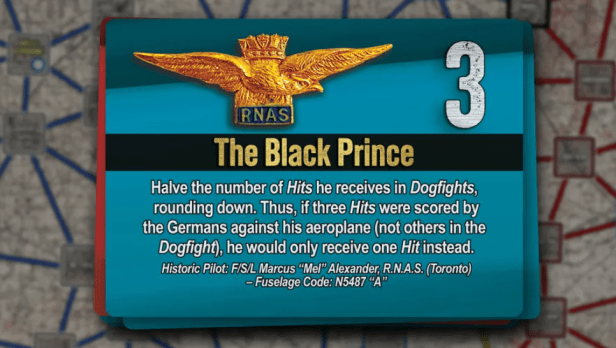
The Trait Cards and Vice Cards are not universal either. The RNAS Trait Cards from Black Flight are carefully developed to reflect the culture and attitudes of Canadian pilots in the Great War. Similarly, the upcoming game release that will have you managing a German Jasta of scout planes will feature another 45 Trait Cards and 45 Vice Cards that are uniquely German in their character. You’ll have Prussians who strut around with a straight back and polished boots, aristocratic sons of Bavarian nobility who enjoy certain (usually annoying) privileges, like getting upset and not flying unless they lead the flight, even if another pilot is more skilled, and so forth.
The core of the game is not just in gameplay but in these Trait Card and Vice Card decks. Yes, the French pilots will be, well, how the French really were. You can’t stop the French from being French, after all. I think you already know how the Americans of the Lafayette Escadrille will comport themselves.
The Great War Series turns your pilots into a collection of “non-player characters”, like in a role-playing game. You never know when one of them is going to pull a Leeroy Jenkins move out of his hat. I think that players will have a lot of fun with that, even if it might be frustrating at times.
In short, the game packs a lot of personality and action – it is the biggest game I’ve ever designed with the greatest breadth. I don’t know if it would be possible to do a game like this for any other era. The Great War was a really unique time in history.
Grant: You mentioned that there was another game that you’re designing, something about air racing? What’s that?
Thomas: Some years ago, I did a video on my Historic Wings YouTube aviation channel about a flight from England to India in 1925. That’s exactly one hundred years ago. You can see that video at:
www.youtube.com/watch?v=WRDPMy2NyJU
Please take a moment to LIKE and Subscribe to my channel!
That story got me thinking that there’s a lot of aviation games about air combat but almost none about air racing. As well, one of the most popular boardgame genres is car racing, whether it’s Formula 1 or NASCAR, or dozens of others, from the old 3M game called Speed Circuit to Formula D, and, most recently, Heat, which came out last year. Somehow there are almost no air racing games, even if they would be a lot more exciting than cars, though that’s just my opinion.
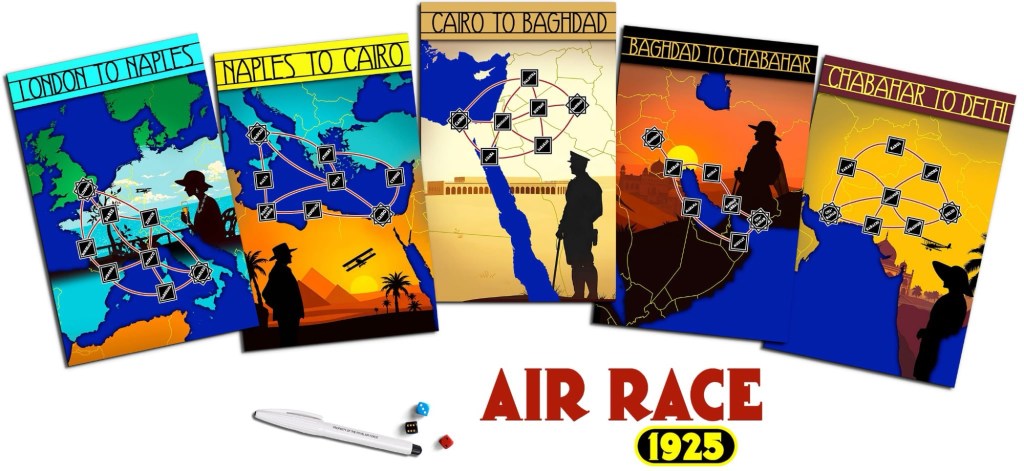
Anyway, I decided it was time to create one. It won’t be an “air racing variant” of a car racing game, which just swaps themes from cars to airplanes, but a realistic, historically accurate representation of what it really was like in the Golden Age of the 1920’s and 1930’s. Those who think that you can just port over car racing rules to air racing usually miss the mark – for instance, in cars, you have slipstreaming, but in airplanes, if you’re forced to fly through the wake turbulence of the guy ahead of you, you’re going to fall off the pace or maybe even lose control of your airplane.
As a pilot, I have a good understanding of flight dynamics and I have friends who flown in international air racing competitions, including in the Red Bull series. As well, I’m an aviation history guy, so I hope that I have the “right background” to take on a project like this. For instance, most of the races in the 1920s weren’t flown head-to-head, though it seems that most people don’t know that. They were long distance, endurance, or reliability races. Even the Schneider Cup seaplane races had more tests about sea-worthiness of the floatplanes than flying the circuit at high speed. In the end, the job was still to fly the fastest you could on a timed, close-circuit course, but that was only after you passed the reliability tests. They flew one plane at a time around the course, not against one another, struggling to pass each other. Later, in the Bendix Races and Thompson Trophy, they flew head-to-head, but these were special events that departed from the standard in Europe at the time.
Thus, the real story of air racing in the 1920’s is about the setting and the challenges the pilots and flight crews faced. This was the “Roaring ‘20’s era”. There were flappers, great music with its early roots in jazz, high society socialites, and, since it was long range air racing, it was a bit exploratory. The pilots were flying to exotic India, connecting cities that had never seen an airplane fly between them. They were racing across the deserts of Iraq, hoping to navigate their way to Rutbah Station, where fuel was being trucked in so that they could carry on to Baghdad. In many of the stops along the way, there were no runways or airports.
The game will bring that to life. I’m shooting very high with this title too – I’m hoping to make it a series of games where the challenges, stories, and experiences will be unique in each individual race course. Everything from the maps to the airplanes and pilots will be colorful – in every sense of the word.
You will have multiple airplanes of different types fielded by national teams. The Italians will show up in style with their planes painted in red. The British always will have their stiff upper lip – in racing green. German engineering will be the best there is and their planes will be silver and white. The French, in racing blue, will have their own style. The Americans will have in their swaggering style. Don’t discount the Finnish team with their well-documented “sisu” trait, the ability to persevere when all others would have long since given up and turned back in the storm.
As you fly each leg of the race, crossing off each checkpoint on your way to the finish line in Delhi, India, you’ll encounter risks and other events that are drawn from the pages of history. You’ll attend embassy events and plan for what to do if you suffer fuel shortages at one of the remote desert outposts en route. Likewise, why not use up the fuel that is pre-positioned there so the next guy coming in behind you has to wait a day or two before another fuel caravan comes in with enough fuel tanker trucks for him to follow after you on the way to Baghdad?
There’s a lot of action that unfolds under the shadow of the pyramids, by the sea in Naples, or in Paris. You might even engage in a bit of sabotage – you know, if you’re the German player, you might want to pay back the British and French for the limits they put on German aviation in the Treaty of Versailles….
Grant: That sounds fun! Where can we buy your games today?
Thomas: My games are in book format, but also in boxed sets for those who want to buy a “traditional” boxed game. This provides you with the opportunity to get into a title for less money, if you want to make your own maps and game assets, or just buy a full-featured boxed set with everything inside, in a ready-to-play format. As always, the boxed sets will feature the highest quality components. Best of all – the combined cost of the book and boxed set is about the same as a regular wargame.
You can find my wargame books on Amazon at:
The boxed sets of the components are available from Blue Panther at (again, you need both the book and the boxed set to play):
www.bluepantherllc.com/collections/historicwings
For those in Europe, you can find the games at Second Chance Games, which sells a lot of my games. Others in Europe carry my games as well. For instance, in Germany, Gamer’s HQ offers a combined package that includes BOTHthe book and the boxed set together in a single purchase for your convenience (with great pricing and free shipping within Germany too) at the following link:
gamers-hq.de/en/detail/index/sArticle/26148
Their pricing at Gamer’s HQ is good too and it serves the EU well, which is helpful for those who have difficulty buying from the UK after Brexit.
Finally, I’d like to take a moment and invite your readers to check out the Historic Wings YouTube channel, which I’ve just relaunched. Please check it out at:
www.youtube.com/@HistoricWings
Thanks for having me on with you again! I love the Player’s Aid – one of the best there is!
Once again, it has been a real treat to have you on the blog and thank you so much for your time in answering our many questions about Black Flight as well as your other Solitaire Book Wargames. Also, thank you for your tireless service in defense of our nation’s freedom and for all the great work that you were a part of in the 1980’s and 1990’s and beyond.
The game is not quite out as of yet but I will edit this post with a direct link to Amazon so readers can purchase a copy once it is released.
-Grant
 The Players' Aid
Great interview on what looks like a fascinating game. Also looking forward to more on his air racing game since September’s Eagles is the only other air racing game I know. However, as an aside, I don’t agree with his definitions of “bale” and “bail.” 🙂
LikeLiked by 1 person
For those of you who want to play online slot games with full wins, we provide several platforms that you can play. Keep visiting our website at https://waktogel.livejournal.com/
LikeLike