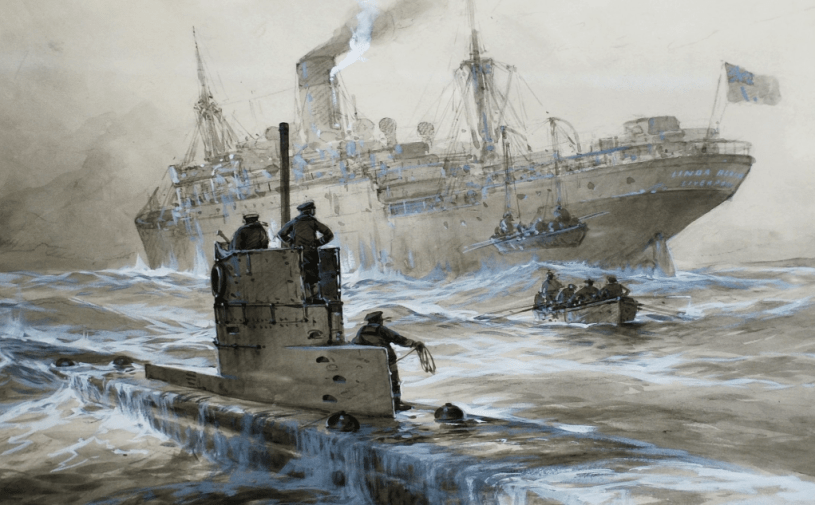
I love a good game that is focused on submarines and their operations in World War II or in other theaters and periods as well, such as during the Cold War. There is something to say about those brave men who fought and died below the waves in a steel tube to keep us all safe! Well, in today’s Best 3 Games with… Series, I wanted to take a look at 3 games that I love that portray submarine warfare well.
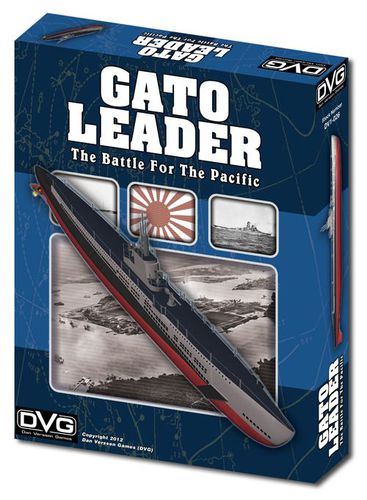
3. Gato Leader: The Battle for the Pacific from Dan Verssen Games
Gato Leader: The Battle for the Pacific focuses on the American Submarine campaign in the Pacific during World War II from 1942, shortly after the dastardly sneak attack by the Empire of Japan on Pearl Harbor, through the end of the war in 1945. Players will be placed in command of a squadron of Submarines to control over the course of a Campaign. The primary goal of each squadron commander is to sink enemy merchant ships and warships in order to meet their Victory Point goal for each chosen Campaign.
The game plays with two different maps. The first map is the Campaign Map or strategic Map as it shows the relative position of your Submarines and various Map Areas and Ports as well as transit areas and special mission boxes. The 2nd map is the Tactical Display which is drawn in the shape of a radar array that shows the location of the convoy that a Submarine has made contact with and the relative position of the Submarine and the various merchant, escort and naval ships assigned to that convoy.
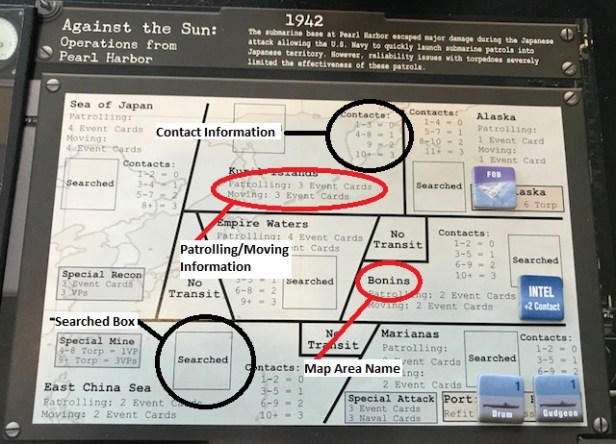
As you can see in the picture above, the Map Areas are named and contain lots of key information for game play, including the number of events that are drawn when a Submarine is moving into, through, or patrolling that Map Area, and various special mission boxes, such as Mining, Special Attack missions, Rescue and Recon missions.
The Contact information is used to determine what ships the Submarine will find while searching in the area. Contact rolls are a major part of the game and if you don’t roll well, you will not be able to find the number of ships required to meet your VP objectives. Contact is a good thing! The Contact role happens at the beginning of the Tactical Segment and is a roll of a d10 that is modified by various elements. A Submarine has to be fit for duty to make a Contact roll so if they have taken a load of Stress from the random events that are encountered while moving into a Map Space or patrolling they will be unable to make a Contact roll and will be moved to the Searched Box, effectively ending their turn. The player simply rolls a ten sided die and modifies the roll with various Contact Determination Modifiers. These Modifiers include both positive and negative numbers so you have to pay attention.
Gato Leader includes the following U.S. Navy submarine types: S Class, Narwhal Class, Permit Class, Salmon Class, Tambor/Gar Class and Gato/Balao/Tench Class. Each of these class of ships are available based on their historical years of service. So, when a player selects a Campaign, they must take out of consideration any Submarines that are not in service during that time frame.

The player then consults the Campaign Sheet to choose the length of their campaign to identify the number of Special Option (SO) Points that they will have to spend over the course of the campaign as well as what Special Options they will have to purchase before and during the Campaign. In this example, I will use the Against the Sun 1942 Short Campaign. I consult the above picture table for the Short Campaign and see that I will have to complete 1 Patrol per Submarine and I will have 32 SOs to spend during the campaign.
I first have to choose my Submarines and then outfit them with various upgrades. The first boat that I choose is the Drum commanded by Lieutenant Commander Bernard McMahon, which is a Gato Class Submarine that was in service from April 1942 through August 1945. The Campaign I chose is during 1942 so this boat qualifies. In looking over the various options of skill for the card, I choose the Veteran version which costs 12 SO Points. I then choose to upgrade the boat by adding Radar and a Torpedo Modification. The Radar will give me +1 on Contact rolls and the Torpedo Mod is very important as it will mean my torpedoes are considered to be one year later on the Torpedo Dud Table and will malfunction less. I spend a total of 15 SOs on the Drum and she will end up being my workhorse over the life of my first Campaign.

There is a lot more to this game than the simple elements I have shared with you. There is a fairly involved system of escort detection of Submarines, random movement of those escorts, as well as attacks from escorts and even merchant ships that you will have to learn to play this game. I also really like the damage system for the Submarines when they are hit by enemy ships. Each ship will be given a damage number and when that ship attacks, there are no rolls for their attack as they generally hit unless you have taken actions to avoid them such as Deep Diving or Crash Diving. When hit, you will draw a random counter from a cup and refer to either the Light Damage or Heavy Damage sides. The Light Damage is not lasting while the Heavy is and can only be removed while in Port or from certain Events. Each of these damage counters will count toward your Hull value and if you meet that value the Submarine is considered to be sunk. Evasion can be used by Submarines to reduce those counters from Heavy to Light but you still have to worry about those hits accumulating and sinking your boat.
Gato Leader: The Battle for the Pacific is a very fun and interactive game that I have played several times and still am not tired of. In fact, I am able to try different strategies each game, such as Wolfpacks, Crash Diving when I am attacked to avoid damage, and Silent Running to sneak up on those pesky escorts.
Here is a look at my video review which you can view at the following link:

2. Silent Victory: U.S. Submarines in the Pacific, 1941-45 from GMT Games
One of my favorite movies of all time is Das Boot. I know that this is a movie about a German submarine and I am using it as the introduction to a post about American submarines but it is simply so good and really helped to give me an understanding of the absolute hell that those submariners endured in the depths in a slender metal tube being depth charged to death. I remember the scene where the Chief Machinist Johann loses it and has to be restrained. As we follow along on the patrol of the U-96, we grow to understand the difficulty with which those men had to deal as they did their job and took the punishment. As you know, the movie ends when they are in a sub base and are bombed by Allied planes and we see the Captain and most of the crew shot up and dying as they watch the U-96 slip under the water. After playing Silent Victory, where the player takes the helm of an American submarine in the Pacific Ocean during World War II, I could understand (not physically or psychologically) emotionally how they felt, just a bit, as my boat was depth charged mercilessly and I simply could not get away from the Escort. Eventually, I did get away but not before I lost a few crew to injuries and basically nearly sank myself by deciding to go past test depth to escape.

Silent Victory: U.S. Submarines in the Pacific, 1941-45 is a window into the experience of a submariner during World War II. True, the game boils down to an exercise in chart flipping and dice rolling but it amazes me that all of that can generate a nail biting heart pounding tension filled experience all using nothing more than a few pieces of paper, a few counters and some dice. It is the only submarine game from Gregory M. Smith that I have fully played through and I really need to get the others off the shelf and get them on the table. Along the same lines of thought though this chart flipping and dice rolling can get to some people after a while and this one may not be for everyone. It’s strength is the building of the characters in your captain and crew and the narrative that it weaves all while using a pen, a pad and some dice and charts. There are limited choices, but they mostly have to do with how you attack or whether you attack, as your patrols are basically boxes along a track that you follow and roll dice looking for contact. But the tension is palpable and really kept me on the edge of my seat for several hours.
The game, for me at least, hinges on your capacity to get into the role of captain and bring the game to life in your mind’s eye. The more you can suspend your disbelief and make the dice rolls for more than just numerical charts the greater your experience will be. Role playing takes this game from a dice mashing exercise to a deep story telling device chocked full of tension, agonizing decision making and sublime victory! I have a background in D&D and other pen and paper RPG’s so this aspect of the game came naturally, and when I found myself on the brink of losing my crew and vessel to the dark depths in the China Sea, I felt genuinely sad that my career would come to a watery end. Silent Victory is very much a game of ‘the more you put in the more you get out’. Something that enamoured me to the game was the fact that I could play for twenty minutes and I felt I had played a great game, but that this single session had also contributed to a greater whole; the career of the captain, brings the story of the patrol into a greater context within the war. This was very satisfying.

The game can be played quickly as a patrol might take 30-45 minutes depending on what happens and you can then put it away and come back to it when you have another opportunity to go out on patrol again in trying to complete and survive your tour of duty. For that type of gamer with limited time and table space, this is a lifesaver. But, the best part of this game, is that it’s fun. Unadulterated fun! Sinking ships feels great, and getting away with it unscathed feels even better. But when those escorts find you and the depth charges start to fall those damage rolls and incoming hits feel lethal and that you truly are on the brink of disaster. The historical feel to the game is something that I can’t get enough of, and I found myself watching the clock until my kids’ bedtime so that I could play again.

At this point I’m hooked and loved this one. I have tried to play the other games in the series by Gregory M. Smith but just keep coming back to this one for some reason.
If you are interested in Silent Victory: U.S. Submarines in the Pacific, 1941-45, you can order a copy from Noble Knight Games at the following link: https://www.nobleknight.com/Search?text=silent+victory

1. They Come Unseen from Osprey Games
Have you ever heard the idiom “straight from the horse’s mouth”? This figure of speech is used to denote that what was said was from an authoritative source on the matter. So if you are looking to play an authentic game on Cold War Era submarine warfare, would you want it designed by your babysitter? No, you want the experience of a real submariner. In They Come Unseen published by Osprey Games, that is what you have, a game designed by a Royal Navy Submarine Captain in Commander Andrew Benford. Commander Benford started the design of his Magnum opus in the 1970’s while serving on various submarines in the Royal Navy for 21 years (25 years of total service including training). The game was released in 2015 and was nominated as the “Best Wargame for 2015” by Board Game Geek but eventually lost out to Churchill by GMT Games for this award. I also did an interview with Commander Benford on the blog several years back and you can read that to get greater insight into this interesting and very strategic hidden movement, secret unit deployment asymmetrical game.
At its heart, They Come Unseen is a secret unit deployment and hidden movement game with asymmetric victory conditions. Asymmetric is a fancy way of saying that each side has different conditions for victory. As the NATO player, you’re controlling two diesel-electric hunter-killer submarines that have the mission of destroying four assigned targets in the form of Soviet Ice Stations or bases. These targets are randomly assigned by drawing 4 target cards out of a possible 6. This way, the Soviets will never know exactly which 4 targets you are after making them have to spread their resources thin and try to anticipate those targets. The NATO player controls their submarines from behind a screen that hides a smaller version of the game board in order to hide your movements while controlling and tracking the depth of your submarines. The submarines can reach depths of up to 600′ in increments of 200′. The submarines must also watch carefully their level of battery charge as movement requires energy.
The battery charge is in essence the fuel for the submarines and as it nears depletion, the only way to recharge is to perform a “snort” maneuver, which is the term used for describing the submarine surfacing to charge the batteries. This necessary maneuver temporarily exposes the submarines to the Soviet player and the Soviets use that knowledge to be able to track their movements somewhat, although it is very frustrating thinking you know where he is only to have no contact on your sonar net!
The hunt and the game of hide and seek is really the meat of the game. Sonar searches and the movement of the subs at different depths are the tools that each side has at its disposal to survive and accomplish their mission. I love this part of the game! I always try to judge how good a game is by how it makes me feel as I play. Using that as a yard stick for They Come Unseen, the theme is excellently integrated into the gameplay and is oozing out of every one of its portholes. The hunt is by far the most thematically tense aspect of the game. If you had ever hoped to experience what it must be like to be 600′ below the surface in a steel cylinder with concussive blasts from depth charges missing you by mere inches, look no further. But the game is not just tense for the submarine captain. The Soviet player also frets over whether the submarines have slipped through their net and made their way to freedom.
The main game board is color-coded and marked to indicate depth with deep water being dark blue and shallow water being lighter blue, so the NATO player is not only having to watch the movements of the Destroyers, but also must figure out how deep to run and for how long in order to maximize their movements or to sufficiently decoy the hunter into thinking they are where they aren’t. The subs can only move 6 squares in shallow water so this is definitely something they must be aware of and must be taken into account by the Soviet player as well as they attempt to keep tabs on the subs. There is the constant pressure of a dwindling battery supply, the impending necessity to recharge, which as mentioned previously means surfacing and giving away your location, the desire to remain hidden for as long as possible, and the struggle to continue pressing toward the ultimate destruction of four Ice Stations.
The actual sonar searching is an exciting and frustrating part of the game. The player moving the Destroyer pauses and places a multi-colored sonar template on the starboard and port sides of his ship. These two templates feature four different colors, one for each quadrant of the sonar search. If the submarine is hiding in one of the four quadrants, when asked during the search they must say “Contact Green”, “Contact Red”, etc. which then gives the possible location of the submarine in 9-12 ocean squares depending if it is forward or aft. The sonar net offers a 6 x 7 square coverage but there are blind spots. The line of squares between the 2 templates and under the ship are great hiding spots; I know from experience!

They Come Unseen is a truly great war game that has thought of all of the factors involved in a Cold War Era sub hunt game. Excellent design, great components and especially a lot of FUN to play! I truly loved the tension and the narrative that is created as you play through the game. After playing, I was physically and emotionally spent and felt as if I had been in a steel cylinder beneath the waves for 3 hours being rocked by depth charge after depth charge. This game is a great value, and is sure to see many plays on my table in the future!
Those are my 3 favorite games focused on submarines. I have played several others but feel that these 3 best demonstrate what it is like to be in a tin can under the water getting depth charged to death. What are your favorite submarine games?
-Grant


Great list Grant, of which I own the first two. I haven’t even heard of The Come Unseen so I will definitely have to check that one out. Need one in the modern era in any case as those are so rare it seems.
LikeLiked by 1 person
Well you have now and it is very good! Happy hunting.
LikeLike
Was Compass Games: Raiders of the Deep considered? I was really intreaged by Zilla Blitz’s playthrough series.
LikeLiked by 1 person
I have not played that one. Need to get to it.
LikeLiked by 1 person
Raiders of the Deep and Beneath the Med are my two favorites of the Gregory M. Smith submarine series (he didn’t do Raiders, but it’s based on his mechanincs). I’m also looking forward to his IJN version (Sensuikan – on Compass’ future list).
LikeLiked by 2 people
Somehow, “They Come Unseen” seems to have slipped below my radar (sonar?) as well. Think I would like to learn more about it.
As someone who likes naval games in general, my experience has been that submarine-style games seem to fall into a couple broad categories: narrative-based and tactical-based. Each style of game has its own following of loyalists. I’m not of the opinion that one flavor is better than the other, as everyone has their own tastes in what they like or don’t like. I have played both styles, and find that I gravitate to the more tactical style of sub game. I recently acquired, but have not yet opened, GMT’s “Wolfpack: The North Atlantic Convoy Struggles”, which I believe leans more towards the crunchy tactical side of the scale.
LikeLiked by 1 person
Let me know how it goes with Wolfpack.
LikeLike
I have not played Gato, and have Silent Victory on my P500. I am lucky to own They Come Unseen and having played it a few times, I agree with you — it is an emotional roller coaster. I highly recommend people pick up a copy.
Cheers!
LikeLiked by 1 person
Hear hear! Well said.
LikeLiked by 1 person
Although it’s a much older title, what we’re your thoughts on the classic, hidden movement, written plotting game “Submarine” by Avalon Hill?
LikeLiked by 1 person
Haven’t had the pleasure of playing that one. I will add it to my list.
LikeLike
Submarine by BattleLine/Avalon Hill was my first, true wargame a long time ago. I felt challenged to learn it as a teen, but the more pressing problem was finding other people in my group of friends who wanted to play it.
I wish, mostly for nostalgic sake, that I still my copy of it, but it got lost or discarded when I moved on to living in my own place. In its own era, I think it was a decent game.
LikeLiked by 1 person