
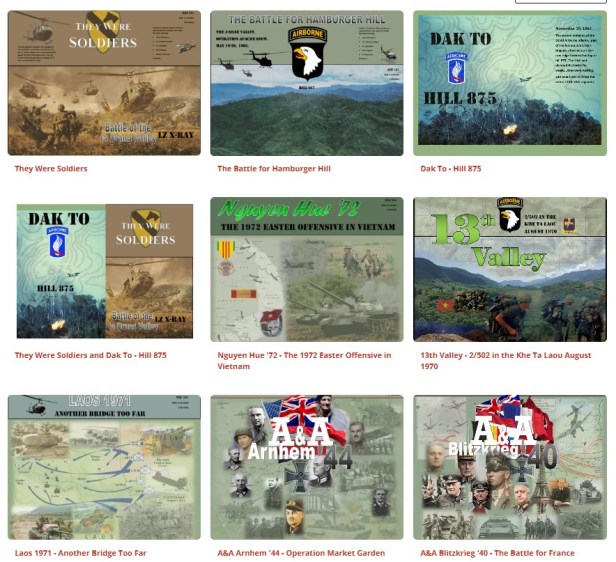
Over the past few years, I have become familiar with Cadet Games who has done some pretty interesting looking wargames on crowdfunding. Their first game was They Were Soldiers: Battle of the Ia Drang Valley followed by Nguyen Hue ’72: The 1972 Easter Offensive in Vietnam. They also did a successful Kickstarter in May 2022 for a game in a new series called Armies & Alliances: Arnhem ’44 – Operation Market Garden. On the back of that success, they then published the 2nd game in this series called Armies & Alliances: Blitzkrieg ’40 – The Battle for France. They are now going back to their very first design to finally bring it to light after years of playtesting and development called The Battle for Hamburger Hill – Operation Apache Snow – May 10-20, 1969. I reached out to the main developer of the game Kevin Talley to see if he could answer some questions about the game.
If you are interested in The Battle for Hamburger Hill – Operation Apache Snow – May 10-20, 1969, you can back the project on the Gamefound page at the following link: https://gamefound.com/en/projects/kevin-talley/hamburger-hill
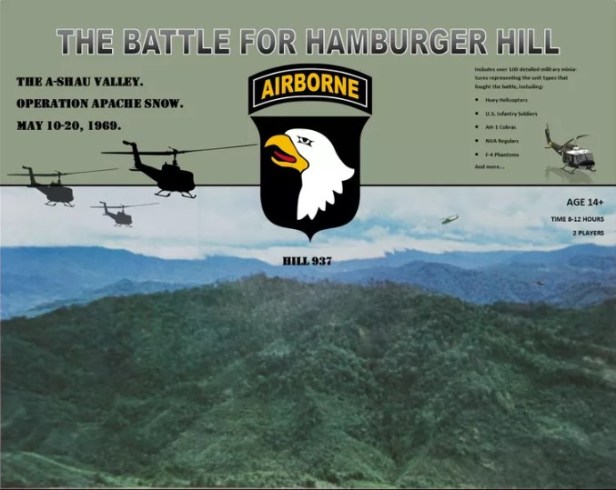
Grant: What is the focus of your new upcoming game The Battle for Hamburger Hill?
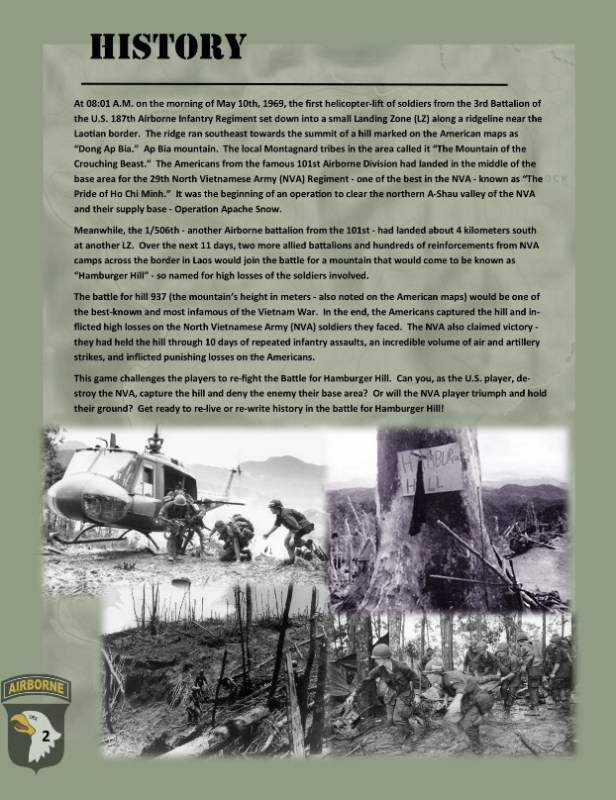
Kevin: This game re-creates the 11-day battle for control of the NVA’s Dong Ap Bia complex in the northern A-Shau valley during operation Apache Snow in May of 1969. The center of the hill mass was also known as Hill 937 on the American maps at the time – but came to be infamously called “Hamburger Hill” after the hundreds of casualties the Americans suffered in repeated frontal assaults against the NVA defenses.
Grant: I believe this was your first game identified but it is now going to be your 6th game published. Why has it taken you this long to get this one ready for crowdfunding?
Kevin: We originally wanted to make this game BEFORE They Were Soldiers, but after play-testing (and especially some problems with the map-creation process), we realized this battle required a ruleset of much greater complexity than the Ia Drang X-Ray LZ battle. Given that they were both well-known engagements from the Vietnam War (probably equally well-known based on the two movies made), we decided we would do They Were Soldiers first. The plan was to do HH next, but we
got into the Easter Offensive design in the meantime, then Linebacker II, Arnhem, Blitz…it just got to where we had issues with HH and making that battle work with the rules and combat system – where our other designs were simply further along (and we hadn’t solved most of the issues with the HH design yet).
Grant: What was important from the history to model in the game?
Kevin: Great question. A typical hex and counter design anticipates losses using “steps” on the counters. But the actions during the battle for Hill 937 were all single squad or 2 or 3-squad engagements (because of the sub-company platoon frontage for any given attack) that featured a handful of casualties for either side each time an assault was conducted. This “granular” aspect of combat was essential to making the game work. We knew that our combat system perfectly modeled combat at this scale for the fight and we also knew that casualty evacuation and LZ’s for this purpose played a huge role in how the Americans conducted the battle.
Grant: How have you modeled the savage fighting for Hill 937?
Kevin: I think the basic components of the fire and close combat mechanics do real justice to the battle at the squad and platoon level. In addition, the fire support mechanics really do a great job of modeling the effect of supporting fires during the battle, particularly given the NVA bunkers.
Grant: What sources did you consult to get the details correct?
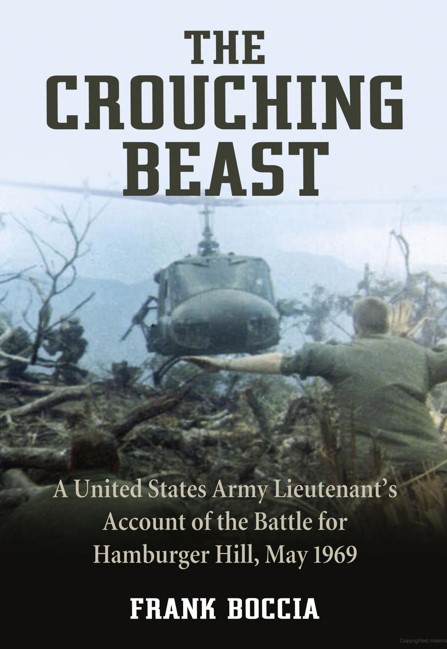
Kevin: Well, Zaffiri’s Hamburger Hill (The Brutal Battle for Dong Ap Bia: May 11-20, 1969) is THE book on the subject, but there are well-known discrepancies that invited us to inspect the various Battalion and Brigade After Action Reviews (AAR’s) from the action in detail (we looked at every battalion and brigade AAR associated with the battle). We also found a lot of really good information in Frank Boccia’s The Crouching Beast about his experience as an officer in the battle – especially details about where the trails were along the western side of the complex, and C company’s dispositions after the NVA had nearly wiped them out.
Grant: I understand you are using counters rather than plastic minis for the units. Why was this better for the design vision and playability (I so do love those little plastic soldiers)?
Kevin: Another great question. In this instance, our original concept of using minis just didn’t work. When we blew up our map concept to 44″ x 34″ and used the minis in stacks (aka They Were Soldiers), the effect was to diminish our “3-D” terrain effect (by the size of the map) from the original map concept and further to diminish it by having stacks of minis reinforcing how flat the map really was. This was counter-productive to the original design intent. Counters lay very flat, and those helped to reinforce the 3D effect of the map – especially when keeping it to 22″ x 34″, where the 3D effect was perfect.
Grant: What is the layout and anatomy of the counters?
Kevin: The counters either represent platoons of soldiers, weapons caches, bunkers, fire support assets, transport and recon helicopters, or mystery events. The ‘hidden’ NVA and mystery counters are simply plain green against the map until they are revealed, but the allied unit counters are always ‘face-up’.

Grant: How much research went into the location of troops and units for the setup?
Kevin: The Battalion and Brigade AAR’s were very specific in exactly which companies were involved in the initial airmobile lifts as the operation kicked off. Same thing with the reinforcements and replacement timing during the battle. The S-2 AAR sections were very specific about which units of the 29th NVA regiment were involved in the battle – and this information was corroborated by the NVA accounts afterwards. There are tons of discrepancies related to particular grid locations and reported actions between various sources that had to be de-conflicted – but we did all that research and got the complete picture. I will add here that even the recent Osprey publication about the battle is full of errors – some incredible ones, even.
Grant: What type of 3D effect have you used to demonstrate the terrain?
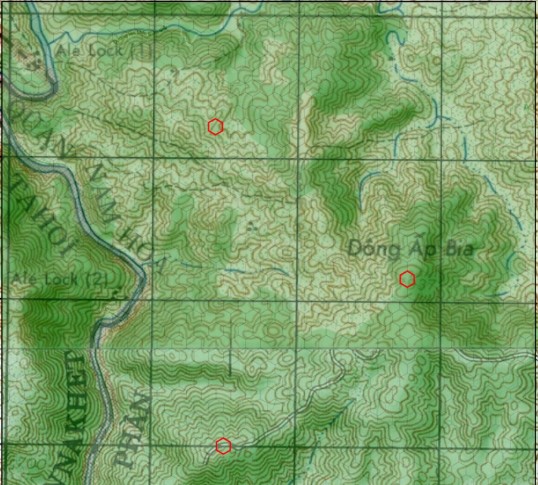
Kevin: The process of creating this ‘3D’ effect is our secret – but we found a way to take the actual 1:50,000 scale UTM grid map from the real battle and create a full 3D topographic relief map – then superimpose the hex grid on it – so that the battle space for the game is the actual map depicting the real terrain used by the American command and fire support elements during the real engagement in 1969.
Grant: What does the board look like? What tough choices does it create for the players?
Kevin: The board looks exactly like the actual terrain of the battle. It simply could not be more accurate. It IS Hamburger Hill. And with that comes all of the issues faced by the American command during the battle – there are simply no easy ways to approach the NVA defenses, especially when attempting to move and assault up the steep slopes on the north and east sides of the massif. Even the western slopes (as with history) have channels based on the locations of the draws and narrow razorback ridges which require the attacker to conform to prepared avenues and “kill zones”. It was a very tough position to attack.


Grant: Who is the artist? How have their talents helped you in realizing the vision?
Kevin: Our design team did all of the map and layout graphics, rulebooks, counters and cards. We actually didn’t have any “artist” involved in this game – it was just us. But we always give the designer’s mom “artist” credit in our official listings for these games (since she was responsible for making the designer).
Grant: What is the general flow of play and the Sequence of Play?
Kevin: It’s all pretty standard; movement and combat phases for both players, with reinforcements and prep fires added in. The night turns feature special movement and combat actions for the NVA, as well as H&I fire for the allies, but the flow of a game turn is pretty standard for those familiar with turn-based combat sims.

Grant: What is the scale of the game? Force structure of the units?
Kevin: This game is based on platoons. The actual unit strength can be as little as a single soldier, but the basic “unit” is always a platoon. This battle was fought in a “platoon” frontage – regardless of how many companies and battalions were engaged (one has to read the history to understand why). A platoon consists of 35 individual soldiers in this design (which is pretty accurate based on the actual combat strength of the real units in the battle).
Combat strength and casualties are based on how many of the soldiers in each platoon are firing/attacking/being hit/wounded/killed in any individual combat event. The combat is very granular.
Grant: What different units do players have available?
Kevin: The units are infantry platoons, artillery batteries, aviation assets like Phantoms, Skyraiders, Huey Cobras and transport helicopters, snipers, mortar sections and Shadow – the AC-119 USAF gunship that was famous for its fire support during the NVA attacks on the night of May 15th
Grant: How does the game hide the NVA units? What type of situation does this create?
Kevin: The NVA are hidden. It isn’t a huge guessing game to know where they are – the blank counters show that something is there – but the exact disposition is a mystery. They can’t be everywhere – there are too many mystery counters for that – but the allied player cannot know for sure what is what. It creates a nifty sense of doubt for the allied player – especially early on, before the other allied battalions get into the battle. Each contact is going to be a surprise (just like the real battle).

Grant: How does combat work in the design?
Kevin: The combat system is just like They Were Soldiers – a number of dice are rolled based on the combat strength of the firing unit (or fire support asset). The dice results are compared to the corresponding box on the Battle Board (which considers the defending unit’s terrain and posture), and the hits are calculated to determine how many enemy soldiers are hit by the attack. It is very simple but also very simulative for combat at this scale.
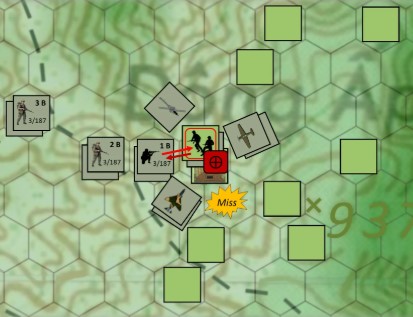
Grant: What is the purpose and function of the Battle Board?
Kevin: The Battle Board is the principal instrument to determine which dice ‘hit’ each time a combat event happens. The Battle Board determines the category that the combat falls under (firing unit type and target unit posture/terrain) – thus determining the “hit” number for the dice that are rolled. Target units in a bunker, for example, will have a smaller ‘hit number’ category and thus will be less likely to take losses.
Grant: How are cards used in the design? Can you show us a few examples?
Kevin: The cards add a lot to the game. Particularly leadership effects, weather, surprise events and combat modifiers. These are all based on historic aspects of the contest – so they make for a very realistic simulative game and add to the re-playability.
An example would be “Sapper Attack” (an NVA player card): “Firebase Airborne was hit hard by a sapper attack last night. A/2-501 suffered 50% casualties. Two of the five artillery units supporting the battle cannot fire today.”
This would be a bummer for the American player, since their planned fire support will be missing 6 artillery attacks from 2 inoperative batteries during the game day.
Another card is “Prisoner” (an Allied player card): “One of your units captures an unarmed NVA soldier. He tells your interpreter that the Ap Bia complex is the base camp for the 29th Regiment. Reveal one hidden unit marker of your choice now.”
Grant: How are reinforcements deployed? What is Landing Zone Prep Fire?
Kevin: Reinforcements for the Allies land by helicopter during the day turns, while NVA reinforcements enter along the Laotian border (the Song A Lin River) during night turns. Landing Zone (LZ) prep fires are employed to suppress or destroy any enemy that might be lurking near a planned LZ – the game includes the danger of groundfire vs. the helicopters. This “LZ Prep” fire support allocation is separate from the support fire allotment that the allied command has available for a typical game day, so the allied player will love it if the NVA try to contest a reinforcing Battalion’s landing. There are restrictions on where the reinforcing LZs may be created.
Grant: What scenarios are included?
Kevin: The game has a standard victory condition, where the mission is to control the hilltop hexes, but there is an alternate. The battle did not begin as an attack on a prepared hilltop defense – it was simply a Reconnaissance in Force (RIF) by several allied battalions aimed at discovering and disrupting / destroying the multiple weapons and equipment caches the NVA had in the northern A-Shau valley. The battle developed from the contact made on May 11th by B/3-187 and then progressively became a meat grinder from that point on. In the alternate scenario, the Allied player is tasked with discovering and destroying 10 supply caches that the NVA player hides anywhere they choose in the operational area during the 11 game days available.
Grant: How is the game won?
Kevin: In the standard scenario, the Allied player has to control both the hilltop hexes of 937 and 916 simultaneously within the 11 game days available. If they fail to do this, the NVA wins.
Grant: What do you believe the game does really well in modeling the assault of Hamburger
Hill?
Kevin: Two things: 1. The combat system reflects a very granular level of combat (even individual soldier losses), including wounded soldiers and casualty evacuation for the allied side. This is important for this battle, as the combat (though technically a multi-battalion action) was between different separated company elements – each company assaulting on less than a platoon frontage (often only a pair of understrength squads). No two platoons (!) were ever able to assault providing mutual support, much less companies (one has to know/study the history and the terrain to understand why). Modeling the combat using typical hex and counter combat factors with adjacent units attacking the same defending hex with a CRT (and flipping counters for step-loss allocation) just wasn’t realistic for this battle – especially at the ‘time and space’ scale of the design. Our unique combat system resulted in actions and outcomes that almost exactly reflected the AAR’s from the
real battle, so we were very happy with that.
The morale rule for the allied player. This battle was famously characterized by the Americans repeatedly assaulting the exact same positions over and over. Many times capturing the NVA positions (trenches/bunkers) but then withdrawing back down the hill to their company LZ’s/NDP’s and allowing the NVA to re-occupy them, requiring a “start over” the next day (with new casualties incurred each time for the same ground). A typical player would not arbitrarily withdraw from ground captured, so the design had to build in the reason this was done – the Allied morale rule does this (and with the exact logic that prevailed during the real battle). This rule was missing in the original design, resulting in very un-historic allied behaviors. We knew we had fixed the problem the first time we played it with the morale rule.
Grant: What has been the experience of your playtesters?
Kevin: Well, the typical Allied player experiences acute frustration (as I am sure Honeycutt and his company commanders did). The experience also challenges the allied “commander” to consider a different approach than the one taken historically. The orthodox history of the battle attempts to defend the American operational design as the “preferred tactical approach” for the battle – in spite of the overwhelming criticism leveled by the press, congress and most of the soldiers themselves. This game will illuminate/necessitate that the allied player thinks differently to get a victory.
The NVA player, likewise, has to understand their specific mission of bleeding the Americans out, resisting the temptation to unnecessarily expose their people to deadly allied firepower. Too aggressive/offensive = lots of NVA losses to arty and air. The defense has to hold through the 20th, so managing NVA losses is key.
Grant: What stretch goals are available?
Kevin: Perhaps we at Cadet Games are not the best marketers, but we believe in making the product great, with all the mounted maps and the full compliment of features for any game we produce. As such, we don’t care to offer some “lesser version” of our products while waiting for the pledge campaign to “unlock” the desired version with the production quality we desire. So far, our other titles have been successful campaigns by simply offering multiple copies at a savings so that players can choose to pledge for multiple copies for gifts, game clubs, retail or whatever. This also greatly simplifies production and fulfillment, for there is no easy way to produce one kind of 100% completely assembled and shrink-wrapped product while also creating an inventory of ALMOST the same product – but without x or y in the box/unmounted mapsheets/etc. for some lesser pledge level. Maybe we will learn more about how to successfully use this aspect of crowdfunding campaign design in the future, but for now it isn’t something we focus any effort towards.
Grant: When can we expect the game to be fulfilled?
Kevin: We are targeting December of this year (!), though that is pretty ambitious, given that these things usually run about a year before they get through production. On the other hand, this is our first game that doesn’t use minis – so we think that will allow production and fulfillment to move more quickly than our previous games.
Thank you for your time in answering our questions Kevin and for the great care you guys are taking with these games to tell a fun and interesting part of history.
If you are interested in The Battle for Hamburger Hill – Operation Apache Snow – May 10-20, 1969, you can back the project on the Gamefound page at the following link: https://gamefound.com/en/projects/kevin-talley/hamburger-hill
-Grant
 The Players' Aid