With this new My Favorite Wargame Cards Series, I hope to take a look at a specific card from the various wargames that I have played and share how it is used in the game. I am not a strategist and frankly I am not that good at games but I do understand how things should work and be used in games. With that being said, here is the next entry in this series.
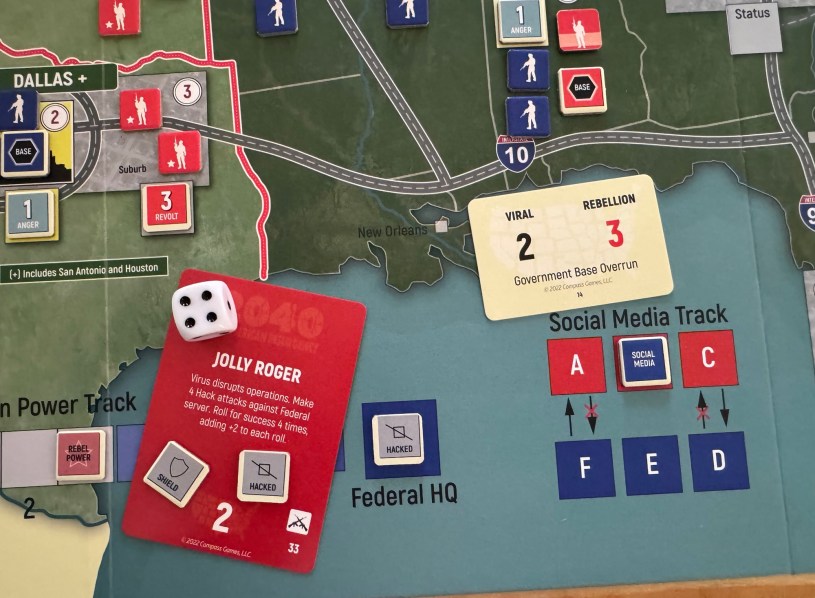
Card #26: Jolly Roger from 2040: An American Insurgency from Compass Games
2040: An American Insurgency is a card driven game that attempts to simulate a near future US civil war in the 21st century. In this 2-player game that plays in less than 3 hours, the blue team is the Federals representing agents of the government in Washington. The red team are the Rebels including militia groups trying to seize control of states, highways, and cities. The conflict spreads across the entire continental US, from Miami to Seattle and from Los Angeles to New York.
This game is not perfect and it has some issues and the graphics are not that great frankly. As I played the game, I actually felt like it was a pretty decent game, with some very interesting mechanics covering an interesting topic. I know it isn’t perfect and in some ways the designer was so careful not to offend anyone in the game that he really didn’t get to say anything about the situation and its causes, and the game somewhat suffers from that. But it was interesting and I believe that we are about the only ones who played the game.
In this post, I want to focus on the Jolly Roger card which is a Rebel aligned event.
As the Rebels, who do not have the number of troops as the Federals do and must rely on various cagey and clandestine activities to ensure their goals are met during the game. The Rebels are also concerned about the status of their Rebellion Power Track. The Rebellion Power Track is used to determine the Rebellion Power Factor during the Rebel’s Internet Operations, which include things like hacking in order to gain intelligence (information about upcoming cards), take funds, interrupt the operation of Headquarters and or take out your opponents hack attempts before they can get to your information. Hacking is a minigame that can dramatically affect the power of enemy operations, especially for the Rebel. In intelligence and theft hacks, the presence of enemies on the server remains hidden. With a Denial of Service attack, the influence of enemies on your network is apparent and everyone knows your system has been compromised. This has a persistent negative effect on the system’s perceived security and therefore its effectiveness. The Rebellion Power Factor can be 0 to 4 and the higher the better. Certain cards and Operations can shift the Rebellion Power Track and these effects will be indicated by placing markers near the track. The status of the Rebellion Power Track should always be discoverable as the sum of Rebellion Factors on active news stories, plus the marked effects of operations and cards.
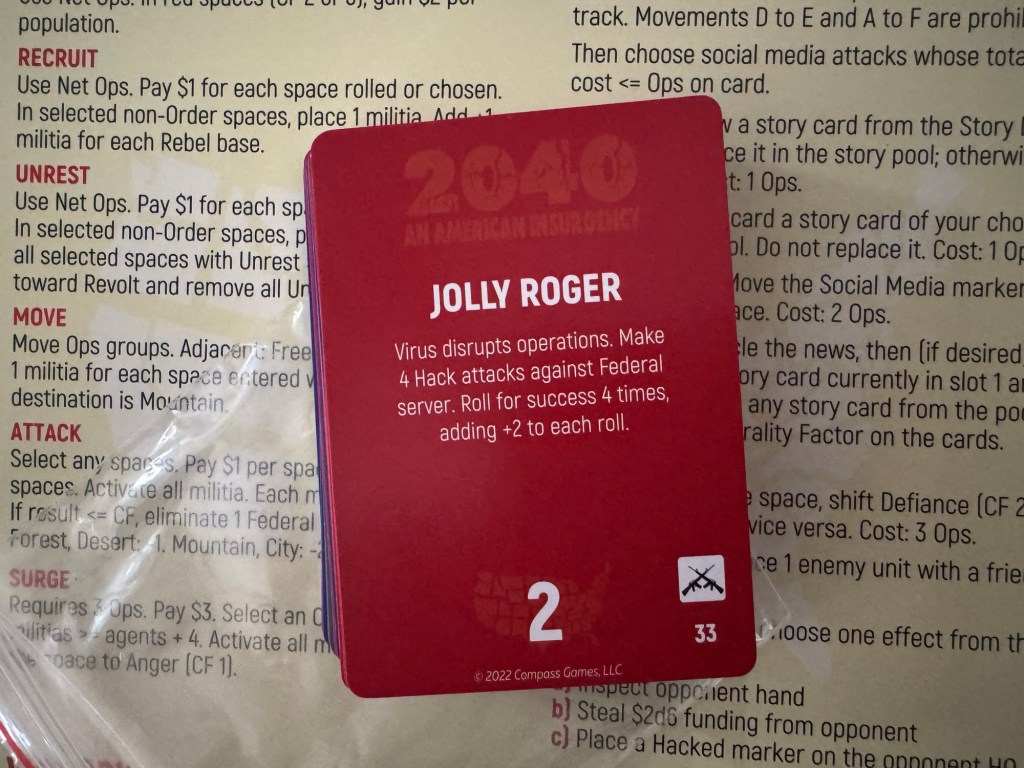
The more Hack Operations that the Rebel player can execute the better as they will gain more benefit and provide themselves with the capital and information they need to win the game. The Jolly Rodger card is a card that gives the Rebel player 4 Hack Attempts and these attempts are made at +2 DRM. A Hack Operation is pretty simple as the players will simply roll the D6 and add the Ops Value of the card as a modifier. If the result is 5 or greater, the hacking attempt succeeds and the successful Hack will allow the player to choose one effect from the following list:
a) Intelligence: Inspect the opponent’s hand of cards.
b) Theft: Roll the D6 die twice. Reduce your opponent’s Resources by that amount. Increase your Resources by the same amount. Resources may not exceed $30 nor fall below $0.
c) Denial of Service (DOS): Place a Hacked marker on the opponent HQ square. As long as there is a Hacked marker on an HQ, the Rebellion Power marker is located one space, left or right, from the space designated by the News Cycle. If the hack is on the Federal server, the Rebellion Power marker is placed one space to the left; if the hack is on the Rebel server, the marker is placed one space to the right. If there are multiple hacks on a server, the marker is shifted by that number of spaces. Hacks on both servers cancel each other out; first subtract one from the other, then apply the net effect. The correct space for the Rebellion Power marker can always be determined by adding the Rebellion Factors of the current stories in the News Cycle, then shifting the marker left or right according to the hacks on each server.
d) Restore Service: Remove a Hacked marker from your own HQ. If you are the Rebel, shift the Rebellion Power marker one space to the left (if possible). If you are the Federal, shift it one space to the right (if possible).
e) Secure: Place one Shield on your HQ. The benefit is that if your HQ has a Shield, your opponent may only choose actions (d), (e), or (f) when hacking your server. Your server is protected against hack actions (a), (b), and (c).
f) Invade: Remove one Shield from your opponent’s HQ.
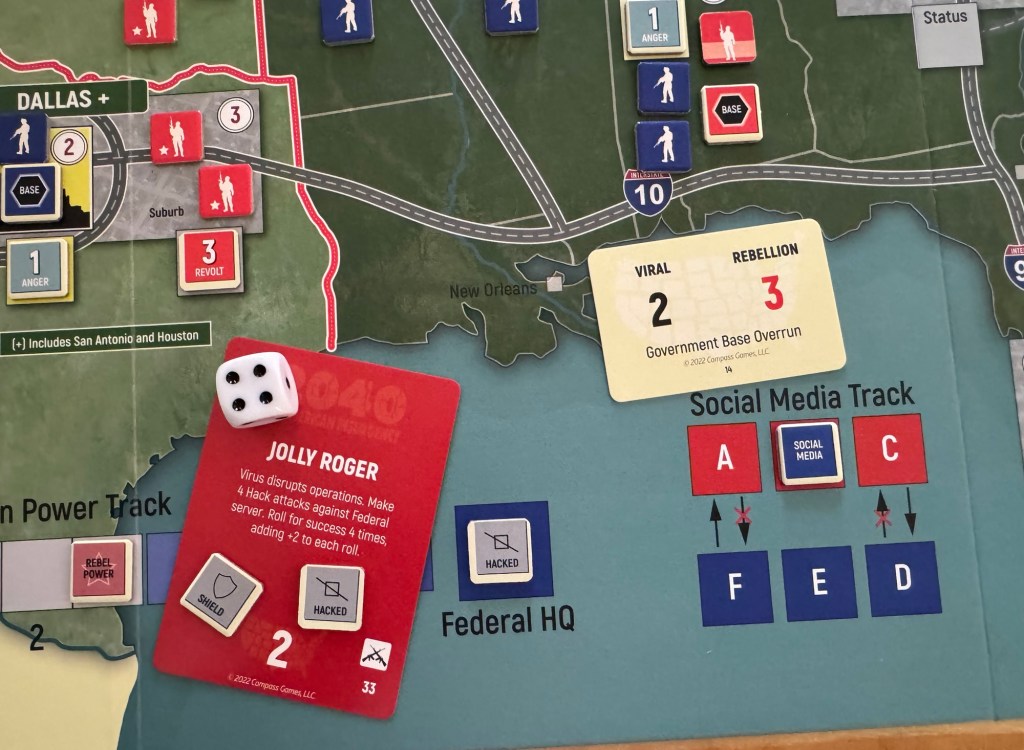
I very much liked this mini-game within the game as it created some interesting opportunities and challenges for both players. Cards such as Jolly Rodger, that give you more opportunities than you could normally do during your turn, and that allow you to do those for no cost with positive modifiers, are pretty rare and when this card comes up for the Rebels, they should really consider using it unless there are other more important things that need to be accomplished with it. If it comes up in the Federals hand, they will want to use it as a Social Media Operation in order to burn it and keep the event from happening.
The best part of the game was the way that players could manipulate the Social Media Track to provide them with different bonuses and advantages. I will be honest though that this track felt a bit underwhelming and sort of half-baked but it was very interesting nonetheless. I actually think the game did what it set out to do, making a playable card driven game on a subject that no one wants to think about or see happen, but that can be explored and experienced. I also really liked the mechanics of what it was that I was trying to do and it seemed to work well. Not anything that you want to look at though as the graphics are very basic, which was a major missed opportunity.
As I am sure that you all know, the Jolly Roger is the traditional English name for the ensign flown to identify a pirate ship preceding or during an attack, during the early 18th century and the Golden Age of Piracy. The vast majority of such flags flew the motif of a human skull, or “Death’s Head”, often accompanied by other elements, on a black field, sometimes called the “Death’s Head flag” or just the “black flag”. The flag most commonly identified as the Jolly Roger today – the skull and crossbones symbol on a black flag – was used during the 1710’s by a number of pirate captains, including Black Sam Bellamy, Edward England, and John Taylor. It became the most commonly used pirate flag during the 1720’s, although other designs were also in use.
So why is this term used in this game? Well, the easy connection here is that the Hacking Operations are an attempt at the piracy of information. Hacking operations in warfare, or cyberwarfare, involve using cyberattacks to disrupt or damage an adversary’s systems, infrastructure, or information, often for the purposes of espionage, sabotage, or propaganda. This game uses this in its core mechanics and ties them to the Social Media Track which is a form of propaganda used in modern political settings. I really liked the naming of this card and after we played was very pleased with this card and its use of the Jolly Roger concept to convey the piracy of the 21st century!
Here is a link to our unboxing video showing the components:
Here also is a link to our full video review:
I also posted an interview with the designer Edward Castronova on the blog and you can read that at the following link: https://theplayersaid.com/2023/04/04/interview-with-edward-castronova-designer-of-2040-an-american-insurgency-from-compass-games-currently-on-kickstarter/
In the next entry in this series, we will take a look at GOSPLAN Advisers from Twilight Struggle: Red Sea – Conflict in the Horn of Africa from GMT Games.
-Grant
 The Players' Aid
It is a very interesting design and has some neat mechanics.
However, I agree that it suffers from the same problem with the “Civil War” film, in ignoring how the war starts – given the cause of a war typically has a huge impact on the conduct of the war, and strategic aims and objectives.
But I do get that in order to expolore the origins of a civil war in mordern day USA, you would have to make some political assumptions – and given the charged atmosphere, I can see why both this designer and the film director, avoided wading into that!
What I think the game does get right is that it assumes a civil war would be a mass insurgency, rather than a civil war between rival armies.I don’t see how the latter is possible given the complexity of defence supply chains, nor the ability for either side to establish an economic base in the way that was possible in the 1860’s. I guess a mass insurgency (of the type depicted in this game) is a possibility. Albeit unlikely. Hopefully!!!
LikeLiked by 1 person
Thanks for your thoughts. I agree on many of your points but is hard to imagine what would bring us to war or what that would look like. I think you are correct about the insurgency part.
LikeLiked by 1 person