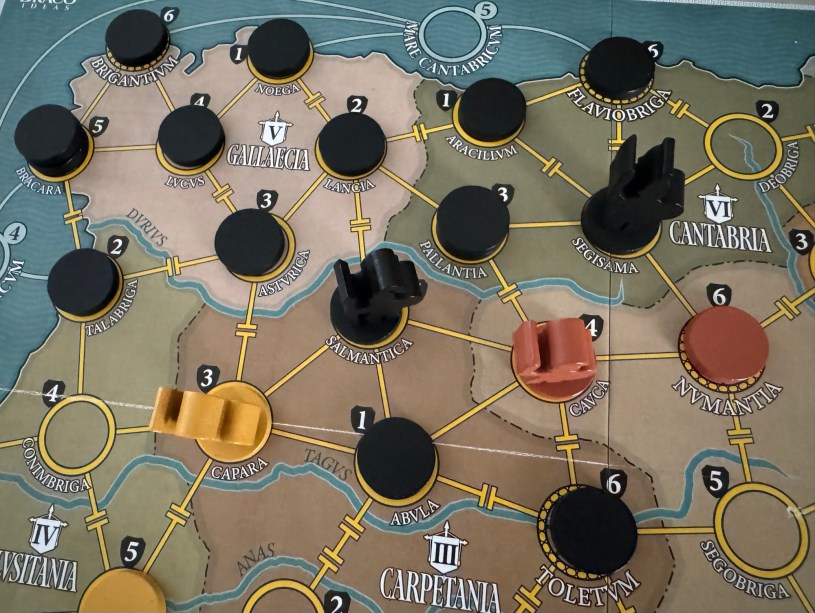
HISPANIA from Draco Ideas is a slick little small box game with a big punch that sees the player controlling the Roman Empire and attempting to subjugate and put down resistance in the provinces of Hispania from 198 to 18BC. The game is extremely flexible and may be played cooperatively by 2-3 players, competitively with 4 players or as a solo game. The game is somewhat of a resource management game as the players must use their limited funds in the form of Denarii wisely to attack and put down revolts springing up around the country as local armies rally support for the resistance to Roman rule.
In Action Point 1, we took a look at the Board, discussing the point to point movement and various terrain features that make moving Legions about the Iberian Peninsula rather difficult. In Action Point 2, we covered the Roman Phase and the various actions available including Move, Garrison, Besiege and Attack. In this Action Point, we will take a look at the Hispanic Phase and how the locals spread Revolt and move Armies around the board.
Hispanic Phase
The main focus of the Hispanic Phase is the spreading of Hispanic threats on the Board through the placing of Revolt markers and the moving of the Hispanic armies. This is accomplished in a very simple manner as the player will roll the white Roman Die and the black Hispanic Die together. Remember that the Roman Die consists of Roman numerals from 1 (I) to 6 (VI) that correspond to the various Provinces on the Board while the black Hispanic Die has simple numerals from 1-6 which refer to the cities within each of the Provinces.
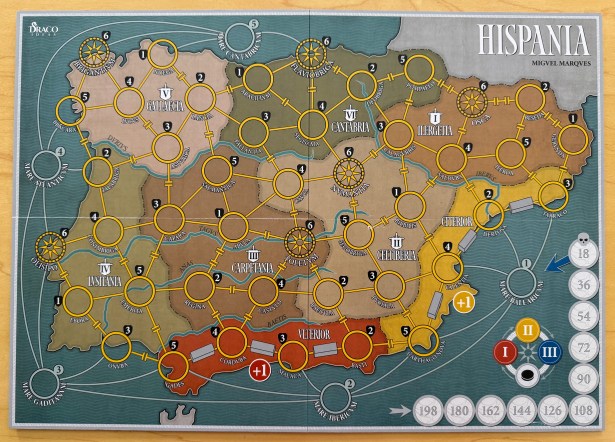
Each of the Provinces shows a Roman numeral in the middle of a white banner, which is used to determine the locations for random Hispanic Revolts at the end of each player turn or a total of 3 times per game turn. Ulergetia is number I, Celtiberia is number II, Carpetania is number III, Lusitania is number IV, Gallaecia is number V and Cantabria is number VI. These Provinces are further delineated by 1 of 6 cities in each whose number can be found in the black shield icon above their circle. Although these Provinces in Hispania did not have formal capitals at the time, the game calls the most important city of each Province the “capital”. These capitals are always denoted by a 6 in the black shield icon.
So the first step in the Hispanic Phase is to roll the dice and check the status and content of the identified city in the Province. If there is a Roman Praetor or a Garrison disc present in the rolled city, then nothing will happen as the space is protected. This represents the protective power of a stationed Roman Garrison in the area, which would have pacified the local populace and kept them from revolting. If the city is empty, then the player will grab a Revolt disc from the Reserve and place it in the space.
But now is when it will get interesting and some additional bad stuff can and will happen! If the rolled city already contains any number of Revolt discs, if there happens to be a Hispanic Army piece left in the Reserve and there is not already an army located in that Province, the player will have to place an Army on the Revolt. If that is not the case, meaning there is already an Army present in the Province or there are no more Armies left in the Reserve, the player will place another Revolt disc on it up to the limit of 3 discs. If you cannot place the Revolt disc, meaning that either there are no Armies or there are already 3 Revolt discs, then nothing will happen. This mechanic and part of the Hispanic Phase is set up to continually bombard the player with fires that they have to stomp out. This will continue at the end of each player turn and will happen 3 times per Game Turn. If the players don’t stay up with keeping the Revolts in check by removing them or by placing Garrison discs out, then they will find that the Reserve will exhaust itself and this leads to an automatic loss.
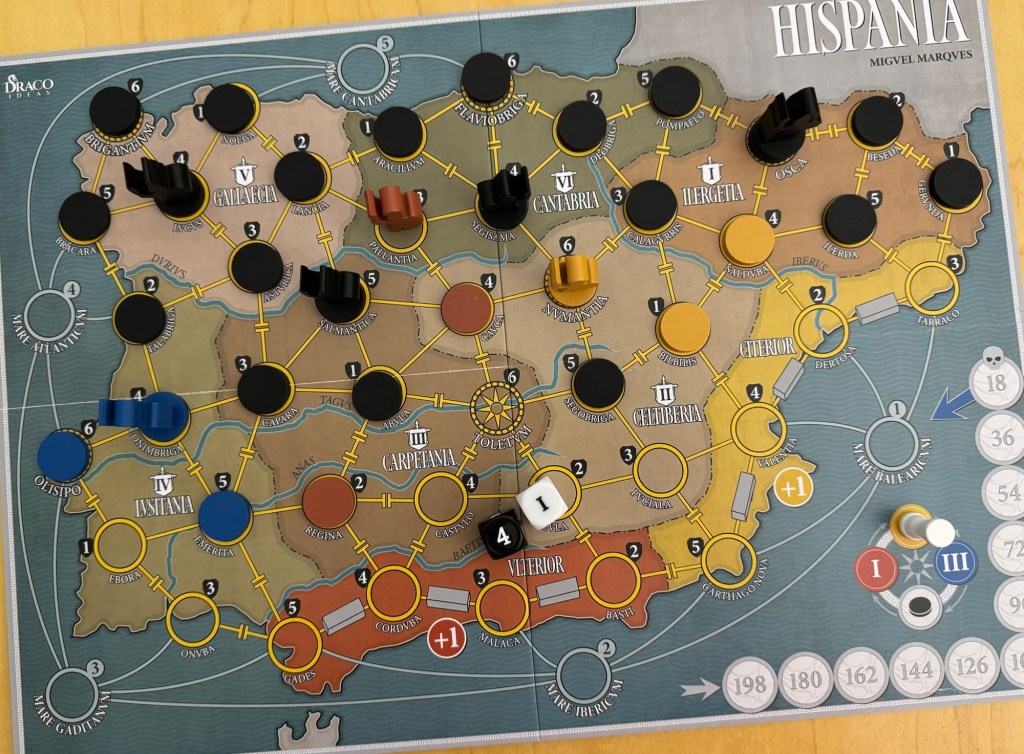
The final step of the Hispanic Phase is the movement of the Armies on the board. Each of the armies on the board, by increasing order of province from I to VI, will now attempt to move towards one of the connected cities in their Province. There is a priority about how they will move and while not complicated it will take some focus to accomplish this correctly. If there is only one connected city, then the choice is easy as the Army will try to move to that connected city. But, if there are several adjacent connected cities that the Army could move to, then the Army will give priority to those without any Revolt discs. And, if among the connected cities there are several alternatives (because they all have revolt or because more than one does not), the Army will choose to which of them it will try to move by rolling the black Hispanic Die and it will move to the alternative with the shield value closest to the rolled result. If by chance, the result is equidistant from 2 alternatives, the Army does not move.
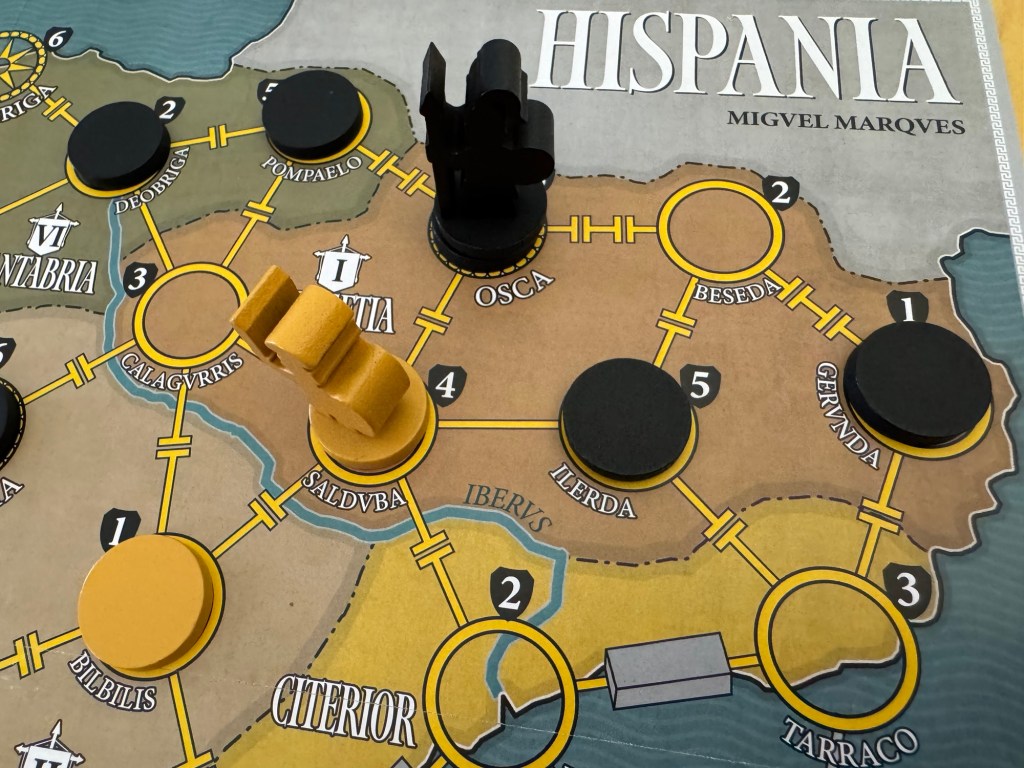
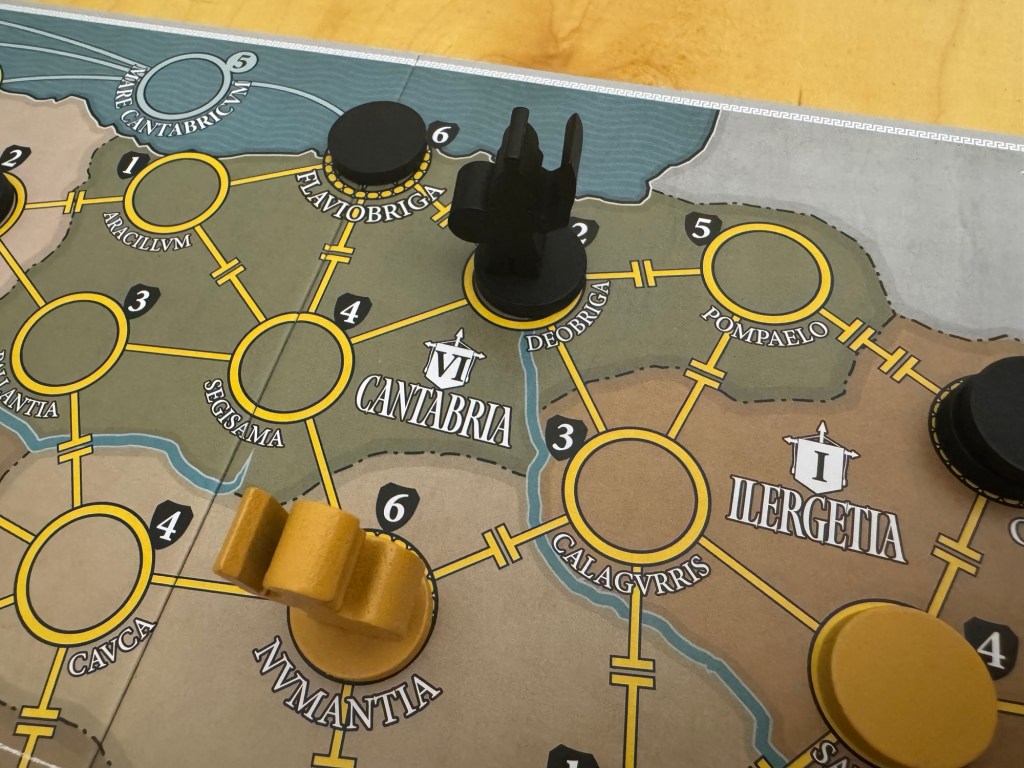
Let’s take a look at an example. In the picture below, the Hispanic Army is located in the city of Deobriga in the Cantabria Province. It is now the tine of the Hispanic Phase where the Army will review its options for movement and follow its priorities. As you look at the picture, you will notice that there are 3 cities connected to the Hispanic Army that are eligible for movement to including Pompaelo, Segisama and Calagarris. Remember, that the Hispanic Army will move first to cities that have no Revolt Discs. Therefore as Flaviobriga already contains a Revolt disc, it is not eligible to be moved into. Also, as you consider the 3 options, you have to remember that the Hispanic Army will not move outside of the Province that it started in until all of their spaces are filled with Revolt discs.. Because of this fact, this makes Calagarris ineligible. Therefore, we have a choice between 2 cities to move the Army to.
Because there are 2 choices, we must roll the black Hispanic Die. We roll a 2 and then must compare this number to the Shield Value of the 2 cities. In this case, Pompaelo has a Shield Value of 5 and Segisama has a Shield Value of 4. We compare the die roll of 2 to the Shield Values of both cities and whichever is closer to the rolled number is the choice for the Army to move to. In this case, 4 is closer to 2 than 5 is so the Hispanic Army will choose to move to Segisama.
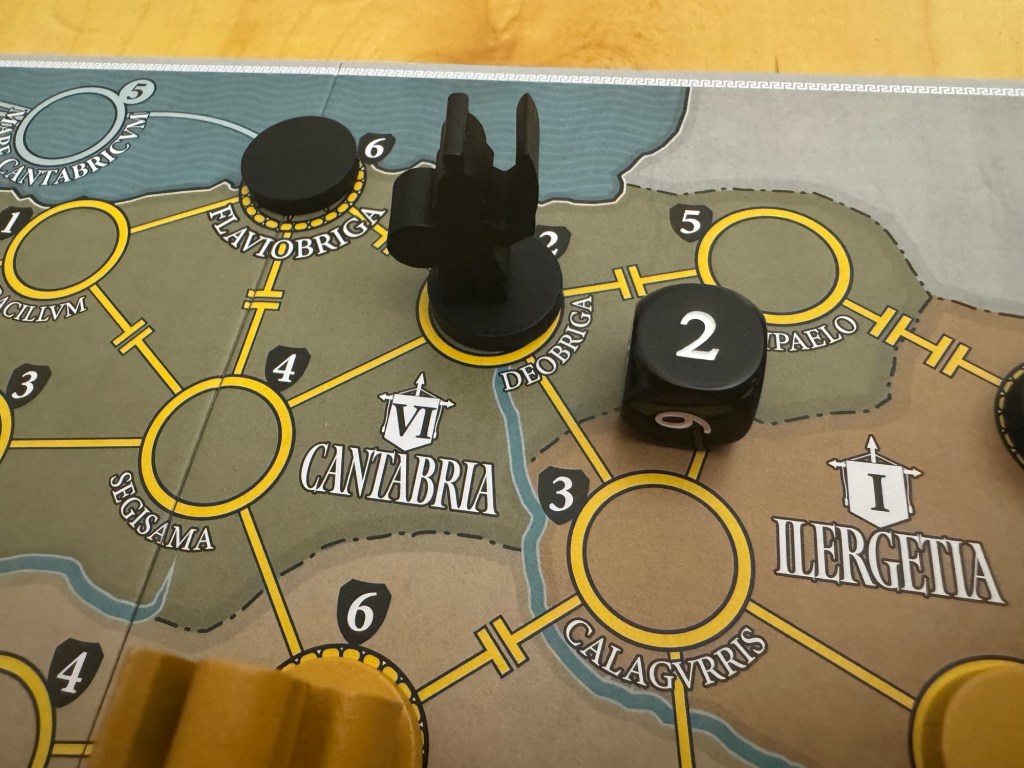
The Hispanic Army moves to Segisama and when it moves in it will drop a Revolt disc from the Reserve into the space. That is it. This really is a pretty simple process but does require a bit of work as you have to quickly look and compare values.
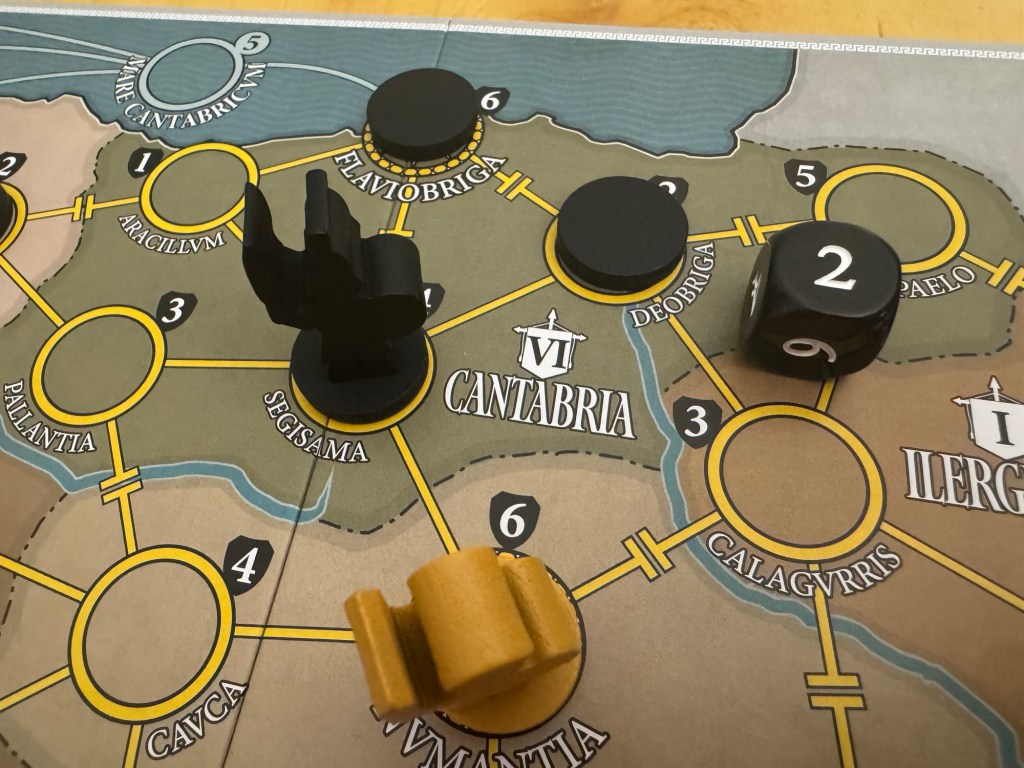
The final aspect about this Hispanic movement is that if the move would take them into a space that is occupied by a Roman Preator, then this will lead to an Attack. This Attack is the same process as the Attack Action from the Roman Phase and is very dangerous for the players. If they lose the battle, their Preator will be killed and will be removed from the board until the start of their next turn. This means that they cannot do as much as they would normally and the marauding Hispanic Armies are out to punish the Romans for their incursion.
I really do enjoy these games that model this type of resistance and pacification from Ancient times. No matter how large, no matter how many soldiers and no matter how ruthless an occupying conquering empire is they will have a difficult time pacifying the local populace. And similar to a wildfire, winds will cause that fire to spread from one city to the next until the entire Hispanic countryside is aflame with the burning spirit of revolt.
And the simplicity of this Hispanic Phase really fits the game as it is not overly deep and can be played easily but has some significant choices and processes that must be followed.
If you are interested, you can check out our interview with the designer Miguel Marqués on the blog at the following link: https://theplayersaid.com/2024/04/12/interview-with-miguel-marques-designer-of-hispania-from-draco-ideas-coming-to-gamefound-soon/
In Action Point 4, we will discuss the way to acquire a Roman Victory.
-Grant
 The Players' Aid