
Neva Wargames is a new publisher who has appeared on the scene as of 2024 and have several games they are working on. When I started seeing their posts on Twitter and Facebook, I was immediately impressed with their interesting topic choices for their upcoming games as well as the fact that they are trying to make small footprint wargames that pack a punch. And the art is also very appealing and brings an aesthetically pleasing and attractive look to their games!
Currently, they have 7 different titles in design and development and are preparing their first game called Sea & Steel: Columbus’ Voyages for a pre-order in February. They will be using their own pre-order system called Incoming! where you will book the game and not be charged unless and until the game reaches its 500 copy goal.
With that in mind, we reached out to the designer of the game Antonio Vaquera to see if he was interested in sharing some more information about the game and he was delighted.
Grant: Antonio welcome to our blog. First off please tell us a little about yourself. What are your hobbies? What’s your day job?
Antonio: Hello everyone! I’d like to express my sincere gratitude for the kind invitation to contribute to this blog.
I am a 54-year-old professor of Financial Law at the University of León in northern Spain, a position I’ve held for the past 30 years. However, my lifelong passion and hobby has been history, particularly its simulation through games.
Beyond wargaming, which I’ve enjoyed since the age of 12, my interests include reading, cycling (both watching and participating), chess, and traveling with my family. I am married, have three children, and a dog.
Grant: What motivated you to break into game design? What have you enjoyed most about the experience thus far?
Antonio: My passion for wargame design began early on, even as a 12-year-old, when I started modifying the rules of the games I played. I was fascinated by history, devouring historical films and documentaries and then attempting to recreate those events on the tabletop. While I was familiar with Risk, I found it too simplistic.

One of my earliest creations was a game about the Roman Empire, followed by one simulating a cycling season. Since then, I’ve continuously explored game design. However, The 98 Disaster: Guerra Hispano Americana, a game about the Spanish-American Wars in Cuba and the Philippines at the end of the 19th century, marks my first professionally published work, released in English and Japanese by Bonsai Games in 2024.
I find game design incredibly rewarding. It allows me to represent historical events, explore alternative outcomes, and grapple with the challenges faced by historical figures. The subject of Columbus’s voyages to the New World has always captivated me. As a child, visiting the coasts of Huelva and Cadiz and gazing out at the Atlantic Ocean, I would often imagine the shores of America on the other side.

Grant: What is your new upcoming game Sea & Steel about?
Antonio: Sea & Steel: Columbus’ Voyages deals with the arrival of the Spanish to the Caribbean Islands from 1492 to 1505. During that time, apart from other exploration trips to other places in the New World, 4 voyages were carried out by Christopher Columbus who thought he had reached the Indies, that is, China and present-day India.
The game simulates the confrontation (and the fraternization) between two cultures: the European and the indigenous, with their difficulties and conflicts.
Grant: What must a game about Columbus’s voyages to the New World include and model?
Antonio: The main thing that a game about Columbus’s voyages should include is the decisions and difficulties that both sides faced, because unfortunately, from the beginning it was very difficult to coexist without causing problems and fighting.
The indigenous side has to be represented by two factions, the Taínos and the Caribs, who also used to be at odds with each other and who try to prevent the Spanish from displacing them from their habitat.
As for the Spanish side, their settlement in the Caribbean Islands must be simulated, discovering as much wealth as possible (represented above all in the gold found) and initiating an incipient colonization of the areas.
The internal conflicts between the Spanish must also be simulated, through the possibility of rebellion by some Spanish captains and some random events, such as earthquakes or eclipses, as historically occurred at that time and in that place.
Grant: What sources did you consult for the historical details? What one must read source would you recommend?

Antonio: My research has drawn upon a combination of contemporary historical scholarship on the Columbian period, the Age of Discovery, and Pre-Columbian cultures. I’ve also consulted primary sources, such as the Chronicles of López de Gómara and the Diaries of Columbus compiled by Bartolomé de las Casas.
Geographical works have been instrumental in designing the game board, while navigational charts have informed the placement of marine currents, enabling realistic movement between islands for the indigenous side.
For further reading, I highly recommend the Diaries of Columbus or a concise summary. These primary sources offer the most authentic account of the encounter between civilizations, providing valuable insights into the challenges of 15th-century navigation and the customs of the time.
Grant: Are you concerned about the game being seen negatively as a colonization game? How have you dealt with this subject?
Antonio: My intention was to create a game, not a series of theoretical or philosophical arguments. While we must acknowledge that many of the actions of that era are now considered unacceptable, it’s crucial to remember that this is a historical simulation, not a political commentary or a moral judgment.
This game does not glorify colonization. It simulates the conflict that arose, not the construction of civilizations or the subjugation of indigenous peoples. Respect for all peoples mentioned in the game is paramount.
This is simply a game based on a historical period. It aims to entertain, amuse, and provide insights into the voyages of Columbus. Contemporary political opinions and current events should not influence or detract from the game’s core purpose.
Grant: What is the scale of the game? Force structure of the units?
Antonio: The game operates at a strategic level, focusing on the major decisions made by indigenous Chieftains and Columbus.
Units represent armed groups, with Spanish units comprising approximately 100 people and indigenous units consisting of roughly 1,000 individuals.
Furthermore, the game differentiates between unit types: each indigenous faction (Taíno and Carib) has two unique unit types, while the Spanish side just distinguishes between soldiers and settlers.
Grant: What is the anatomy of the counters?
Antonio: Game pieces feature a representative figure (a Taíno, Caribbean, Spanish soldier, or settler) and two numerical combat factors: one for attack and one for defense.
Movement is uniform for all units. Each piece has two states: full strength and reduced strength. In the reduced state, a single combat factor is used for both attack and defense.
Leader pieces, such as those representing Columbus or Caonabó, also possess unique combat factors.

Grant: What is the layout of the board?
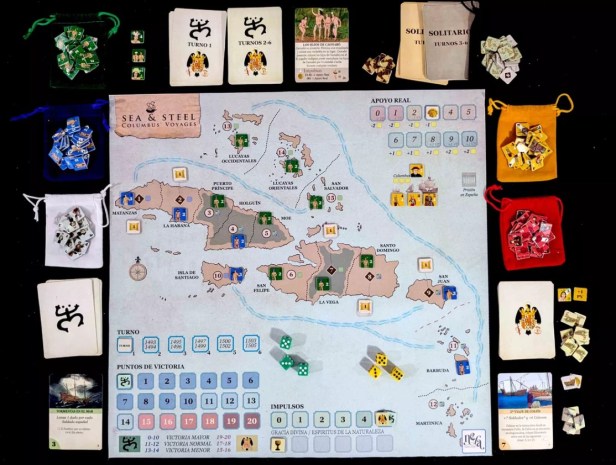
Antonio: The game board depicts the main Caribbean Islands, the primary focus of Columbus’s voyages. Marine currents connecting these islands are also indicated. The board perimeter features registers for tracking Turns, Victory Points, Royal Support, Impulses, and Yaya-Divine Grace.

Grant: What are the 15 distinct Caribbean land zones?
Antonio: The game board is divided into regions representing the major Caribbean islands of the era:
-Cuba (divided into 5 areas)
-La Española (divided into 3 areas)
-Puerto Rico (1 area)
-Jamaica (1 area)
-Lucayan Islands (3 areas)
-Lesser Antilles (2 areas)
All islands are depicted using their 15th-century names.

Grant: How did you decide to break these up?
Antonio: The board’s areas are designed to reflect the diverse sizes and geographies of the islands. Larger islands like Cuba and La Española are divided into multiple zones, while smaller islands have fewer. This approach, resulting in a total of 15 zones, ensures both a quick game pace and efficient Victory Point tracking while maintaining a strategically manageable board size.
Grant: How does the game incorporate historical events and challenges, such as the construction of palisades, gold mining, and the maintenance of Spanish ships?
Antonio: The game features two types of cards: Destiny Cards and Event Cards.
Destiny Cards: Drawn once per turn, these cards represent unpredictable events beyond player control, such as earthquakes, eclipses, or the potential presence of historical figures like Guacanagarí or Anacaona.
Event Cards: Divided into 8 cards for each side, these offer players more strategic choices.
The Spanish side can construct palisades through an action during their impulses, provided they are in controlled areas that are not jungle areas.
Gold extraction is simulated through dice rolls after the Spanish conquer an area. Successful rolls trigger gold discovery, impacting “Royal Support” (funding from the Spanish Crown). Higher Royal Support grants more units and potentially more Victory Points at the end of the game.
Destiny Cards may include naval difficulties, forcing the reduction of Spanish colonist units to maintain seaworthiness. This simulates the historical challenges of ship repair (“caulking”).
Grant: Can you show us a few examples of the cards and explain their use and effect?
Antonio: I will provide four examples: two Indigenous Events, one Spanish Event, and a Destiny Card. These pictures show the text in Spanish but there will be English versions in the game.

Indigenous Event: Roldán’s Rebellion (La Rebelión De Roldán): This card allows the player to place a variable number of rebel counters (allied with the Indigenous) within a Spanish-controlled area, triggering a combat encounter.

Indigenous Event: Caonabó’s Attack (El Ataque De Caonabó): This card allows the player to place 1 Taíno unit, 4 Carib units, and the Caonabó Leader piece within a Spanish-controlled area, initiating an attack.

Spanish Event: Francisco de Bobadilla: This card introduces a new Governor, bringing four soldiers and three settlers. However, it also depicts Columbus’ imprisonment in Spain by order of the Kings.

Destiny Card: Princess Anacaona (La Princesa Ananaona): This card randomly places Princess Anacaona within a zone on the Hispaniola Island. If this zone is not under Spanish control at the end of the game, the Spanish player loses 1 Victory Point.
Furthermore, the Destiny Card indicates four key aspects:
*Impulses: Each side receives 5 impulses to activate their units during their turn.
* Gold Search: A successful Gold Search requires a die roll result between 1 and 3.
*Naval Difficulties: Not present for this turn (ship under maintenance icon not shown).
*Indigenous Conflict: Not present for this turn (The indigenous crown icon not shown)
Grant: What resources must players manage in the game?
Antonio: Players begin the game with five Event Cards, selecting one to play each turn. Strategic card selection is crucial. Each Event Card has a value that is compared to the opponent’s card. The player with the lower value receives replacement points to acquire new units.
New units are randomly drawn from a pool, offering variations within each type: Taíno, Carib, Soldier, or Settler.
Players must carefully manage the activation of their units during each impulse, utilizing actions like attacking, ambushing, or controlling areas.
The Spanish player has additional strategic options: constructing palisades and citadels, and strategically managing gold searches to gain Victory Points and recruit more soldiers.
Grant: What are the two distinct modes in the game? How do they differentiate?
Antonio: The game offers two modes: 2-player and Solitaire. The Solitaire mode includes two difficulty levels, providing a challenging experience against an AI opponent controlling the indigenous side.
Grant: What is the Solitaire Mode like?
Antonio: Solitaire mode incorporates a series of special Solitaire Cards that introduce unexpected advantages and challenges for the player, simulating a more realistic and unpredictable opponent. The game includes a set of instructions and priorities to guide the player through the AI’s actions.

Grant: How does the AI make its decisions and prioritize them?
Antonio: The AI selects its Event Card after drawing two random Indigenous Event Cards and evaluates them based on the provided instructions and priorities. This approach ensures the most advantageous outcome for the AI while maintaining an element of surprise.
For unit collection, the AI prioritizes its own zones, followed by uncontrolled zones, and lastly, Spanish-controlled zones.
The AI utilizes a chit-pull method to determine actions. A token representing a zone on the board is randomly drawn. Based on zone control and the presence of indigenous units in adjacent zones, the AI prioritizes actions such as attacking, raiding, moving, or redrawing another zone token.
Grant: What type of solitaire experience does it create?
Antonio: The solo game presents a significant challenge for the Spanish player, with victory proving elusive in many cases. Game testing has shown that the AI wins approximately 70-80% of games.
Grant: How does combat work in the design?
Antonio: Combat is designed to be simple yet challenging. A maximum of three units from each side may attack opposing units in a given area. Each unit rolls a die. If the result is less than or equal to the unit’s combat factor (determined by its role as attacker or defender), it inflicts a loss on an opposing unit.
If units from both sides remain in an area after a combat round, players may choose to retreat to an adjacent area or engage in another combat round. Only units from one side can occupy an area at the end of an impulse or activation.
Alternatively, players can perform an “ambush” or “raid” action. This allows units to attack an adjacent area without physically moving. A single die roll determines the outcome: successful attacks eliminate an opposing piece, while unsuccessful attempts result in a loss for the attacking unit.
Grant: How is victory obtained?
Antonio: Victory is determined by the Spanish player’s ability to accumulate a specific number of Victory Points (typically 15). Points are earned through:
-Zone Control: Controlling zones on the board (with varying point values).
-Royal Support: Maintaining a high level of Royal Support.
-Citadel Construction: Building Citadels in controlled areas.
-Special Events: Triggering specific events, such as Columbus’ Will (if he dies) or the appearance of Princess Anacaona.
If the Spanish player fails to reach the required number of Victory Points, the indigenous player wins. Ties are not possible.
Grant: What are some basic strategies of both sides?
Antonio: The indigenous side excels in defensive strategies, employing “ambushes” and “raids” to weaken Spanish citadels and units. They benefit from a combat advantage in jungle or dense forest areas. Key indigenous strengths include:
Rebel Tokens: Offer improved combat factors and naval movement capabilities.
Leaders like Caonabó: Enable superior attacks against the Spanish.
Conversely, the Spanish side must expand rapidly due to their initial disadvantage in Victory Points and territory control. They are driven by the need to secure Royal Support through gold acquisition and the imperative to construct at least one Citadel to avoid a Victory Point penalty. This necessitates an aggressive approach, leveraging their superior troop strength and combat factors.
Grant: Who is the artist? How has their style assisted in telling this history?
Antonio: This project has been brought to life by the talented team of German Pasto (Illustrator) and David Prieto (Graphic Designer). Their combined skills have resulted in a visually stunning game. I am confident that, with Neva Wargames’ production quality, this game will become a highly collectible piece that wargame enthusiast would be proud to own.
Grant: What type of experience does the game create?
Antonio: The game offers players the unique opportunity to step into the shoes of historical figures. They can assume the roles of Columbus, Caribbean island explorers, Taino or Carib Chieftains, or even Spanish rebels against the Crown.
The limited number of turns creates a constant sense of tension. Game testing has revealed that a significant majority (95%) of games are decided in the final turn, often during the last combat of the final impulse. This dynamic ensures a consistently engaging and emotionally charged decision-making process.
Grant: What are you most pleased with about the design?
Antonio: I particularly enjoyed the challenge of translating the epic of the “Discovery of America” and the stark contrast between European and indigenous civilizations onto a game board, utilizing cards and game pieces.
The combat system, incorporating raids and ambushes, and the abstracted representation of naval movement and gold exploration are innovative aspects of the design.
Grant: What has been the experience of your playtesters?
Antonio: Playtesters consistently highlight the game’s high replayability and unpredictability. Numerous games have witnessed remarkable comebacks, demonstrating the dynamic and ever-changing nature of the gameplay.
Furthermore, playtesters appreciate the game’s concise playtime, typically ranging from 60 to 90 minutes. This allows players to easily switch sides and enjoy multiple games within a single session, a valuable feature in today’s busy world.
Grant: What other designs are you mulling over?
Antonio: I am currently finalizing the design and testing of three new games:
-A solo game set during the 16th-century Spanish expeditions to the Americas, serving as a sequel to Sea & Steel as it begins where Columbus’s voyages conclude.
-A game exploring the history of the Near East in Antiquity, encompassing civilizations such as Sumeria, Akkad, Assyria, and the Greek world.
-A game focused on 19th and 20th-century conflicts in North Africa involving Spain and Moroccan populations.
And, of course, I have many more ideas brewing!
I would like to express my sincere gratitude to Neva Wargames Publishing House for this invitation and, most importantly, for making my dream of publishing a game about Columbus’s voyages a reality.

If you are interested in Sea & Steel: Columbus’ Voyages, you can back the project through the Incoming! Pre-Order program for €38 ($39.00 US Dollars) at the Neva Wargames website at the following link: https://nevawargames.com/pre-launch/
-Grant
 The Players' Aid
Oops you did it again. I read an interview and ordered the game. My bank account would like a word.
LikeLiked by 1 person
Hahahaha. Its called self control! Seriously this game looks interesting. Probably not as deep as it could be but definitely a unique and interesting look at the situation. How is Libertadores going?
LikeLike
Final copy of everything sent to Randy. He said in his BGG discussion that he’s been under the weather the last few months and behind schedule. We hope to hear something about it going to the publishers soon.
LikeLiked by 1 person
Nice. Looking forward to it. Hopefully in 2025!
LikeLike
Sounds like an innovative game on an interesting topic!
LikeLiked by 1 person
I couldn’t get the Comment thing to work….so I send it here:
Oh man…I’m with Matthew Shirley…these posts always end up w/ me buying something!
Great interview….looks like a fun game on a topic I’ve always been fascinated with. I read the “Diarios” book. I also recommend “The Four Voyages of Columbus” (Lawrence Bergreen) and “The Last Voyage of Columbus” (Martin Duggard).
Thanks, as always!
LikeLiked by 1 person
Agree. I need to check out on me of the books. Always interested in learning.
LikeLike
Great interview — backed both this and Iwo Jima.
Cheers!
LikeLiked by 1 person
Great account name.
LikeLiked by 2 people
Thanks!
I agree with you — every time (it seems) that Grant or Alexander post, I end up adding to my collection — they should get commissions!
LikeLiked by 1 person
Neva Wargames is bringing new interesting topics to the hobby. Antonio Vaquera is a new Spanish designer who have great designs. More to come !!
LikeLiked by 1 person