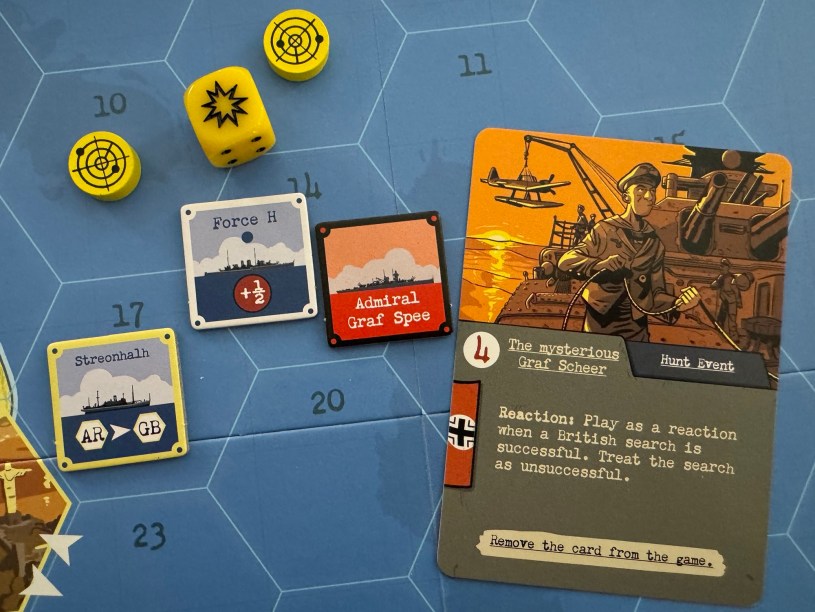
With this new My Favorite Wargame Cards Series, I hope to take a look at a specific card from the various wargames that I have played and share how it is used in the game. I am not a strategist and frankly I am not that good at games but I do understand how things should work and be used in games. With that being said, here is the next entry in this series.
Card #24: The Mysterious Graf Scheer from The Hunt from Salt & Pepper Games
I have played several hidden movement games over the years and enjoyed them all. Some of these titles have included wargames such as They Come Unseen from Osprey Games, Sniper Elite: The Board Game from Rebellion Unplugged and Bomber Command from GMT Games as well as a few board games including Hunt for the Ring from Ares Games. The concept of moving cautiously, attempting to evade pursuers, all while trying to locate and acquire or destroy objectives makes for a very interesting gaming experience. These situations can make for some really tense games that cause your head to ache and your wits to be tested. But they rely on some bluffing as well. Trying to force your opponent to anticipate where they think you should be and then trying not to be there. A really great mechanic in board games but not always easy to pull off and make for a very playable and interesting game. In 2022, we played a new design from Matthias Cramer and Engin Kunter that took this hidden movement concept and put it into a historically based game about the struggle over control of the South Atlantic between the British Royal Navy and the German Kriegsmarine during the early years of World War II called The Hunt from Salt & Pepper Games.
The Hunt is a Card Driven Game where the German player has to attempt to stay hidden while trying to sink merchant shipping as the Royal Navy hunts for them throughout the South Atlantic. The players each have asymmetric actions to use to accomplish their missions and each has a tough time doing what they have to do. But, if they manage their cards wisely, using them as effectively as possible, they can successfully either evade their pursuer or catch their prey.
In The Hunt, the German player is trying to hunt down shipping while staying hidden from the searching British. This situation is really a challenge for both players and creates some fantastic tension. With today’s card, The Mysterious Graf Scheer, we will take a look at one of the German’s hidden tricks. The British player can conduct a search in any space containing any of their Forces on the board for 1 Action Point. These Action Points come from the printed value shown on the cards and higher value cards are very important to both sides as they will allow the taking of several different actions on the turn they are played. One of those actions available to the British player is the Search and Attack Action, which is used to find the Graf Spee and send her to the bottom. When the Search and Attack Action is taken, the player will move to a space that they expect contains the hidden Graf Spee and then will get to roll the special 6-sided die. The Search will be successful with a die roll of 5+ and this can be modified by using the British Intelligence Action to play a card from their hand for the printed power located on the bottom of the card which normally gives a +1 for the Search Action. Each Force can only search once per turn so it is very important to make this count as you won’t get many of them in the game. A success will cause a Battle if the Admiral Graf Spee is located in the searched space.
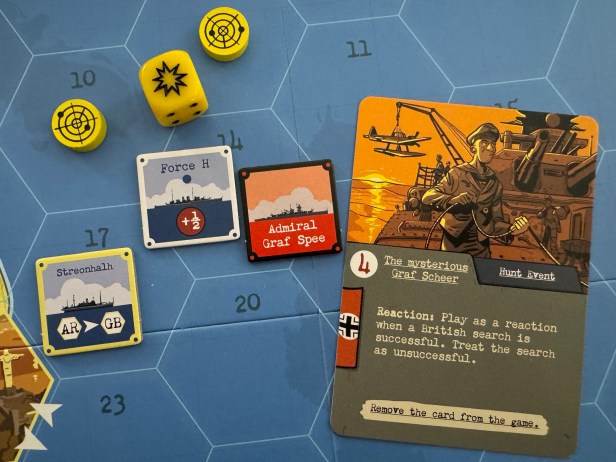
As you can see, this is not an easy proposition. Having to move and then roll a die hoping for a 5 or 6 is never guaranteed. But, when it does work and the British find the Graf Spee the game can come to a swift conclusion with a climactic battle. Here is where The Mysterious Graf Scheer card comes into play. The Mysterious Graf Scheer is a special Reaction Card, which means that it is one of the only type of cards that can be played during the other player’s turn. When the British player successfully searches for and locates the Graf Spee, this card is invaluable in allowing the quarry to slip away into the waves. I normally really dislike these type of cards as they ruin the efforts of the other side, and this process of Searching is never easy, but this card truly fits the historic reality of this situation as the Graf Spee was slippery and used lots of different tricks to evade location. This card though is a bit of an interesting historical addition as the Graf Scheer was dispatched into Norway to perform shipping raids but not into the South Atlantic where the Graf Spee was located. So why is this card included in this story? Well, I like to look at it as the Graf Scheer was drawing away resources and assets of the British Navy to Norway which could have been useful in searching for the Graf Spee. This watering down of the search capabilities of the Royal Navy would lead to just missing their prey often as they wouldn’t have backup or additional searchers allowing the large Deutschland-class Cruiser to escape.
But there was actually a single sortie by the Graf Scheer into the Atlantic in 1940. On the night of October 31st, she slipped through the Denmark Strait and broke into the open Atlantic. Her B-Dienst radio intercept equipment identified the convoy HX 84, sailing from Halifax, Nova Scotia. Admiral Scheer‘s Arado seaplane located the convoy on 5 November 1940. The armed merchant cruiser HMS Jervis Bay, the sole escort for the convoy, issued a report of the German raider and attempted to prevent her from attacking the convoy, which was ordered to scatter under cover of a smoke screen. Admiral Scheer‘s first salvo scored hits on Jervis Bay, disabling her wireless equipment and steering gear. Shells from her second salvo struck the bridge and killed her commander, Edward Fegen. Admiral Scheer sank Jervis Bay within 22 minutes, but the engagement delayed the German ship long enough for most of the convoy to escape. Admiral Scheer sank only five of the convoy’s 37 ships, though a sixth was sunk by the Luftwaffe following the convoy’s dispersal.
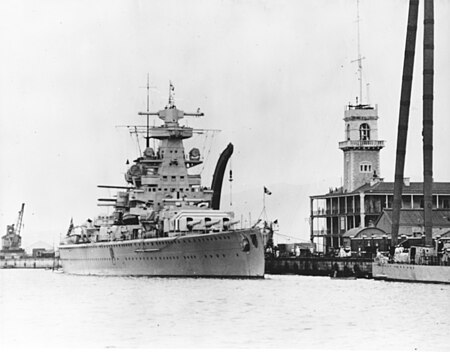
Admiral Scheer was a Deutschland-class heavy cruiser (often termed a pocket battleship) which served with the Kriegsmarine of Nazi Germany during World War II. The vessel was named after Admiral Reinhard Scheer, German commander during the Battle of Jutland. She was laid down at the Reichsmarinewerft shipyard in Wilhelmshaven in June 1931 and completed by November 1934. Originally classified as an armored ship (Panzerschiff) by the Reichsmarine, in February 1940 the Germans reclassified the remaining two ships of this class as heavy cruisers.
In the next entry in this series, we will take a look at Maximus Decimus Meridius from The Wars of Marcus Aurelius: Rome 170-180CE from Hollandspiele.
-Grant
 The Players' Aid