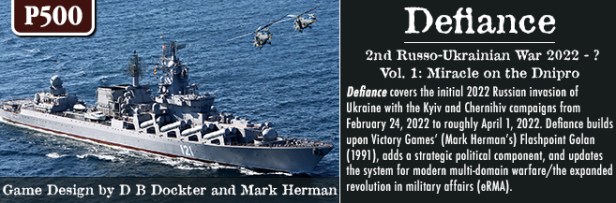
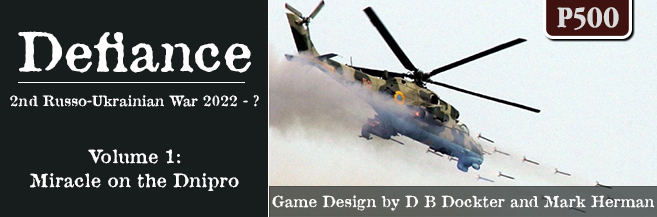
I know that many designers and publishers have a strict “no current ongoing war designs allowed” policy. I also understand that not all games are for all gamers and that is fine. With that being said, with the events in Ukraine over the past 2+ years, it is just a matter of time before we get several of these designs (this being the 2nd I am aware of with the other being 2022: Ukraine from Conflict Simulations Limited). The situation in Ukraine is a study in modern warfare and I for one am glad that this game is coming to light. Plus, Mark Herman is one of my favorite designers and I am excited to see what he can do with a modern war. Mark has partnered with DB Dockter to create a new study into this conflict called Defiance: 2nd Russo-Ukrainian War 2022-? from GMT Games. This game was announced in the December 2023 Monthly Update from GMT Games and I am very much interested in it. I have reached out to DB Dockter who is codesigner on the project and he was willing to share on the design.
If you are interested in 2nd Russo-Ukrainian War 2022-? Volume 1: Miracle on the Dnipro, you can pre-order a copy for $64.00 on the P500 game page at the following link: https://www.gmtgames.com/p-1087-defiance-2nd-russo-ukrainian-war-2022.aspx
*Please keep in mind that the artwork and layout of the various components shown in this interview are not yet finalized and are only for playtest purposes at this point. Also, as this game is still in development, rules and scenario details may still change prior to publication.
Grant: David welcome to our blog. First off please tell us a little about yourself. What are your hobbies? What’s your day job?
David: Hobbies: gaming, history, writing, traveling and what not. Day job: strategist and problem solver for entities in TMT (Telecom, Media, Tech) space in the more “challenging” international markets.
Grant: What motivated you to break into game design? What have you enjoyed most about the experience thus far?
David: I wanted to play a heavy game with lots of historical flavor regarding the Russian Civil War with my mates. I love Paths of Glory and Days of Decision; I thought a mix of both games might work as a vehicle. What did I enjoy most about the design experience? The engaging community that sprung up around my game; I’ve met some great people I otherwise would not have.
Grant: What designs have you had published in the past?
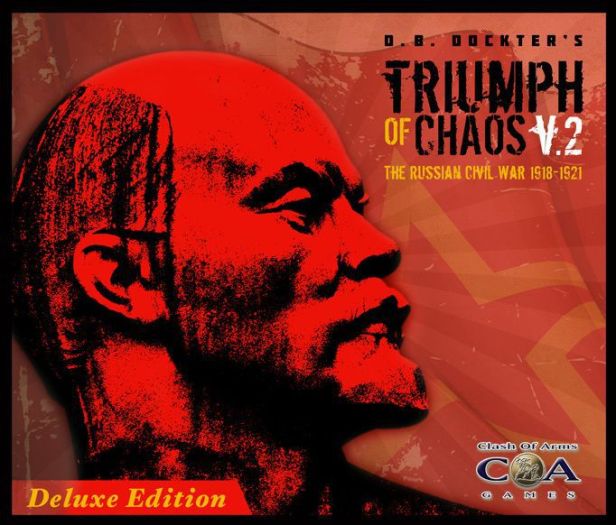
David: Triumph of Chaos: The Russian Civil War. I took three swipes at it: Triumph of Chaos v1 (2005), The Comrades Guide (2007) and Triumph of Chaos Deluxe: v2 (2019)
Grant: What is your upcoming game Defiance about?
David: Russia’s war of aggression on and attempted conquest of Ukraine. Volume 1 will only cover Russia’s initial 5 week 2022 attack on Kyiv and Chernihiv. We plan to offer subsequent volumes on other operational campaigns – assuming our game is well received.
Grant: How did you and your design partner Mark Herman work together? What roles did you each play?
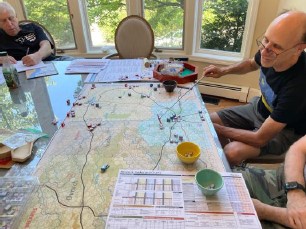
David: We’re very close friends. We met at WBC 2001…Mark was holding court at WBC – demo’ing a big game version of For the People. We hit it off in about 5 minutes. Mark is a Jedi Master level game designer. I am just a gamer. We’re both storytellers. We’ve taken Mark’s design, Flashpoint: Golan: The Fifth Arab-Israeli War from Victory Games, updated it to reflect operational warfare circa 2020’s and tossed on a political module (some Triumph of Chaos) to reflect the strategic context within which the operational war occurs.
I’ve been responsible for research regarding the conflict, updating the Flashpoint: Golan model, playtesting and spin. Mark reviews/modifies each update of the design and gives insight/game suggestions possible from an OG designer (SPI, Victory Games): he’s our guild master on Defiance. Bob Heinzman is our developer. 1st Minnesota provides the core playtesting teams. We’ve had strong collaboration across the “guild’.
How do we work together? Shouting, listening, badgering, collaborating, gaming, lots of eating and drinking; a productive relationship. Mark is one of the top three strategist/analyst/story tellers I’ve ever met…so, I constantly learn something from him regarding game design.
Grant: Why was this a subject that drew your interest?
David: I’m 100% 2nd generation Ukrainian. Worked and lived in Ukraine – and Russia. Friends and family in both places. Mates in the fight. Some people asked Mark and I to design a game on the subject.
Grant: What is your design goal with the game?
David: First and foremost, to tell a great story. Maybe provide some insight regarding modern operational & strategic conflict to some interested parties.
Grant: Are you concerned about the topic of the Russo-Ukrainian War being too soon to make a game on?
David: No! Keeping quiet when a fascist dictator making war on the west attempting to exterminate a people is a sin. Others suggested that we can use our skills in lieu of hand wringing – besides a number of other items we’re involved with related to the war.
Grant: What sources did you consult about the details of the ongoing battles? How are you assembling the OOB?
David: I’ve kept a reference list (will include here) since beginning this journey and update it on the BGG Defiance design blog. And, talk with mates in Ukraine. I also keep an eye on the #OSINTguild224 (twitter).
Grant: What challenges have presented themselves in telling this story? How have you overcome them?
David: The biggest challenge is keeping faithful to the actual story; trying to discern truth when an information war is being waged by Russia and its collaborators. The data “fire hose” regarding this conflict has been incredible. In real life, Mark and I work in the big data space and do stuff related to military conflicts. We rely on those skills and existing networks to supplement the raw data. The other big challenge is that this is a first draft of history. Consequently, we’ll get a lot wrong.
Grant: How have you gone about modeling an ongoing major European war in the first part of the 21st century?
David: I’d point you to our design blogs regarding Defiance we maintain on GMT Games website and BGG. Plus the various interviews we have already done regarding the game with a variety of hobby podcasters. Primarily, it’s a brigade level chit driven engine within a political context. Sides utilize logistics points to purchase chits (which activate brigades, provide additional offensive supply juice, operational flexibility and replacements) to implement their operational goals.
Grant: What game system have you based this game on? Why do you feel that system was well suited for this war?
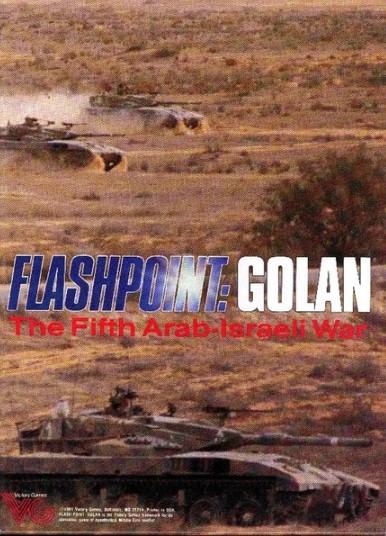
David: Flashpoint: Golan is the basic operational engine…which has roots in Gulf Strike. We have SIGNIFICANTLY updated the FG basic model. Also, elements of Triumph of Chaos and Empire of the Sun have been included.
David: What are the major drivers/dynamics of the Russo-Ukraine war? What was Putin’s overall war plan?
David: I could write a book on this one. Here is a VERY high level summary with dynamics split into four buckets:
1.) Background
a. Ukraine is a fiercely separate culture and country that wants to be a part of the European community and NOT a part of a decaying Russian empire.
b. Russia has been making war on Ukraine for hundreds of years.
c. Putin and team want to create some Eurasian empire with “traditional Russian values”.
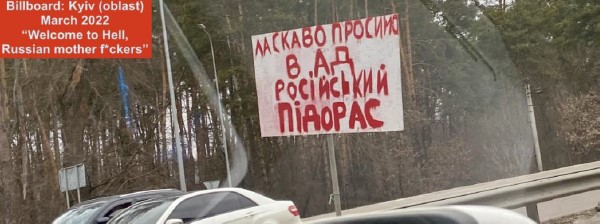
2.) Geopolitical
a. Putin’s invasion did the impossible: to unify NATO (post previous USA administration chaos) and expand Nordic bloc (Sweden & Finland).
b. Ukraine wants to join NATO – as did all other countries in Eastern Europe which were formerly occupied by Russia.
c. Russian victory would encourage further expansion (Baltic Republics at a minimum) and China regarding Taiwan.
3.) Strategic Will of “The West”
a. Putin’s invasion did the impossible: to unify Ukraine.
b. Significant fascist friendly and appeasement factions in the West attempting to collaborate with Russia.
c. Speed, level and type of NATO aid provided to Ukraine is critical to allow them to resist Russia’s aggression.
4.) Military
a. The Ukrainian army have proven to be MUCH more capable than anticipated.
b. Russian army has proved MUCH less capable than anticipated: we may need to toss out all those hypothetical WW3 wargames that VASTLY overestimated Soviet capabilities.
c. The age of data and drones has arrived
• Drones on steroids
• Crowd sourced intel
• AI and algorithms
• Integrated data inputs for target selection and subsequent strike execution
• Significant innovation in electric warfare
d. Some things still matter…
• Lead in the air…amount of artillery shells/strike payload
• Leadership, morale/élan, troop quality and cohesion – Napoleon’s “morale is to the physical as three is to one”.
• Logistics
Putin’s overall war plan:
• Maintain perpetual state of war with the West as a method of staying in power.
• Conquer a chunk of Ukraine to expand Russian empire – and combat its current decline.
• Blitz Kyiv, be greeted as liberators, topple the government and hold a parade all within a few weeks.
• Pressure south and east in order to prevent Ukraine from concentrating resources on defense of Kyiv.
• Diplomatically isolate Ukraine: attack the West’s will to aid and resist from within.
Grant: How do politics affect the game? What different political tracks are included in the game?
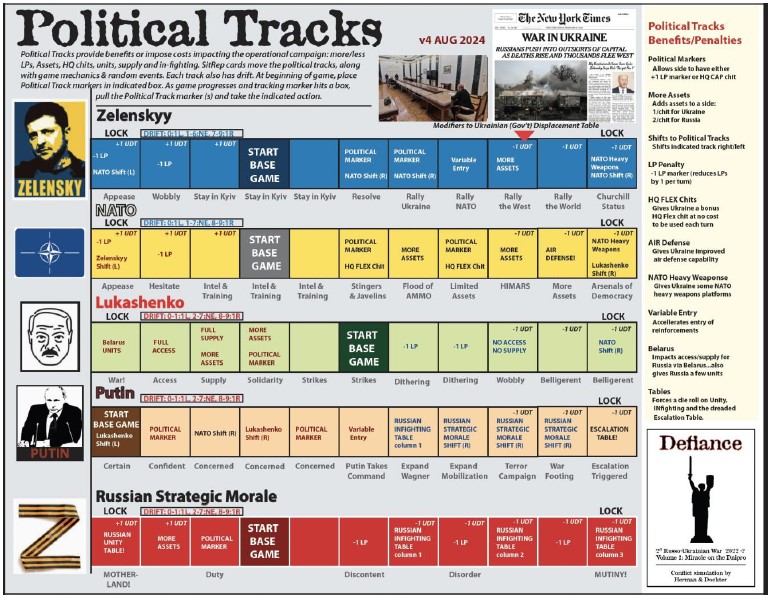
David: The five political tracks reflect the strategic will of Ukraine and NATO, Belarus participation (or lack of it), Putin’s “will” and the commitment of the Russian army. Politics provide the context in which operational warfare occurs: the goals each side is attempting to maximize, the constraints and the allocated resources/capabilities.
Grant: Why did you feel that allowing variable setup was the right direction to go with the game?
David: We have a standard setup for the main campaign scenario. Variable setup occurs with a few scenarios that advantage Russia or Ukraine depending upon how the war breaks out.
Grant: What is the concept of Base Logistics Points? How has this guided the design?
David: Logistics Points (LP’s) represent the relative operational resource levels for both Russia and Ukraine to conduct this conflict. We wanted to give players some control regarding how they are spent to further their goals. We also wanted the amount of LP’s available as a function of random events, the political game and battlefield performance.
Grant: How have you modeled Russian inter-service and intra-service rivalry?
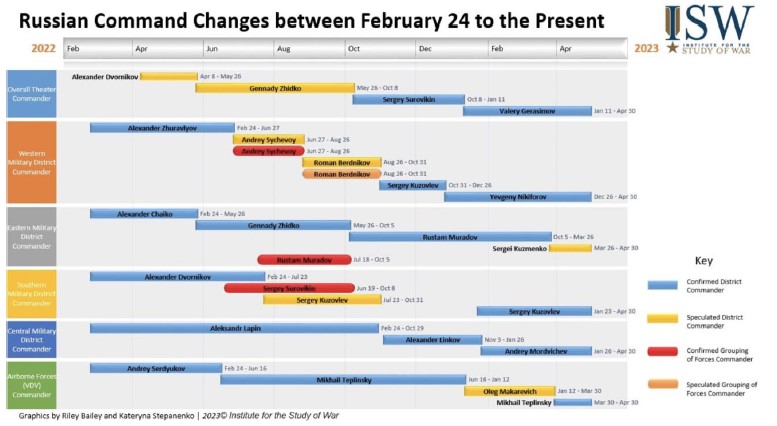
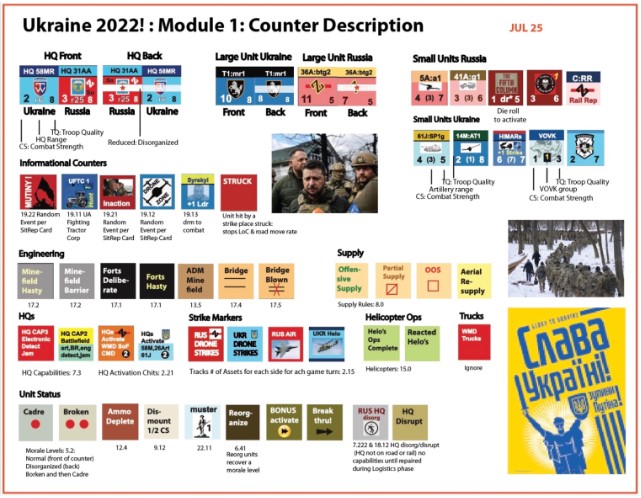
David: Russia did not have a unified commander for the operation, with the exception of “the little tsar”. Some of Russian command friction is depicted in the chart above. Parts of three regions involved, plus independent VDV and SOF and a few other formations. We’ve baked in a variety of “friction rules” including the sheer number of uncoordinated Russian formations engaged vs Ukraine, additional operations “costs” for Russia to do this or that, inaction rule, mutiny rule and a number of random events.
Grant: How have you modeled the high morale and apparent unification of Ukraine? What advantages does this give the Ukrainian player in game terms?
David: Essentially quality (Ukraine) vs quantity (Russia) reflected in Troop Quality ratings, leadership, one Ukrainian GHQ vs three Russian GHQ’s and a few other friction points for Russia’s lack of unity of command.
Grant: How have you tackled Soviet doctrine in the game?
David: Well, Soviet doctrine obviously still significantly comprises MUCH of Russian doctrine. We did some re-reading/study of Soviet doctrine/experience (see our reference list). Russian logistical doctrine/capability has been …atrocious. And, lack of battlefield adaptation (and command flexibility) significantly impacted their performance. Plus, Soviet/Russian doctrine failed to anticipate or mitigate Ukrainian partisan and special force operations. And, Russia was woefully short regarding the impact of drones and crowd sourced intel.
Grant: How does this compare to the NATO training given to and forming the strategy of Ukraine?
David: NATO has been training about a brigade per month since war start (45k troops since war start). Additionally, a number of Ukrainian officers have trained with the USA (ex: Ukraine’s army is a blend of NATO training/capabilities and lingering Soviet practice. It’s been a real fight between the two schools. Ukraine has demonstrated significant innovation and ability to change up. They have also “misfired” using NATO doctrine: their 2023 summer offensive.
Grant: What different aspects do you want players of the simulation to be able to manipulate?
David: Primarily, how the operational campaign is waged. Ability to access assets, but, not control which are provided – or even their availability. Politics? Nah – players should be more a victim of the political dynamics rather than driving it (a change from Triumph of Chaos).
Grant: What is the layout of the board and how does it incorporate these two scales?
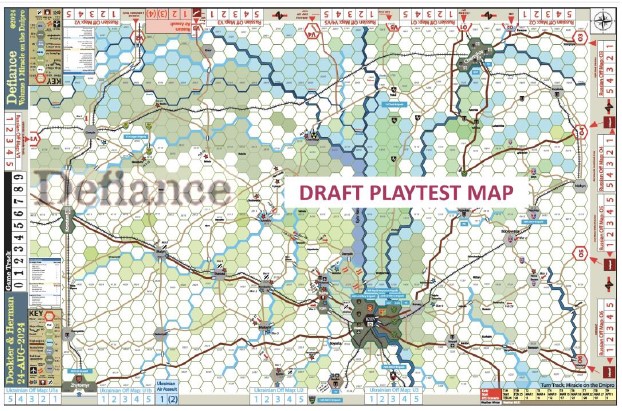
David: Game map is 34″ x 44″ (2 standard wargame maps). 8 KM per hex. It only reflects the operational campaign. At some point, we’ll publish a strategic map that ties together various modules.
Grant: How does combat work in the design?
David: Combat is handled in three different ways, depending upon force composition involved and type of engagement:
1.) VOVK: Occurs when a Russian stack encounters Ukrainian partisan/SOF.
2.) Meeting Engagement: Activated stack wishing to dislodge an enemy stack.
3.) Set Piece Battle: All units of activated formation engagement all enemy units within their zones of control: one big battle.
In each case, sides may use assets including AIR, HELO, MISSILE and DRONE to assist…plus artillery of course.
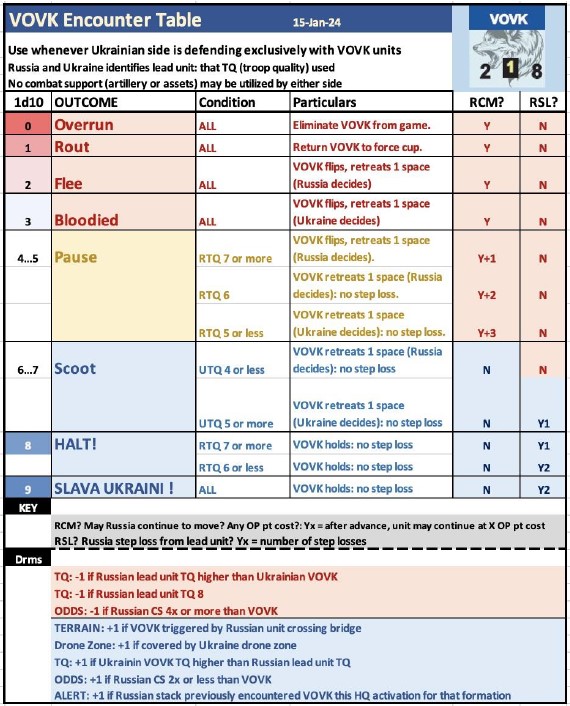
Combat results are quite wide ranging…units taking morale losses, retreats (or push back in the case of attacker), pursuit/breakthrough or a draw (which will then force defender to either attack during their turn or attempt to hold or withdraw).
Grant: How does the game use Chit Pull?
David: A basic model. Toss purchased formation chits, flex chits (cost more in LP’s, but grant ability to activate any formation), Berg random event and three phase enders (Op phase has variable ending). Pull three chits out. Side with 2 or 3 selects one. Other side – if one of their chits were among the three pulled can designate that as the next formation activated – or toss back into the pool and take their chances.
Grant: What types of cards are available in the game? Did you consider using the Card Driven Game mechanic? What or why not?
David: We’re using SitRep Cards. One is revealed at the beginning of each turn (out of five possible) that generate random events, move political tracks and provide a bonus or penalty for each side depending upon what they have accomplished (or fail to).
Card Driven Wargame? Nah…we think we have a better model for what we were trying to accomplish…although we love Card Driven Wargames. We could have potentially borrowed and modified the operational strategic model from Empire of the Sun, but that didn’t feel quite right. We liked the idea of the chit pull – not knowing if one side will be able to get off a series of moves or not – and the unpredictability of it. We have tweaked the basic chit pull model to mitigate some of its usual issues. Can’t wait for players to give it a try.
Grant: What type of experience does the game create for the players?
David: To be determined! We’ve received good feedback from playtest teams, but won’t know until it is played a few thousand times.
Grant: What are you most pleased about with the design?
David: Interactivity and the unpredictability of combat. We think it models well our view of modern operational scale conflict; outcome more an outcome of force multipliers and troop quality instead of quantity of troops and equipment. Quantity of troops (concentration) has very negative ramifications on a 2020’s battlefield, since if you move (or not), you can be seen. If seen, you can be struck from a WIDE variety of platforms. If struck, likely eliminated.
Grant: What are your future plans for this conflict with this system?
David: Assuming Volume 1 is well received, we’ll roll out additional volumes covering other operational campaigns in the war. Next would likely be the initial Russian blitz in the south. We’ve sketched out a few others. At some point, we would like to publish a module that ties all the volumes together for the true nutcases. Thank you for the interest in our game.
Thank you so much for your time in answering our questions David. I am very much looking forward to this design and to see how it explores a conflict that has so recently been, and continues to be, in the headlines! I am also very much excited to see what future volumes this effort spawns and to see what the two of you can do together.
If you are interested in 2nd Russo-Ukrainian War 2022-? Volume 1: Miracle on the Dnipro, you can pre-order a copy for $64.00 on the P500 game page at the following link: https://www.gmtgames.com/p-1087-defiance-2nd-russo-ukrainian-war-2022.aspx
-Grant


Where is the possibility of a successful peace deal, as was being worked on in Minsk and Istanbul? Putin stated that the Russian withdrawl from Kiev was a goodwill gesture to facilitate this agreement?
LikeLike