
After having met Raymond Weiss in person a few years ago at WBC and after having done a few initial interviews with him for the blog (Rostov ’41: Fritz on the Don from Multi-Man Publishing, Imperial Bayonets: Liberty for Lombardy 1859, Destroy All Monsters Operational Series (DAMOS). 2022: Ukraine and The Great Northern from CSL), we have been impressed with the success to date of his new publishing company Conflict Simulations Limited and his very interesting design approach. Recently we reached out to him to get a look inside his new pre-order game called With the Hammer: Thomas Müntzer & The German Peasant War in Thuringia.
If you are interested in With the Hammer: Thomas Müntzer & The German Peasant War in Thuringia, you can pre-order a copy for $69.99 from the Conflict Simulations Limited website at the following link: https://www.consimsltd.com/products/with-the-hammer

Grant: What is the focus of your new upcoming game With the Hammer?
Ray: With the Hammer is somewhat of a passion project of mine on a small part of history that is pretty well unknown as the game covers a small theater of the much wider German Peasant War which took place 500 years ago this year.
Grant: Who is Thomas Müntzer and what is the German Peasant War in Thuringia?
Ray: Thomas Müntzer was a radical preacher who complained and wrote much about how a small group of nobles made the lives of everyone else miserable – the German Peasant War in Thuringia was a conflict in which he was a leading participant amongst a slew of other colorful personalities. In the early/mid-16th century, German peasants were no longer de-facto serfs, yet they still may as well have been given the restrictions on their livelihood. Peasants could not choose their own priest, could not move nor marry without paying a tax or getting permission, could not hunt nor fish on the lands they lived and generally lived short, brutal and miserable lives. There had been sporadic peasant uprisings in previous centuries, but none were organized enough to have made much of a difference.
After particularly bad harvests in the 1520’s, German and Austrian Peasants had decided to buck their noble patrons and began a rebellion in earnest, in what would become the largest organized people’s movement up until the French Revolution, and easily the largest people’s movement in German history aside from the post-WW1 era. One priest, Thomas Müntzer, would come to embody this rebellion as he put into words something that remains true to this day, “The princes are nothing but tyrants who flay the people; they fritter away our blood and sweat on their pomp and whoring and knavery.”
With the Hammer follows the major personalities of the German Peasant War as they preach, negotiate, and fight in the largest social movement in European history before the French Revolution.
Grant: Why was this a subject that drew your interest?
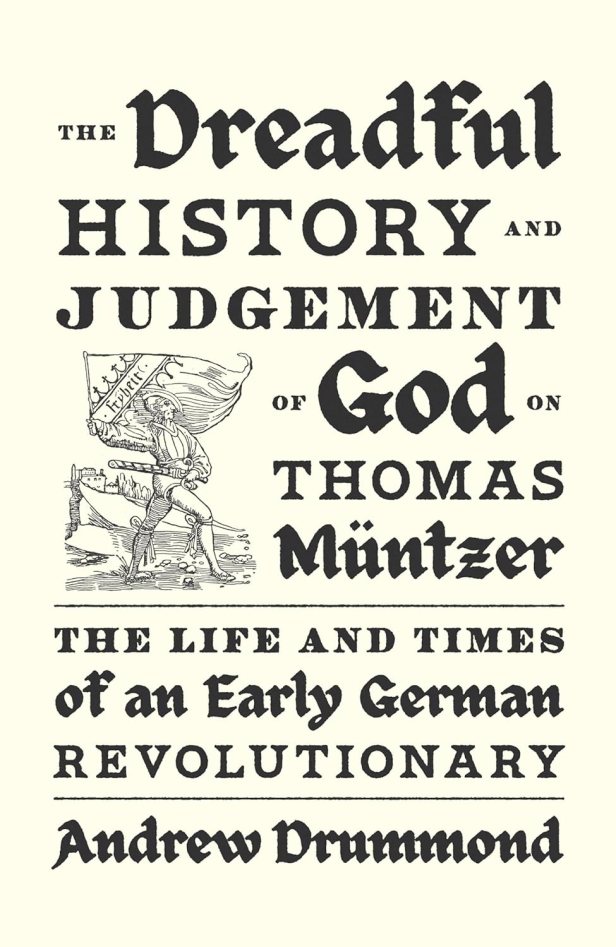
Ray: Probably a number of reasons but I read Andrew Drummond’s recent book on Müntzer and felt very much inspired to do this game – I was lucky enough to get Drummond to agree to writing the historical background information as well so I’m really thrilled about that. Overall Müntzer is an inspiration for me as a utopian millenial with lefty leanings, but admittedly he helped to get some 100 thousand peasants killed in the process rebelling against the nobility. However, the fact that this happened at all, the largest organized social movement before the French Revolution, is incredibly fascinating to me.
Grant: How would you classify this game? Who do you believe the game will best appeal to?
Ray: One thing I’m most proud of with this game is that I think it can appeal to all types of board gamers. There is an action point economy that should be familiar enough to the majority of modern gamers and things are very straightforward and simple. One reason I’m so happy with this is that Fred Serval has done an excellent job in assisting me with development taking my raw prototype and turning it into something that can be enjoyed by all different types of gamers.
Grant: What sources did you consult to get the historical details correct? What one must read source would you recommend?
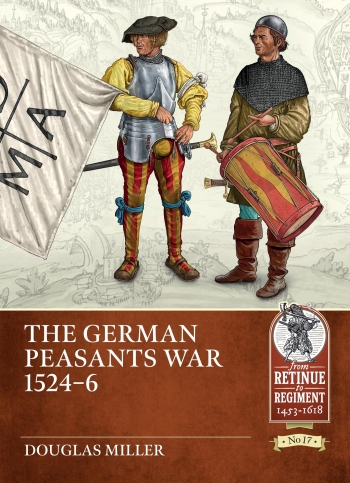
Ray: There are two Hellion books on the German Peasant War by Professor Douglas Miller and as well as the book I mentioned by Andrew Drummond titled The Dreadful History and Judgement of God on Thomas Müntzer. Miller also has a book on the battle of Frankenhausen titled after the battle that proved helpful in figuring out some of the art style and banners used in the war as well. I’ve been in direct contact with both of these authors who have been gracious in dealing with my many, and admittedly sometimes rambling and excessive emails, with grace and patience, but their contributions have been essential during the design and development process.
Grant: What are the different factions in the game? Who does each faction represent?
Ray: There are two factions included in the game, the Nobles and Peasants. Peasants have Peasant Leaders and Nobles have Noble Armies.
Grant: What is the scale of the game? Force structure of the units?
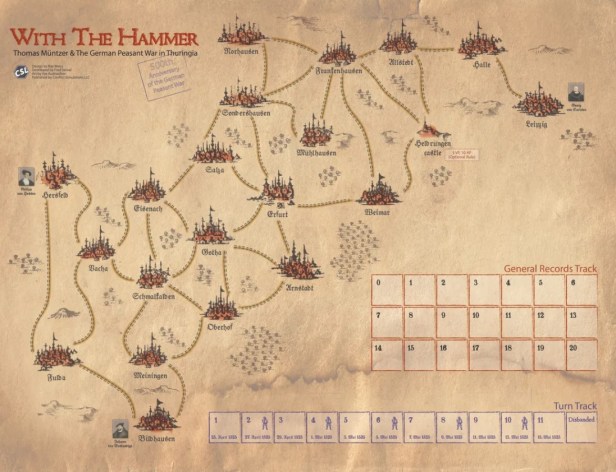
Ray: The game takes place over a two-week period where each turn is two days long – scale of the game though is otherwise abstracted to a point to point map covering the relevant part of Germany (figuring out this map was incredibly difficult).
Grant: What is the anatomy of the unit counters?
Ray: Nearly all of the counters in the game are markers with the exception of Freelancers which are sort of units that can get hired to either side, so all of them should be self explanatory. They are used for things like Supply and marking towns as Exhausted or Depleted.
Grant: What different Leaders do players get to choose from? How are these Leaders different?
Ray: There are 4 Peasant Leaders, including Thomas Müntzer, Henrich Pfeiffer, Hans Sippel and Bonaventura Kurschner – they only differ in that they have slightly different ratings and each have a unique special power or ability. Players can play as one or more of these leaders during a game. Each of them is rated for Zeal, Influence and Leadership.
Grant: What is the makeup of Peasant Bands? How do Leaders and Nobles influence these bands?
Ray: The word Peasant Band is used to describe the groups of (mostly) peasants that would band together in military order and generally took to raiding castles or monasteries, but these groups often included veterans, artisans, and other members of the burgeoning middle classes who were in one way or another ready to take up arms to force change on the ruling classes. Peasant Leaders will generally be trying to Inspire Peasant Bands to join up with them while Noble Armies will be Negotiating with them to Disband and return to their homes.
Grant: What is the makeup of the Noble Armies?
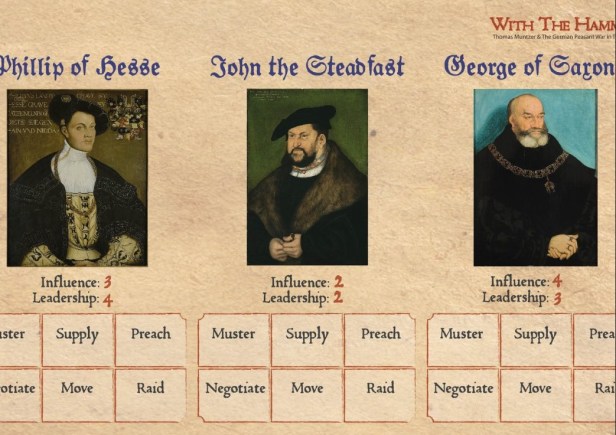
Ray: The Noble Armies are made up of the major nobles in the region, primarily those of Phillip of Hesse, George of Saxony and John the Steadfast. Nobles Armies must first procure supply before they can move representing the fact that these forces took significant efforts to make sure everyone would be paid and fed.
Grant: What is the concept of Propaganda in the game?
Ray: Propaganda refers to areas under the influence of Thomas Müntzer, whose influence and popularity had spread throughout the region by this point. These locales would be much more friendly to the rebels than those towns that were not swayed by the priest. Areas under Propaganda grant benefits to Peasant Leaders and penalties to Nobles when taking actions.
Grant: How are Locales controlled?
Ray: Locales are controlled by occupying them but control is really not super important in this game, unlike other wargames. More important than control frankly is if the locale is under Propoganda or not as it will make dealing with Peasant Bands much easier for Peasant Leaders and much harder for Nobles. Rather than focus on control, this game focuses on interactions between the players and pieces in play, not the players and the map like most wargames, so control is generally less important.
Grant: What are Freelancers? How do they get deployed? What does this represent from the history?
Ray: Freelancers represent groups of soldiers or miners that either side can interact with. Both players can recruit soldiers while only the Peasant side can recruit miners. These pieces join up with the armies to augment their strength in battle.
Grant: How does the game utilize Event Cards? What different type of events are there?
Ray: Whenever Freelancers are placed, there is a chance that Events may get drawn. Events are a mix of historical events like Luther showing up and executions which greatly upset the Nobles, as well as some generic things like raids, all meant to mix things up for a turn.
Grant: What different actions can the Peasants take?
Ray: Peasant Leaders can Move, Inspire, Preach Raid and Parley.
Grant: What about the Noble’s actions?
Ray: Muster, Supply, Negotiate, Preach, Move and Raid.
Grant: What is the area covered by the board? What strategic considerations does it create?
Ray: The board covers all of the strategically relevant parts of Thuringia – Peasant Leaders have slightly better movement so there is a bit of asymmetry in planning on either trying to Inspire Peasant Bands maybe leaving yourself at risk of attack by a Noble Army, this is where most of the other actions become relevant.
Grant: How does combat work in the design? What are the results of combat?
Ray: Combat is fairly traditional for wargamers and uses both a Peasant CRT and a Noble CRT – this is the most wargamey thing in the design. The most interesting combat result is the Rout result which has a little procedure for figuring out what happens to whichever side Routs, it’s probably my favorite part of the game, otherwise the combat results are fairly standard from retreats to exchanges.
Grant: How is victory achieved?
Ray: There are multiple paths to victory for each side. The basic way is by bringing the VP marker to 20 for the Peasants and 0 for the Nobles, which represents either side capitulating to the other. However there are other conditions for both sides such as placing the entire map under Propaganda markers or entirely removing them from the map, etc.
Grant: What are some basic strategy concepts that each side must keep in mind?
Ray: At the start of the game there is kind of a race to gather as many bands as possible for the Peasant Leaders while Noble Armies will typically try to Punish Leaders that get too close while disbanding any Bands they come across. As the game goes on, things reset as Disbanded bands eventually make it back to the game board.
Grant: What type of gaming experience does it create?
Ray: Hard for me to say but I think Fred does it better, ” With its mix of wooden pieces, counters, and historical commentary by Professor Andrew Drummond, With The Hammer promises an engaging blend of strategy and history.”
Grant: What are you most pleased with about the design?
Ray: It’s playability by far. It takes minutes to set up and only about 45-90 minutes to play depending on how many players you are playing with, the game can support 1-7 and Fred is developing a solo module.
Grant: What has been the experience of your playtesters?
Ray: So far all of the playtesters have enjoyed the mix of playability and strategy that the game provides, as well as a unique look into a little known part of history. I love it when my games can both teach while inspiring players to learn more
Grant: Are you still looking for playtesters?
Ray: Yes, up until release in early January, just shoot me an email at rweiss@consimsltd.com.
Grant: What other designs are you mulling over?
Ray: This design has been a labor of love for me and frankly a distraction from my pre-order catalog so my goal after this is to finally get DAMOS North Africa out as well as my game on the Peloponnesian War The Earth As Their Memorial. My PC died recently which made me lose a bunch of files so I lost some time but I’m working on replacing everything and just glad I was able to get a new PC as I would be much worse off without one!
Thanks for the opportunity to talk about the game Grant! If I can answer any one’s questions please go ahead and ask.
If you are interested in With the Hammer: Thomas Müntzer & The German Peasant War in Thuringia, you can pre-order a copy for $69.99 from the Conflict Simulations Limited website at the following link: https://www.consimsltd.com/products/with-the-hammer
-Grant
 The Players' Aid
Hi! Could you add tag ilya-kudriashov, as I’m an artist of all game components?
LikeLiked by 1 person
Done
LikeLike