
A few years ago, Sergio Schiavi broke onto the scene with his new company called Dissimula Edizioni with their first Kickstarter called Radetsky’s March: The Hundred Hours Campaign and that game was then followed a few years later by From Salerno to Rome: World War II – The Italian Campaign, 1943-1944 and then their third game called Give Us Victories: The Chancellorsville Campaign. Now, they have launched a very interesting looking East Front wargame during the summer of 1944, after Soviet forces launched a series of offensives that annihilated much of the German army but Field Marshal Model rallied some intact forces and counterattacked managing to halt temporarily the Soviet forces. This game is called Model’s Counterattack: The Battle of Radzymin and Bagration’s End and is currently on Kickstarter.
If you are interested in Model’s Counterattack: The Battle of Radzymin and Bagration’s End, you can back the project on the Kickstarter game page at the following link: https://www.kickstarter.com/projects/guv/models-counterattack

Grant: What is the focus of your new design Model’s Counterattack?
Sergio: The game focuses on the final phase of Operation Bagration where the Second Tank Army of the Red Army breaks through the German infantry lines and approaches Warsaw. The game period spans from July 27 to August 5, 1944, covering ten days of continuous clashes that culminated in the battles around Radzymin. There, the Germans nearly encircled an entire Soviet tank corps, inflicting significant losses.
Grant: What was the significance of the action near Radzymin?
Sergio: Radzymin is a key location, as it is a railway hub connecting Warsaw to the east and represents the furthest point of the Soviet advance in the region at that time.
Grant: What aspects of the fighting during this campaign on the East Front did you need to model in the design?
Sergio: Aside from a few infantry units, most counters represent highly mobile, armored, and often very powerful units, which can be employed in various ways. I took inspiration for the game’s design from the Standard Combat Series by MMP, of which I am an ardent fan. My aim was to create a simple yet entertaining and fast-paced system that would provide some alternate looks at this part of the fighting in the East.
Grant: What operational differences exist between the two armies? How did you model these differences?
Sergio: The gameplay seeks to simulate the operational differences between the two doctrines: the Soviets’ rather rigid approach versus the Germans’ highly flexible tactics. German mobile units and even Soviet reconnaissance units can, under certain conditions, disengage from combat, ceding ground to regroup further back and counterattack. The Red Army, on the other hand, is powerful but somewhat constrained in its movements.
The Second Tank Army’s core consists of three tank corps, each further divided into nine tank brigades equipped with T-34’s and Sherman’s. Supporting them are regiments of self-propelled guns and heavy tanks, along with additional support units. Infantry is scarce—each corps has just three battalions, and this limitation is strongly felt.
The Germans start with one infantry division and some support troops. As the game progresses, elements of five different Panzer divisions arrive, including numerous Panzer battalions, with four full Panther battalions.
Grant: What sources did you consult to get the historical details correct? What one must read source would you recommend?
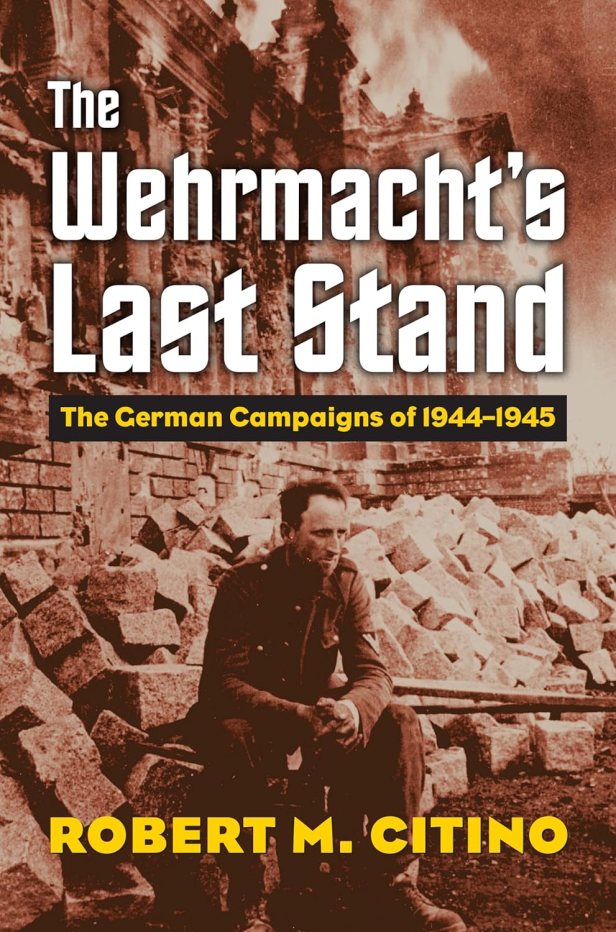
Sergio: The idea for the game came to me after reading Robert M. Citino’s brilliant book on the Wehrmacht’s collapse called The Wehrmacht’s Last Stand: The German Campaigns of 1944-1945. Together with Giovanni Maccioni, my go-to expert for all Dissimula games, we dug into additional sources like Glantz and Nebolsin. However, finding accurate data on unit strengths and equipment proved challenging, as sources often conflict or are incomplete. Eventually, Piotr, a recent and dear friend with a Ph.D. in military history from Białystok, joined the team and was a great help. His expertise and access to Russian primary sources have been invaluable and changed the course of the design from the OOB perspective.
Grant: What is the scale of the game? Force structure of the units?
Sergio: The map scale is 2 km per hex, and units are scaled at the battalion, regiment, and brigade levels.
Grant: What is the anatomy of the unit counters?
Sergio: The counters are straightforward. I decided to represent armored units with the actual type of vehicles they used, each with a unique design, as I did for From Salerno to Rome. Other units are represented with NATO symbols. Each counter has two primary values: combat and movement, along with bonuses in white circles (applicable for both attack and defense) and red circles (defense-only). These values modify die rolls on the CRT.
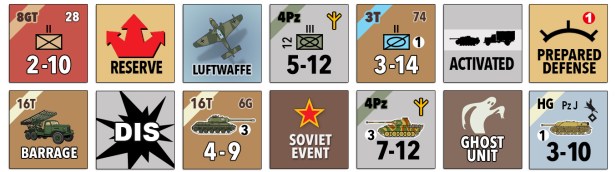
Artillery is abstracted in the game and is represented by markers.
Grant: What role does the Warsaw Uprising play in the game? How does it affect the Germans?
Sergio: The Warsaw Uprising is triggered automatically when Soviet units reach a certain distance from Praga, the district east of the Vistula. On the following turn, no German units can move from Warsaw to the east. Subsequently, a die roll determines how many movement points German units lose when moving from the city east of the Vistula and, in the worst case, how many steps they lose.
Grant: What other historical events happen during the course of gameplay?
Sergio: Another challenge for the Germans comes in the sixth turn: they must send reinforcements west of the Vistula and south of Warsaw, as the Soviets establish a bridgehead threatening German rear lines. Warsaw and its access routes are key; supplies and many German reinforcements pass through there. Controlling its three bridges allows the Soviets to disrupt German forces significantly. However, German units also enter from other points, so the Soviets must carefully choose where and how to concentrate their forces.
The game includes randomly drawn events, with separate decks for each player. Events range from the Soviets recovering a tank step or equipping an infantry unit with Molotovs, to the Germans receiving a “Panzer Ace” or a Panzerfaust event.
Grant: What area does the board cover?
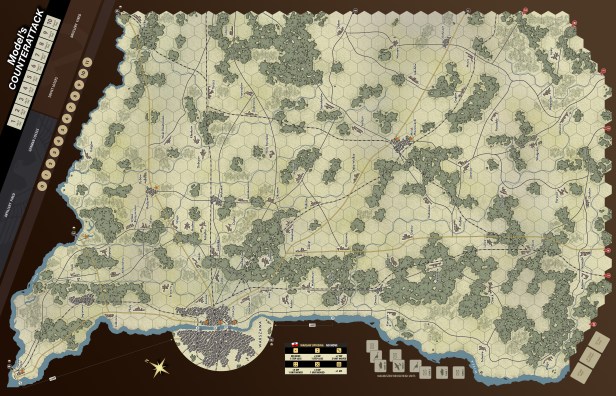
Sergio: The playable area is east of the Vistula and south of the Narew and Bug Rivers, which truly limit the gaming space. The eastern part of Warsaw is represented as a single large area.
Grant: What sources did you consult about the terrain and other features?
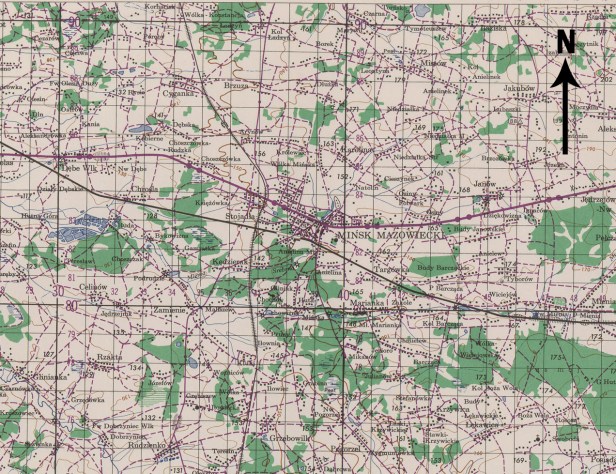
Sergio: For the map design, I used sources from various countries—Russian, Polish, German, and even American. The design process went through about twenty iterations, which I thoroughly enjoyed.
Grant: How does combat work in the design?
Sergio: Combat is brutal and comes in two forms: mobile (overrun) and coordinated attacks, both using the same CRT. The CRT is inspired by an SCS game title that I love, albeit with significant modifications.
Grant: What role does the General Model counter play?
Sergio: Field Marshal Model is represented by a counter that enters play in the seventh turn. He provides powerful abilities, but the German player must choose carefully: Model can better coordinate attacks, delay Soviet reinforcements, or reroll combat dice.
Grant: What are you most pleased with about the design?
Sergio: I’m proud that the initial framework for the map—its dimensions, scale, unit density, and gameplay characteristics—worked immediately without major issues. Of course, I created many prototypes, but I didn’t need to deviate much from the original concept.

This project felt different from my previous ones, thanks to the wonderful group of collaborators. Working with Jack Polonka for the first time was a highlight; he’s an incredible developer, always attentive and full of essential suggestions. I’m sure we’ll continue collaborating. Giovanni Maccioni, as always, served as the historical researcher and quality controller for every aspect of the project—a role he’s played for all Dissimula games. His contribution is invaluable.
Grant: What has been the experience of your playtesters?
Sergio: Piotr Popławski, as mentioned earlier, has been instrumental, and I hope he’ll assist with my next project, which uses the FSTR system. The title, for now, is a closely guarded secret. Pier Giorgio Lovera, whom you may know from FSTR and Give Us Victories, designed the tank icons with his incredible skill.
Lastly, my great friend Alessandro Barbero, the greatest Italian historian, always playtests my games first. His advice and enthusiasm continually motivate me to improve.
The game’s playtests consistently highlight one aspect: it is not easy for either player to win. It’s asymmetrical but balanced—and fast!
Grant: What different stretch goals are being offered?
Sergio: Stretch goals include a small poster featuring all the beautifully designed Soviet and German tanks by Giorgio. These illustrations are, of course, stunning!

Then, more counters: The third and fourth steps for the strongest armored units and the variants rules to use them.
Finally, an additional display and counters to simulate the fog of war, an alternative option that allows players to hide the type and the number of their units from opponents, creating strategic uncertainty and better simulating the fog of war.
Grant: What other designs are you mulling over?
Sergio: You know, these past few days, I had to organize all the Dissimula archives, and I realized that I’ve created so many games over the years. It was surprising to see them all lined up!

What’s planned for next year? Of course, Sicilia 1943: Operation Husky—this massive game on Operation Husky with four maps by Andrea Brusati, which I’m producing. It has now surpassed 200 pre-orders, and we’re almost there.
Then there’s the game on Frederick the Great’s battles; it will be a bold move because we’ll include two rulebooks in the box: one quick and introductory, written by me, and one advanced and fantastic, created by Diego Lena. This project is coordinated by Flavio Acquati, one of the historical figures collaborating with Parabellum and a dear friend. I already have 8 maps and 8 battles practically ready, including some that have never been featured in any game before, as well as a mini-campaign game that links Prague and Kolín, also by Diego.
As for the secret project related to From Salerno to Rome, I’ve already hinted at it; the first image will be revealed next year. Then, together with Nicola Contardi from Europa Simulazioni, we’re considering a joint project. This one is Napoleon-themed—a real surprise if we can make it happen.
Finally, there’s another proposal from a dear friend for a game about the Middle Ages… so, more projects than time! Thanks, Grant!
If you are interested in Model’s Counterattack: The Battle of Radzymin and Bagration’s End, you can back the project on the Kickstarter game page at the following link: https://www.kickstarter.com/projects/guv/models-counterattack
-Grant

 The Players' Aid