
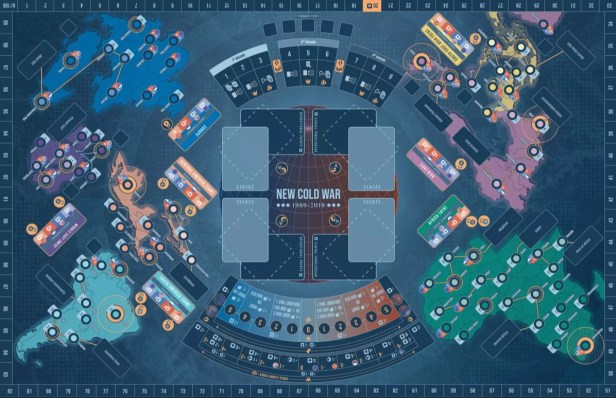
New Cold War is a game about geopolitics that takes place from 1989 to 2019. It begins with the disintegration of the Soviet Union and ends with the arrival of the COVID-19 pandemic. Players (from 1 to 4) take the role of the great powers fighting for the new world order: Russia, China (forming the Red Bloc), the United States and the European Union (Blue Bloc). The allied powers will have to cooperate with each other (exchange of cards, media marker…), but victory will be individual. There are two victory conditions: a power must declare two of the hidden objectives on its agenda during the game or lead the victory point score at the end of the last turn of the game. The game consists of nine turns divided into three decades with a game duration of 150-180 minutes.
New Cold War is a Card Driven Game (CDG) featuring the 135 most important events of the 30 year period covered by the game. Your power’s cards can be played as an event or as operations, while opponents’ cards and your own negative cards are played as OPS and the event is executed for or against the power to which it belongs. OPS can be played in six different ways: 1) placing or removing influence on countries on the map (based on their stability, geopolitical value and initial alignment), 2) by staging a coup d’état, 3) stabilizing or destabilizing countries to protect or favor access to them, 4) advancing on the prestige marker, 5) advancing on the media marker, either alone or in cooperation with your ally (it is a track that is contested by blocks) or 6) creating a reserve of OPS to play in later rounds or game turns.
In this series of Event Card Spoilers, we will cover several different types of cards included in the game and from the different Decade Decks and give their details so that you can understand how the game works and how it incorporates the historical narrative of the new Cold War struggle between super powers from the end of the first Cold War through 2019.


Card #61: 1st Decade Deck – UNSC Presidency
The four powers in the game are permanent members of the United Nations Security Council (UNSC) and have the right to veto any proposal even if it has received the required votes. This issue has been embodied in the game through what is referred to as the Veto Mechanism, whereby a player can prevent an event of his rivals or a Negative Event of his own from being executed. This will not affect, if any, the operations played with that card. Vetoes are limited to three per game (maximum one per turn) for China and the EU and four for Russia and the United States, which have an extra veto in the first decade. These vetoes are represented by a
series of markers of 3, 2 and 1 Operations Points indicating the value of the events on which
they can be played. In New Cold War, vetoes have consequences, so the political cost will be
-3, -2 and -1 Victory Points respectively for taking the Veto. Choosing when to use them is one of the most important decisions in New Cold War.
The next card up in the series will be Card #30: 1st Decade Deck – Gulf Monarchies.
You can catch up on the series to date by following these links:
Card #7: 1st Decade Deck – The Tibetan Conflict
Card #105: 3rd Decade Deck – Annexation of Crimea
Card #82: 1st Decade Deck – Warsaw Pact Dissolved
Card #134: 3rd Decade Deck – Rise of the Far Right
Card #41: 2nd Decade Deck – Afghanistan and Iraq Wars
Card #25: 3rd Decade Deck – Xi Jinping
Also, if you are interested in learning more about New Cold War, you can visit the Board Game Geek game page at the following link: https://boardgamegeek.com/boardgame/405994/new-cold-war
The game is not yet ready for pre-order but should be sometime in the next several months.
-Grant
 The Players' Aid
Just backed World Order, but believe will have to order this when it comes up also. Looking good, and looks to scratch the same itch.
LikeLiked by 1 person
Very kool. Thx for the insights G-man. Sent from my iPhone
LikeLiked by 1 person