
A few years ago, while attending the WBC, I had the chance to meet Wes Crawford who was demoing his upcoming game Engine Thieves. He was a very nice guy and his game was pretty interesting as well. Since that time, he has another game ready to see the light of day in The Pursuit of John Wilkes Booth from Blue Panther. I had a chance to play the game solitaire (with Wes overseeing the game and giving me guidance and pointers) at this past year’s WBC and had a really great time with it. Great little solo game with several other modes where the player uses resources like police and detectives to search for clues in the hunt for Lincoln’s assassin after the events at Ford’s Theater on the evening of April 14, 1865. There really is a lot to like with the way that clues are found and chits are blindly drawn to verify clues from a bag. There is also a great little movement mechanic with police and detectives to try to acquire more clues. I reached out to Wes to ask him some questions about the game and he was more than interested to answer.
If you are interested in The Pursuit of John Wilkes Booth, you can order a copy for $60.00 starting in mid-January from the Blue Panther website at the following link: https://www.bluepantherllc.com/products/pursuitofjwb

Grant: Wes welcome to our blog. First off please tell us a little about yourself. What are your hobbies? What’s your day job?
Wes: I guess my hobbies are my day job. In 1980, I quit an MBA program to play drumset for a living, or at least give it a try! Here we are in 2024 and I still perform with numerous bands in a variety of styles and teach about 30 private students. I taught at Goucher College for 28 years but have “retired” from that to make more room for game design activities. So, now I design games and beat on my drums all day.
Grant: What motivated you to break into game design? What have you enjoyed most about the experience thus far?
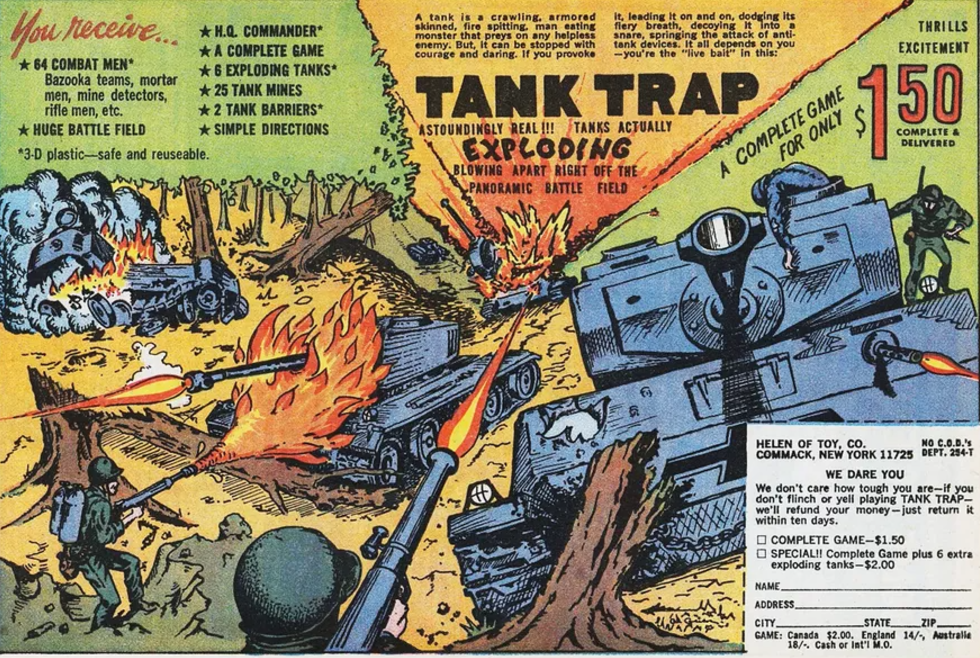
Wes: I used to make up games from as far back as I can remember. When we were playing “Army” throughout the neighborhood with about 10 of us kids, I was always the one making the rules regarding boundaries and how high you had to count with your eyes closed when you were “shot.” Then I discovered those Helen of Troy games on the back of comic books and ordered a few. Generally, they seemed to take forever to arrive (maybe they had a secret P10,000 system I didn’t know about?), and when they arrived they were rather chintzy. But I still sometimes consider buying a copy of Tank Trap off of eBay and have to stop myself. I remember their comic book ad that stated, “A tank is a crawling, armored skinned, fire spitting, man eating monster that preys on any helpless
enemy.” This just might be the strongest game tag line for 9-year-old boys ever. I then graduated to the Milton Bradley American Heritage Series of games, although even then I wondered how a single battle could extend from Georgia to Ohio in Battle-Cry.
Finally, at age 11, I discovered games in a department store in Roanoke, VA and the boxes had cool war pictures and said things like, “Now YOU fight the battle…”, which is probably the greatest game tag line for 11–13-year-olds. Midway was my first Avalon Hill Game and I was in awe of the design. It was like Battleship on steroids!! Many more AH and SPI games soon followed. From these games I learned that seemingly anything can be mathematically modeled in game form. I started designing games in earnest through middle school and high school with my greatest accomplishment a game
on the WW2 ETO that had a map created from 6 posterboards and took up most of our ping pong table. I drew 2” hexes individually by hand with a stencil. Counters were large and had a sliding paperclip across the top to account for unit degradation. There were Event Cards, too. In later years it got thrown out while I was on the road touring. I love researching history and modeling it into a game!
Grant: What designs have you had published in the past?
Wes I have not had any board games published yet, although several are upcoming. I have an interactive DVD game that is self-published from some years back. It’s called A Rhythmic Murder Mystery and features a Masterpiece Theatre-style narrator gone really bad who outlines a murder mystery that may only be solved by watching and listening to my solo performance pieces on electronic drums. I used to perform these participatory shows live, too.
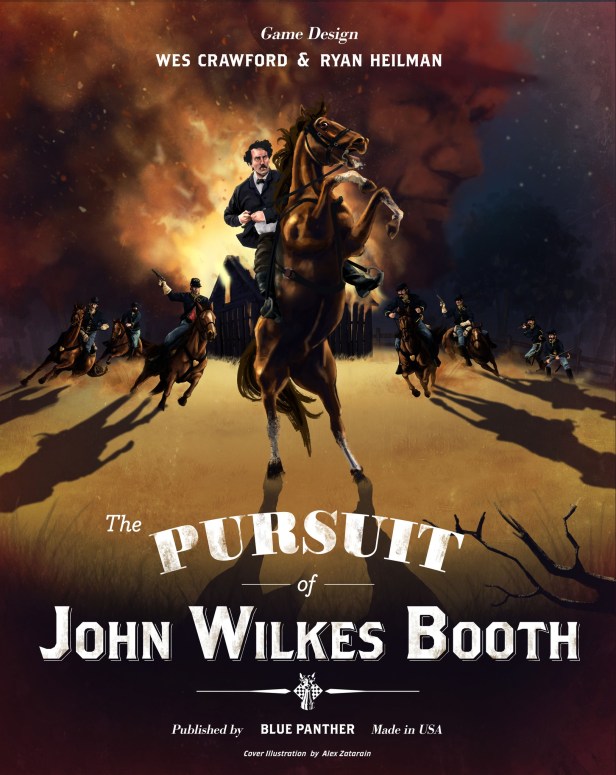
Grant: What is your upcoming game The Pursuit of John Wilkes Booth?
Wes: This project has been a lot of fun! First, I want to mention that this game is a codesign with designer/developer/production manager/graphic artist Ryan Heilman. In fact, this game was Ryan’s idea! We were brainstorming one day and he suggested that a game about the manhunt for John Wilkes Booth could be very interesting. I agreed but didn’t give it much thought. Then, the very next day I went to Jason Matthews’ Wargame Wednesday at Labyrinth Games in Washington, DC and ran into Mitch Reed. I believe Mitch is now in charge of wargaming for the USMC. Out of the blue he said, “It sure would be interesting if someone designed a game on the pursuit of John Wilkes Booth.” That clinched it.
To better answer your question, our game is indeed about the pursuit of John Wilkes Booth. Play begins the moment Lincoln is assassinated, and players are Union detectives and so the historical narrative is from the Union perspective. It was thought that Booth might head to Canada where the CSA Secret Service had been influential and had funds, to New York City where he could get lost in
the crowds and had lots of actor friends, down South through Confederate territory to Charleston, SC or New Orleans where he could sail to Europe or to South America, or he could head to the vast Western US and eventually to Mexico. The game may be played solo, cooperatively, competitively, and most recently, we have created a version where one player may play as Booth and his accomplices. This decision took some soul searching and we talked to lots of playtesters. They unanimously wanted this option. I want to stress that no one ever must play Booth in this game and the Booth bot works just fine.
Grant: How did you and your design partner Ryan Heilman work together? What roles did you each play?
Wes: I first ran with the game on my own and asked him to let me try out my idea and then we’d assess it. I took the quantitative hidden information clue system from my previous, much more involved game Terror Cell- Washington, DC” (yet to be published but I think it will be). Lead Cards provide historical destinations where clues may be found. Stanton Cards are available to possibly gain reinforcements and other advantages. Meanwhile, the Booth bot advances him on one or more spaces on the previously mentioned Trails. Booth Cards that help him to hide and resist capture are added most Phases. When this much was accomplished, Ryan helped with cards and single-handedly created a nice protype. He did some deep-diving research and created an accurate map of downtown 1865 Washington, DC and even corrected some errors we found in books. Ryan had lots of great suggestions during our playtesting and came up with the push-your-luck Police D6 mechanic. Ryan is also Developer for this game. He created the prototypes for two of my other games that will be published by Compass Games and I think we really work well together. I feel very lucky to have met him- on a Facebook gaming group, even!
Grant: Why was this a subject that drew your interest?
Wes: The game covers one of the most pivotal episodes in our nation’s history. The American Civil War had barely ended and the carnage was over. The killing of Lincoln has repercussions that last through today. This game presents players the opportunity to command detectives, police, and cavalry as our country’s most vile assassin is pursued in the greatest manhunt ever seen in North America. This could be considered the last action of the ACW and I believe it deserves a place on the shelf for anyone interested in this era and topic. Ryan has a more personal connection to this event and he should be the one to tell about this!
Grant: What is your design goal with the game?
Wes: Since this slice of history has never been gamed, we hope to provide players the opportunity to learn a lot about what transpired through the cards’ historical flavor text and the feeling and narrative of running an important manhunt for the dastardly Booth and his accomplices.
Grant: What sources did you consult about the details of the history? What one must read source would you recommend?
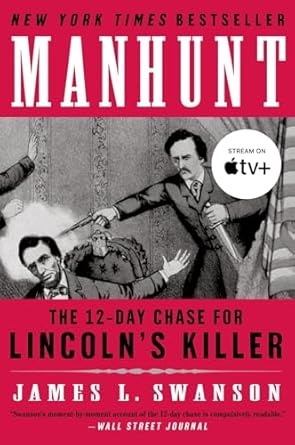
Wes: First, James Swanson’s Manhunt is an excellent read and is as good as most murder thrillers. He brings the times to life. Killing Lincoln by Bill O’Reilly and Martin Dugard filled in a few more details here and there, but it does not seem to be highly regarded by serious historians. The Lincoln Assassination
Encyclopedia, by Edward Steers, Jr., provided lots of details and depth in an easily searchable book form. Finally, the Manhunt Apple+ miniseries is a lot of fun and engaging, but really plays with history and turns Secretary of War Stanton into something akin to an action hero who actively participates in pursuing Booth rather than presenting him as the master coordinator and delegator in Washington, DC that he really was.
Grant: What other games did you draw inspiration from?
Wes: Ever since Midway, I have been interested in hidden movement games, so I have checked out quite a few. Fury of Dracula creates a fascinating trail of cards for Dracula and this inspired me to use a card trail for Booth, although the mechanics after that are quite different. Every third Phase the Booth bot places a new Trail card facedown which, when enough Clue Points are placed on the card to flip it over, shows where Booth moved in relation to his last known position. In the first prototype, I attempted to keep the game a bit chess-like with only about 10 pieces on the board at a time and with dice-less play. Eventually Ryan added a single custom D6 with a push-your-luck mechanic and then the die became crucial to the mode where a player plays Booth. When I began playing and designing games again around 2017, Whitechapel was one of the first games I picked up and I saw that game themes and processes had really changed since the 1970’s and not many themes must be taboo anymore.
Grant: What has been your most challenging design obstacle to overcome with the game? How did you solve the problem?
Wes: When Ryan and I decided to create a Booth player mode, I had a simple set of actions for that player which made Booth a little more difficult to catch but really didn’t give the player much agency in the game. I think we solved this by creating three counters for the three major accomplices with a menu of actions they may take to aid Booth and eventually they may try to join him on the Trail. The greatest component challenge has been the board and how to get it smaller. Alex Zatarain, the artist, is working on a solution as I write this.
Grant: As the game is a hunt, what is the main focus of the player?
Wes: The Detective player(s) must balance their force mix of Detectives (necessary for gaining clue chits, strong at searching, weak at raiding), Police (moderately good at searching and raiding but must stay within one space of their starting city), and Cavalry (good at searching and great at raiding). Detectives must follow up Leads in historical locations to gain clue chits to flip over Trail Cards. Then a strong force needs to catch up to Booth, find his precise location (Search), and Raid his hideout with sufficient strength to kill or capture him. A new Trail Card is added for Booth every three phases and he regularly gains more Booth Cards which help him fend off searches and raids. If Booth makes it to the ending 8th space of any Trail or if he can evade capture or death for 9 or 10 turns (depending on mode of play), the players lose.
Grant: What tools do they have at their disposal?
Wes: At any time on the player’s turn they may decide to forgo movement, Searching, and Raiding and instead draw two Stanton Cards. These cards may gain extra detectives, police, or cavalry as well as provide other assets helping with future Search or Raid Actions. Understanding when and how often to partake of Stanton’s help is crucial.
Grant: What elements from the real hunt for John Wilkes Booth were important to model in the game?
Wes: It didn’t take long to figure out who killed President Lincoln but I believe it was important to model the feeling that Booth could have gone in any number of directions to make his escape. And, with any situation of this sort, there never seems to be enough resources right where you need them. We wanted to include historical locations that provide clues to Booth’s progress, the aid that he received during his escape, and all the major and minor characters from this national drama.
Grant: What are the Detective Ability Cards? What different type of benefits do they offer?
Wes: The game begins with only two of the six Detectives in play- one at Ford’s Theatre and the other at Seward’s home after he was viciously attacked. Three of the Detectives are stronger at Searching and/or Raiding. One is allowed two moves but only once per Turn (every three Phases). One can flip a Trail Card with one less Clue Point than is usually necessary, and one can gain an extra Clue Chit draw from the Clue Bag when he is on Booth’s “Last Known Location”- the space designated by the most recently turned faceup Trail Card.
Grant: What purpose do the Stanton Cards play?
Wes: Stanton Cards can provide reinforcements and extra advantages for Searching or Raiding. They can be discarded to provide extra Police in DC, and they can be played to discard the top Booth Card, thereby lessening his aid.

Grant: What are the Lead Cards? How do players utilize these cards?
Wes: Generally, two Lead Cards are active at any time. Most Lead Cards designate a location on the board, usually within Washington, DC, where at least one Detective must move to gain the stated number of Clue Chits from the bag to place on a Trail Card. Historical flavor text is found at the bottom of each Lead Card. Washington, DC was chaotic at this time, so there are also Lead Cards that do not reward players with Clues but rather instruct the player(s) to send Police to important locations to guard them. This must be done as quickly as possible so that these Lead Cards may be discarded and hopefully a more rewarding one will replace it. Otherwise, there would be only a single useful slot for a Lead Card!
Grant: What are the Booth Cards and the Trail Cards and how do they work together?
Wes: There are three types of Booth Cards – Search, Raid, and Play Now. The Search Cards generally provide benefits to Booth when a Union Search is being performed. Raid Cards help Booth fend off any subsequent Union Raid. Play Now Cards are played immediately and mostly consist of the major Accomplices – Powell, Herold, and Atzerodt. If these Accomplices are drawn and their corresponding Lead Cards have not already been drawn and fulfilled, then the Accomplice joins Booth on the run and can further help him. Booth cards are drawn from the bottom of the deck so that players won’t know in advance what type of card is being drawn for the Booth bot. As mentioned, Booth’s Trail Cards designate his nearly infinitely variable escape route. The cards either move Booth forward 1 or 2 spaces, laterally 1 or 2 spaces towards a new Trail, “Hide” Booth in a current space (making him more difficult to locate and gaining him an extra Booth Card), and 1 card reverses him 1 space and gives him two extra Booth Cards. Each space on the board also has a modifier when calculating the success or failure of location Searches and Raids. With all this variability alone, no two games are alike.
Grant: What are the Clue Chits? Why are they needed by the player?
Wes: There are 58 Clue Chits in the Clue Bag. These are drawn by players when a Lead Card is fulfilled, whenever a Detective is on Booth’s Last Known Location, from the Police D6, and occasionally as instructed from Stanton Cards. Three of the 58 chits are an AMBUSH where the player must lose one piece involved in fulfilling a Lead. This is one reason it’s best to have a Police along with a Detective. Police are much easier to replace. If a Detective must be lost, they go to the Hospital for up to two turns. Additionally, if a Police is in the same Lead Zone as a Detective, the player may choose to roll the Police D6 one time. There is a 3/6 chance that an extra Clue Chit may be drawn, a 2/6 chance that nothing extra happens, and a 1/6 chance that an AMBUSH occurs and the Police is lost.
Clue Chits range in value from 0-4 as a Bell Curve shifted towards the lower values. Clue Chits are placed on the facedown Trail Cards until the card’s Clue Quota has been reached. Then that Trail Card is turned faceup, and Booth’s Last Known Location or Actual Location is marked accordingly.
This might be a good time to talk about the AMBUSH mechanic. This might be seen as the most fanciful part of the game. However, from the Union perspective, they did not know for some time if the plot was larger than it actually was or if a coup was imminent. It was rumored that many of Mosby’s Raiders had infiltrated the city and were waiting to spring into action, and there were a lot of Confederate sympathizers in Washington, DC and soldiers wandering and making their way home. Often, though, I think of an AMBUSH representing Union pieces being reassigned.
Grant: What is the general Sequence of Play?
Wes: The Solo mode demonstrates this most effectively since other modes elaborate on it.
A Turn consists of three Phases. On the first Phase of each Turn, a new Trail Card is placed facedown on the next open space of Booth’s Trail. On the second and third Phases, a Booth Card is drawn and kept facedown. As necessary, both Lead Card slots should be filled with two active Lead Cards. The Detective player first decides if they want to draw two Stanton Cards and play or keep them OR move up to all their pieces in order to gain Clue Chits and, if at least one Detective and other pieces are on the same board space as Booth’s Current Location (i.e., all Trail Cards are faceup and the pieces are where Booth is shown to be), a Search may be conducted for Booth’s exact location. If found, a Raid may ensue. The Sequence of Play varies a bit with other modes of play.
Grant: How does the player utilize the Police, Detectives and Cavalry pieces?
Wes: The pieces each have their own characteristics for Search/Raid values:
Detective 3/1
Police 2/2
Cavalry 2/3
Detectives are great for Search actions and are required to fulfill Leads, Searches, and Raids. Only Detectives can normally use Rail movement (city to city in a single move) and each Detective has its special ability. Police cannot move more than one space outside of their starting city but are easiest to replace if lost. They also provide the opportunity to use the Police D6 when attempting to fulfill a Lead Card. Cavalry are the most powerful pieces but do not operate inside Washington, DC. They move from their encampment directly to the first space of any Trail. Players need to analyze all of these characteristics to plan how to best utilize their resources. I’ll give a hint here and let you know that you probably don’t have enough pieces at the start to win the game and you will need to appeal to Stanton for reinforcements.
Grant: What is the layout of the board?
Wes: I bet it sounds crazy if I say here in December that I’m not 100% sure about the exact
layout of the board when the game is set to release in December, but the artist is coming up with lots of interesting ideas right now and Blue Panther, being a printer as well as a publisher, can move very quickly. Functionally, the board has Washington, DC in the center. DC is divided into 13 Zones and structures such as Ford’s Theatre, the White House, and Old Capitol Prison are shown. Six
Trails, each 8 spaces long, emanate from the center and lateral trails connect the main ones at many points. This rather abstract representation includes important cities, rail lines, and CSA troop concentrations such as Mosby’s Raiders in VA and Johnston’s army in NC. The board and/or mats will include Booth’s Trail, card slots and boxes, the Phase track, the Hospital, Old Capitol Prison (for
captured Accomplices), and a computational tracker for computing Search and Raid net values.
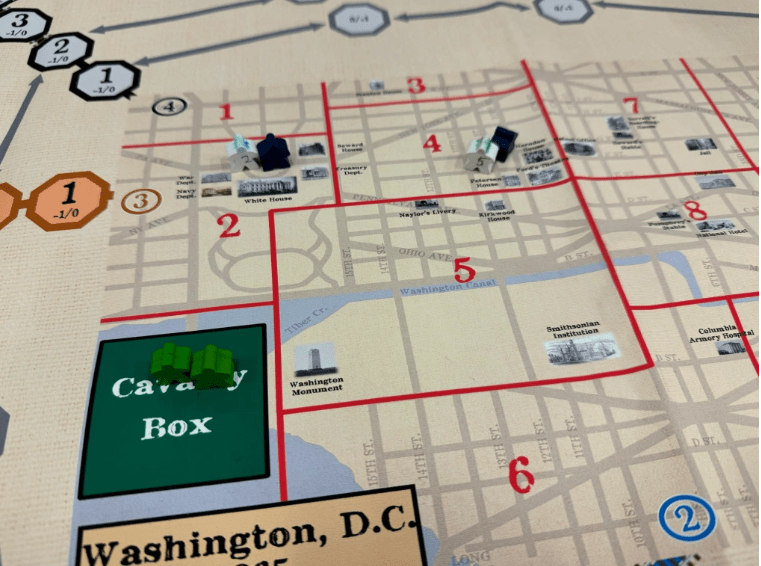
Grant: What happens on the Washington DC portion of the board?
Wes: Although Booth will very rarely be captured in Washington, DC (he is sometimes found to Hide in DC for a few days before making his escape attempt), lots of action occurs in this portion since most of the Leads direct Detectives to specific Zones here. The B&O Depot (now Union Station) can get busy with Detectives arriving in and leaving DC.
Grant: How do things change on the Escape Trails?
Wes: As each Trail Card is turned faceup, this lets players know where Booth moved in relation to his previous location. For instance, historically, the first Trail Card would show Booth moving one space to Green Trail Space 1. The next card, when turned faceup, shows “Hide”, so Booth stayed where he was but gained extra aid. The third card shows he moved 1 space so he is still on the Green Trail but now on Space 2. This would have been where he was killed and David Herold was captured.
For those that like a time scale, I generally think of each of the first three Phases as representing 2 days each with subsequent Phases equaling one day each.
Grant: Ultimately how do players close in on Booth and capture him?
Wes: Booth’s general location is determined when the current Trail Card is turned faceup. At this time (or before the next Trail Card is placed facedown at the beginning of the first Phase of a Turn) there is an open window of opportunity to Search to find Booth’s specific location and, if found, to Raid to capture or kill him. Since a Detective must be present for a Search and Raid, at least one
should be travelling along Booth’s Trail for exactly this opportunity. Cavalry will likely be necessary to help Search and Raid successfully.
There is a quick but lengthy process to determine the results of a Search and/or Raid. While at Circle DC I played the game with Stuka Joe and it struck me that a Search/Raid Sequence-of-Play deck (“Stuka Joe deck”) would make this process go quicker, so that has been added to the game. There is also a numerical tracker included for the computation.
As an example, for a Search:
- Add up the Detective, Cavalry, and Police Search Values in the space with Booth as well as any Detective Special Ability modifiers. Add to this any useful Stanton or “Betrayal” Cards in play.
- Subtract 1 for Booth as well as any Accomplice modifiers if any are with him.
- Add or subtract any modifiers in the Space where this is happening. Subtract 2 if in a “Hide” space. Subtract 2 if it’s a “Night” Phase (each third Phase of a Turn).
- Draw the top 5 Booth Cards from Booth’s Deck and modify the result according to the values on each card, BUT, only use the first “Sympathetic Citizen Provides Aid” Card if more than one is found within these 5 cards.
- Draw one Clue Chit out of the Clue Bag and add its value.
- Draw one Clue Chit out of the Clue Bag and subtract its value.
- Compare this net result on the Search Table to find out if Booth was found or some other result.
The process is very similar for a Raid. As you might be able to tell, every decision the Union player has made within the game has led them to this very situation and so every decision counts greatly. The player will usually only get about 1-3 opportunities for a Search and Raid at best!
Grant: What different modes does the game offer?
Wes: We recommend starting with the Solo Mode to quickly get a good idea about the rules and challenges in the game. 2-Player Cooperative Mode is very similar to Solo Mode except that the concept of Initiative is introduced – each player plays as “chief detective” for a Turn before handing over this duty to the other player. The players either win or lose together. The 2-Player Competitive Mode is probably the most realistic since soldiers and civilian police and detectives were eligible for the $100,000 reward offered for Booth and the conspirators. That would be worth about $2,000,000 today! In this mode each player works with their Detective(s) to claim the most Victory Points. For each Clue Point added to a Trail Card, that investigating Detective earns one VP and three VP’s are earned for being the player that placed the last Clue Chit that flipped the Trail card faceup. More VP’s are earned by killing or capturing minor and major Accomplices and the most VP’s are earned for killing or capturing Booth. Of course, occasionally rival Detectives may share in this kill/capture so VP’s may be split between players. The competitive nature of play may often create conflict between doing what is best for oneself versus what is best for the team. If Booth escapes, both players still lose and are sent to Alaska (“American Siberia” at the time). If the players succeed in killing or capturing Booth, both players may claim Victory but the one with the most VP’s is awarded
the most reward money and fame. Finally, an extra player may play as Booth and his major Accomplices and has some degree of control over their movements and actions and wins if Booth
escapes. Combining these options means there are actually six modes of play.
Grant: What type of experience does the game create for the players?
Wes: The hidden movement mechanic keeps players in suspense for much of the game. Every decision the players make can have far-reaching impacts later. The worker movement/placement mechanic is somewhat of a puzzle each turn since there are usually two Leads for Detectives to follow and a Detective with sufficient accompanying firepower must be following Booth as his Trail is uncovered. There is also the dilemma for when to use a Phase to call on Stanton to help. Finally, when Booth is found to be in an area, it’s up to the player to decide when optimum conditions for a Search and Raid exist before the next Trail Card must be drawn. The Competitive Mode magnifies these problems.
Grant: What are you most pleased about with the design?
Wes: Our attempt was to create this game from the Union perspective and I believe we have done that. Booth may run to anywhere it was thought he could have gone in any number of directions. This is a Civil War game, but it’s largely a mystery game. We wanted to avoid creating a mystery game with only one solution or one that relies on the process of elimination (like CLUE). The quantifiable Clue Points system means that there are seemingly an infinite number of possible outcomes. Replayability is astronomical due to the interactions between the Lead Cards, Stanton Cards, Booth Cards, Trail Cards, and the 67 spaces on or between Trails on the board.
And, while the pursuit and outcome might seem ahistorical to some, the related historical flavor text educates players about what really happened. Finally, we want to ground the players back to reality and the consequences of history, so Lincoln’s powerful but short Second Inaugural Address is included in the rule book. I hope this game will help stimulate interest in Lincoln. Just last night my
wife and I saw Scott Bakula perform the one-man show, Lincoln in Ford’s Theatre and it was mesmerizing. I think we all need to remind ourselves how wise and powerful Lincoln’s words were!
Wes: When can we expect to see the game ready for purchase?
Wes: Realistically, somewhere between early November and early January is when I expect the game to be available. Steve Jones, the owner of Blue Panther, LLC, has decided to upgrade the components of this game in several ways so the artist, Alex Zatarain, suddenly has more work to do. The most up-to-date artwork and information should be found on the game page on the Blue Panther website. Steve Jones has been very supportive of this project.
Grant: What other designs are you currently working on?
Wes: I have three games coming out with Compass Games. The first Engine Thieves is about the 1862 ACW raid where Union raiders made their way behind Confederate lines and stole a train to cut telegraph lines, tear up track, and burn bridges between Atlanta and Chattanooga as Union General Michel advanced. Gregg Pittenger is the Developer. His great-great uncle was historical raider William Pittenger. William was the author of the first-hand account of the raid, The Great Locomotive Chase, upon which the 1956 Disney movie is based upon. I have another ACW game where raiders sneak behind enemy lines to steal something valuable, attempt to burn structures, and are chased by railroad workers. This game concerns the Confederate Raid on St. Albans, VT and is tentatively called Yankee Scare Party, as the raiders called themselves. I believe that small unit raids are a much-neglected topic from the Civil War. I plan to rectify that and I hope other designers follow me. My third Compass game is a historical fantasy game, and I’ll talk more about that at a future time.
A recent exciting development is that Ryan and I have started a new game publishing company called Wharf Rat Games (www.WharfRatGames.com). We are starting slowly with a single game and are presently accepting submissions in the historical, sci-fi, and fantasy realms. Our goal is to help grow our hobby and the industry in general. To help us do that, we will also produce our own show where we feature designers, artists, and publishers from throughout our hobby. Watch for The Rat Chat!
Update – Hermann Luttmann has signed to design the first game for Wharf Rat Games!
Thank you very much for providing this interview opportunity!

Thanks so much for your time in answering our questions Wes about the game. I have played it while attending WBC this past summer and had a great time learning the game from you, while also chatting about your design thoughts and the history of the event.
If you are interested in The Pursuit of John Wilkes Booth, you can order a copy for $60.00 starting in mid-January from the Blue Panther website at the following link: https://www.bluepantherllc.com/products/pursuitofjwb
Here is a link to our video interview with Wes at WBC:
-Grant
 The Players' Aid