After getting back from SDHistCon a few weeks ago, I have been awaiting the GMT Games Monthly Update to see what new games would be announced and I was not disappointed. There were a few that I was hoping for but I am sure they will be in the next few months. These updates are always a joy to read and I just love the way that GMT communicates the progress on their great games and then discusses their new ones. They also provide such great information about the goings on in the wargaming world with various conventions, gatherings and other things and it is really nice to see a publisher who connects so well with their audience. I like other companies communications, and I realize that everyone approaches things differently, but I think there are things that can be learned and modeled here. I am just grateful that we get this kind of thing each month and have something to look forward to.
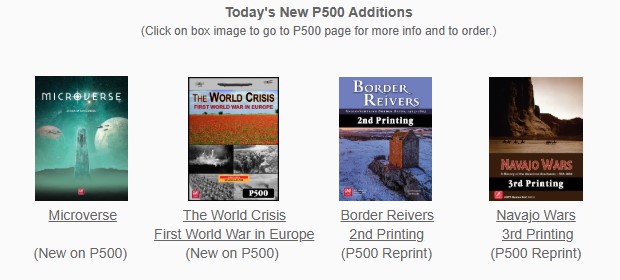
There were 2 new P500 additions offered this month including The World Crisis: First World War in Europe that uses many of the mechanics used in World At War designed by Bruce Harper and Microverse designed by Sam London. There also were 2 reprints offered in Border Reivers: Anglo-Scottish Border Raids, 1513-1603 2nd Printing and Navajo Wars 3rd Printing.
But that wasn’t all as there was plenty of other information shared including updates on GMT One products, development updates, upcoming future P500 additions and the usual gorgeous art samples!
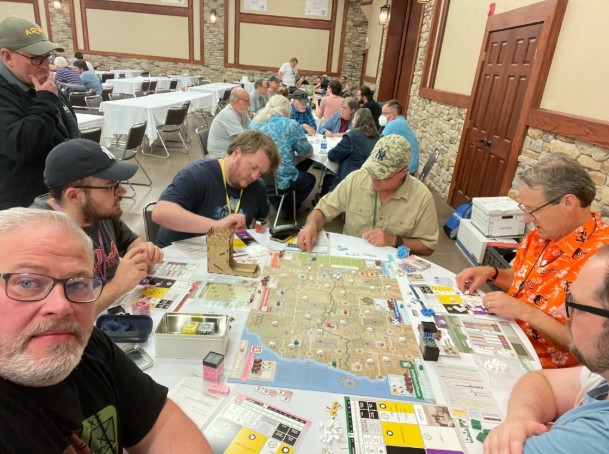
I have already mentioned it but we just attended SDHistCon in San Diego and had a chance to meet Gene Billingsley and his two adult children Luke and Rachel Billingsley. We didn’t get a lot of time to chat as they were busy and we were busy but it was good to see him. He aid it very well in the intro to the Update about conventions and I wanted to share his thoughts here:
The joy of these gatherings, for me, is found in the PEOPLE and in the RELATIONSHIPS that you build and nourish at the events. It was so great this time to see and catch up with some great people and friends like Ananda, Jason Matthews, Sam London, Harold Buchanan, Mark Herman, Mark Miklos, Kai, Terry Leeds, Mike Bertucelli, Justin Fassino, David Thompson, Maurice Suckling, Trevor Bender, Liz Davidson, Steve Carey, Karl Kreder, Tim Porter, Candice Harris, Mike Smart, Cole and Drew Wehrle, Grant and Alexander from The Player’s Aid, and plenty of others that I’ve either temporarily forgotten in the post-convention haze or just didn’t get to spend much time with this year. It’s people like these that make the conventions “must attends” for me. Sometimes you meet over a game board, other times you talk about games or your families over good food, and once in a while you’re off in a quiet corner of the event to evaluate a new product or work on a secret project. However it happens, the “special sauce” of events like this one for me is just getting to see and spend time with people who share a love for this hobby and who bring a smile to my face unbidden as soon as I see them. Thanks to all of you who made this convention a joyful one for me! Rachel and I are looking forward to seeing many of you again at Circle DC at the end of March.
I do love conventions for these very same reasons but also love the games. And we had a blast! Here is a link to my overall wrap up post for the convention as well as my Daily Debrief Posts to get you up to speed:
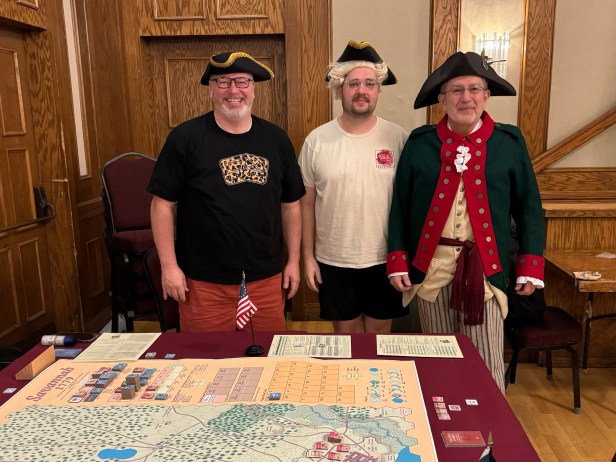
We played a game of Savannah with the Battles of the American Revolution Series designer Mark Miklos and it was a great experience! Thanks Mark!
Now onto the main event with the new P500’s.
New P500’s
As mentioned above, there were 2 new P500 additions offered this month including The World Crisis: First World War in Europe that uses many of the mechanics used in World At War designed by Bruce Harper and Mircroverse designed by Sam London. There also were 2 reprints offered in Border Reivers: Anglo-Scottish Border Raids, 1513-1603 2nd Printing and Navajo Wars 3rd Printing.
The World Crisis: First World War in Europe
Big, badass wargame incoming ya’ll! The new monster from the mind of Bruce Harper has been announced and it looks amazing. I am very much interested in this one for several reasons. One being that this is a game on World War I, which I have very much enjoyed gaming over the past few years, and also that it appears to be a bit more approachable than A World At War that has intimidated me for years and haunted my dreams! The World Crisis: First World War in Europe is a new game that uses some of the systems from A World At War and I am very much interested.
From the game page, we read the following:
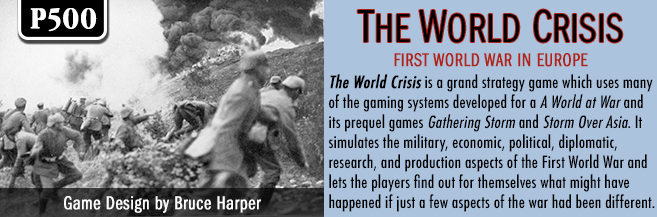
The World Crisis is a grand strategy game which uses many of the gaming systems developed for A World at War and its prequel games Gathering Storm and Storm Over Asia. It simulates the military, economic, political, diplomatic, research, and production aspects of the First World War and lets the players find out for themselves what might have happened if:
Germany had stood on the defensive in 1914 and attacked in the east.
Austria-Hungary had deployed its forces differently in 1914.
Germany had remained true to the spirit of the Schlieffen Plan.
Turkey and Italy had entered the war earlier, later, or on a different side.
Germany had pursued a more aggressive naval strategy.
The Gallipoli campaign had succeeded—or hadn’t been undertaken at all.
Italy had broken the Austro-Hungarian front.
Bulgaria, Rumania, and Greece had pursued different policies.
Germany hadn’t attacked at Verdun, had followed its original plan, or had won the battle.
Russia had collapsed earlier or hadn’t collapsed.
The U.S. had remained neutral.
YOU had been in command.
I once read a very funny and interesting review of A World At War on Board Game Geek and it has always made me laugh. And I know that this system is nothing to laugh at but I also know that it is not for the feint of heart. But it is very meaty!
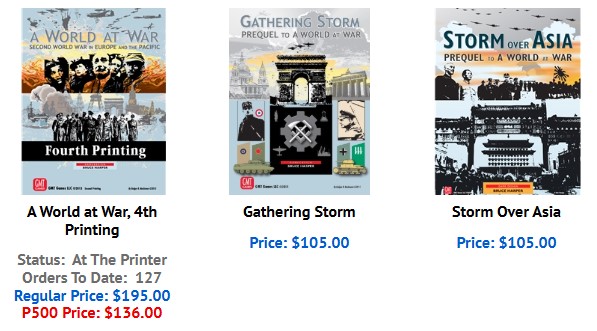
The World Crisis uses many of the game systems developed in A World at War, Gathering Storm, and Storm Over Asia, but it also includes the following innovations:
Placement of ground units on Army Charts, similar to Task Forces in A World at War, recreating the fog of war for both attacking and defending forces until combat occurs.
An integrated movement and combat phase, giving ground combat the flexibility of naval combat.
Multiple rounds of ground combat, with counterattacks and reinforcement for both sides, emphasizing both the importance of achieving results at the outset of a battle and the importance of staying power for the defense.
The control of terrain features in hexes still under enemy control, depending on combat results.
National cohesion levels as the crucial measurement of major power resistance.
A look at the Murderer’s Row of Wargaming! There is one new suspect being added to this lineup…
I still own my copy of Storm Over Asia and have never done anything with it. Partly because it is huge, partly because I am a wuss! But it sits on my shelf taunting me and one day I am going to force the Brit to read the rules so we can play it…maybe that day will come sooner rather than later so we can prepare for this incoming mortar shell called The World Crisis: First World War in Europe.
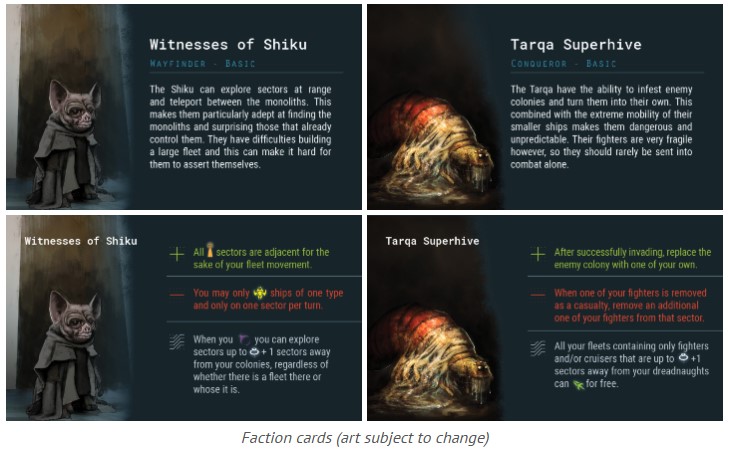
In 2023, we attended SDHistCon for the first time and ended up playing a few games with new designer Sam London. We played his Firefight: Tactical, which has been on the P500 for over a year now and has Made the Cut with 719 pre-orders, but also another lighter 4X style card based game called Microverse. The game uses hex tiles that are laid out to create the board which includes unexplored areas of space that contain planets that can be colonized, dead space, asteroid fields, wormholes and super novas. We had a blast with our game of it with Sam and Jason Carr from GMT Games.
From the game page, we read the following:
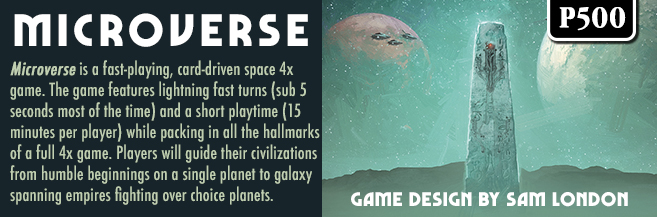
Microverse is a fast-playing, card-driven space 4x game. The game features lightning fast turns (sub 5 seconds most of the time) and a short playtime (15 minutes per player) while packing in all the hallmarks of a full 4x game. Players will guide their civilizations from humble beginnings on a single planet to galaxy spanning empires fighting over choice planets.
Each player has a hand of cards which are tied to one of the game’s four actions: Build, Colonize, Explore, and Mobilize. On a player’s turn, they play one or more of these cards of the same action type to generate resource points that they will later use to perform those actions. These resource points are then increased by the number of worlds they have colonized that contain the matching action icon. Finally, the player performs the action and draws back up to their hand size.
When we played the prototype, the game included over 80 species that players can choose from which gives lots of replayability. Each of these civilizations have different abilities and even weaknesses. But, now they appear to have scaled that back a bit, at least for the base game, as I remember the time spent trying to determine who I was going to play because there were so many choices.
The core game of Microverse boasts 21 playable factions (with many more coming) that radically vary the gameplay. Each faction has their own unique strength, weakness, and research ability. This research ability is tied to a special icon found on worlds as the players explore. Players can choose to colonize these worlds to make their faction even more unique and powerful.
My final comment about the game is that it is fast playing. We played a 4-player game and it played in about an hour. There is a lot to like here as players use cards to take actions such as explore, colonize, mobilize (move) and build (ships). The other very interesting part of the cards is that there are no dice used for combat and cards are pulled and icons for shields, hits and command are included and compared during battles. Overall a very nice looking game that was a blast to play.
Ed Beach usually designs games that use the CDG mechanic and that allow a lot of gamers to get in on the action. Games like Here I Stand and Virgin Queen allow up to 6 players and Border Reivers allows 4-6 players although 2 and 3-player versions are also supported (where each player leads both an English and a Scottish family). But, this game is not similar to the others I mentioned. Not even close! It incorporates some elements of a Euro and is a very interesting and unique experience as it uses Meeples of sheep and cows (which frankly I am totally fine with).
From the game page, we read the following:
In Border Reivers, each player rules over one of the Marches as leader of one of the six major riding families of the border: Grey, Fenwick, Dacre, Maxwell, Kerr, or Hume. Your goal is to increase the wealth and fame of your clan throughout the reigns of Henry and Elizabeth to end the century as the most famous Border Reiver of all time. Players gain VPs from successful combats, amassing large herds of livestock, and by elevating their Notoriety above the other players in the regions of the map.
Here is a fairly detailed summary of the the different seasons and how it works:
In Summer, players build their strength through a card-drafting system that lets you strengthen your March for the winter raids that follow. Players build fortified peel defense towers, garrison old castles, and build walls around their farmhouses (creating “bastles”) to guard against enemy raids. At the same time, you recruit famous reivers and wardens to your cause and ally with the most notorious clans of the time (including the infamous Elliotts, Scotts, Johnstones, and Armstrongs). And don’t forget to buy the favor of the most powerful office holders, whether it be the Bishop of Carlisle, the Keeper of Liddesdale, or the mighty Lord Warden of the Marches.
As the air cools and Fall arrives, players commit their defensive assets to the map to prepare for the raids and feuds that are soon to follow. At this time a set of events drawn from the history of the region are chosen, presenting the players with short-term opportunities that may gain them an advantage. Events include the battles of Flodden Field and Solway Moss, Henry VIII’s Rough Wooing to try and force a marriage alliance, Mary Queen of Scots’ tour of the Scottish borders, and the Catholic Rising of the North.
To initiate Winter combats, players select one of their Target cards to secretly designate their intended combat activity. Options include launching a Raid to steal precious livestock, joining their national army as light cavalry forces in one of the historical Battles, or representing their family against a specific target player with whom you have a Feud or Gaolbreak attempt that needs to be prosecuted. Careful play of cards that were drafted during the Summer can help these combats break favorably for your clan.
At last, Spring arrives and the raiding ceases. It’s time to count points and sing of the heroic exploits just witnessed. And on the final turn, that’s exactly what happens—players cash in one or more of the Border Ballad cards for extra VP, especially if the ballad aligns with the strategic path they have followed throughout the game. Which ballad will commemorate your deeds on the Border? May you fare better than Johnny Armstrong, the subject of the famous ballad “Armstrong’s Goodnight,” that captures the spirit of the Reivers.
So as you can tell, this one is a bit of a different game and we had a chance to play it at WBC in 2023 with the designer and it was very interesting.
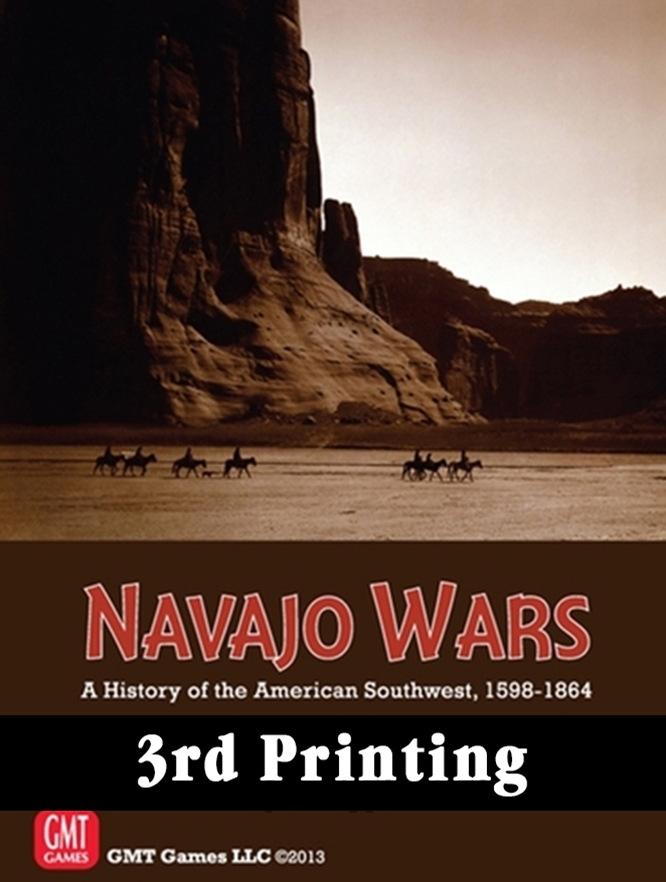
As my may know, I am a huge fan of Commancheria designed by Joel Toppen in the First Nations Series. I fell in love with the system upon playing that game but while I own the first volume in the series I have never got around to playing it. Navajo Wars started the First Nations Series and is now getting a 3rd Printing which should tell you something about the game.
From the game page, we read the following:
Navajo Wars is a one to two-player game which covers the amazing history of the Navajo people from their first encounters with European colonists until their brutal subjugation by the Americans. For over 250 years, the Navajo fought to preserve their way of life. Navajo Wars gives YOU a detailed look at this epic historic period from the perspective of the Diné—the Navajo people.
In Navajo Wars, you will face a constantly changing and aggressive enemy. You will face Spanish, Mexican, and American soldiers and settlers. You must use skillful planning and resource management in order to maintain your tribe’s freedom.
Navajo Wars uses a unique mixture of cards and enemy instruction matrix to drive the actions of the Navajo’s opponents. More than just chart-checking and die-rolling, in Navajo Wars you have to make lots of meaningful decisions in order to win!
Though designed from the beginning as a solitaire game, Navajo Wars also includes rules to play a semi-cooperative 2-player variant. In the 2-player game, both players can lose, but only one player can win!
One of the features that I have always enjoyed about these Monthly Updates has been the New P500’s on the Horizon segment where Gene Billingsley shares a few very cryptic comments about an upcoming project and we are supposed to somehow decipher his meaning from these “clues”.
Here is a brief tease for P500 additions lining up in the coming months. This month’s The World Crisis was teased in August as “A new design from Bruce Harper.” And Microverse was previewed last month as “A massively cool Sci-Fi Game Experience from Sam London.” (It is!) Note that this is not a comprehensive list (nor will I preview EVERY game we have planned), so I will switch these up a bit from month to month. Over the coming 1-6 months, I anticipate that we will add:
A new series game with battles set in the War of Breton Succession – I have nothing.
A new expansion from Ted Raicer – this is the rumored card expansion for I, Napoleon, which is a very cool historical solitaire game that I have enjoyed getting my teeth kicked in by.
An historical strategy game set in the American West in the 1800’s – if I had to guess this would be an 18XX game because Gene uses the words “strategy game” but I have not other information.
A game featuring conflict in Vietnam – hhhhhm? I just learned somethings at SDHistCon earlier this month and I think that this is Will to Fight: Vietnam designed by Sam London which uses the same system as his Common Sense American Revolutionary War game.
Utterly pitiful effort this month! I just have been too busy to do much sleuthing recently. I do think that I get 1 correct so that is at least something. Maybe a 2nd? Gene?
Charging & Shipping
The following information for Charging and Shipping was copied directly from the Update:
Shipping Now (began November 8th). This shipment includes:
The next shipment should arrive at the warehouse in late December. We’ll plan to charge/ship in early January. We’ll let you know final details on this and the following shipment in our December customer update.
That is a lot of good games right there! Man, we are going to busy over the next few months.
Project Updates and Sample Art
One final thing that I wanted to share this month is all of the great sample art that has been shared as a part of the update on various games as they run up to production. There is not near as much as normally but what they showed was pretty amazing!
The first item they shared was the box back for the upcoming The Bell of Treason designed by Petr Mojžíš. Last month, we got a look at the cover and this month they turned it around and gave us a look at the box back. I am very much looking forward to this one!
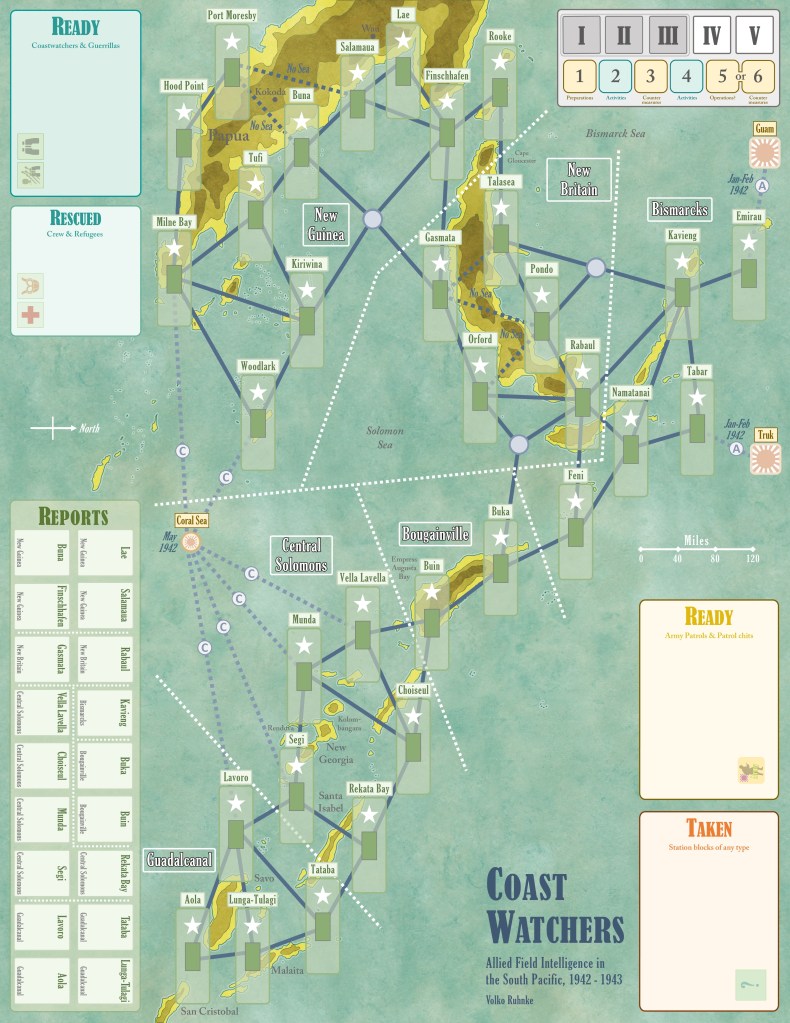
Next up, we got a great look at the near final board for the upcoming Coastwatchers designed by Volko Ruhnke. I just love how Volko is expanding the hobby to take into account other aspects of war other than the traditional combat. This new look at intelligence gathering and then using that intel to alter planning and command has infinite possibilities for applications to dozens of games over the next decade and I am very much all in on this concept.
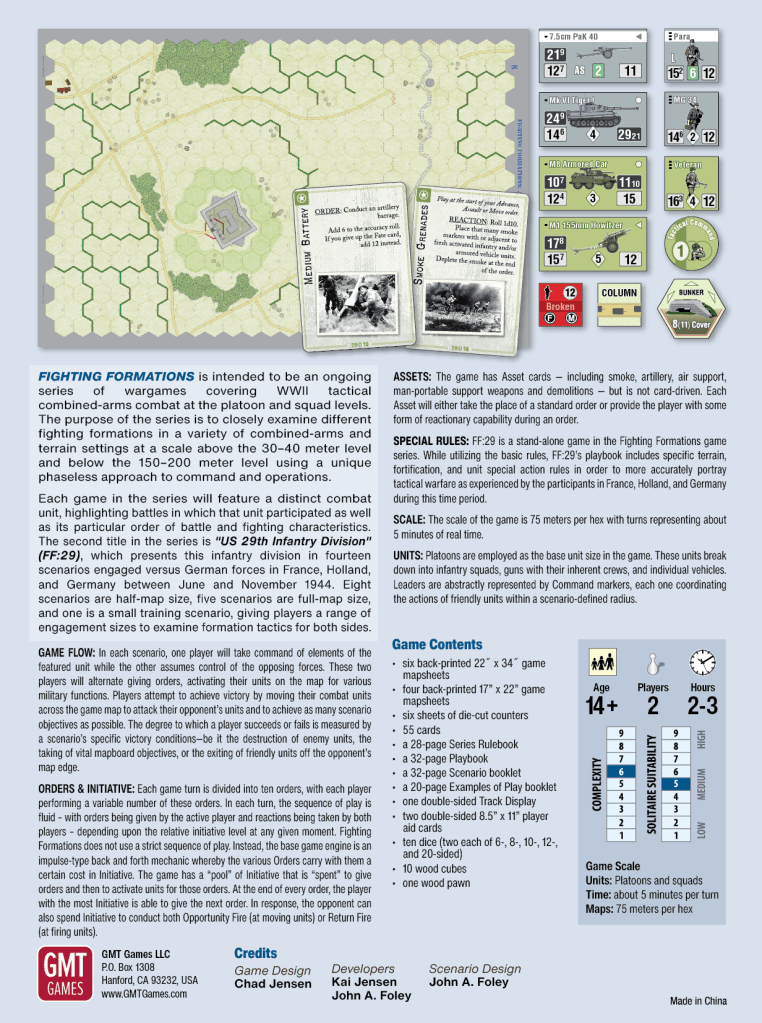
We then got a look at the box back for the upcoming Fighting Formations: 29th Infantry Division. This series just looks so great! We own the base game and the Battle for Kharkov expansion but have yet to play them. I love the vehicle counters and the way they look on the board.
The final item that we got a peak at was the combined maps for the American Civil War game Three Days of Gettysburg Deluxe Edition in the Great Battles of the American Civil War Series. These are done by Mark Simonitch and look divine.
I also wanted to share a few of the project updates that were included in the email as they are just chocked full of great information.
The first was an update about the Combat Commander Series from Series Developer Kai Jensen:
We had the chance to speak with Kai at SDHistCon and she shared a lot of great information about upcoming Combat Commander stuff but I am sworn to secrecy and I keep my word!
The Minor Nations Battle Pack (BP8) is complete and has been through proofing already.
Work on the (re-subtitled) Europe/Med. 20th Anniversary Edition is moving along but had interruptions for conventions in October and November. Now that the cons are in the rear view mirror, I am back to work on this. If you are new to this game, please note that the Minor Nations (BP8) will be included in the big box automatically as it was intended that way from the start.
Island Hopping Battle Pack (BP9) is undergoing playtesting with our scenario developer, Gina Willis, and fine-tuning is getting done. The last few scenarios are taking shape and will also get onto the table for polishing after the holidays.
As a reminder, the last printing of the individual sets of both Europe and Mediterranean will be run at the same time as the Europe/Med. 20th Anniversary Edition. If you have one box but not the other and want to complete your set without having to buy the big box, now’s the time! Note that this will be the final printing of these individual sets. All future reprints will be of the Europe/Med. 20th Anniversary Edition.
Resistance will also head off to the printer along with the rest of the CC family. This one is a straight reprint—nothing new—but it’s a great addition to any CC collection.
Once all of this goodness is on its way, I have more Combat Commander fun on the horizon for you. Stay tuned in the coming months for announcements on some of the projects already in the works.
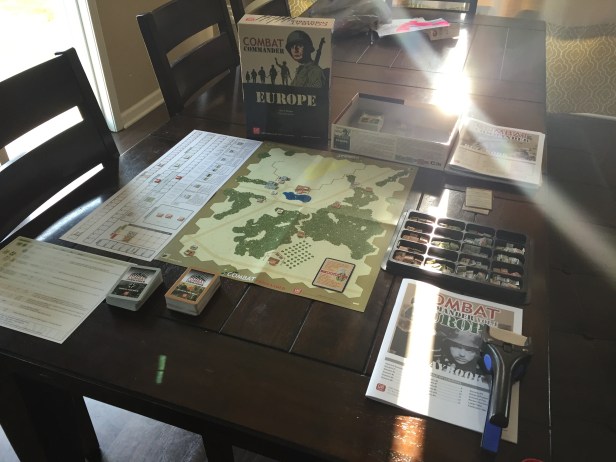
I have a great affinity for Combat Commander. I love the game and am very glad that I took the chance and purchased a copy in 2016 to get us started on our tactical wargame kick. There are two major reasons that I love it!
1. One is that it is a card-driven strategy game. The cards are what you rely on to take actions and if you do not wisely manage those cards, you may not have the card you need, such as a fire or advance, when you need it! Some would complain that this is randomness and doesn’t belong in a strategy game but I disagree. I have never been in the service nor had to participate in a battle, but I can only imagine that there is chaos. This chaos changes all of the best laid battle plans and there are certain factors that contribute to that chaos, such as running out of ammo, your guns jamming, being pinned down by a sniper or having your units morale drop leaving them hugging the ground and keeping their heads down, that make battle difficult. The cards represent this part of the chaos and is a genius addition to the game. I also enjoy the way the designer chose to address rolling using the dice printed at the bottom of each order card. This is a very solid way of handling this necessary random determination of combat.
2. The other favorite part for me is the narrative that is told as the battles unfold! As I was playing the Example of Play scenario, I felt as if I was Sergeant Kaminsky trying to inspire his men to move up on the first building to engage the enemy and knock them out of that fortification. I experienced the disappointment of Sergeant Ganz as his troops were forced to retreat to the north to try to repel the Russians who were threatening the German troops in the buildings. I felt the disgust in my unit’s performance when the very powerful infantry gun continued to miss its targets (twice)! I was relieved when the random event put a blaze marker in between my troops and the German forces in the woods obscuring their line of sight and not allowing them to effectively fire. The narrative is the best part and allows my mind to participate in the battle, even though I am not there. It is a similar feeling to a well written book that forces you to take the role of characters and experience their feelings as you read the pages.
Next is an update on Resisting Revolution from designer Joe Dewhurst:
Feedback from testing has been very positive so far, and I am happy with how all three expansion game modes are looking at this point in time. The next step for me will be to work on the non-player system for the main four-player Resisting Revolution game, which will use the Jacquard card-based approach that is now the norm for new COIN volumes. Traditionally this task has been offloaded by designers onto some other poor fool willing volunteer, but in this case I feel that I am best placed to get the non-player system finished off as quickly and efficiently as possible, as I have now designed four other iterations of this system (for People Power, Sovereign of Discord, Red Dust Rebellion, and China’s War), and of course there is no one else who is more familiar with the base game itself. I should be able to get started on that by the new year, so I will be looking to recruit new testers for it sometime in the next few months.
Next is an update on Seljuk from designer Justin Fassino and developer Christophe Correia:
Freshly returned from SDHistcon (where we did some designer-led Seljuk play sessions and demos), we’re happy to say that we’re almost done! The final proofreading of booklets and components is currently underway, and then the development process of Seljuk will be complete. We’ve been looking at the rules layout from Charlie Kibler, and they are shaping up excellently. The Levy & Campaign Discord community will get one more opportunity to catch anything we missed, and then our current goal is to wrap up the proofing and turn everything over to GMT with a bow before Christmas so that the game can begin its journey to being produced in the new year (fingers crossed). Both Christophe and myself want to thank everyone who has playtested, demoed, and proofread material for the game over the years; your contributions have been made all the better for it.
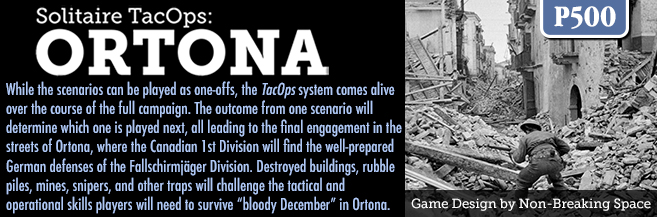
Next is an update on Solitaire TacOps: Ortona from designer Non-Breaking Space:
There are a lot of little details that make the TacOps system unique, but what really pulls the concept together is the campaign. Having designed a scenario framework that fulfills the promise of the single play experience, defining the parameters to ensure connected playthroughs are just as engaging as an experience has been my focus since the summer. An important part of this was printing prototype maps to cover the campaign. I turned over a full playtest kit to the development team during the Weekend at the Warehouse, where I also had a great playtest with John Butterfield. The Germans were pretty rough on John, but it was a real pleasure watching a solo wargame design legend get immersed.
I’ll be sharing more to honor the anniversary of the battle in December with a series of Inside GMT articles. In the meantime, check out how all of the urban playtest maps come together to present the town of Ortona.
Next we got an update on The Bell of Treason from designer Petr Mojžíš:
We recently finished testing the solo mode that Jason Carr put together for the game, and since then we’ve been busy finalizing everything for layout, including an excellent guide to Czech pronunciation written by my friend Petr Šťastný. All the materials are now with Tomasz Niedziński, the graphic designer who also worked on the map and cards for the game, so we are rapidly approaching the final stages of editing and proofreading! This means that the game should be ready to go to the printer by the end of the year and will reach you sometime in the first half of next year. Thank you for all your support and patience, and we hope you enjoy the game!
Next we got an update on The British Way: Enemy of My Enemy from designer Stephen Rangazas:
My brilliant developer Joe Dewhurst has been hard at work doing some in-depth testing of the new Arab Revolt and Japanese Occupation games with our lead playtester Adrian Luth, who has an amazing talent for pushing these games to their limits and identifying potentially broken or degenerate strategies (we first worked with Adrian while we were finalizing the Advanced Cyprus Variant). So far I’ve had to make a few minor tweaks in response to their feedback, but overall I’d say that the games themselves are pretty much done, so now we are just waiting patiently for art department availability. In the meantime, Joe and Adrian are planning to play through the fully expanded End of Empire campaign a few times, just to check that nothing too unusual happens with the addition of the two new games and the variant game modes.
I want to end this post by sharing our recent content on the blog and YouTube Channel for GMT Games products including reviews/interviews/unboxing videos:
Great update, Grant! I wonder if the alluded to P500 Vietnam game is the Sam London “Will to fight” system mapped to vietnam like he mentioned in your video?
Please, you did the “investigative journalism”, I was just watching your excellent video with Sam! It’s probably a reach since he kind of slipped in the mention of porting it to Vietnam, but it caught my attention since that system seems quite interesting.
Hahahaha. Just so much memory left in my hard drive. I tend to forget little things like this that I have learned and am unable to apply them, even just a few weeks later!
I can’t say enough about Combat Commander (for the same reasons as you described). I have CC:E and CC:M and the first couple of expansions and still have the Big Box on P500. Very excited














 The Players' Aid
Great update, Grant! I wonder if the alluded to P500 Vietnam game is the Sam London “Will to fight” system mapped to vietnam like he mentioned in your video?
LikeLiked by 1 person
Hahahaha. I bet you are 100% correct. Sometimes I can be so obtuse and dumb.
LikeLike
Please, you did the “investigative journalism”, I was just watching your excellent video with Sam! It’s probably a reach since he kind of slipped in the mention of porting it to Vietnam, but it caught my attention since that system seems quite interesting.
LikeLiked by 1 person
Hahahaha. Just so much memory left in my hard drive. I tend to forget little things like this that I have learned and am unable to apply them, even just a few weeks later!
LikeLike
I can’t say enough about Combat Commander (for the same reasons as you described). I have CC:E and CC:M and the first couple of expansions and still have the Big Box on P500. Very excited
LikeLiked by 1 person