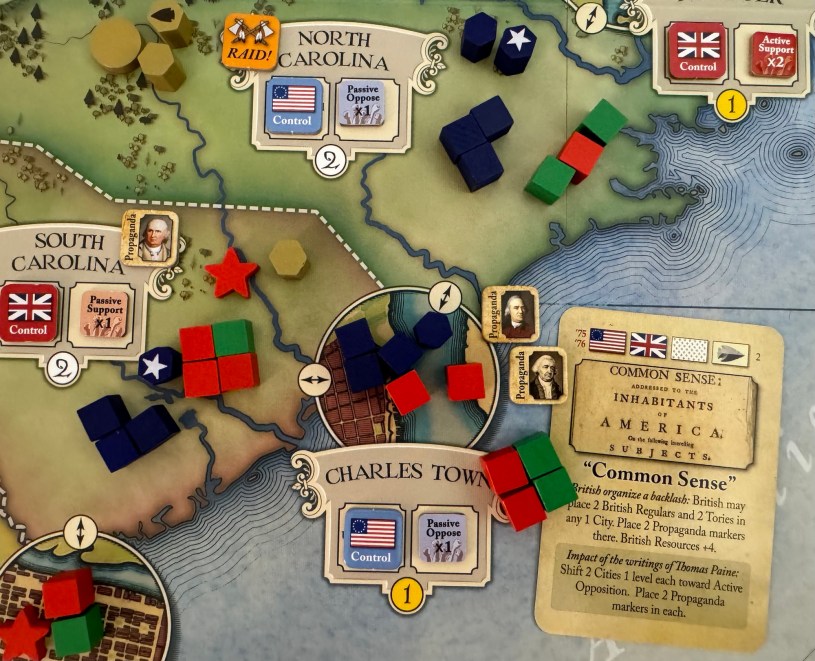
With this new My Favorite Wargame Cards Series, I hope to take a look at a specific card from the various wargames that I have played and share how it is used in the game. I am not a strategist and frankly I am not that good at games but I do understand how things should work and be used in games. With that being said, here is the next entry in this series.
Card #13: Common Sense from Liberty or Death: The American Insurrection from GMT Games
In case you didn’t know, I love Liberty or Death: The American Insurrection! This is my 2nd favorite volume in the COIN Series and is such a fantastic game filled with the history of my favorite historical period the American Revolutionary War. Liberty or Death was the COIN Series’ first foray into non-modern warfare and takes us to the 18th Century and the days of the Brown Bess musket, the 18 pound siege cannon and nice and tidy formations better suited for a gentleman’s war. The focus of the game is the struggle of the American Patriots against their mother British government as they have made their intentions clear to become independent with the Declaration of Independence. The game is a multi-faction treatment of the American Revolution, which includes the Patriots and their allies the French against the British and their reluctant allies the Indians.

Liberty or Death is a 1 to 4 player game focused on all aspects of the struggle including financing operations with Rabble Rousing, infiltrating British held cities to Skirmish, blockading major cities with the mighty French fleet, Raiding the frontiers with the Indian nations, the spread of propaganda to build support for the revolution, fort building and small scale battles. So, with this short description you can see that this game is not a “traditional” wargame but does contain some armed conflict. So a game about the American Revolution that isn’t focused on battle you say? How can that be? Well, I will tell you that this game is probably a perfect representation of the multifaceted struggle that wasn’t necessarily decided on the field of combat, but by the little actions of many behind the scenes characters. Yes battle will decide the control of major areas of the board and decide the fate of troops as they must be concerned about being in supply through a network of forts but the game is so much more than just rolling some dice and consulting a CRT!
I think that my choice in card for this entry isn’t really because of the interesting or game breaking action of the card but more because the historical aspect of this card is so well represented in the game that I was very much impressed by how it was handled. Common Sense is an Event Card that has a positive effect for both sides of the conflict. The top of the card is more suited for the British while the bottom of the card is made for the Patriots.
But I love the thematic connection here because the furor caused by the release of this pamphlet by Thomas Paine created such a polarization that the struggle became much more charged and people began to shift toward the side of the rebels. During the Summer of 1776, Thomas Paine anonymously wrote this 48-page pamphlet printed by Robert Bell. 120,000 copies were sold in the first 3 months. The pamphlet was targeted at the common colonist rather than elites and the message of Common Sense was a clear and forceful argument for the American colonies to declare independence from Great Britain, primarily by denouncing the tyranny of the British monarchy and advocating for a new government based on the principles of self-governance and republicanism, accessible to the common people through plain language. It is believed that most colonists were on the fence regarding the subject of independence from the British crown at the time and really wished to remain a part of the British Empire as they saw themselves as first subjects to King George III, even though they felt that he was not looking out for their best interests. But, after the publication and distribution of Common Sense things changed dramatically. The top portion of the card is for the British as it allows them to organize and enhance their forces in any city to deal with the negative backlash. The British may place 2 British Regulars and 2 Tories in any one City. Secondarily, the player will have to place 2 Propaganda markers there as well and the British will gain +4 Resources.
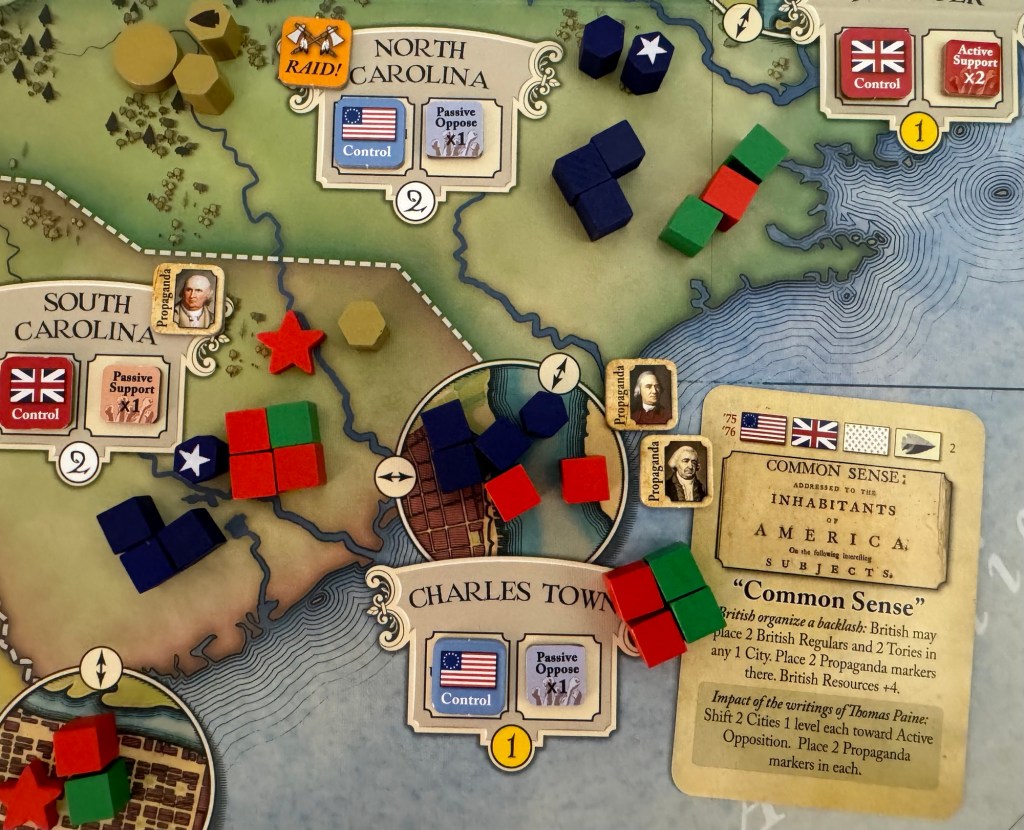
The bottom of the card is for the Patriots and drives home the true impact of the writings of Thomas Paine as it causes the shifting of 2 Cities one level each toward Active Opposition as the ideas really caused many to reconsider the issues and decide to be independent. But, the same as the top part of the card, the player must then place 2 Propaganda markers in each of the Cities. The Propaganda markers are not significant until either player decides that they wish to spend their resources to sway the space toward their side. For each Propaganda marker, the player will have to spend resources to remove them prior to being able to pay to shift toward either Support or Opposition. I love this thematic connection as either side will have to commit to this effort to really make any change and it will not be easy. This card, more so than many of the other cards in the game, really drive home the concept of the American Revolution being about the swaying and influencing the people’s hearts and minds and reinforce the famous quote by John Adams: “The Revolution was effected before the War commenced. The Revolution was in the minds and hearts of the people…” And I believe that this statement concisely summarizes the American Revolution.
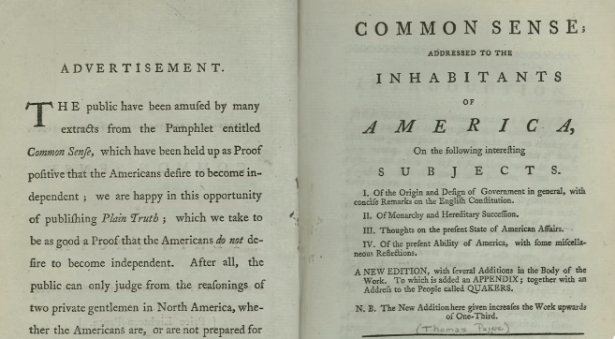
Common Sense advocated independence from Great Britain and was written by someone who had a stake in this fight and had the gift and ability to convey his feelings in writing. Writing in clear and persuasive prose, Paine collected various moral and political arguments to encourage common people in the Colonies to fight for egalitarian government. It was published anonymously on January 10, 1776 at the beginning of the American Revolution and became an immediate sensation. He also later wrote The American Crisis (1776–1783), which was less popular but still laid out clear arguments for what America has become. These two pamphlets are some of the most influential pamphlets written during the Colonial period and had a hand in changing of attitudes toward the ongoing American Revolution and helped to inspire the colonial era patriots to fight for independence.
In the next entry in this series, we will take a look at Seychelles from Twilight Struggle: Red Sea – Conflict in the Horn of Africa from GMT Games.
-Grant
 The Players' Aid
Paine also included the outlines of what the new government should cover, including what social responsibilities are due both to and by people and the government.
Armando
LikeLiked by 1 person
Yes. He was a very wise and insightful person and his writings influenced all of the Founding Fathers as they wrote the constitution and created the American experiment.
LikeLike
What is your favorite COIN game then? Fire in the lake?
LikeLiked by 1 person
Fire in the Lake.
LikeLike